

Sales Rewards: The Operational Playbook for 2026
U.S. businesses spend $176 billion on sales incentives annually - nearly double what they spent in 2016. Yet most sales rewards programs are designed on vibes, not data. That gap is where budget disappears.
We've watched teams pour six figures into incentive programs built on gut feelings, then wonder why participation flatlines by Q2. This playbook covers what top-performing companies actually do differently, the tax traps that catch everyone off guard, and how reps game your program when you're not looking.
The Quick Version
An IRF study of 600 companies found that top performers use gift cards (94%), points-based rewards (93%), and travel (93%) - not just cash bonuses. They also lean heavily on Fast Start incentives and tiered structures.
Here's the thing: the "calculator test" matters more than the reward itself. If a rep can't calculate their own payout in under 30 seconds, your plan is too complex and participation will crater. In our experience, this single test predicts program adoption better than any survey.
Gift cards are taxable. Always. Regardless of amount.
What Top Performers Actually Use
Only 22.5% of those 600 companies qualified as top-performing. What separated them wasn't reward size - it was the mix. Top performers layered multiple incentive types, tied qualification to customer relationship measures alongside revenue, and designed for multi-contributor deals where SDRs, AEs, and CSMs all touch the same opportunity. They treated incentive design like product design: iterative, data-informed, and built around how people actually behave rather than how leadership wishes they'd behave.
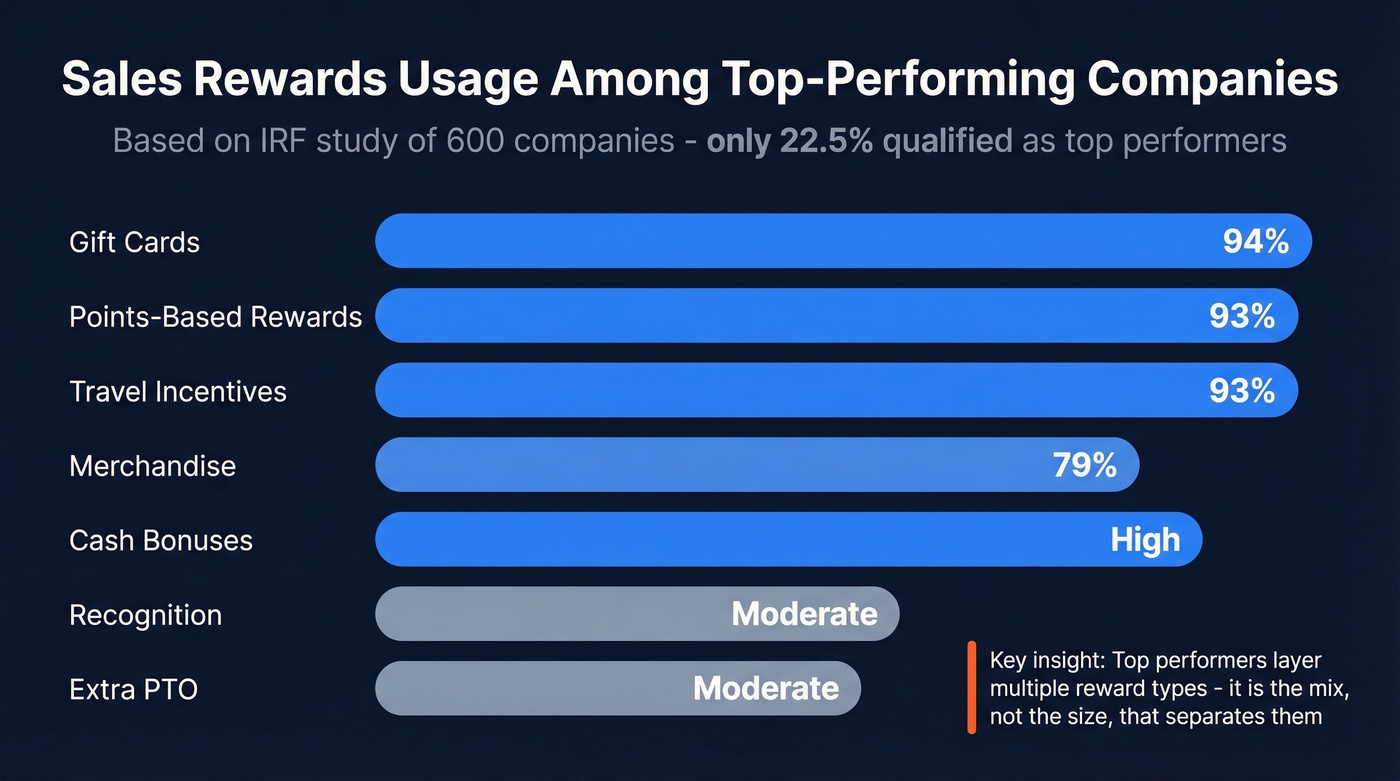
| Reward Type | Cost Range | Taxable? | Top-Performer Usage | Best For |
|---|---|---|---|---|
| Cash bonuses | $500-$5K+ | Yes | High | Immediate motivation |
| Gift cards | $25-$500 | Always yes | 94% | Quick recognition |
| SPIFFs | $100-$1K/win | Yes | High | Short-term pushes |
| Points-based | Varies | Typically yes, when redeemed | 93% | Ongoing engagement |
| Travel | $2K-$15K/trip | Yes | 93% | Annual top performers |
| Merchandise | $50-$500 | Sometimes no (de minimis fringe) | 79% | Brand reinforcement |
| Recognition | $0 | No | Moderate | Culture building |
| Extra PTO | $0 | Yes (taxable wages) | Moderate | Recovery + retention |
Merchandise in the $50-$100 range is growing fast - logo'd brand-name merchandise appears in nearly 70% of non-cash programs. Travel remains the aspirational anchor: 81% of companies cite retention as the primary motivation for incentive travel programs.
Fast Start incentives deserve special attention. They reward early-quarter momentum rather than end-of-quarter heroics, smoothing out the revenue hockey stick that drives finance teams crazy.
Cash vs. Non-Cash Incentives
When researchers at Wichita State University gave people a choice between cash and a tangible reward of equal value, nearly two-thirds chose cash. But when asked about expected happiness, the HDTV and cruise outranked cash every time.
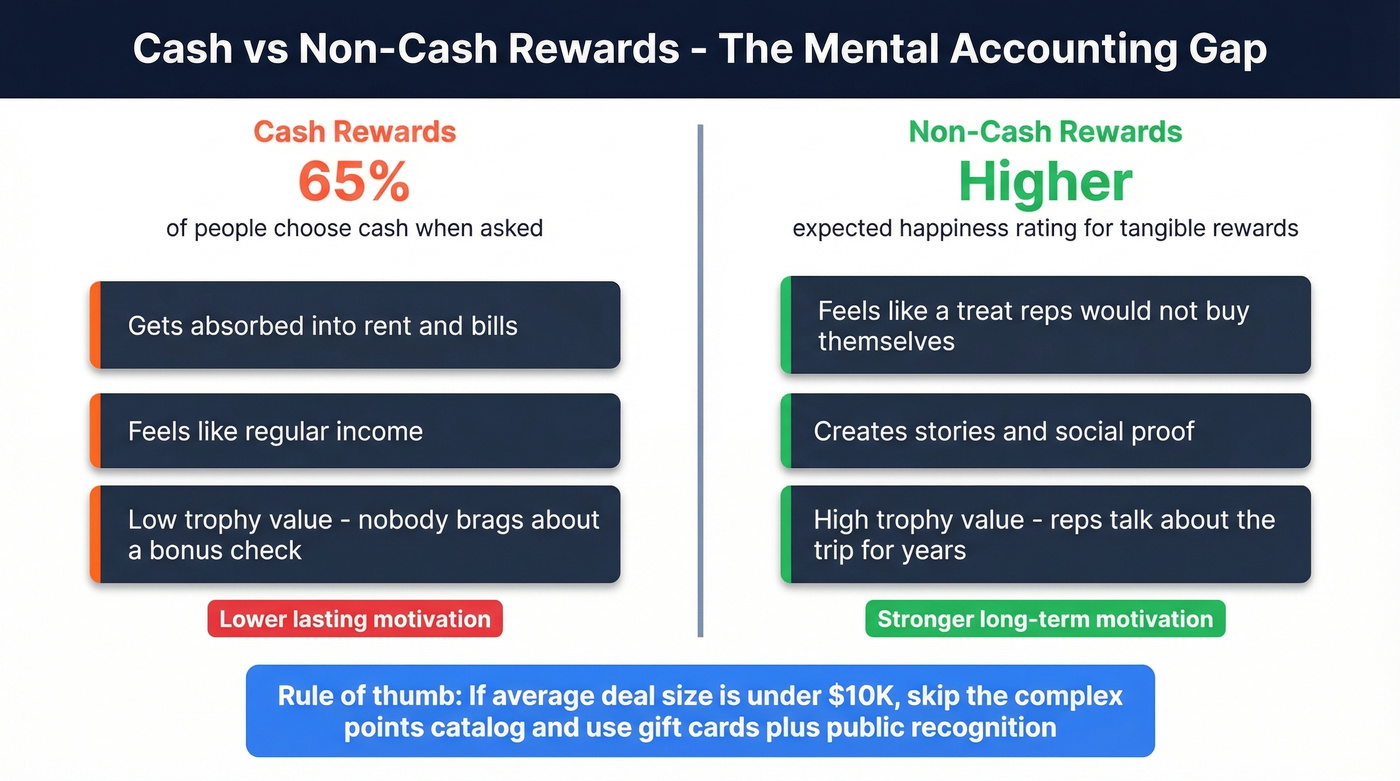
The mechanism is mental accounting. Cash gets absorbed into rent and credit card payments. A weekend trip feels like a treat - something the rep wouldn't buy for themselves. That "trophy value" is why non-cash rewards punch above their dollar weight in motivation.
If your average deal size sits below $10K, skip the elaborate non-cash catalog. A simple gift card program with public recognition will outperform a complex points system that nobody understands. We've seen this play out across dozens of teams.
Zero-Budget Ideas That Work
When management won't fund incentive spend, you get creative or you get ignored. One approach from a Reddit sales thread that actually works: a monthly poker game where reps earn cards each week based on metrics - most sold, most bids, best close rate. Lightweight gamification that costs nothing and creates genuine competition.
Privilege-based rewards are underrated. These cost zero dollars but carry real value:
- Choice of one inbound lead each Monday
- Manager handles a sale in your name - rep gets credit, manager does the work
- Hand off one problem client each week
As the original poster put it, these are "mostly for fun and mild encouragement." But giving a top performer first pick of inbound leads is a real competitive advantage that costs nothing. The consensus on r/sales tends to agree: recognition and autonomy often beat a $50 gift card.

The best sales reward is a pipeline full of real buyers. Prospeo gives your reps 300M+ verified contacts with 98% email accuracy - so every incentive dollar you spend drives revenue, not bounced emails.
Reward your reps with data that actually connects them to buyers.
How Reps Game Your Program
Every incentive program gets gamed. Every single one. The question is whether you've designed for it. A compliance-focused analysis identifies eight categories of gaming behavior. The most damaging four:
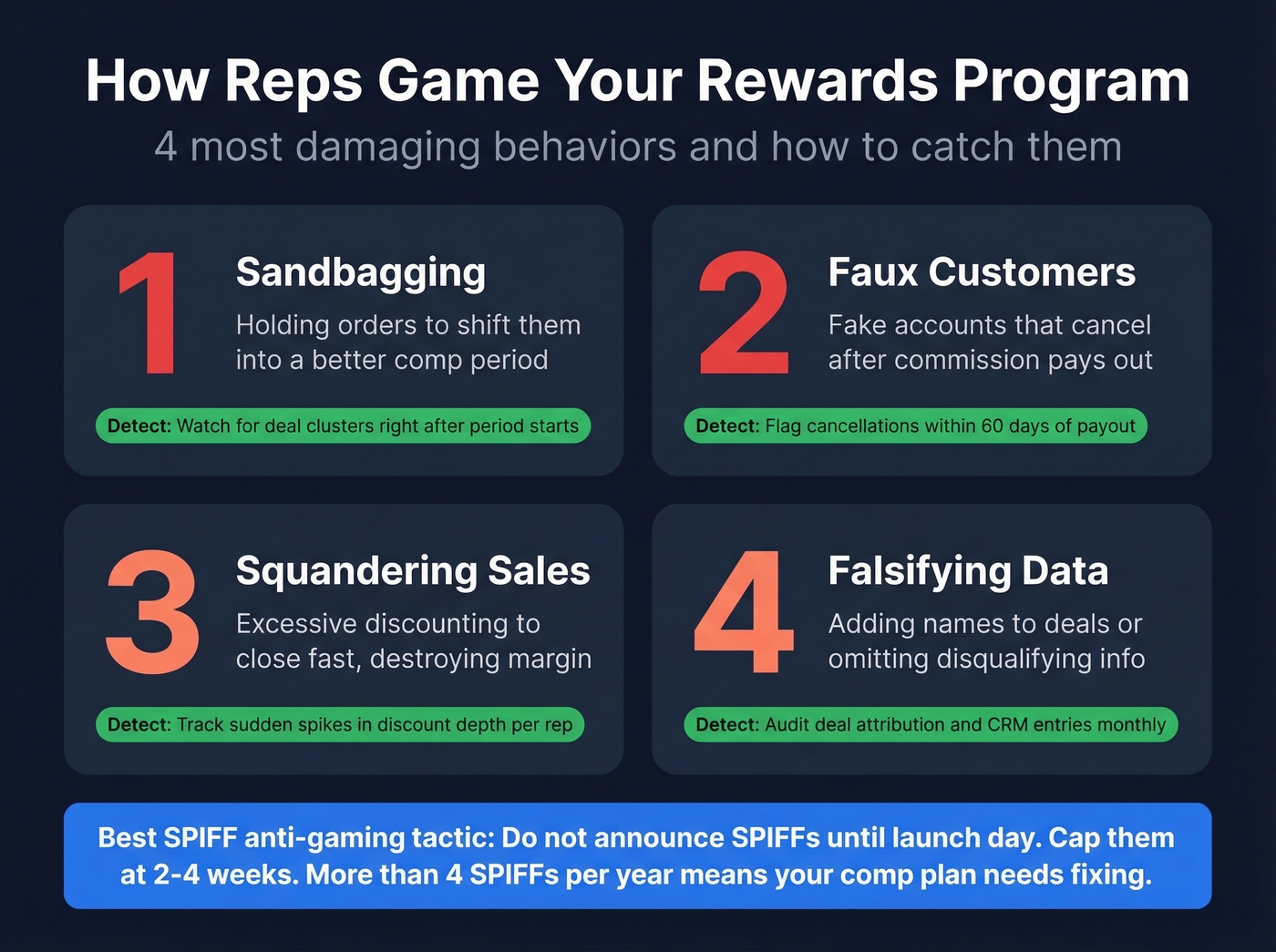
- Sandbagging - holding orders to shift them into a better comp period
- Faux customers - fake accounts that cancel after commission pays out
- Squandering sales - excessive discounting to close fast, destroying margin
- Falsifying data - adding names to deals, omitting disqualifying info
The remaining four - partners in profit, lost in segmentation, carrot and stick, and misleading customers - are subtler but equally corrosive over time.
The single best anti-gaming tactic for SPIFFs: don't announce them until launch day. If reps know a SPIFF is coming, they'll hold deals. Cap SPIFFs at two to four weeks. And if you're running more than four SPIFFs per year, you don't have a SPIFF problem - you have a sales performance management problem.
Use your CRM data to flag anomalies: sudden spikes in discount depth, clusters of cancellations post-payout, deals that close suspiciously fast. Most gaming isn't malicious. It's rational behavior responding to poorly designed incentives.
Tax Rules Most Guides Skip
Under Sec. 102(c), transfers from employer to employee are taxable compensation by default. The "it's a gift" defense doesn't work.
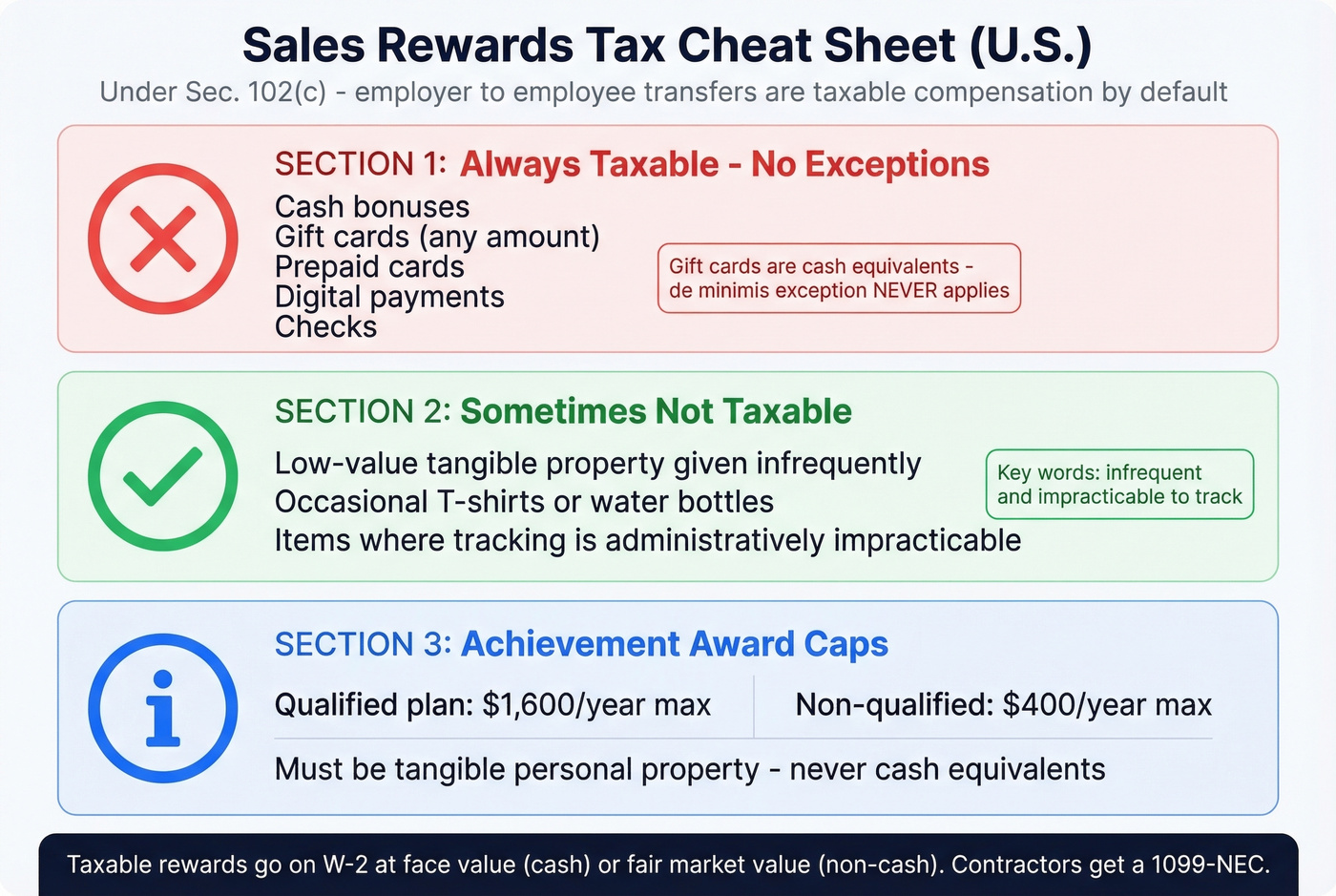
Always taxable, no exceptions: Cash, gift cards, prepaid cards, digital payments, checks. Gift cards are cash equivalents - the de minimis exception never applies to them, regardless of dollar amount. I can't tell you how many ops leaders we've talked to who didn't know this until audit season.
Sometimes not taxable: Low-value tangible personal property given infrequently, where it's administratively impracticable to track. Think an occasional T-shirt or water bottle. The key words are "infrequent" and "administratively impracticable to track."
Achievement award caps: Qualified plan awards max out at $1,600/year. Non-qualified awards cap at $400. Must be tangible personal property - never cash equivalents. Taxable rewards go on the employee's W-2 at face value for cash equivalents, fair market value for non-cash property. For contractors, it's a 1099-NEC. One newer wrinkle worth knowing: SECURE 2.0 allows incentives up to $250 to encourage 401(k)/403(b) participation without triggering taxable income.
For non-US team members, check local rules. These thresholds are U.S.-specific.
Measuring Incentive ROI
Most teams launch reward programs on faith and measure them on feelings. Actual measurement looks different.
Documented case studies show real numbers: one dealer incentive program generated $7.44M in incremental profit against $3.5M in program costs - a 112.5% ROI. A distributor incentive case produced a 7.5% net sales gain and improved accounts receivable from 59 to 32 days. These cases are older but remain the most detailed public ROI documentation available for incentive programs.

The KPIs that matter: incremental revenue attributable to the program, total program cost ratio, participation rate, and quota attainment lift. But ROI measurement only works when quotas are set on accurate pipeline data. Stale CRM data leads to unfair territories, which leads to disengaged reps, which leads to wasted incentive spend. Fix the first link and the rest follows - tools like Prospeo that refresh contact data on a 7-day cycle help ensure territory assignments reflect real, reachable prospects before you attach incentives to them.
Tools to Run It
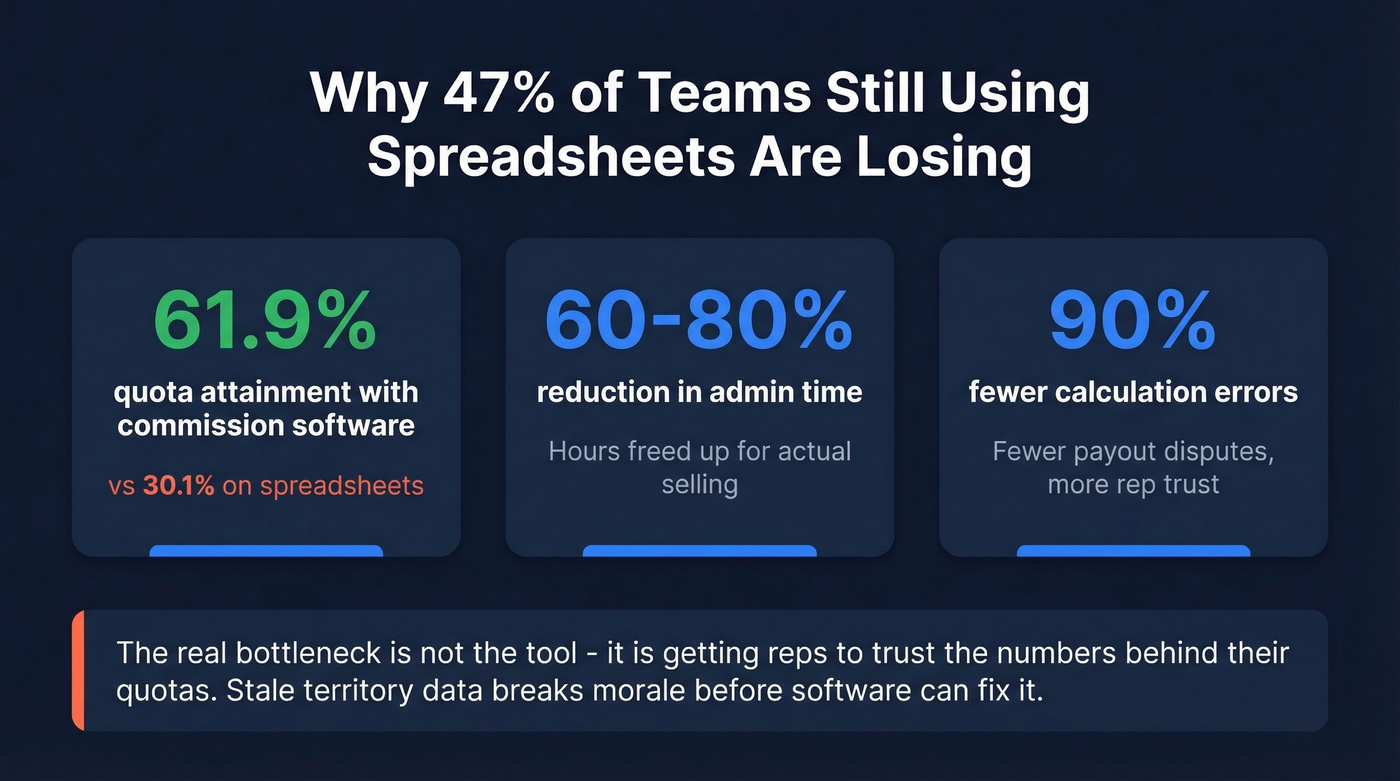
47% of organizations still use spreadsheets for incentive comp. That's frustrating, because the data is clear: reps using commission software exceed quarterly targets at a rate of 61.9% versus 30.1% on spreadsheets. Commission software also saves 60-80% of admin time and reduces calculation errors up to 90%.
| Tool | Starting Price | Rating | Best For |
|---|---|---|---|
| QuotaPath | ~$25/user/mo | 4.7 | SMB simplicity |
| Sales Cookie | ~$30/payee/mo | 4.6 | Flexible plan design |
| Everstage | ~$35-50/user/mo | 4.9 | Mid-market SPM |
| CaptivateIQ | ~$40-60/user/mo | 4.7 | Complex plans |
| Xactly | Not public | 4.2 | Enterprise scale |
For teams under 50 reps, QuotaPath gets you off spreadsheets in a week. Everstage and CaptivateIQ handle multi-tier plans with more sophistication. Xactly is the enterprise incumbent - powerful but heavier to implement.
Let's be honest about the real bottleneck, though. A Reddit thread on r/salesoperations echoes what we've seen firsthand: the biggest friction isn't picking the tool. It's getting reps to trust the numbers behind their quotas. If your territory data is stale, no commission platform will fix the morale problem underneath.
If you're rebuilding your stack, start with contact management and data enrichment so comp calculations and territories are based on reality, not outdated records.
Zero-budget rewards only work when reps have leads worth calling. Prospeo delivers 125M+ verified mobile numbers with a 30% pickup rate - turning inbound lead picks and SPIFFs into closed deals instead of voicemails.
Give your team the unfair advantage no gift card can match.
FAQ
Are gift cards taxable when used as sales rewards?
Yes - always. Gift cards are cash equivalents under U.S. tax law and must be reported on the employee's W-2 at face value, regardless of dollar amount. The de minimis fringe benefit exception explicitly doesn't apply to gift cards or any cash-equivalent instrument.
What's a good ROI for a sales incentive program?
Documented cases show ROI ranging from 50% to 112%. One dealer incentive program generated $7.44M in incremental profit against $3.5M in costs - a 112.5% return. Track incremental revenue against total program cost, including administration and tax gross-ups.
How long should a SPIFF run?
Two to four weeks is the sweet spot. Anything shorter doesn't give reps enough time to change behavior. Anything longer and the SPIFF becomes a de facto comp plan change that distorts your baseline metrics. If you need motivation beyond four weeks, redesign the underlying comp plan instead.
How do I set fair quotas so sales rewards actually motivate?
Fair quotas require accurate territory data - reps disengage when they know their patch has stale contacts. Use a data platform with frequent refresh cycles alongside your CRM to ensure each territory reflects real, reachable buyers before you attach incentives.