

Sales Scripts for Cold Calling That Book Meetings in 2026
It's 9:47 AM on a Wednesday. You've got 200 dials queued, a script you copied from a blog post last quarter, and a connect rate that's been stuck at 3% for six weeks. The average cold call success rate dropped from 4.82% in 2024 to 2.3% in 2025. Generic sales scripts for cold calling are getting punished harder every year - and yet 49% of buyers still prefer to be contacted by phone. The channel works. Most scripts don't.
Stop collecting templates. Start building a framework. The 12 scripts below are copy-paste ready, but the real value is the structure underneath - a modular system you can adapt to any persona, industry, or objection without starting from scratch.
Cold Calling Benchmarks Worth Knowing
Before you touch a script, know what "good" looks like:
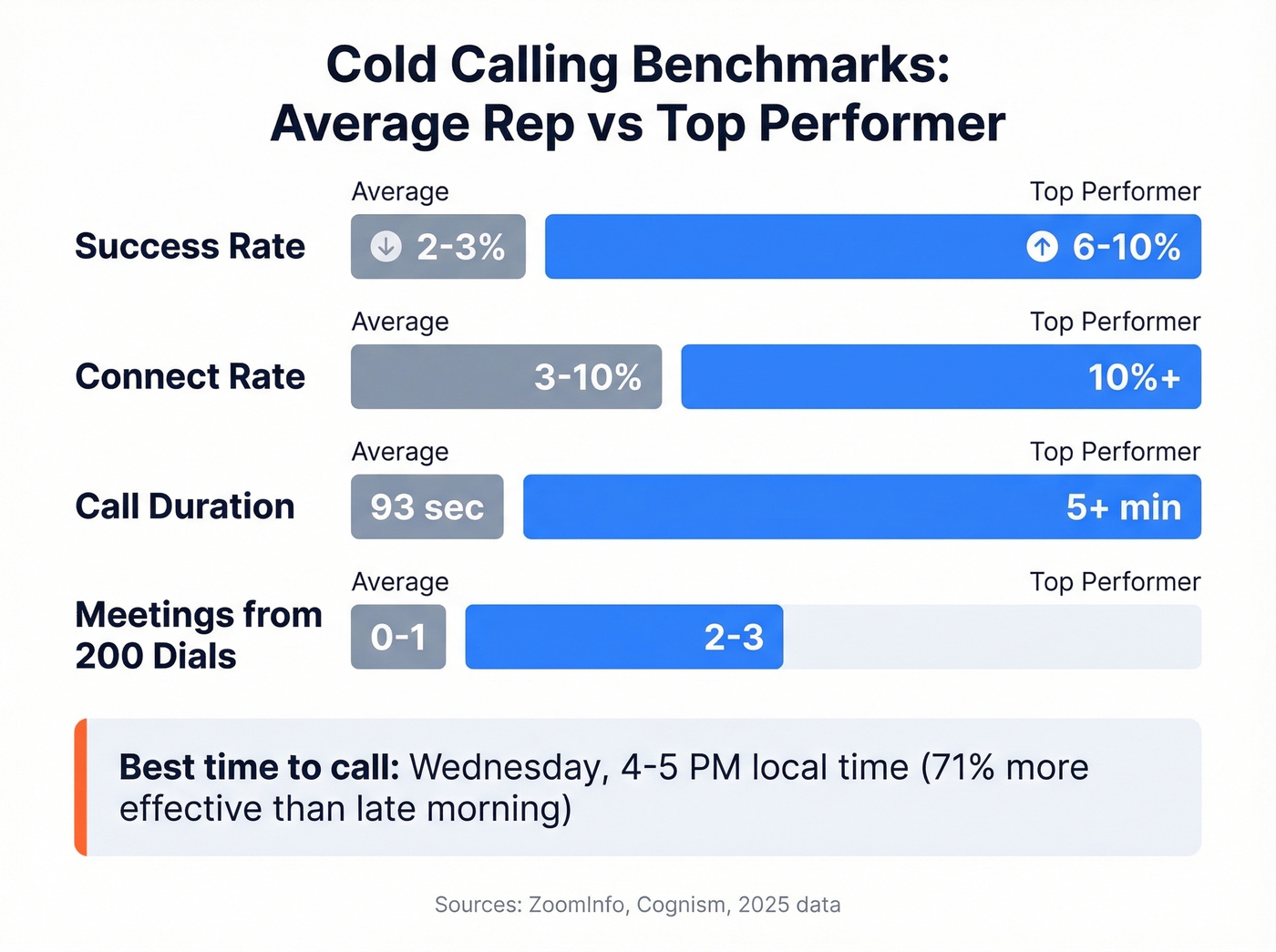
| Metric | Average | Top Performer | Source |
|---|---|---|---|
| Success rate | 2-3% | 6-10% | ZoomInfo |
| Connect rate | 3-10% | 10%+ | ZoomInfo |
| Call duration | 93 seconds | 5+ minutes | ZoomInfo |
| Attempts to reach | 8 calls | - | Cognism |
| Best time | 4-5 PM local | 4-5 PM local | ZoomInfo |
| Best day | Wednesday | Wednesday | ZoomInfo |
Calling between 4-5 PM is 71% more effective than the late-morning slot most reps default to. Wednesday consistently outperforms other days. These aren't marginal gains - they're the difference between one meeting a day and zero.
For context on what volume produces: one HubSpot author documented 11,519 cold calls that generated 335 meetings, 69.1% SQL conversion, and $287K in new business](https://blog.hubspot.com/sales/cold-call-blunders). That's roughly a 2.9% booking rate, solidly above average. The consensus on r/sales is that 200+ dials per day with a parallel dialer, a 5% connect rate, and tight messaging should yield at least one meeting daily. If you're consistently below that, audit your data before blaming the script.
How to Build Your Own Cold Call Script
Here's the thing: collecting templates is easy. Building a framework that works across personas and industries is what separates reps who book meetings from reps who read into voicemail.
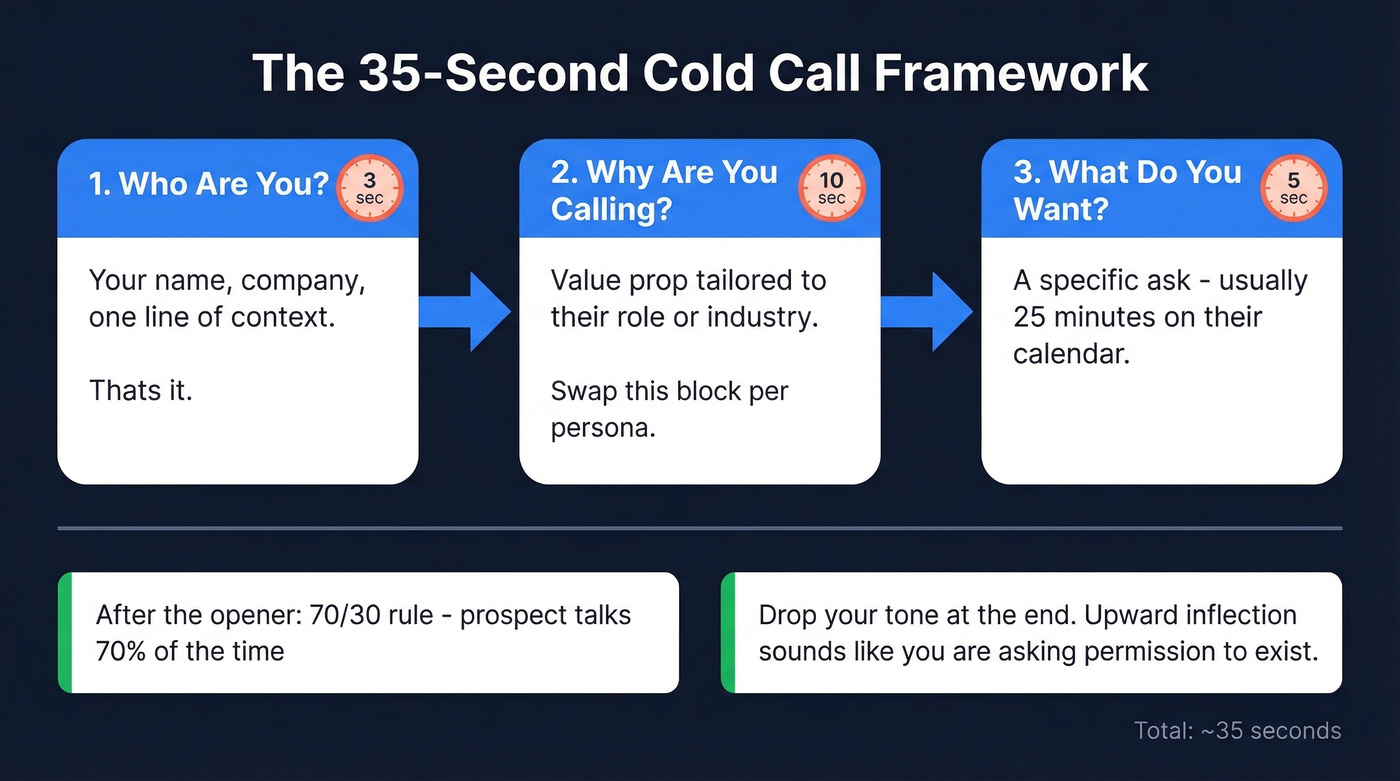
Every cold call script answers three questions fast:
- Who are you? Name, company, one-line context. Three seconds.
- Why are you calling? The value prop, tailored to the prospect's role or industry. Ten seconds.
- What do you want? A specific ask - usually 25 minutes on their calendar. Five seconds.
Deliver all three in roughly 35 seconds. The Higher Levels framework nails this structure - keep your opener consistent across every call, then swap only the "why I'm calling" block based on persona and industry.
The modular approach lets you practice one opener until it's second nature while still personalizing the meat of the call. After your opener, aim for a 70/30 talk-time ratio - the prospect should be talking 70% of the time. Your job after the first 35 seconds is to ask questions, not pitch.
Two delivery mechanics that matter more than most reps realize: pause for one beat after saying your name - it signals confidence and gives the prospect a moment to orient. And drop your tone at the end of your opener. Upward inflection sounds like you're asking permission to exist.
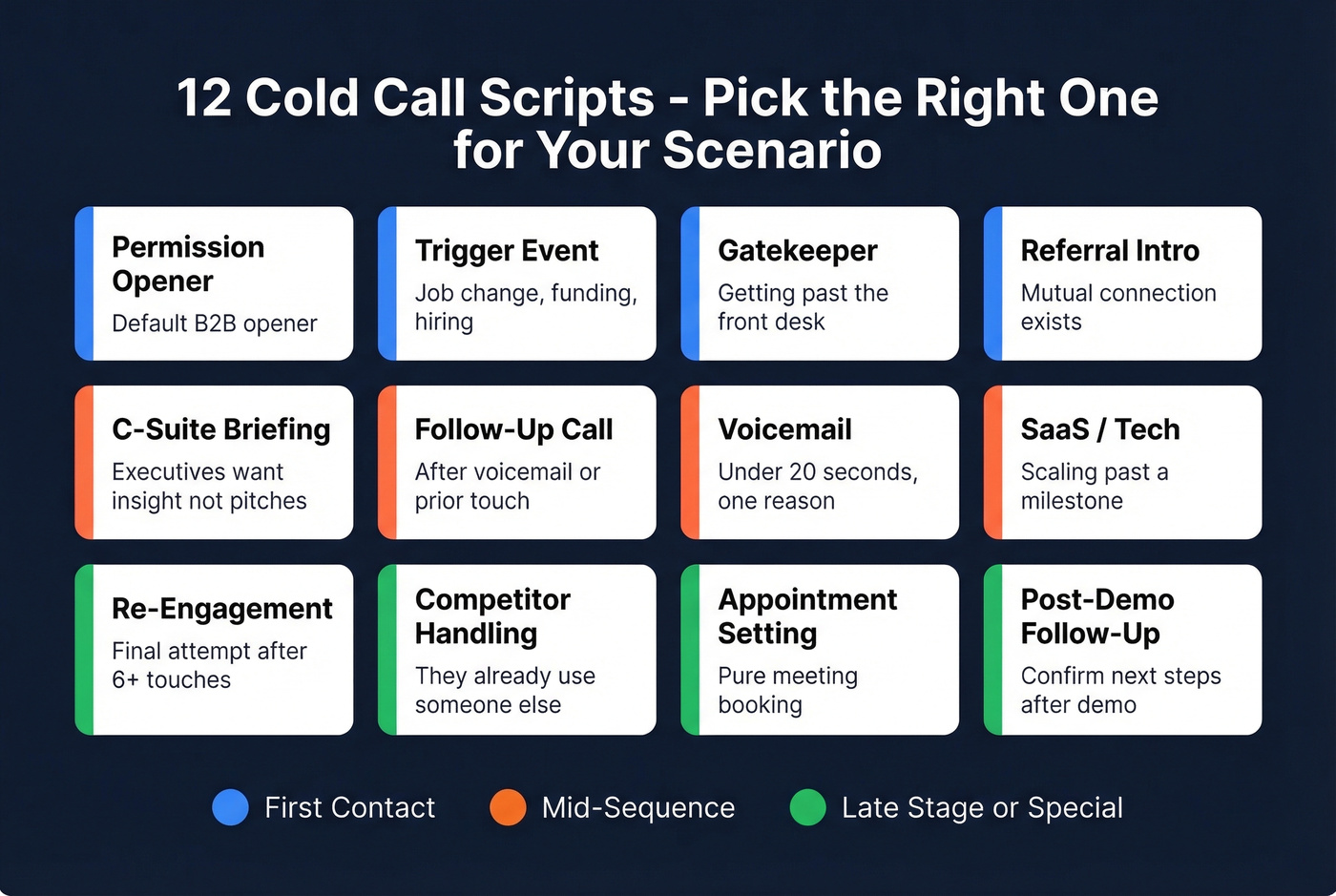
12 Cold Calling Templates by Scenario
These are ready to use. Adapt the bracketed sections to your product, persona, and industry. Don't read them word-for-word - internalize the structure, then make them yours.
Permission-Based Opener
The workhorse. It works for most B2B scenarios because it gives the prospect a sense of control without actually giving them an easy out.
"Hi [First Name], it's [Your Name] from [Company]. Have you got 30 seconds for me to explain why I'm calling, and then you can tell me if it's worth continuing?"
[If yes]: "We help [role/company type] solve [specific problem]. I've seen teams like yours [specific result]. I'd love 20 minutes to show you how - does Thursday afternoon work?"
The "30 seconds" framing comes from Cognism's script library and works because it's specific and doesn't feel like a time trap.
Direct Opener (Trigger Event)
Use this when you've got a warm signal - a job change, funding round, or hiring surge. The trigger does the heavy lifting.
"Hi [First Name], it's [Your Name] from [Company]. I noticed [trigger - e.g., you just raised your Series B / you're hiring 5 AEs / you moved into the VP role last month]. Congrats. Usually when that happens, [specific challenge] becomes a priority. Worth a quick conversation?"
Skip this if you don't have a real trigger. Faking one ("I noticed your company is growing!") is worse than a generic opener because it signals you didn't do real research.
Gatekeeper Script
Keep it casual and confident. Gatekeepers can smell a cold caller from the first syllable.
"Hi, it's [Your Name] from [Company]. Is [First Name] available?"
[If asked why]: "I'm following up on an email I sent about [topic]. Just wanted to make sure it landed."
The "following up on an email" rationale works because it implies an existing thread. If you haven't actually sent an email, send one five minutes before you call. Now it's true.
Referral / Warm Intro Script
The highest-converting opener you'll ever use. A name they recognize changes everything.
"Hi [First Name], [Mutual Connection] suggested I reach out. They mentioned you're dealing with [problem], and that's exactly what we help with at [Company]. Could I get 20 minutes to walk you through what we did for [similar company]?"
C-Suite / Executive Briefing
57% of C-level execs prefer phone over other channels. But they don't want a pitch - they want insight.
"Hi [First Name], it's [Your Name] from [Company]. I'll be brief - we just published research on [relevant trend] that's affecting [their industry]. I'd love to share the key findings and get your take. Would 15 minutes next week work?"
Lead with value exchange, not product features. Executives trade time for insight, not curiosity.
Follow-Up Call (Bad vs. Good)
Most reps treat follow-up calls like first calls. That's a mistake.
Bad: "Hi [First Name], it's [Your Name] from [Company]. I'm calling to see if you had a chance to think about our solution..."
Good: "Hi [First Name], it's [Your Name] from [Company]. I left you a voicemail last [day] about [topic]. I know you're busy - I just want to make sure this is on your radar because [one-sentence value prop]. Is now a bad time for a quick 2-minute conversation?"
The difference: the good version references a specific prior touchpoint and asks a negative-framed question ("Is now a bad time?"), which gets more yeses than "Do you have a minute?"
Voicemail Script
Under 20 seconds. One reason to call back. That's it.
"Hi [First Name], it's [Your Name] from [Company]. I'm calling because [one specific reason tied to their role/company]. My number is [number] - I'll also shoot you an email. Talk soon."
Don't pitch in voicemail. Create enough curiosity to earn a callback or an email open.
SaaS / Tech Script
"Hi [First Name], it's [Your Name] from [Company]. I work with [similar SaaS companies] that are scaling past [milestone]. The #1 bottleneck we keep seeing is [specific problem]. Is that on your radar, or is [alternative problem] the bigger headache right now?"
The either/or question at the end is key - it forces a substantive answer instead of a yes/no.
Re-Engagement / Breakup Script
Final attempt after 6+ touches. Create urgency through closure.
"Hi [First Name], it's [Your Name] from [Company]. I've reached out a few times about [topic] and haven't heard back - totally understand. I'm going to close out your file on my end, but before I do, I wanted to check: is [problem] still a priority, or should I circle back in Q3?"
The "close out your file" framing triggers loss aversion without being pushy.
"We Already Use [Competitor]"
Don't try to unseat the competitor on the spot. Re-sell the time.
"That's great - [Competitor] is solid. I'm not asking you to switch. But most teams I talk to are evaluating options for when their contract comes up. Worth a 20-minute intro so you have a comparison point when that happens?"
This approach, borrowed from the Higher Levels framework, works because it removes the pressure of an immediate decision.
Appointment-Setting Script
Pure meeting-booking. No product education, no demo pitch.
"Hi [First Name], it's [Your Name] from [Company]. We help [role] at [company type] with [outcome]. I'm not going to pitch you on the phone - I just want to find 20 minutes where our team can show you [specific deliverable]. What does your Thursday look like?"
Post-Demo Follow-Up
Confirm next steps and surface lingering objections before they go silent.
"Hi [First Name], it's [Your Name]. Thanks again for the time yesterday. I wanted to check - did anything come up after our call that you'd want to talk through? I also wanted to confirm: are we still good for [next step] on [date]?"
Handling Objections Mid-Call
Objections aren't rejections. They're the prospect telling you they need a better reason to stay on the line.

The framework is simple - Listen, Clarify, Respond - and it covers every objection you'll encounter. The LeadsAtScale objection library breaks this into three steps: understand what they're actually saying, confirm you heard it right, then respond with value.
| Objection | Response Gist | Why It Works |
|---|---|---|
| "I'm not interested" | Ask for 90 seconds, offer to hang up if irrelevant | Lowers the commitment ask |
| "Send me an email" | Agree, then ask one quick question first | Keeps the conversation alive |
| "We have a solution" | Acknowledge, suggest intro for future evaluation | Removes switching pressure |
| "I don't have time" | Ask for a better 10-minute window this week | Redirects without arguing |
| "What's the price?" | Explain it depends on setup, offer a 15-min scoping call | Moves toward a meeting |
| "Call me next quarter" | Agree, then ask what's changing next quarter | Qualifies the stall |
Let's break down the top two. When someone says "I'm not interested" after three seconds, they haven't heard enough to actually be uninterested - they're reflexively screening. Try: "Totally fair. Could I get 90 seconds to share one thing? If it's not relevant, I'll hang up." The 90-second ask resets the conversation because it's so low-commitment it feels rude to refuse.
When you hear "Send me an email," the instinct is to comply and hope for the best. Instead: "Happy to. Emails can only go so far though - could I ask one quick question first?" This keeps the door open while respecting their preference. If they still want the email, send it - but now you've earned 15 more seconds of context.
The key across all objections: never argue. Acknowledge, then pivot to value.

A 5% connect rate means nothing if 35% of your dials go to dead numbers. Prospeo gives you 125M+ verified mobile numbers with a 30% pickup rate - refreshed every 7 days, not every 6 weeks. That means more live conversations per dial session and more chances to use the scripts above.
Stop rehearsing scripts into voicemail. Start dialing numbers that pick up.
Your Cold Calling Tech Stack
Your script is only as good as the infrastructure behind it. Three categories matter: dialer, data provider, and CRM/recording.
| Category | Tool Examples | Price Range |
|---|---|---|
| Power dialer | Kixie, PhoneBurner | ~$30-100/user/mo |
| Parallel dialer | Orum, Nooks | ~$250-500/user/mo |
| Data provider | Prospeo | Free-$39+/mo |
| CRM | Salesforce, HubSpot | ~$0-$150+/user/mo |
| Call recording | Gong, Chorus | ~$100-200+/user/mo |
Parallel dialers like Orum and Nooks let reps dial 3-10 lines simultaneously. They're expensive, but they're the reason 200+ dials per day is achievable. Power dialers like Kixie are the budget-friendly option for smaller teams.

Your dialer amplifies whatever data you feed it. Bad numbers mean burned dials - and at $250+/user/month for a parallel dialer, every wrong number has a real cost. We've tested this extensively: teams that fix their data quality first see bigger gains than teams that upgrade their dialer first. Prospeo covers 300M+ professional profiles with 125M+ verified mobile numbers delivering a 30% pickup rate, refreshed every 7 days instead of the industry-standard 6 weeks. The free tier gives you 75 emails and 100 Chrome extension credits per month - enough to figure out whether your connect rate problem is a script problem or a data problem.
Hot take: If your average deal size is under $15K, you probably don't need a $250/user/month parallel dialer. A power dialer at $50/month plus accurate mobile numbers will outperform an expensive dialer fed garbage data every single time. Fix your data first, then upgrade your dialer.
Cold calls also work best inside a multi-touch cadence. The reps booking the most meetings on r/sales aren't just calling - they're layering calls with personalized emails and social touches across 8-12 touchpoints. Your dialer and your email sequencer should feed the same CRM so nothing falls through the cracks.
If you want a repeatable process, build a full cold calling system that ties data, dialer, and follow-up together.
Mistakes That Kill Your Numbers
We've seen teams invest in expensive dialers and polished scripts, then wonder why connect rates stay flat. Usually it's one of these:
No research before dialing. Spend 2-3 minutes per prospect minimum. Check their role, recent company news, and industry context. Walking in blind wastes everyone's time.
Generic opener. "How are you today?" is an instant hang-up trigger. Personalize or use a permission-based frame.
Robotic delivery. Use frameworks, not word-for-word scripts. The LARA method - Listen, Acknowledge, Respond, Ask - keeps conversations natural. Treat your script like a jazz chart: know the structure, improvise the notes.
Pitching too early. Your first 35 seconds should earn the next 5 minutes, not close the deal.
Mishandling objections. Arguing with "I'm not interested" is the fastest way to get hung up on.
Bad or outdated data. Most B2B databases refresh every 6 weeks. By the time you're dialing, a chunk of those numbers are already dead. If you're cleaning lists and filling gaps, data enrichment can be the fastest fix.
Ignoring timing. Calling at 10 AM on Monday when the data says 4 PM Wednesday is leaving meetings on the table.
Giving up too early. 80% of sales require 5+ follow-up calls. Most reps stop at two. Use a consistent follow-up plan so touches don’t get random.
Not booking the next step on the call. If you hang up without a calendar invite sent and confirmed, the meeting doesn't exist. Always close with a specific date and time, then send the invite while they're still on the line.
Reducing No-Shows After Booking
Booking the meeting is half the battle. Keeping it is the other half.
One HubSpot author maintained a sub-18% no-show rate on cold-call-sourced meetings. Here's what worked: send a strong agenda immediately after booking - not "looking forward to connecting" but an actual agenda with 2-3 bullet points of what you'll cover. Then confirm the calendar invite live on the call: "I just sent the invite - can you check it landed?" This creates a micro-commitment that makes the meeting feel real.
Book same-week when possible. The further out the meeting, the higher the no-show rate. "How about Thursday?" beats "How about three weeks from now?" Send a brief reminder 24 hours before - one sentence referencing the agenda, nothing more.
Physical prep matters too. Get enough sleep the night before a heavy dial day, eliminate distractions during your call block, and stand up while you dial. Your energy comes through the phone whether you realize it or not.
Cold Calling Compliance in 2026
Look, compliance isn't optional, and the penalties have teeth. TCPA litigation surged nearly 95% year over year in 2025, and 2026 enforcement is even more aggressive.
TCPA penalties run $500 per violation, $1,500 if willful. That's per call, not per campaign. DNC scrubbing is required at least every 31 days, with federal fines up to $50,120 per illegal call. The federal calling window is 8 AM-9 PM in the recipient's local time zone - not yours, theirs.
AI-generated voices now count as "artificial or prerecorded" under TCPA per the FCC's February 2024 ruling. Prior express written consent is required. If you're using AI voice agents for outbound, get legal sign-off first.
Consent revocation rules took effect April 11, 2025 - consumers can revoke consent by any reasonable method, including text, email, or verbal request on a call. State mini-TCPAs are expanding fast: Texas SB 140 (effective September 2025) and Virginia SB 1339 (effective January 2026) add layers on top of federal rules. Connecticut can fine up to $20,000 per violation.
If you're running any kind of volume, consult counsel on state-specific rules - especially call recording consent, which varies between one-party and two-party states. The cost of a legal review is trivial compared to a single TCPA class action.
If you’re adding SMS as a channel, review cold texting rules before you scale.
The benchmarks above say it takes 8 attempts to reach a prospect. Cut that in half with direct dials that actually connect. Prospeo's 98% email accuracy and 125M+ verified mobiles mean your multi-touch sequences - calls, voicemails, follow-up emails - all land where they should.
Book more meetings with data that connects you to real buyers.
FAQ
Do cold calling scripts actually work?
They work when they're frameworks, not crutches. Top performers internalize the structure - opener, value prop, ask - and adapt it live. Reading word-for-word is why cold calling has a bad reputation; using a script as a skeleton while improvising delivery is why top reps hit 6-10% success rates.
What's a good cold calling success rate?
The average is 2.3% based on Cognism's 2025 data, down from 4.82% the year before. Top performers consistently hit 6-10%. Above 3% means your messaging and data are working. Below 2%, audit your contact list quality and opener before changing anything else.
How many cold calls should I make per day?
With a parallel dialer, 200+ dials is a standard SDR target. At a 5% connect rate, that's roughly 10 live conversations and one booked meeting per day. Without a parallel dialer, 80-100 dials is more realistic with a power dialer like Kixie.
When's the best time to cold call?
Between 4-5 PM in the prospect's local time zone - it's 71% more effective than late morning. Wednesday is the highest-converting day. Avoid Monday mornings and Friday afternoons when decision-makers are least receptive.
How do I get accurate phone numbers for cold calling?
Prospeo's mobile finder covers 125M+ verified numbers with a 30% pickup rate, refreshed every 7 days. The free tier includes 75 emails and 100 Chrome extension credits monthly - enough to test whether low connect rates stem from bad data or bad messaging. Apollo and ZoomInfo also offer mobile data, though pickup rates tend to run 11-12.5%.