

Sales Team Engagement Is a Management System Problem - Here's How to Fix It
Your reps aren't disengaged because they lack motivation. They're disengaged because their 1:1s are interrogations, their comp plan is a spreadsheet puzzle, and they spend hours every week on admin instead of selling. 52% of sales leaders rate their team's engagement as "very low" - based on insights synthesized from 6,972 U.S. sales leaders over 12 months.
U.S. employee engagement hit 31% in 2024, matching 2014 levels. Gallup's broader research is blunt about the lever that matters most: 70% of team engagement is attributable to the manager. Not the perks. Not the culture deck. The manager.
You don't need 22 tactics. You need three things done consistently: restructure your 1:1s, simplify your comp plan, and kill the admin burden.
The Business Case for Engagement in Sales
The Q12 database - 3.3 million workers across 100,000+ teams - shows highly engaged teams deliver 18% higher sales productivity, 23% higher profitability, and 21-51% lower turnover. A 10% drop in engagement equates to roughly a 4% drop in sales productivity.
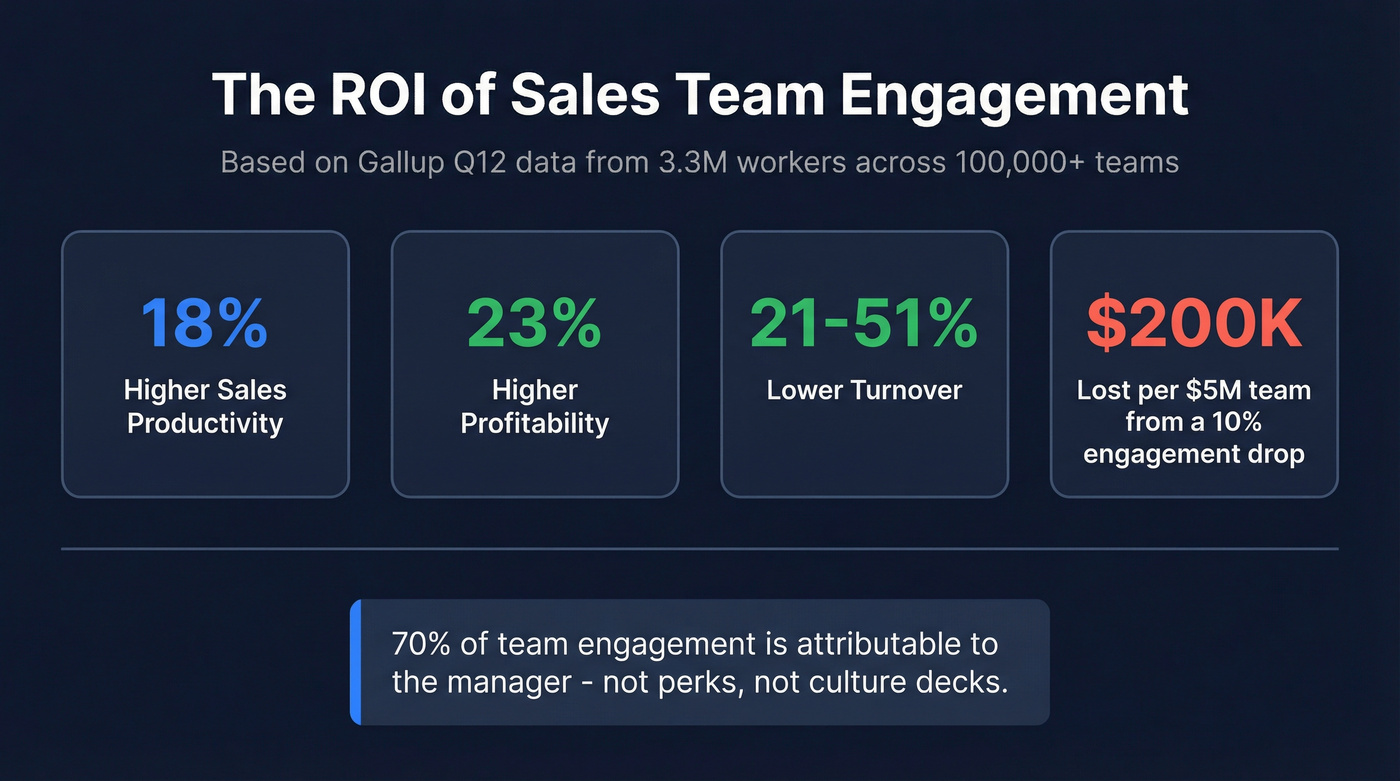
Do the math on that. For a team doing $5M in annual bookings, a 4% productivity hit is $200K evaporating - not because your reps forgot how to sell, but because your management system is broken. That's why employee engagement metrics deserve the same rigor you give pipeline coverage ratios.
Burnout Is the #1 Engagement Killer
55% of the U.S. workforce is burned out, per Eagle Hill's November 2025 survey. Among burned-out workers, 72% say it diminishes efficiency and 71% say it hurts performance. They're nearly 3x more likely to leave within the year.
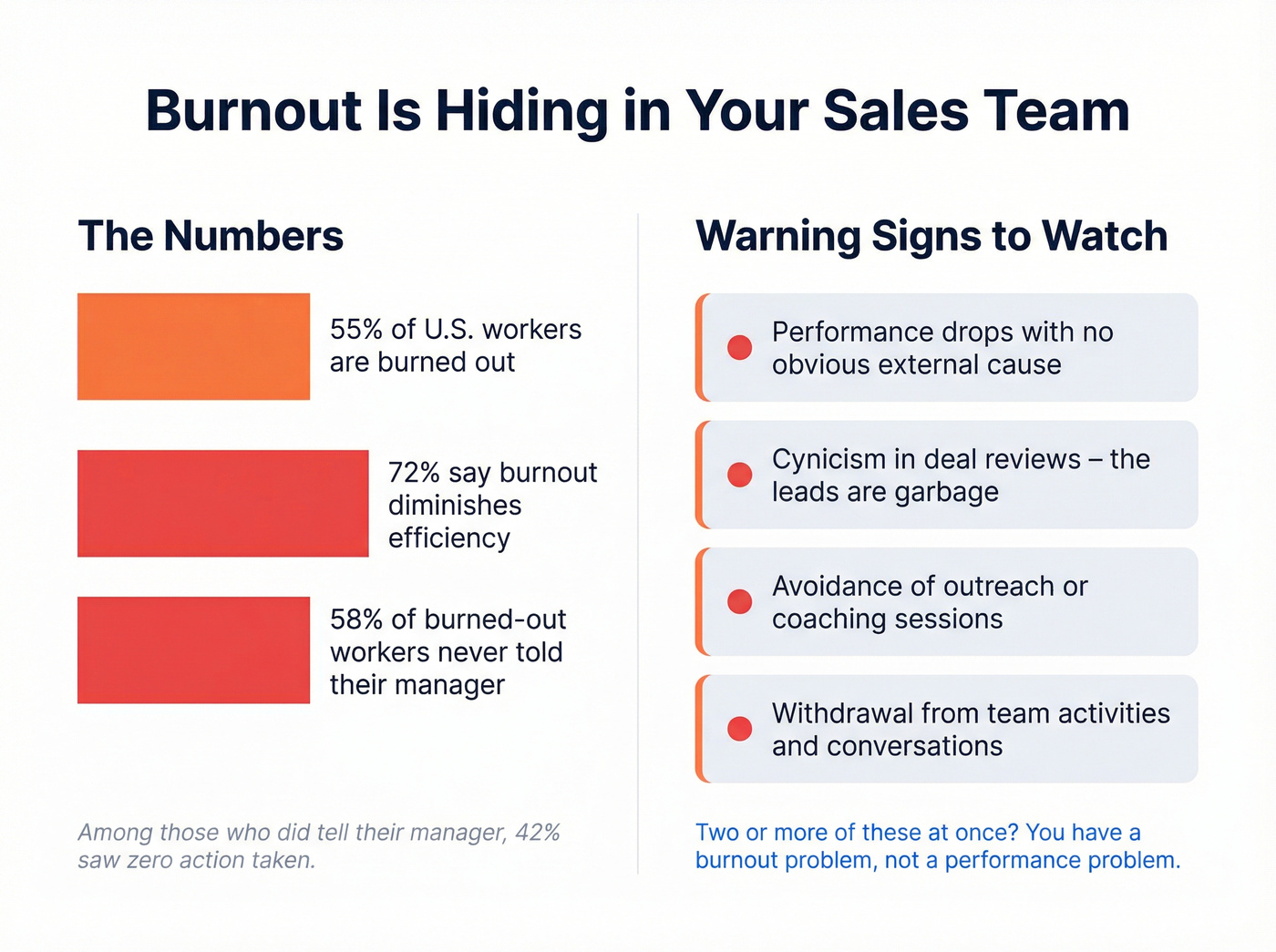
Here's the part that should make every sales manager uncomfortable: only 42% of burned-out workers told their manager. And among those who did, 42% of managers took no action. That's a staggering failure rate on both sides of the conversation.
Watch for these warning signs: performance drops without an obvious external cause, cynicism creeping into deal reviews ("the leads are garbage"), avoidance of outreach or coaching sessions, and withdrawal from team activities. If you're seeing two or more of those simultaneously, you don't have a performance problem. You have a burnout problem wearing a performance mask.

Every bounced email chips away at your reps' engagement. Prospeo's 98% email accuracy and 7-day data refresh mean your team stops playing data janitor and starts selling - the single fastest way to kill admin burnout.
Give your reps data that works so they can focus on closing.
Three Fixes That Actually Move the Needle
Restructure Your 1:1s
The most common rep complaint we hear? Weekly 1:1s that are just pipeline interrogations. The fix isn't eliminating them - it's restructuring around a 20% inspection / 80% coaching split. Use the 10/10/10 format for a 30-minute session:
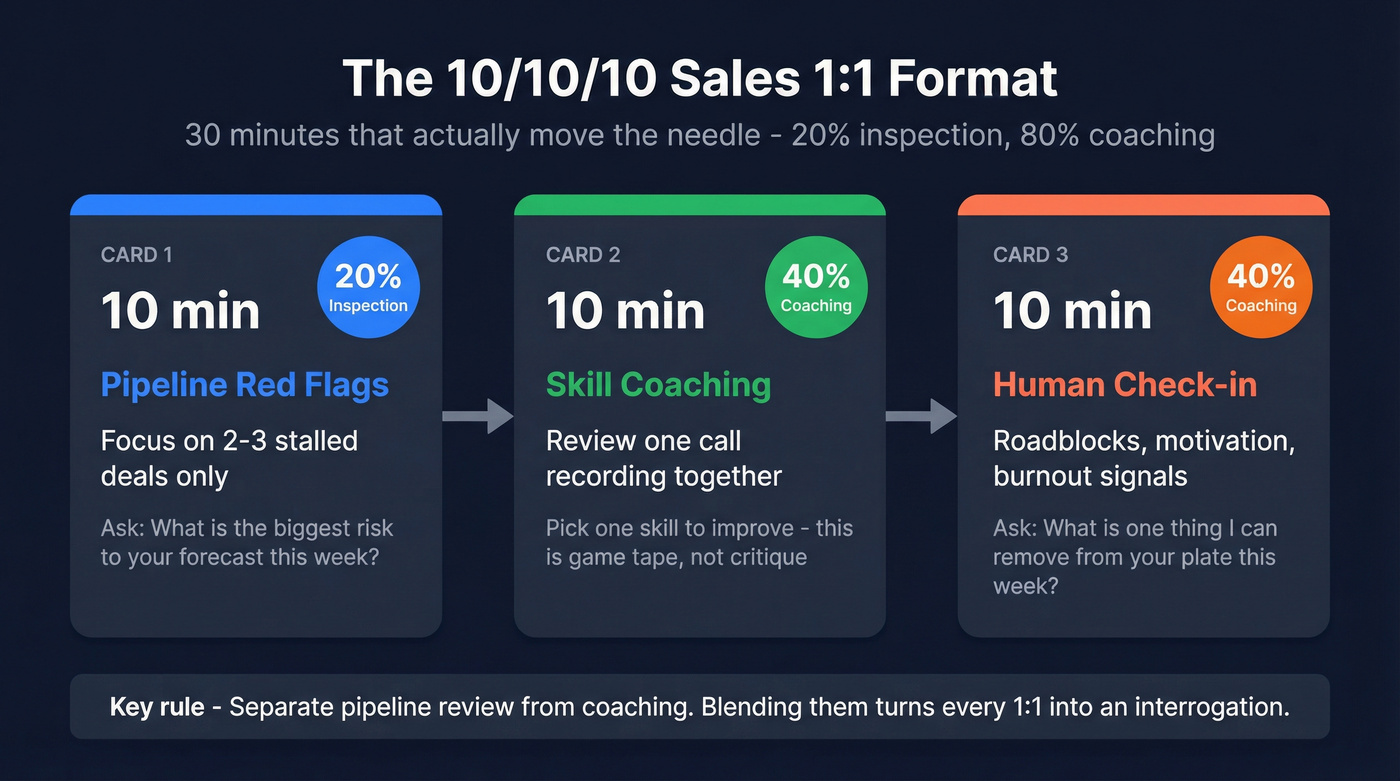
- 10 min - Pipeline red flags. Not a deal-by-deal walkthrough. Focus on two or three stalled deals. Ask: "What's the biggest risk to your forecast this week?"
- 10 min - Skill coaching. Review a call recording together. Pick one skill to improve. This is game tape, not critique.
- 10 min - Human check-in. Roadblocks, motivation, burnout signals. Ask: "What's one thing I can remove from your plate this week?"
Separate your pipeline review from your coaching conversation entirely. They serve different purposes, and blending them turns every 1:1 into an interrogation disguised as development. This restructuring is one of the simplest engagement ideas to implement - it costs nothing and reps feel the shift within a single meeting cycle. I've watched a team go from 40% voluntary attrition to under 15% in two quarters just by making this one change.
Simplify Your Comp Plan
39% of revenue leaders admit their comp plans don't align with business goals. In many orgs, 30-50% of reps can't accurately explain how they're paid. That's not a comp plan. That's a trust problem.
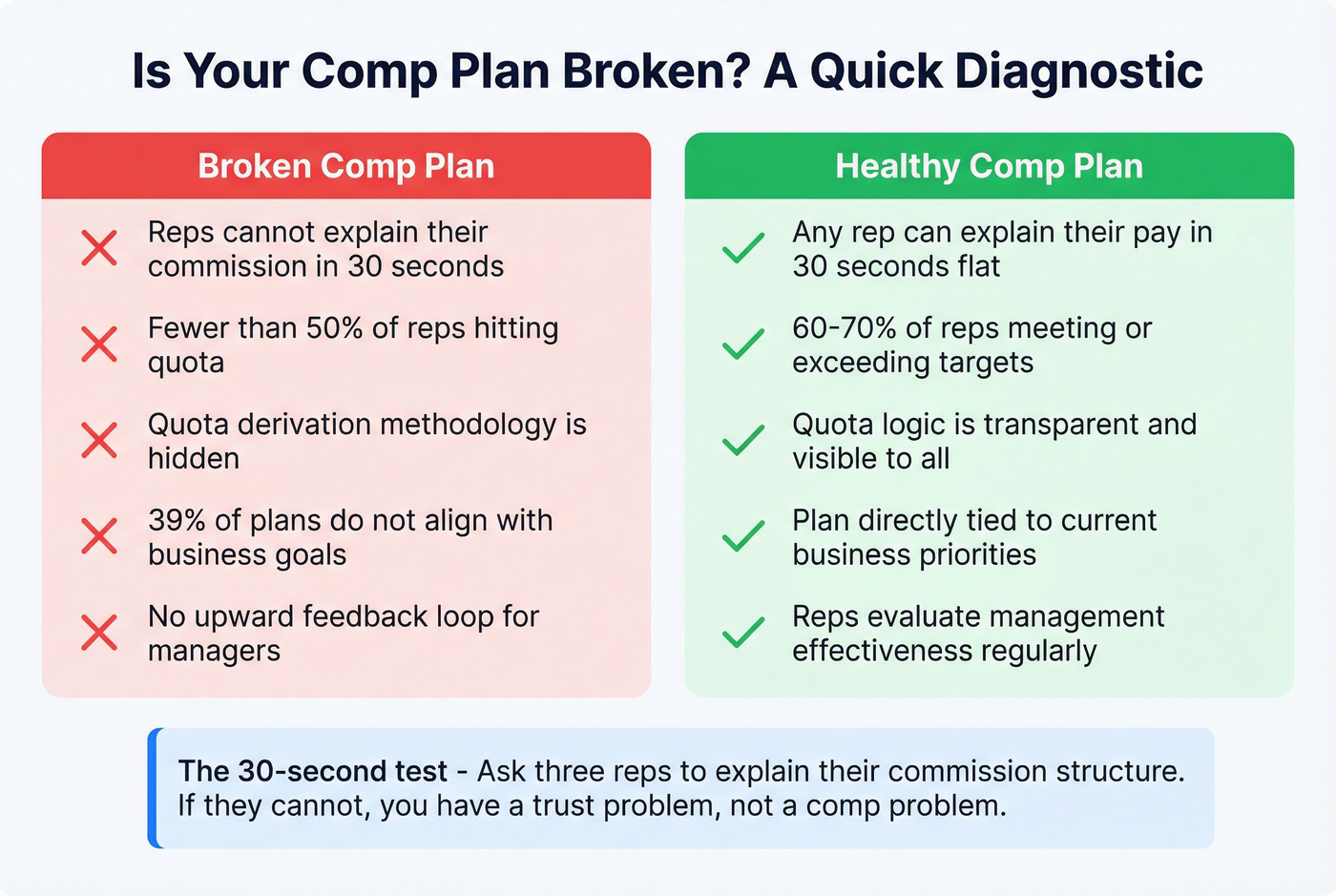
Here's the diagnostic: ask three reps to explain their commission structure in 30 seconds. If they can't, the plan is too complex. Make quota derivation methodology visible to every rep - when people can't see how their number was set, they assume it was arbitrary, and that assumption poisons everything downstream.
A healthy benchmark: 60-70% of your reps should be meeting or exceeding targets. If fewer than half are hitting quota, the plan is either misaligned or unattainable. And let reps evaluate management effectiveness alongside their own reviews. If 70% of engagement is on the manager, managers need a feedback loop too.
Kill the Admin Burden
Look - reps spending hours on manual prospecting with bad data aren't just unproductive. They're demoralized. Every bounced email is a small trust fracture between your team and the tools you've given them. Bad data is a burnout accelerator because it makes reps feel like data-entry clerks instead of sellers, and that frustration compounds week after week until someone quietly starts interviewing.

The 2026 theme on r/sales is straightforward: AI sales assistants and notetakers are becoming non-negotiable, and it's getting harder to do basic ops tasks like sending emails or finding valid, verified data. Prospeo delivers 98% email accuracy on 143M+ verified addresses with a 7-day data refresh - free tier, no contract, no procurement cycle. When your data is clean, reps sell instead of playing data janitor, and that shift alone reduces the frustration that compounds into disengagement.
Here's the thing: most engagement problems aren't motivation problems or culture problems. They're data hygiene problems that nobody wants to own. Fix the tools first, then worry about the motivational Slack channels.
If you're rebuilding your outbound motion, start with sales prospecting fundamentals and a clean list workflow.
Community Building as an Engagement Lever
The three fixes above are structural - they address systems. But sustainable sales team engagement also requires connection between reps, and that doesn't mean forced happy hours or cringey Slack emoji contests.
It means creating spaces where reps learn from each other without manager oversight: peer-led deal clinics, shared win/loss libraries, and cross-pod ride-alongs. When we've seen teams implement peer deal clinics - where a rep presents a stuck deal and three peers brainstorm approaches for 15 minutes - the quality of ideas is often better than what comes out of formal coaching sessions. Reps who feel like they belong to a team that has their back are far less likely to quietly disengage or start interviewing elsewhere.
Skip this if your team is under five people. At that size, community building happens naturally through proximity. These structures matter once you're scaling past the point where everyone knows everyone's deals.
Measuring Engagement Over Time
Quota attainment alone won't tell you whether your team is engaged or just grinding through. We've run pulse surveys monthly during high-churn periods - quarterly is the floor, not the ceiling. Adapt the Q12 framework for sales and track these failing indicators:
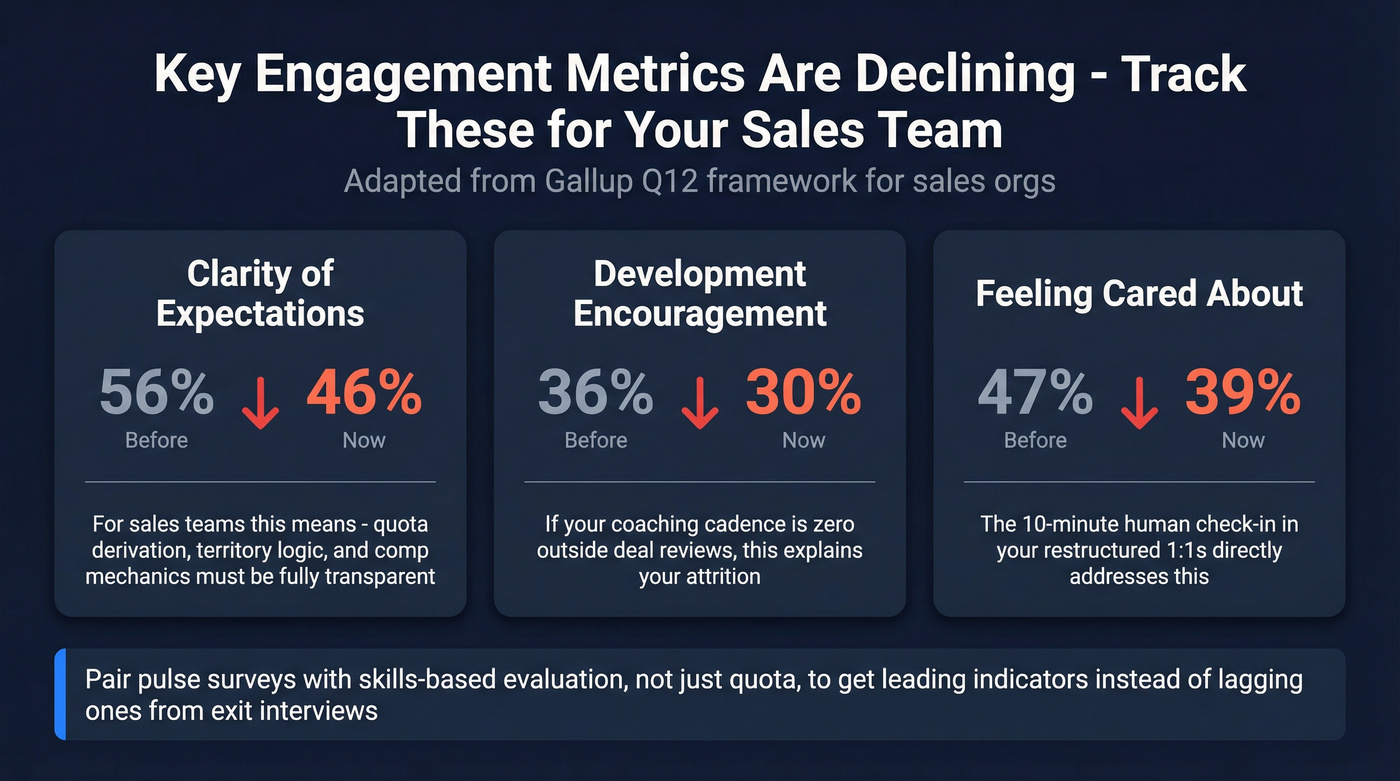
Clarity of expectations - only 46% of workers strongly agree they know what's expected, down from 56%. For sales, this means quota derivation, territory logic, and comp mechanics must be transparent.
Development encouragement - just 30% feel someone encourages their growth, down from 36%. If your coaching cadence is zero outside deal reviews, this explains your attrition.
Feeling cared about - 39% strongly agree, down from 47%. The 10-minute human check-in in your restructured 1:1s directly addresses this metric.
Pair pulse surveys with skills-based evaluation - not just quota - to see who's engaged, who's coasting, and who's about to leave. The combination gives you a leading indicator instead of the lagging one you get from exit interviews.
If you want to operationalize this, treat it like sales performance management: define inputs, measure weekly, and coach to the gaps.
Bad data is a burnout accelerator hiding in plain sight. Prospeo gives your team 143M+ verified emails and 125M+ direct dials - no contracts, $0.01/email - so reps spend hours selling, not scrubbing spreadsheets.
Stop bleeding $200K in productivity to broken tools.
FAQ
What's the difference between sales engagement and sales team engagement?
Sales engagement refers to buyer-facing outreach - sequences, cadences, digital deal rooms. Sales team engagement is internal: how motivated, connected, and committed your reps are. This article covers the internal side, which is a management system problem, not an outreach strategy question.
What's the fastest way to improve sales team engagement?
Restructure your 1:1s. Most sales 1:1s are pipeline interrogations that demoralize top performers and stress everyone else. Switching to a 10/10/10 format takes one meeting cycle to implement and reps feel the difference immediately.
Can better data tools actually reduce rep burnout?
Yes. When reps waste hours on bounced emails and dead phone numbers, frustration compounds into burnout. Teams like Snyk cut bounce rates from 35-40% to under 5% and saw AE-sourced pipeline jump 180% after cleaning up their data stack.
What are some low-cost sales team engagement ideas?
Start with the 1:1 restructure - it's free. Beyond that, peer-led deal clinics, shared call libraries where reps tag their best moments, and transparent quota-setting sessions all cost nothing but signal to reps that leadership values their growth, not just their numbers.