

Sales Team Recognition Ideas That Actually Work in 2026
It's Monday morning standup. The AE who closed the biggest deal last quarter gets the shout-out. Again. Meanwhile, the SDR who booked 14 qualified meetings and the SE who rescued a stalled demo get nothing - because the leaderboard only tracks closed revenue. That's not recognition. That's a highlight reel for people who were already winning.
The best sales team recognition ideas drive revenue, not just morale. But most sales orgs treat recognition like an afterthought - a President's Club trip once a year and a "great job team!" Slack message when the quarter closes. Let's fix that.
What You Need (Quick Version)
You don't need 50 ideas. You need three that run on autopilot.
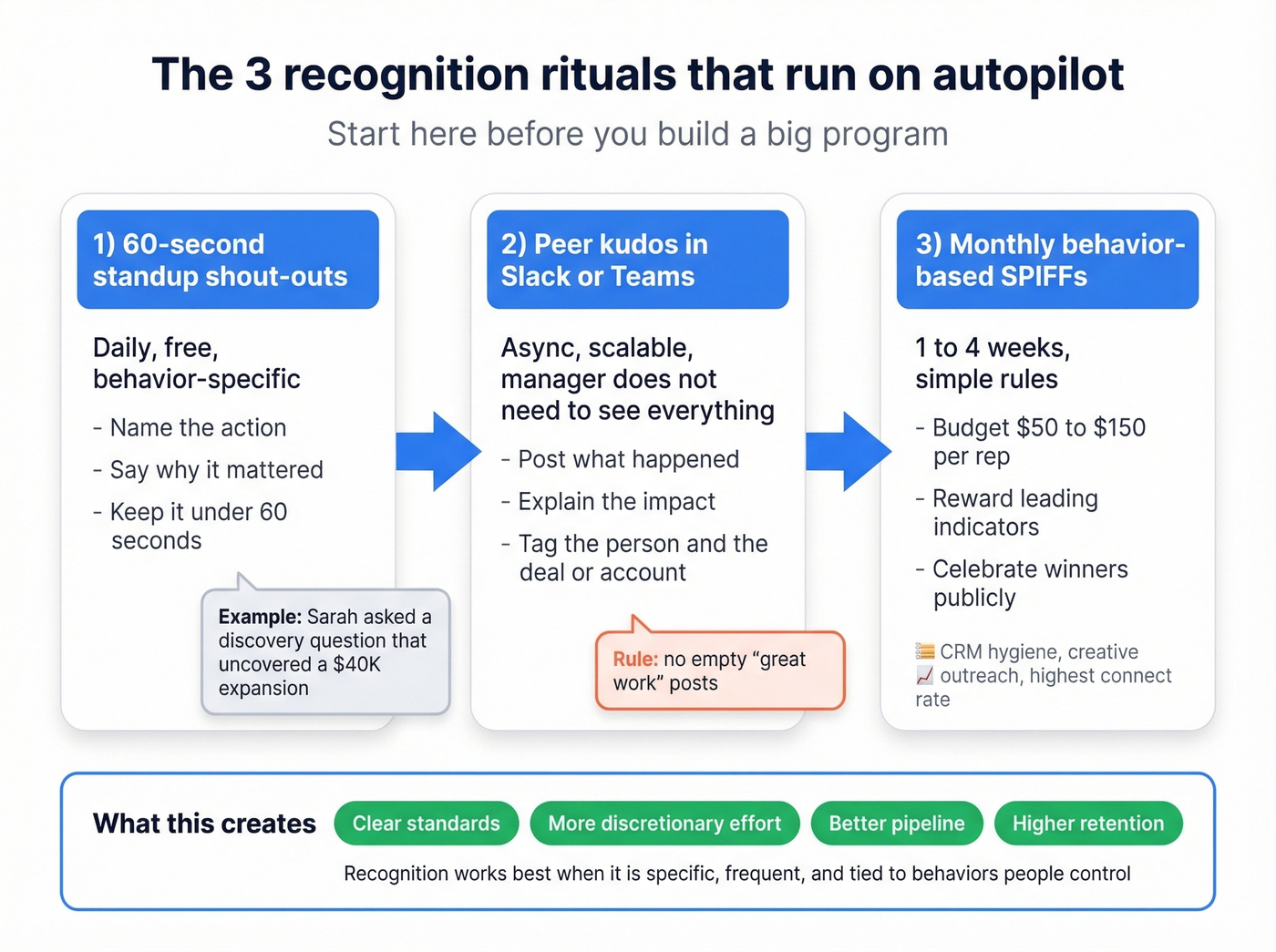
60-second standup shout-outs. Free, daily, behavior-specific. At the start of every team standup, one person calls out something specific a colleague did well yesterday. Not "nice job" - more like "Sarah asked the best discovery question I've heard this month and it uncovered a $40K expansion."
Peer kudos channel in Slack or Teams. Free, async, scalable. Set norms: every kudos must include what happened and why it mattered. No empty "great work!" posts. This is the easiest way to celebrate sales wins across the entire org without waiting for a formal ceremony.
Monthly behavior-based SPIFFs. Budget $50-$150 per rep. Tie them to specific actions - best CRM hygiene, most creative outreach, highest connect rate - not just quota attainment. Run them for 1-4 weeks, keep rules simple, celebrate winners publicly.
Implement those three this week. Read the rest when you're ready to build a full program.
Why Recognition Drives Sales Performance
A Great Place to Work survey analyzing 1.3 million responses representing 8.4 million U.S. employees found that when everyone has an opportunity to receive special recognition, employees are 2x more likely to say promotions are fair, 60% more likely to feel paid fairly, 60% more likely to give extra effort, and 40% more likely to participate in innovation. Those aren't soft metrics - that's discretionary effort translating directly into pipeline.
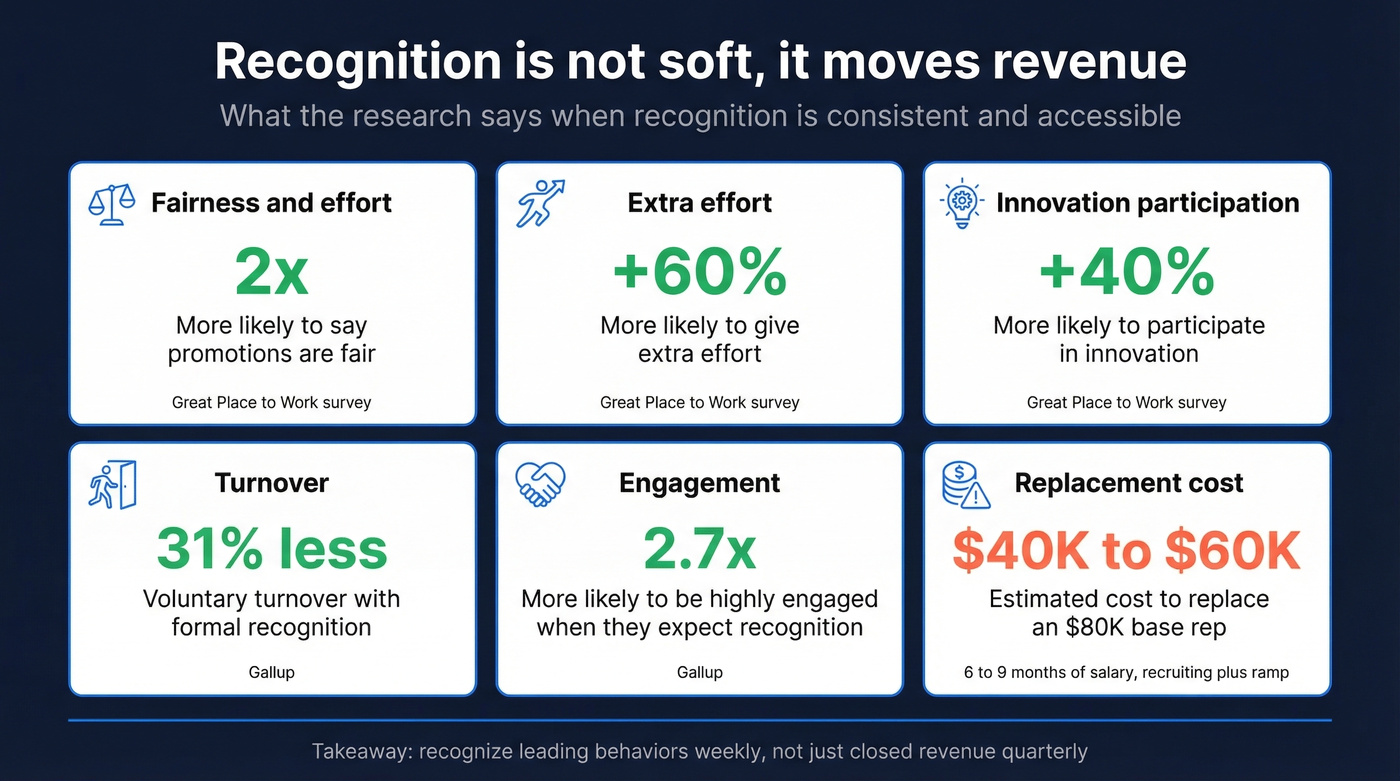
The business case gets sharper when you look at retention. Organizations with formal recognition programs see 31% less voluntary turnover and are 12x more likely to have strong business outcomes. When employees believe they'll be recognized, they're 2.7x more likely to be highly engaged.
Now consider what it costs to replace a sales rep: roughly 6-9 months of salary when you factor in recruiting, onboarding, ramp time, and lost pipeline coverage. For a rep earning $80K base, that's $40-60K walking out the door. A BHN/NAPCO Research report puts it plainly: 90% of employees say recognition matters, and 83% say it improves productivity and loyalty. The math isn't complicated.
Recognition vs. Rewards
These terms get used interchangeably. They shouldn't.
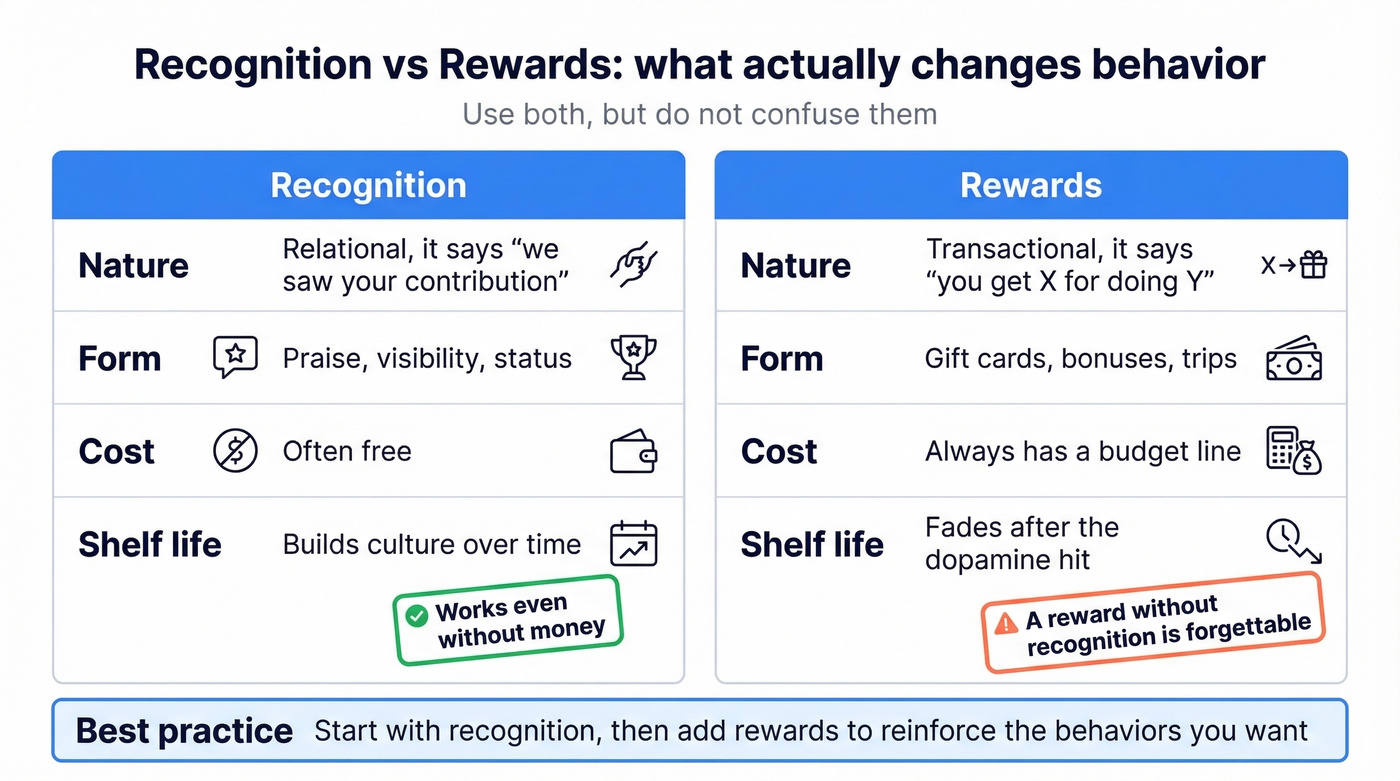
| Recognition | Rewards | |
|---|---|---|
| Nature | Relational | Transactional |
| Form | Praise, visibility, status | Gift cards, bonuses, trips |
| Cost | Often free | Always has a budget line |
| Shelf life | Builds culture over time | Fades after the dopamine hit |
A reward without recognition is forgettable - it's a direct deposit that blends into the next paycheck. Recognition without a reward still works, because it signals that someone's contribution was seen and valued.
The best programs combine both. But if you're starting from zero, start with recognition. It costs nothing and compounds.
25+ Ideas to Recognize Your Sales Team
Behavior-Based Recognition
Here's the thing: this is where most programs fall short. Instead of only celebrating closed deals, recognize the behaviors that lead to deals. Award the rep who asks the best discovery questions each week. Spotlight whoever maintains the cleanest CRM data - pipeline accuracy saves everyone time.
Recognize multi-threading: the AE who maps three stakeholders before the first proposal. Give a "Best Handoff" award to the SDR who writes the most thorough meeting briefs. These behaviors are leading indicators. Recognizing them tells your team what "good" actually looks like beyond the number, and consistent positive feedback around these habits reinforces the daily actions that compound into quota attainment over months and quarters.
Outcome-Based Recognition
Quota attainment still matters - don't abandon it. But layer in milestones beyond "hit your number." Celebrate first new logo of the quarter, largest deal size, fastest sales cycle, or biggest comeback (a deal marked dead that came back). Outcome recognition works best paired with behavior recognition, so reps understand the full picture.
Peer-to-Peer Recognition
Managers can't see everything. BHN's research shows 77% of employees want the ability to recognize their peers. A dedicated kudos channel in Slack or Teams is the simplest implementation - set the norm that every post includes what happened and why it mattered.
Try a pass-the-praise chain: each person who receives kudos nominates the next recipient, so recognition doesn't bottleneck at managers. Peer nominations for monthly awards add a democratic layer that managers alone can't replicate. Atlassian's Kudos program tags recognition to company values, which makes the praise specific and reinforces culture at the same time.
Team and Cross-Functional Recognition
Modern B2B deals involve 6-10 decision-makers, which means they involve multiple internal roles too. Pod awards recognize the SDR + AE + SE trio that worked a deal together. Deal-team shout-outs at all-hands meetings make the invisible work visible - the SE who built the custom demo, the CSM who provided a reference, the marketing manager who sourced the lead.
Recognition that only flows to the closer creates resentment in everyone who helped close.
Remote and Hybrid Recognition
Remote workers show higher engagement but greater distress, according to Gallup research. Recognition rituals bridge that gap, but they need to be async-first.
A weekly wins roundup works well: collect highlights in a shared doc throughout the week, then post one tidy summary every Friday. Manager thank-you DMs - specific, not generic - take 30 seconds and land harder than you'd expect. A "behind-the-scenes hero" spotlight surfaces work that's invisible in remote settings and prevents recognition from becoming a popularity contest.
Low-Cost and No-Cost Ideas
The 60-second recognition moment is the single highest-ROI ritual we've seen on sales teams. At the start of every standup, one person spots a colleague doing great work. It takes a minute, costs nothing, and builds a habit of noticing.
Handwritten notes from a VP or director carry surprising weight - the physical artifact sits on a desk for months. Customer feedback spotlights, where you share a positive customer quote and attribute it to the rep who earned it, connect recognition to real impact. At Conrad DC (a Hilton property), the top housekeepers with the highest customer satisfaction scores are recognized as the "Court of Cleanliness" - proof that creative naming works in any industry.
Experience-Based SPIFFs
Short-term SPIFFs work best when they're 1-4 weeks long, goal-specific, and promoted actively via email, Slack, and dashboards. Non-cash options include team dinners, event tickets, extra PTO, or premium merchandise. Gen Z and Millennial reps often prefer experiences over material rewards, so offering choice matters.
Budget planning range: allocate around 1-3% of a rep's OTE for quarterly recognition spend. A $100 SPIFF for "most CRM entries in a week" or "highest connect rate this sprint" drives specific behaviors without requiring executive budget approval.
Creative Award Names
Rename your awards to reflect the behaviors you want:
- Pipeline Builder - most new qualified opportunities created
- Discovery Champion - best discovery questions, peer-voted
- CRM MVP - cleanest data, best notes, fewest stale records
- Comeback King/Queen - resurrected a dead deal
- Team Assist Award - best cross-functional collaboration
- Cold Call Closer - best cold call connect rate
- The Architect - most multi-threaded deal
- The Mentor - most helpful to new reps, peer-nominated

Want more behaviors worth recognizing? When your reps work with 98% accurate emails and 30% mobile pickup rates, they generate the pipeline wins that fuel your recognition program. Prospeo gives every SDR and AE data that turns outreach into meetings worth celebrating.
Give your team data that earns the shout-out.
Role-Specific Recognition Programs
One-size-fits-all recognition ignores the reality that SDRs, AEs, SEs, and CSMs do fundamentally different work. We've watched teams try a single awards track and end up rewarding the same three closers every quarter while everyone else checks out. Split incentives and role-specific design fix that.
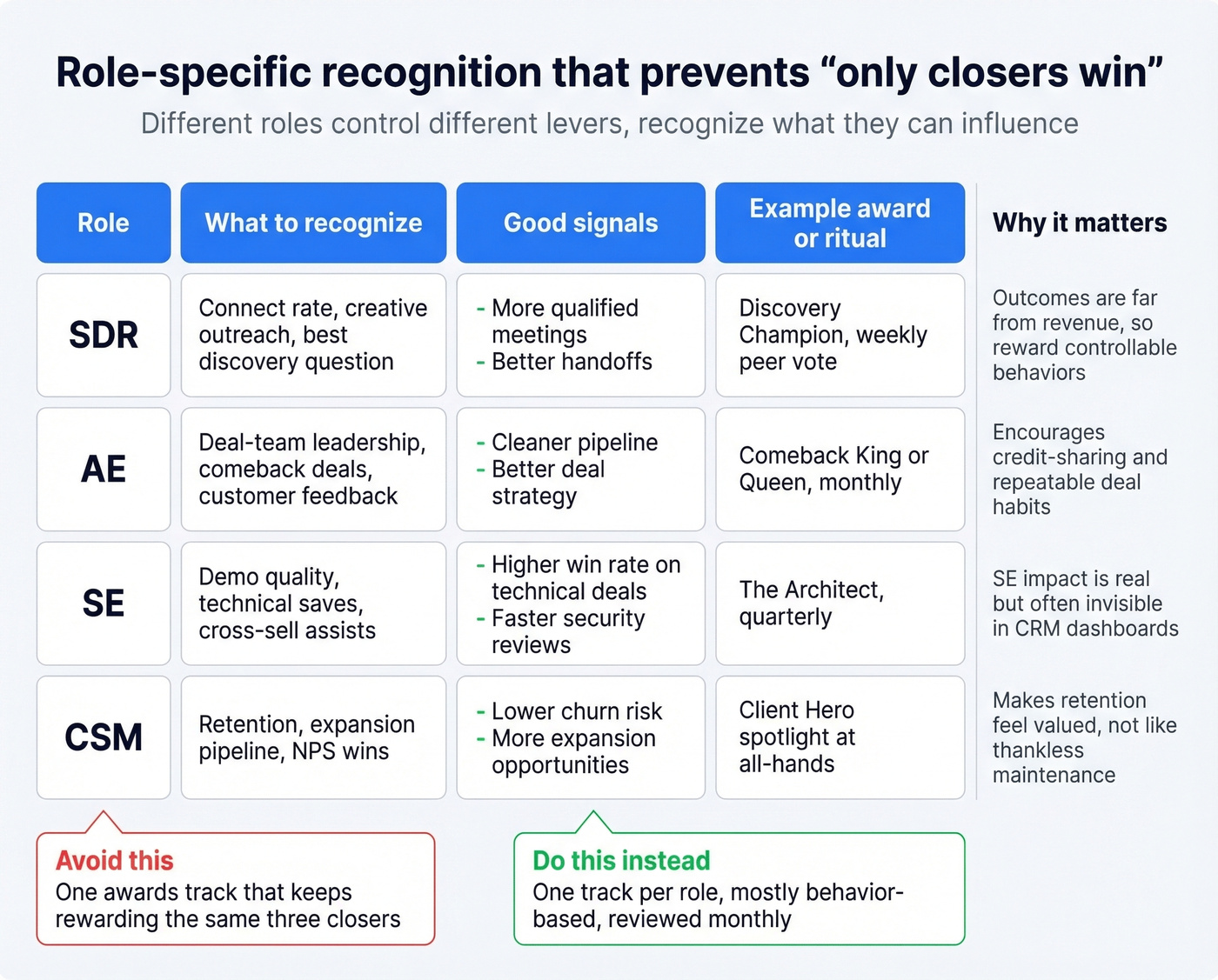
| Role | What to Recognize | Example Award/Ritual |
|---|---|---|
| SDR | Connect rate, creative outreach, best discovery question | "Discovery Champion" weekly vote |
| AE | Deal-team leadership, comeback deals, client feedback | "Comeback King/Queen" monthly |
| SE | Demo quality, technical saves, cross-sell assists | "The Architect" quarterly |
| CSM | Retention rate, expansion pipeline, NPS wins | "Client Hero" spotlight at all-hands |
SDRs need activity-based recognition because their outcomes are further from revenue. AEs need deal-team acknowledgment so they share credit. SEs need visibility because their work is often invisible in CRM dashboards. CSMs need expansion recognition so retention doesn't feel like thankless maintenance.
If your recognition program only has one track, make it behavior-based, not outcome-based. Outcomes reward luck and territory assignment as much as skill. Behaviors reward the things reps actually control - and they're the leading indicators that predict outcomes anyway.
Recognition That Backfires
Bad recognition is worse than no recognition. Three anti-patterns we see constantly.
The President's Club tax trap. A $10K trip to Cabo sounds amazing until it shows up on your W-2 as taxable income. For many reps, that means a surprise tax bill of a few thousand dollars. A thread on r/sales flags this regularly - reps call it a "gift with strings attached." Add in time away from territory, family disruption, and "mandatory fun" dynamics, and the reward can feel like a punishment. The fix: offer choice. Cash equivalent, trip, or a tax gross-up so the rep doesn't eat the bill.
Leaderboard toxicity. Public leaderboards reward the top 10% and demoralize the other 90%. If your recognition program only celebrates closers, you're telling most of your team that their work doesn't matter. Rotate what the leaderboard tracks - activity metrics one month, deal quality the next, CRM hygiene the month after.
Performative praise. The "great job team!" email after a tough quarter fools no one. Generic recognition erodes trust faster than silence does. Every piece of recognition should answer two questions: what did this person do, and why did it matter?
There's also a recognition gap most managers miss entirely. Deloitte research shows managers consistently overestimate how recognized their teams feel. What managers think reps want (cash bonuses, promotions) often diverges from what reps actually want (specific praise, career visibility, peer respect). Ask your team. You'll be surprised.
How to Keep Recognition Fair
Fairness is the difference between a recognition program that builds culture and one that breeds cynicism.
The GPTW data is unambiguous: when everyone has an opportunity to receive recognition - not just top performers - perceptions of fairness and effort both spike. Universal access is the foundation. Everything else is implementation detail.
A quick checklist for that implementation:
- Publish explicit rubrics with scoring ranges so everyone knows the criteria before nominations open
- Use multi-phase review - screening, scoring, then deliberation - to reduce single-reviewer bias
- Blind nominations where possible, removing names and territories during initial scoring
- Diverse judging panels that include peers, not just managers
- Require comments with every score to create an audit trail and force thoughtful evaluation
Only 35% of employees receive recognition monthly or weekly, and half want more. Build a cadence pyramid: daily micro-recognition through standup shout-outs, weekly peer kudos, monthly SPIFFs, quarterly formal awards. Frequency matters more than magnitude. The goal is to celebrate wins at every level so recognition doesn't feel like a once-a-year event reserved for the top three closers on the board.
Give Your Reps Something Worth Recognizing
Recognition programs treat the symptom. Clean data treats the cause.
A rep can't earn "Pipeline Builder of the Month" if 20%+ of their emails bounce and half their dials hit dead numbers. I've seen teams pour energy into recognition while their reps fight bad data every morning - handing out trophies while the team runs in broken shoes.
Prospeo fixes this at the source. With 300M+ professional profiles, 98% email accuracy, a 7-day data refresh cycle, and 125M+ verified mobile numbers hitting a 30% pickup rate, reps spend time selling instead of hunting for valid contacts. GreyScout's results tell the story: bounce rate dropped from 38% to under 4%, pipeline jumped 140%, and rep ramp time was cut from 8-10 weeks to 4. When reps have clean data, they generate wins. When they generate wins, you have something real to recognize.

You can't recognize connect rates and qualified meetings if your team is burning hours on bad data. Prospeo's 143M+ verified emails and 125M+ direct dials mean your reps spend less time chasing bounces and more time earning peer kudos for real pipeline created.
Replace bad data with behaviors worth celebrating.
FAQ
How often should you recognize your sales team?
Daily micro-recognition through standup shout-outs, weekly peer kudos in Slack or Teams, monthly behavior-based SPIFFs, and quarterly formal awards. Only 35% of employees get recognition monthly or more - and half want more than they're getting. Frequency beats magnitude every time.
What's a good budget for sales incentives and awards?
Plan for $25-$150 per rep per month, or roughly 1-3% of each rep's OTE for quarterly recognition spend. Low-cost rituals like standup shout-outs and peer kudos channels cost nothing and often outperform expensive annual events. SPIFFs in the $50-$150 range drive specific behaviors without requiring executive budget approval.
What's the difference between positive feedback and formal recognition?
Positive feedback - a specific comment after a call, a DM noting a smart objection handle - is informal and immediate. Formal recognition involves structured programs like SPIFFs, awards, and public ceremonies. Both matter, but daily positive feedback builds the foundation that makes formal programs feel authentic rather than performative.
How do you make sure recognition doesn't just go to top performers?
Rotate what you measure. Track activity metrics one month, deal quality the next, CRM hygiene the month after. Use blind nominations, peer voting, and role-specific tracks so SDRs aren't competing against AEs for the same award. When the criteria change regularly and everyone's eligible, recognition stops being a popularity contest.