

Sales Tech Consolidation: The Practitioner's Playbook for 2026
Finance is asking why you're spending around $187/rep/month on sales tools when reps lose 40% of their productivity to context switching between them. That's the tension driving every sales tech consolidation conversation right now - and it's only getting worse.
Here's a 90-day framework that works, starting with the step most guides get wrong.
The Frankenstack Problem
73% of sales teams report tool overlap wasting $2,340/rep/year. For a 20-rep team, that's $46,800 in pure waste before you count the admin hours and integration duct tape.
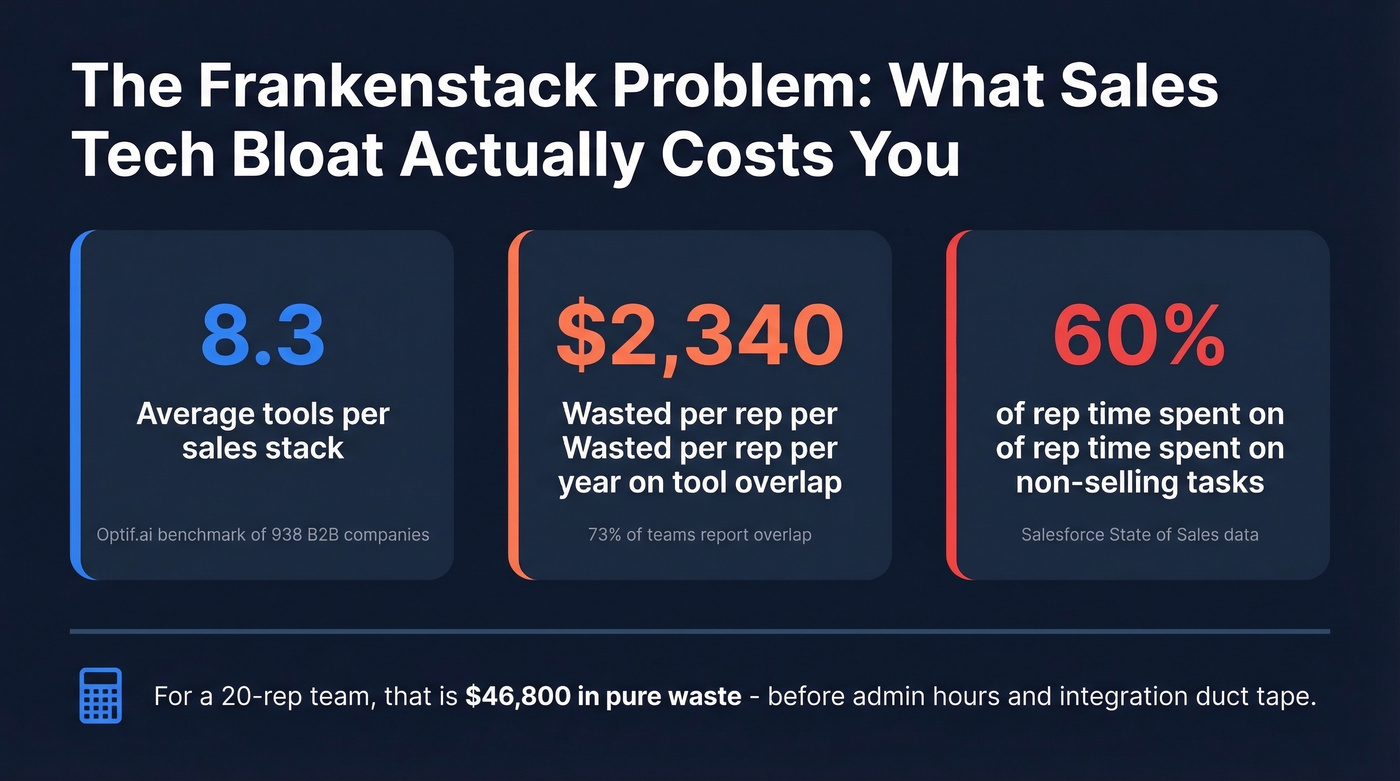
An Optif.ai benchmark of 938 B2B companies found the average stack runs 8.3 tools at $187/rep/month - and founders talk about "Frankenstacks" ballooning past 20+ tools before anyone notices. We've seen it firsthand. One team we spoke with had three separate enrichment providers, two email verification services, and a phone data tool they'd forgotten they were paying for. Nobody could explain why.
The real cost isn't licenses. It's fragmentation. Same customer and contact data living in five systems with conflicting job titles. Reps toggling between tabs instead of making calls. Salesforce's data shows reps spend 60% of their time on non-selling tasks, and a Frankenstack is a big reason why. You didn't buy bad tools. You bought too many decent ones.
Why Consolidation Is Urgent in 2026
Tech budgets are climbing from 8% of revenue to 14%, per Deloitte's survey, with 74% of organizations pouring money into AI and generative AI. That money has to come from somewhere, and bloated sales stacks are the obvious target.
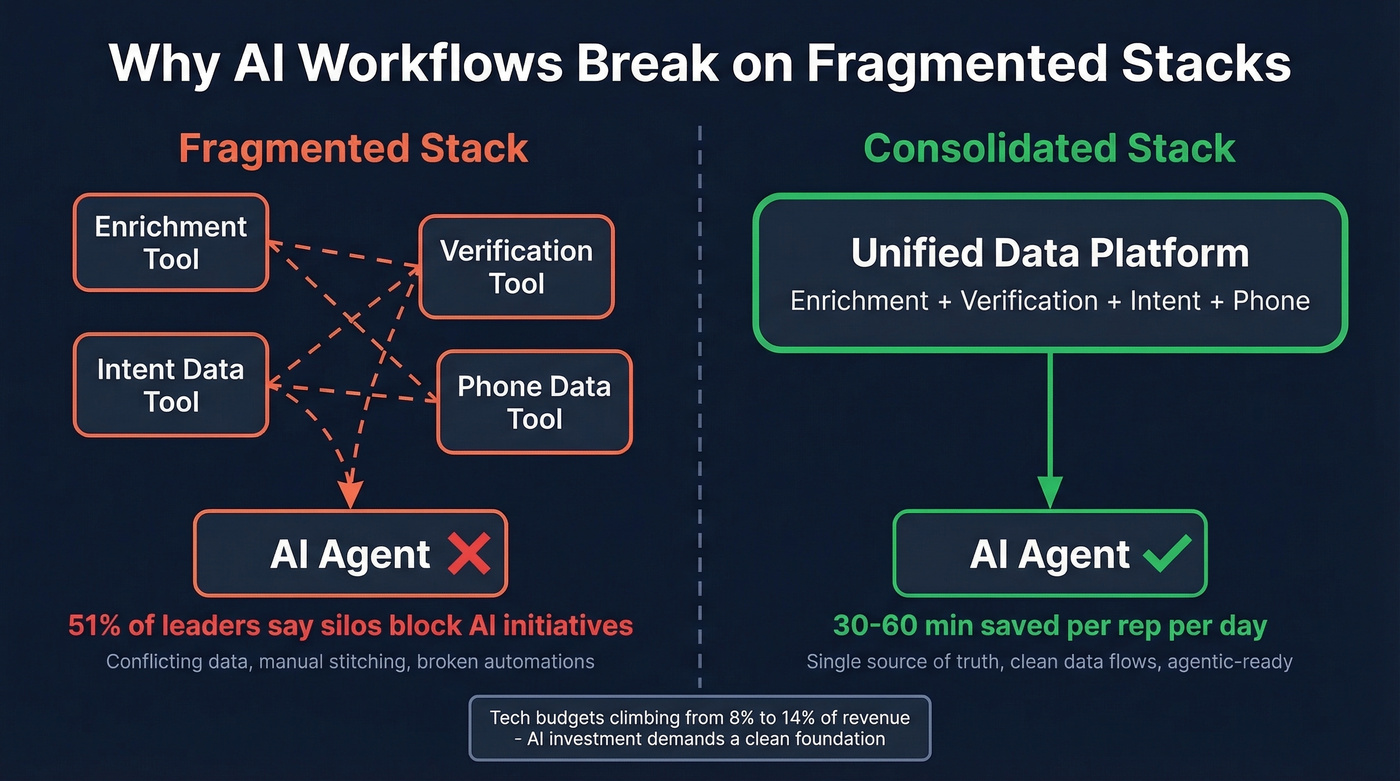
But the deeper urgency is AI readiness. 51% of sales leaders say tech silos delay or block their AI initiatives. Agentic AI workflows break down fast when your stack is fragmented - they need a unified data model and a single source of truth to work reliably across systems. If your enrichment data lives in one tool, your verification in another, and your intent signals in a third, you're forcing humans or brittle automations to stitch it together. That's not a workflow. That's a prayer.
In a 2026 CRO survey of 26 senior revenue leaders, early adopters report saving 30-60 minutes per rep per day with AI-assisted workflows - but only when the underlying stack is consolidated enough to support them. Marketing tech consolidation follows the same logic. When sales and marketing tools share a unified data layer, GTM consolidation becomes possible across the entire revenue org.
The 90-Day Consolidation Playbook
Most consolidation projects fail because they try to boil the ocean. A phased approach keeps scope manageable and delivers measurable wins at each stage.
Weeks 1-2: Inventory and Map
Catalog every tool your revenue team touches - not just what's in procurement, but the shadow subscriptions, the "free" Chrome extensions, the Zapier automations nobody documented. For each tool, capture the owner, annual cost, renewal date, features actually used versus purchased, and integration dependencies.
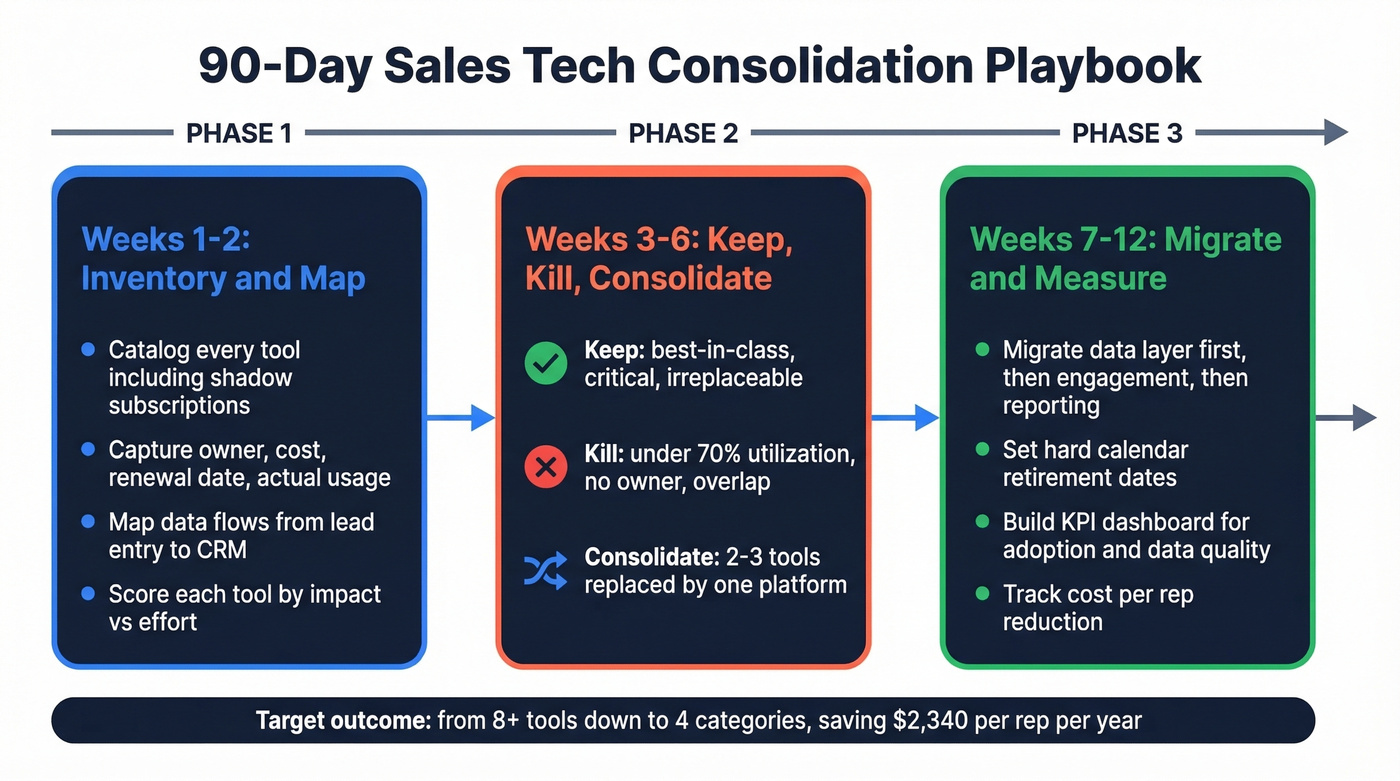
Then map your data flows. Where does a new lead enter? How does it move from enrichment to CRM to sequencer? Where do duplicates spawn? Score each tool by impact versus effort - that scoring becomes your decision engine in the next phase. This inventory step is where most revenue tech stack rationalization efforts either gain momentum or stall out. Don't rush it.
Weeks 3-6: Keep, Kill, Consolidate
Sort every tool into three buckets.
- Keep tools that are genuinely best-in-class for a critical workflow and can't be replicated.
- Kill anything with low license utilization (below ~70%), overlapping functionality with a kept tool, or no clear owner.
- Consolidate where two or three tools can be replaced by one platform covering the same ground - this is where tool consolidation delivers the fastest ROI.
Use this equation to quantify each decision:
Consolidation Value = economies of scale + (marginal rep quota attainment x total reps) + (marginal RevOps seat efficiency x total RevOps seats)
Don't just count license savings. Count admin hours, integration maintenance, and onboarding drag - the total cost of ownership.
Weeks 7-12: Migrate and Measure
Execute migrations in order of impact: data layer first, then engagement tools, then reporting. Set specific retirement dates for killed tools - not "sometime next quarter," but calendar dates with hard cutoffs. Build a KPI dashboard tracking adoption rates, data quality scores, and cost per rep.
Here's the thing: if your average deal size is under $10k, you almost certainly don't need a $30k/year data provider. Stack rationalization isn't about buying the most powerful tools. It's about right-sizing your spend to your deal economics.

Three enrichment vendors, three contracts, three data models - that's the Frankenstack tax. Prospeo replaces them all: 300M+ profiles, 98% email accuracy, 125M+ verified mobiles, and intent data across 15,000 topics. One platform, 7-day data refresh, roughly $0.01/lead.
Kill three line items and get better data from one.
Start With Your Data Layer
Most consolidation guides say start with your CRM. They're wrong.
Your CRM is the system of record - it stays. The real waste lives in the constellation of enrichment, verification, and intent tools orbiting around it. Revenue technology consolidation starts by collapsing these overlapping data providers into a single source of truth.
We've seen teams running ZoomInfo for enrichment at $15-40k/year, a separate email verification service, and a standalone phone data provider. Three contracts, three logins, three data models, conflicting information on the same contacts. It's maddening, and it's common.

Prospeo collapses all three into one platform: 300M+ professional profiles, 143M+ verified emails with 98% accuracy, and 125M+ verified mobile numbers, refreshed on a 7-day cycle versus the 6-week industry average. Intent data covers 15,000 topics via Bombora. At roughly $0.01/lead, you're looking at a fraction of what a ZoomInfo contract costs - and meaningfully better email accuracy than Apollo's 79%.
Meritt switched and saw their bounce rate drop from 35% to under 4% while tripling pipeline. One accurate source beats three mediocre ones. Every downstream tool - your sequencer, your CRM workflows, your AI agents - inherits whatever data quality you feed it. Start here.
When Consolidation Projects Fail
The consensus on r/salesengineers is blunt: consolidation projects "start with enthusiasm and end with more chaos" when the suite you consolidate onto is decent at most things but falls apart for one critical workflow. Practitioners also flag migration overwhelm as the #1 blocker for SMBs - the sheer dread of moving 10-15 tools keeps teams stuck in expensive sprawl.
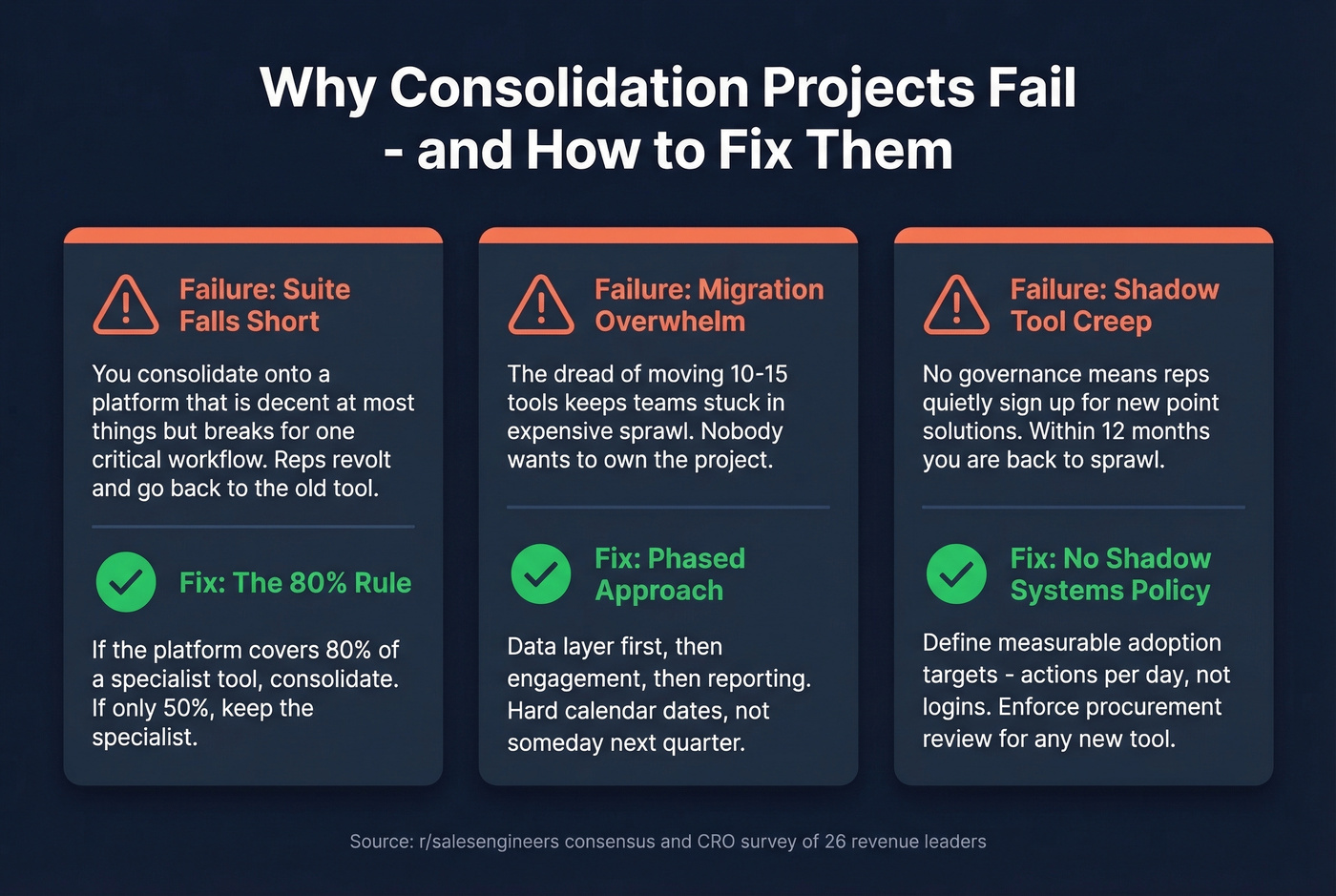
The fix is governance, not optimism.
Enforce a "no shadow systems" policy. Define adoption targets that are measurable - actions per day, not logins. And follow the 80% rule: if a consolidated platform covers 80% of a specialized tool's functionality, that's good enough. If it covers 50%, keep the specialist. Platform consolidation attempted without governance is a 12-month detour back to sprawl.
Consolidated Stack vs. Best-of-Breed
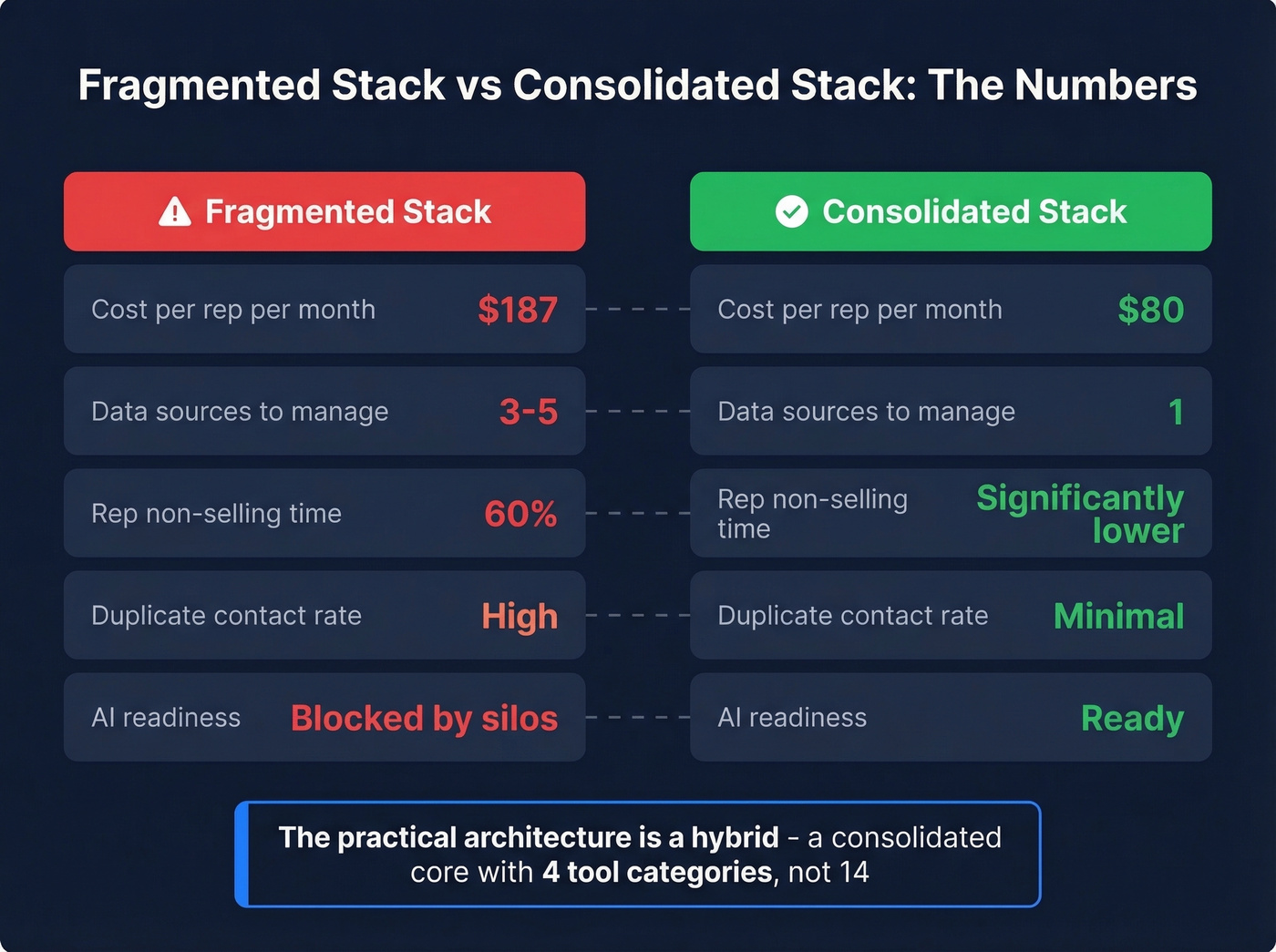
Pure consolidation is a myth for most teams. The practical architecture is a hybrid - a consolidated core with specialized tools where they're genuinely needed. Let's break down the recommended stack for most mid-market teams:
- CRM (Salesforce, HubSpot) - system of record, stays
- Consolidated data layer - enrichment + verification + intent in one platform
- Single engagement platform (Outreach or Salesloft, ~$100-150/user/month) - pick one, kill the other
- Standalone conversation intelligence (Gong, ~$100-150/user/month) - nobody does this well as a feature inside a suite
Four categories, not fourteen. That's what revtech consolidation looks like in practice - fewer contracts, cleaner data, and a revenue platform strategy that actually holds up over time.
For enterprise teams with a data warehouse, there's a third path worth knowing: warehouse-native architecture where Snowflake or BigQuery becomes the single source of truth, with reverse ETL pushing modeled data into your CRM. It's a bigger project, but it future-proofs your stack for agentic AI workflows and gives you true data sovereignty.
| Metric | Fragmented Stack | Consolidated Stack |
|---|---|---|
| Cost per rep/month | ~$187 | ~$80 |
| Data sources to manage | 3-5 | 1 |
| Rep non-selling time | 60% | Significantly lower |
| Duplicate contact rate | High | Minimal |
| AI-readiness | Blocked by silos | Ready |
Skip the consolidated stack approach if your team is under five reps and only uses three tools total. At that scale, the migration cost outweighs the savings. Focus on data quality instead and consolidate when you grow into the problem.
Meritt consolidated their data layer onto Prospeo and tripled pipeline while dropping bounce rates from 35% to under 4%. When your enrichment, verification, and intent signals live in one platform, every downstream tool - sequencers, CRM workflows, AI agents - inherits clean data automatically.
One accurate data source beats three mediocre ones. See for yourself.
FAQ
How much does consolidation typically save?
Teams waste $2,340/rep/year on tool overlap alone. Consolidation commonly drives 30-40% reductions in total cost of ownership. Using the Optif.ai benchmark of $187/rep/month, a 20-rep team can cut roughly $13k-$18k/year in license costs - before you add back RevOps time, integration maintenance, and onboarding drag.
What tools should you consolidate first?
Start with your data layer - enrichment, verification, and intent. Every downstream tool inherits your data quality, so consolidating here has the highest multiplier effect. Replacing three separate contracts with a single platform at roughly $0.01/lead with 98% email accuracy and a 7-day refresh cycle is the fastest win most teams can make.
Can you consolidate without replacing your CRM?
Yes. Your CRM stays as the system of record. Consolidation targets the tools orbiting it: enrichment providers, verification services, intent platforms, and redundant engagement tools. A well-executed project trims the periphery while strengthening the core - most teams land on four tool categories instead of fourteen.