

Sales Territories: How to Design, Balance, and Execute Them in 2026
A RevOps lead we know inherited a territory map last quarter - a 47-tab spreadsheet held together by VLOOKUP formulas and one senior rep's memory of "who owns what." Within two weeks of a reorg, three reps were working the same accounts and the top performer quit over a territory she called "a graveyard." That spreadsheet cost the company a $180k OTE rep and six months of pipeline velocity momentum.
The VP of Sales just told you to split sales territories. Or rebalance them. Or "figure out why the West Coast team is crushing it and the Midwest isn't." Whatever the trigger, you're here because your current approach - Excel, tribal knowledge, maybe a CRM field nobody trusts - isn't cutting it anymore.
What You Need (Quick Version)
Territory design isn't the hard part. Execution is. You need three things: a scoring model that balances fit and engagement (not just geography), a workload formula that keeps territories within ±10% of each other, and clean contact data so reps can actually reach the people in their assigned segment.
What Is a Sales Territory?
A sales territory is a defined segment of your market assigned to a specific rep or team. That's the textbook definition. The practical answer is broader: territories are how you distribute opportunity, workload, and accountability across your sales org.
Modern territories go well beyond geography. You can carve them by industry vertical, account size, product line, named accounts, or even intent signals. The best teams combine multiple dimensions - a rep might own mid-market fintech accounts in the Northeast, not just "the Northeast." The model you choose shapes everything downstream: quota setting, comp plans, hiring, and ultimately whether reps feel the game is fair.
Why Territory Alignment Drives Revenue
The numbers make the case. Effective territory realignment can increase revenue by 2-7% without adding headcount. The Alexander Group pegs productivity gains at 10-20%, and some industry benchmarks cite up to 30% higher sales performance for optimized territories.
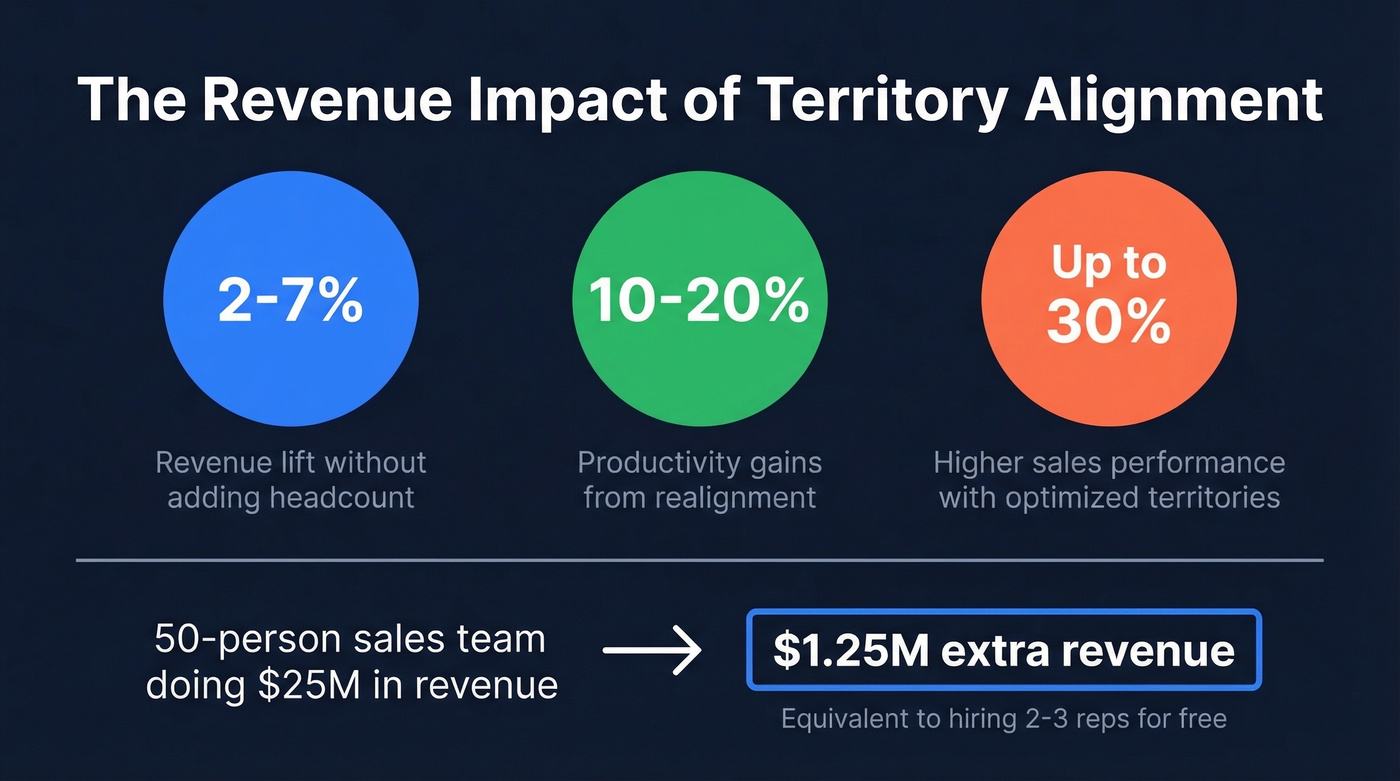
On a 50-person sales team doing $25M in revenue, a 5% lift from better territory alignment is $1.25M - the equivalent of hiring 2-3 reps for free. You don't have to ramp them, manage them, or pay their OTE.
The flip side is equally real. Unbalanced territories create friction and inconsistent results. Reps in thin territories disengage. Reps in overloaded territories burn out. Both scenarios tank retention and forecast accuracy. Beyond the revenue impact, well-designed territories also improve customer experience - accounts get consistent attention from a single owner instead of being bounced between reps who each think someone else is handling the relationship.
Choosing the Right Territory Model
Geography-only is a relic for most SaaS teams. It made sense when reps drove to meetings. It doesn't make sense when your ICP spans three continents and deal size varies 10x within the same zip code.
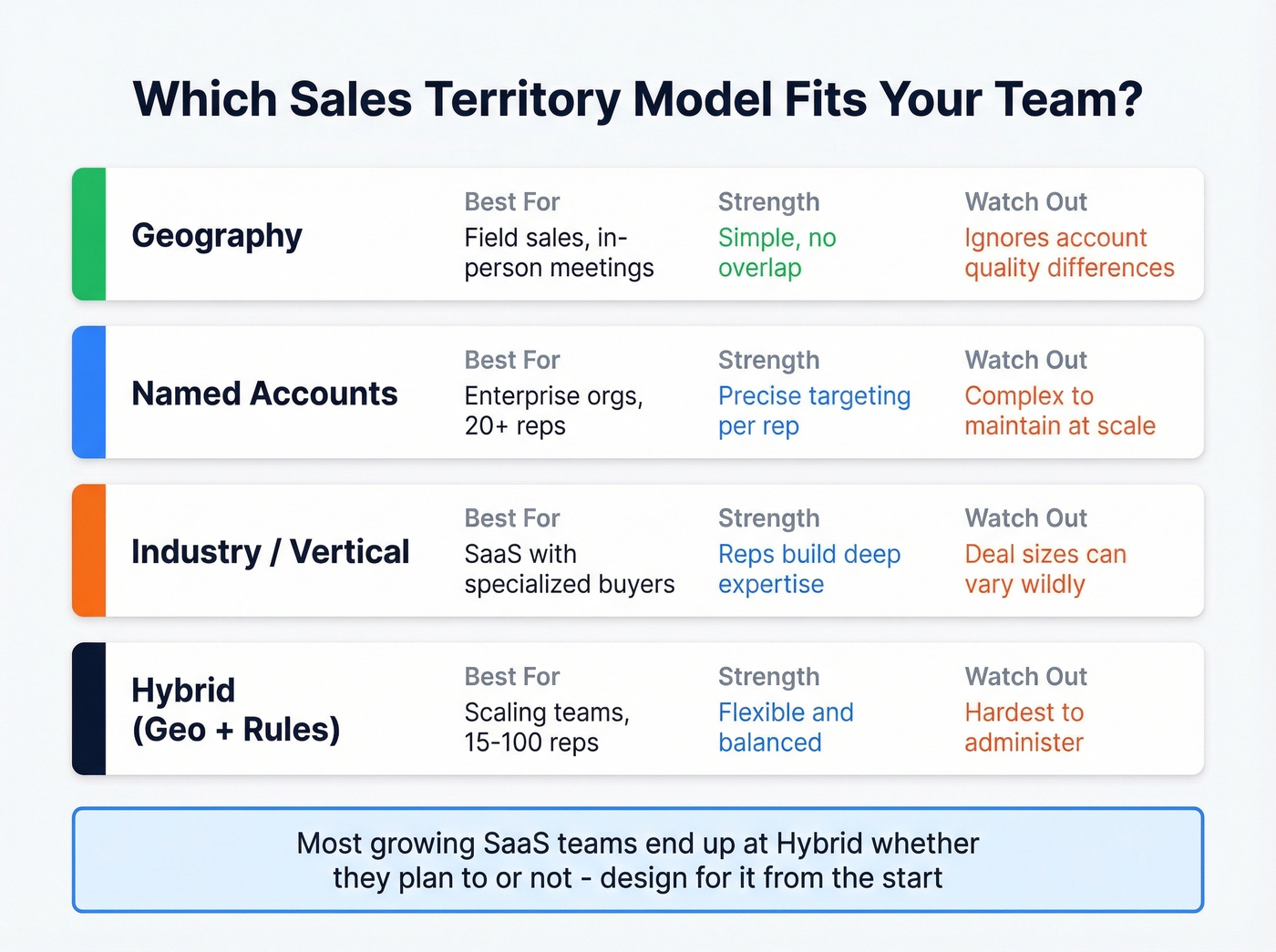
The Alexander Group breaks territory alignment into three methodologies: geography-based, account-based, and hybrid. Your choice hinges on three factors: GTM strategy (inbound-led vs. outbound-heavy), role structure (generalists vs. specialists), and tech capabilities (can your stack support multi-dimensional routing?).
| Model | Best For | Pros | Cons |
|---|---|---|---|
| Geography | Field sales, in-person | Simple, no overlap | Ignores account quality |
| Named Accounts | Enterprise, 20+ reps | Precise targeting | Complex to maintain |
| Industry/Vertical | SaaS, specialized | Deep expertise | Uneven deal sizes |
| Hybrid (geo + rules) | Scaling teams | Flexible, balanced | Hardest to administer |
Most growing teams end up at hybrid whether they plan to or not. You start with geography, then carve out a few strategic accounts, then add vertical specialization for your biggest segment - and suddenly you're running a hybrid model on a spreadsheet that wasn't built for it. Better to design for hybrid from the start and keep the rules clean.
How to Design Sales Territories
The process isn't complicated. The discipline to follow it is.
- Define objectives. Revenue targets, coverage goals, headcount constraints. Write them down before touching any data.
- Analyze your data. Pull account-level revenue, pipeline, win rates, and activity metrics. If your CRM data is messy, fix it first - garbage in, garbage out.
- Segment accounts. Group by the dimensions that matter: size, industry, geography, product fit, intent signals.
- Assign territories. Map segments to reps based on capacity, expertise, and strategic priority.
- Balance workload. This is where most teams fail. Use effort-weighted workload - not raw account count. A territory with 200 SMB accounts and one with 40 enterprise accounts might require identical effort.
- Set metrics. Define what "working" looks like: quota attainment, coverage percentage, activity levels, pipeline velocity.
- Monitor continuously. Build a quarterly review cadence from day one.
The Workload Formula
The core concept is straightforward:
Workload = (Current accounts x average time to service) + (Prospects x time to convert a prospect into an active account)
In practice, most RevOps teams translate that into a scoring model:
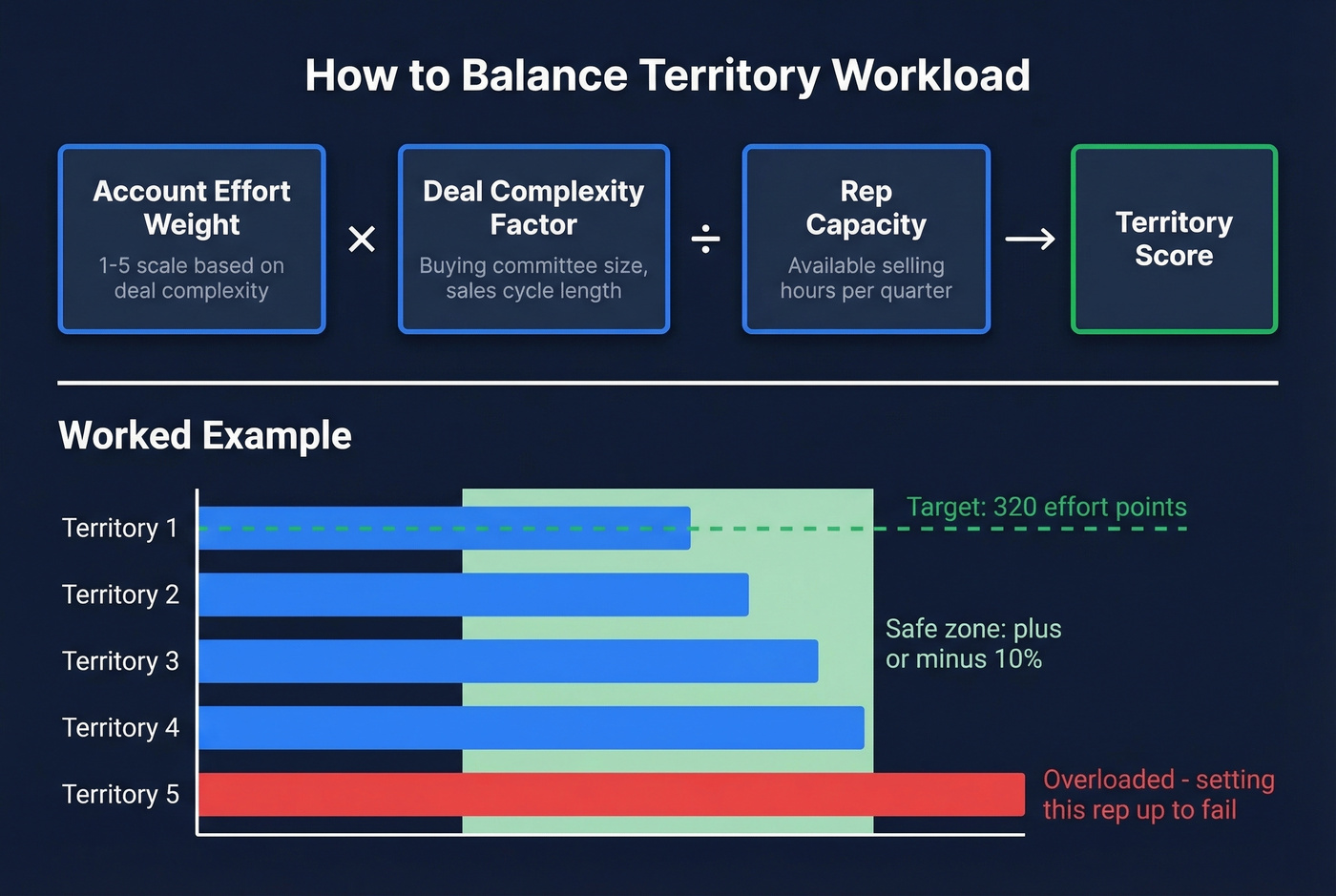
Territory Score = Sum of (Account Effort Weight x Deal Complexity Factor) / Rep Capacity
Target: each territory within ±10% of the team average.
Here's a worked example. Say you have 10 reps and 1,000 accounts scored on effort using a 1-5 scale based on deal complexity, buying committee size, and sales cycle length. Total effort points come to 3,200, so the target per rep is 320 ±10% - meaning each territory should land between 288 and 352 effort points. If a territory hits 400, you're setting that rep up to fail.
The anti-pattern we see constantly: teams treat territory planning as an annual fire drill. They stitch together disconnected datasets manually, sacrifice analytical rigor to hit a deadline, and ship a plan that's already stale. When your data and tools are disconnected, territory planning becomes a "get it out the door" exercise instead of a strategic advantage.
If you want a pre-built starting point, HelloGrowth's territory planning template includes scoring formulas and gap analysis views you can set up in under an hour.

Your territory plan is only as good as the contact data inside it. Prospeo gives reps verified emails (98% accuracy) and 125M+ direct dials so every assigned account is actually reachable - not a name on a spreadsheet nobody can contact.
Stop designing territories around data your reps can't use.
Prioritizing Accounts Inside a Territory
Once a rep has their territory, the next question is: which accounts do I work first?
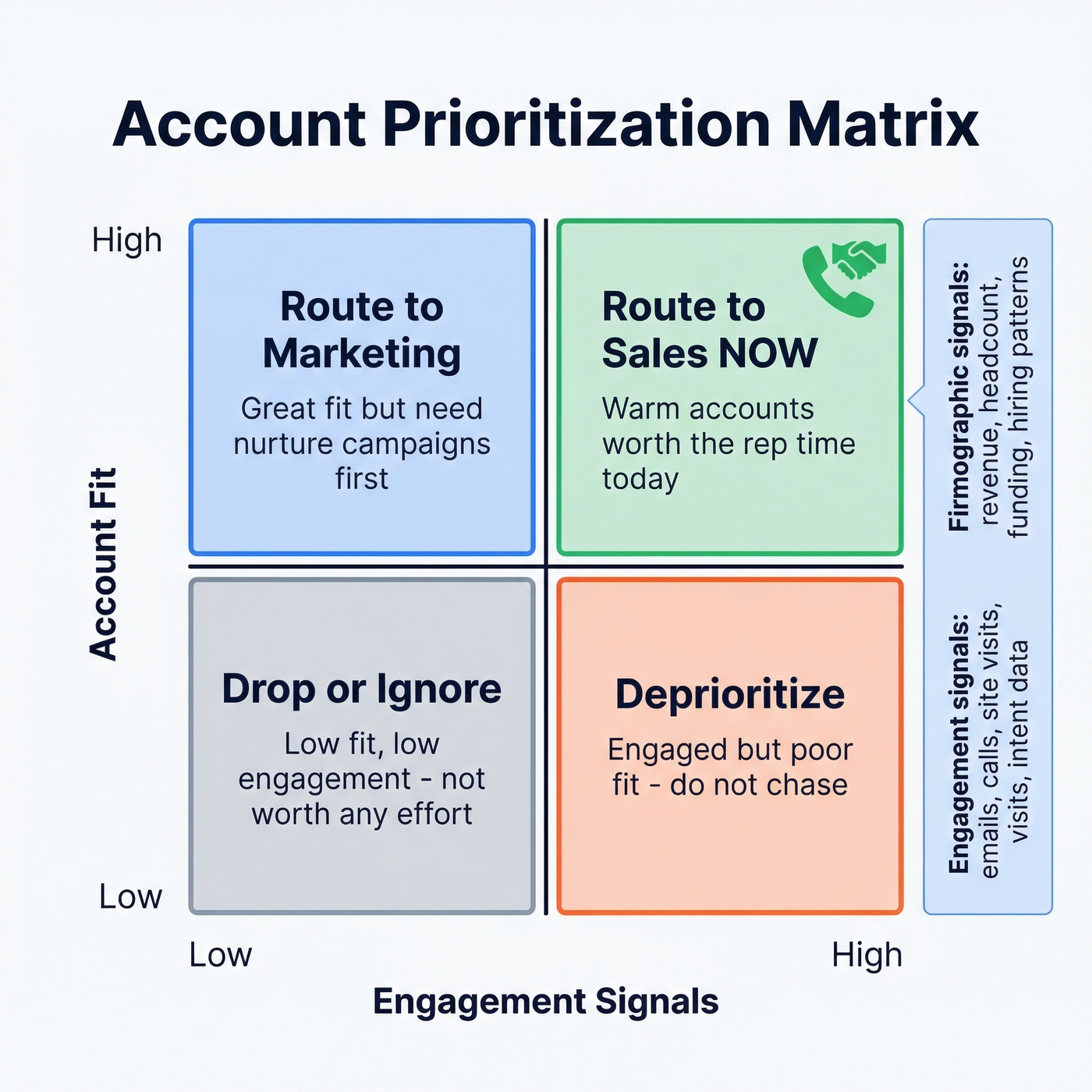
The best framework we've found combines third-party firmographic signals into an account fit score, then layers first-party engagement signals on top. Firmographic signals include revenue, headcount, funding rounds, and hiring patterns. Engagement signals cover email threads, call activity, website visits, inbound form fills, and intent data.
The operational split is clean:
- High fit + high engagement goes straight to sales - these accounts are warm and worth the rep's time right now.
- High fit + low engagement routes to marketing for nurture campaigns.
- Low fit accounts, regardless of engagement, get deprioritized or dropped entirely.
Gradient Works recommends starting with rule-based scoring - a handful of firmographic rules plus behavioral triggers - then refining quarterly as you learn what actually predicts conversion. Don't overcomplicate it with ML models until you've exhausted the value of simple rules.
Territory Planning Tools and Pricing
The territory planning tool market is projected to grow from ~$2.5B to $7B by 2033. There's real demand, and a lot of vendors chasing it.
Here's the thing: if your average deal size is under $15k and you have fewer than 50 reps, you don't need a $50K enterprise territory platform. A CRM-native mapping feature, a $30-50/mo visualization tool, and a data enrichment layer will get you 90% of the way there at a fraction of the cost.
Reddit threads consistently flag Salesforce Maps pricing as steep for mid-market teams, and the consensus on r/sales is that dedicated mapping tools like Spotio and Badger Maps serve field sales teams well at more accessible price points. Desktop GIS tools like Maptitude offer a one-time purchase for teams that need deep geographic analysis without recurring costs.
Data Foundation
| Tool | Focus | Pricing |
|---|---|---|
| Prospeo | Data enrichment + intent | Free tier; paid ~$0.01/email |
Mapping & Alignment Tools
| Tool | Focus | Pricing |
|---|---|---|
| Salesforce Maps | CRM-native mapping | ~$75-150/user/mo |
| Spotio | Field sales mapping | From $39/user/mo |
| Badger Maps | Route + territory | From $49/user/mo |
| MapBusinessOnline | Entry-level mapping | From $29/mo |
| Mapline | Mapping + analytics | From $99/mo |
| eSpatial | Scenario planning | From $1,295/user/year |
| Maptitude (Caliper) | Desktop GIS | $695 one-time |
| Xactly AlignStar | Enterprise alignment | Enterprise pricing (custom) |
Skip Xactly AlignStar unless you have 100+ reps and a dedicated RevOps team to administer it. For most mid-market orgs, the ROI doesn't justify the implementation overhead.
Mistakes That Kill Territory Plans
Do this: Weight territories by effort, not account count. A rep with 30 enterprise accounts requiring multi-threaded outreach to 11-15 stakeholders each has a heavier workload than a rep with 150 SMB accounts.
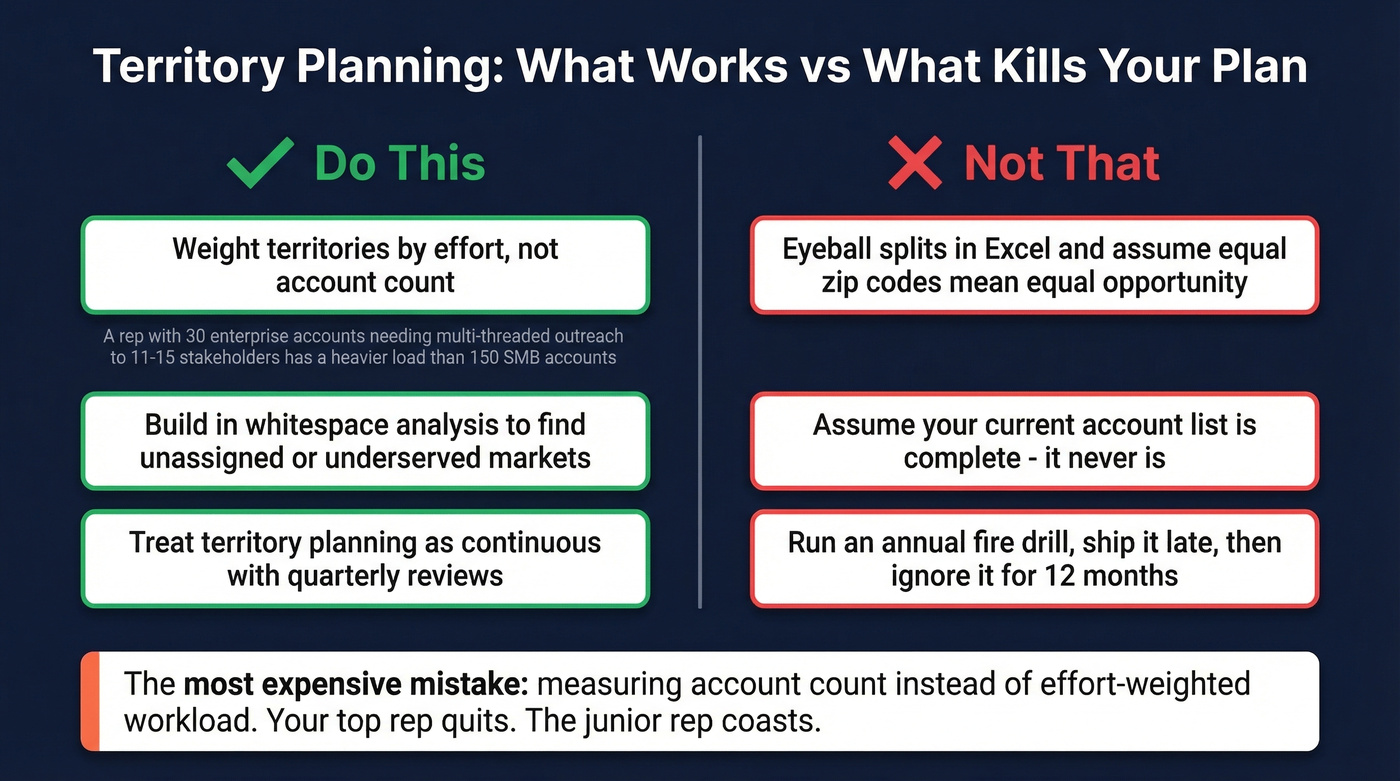
Not that: Eyeball splits in Excel and assume equal zip code counts mean equal opportunity.
Do this: Build in whitespace analysis. Identify under-served markets and accounts that aren't assigned to anyone.
Not that: Assume your current account list is complete. It never is.
Do this: Treat territory planning as a continuous process with quarterly reviews.
Not that: Run an annual fire drill where you rebuild everything from scratch, ship it late, and don't touch it again for 12 months.
The most expensive mistake is the one that's hardest to see: measuring account count instead of effort-weighted workload. It's the reason your top rep has a "small" territory of 25 accounts that each require six-month sales cycles and eight-person buying committees, while a junior rep coasts on 200 transactional accounts. One of them quits. Guess which one.
Rebalancing Without Losing Reps
Highspot's guidance is solid: review quarterly to catch misalignment early, lock structural changes semi-annually. This cadence gives you enough data to spot problems without creating the chaos of constant reshuffling.
Territory changes always ripple into comp plans. If you move accounts between reps mid-quarter without adjusting quotas and commission splits, you're guaranteeing backlash. Coordinate rebalancing with your comp team - or better yet, build territory-change triggers directly into your comp plan rules so adjustments happen automatically.
Let's be honest about how reps actually feel about this. The consensus on r/sales is that reps see territory plans as management busywork - "not for you, but to make the boss feel better." If you're asking reps to produce five separate plans a year, you've lost them. Make the plan a selling tool that helps reps prioritize their week, or don't bother. A territory plan that lives in a drawer is worse than no plan at all, because it consumed time and goodwill for zero return.
Buying groups now include 11-15 stakeholders on average. A rep can't multi-thread 15 stakeholders across 200 accounts. The math just doesn't work. Balance for reality, not for optics.
The Data Quality Fix Most Teams Miss
Nobody wants to hear this, but a perfectly balanced territory with bad data produces the same result as no territory at all.
You can spend weeks modeling workload, scoring accounts, and balancing effort across reps. But if 35% of the emails bounce and half the phone numbers are disconnected, your reps are burning hours on dead contacts instead of selling. Poor data quality costs organizations an estimated $12.9M annually, and 64% of organizations cite data quality as their top challenge.
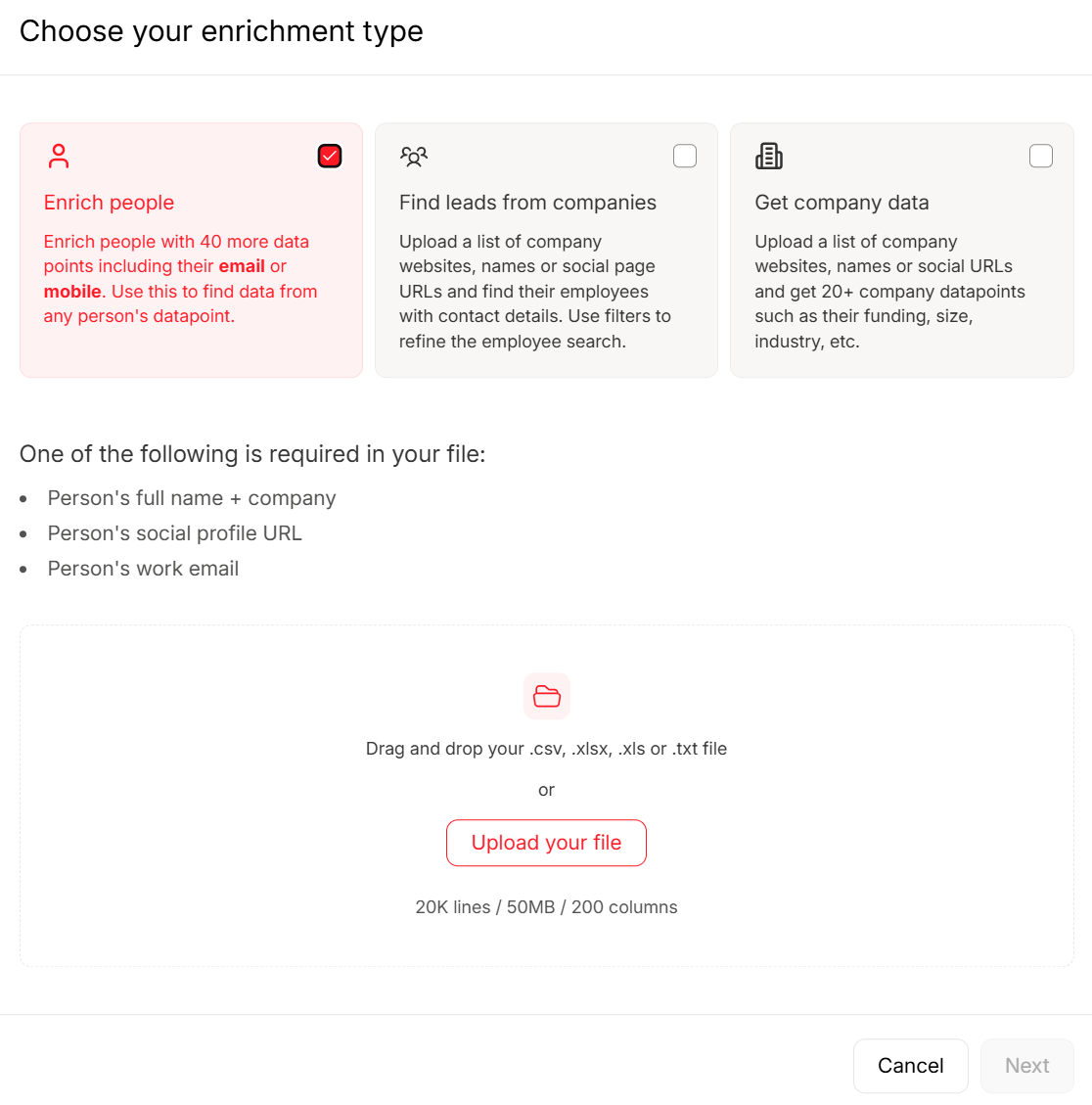
We've seen this play out firsthand. After you've designed and balanced territories, upload your territory account list as a CSV and enrich it with Prospeo against 300M+ professional profiles. You get back 50+ data points per contact at an 83% match rate - verified emails at 98% accuracy, 125M+ verified mobile numbers, and data that refreshes every 7 days instead of the 6-week industry average. Meritt ran this exact workflow and watched their bounce rate drop from 35% to under 4%. That's the difference between a territory plan that looks good on paper and one that actually produces pipeline.
Effort-weighted scoring falls apart when firmographic data is stale. Prospeo refreshes 300M+ profiles every 7 days - not every 6 weeks - so your account fit scores, headcount signals, and hiring data reflect reality, not last quarter's snapshot.
Build territory scores on data that's actually current.
FAQ
When should I use geographic territories vs. named accounts?
Geographic territories work best for field sales teams with in-person meetings where proximity matters. Named accounts suit enterprise SaaS orgs with 20+ reps pursuing high-value targets regardless of location. Most growing teams benefit from a hybrid model that starts with geography and layers in account-based rules for strategic segments.
How often should I rebalance my territories?
Review quarterly to catch pipeline imbalances, rep complaints, or coverage gaps early. Lock structural changes semi-annually so reps have enough stability to build relationships. Always rebalance based on effort-weighted workload, not raw account count, and coordinate changes with your comp team to avoid backlash.
How do I make sure reps have accurate contact data?
Enrich territory account lists with a data platform before reps start working them. Prospeo returns verified emails at 98% accuracy and direct dials across 300M+ profiles at ~$0.01/email - Meritt cut bounce rates from 35% to under 4% using this workflow. Push enriched contacts into your CRM so reps dial instead of data-hunt.
What's the most common territory planning mistake?
Balancing on account count instead of effort-weighted workload. A territory with 30 enterprise accounts requiring multi-threaded outreach to 11-15 stakeholders is heavier than 150 transactional SMB accounts. Other killers: ignoring whitespace analysis, treating planning as an annual event, and failing to sync territory changes with comp plan adjustments.