

Sales Trigger Events: Track 5, Not 25
Most sales trigger events listicles hand you 23 triggers and zero framework for deciding which ones matter. SDRs drown in alerts, chase funding rounds from six weeks ago, and write "personalized" emails that bounce.
Here's what actually works: five triggers, clear SLAs, and a system that converts.
What Are Trigger Events?
A trigger event is a concrete, observable business change - a funding round, an executive hire, a reorg - that disrupts the status quo and opens a window where a decision-maker will consider new solutions. Craig Elias calls this the Window of Dissatisfaction: the period after someone realizes their current setup no longer works but before they start actively shopping.
Trigger events create urgency. They don't create a buying decision on their own. Intent signals like pricing page visits and G2 comparisons confirm someone is researching; triggers tell you why they started. Most pipeline problems are timing problems, and triggers fix timing.
The Short Version
Track only Tier 1-2 triggers aligned to your ICP - funding, champion job change, hiring surge, tech stack change. Everything else is noise. Act within 48 hours for Tier 1, within one week for Tier 2. Trigger windows close in 7-14 days, and after that, you're just another cold email. And verify contact data before outreach. A perfect trigger with a bounced email is a wasted trigger.
Why Triggers Beat Spray-and-Pray
Sellers who reach decision-makers first during the Window of Dissatisfaction win 74% of the time versus 16% for everyone else. That gap is enormous.
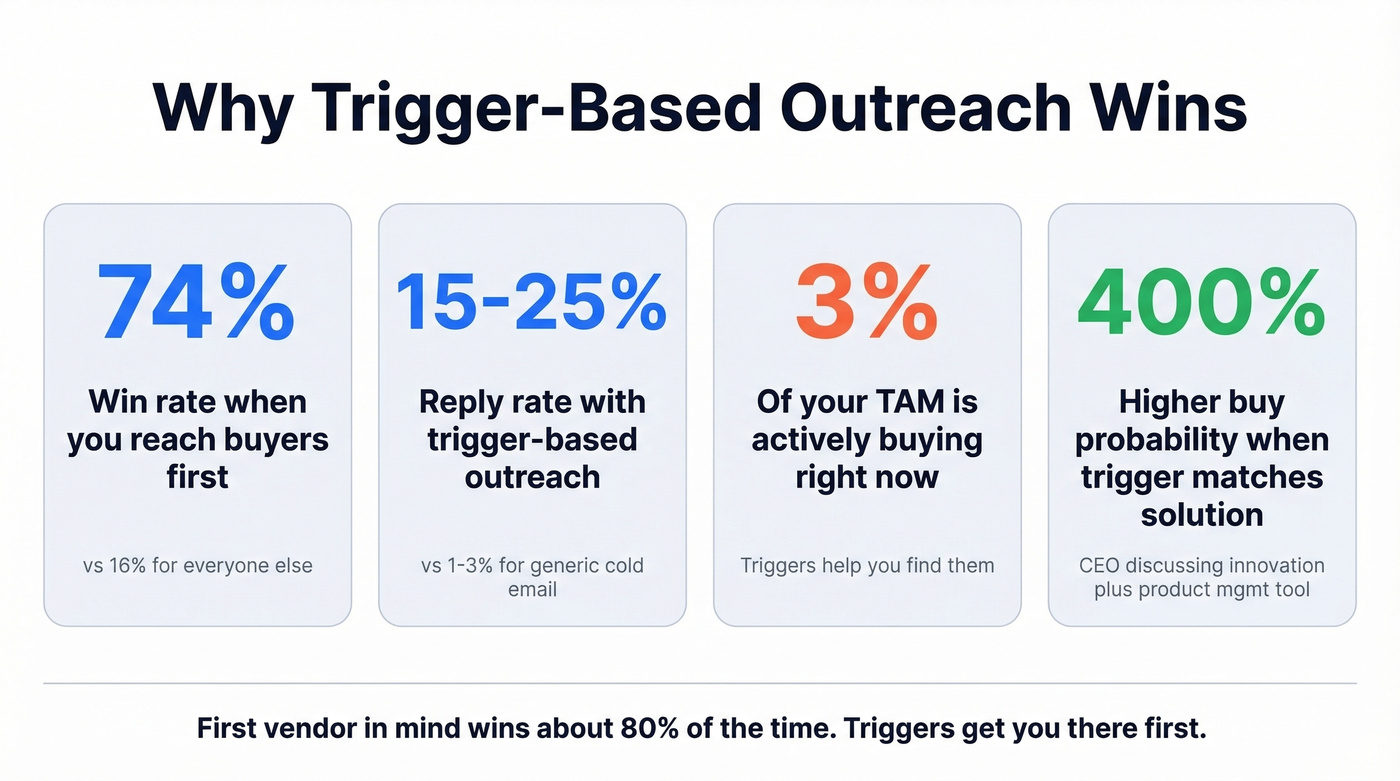
Industry benchmarks reinforce the pattern: 92% of B2B buyers start with at least one vendor already in mind, and the vendor ranked first wins about 80% of the time. Trigger-based outreach pulls 15-25% reply rates compared to 1-3% for generic cold outreach. In one case study, accounts where the CEO publicly discussed "innovation" had a 400% higher probability of buying a product management tool - that's what happens when you match a specific trigger to a specific solution.
Only about 3% of your TAM is actively buying at any given time. Triggers help you find that 3% instead of spraying the other 97%.
The r/sales crowd is rightfully skeptical - practitioners call many triggers "generic" and say they "aren't necessarily triggers." They're right when you're tracking 23 of them with no prioritization. A funding round from two months ago isn't a trigger. It's old news. The fix isn't more triggers. It's fewer triggers, faster response, and verified contacts.

A trigger event without a verified email is a wasted trigger. Prospeo gives you 98% email accuracy on a 7-day refresh cycle - so when that champion changes jobs or a target account raises their Series B, you reach the right person before the window closes.
Stop losing trigger windows to bounced emails. Start for free.
The 5 Trigger Events Worth Tracking
Tier 1: Act Within 48 Hours
Champion job change. When a former buyer moves to a new company, they already trust your product. These contacts convert at 3-5x the rate of cold outreach. We've seen this outperform every other trigger by a wide margin across hundreds of campaigns - it's the single highest-converting signal in B2B. The outreach practically writes itself: "Hey, loved working with you at [OldCo]. Building something similar at [NewCo]?" That's not a cold email. That's a warm conversation.
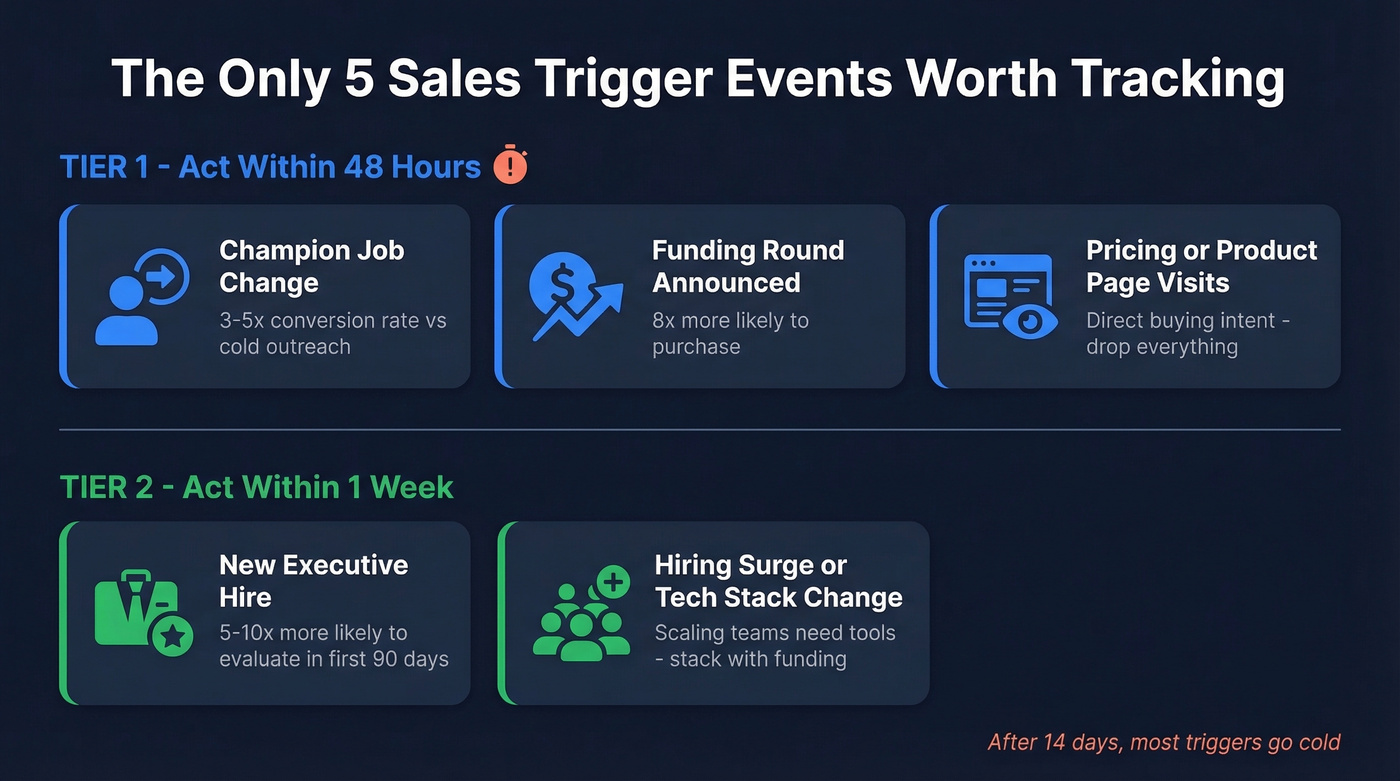
Funding round announced. Organizations that recently raised are 8x more likely to make purchases. Stack this with hiring velocity spikes in your target department. If they just raised a Series B and posted five SDR roles, they're building pipeline infrastructure right now.
Pricing or product page visits. Direct buying intent, not a proxy. When a named account hits your pricing page, that's Tier 1 urgency - drop everything.
Tier 2: Act Within 1 Week
New executive hire. Newly hired executives are 5-10x more likely to evaluate vendors within their first 90 days of joining. They're building their stack, proving themselves, and open to meetings. The window here is wider than Tier 1, but don't let it drift past 90 days.
Hiring surge or tech stack change. If a company posts 12 engineering roles in a week, they're scaling - and scaling teams need tools. Similarly, a competitor's contract up for renewal or a ripped-out integration both create natural evaluation windows. Stack either with a recent funding round for a strong compound signal.
Let's be honest about something no SERP competitor covers: trigger decay. Score each trigger on recency and relevance, then decay the score daily. Automate routing in your CRM so Tier 1 triggers hit a rep's queue within hours, not days. We've watched manual spreadsheet tracking die within two weeks at multiple orgs. It always dies.
One more thing: if your average deal size is under $10k, you probably don't need a dedicated trigger platform. Google Alerts, a CRM with basic automation, and verified contact data will outperform a $50k sales intelligence suite that your team half-uses.
How to Act on a Trigger
Use the signal-context-proof-action formula. Lead with the trigger, show you understand their situation, drop one proof point, and make a specific ask. Keep the email under 80 words.
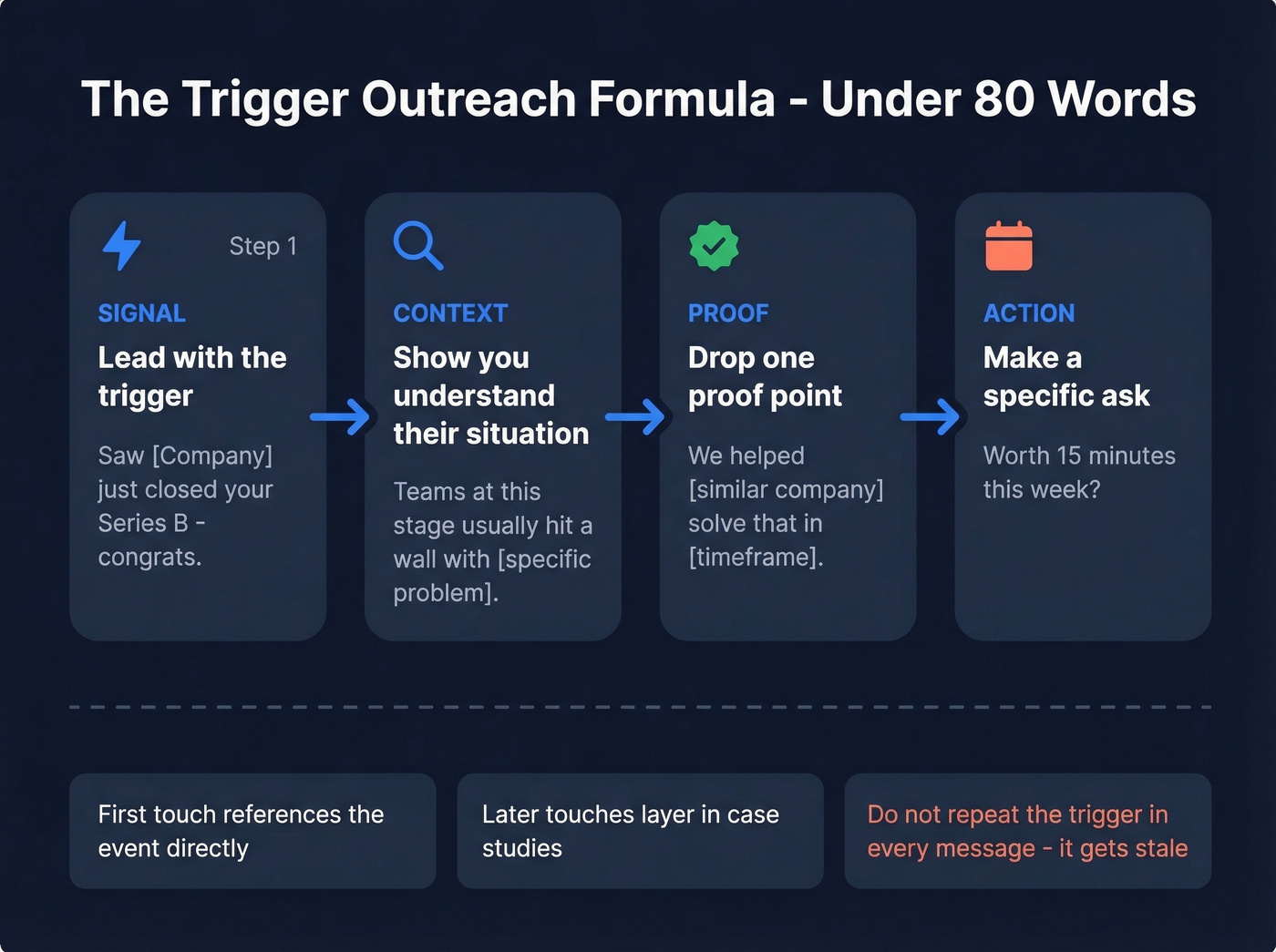
"Saw [Company] just closed your Series B - congrats. Teams at this stage usually hit a wall with [specific problem]. We helped [similar company] solve that in [timeframe]. Worth 15 minutes this week?"
Build a 3-7 touch sequence around the trigger. The first touch references the event directly. Subsequent touches layer in case studies or a different angle on the same problem - don't repeat the trigger reference in every message. It gets stale fast, and reps who do this sound like bots.
Tools and Pricing (2026)
| Tool | What It Does | Starting Price |
|---|---|---|
| Google Alerts | Free trigger monitoring | Free |
| Prospeo | Verified contacts + intent data across 15,000 topics | Free tier; ~$0.01/email |
| Lusha | Contact data + alerts | ~$29/mo |
| LeadIQ | Prospecting + signals | ~$39/mo |
| Apollo | Prospecting + signals | ~$49/mo |
| Hunter | Email finding + search | ~$49/mo |
| Trigify | Dedicated trigger platform | ~$450/mo |
| UserGems | Job-change tracking | ~$1,000+/mo |
Skip the enterprise platforms unless you're running trigger-based selling across thousands of accounts. Trigify at $450+/mo and UserGems at $1,000+/mo make sense at that scale, but they're overkill for a 5-person SDR team.
Why Triggers Fail Without Verified Data
Here's a scenario we see constantly. Your SDR gets a Slack alert - the CMO at a target account just changed jobs. They write a perfect 60-word email referencing the move. It bounces. The CMO's email changed after a company rebrand, and the data in your CRM is three months old.
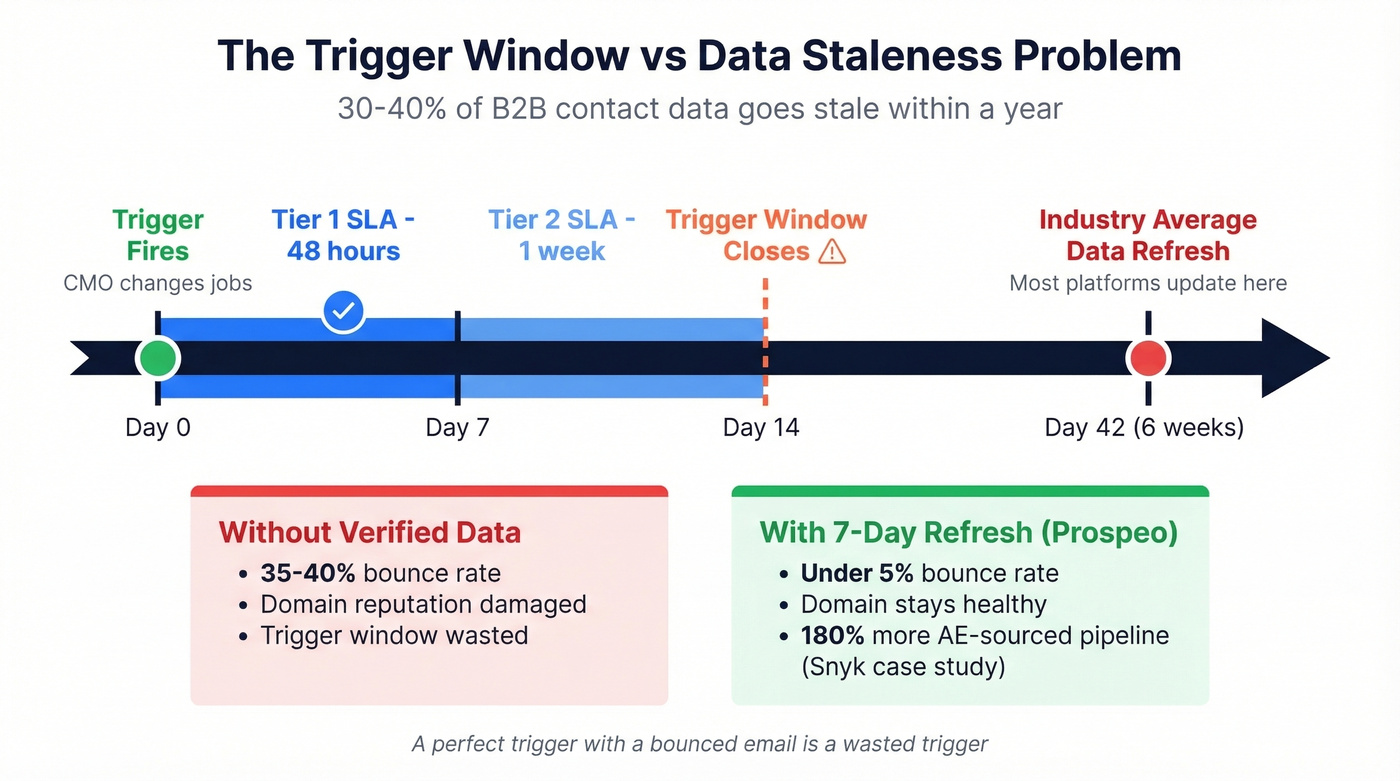
Roughly 30-40% of B2B contact data goes stale within a year, and most platforms refresh on a 6-week cycle. That's a lot of bounced emails burning your domain reputation during the exact window when timing matters most. When Snyk addressed this by rolling out verified data across 50 AEs, their bounce rate dropped from 35-40% to under 5%, and AE-sourced pipeline jumped 180%. That's what fresh data does when you're racing a 14-day trigger window.
If you want to go deeper on keeping records fresh, start with CRM hygiene and a lightweight data enrichment process that runs weekly.
Tracking job changes, funding rounds, and hiring surges means nothing if your contact data is six weeks old. Prospeo refreshes 300M+ profiles every 7 days - not the 6-week industry average - and layers in intent data across 15,000 topics so you stack triggers with live buying signals.
Verified contacts at $0.01/email. No contracts. No stale data.
FAQ
What's the difference between trigger events and intent signals?
A trigger event is a concrete business change - funding, exec hire, reorg - that creates urgency. An intent signal is behavioral data showing active research, like G2 visits or pricing page views. Triggers cause action; intent confirms it. Stack both for the strongest outbound results.
How fast should I respond to a trigger?
Tier 1 triggers demand outreach within 48 hours. Tier 2 gives you about a week. After 14 days, most triggers go cold - sellers who arrive first win 74% of deals.
Do I need an expensive trigger platform?
Not unless you're working thousands of accounts. Teams under 500 accounts can run trigger-based selling with Google Alerts, a CRM, and a verification tool with a free tier. Dedicated platforms justify their cost only at scale.
What other trigger event examples exist beyond the top five?
Beyond the five core triggers above, teams sometimes track M&A activity, office relocations, product launches, and regulatory changes. Most of these lower-tier signals convert poorly without stacking them against intent data. Start with the five high-converting triggers in this guide, nail your response SLAs, and only expand once those run consistently.