

Saleshandy vs Apollo.io: Which One Actually Delivers?
Apollo.io and Saleshandy look like they compete head-to-head, but the real split is simpler than most reviews make it. Apollo is prospecting-first with outreach attached. Saleshandy is outreach-first with prospecting attached. That distinction shapes everything - pricing, deliverability, where each tool shines, and where each one quietly falls apart.
B2B contact data decays at roughly 22.5% per year. So the "best" tool isn't the one with the biggest database or the slickest UI. It's the one that keeps bad data from wrecking your sender reputation and pipeline.
30-Second Verdict
Pick Apollo.io if you want one seat that handles prospecting, sequences, and a dialer, and you're fine navigating its credit system.
Pick Saleshandy if you send at volume and care more about inbox placement, mailbox rotation, and agency-friendly workflows than having a giant database baked into the same UI.
Here's the thing: if your average deal sits below $10k, you probably don't need an "all-in-one" platform. You need clean data, a simple sender, and discipline.
Feature Comparison at a Glance
Ratings and review data below come from G2's head-to-head comparison, plus each vendor's published plan details.
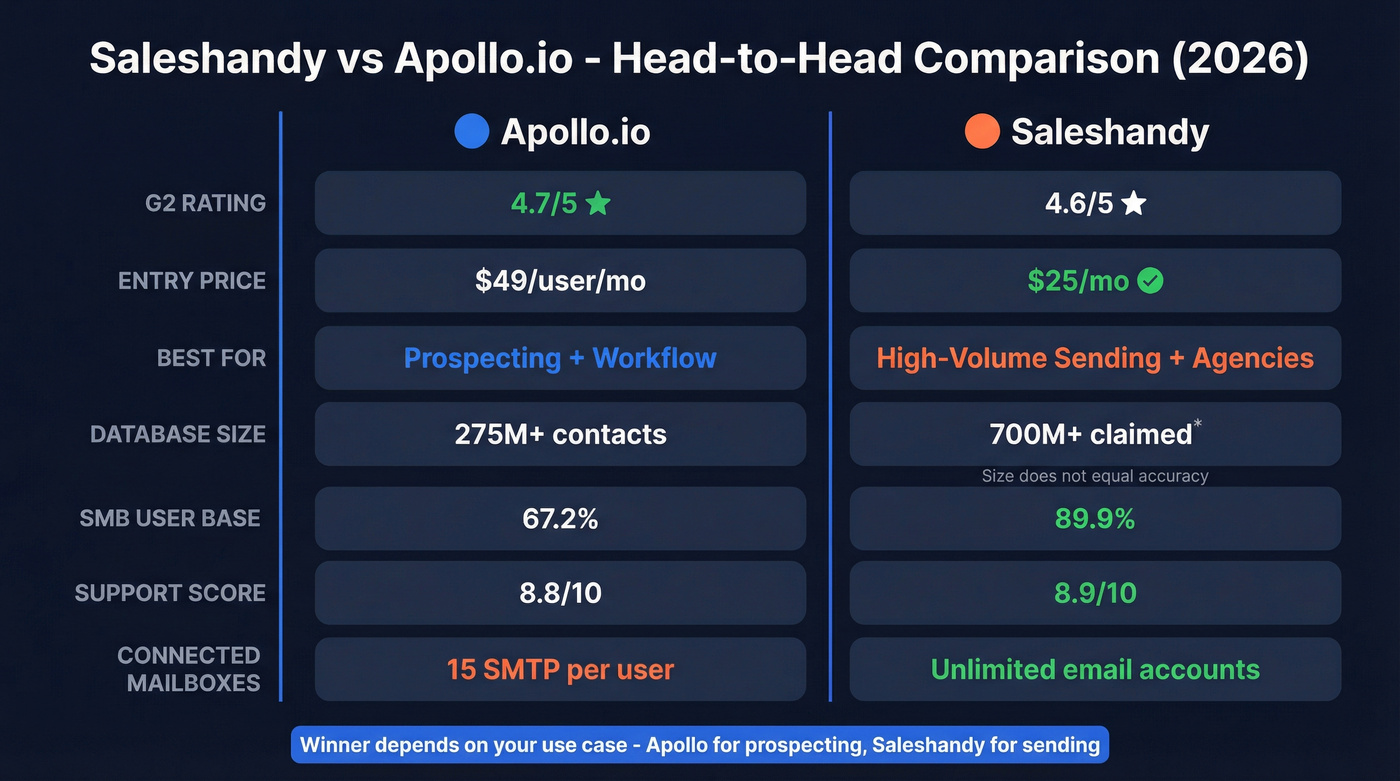
| Dimension | Apollo.io | Saleshandy | Edge |
|---|---|---|---|
| G2 rating | 4.7/5 | 4.6/5 | Apollo.io |
| Entry price | Free tier; paid from ~$49/user/mo (annual) | From ~$25/mo (annual) | Saleshandy |
| Best for | Prospecting + workflow in one place | High-volume sending + agencies | Tie (different jobs) |
| Database size | 275M+ contacts | 700M+ contacts claimed | Neither (size ≠ accuracy) |
| SMB-heavy user base | 67.2% | 89.9% | Saleshandy |
| Support score | 8.8/10 | 8.9/10 | Saleshandy (slight) |
| Connected mailboxes | Unlimited Google/Microsoft; 15 SMTP per user | Unlimited email accounts | Saleshandy |
Pricing Breakdown
Apollo.io looks simple until you hit credits. The Free plan is generous enough to test the workflow, but it's constrained - limited mobile reveals and export credits. Paid starts around $49/user/month on annual billing, climbs to roughly $79/user/month for more sequencing and dialer features, and hits about $119/user/month on the Organization tier with a 3-user minimum. The catch is always credits: exports and mobile reveals burn through them fast, and extra credits commonly land in the $0.03-$0.10 range per record.
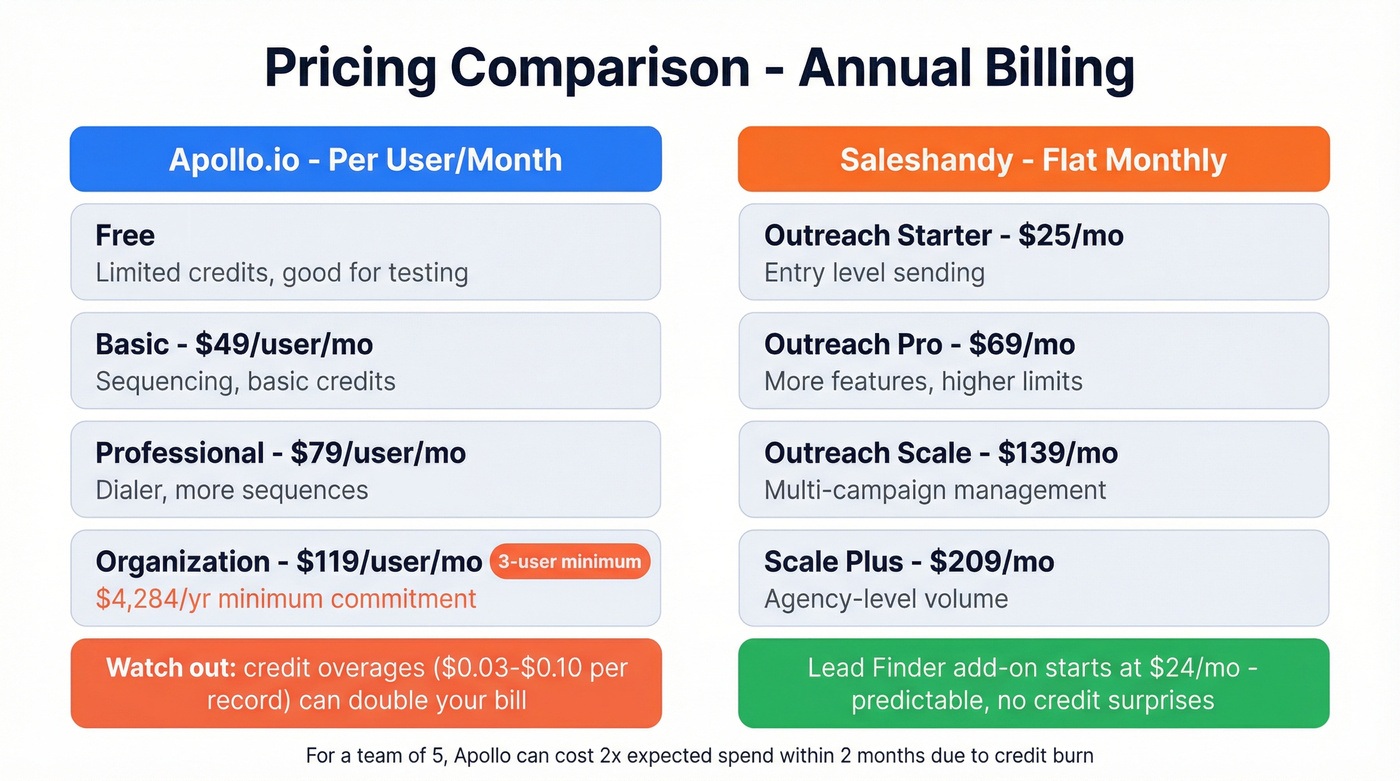
Saleshandy is easier to budget. On annual billing, you'll see Outreach Starter at $25/month, Outreach Pro at $69/month, Outreach Scale at $139/month, and Scale Plus starting at $209/month. Monthly billing bumps those to $36, $99, $199, and $299 respectively.
Want prospecting inside Saleshandy? Its Lead Finder pricing is separate but also public: annual billing starts at $24/month, scaling up to $49, $99, and $179/month at higher tiers.
If you're buying for a team of five or more, Apollo's per-seat pricing plus credit overages can spike fast. We've seen teams hit 2x their expected Apollo spend within two months because nobody budgeted for mobile credit burn. Saleshandy is the cleaner choice when you want predictable spend tied to sending volume rather than data consumption.

Apollo's credits spike. Saleshandy's data needs verification. Skip the guesswork - Prospeo gives you 98% accurate emails on a 7-day refresh cycle at $0.01 per lead. No per-seat pricing, no credit surprises.
Stop paying twice - once for leads, again for bounces.
Data Quality Compared
Apollo markets 91% email accuracy with a 7-step verification process. In practice, teams routinely see 65-80% accuracy once they export at scale - good enough for targeted outreach, not good enough for high-volume sends. Inaccurate and outdated data is one of the most repeated complaints in G2 reviews, and r/coldemail threads regularly warn that bad lists are what trigger the deliverability spiral.
Saleshandy's database number is bigger on paper, and its Lead Finder workflow is convenient when you want to go from "ICP idea" to "list" quickly. But the only database metric that matters is whether the emails you send are valid today - not six weeks ago.
Let's be honest: treat databases as lead sources, not ground truth. Build your list from whatever tool you prefer, then verify before you send. That one step saves domains. Gartner-cited research puts the cost of poor data quality at $12.9M annually per organization, and outbound teams feel it first as bounces, spam placement, and dead sequences.

Deliverability and Sending
Saleshandy wins this category for one reason: it behaves like a dedicated sending platform. Unlimited email accounts across plans, sender rotation, and a unified inbox are exactly what you want when you're running multiple campaigns, multiple domains, or multiple clients. It's built for the unglamorous work of keeping volume steady without torching reputation.
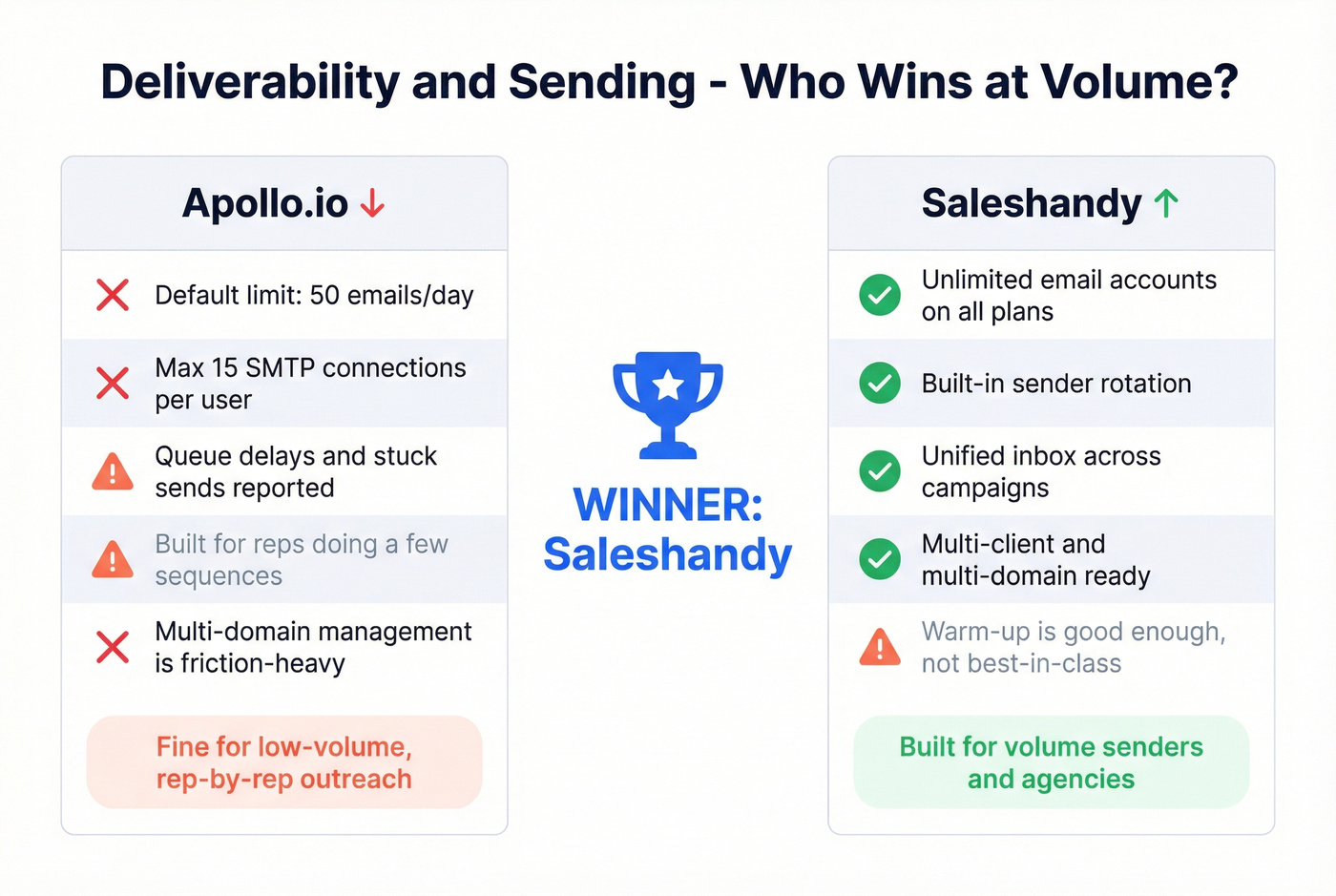
Apollo can send, but it's opinionated and restrictive. It recommends conservative sending limits - 50 emails/day by default - caps SMTP connections at 15 per user, and its queue can behave unpredictably. The r/coldemail subreddit is full of people dealing with "Scheduled - Delayed" behavior and stuck sends. If you're doing a few sequences per rep, it's fine. If you're trying to run serious volume across multiple domains, it becomes friction.
One nuance worth flagging: Saleshandy's warm-up experience is more "good enough" than "deep." If you want obsessive warm-up analytics, you'll pair it with a dedicated warm-up tool anyway (and you’ll want to watch your email velocity either way).
Operational Gotchas
Apollo's complexity is the tax you pay for consolidation. It's powerful, but it isn't lightweight. Teams lose time to setup, permissions, and figuring out why credits disappeared. The Organization tier's 3-seat minimum means you're at $4,284/year on annual billing before you've proven ROI - a real commitment for a team still testing its outbound motion.
Saleshandy is agency-friendly, but watch your mailbox admin. If you manage client domains, staff turnover and access changes are normal. Community reports flag painful edge cases around connected inbox changes after setup. The fix is simple but non-obvious: decide your mailbox naming and ownership rules before you connect anything, and document it like it's production infrastructure. Because it is.
Neither tool is "beautiful." Saleshandy is faster to get live. Apollo is better once it's dialed in.
The Third Option: Verify First
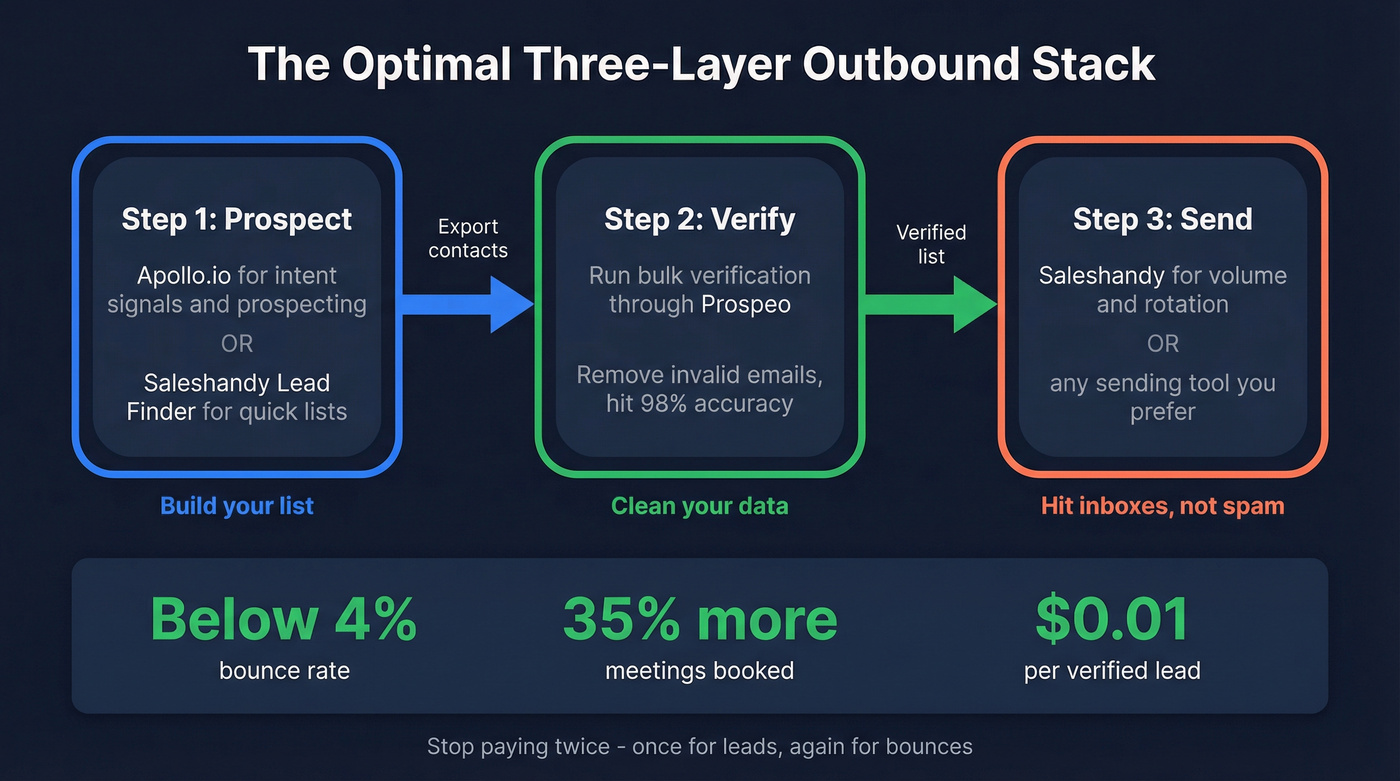
If you're reading this because your bounce rate is ugly, the answer isn't picking a side in the Saleshandy vs Apollo.io debate. The answer is verified data.
Two ways to use it:
- As a verification layer: export from Apollo or Saleshandy Lead Finder, verify in bulk through Prospeo, then send from your preferred tool. You're not donating bounces to the spam gods anymore. (If you’re troubleshooting bounces, start with bounce rate benchmarks and fixes and then work backward.)
Your bounce rate isn't a Saleshandy problem or an Apollo problem - it's a data quality problem. Teams using Prospeo's verification layer cut bounce rates below 4% and book 35% more meetings than Apollo users.
Verify every export before it touches your sending tool.
FAQ
Can I use Apollo.io and Saleshandy together?
Yes, and many teams do. Use Apollo for prospecting and intent signals, verify the exported list through Prospeo to hit 98% accuracy, then run sequences in Saleshandy for superior sending control and mailbox rotation. This three-layer stack gives you the best of each tool without the compromises of going all-in on either one.
Is Saleshandy better for agencies?
Saleshandy is the stronger choice for agencies managing multiple client domains. Unlimited email accounts, sender rotation, and a unified inbox across campaigns make multi-client work manageable. Apollo is built primarily for internal sales teams, and its per-seat credit model gets expensive fast when you're scaling across client accounts.
How accurate is Apollo.io's data really?
Apollo advertises 91% email accuracy, but at scale most teams report 65-80% real-world accuracy. If you're running outbound at volume, verify exports through a dedicated tool before sending. The difference between 75% and 98% accuracy is the difference between a healthy domain and a spam folder.
Which tool is cheaper for small teams?
Saleshandy starts at $25/month on annual billing versus Apollo's $49/user/month, making it roughly 50% cheaper at entry level. That said, Apollo's Free plan lets you test prospecting workflows at no cost, which is genuinely useful for validation. For teams under five reps focused on cold email, Saleshandy paired with Prospeo for data verification typically costs less than Apollo's paid tiers once you factor in credit overages.