

Sandler Prospecting: Techniques, Scripts & Rules That Actually Work
Most sales methodologies tell you what to say. Sandler tells you what to shut up about - and when to walk away. That distinction is why it's survived four decades while flashier frameworks come and go.
David H. Sandler built one of the most effective qualification-first systems in B2B sales, often called the "sales submarine" approach. Each compartment - pain, budget, decision - has to hold pressure or the whole deal sinks. Here's what Sandler prospecting looks like in practice, without a five-figure training bill. If you want the full book treatment, Prospect the Sandler Way covers this in depth, but what follows is the operational framework.
The Core Idea in 30 Seconds
Sandler's approach is a qualification-first call structure: pattern interrupt, upfront contract, third-party story, appointment close, post-sell. The Pain Funnel's eight questions are the single most valuable technique in the system - when you use the sequence correctly, calls run longer but sales cycles get shorter and closing ratios climb. And the "cookbook" concept ties daily activity numbers to revenue targets, though the math only works if your contact data is accurate. If 30-40% of your dials go to disconnected numbers, the model falls apart before it starts.
The 5-Step Sandler Call Structure
This is the skeleton of a Sandler-style prospecting conversation. It's built for the phone, but the principles translate to any channel.
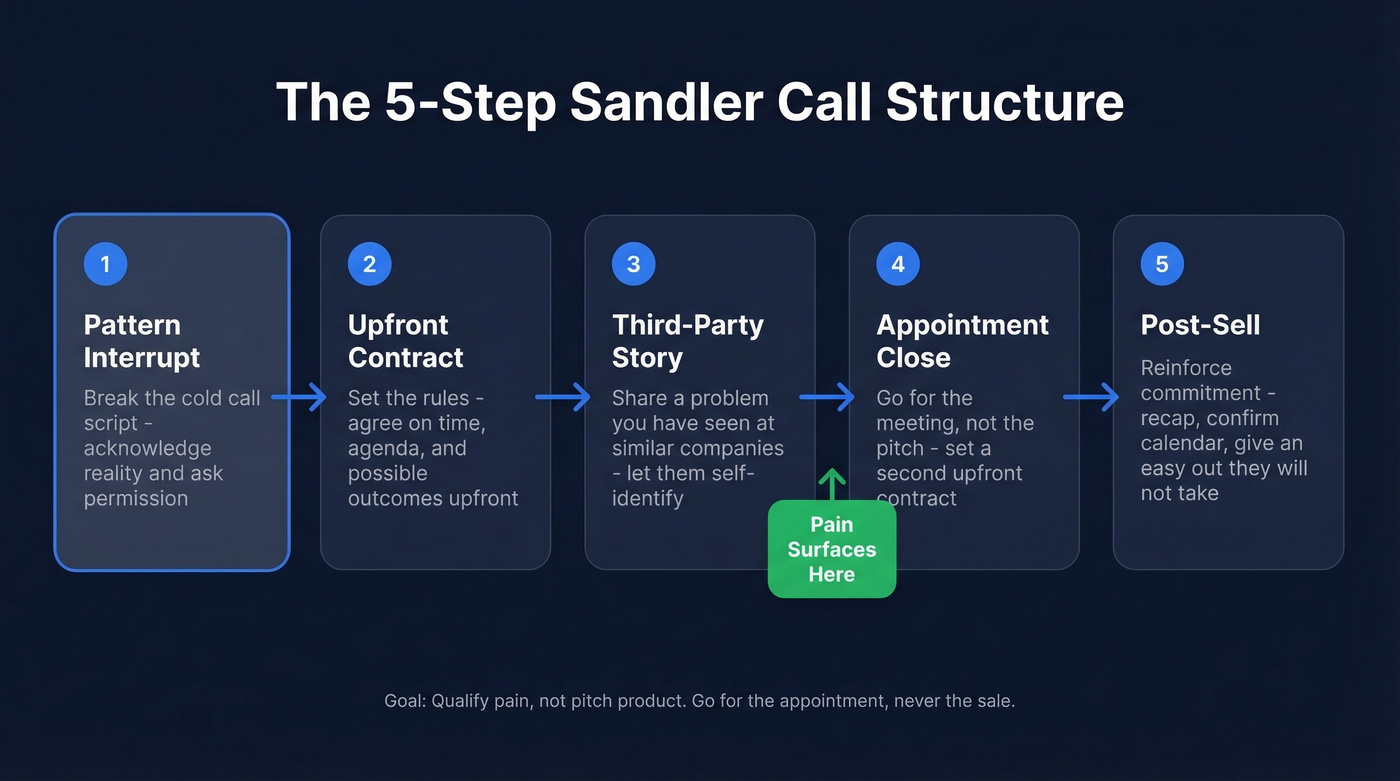
Step 1: Pattern Interrupt. Break the expected cold call script immediately. You're disrupting the buyer-seller dynamic and inviting a candid response.
"You probably get a lot of calls like this - mind if I quickly explain why I reached out?"
That opener acknowledges reality. You're not pretending this isn't a cold call. Asking for permission flips the dynamic, and most prospects respect it enough to give you 30 seconds.
Step 2: Upfront Contract. Set the rules before diving in. This kills the "send me something" and "let me think about it" stalls that waste everyone's time.
"Let's spend 20 minutes exploring this. If it makes sense, we'll define next steps. If not, we part ways - fair?"
Step 3: Third-Party Story. Don't pitch your product. Share a problem you've seen at similar companies so the prospect self-identifies without feeling sold to.
"A lot of VPs of Sales we talk to are dealing with reps missing pipeline targets despite hitting dial numbers. Is that something you're seeing too?"
Step 4: Appointment Close. If pain surfaces, don't try to sell on the spot. Sandler's No Pressure Prospecting program is explicit: go for the appointment, not the pitch. Set a second upfront contract for the next meeting.
Step 5: Post-Sell. After they agree to meet, reinforce the commitment. Recap what you'll cover, confirm the calendar hold, and give them an easy out they won't take. This prevents no-shows - and in our experience, it cuts no-show rates roughly in half compared to calls that end with a vague "sounds good, talk soon."
Pain Funnel: 8 Questions That Close Faster
The Pain Funnel is Sandler's crown jewel. HubSpot's 2024 State of Sales Report found that 58% of reps say landing best-fit deals is among their most effective selling techniques - and the Pain Funnel is a direct mechanism for identifying fit before you burn a full sales cycle on a bad one.
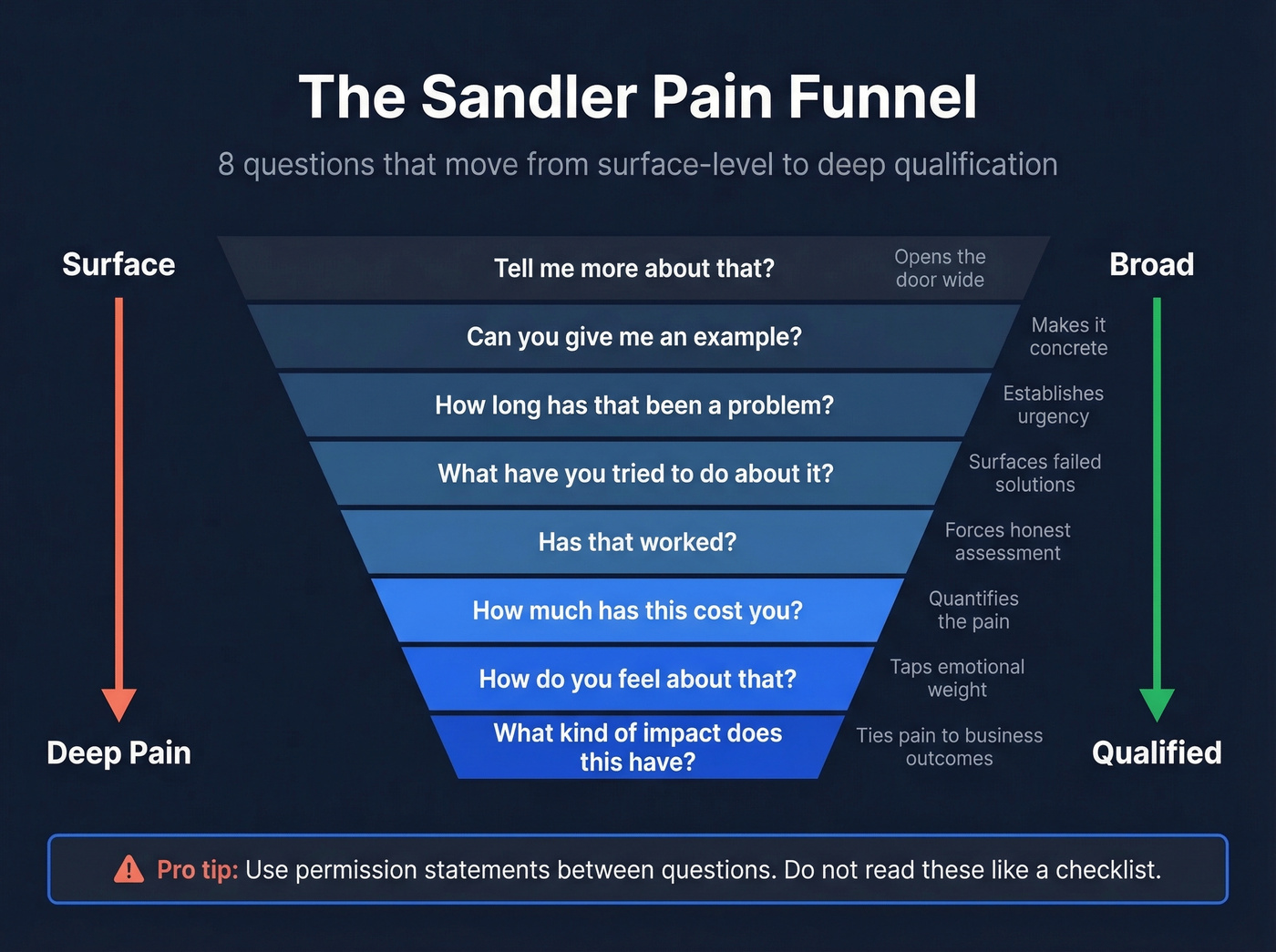
Sequence matters more than exact wording. Here's the classic progression:
| Question | Purpose |
|---|---|
| "Tell me more about that?" | Opens the door wide |
| "Can you give me an example?" | Makes it concrete |
| "How long has that been a problem?" | Establishes urgency |
| "What have you tried to do about it?" | Surfaces failed solutions |
| "Has that worked?" | Forces honest assessment |
| "How much has this cost you?" | Quantifies the pain |
| "How do you feel about that?" | Taps emotional weight |
| "What kind of impact does this have?" | Ties pain to business outcomes |
The biggest pitfall is sounding like you're reading from a checklist. Fix this with permission statements between questions - "Would it be okay if I dug into that a bit more?" - and by building on what they actually said rather than robotically advancing to the next line. We've watched reps nail the sequence on paper and still bomb the call because they weren't listening between questions.
Here's what makes the funnel so effective: it pushes you toward budget and decision early. In the submarine model, those are compartments you lock in before you ever get deep into fulfillment or presentation. That's why the method prevents a lot of late-stage price shock. You qualify money and decision process during discovery, not after the prospect has already mentally checked out.
Let's be honest - if your average deal size is under five figures, you probably don't need the full Sandler training program. You need the Pain Funnel, the upfront contract, and accurate phone numbers. That's 80% of the value.

The Pain Funnel only works if you reach the prospect. With 125M+ verified mobile numbers and a 30% pickup rate, Prospeo gives your Sandler calls a fighting chance - at $0.01 per email, no contracts.
Stop perfecting your script and start reaching real buyers.
7 Sandler Rules for Prospectors
These come from Sandler's widely cited 49 Timeless Selling Principles. Here are the seven that matter most when you're prospecting:
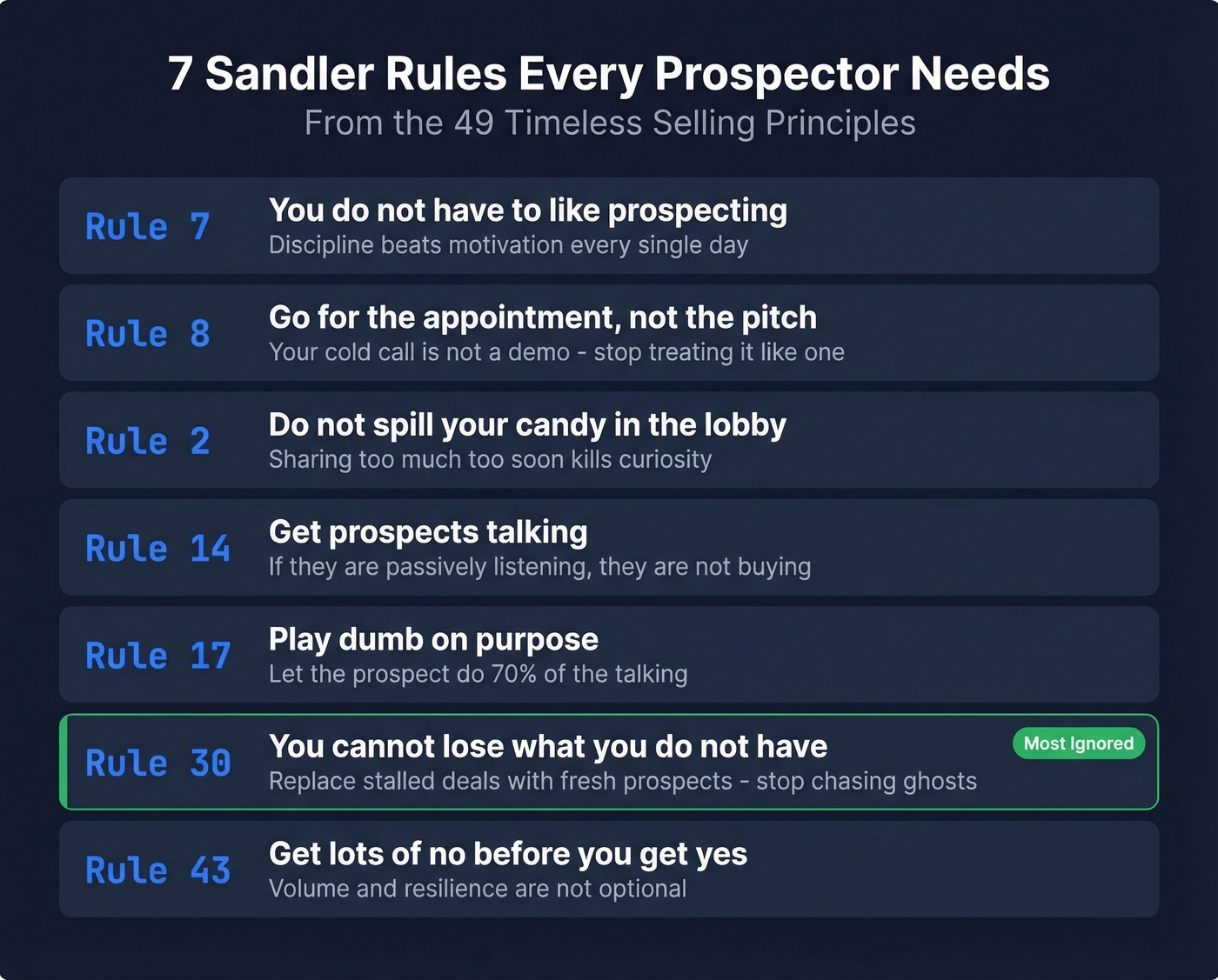
- Rule 7: You don't have to like prospecting - you just have to do it. Discipline beats motivation every single day.
- Rule 8: Go for the appointment, not the pitch. Your cold call isn't a demo. Stop treating it like one.
- Rule 2: Don't spill your candy in the lobby. Sharing too much too soon kills curiosity and hands the prospect control.
- Rule 14: Get prospects talking. If they're passively listening, they're not buying.
- Rule 17: Play dumb on purpose. Let the prospect do 70% of the talking.
- Rule 30: You can't lose what you don't have. Replace stalled deals with fresh prospects instead of chasing ghosts.
- Rule 43: The best way to get "yes" is to get lots of "no" first. Volume and resilience aren't optional.
Rule 30 is the one most reps ignore. They cling to a "maybe" pipeline full of deals that died weeks ago because letting go feels like admitting failure. Sandler's framework gives you permission to cut bait - and the cookbook gives you the activity plan to refill the pipe fast.
Building Your Prospecting Cookbook
The cookbook is Sandler's term for your daily and weekly activity plan - the specific numbers connecting activity to revenue. Sandler recommends segmenting targets using the KARE framework: Keep existing accounts, Attain net-new logos, Recapture win-backs, and Expand through upsell and cross-sell.
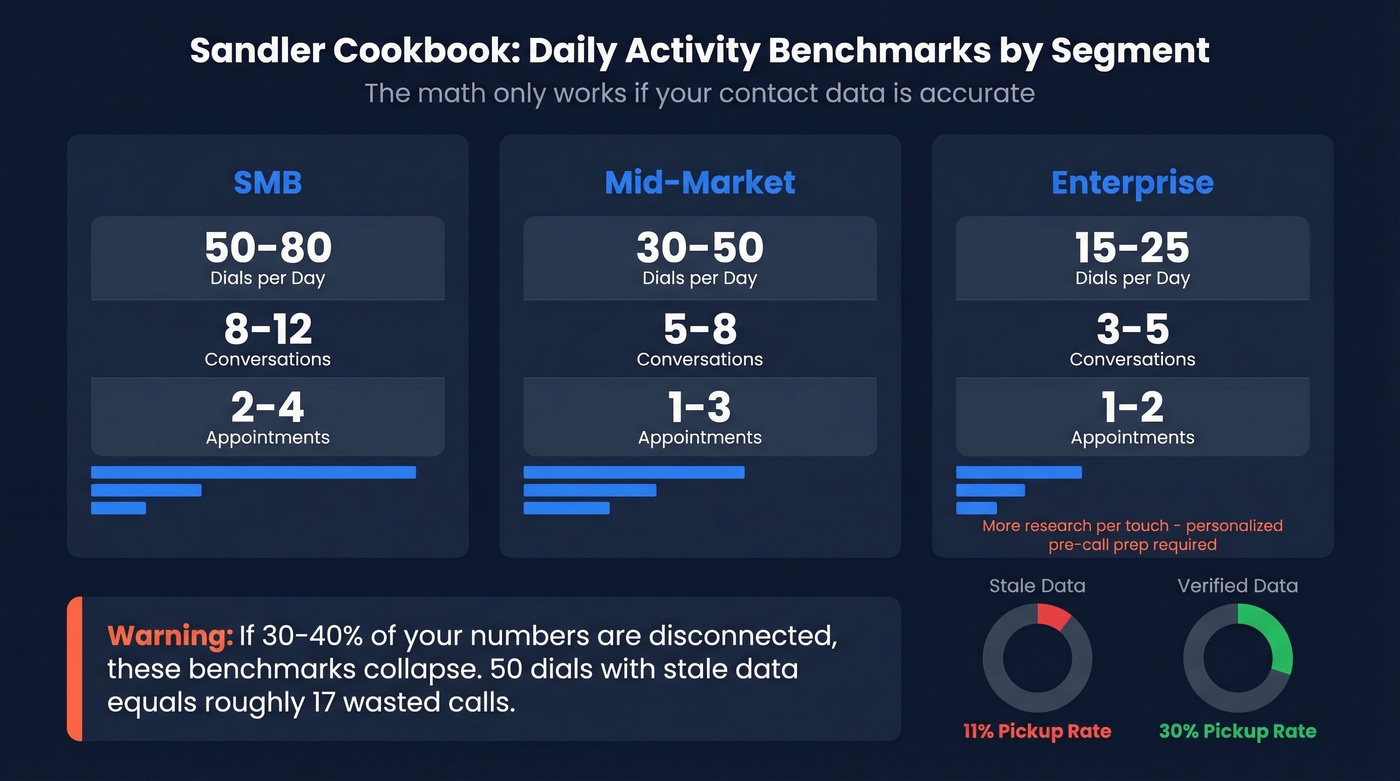
Typical outbound benchmarks by segment: SMB teams often run 50-80 dials per day to generate 8-12 conversations and 2-4 appointments. Mid-market reps usually run 30-50 dials for 5-8 conversations. Enterprise is lower volume with more research per touch - think 15-25 highly targeted calls with personalized pre-call prep.
Those numbers only work if the data underneath them is accurate. If 30-40% of your numbers are disconnected or outdated, you can "hit your dials" and still miss pipeline by a mile. The Sandler method means obsessing over call structure and activity planning, but it doesn't come with a contact-data product. That's where your stack matters. If you're rebuilding your outbound motion, start with a repeatable cold calling system and then layer Sandler on top.
We've seen teams pair the Sandler cookbook with Prospeo's 125M+ verified mobile numbers and 7-day data refresh cycle, and the difference is stark. When your cookbook says "50 dials," those 50 dials actually reach real people at a 30% pickup rate - compared to the 11-12% you'd get from stale databases. Fewer wasted touches, more Pain Funnel conversations per day.

Is Sandler Training Worth the Money?
Gartner Peer Insights rates Sandler 4.2 out of 5. The consistent praise: it creates a common language across teams and works well when leadership buys in. The consistent criticism: coach quality varies between providers, and virtual delivery doesn't hit as hard as in-person sessions.
Pricing isn't public and varies by provider, but for Sandler-style training and coaching engagements, expect around $5K-$25K per year per seat, with many mid-market teams landing in the $10K-$15K range depending on scope and coaching cadence. If you're comparing enablement options, it helps to map Sandler against other competitive sales training approaches.
If that's steep, skip the certification and grab Prospect the Sandler Way on Kindle for around $9.95, or look at the 8-lesson 21st Century Prospecting course that covers everything from call structure to referral strategy. The framework itself is more valuable than the certificate on the wall - and you now have the core of it for free. You just need accurate data to fuel it. For more modern plays beyond Sandler, see these sales prospecting techniques.
Your Sandler cookbook says 50-80 dials a day. But if 35% of those numbers are dead, you're burning 25 dials into nothing. Prospeo refreshes data every 7 days - not 6 weeks - so your activity math actually holds.
Make every dial in your cookbook count.
FAQ
How Does Sandler Differ From SPIN Selling?
SPIN uses four question types across a full sales conversation. Sandler's Pain Funnel drills deeper into a single problem and qualifies budget and decision authority much earlier in the process. SPIN is broader; Sandler is sharper on qualification speed. Most reps who adopt the Sandler framework see shorter sales cycles within the first quarter.
Can Sandler Techniques Work for Email?
Pattern interrupts, upfront contracts, and third-party stories translate directly to cold email subject lines and body copy. The curriculum is still heavily phone-first, but the principles are channel-agnostic. For teams running email alongside phone, pair the framework with a verified email source - bounce rates above 4% will tank your domain reputation fast, regardless of how good your copy is.
What Tools Do You Need for Sandler Prospecting?
Three things: a CRM to track activity against cookbook targets, a dialer for call volume, and a verified contact data source to ensure your dials and emails actually reach real people. The methodology is only as good as the data feeding it. Bad numbers turn a disciplined cookbook into wasted hours, and no amount of Pain Funnel mastery fixes a disconnected line.