

The Biggest SDR Challenges in 2026 - and What Actually Fixes Them
Your SDR team just missed quota again. Third straight month. Before you blame the reps, look at the data they're working with: 83.4% of SDRs fail to consistently hit quota, and quality conversations have dropped 45% since 2014. The problem isn't effort. It's structural.
Most SDR challenges trace back to bad data, not bad reps. 43% of SDRs call it their #1 problem. Supported reps hit 95% of quota vs. 80% for those left to figure it out alone. And the gap between what leadership expects and what the math supports keeps widening - the numbers below prove it.
Outreach That Doesn't Land
Cold email reply rates have cratered to 5.1%, down from roughly 7% a year ago. Open rates sit at 27.7%. And 17% of cold emails never reach the primary inbox - they land in spam or get silently filtered.
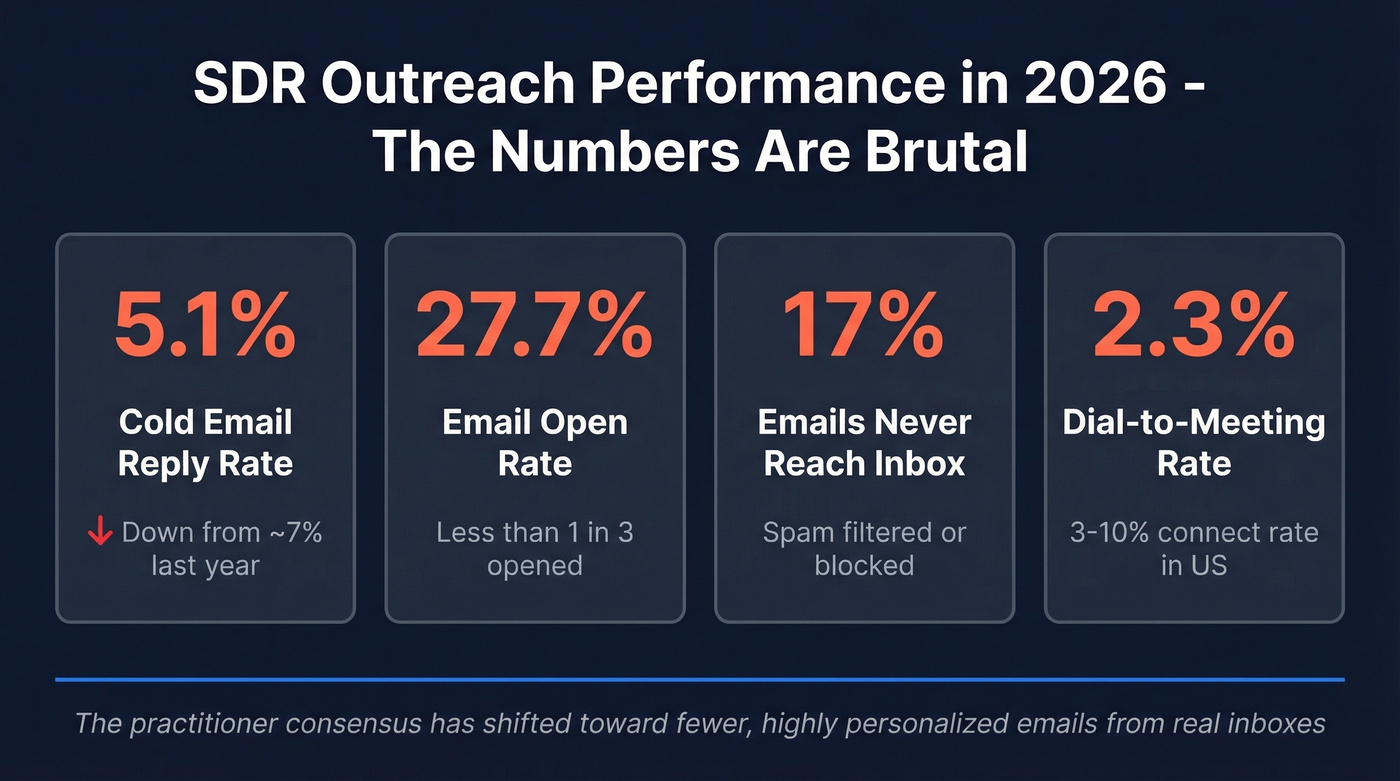
Cold calls aren't much better. Connect rates run 3-10% in the US, with dial-to-meeting success at just 2.3%. One poster on r/SaaS summed up the current reality: new domains get crushed by spam filters, templates get flagged instantly, and domain warming feels like a full-time job. The practitioner consensus has shifted toward fewer, highly personalized emails sent from real inboxes - not blasting sequences from a warmed-up burner domain.
Bad Data Kills Everything Else
When 43% of your team says data quality is their single biggest challenge, and 45% say their existing data is incomplete, you don't have a prospecting problem. You have a data problem wearing a prospecting costume.
Bad emails don't just bounce - they torch your domain reputation. Once your sender score drops, even your good emails start landing in spam. We've seen teams running bounce rates above 35% before they finally audit their data stack. At that point, the damage compounds fast: every week of bad sends makes the next week's deliverability worse, and clawing back a burned domain can take months.

Prospeo's 98% email accuracy and 7-day data refresh cycle - vs. the 6-week industry average - mean your reps aren't burning sends on dead addresses. Meritt, one of Prospeo's customers, saw their bounce rate drop from 35% to under 4% and their connect rate triple after switching. That's not a marginal improvement. It's the difference between a functioning outbound motion and an expensive noise machine.
The Productivity Paradox
SDRs spend 41% of their day on admin tasks. Only 28-39% of their time goes toward revenue-generating activities. The median tech stack is a CRM like HubSpot or Salesforce plus 4.5 additional tools, and reps using 5+ tools spend 30-40% of their day context-switching between them.
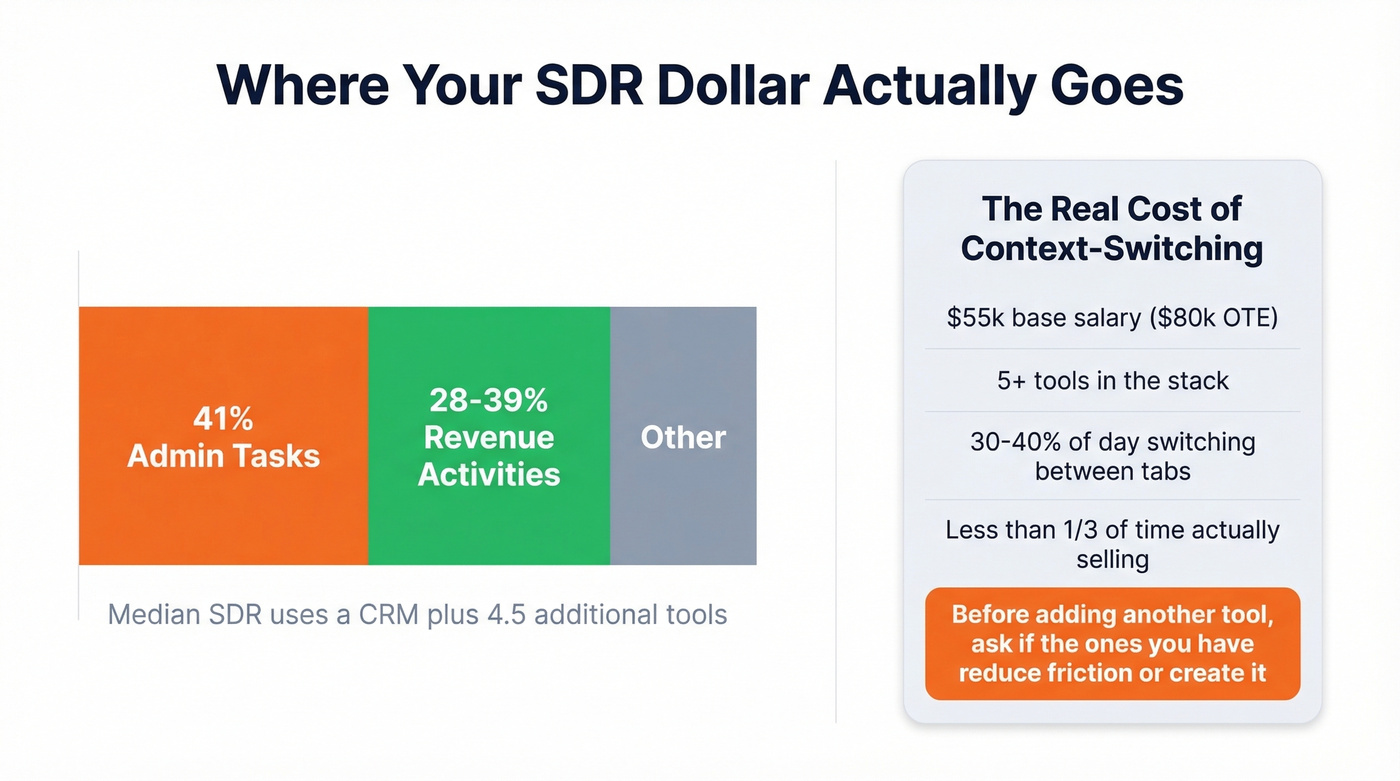
Let's be honest: you're paying an SDR $55k base ($80k OTE) to spend less than a third of their time actually selling. The rest is logging activities, updating CRM fields, and toggling between tabs. Before you add another tool to the stack, ask whether the ones you have are reducing friction or creating it.
Quota Pressure vs. Math
The gap between what leadership expects and what the numbers support is widening. Here's what the Bridge Group's 2025 study of 351 B2B companies shows on team structure and core benchmarks - and what the 6sense 2025 benchmark shows on cadence intensity:
| Metric | Number | Source |
|---|---|---|
| Daily dials | 44 | Bridge Group 2025 |
| Daily emails | 41 | Bridge Group 2025 |
| Quality conversations/day | 4.1 | Bridge Group 2025 |
| Attempts per contact | 21 | 6sense 2025 |
| Average cadence length | 53 days | 6sense 2025 |
| Quota attainment (avg) | 88% | 6sense 2025 |
Even well-run orgs are setting quotas their teams systematically miss. When reps need 21 attempts per contact over a 53-day cadence - and you're only getting around 4.1 quality conversations a day - the bottleneck isn't hustle. It's the math itself.
Here's the thing: if your average deal size sits below $15k, the SDR cost stack - salary, tools, management overhead, ramp time - may never produce a favorable CAC/LTV ratio. Post-ZIRP economics have exposed this mismatch, and the trend toward full-cycle AEs handling their own prospecting is a direct response. SDRs still make sense for complex, high-ACV sales. For everything else, do the math before you hire.

Bad data is the root cause behind most SDR challenges - burned domains, tanked deliverability, and wasted rep hours. Prospeo's 98% email accuracy and 7-day data refresh cycle keep your outbound clean. Meritt dropped their bounce rate from 35% to under 4% and tripled connect rates.
Stop burning your SDRs' time on dead emails.
Turnover and Burnout
SDR annual turnover runs around 40% - roughly triple the 13% US average across all roles, per Mercer's survey of 2,617 organizations. Each departure costs $78,500-$149,000 when you factor in recruiting, ramp time, lost pipeline, and vacancy gaps.
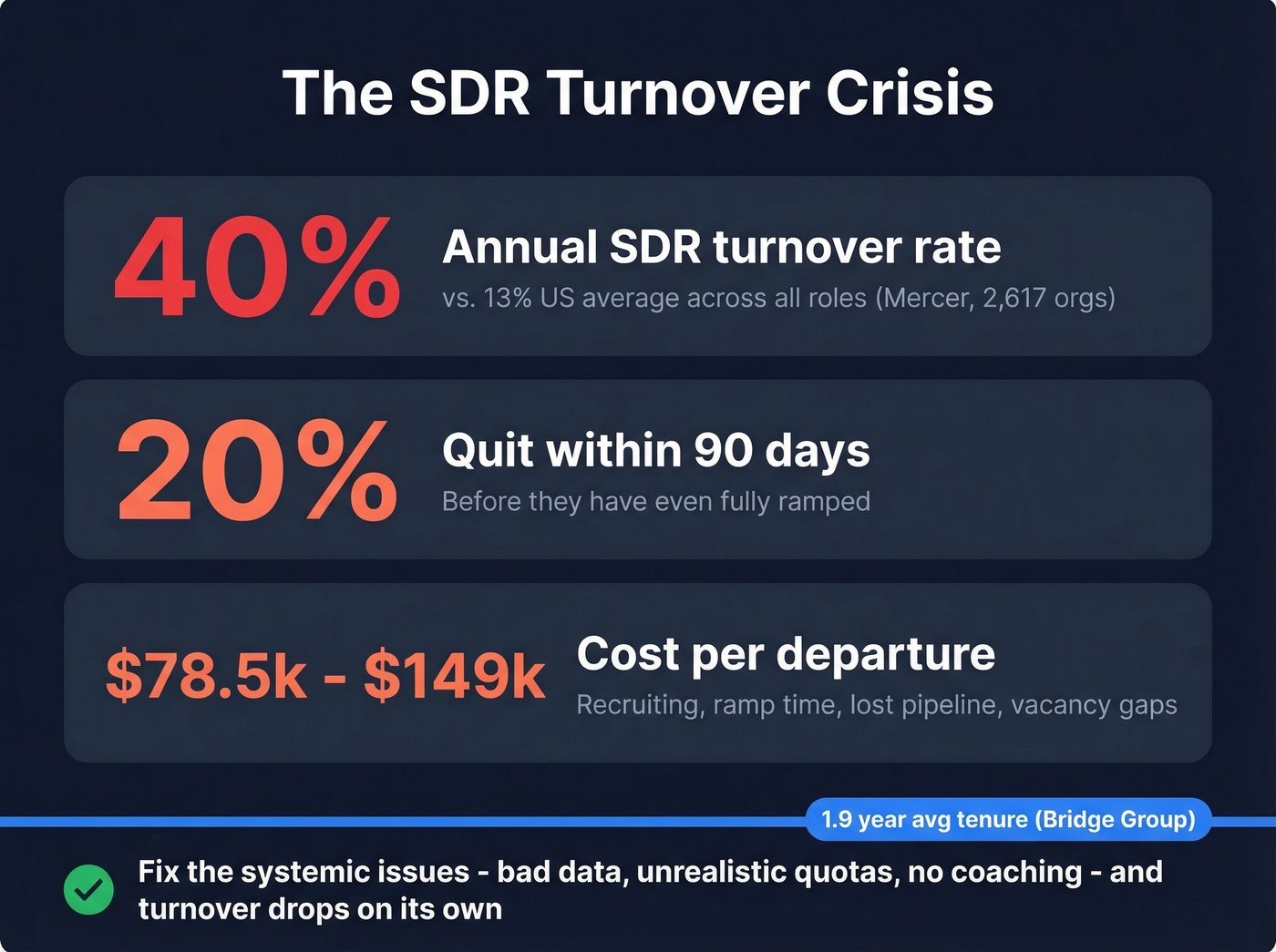
And 20% of new SDRs quit within 90 days, before they've even fully ramped. Average tenure sits at 1.9 years per the Bridge Group. The economics of constantly replacing entry-level reps are brutal, especially when the role itself is under structural pressure from both AI and the full-cycle AE trend. Skip the "pizza party retention strategy" - fix the systemic issues (bad data, unrealistic quotas, no coaching) and turnover drops on its own.
Sales and Marketing Misalignment
Only 8% of companies report strong alignment between sales and marketing. The breakdown point? 53% say it happens at the nurture-to-sales handoff. Less than 35% of engaged contacts even get a follow-up from sales.
Meanwhile, aligned teams generate up to 208% more revenue from marketing efforts. SDRs are either getting leads too cold, too late, or with too little context. The fix isn't another alignment workshop - it's behavior-based handoffs with SLAs enforced in the CRM, so engaged contacts get followed up within hours, not days. Layer in intent data from providers like Bombora to prioritize accounts showing active buying signals, and the handoff problem shrinks dramatically.
AI Is Reshaping the Role
60% of BDRs already use AI tools, and 62% say it enhances their productivity. But only 13% see AI as a direct threat to their role. Gartner predicts that by 2027, 95% of seller research will be AI-initiated - up from under 20% in 2024. And 2026 marks the first year "AI SDRs" appear in the Bridge Group's benchmark data.
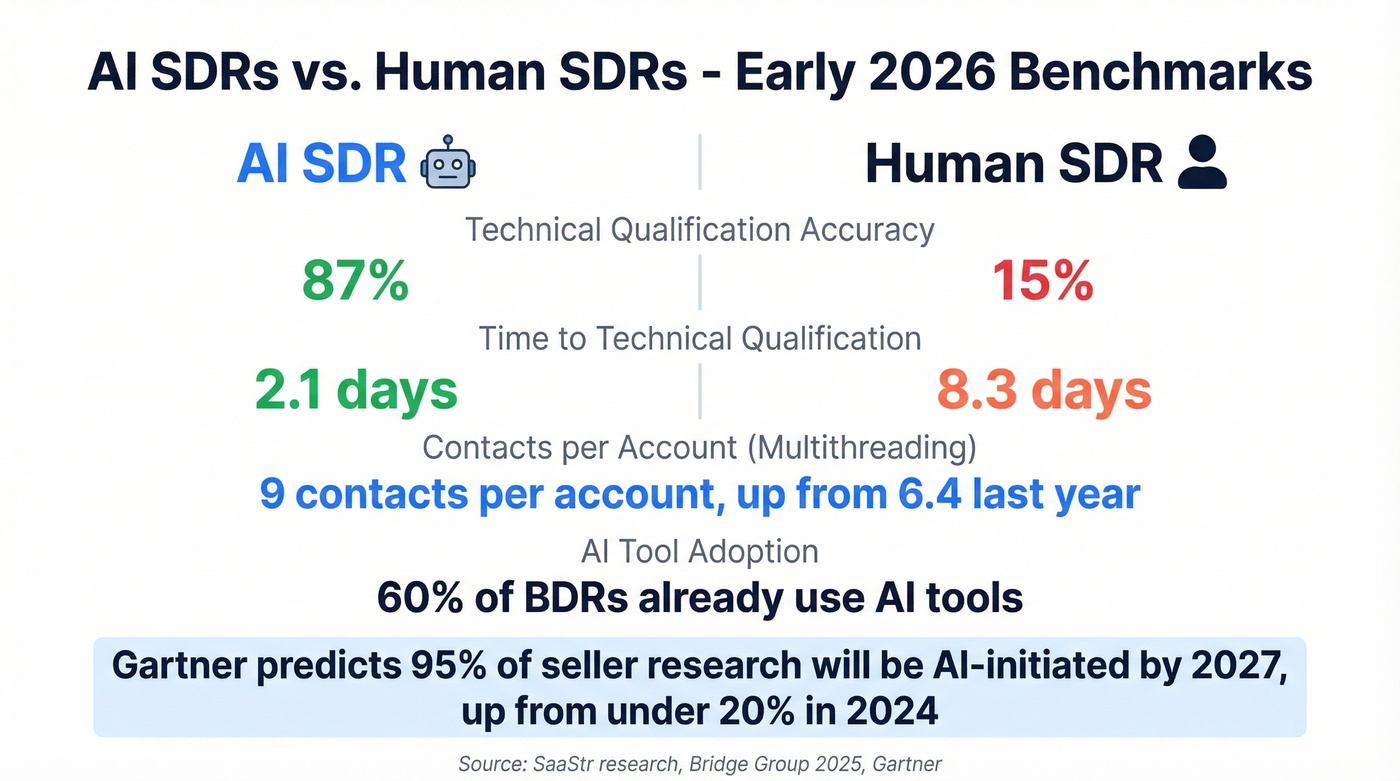
The early numbers are provocative. SaaStr's research shows AI SDRs answer technical qualification questions correctly 87% of the time vs. 15% for human reps, and cut time-to-technical-qualification from 8.3 days to 2.1. On r/salesdevelopment, the recurring question is whether AI will eliminate the SDR role entirely - but the data suggests transformation, not elimination. Multithreading has jumped to 9 contacts per account, up from 6.4 last year. The SDRs who thrive in 2026 use AI for account research and personalization, then bring the human judgment for relationship-building and complex qualification.
Ramp Time and Enablement Gaps
Average ramp time is 3.0 months - the lowest the Bridge Group has recorded since 2010. But ramp speed means nothing if reps aren't supported once they're live.
Supported BDRs hit 95% of quota vs. 80% for unsupported ones, per 6sense's benchmark of 262 BDRs. The manager-to-SDR ratio has tightened to 1:6.4 (down from 8 in recent years), which helps - but "support" means coaching, clean data, functional tooling, and clear handoff processes, not just manager access. That 15-point quota gap is the single most actionable stat in this entire article. If you're only going to fix one thing, make it enablement.
What Actually Fixes These SDR Challenges
Fix data first. When 43% of your team says data quality is their biggest problem, that's where you start. Clean emails protect your domain reputation, reduce wasted sends, and give reps confidence that their outreach is actually landing. In our experience, teams that fix data quality first see measurable results within the first month - often before any playbook changes.
Invest in enablement, not just tools. The 95% vs. 80% quota gap between supported and unsupported reps is enormous. Coaching, call reviews, and structured onboarding deliver more ROI than adding another tool to the stack. Tighten your manager-to-rep ratio and make enablement a line item, not an afterthought.
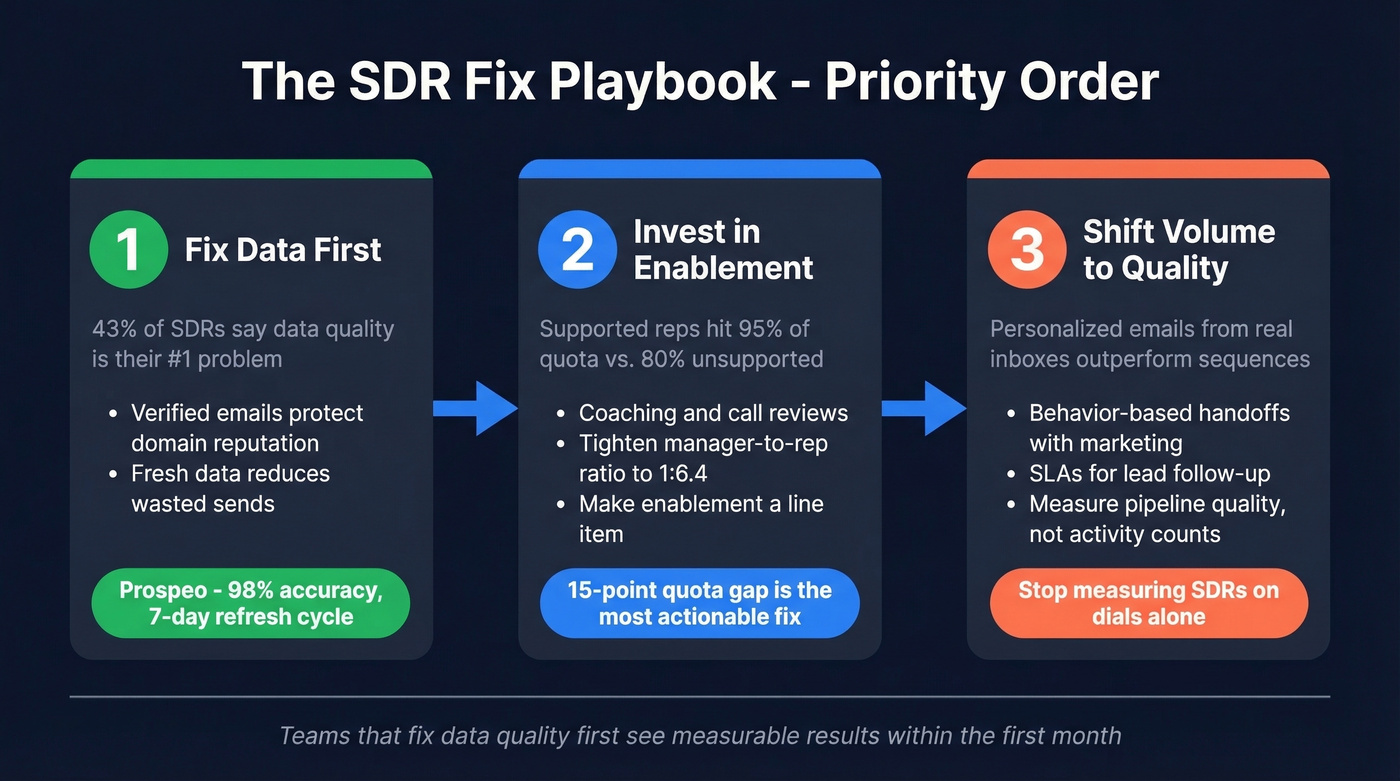
Shift from volume to quality. Fewer personalized emails from a real inbox outperform high-volume sequences in 2026. Build behavior-based handoffs with marketing. Set SLAs for lead follow-up. And stop measuring SDRs purely on activity counts - measure pipeline quality and conversion instead. For teams that can't overhaul their process fast enough, fractional SDR services are worth evaluating as a bridge.
Your SDRs already spend 41% of their day on admin. Don't make them waste the remaining selling time on bad numbers and stale contacts. Prospeo gives reps 300M+ verified profiles, 125M+ direct dials, and intent data across 15,000 topics - so every touch counts.
Give your reps data that actually connects them to real buyers.
FAQ
What are the biggest SDR challenges?
Bad data and declining channel effectiveness top the list. 43% of SDRs cite data quality as their biggest obstacle, and cold email reply rates have dropped to 5.1%. When nearly one in five emails never reaches the inbox, the role becomes structurally harder regardless of individual skill.
What percentage of SDRs hit quota?
Only about 16.6% consistently hit quota - the inverse of the 83.4% miss rate. Across the 6sense benchmark, BDRs achieve roughly 88% of quota on average. Quota-setting itself is often the problem, with targets disconnected from actual connect and conversion rates.
How can SDR teams improve performance quickly?
Start with data quality - verified emails and fresh phone numbers eliminate the most common source of wasted effort. Then invest in enablement: supported reps hit 95% of quota vs. 80% without structured coaching. Those two changes alone close the biggest gaps we see across teams.
Will AI replace the SDR role?
Not outright, but it's transforming it fast. 60% of BDRs already use AI tools, and Gartner expects 95% of seller research to be AI-initiated by 2027. The reps thriving now use AI for account research and personalization while handling complex qualification and relationship-building themselves.