

The SDR Competition Playbook: Formats, Scoring, Prizes, and What Nobody Tells You
It's 2:14 PM on a Thursday. Your floor is quiet. Half the team is "researching accounts," which really means scrolling their phones. The other half is grinding through a call list with the enthusiasm of someone filling out a tax form.
Only 34% of US workers are actively engaged at any given time, and every 5-point improvement in engagement drives a 3% lift in revenue. SDR competitions change the energy - sales teams using gamified engagement report 28.5% more revenue and 59% higher KPIs. But poorly designed contests create a week of chaos, reward the same two reps, and leave everyone else more disengaged than before.
The difference comes down to format, scoring, and prizes. Most managers wing all three.
What You Actually Need
- Three formats, rotated quarterly. One activity-based, one skill-based, one team-based. You don't need 12 contest ideas. You need 3 that you rotate.
- Score on weighted quality metrics, not raw dials. A VP conversation is worth more than 10 calls to office managers. Your scoring should reflect that.
- Budget $25-$150 per rep per month. A 10-person team can run effective monthly contests for $250-$1,500 total. Keep marquee contests to once a month to avoid burnout.
Competitions vs. Comp Plans
SDR competitions aren't a replacement for your comp plan. They inject urgency when momentum stalls - without touching base salary or commission structures.
| SPIFF / Contest | Commission | |
|---|---|---|
| Duration | 1-4 weeks | Ongoing |
| Reward type | Fixed (cash, gift, experience) | Variable % of revenue |
| Tied to | Specific actions | Long-term performance |
| Purpose | Shift behavior fast | Sustain baseline output |
Commissions reward outcomes over months. SPIFFs reward specific behaviors over days. A well-timed contest can redirect energy toward a new product launch, a lagging metric, or a pipeline gap - without renegotiating anyone's OTE.
Contest Formats That Actually Work
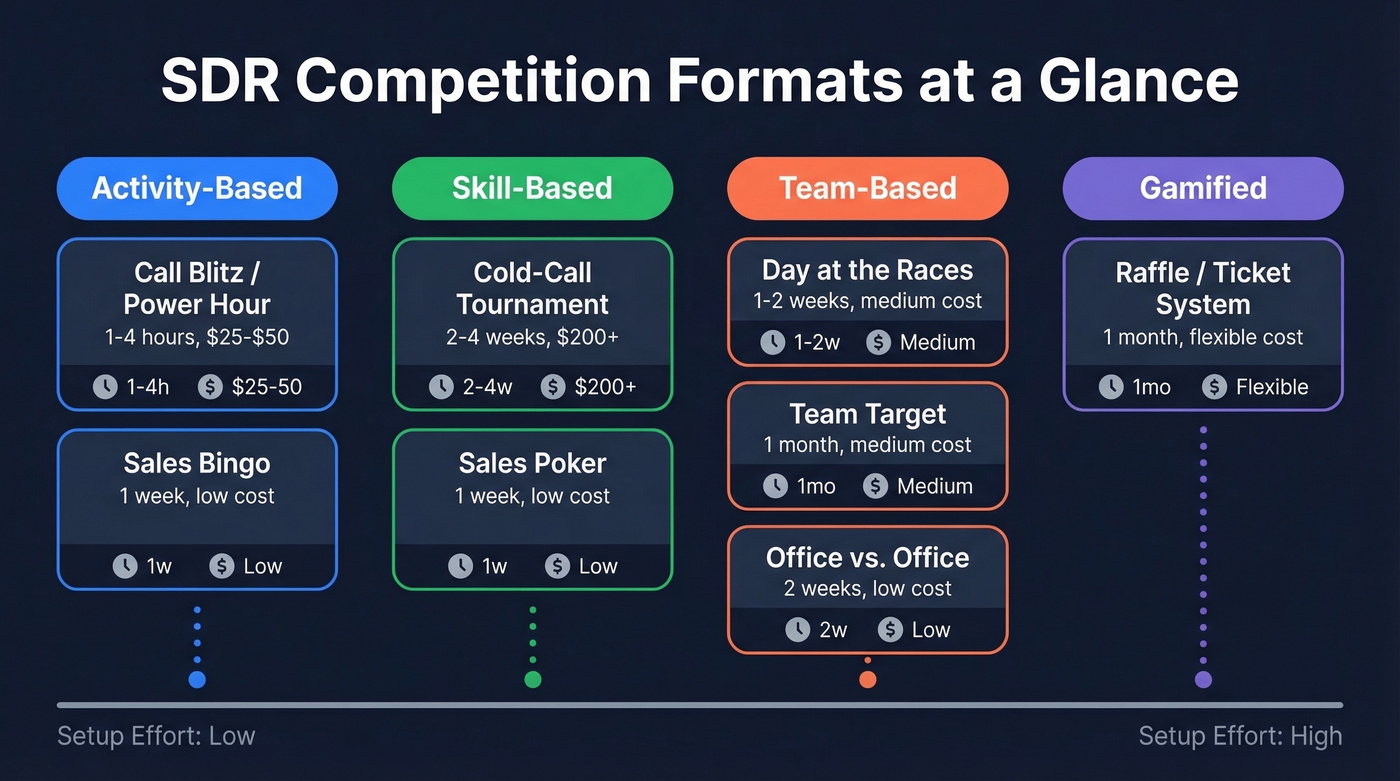
Not every format fits every team. Here are eight that work across remote, hybrid, and in-office setups, organized by what they actually test.
Activity-Based Formats
Call Blitz / Power Hour
The simplest format and the easiest to launch tomorrow. Set a 1-4 hour window, track dials, and crown a winner. Run it on Wednesday - it consistently has the highest pickup and reply rates of the week.
The key to keeping this honest: weight by contact title. A conversation with a VP earns 2 points, a manager earns 1. This prevents reps from blitzing through the easiest contacts on their list. Budget is minimal - $25-$50 for the winner - and it works just as well on Zoom as it does on the floor.
Day at the Races
If you try one team-based contest this quarter, make it this one. Mix SDRs into cross-functional teams, assign each team a "horse," and every meeting booked moves the horse forward. The mixed-team structure forces top performers to coach weaker ones, and it kills the "same two reps win every time" problem. It's also one of the most remote-friendly formats because the entire contest can run off a shared digital board.
Sales Bingo
Create a bingo card with specific outreach events: "booked a VP demo," "got a callback," "prospect opened email 5+ times," "handled a pricing objection." First rep to complete a line wins. This one-week format costs almost nothing, works async, and keeps the energy playful rather than pressure-heavy. Encourage creative squares - "got a prospect to laugh" is a legitimate morale booster.
Skill-Based Formats
Cold-Call Tournament
This is the most involved format, and it's worth every hour of setup. GTMnow documented a case study where they ran regional qualifiers - LA vs Bay Area - with finalists flown to HQ for a finals round and a $1,000 grand prize.
The fairness control that makes this work: use role-play prospects instead of live calls. This standardizes the objections each rep faces and removes the luck factor. Give reps the scenarios weeks in advance so they actually practice. Have a small judging panel with printed score sheets using this rubric:
| Dimension | 1 (Low) | 5 (High) |
|---|---|---|
| Comfort & confidence | Nervous, scripted | Natural, adaptive |
| Competitor knowledge | Can't differentiate | Clear value articulation |
| Objection handling | Freezes or deflects | Reframes with stories |
| Rapport building | Transactional | Warm, conversational |
| Close | No ask | Clear next step secured |
Provide individual feedback afterward. The learning value alone makes this worth running once a quarter. Plan 2-4 weeks and budget $200+ for the grand prize.
Sales Poker
Reps earn playing cards for hitting specific targets - a pair for two demos, an ace for a C-suite meeting. It's lightweight, async-friendly, and keeps things interesting because a rep with one great card can still beat someone with five mediocre ones. Budget: low. Duration: 1 week.
Team-Based Formats
Team Target
Nobody wins unless the team hits its collective target. This is the go-to format for lifting lower performers because top reps can't coast on individual numbers - they have to pull the whole team across the line. It creates peer accountability without managers having to micromanage. Duration: 1 month. Budget: medium.
Office vs. Office
Pit two offices - or two pods, for remote teams - against each other on a shared metric. Use a race-to-average structure so team size doesn't create an unfair advantage. Theme it around major events for extra energy: March Madness brackets in Q1, summer tournament brackets in Q3. This two-week format runs itself once you set the scoreboard.
Gamified Formats
Raffle / Ticket System
Reps earn raffle tickets for activities: 1 ticket per 10 calls, 2 tickets per rejection handled, 10 tickets per meeting booked. At the end of the month, draw a winner. The beauty is that nobody gets eliminated - even a rep having a rough week keeps accumulating tickets. The r/sales community consistently recommends this format for keeping mid-performers engaged, since the randomness gives everyone a shot.
Scoring Without Rewarding Bad Behavior
Raw activity metrics are gameable. A rep who dials 200 numbers and hangs up after two rings will crush a call blitz on paper. You need weighted scoring that rewards quality.
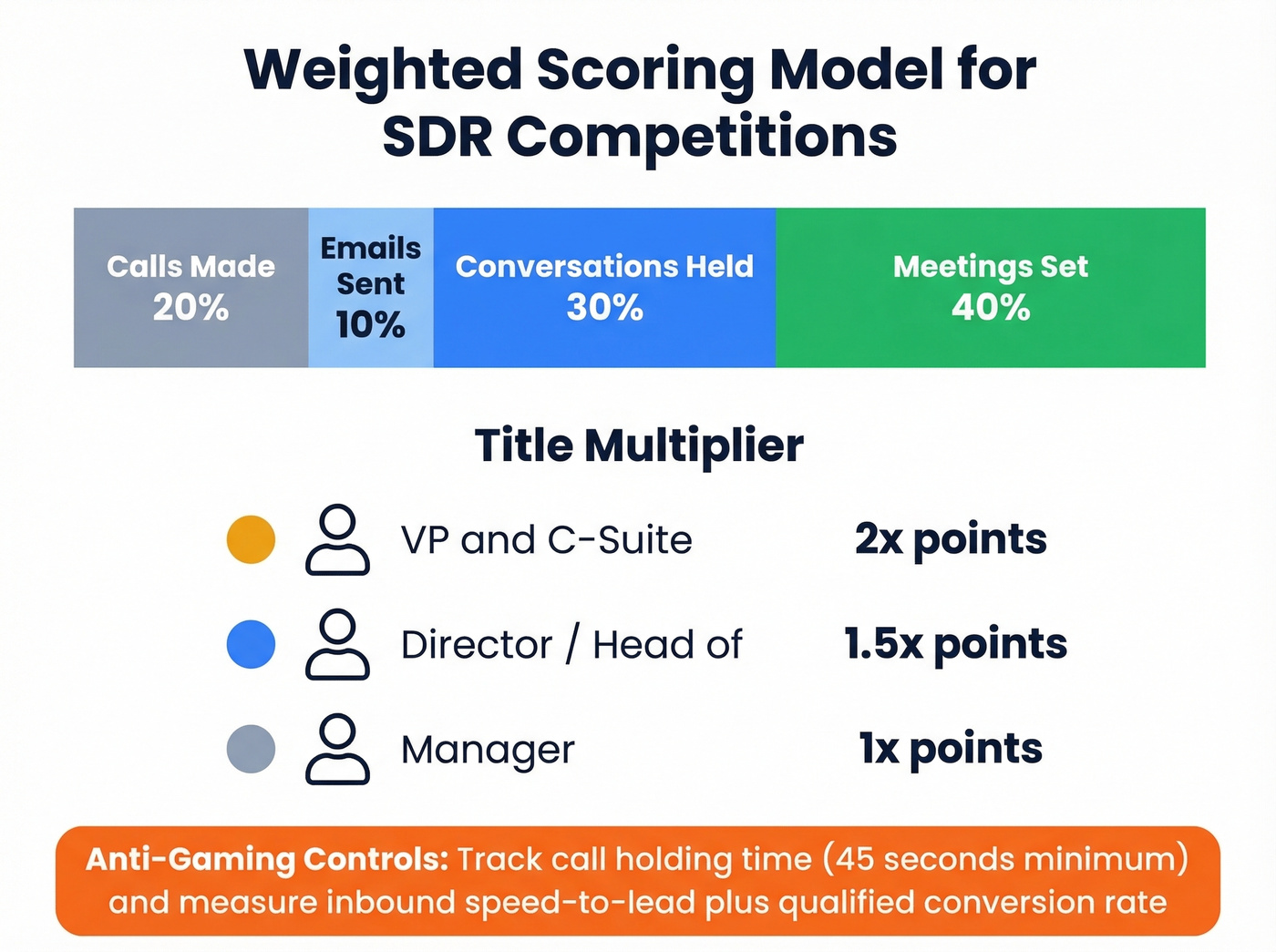
PersistIQ published a weighted scoring model that's still the best template we've found:
| Metric | Weight | Why |
|---|---|---|
| Calls made | 20% | Activity floor |
| Emails sent | 10% | Supporting channel |
| Conversations held | 30% | Proves real engagement |
| Meetings set | 40% | The actual goal |
Then layer in title-weighting: VP and C-level conversations earn 2 points, Director/Head earn 1.5, Manager earns 1. This forces reps to pursue higher-value meetings instead of padding stats with easy targets.
Two anti-gaming controls worth implementing. First, track holding rate - how long conversations actually last. A 45-second "conversation" isn't one. Second, for inbound SDRs, measure 50% speed-to-lead and 50% qualified conversion rate. Raw meeting counts on inbound are meaningless if half of them no-show.
Adapting Contests by Selling Motion
The contest that works for an SMB velocity team won't work for enterprise SDRs. Match the format to the motion.
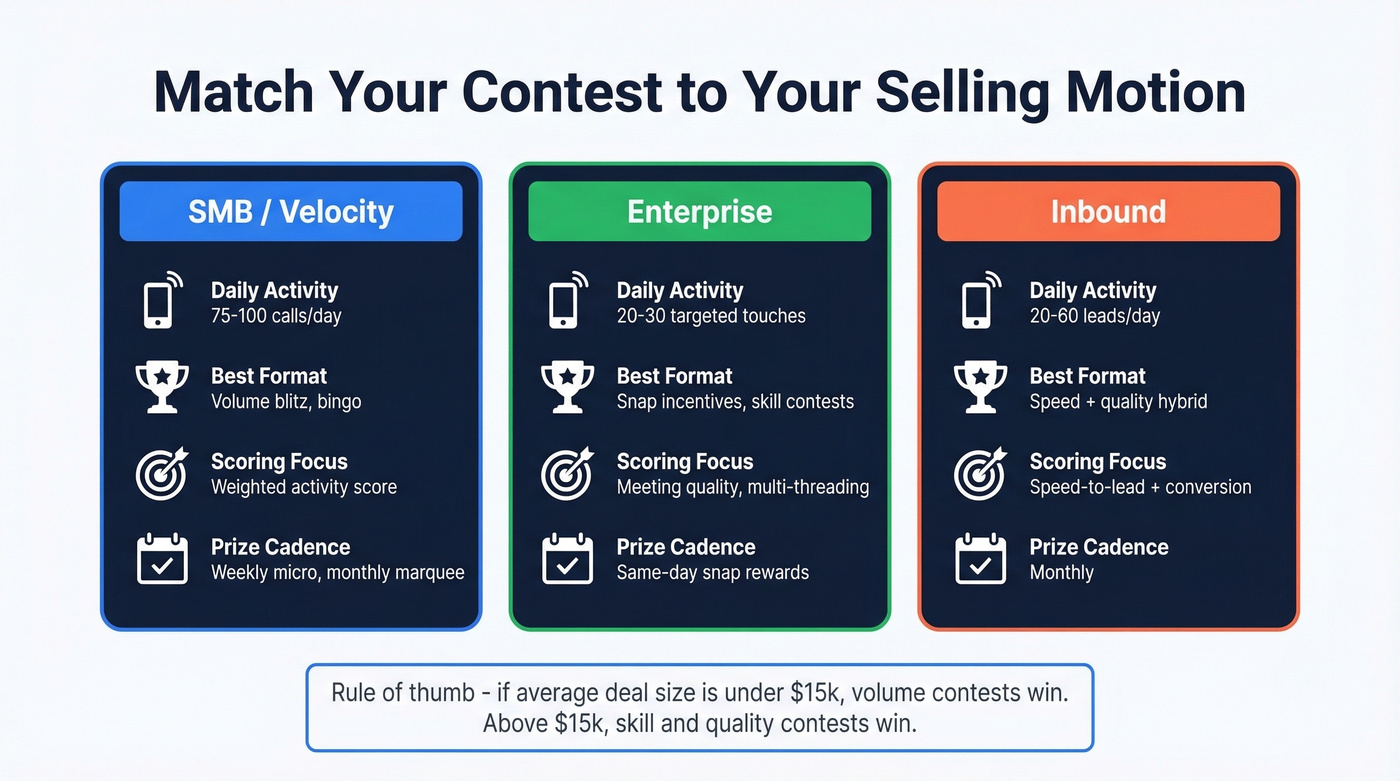
| SMB / Velocity | Enterprise | Inbound | |
|---|---|---|---|
| Daily activity | 75-100 calls/day | 20-30 targeted touches | 20-60 leads/day |
| Best format | Volume-based (blitz, bingo) | Snap + skill contests | Speed + quality hybrid |
| Scoring focus | Weighted activity score | Meeting quality, multi-thread | Speed-to-lead + conversion |
| Prize cadence | Weekly micro, monthly marquee | Same-day snap rewards | Monthly |
Here's the thing: if your average deal size is under $15k, volume-based contests will outperform skill-based ones every time. Enterprise SDRs working longer cycles with fewer accounts need a different approach entirely. One B2B sales team found that "snap incentives" - same-day pushes like "book 2 more meetings today, expense dinner" - create urgency without forcing artificial activity volume. Respect the selling motion in your contest design.

Weighted scoring rewards reps who reach VPs and C-suite buyers - but only if your data actually connects them. Prospeo's 300M+ profiles with 30+ filters let SDRs target decision-makers by title, intent, and company size, so every competition dial hits the right person.
Stop rewarding reps for calling bad numbers. Give them verified contacts.
Prizes That Actually Motivate
Cash seems like the obvious choice, but it's often the wrong one. SDRs already earn commission. Another $100 in cash blends into their paycheck and gets taxed. A $100 experience - dinner, concert tickets, an extra PTO day - feels distinct and memorable.
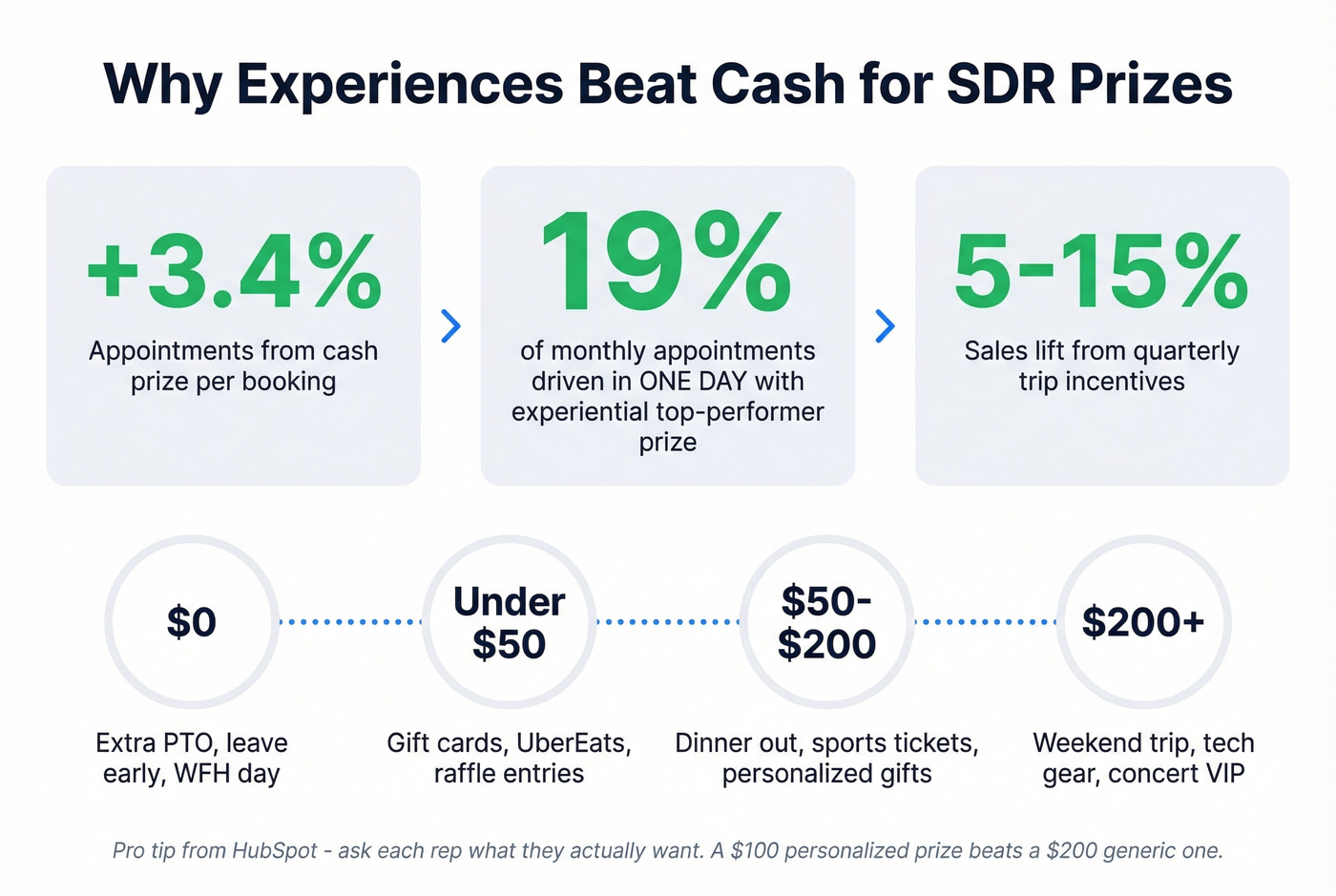
The data backs this up. EngageTech found that offering a cash prize per appointment increased appointments 3.4%. Adding a top-performer experiential prize drove 19% of the month's total appointments in a single day. Quarterly trip incentives lift sales 5-15%.
| Budget Tier | Prize Ideas |
|---|---|
| $0 | Extra PTO, leave early, WFH day, preferred parking |
| Under $50 | UberEats voucher, gift card, AirPods raffle entry |
| $50-$200 | Dinner out, sports tickets, chef's knife, whisky |
| $200+ | Weekend trip, tech gear, concert VIP, $1K cash |
Quick tax note: cash bonuses are taxable compensation. Non-cash prizes are often still taxable, but buying a $200 item through the company is cleaner than cutting a $200 bonus check.
The best practice we've borrowed from HubSpot's Dan Tyre: ask each rep what they actually want. One sales org's monthly grand prize is roughly $100, personalized to the rep - whisky for one, a chef's knife for another. That specificity signals you care about the person, not just the number.
Fix Your Data Before You Launch
We've watched teams run a call blitz where 2,000 dials produced 4 meetings, and 3 of those no-showed. The problem wasn't effort or technique. It was data - disconnected numbers, wrong direct dials, and stale records that never should've been in the list.
Contests amplify activity. That's the whole point. But amplified activity on bad data just means amplified waste. If a big chunk of your numbers are dead, your call blitz generated hundreds of wasted dials and a demoralized team.
Verify your call list before launch day. Prospeo's 125M+ verified mobile numbers with a 30% pickup rate and a 7-day refresh cycle mean your reps dial numbers that actually ring - not dead lines during a power hour. For email-based contests like bingo or poker, 98% email accuracy means your sequences land in inboxes instead of generating bounces that tank your domain reputation.

Call blitzes and power hours fall flat when 35% of emails bounce and half the phone numbers are dead. Prospeo delivers 98% email accuracy and 125M+ verified mobiles with a 30% pickup rate - so your contest leaderboard reflects real conversations, not wasted effort.
Reps book 26% more meetings when the data actually works.
Tools for Running Contests
Let's be honest: for teams under 50 reps, use a spreadsheet and Slack. Don't buy software until you've proven contests work for your team. The novelty of a new platform wears off fast - Reddit threads consistently flag adoption decay as the biggest risk with gamification tools.
Skip dedicated tools entirely if your team is under 20 people. A Google Sheet with conditional formatting and a Slack bot that posts updates every hour will get you 80% of the way there.
Once you've outgrown the spreadsheet:
| Tool | Starting Price | G2 Rating | Best For |
|---|---|---|---|
| Ambition | Custom | 4.6/5 | Large teams, full suite |
| SalesScreen | $20/user | 4.7/5 | TV leaderboards, visual energy |
| Spinify | $16/user | 4.5/5 | Gamification-first teams |
| SmartWinnr | $15/user | 4.5/5 | Coaching + contests combined |
| Pointagram | $5/user | 4.3/5 | Budget-conscious teams |
| Plecto | $200/mo | 4.3/5 | Dashboard-heavy orgs |
If you're building contests around outbound, make sure your stack supports the basics: SDR tools, a clean cold calling system, and a repeatable sequence management process.
Quarterly Contest Calendar for 2026
You don't need 12 unique contest ideas per year. You need three solid formats that you rotate, with micro-incentives filling the gaps.
| Quarter | Marquee Contest | Format | Micro-Incentives |
|---|---|---|---|
| Q1 | Cold-Call Tournament | Skill-based, 3 weeks | Weekly snap bonuses |
| Q2 | Team Target Race | Team-based, 1 month | Daily bingo cards |
| Q3 | Call Blitz Championship | Activity-based, weekly | Raffle tickets |
| Q4 | Office vs. Office Finals | Team-based, 2 weeks | Sales poker |
Run one marquee contest per month with micro-incentives in between. Build in rest weeks - the consensus on r/sales is that constant contests lead to burnout faster than anything else. A week off between pushes keeps the energy fresh when the next one launches.
Before each quarter, refresh your contact data and tighten your targeting with an Ideal Customer Profile. If you're struggling to keep pipeline full, audit your sales prospecting techniques and the sales activities you're actually rewarding.
SDR Competition FAQ
How often should you run SDR competitions?
One marquee contest per month with micro-incentives in between. Running contests every week causes burnout and dilutes the urgency that makes them effective. Build in at least one rest week between major pushes.
What's a good budget for an SDR contest?
Plan $25-$150 per rep per month. A 10-person team runs effective monthly contests for $250-$1,500 total. Non-cash prizes - experiences, PTO, personalized gifts - deliver more impact per dollar than cash at this budget level.
How do you prevent SDRs from gaming contest metrics?
Weight scores by contact title (VP = 2 points, Manager = 1), track conversation holding rate to catch short hang-ups, and measure qualified conversion instead of raw activity. Title-weighting alone eliminates most stat-padding.
Do sales contests work for remote teams?
Yes. Bingo, raffle, poker, and bracket formats are all async-friendly. Use Slack leaderboards and digital scoreboards. Day at the Races works especially well with a shared board that updates in real time - no office floor required.
What's the cheapest way to verify call lists before a contest?
Prospeo's free tier includes 75 verified emails and 100 Chrome extension credits monthly - enough to spot-check a contest list. For full verification, credit-based pricing starts at roughly $0.01 per lead with no contracts.
The best SDR competition is the one you actually run. Pick a format, verify your data, and launch it next week.