

SDR Tips That Actually Work (With Data, Scripts, and a Daily Schedule to Steal)
It's your second week as an SDR. You've made 200 calls and sent 300 emails. You have zero meetings booked. Your manager says "keep going, it's a numbers game," which is the sales equivalent of "thoughts and prayers."
The average SDR generates $3M in annual pipeline, and 70% of sales leaders plan to hire more of them. The role matters. The SDR tips you're getting don't. Here's what actually moves the needle.
The Quick Version
- Build signal-based target lists instead of blasting ICP spreadsheets. Only 3-5% of your market is buying right now.
- Protect your 10 AM-12 PM calling block. Mid-week, 4-5 PM calls are 50-70% more effective than random-hour dials.
- Verify every email before it enters your sequence. If your bounce rate is above 2%, your data is the problem, not your copy.
Stop Spray-and-Pray: The Signal Stack
Everyone tells new SDRs to "make more calls." That's wrong. Volume is the lazy answer. The reps hitting 10-15% dial-to-meeting rates aren't making more calls - they're making better-timed calls to better-researched prospects.
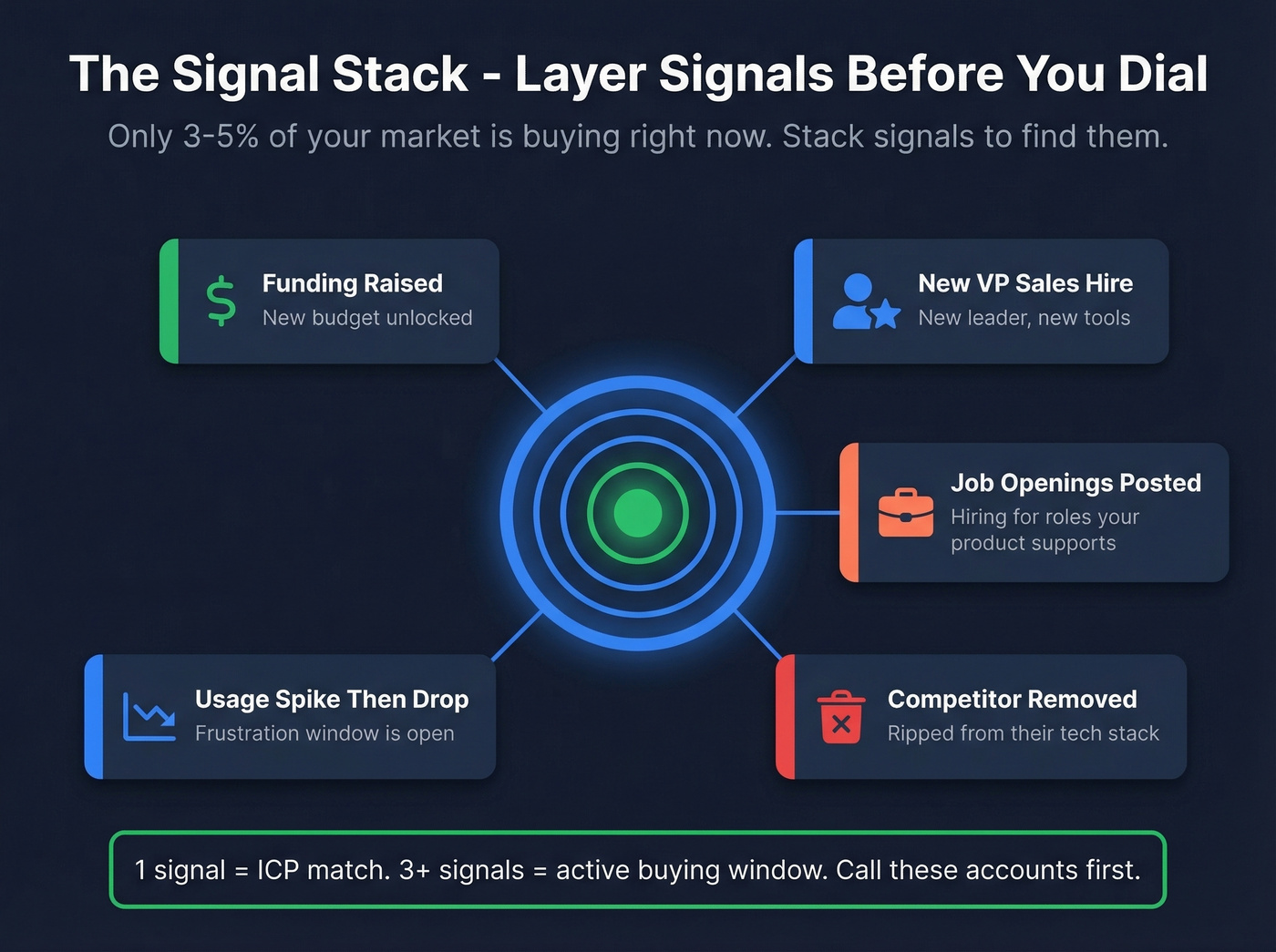
Only 3-5% of your market is actively buying at any given time. Another ~7% is open to a conversation. That means roughly 90% of your list doesn't care, no matter how clever your opener is. We call this approach The Signal Stack - layering multiple buying indicators on the same account before you ever pick up the phone.
Five signals worth tracking:
- Funding raised - new budget unlocked
- New VP Sales hire - new leader, new tools
- Job openings for roles your product supports
- Competitor removed from their tech stack
- Product usage spike then drop - frustration window
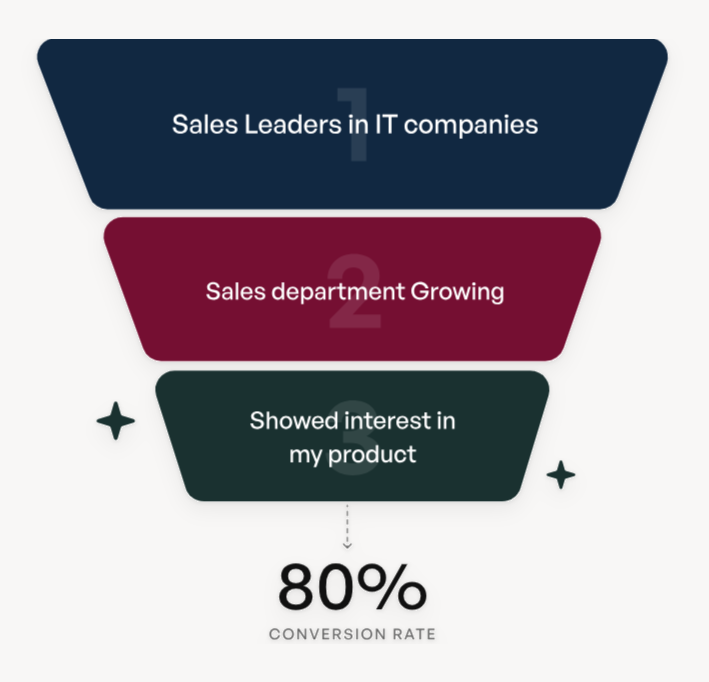
Don't act on a single signal. A company that just raised a Series B, hired a VP of Sales, and posted three SDR openings is a fundamentally different prospect than one that merely fits your ICP filters. The consensus on r/sales backs this up - the top-performing reps almost always talk about research quality over dial quantity.
Prospeo makes signal stacking practical: it tracks 15,000 intent topics via Bombora, so you can layer buyer intent with job changes and funding signals to find accounts showing multiple buying indicators at once.
The 10-to-Noon Rule: Your Daily Schedule
Most SDRs average 3.6 quality conversations per day. The difference between reps who book meetings and reps who don't isn't talent - it's how they protect their calling hours.
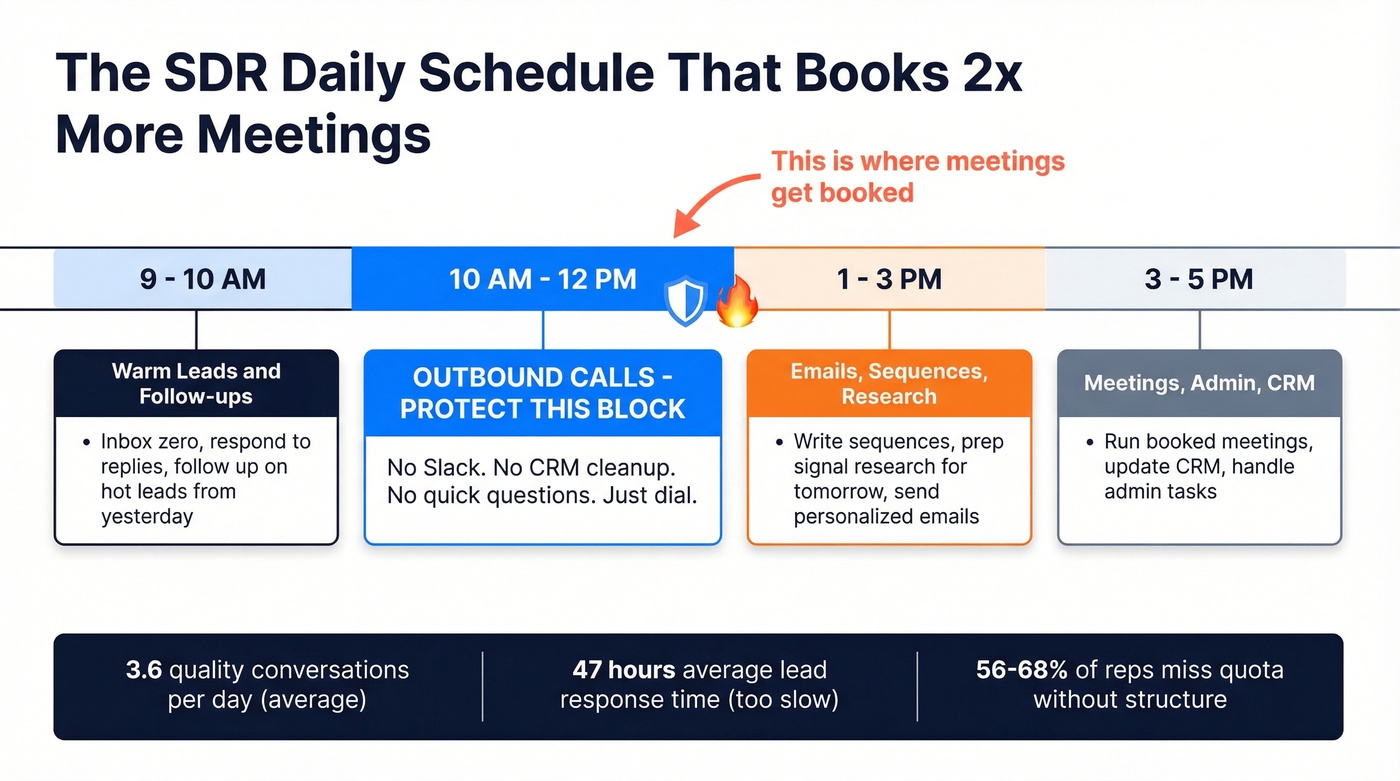
Here's the thing: the average lead response time is 47 hours. By then, your prospect has already talked to a competitor. Speed kills deals, and slow follow-up kills more.
| Time | Activity |
|---|---|
| 9-10 AM | Warm leads, inbox, follow-ups |
| 10 AM-12 PM | Outbound calls (protect this block) |
| 1-3 PM | Emails, sequences, research |
| 3-5 PM | Meetings, admin, CRM updates |
The 10 AM-12 PM block is sacred. No Slack. No CRM cleanup. No "quick question" from your AE.
We've seen SDRs who protect this window consistently book 2x more meetings than those who let it fragment. Two hours of dedicated prospecting is what separates quota-crushers from the 56-68% of reps who miss quota entirely.
Cold Call Script That Books Meetings
Here's a 35-second framework: Who you are, why you're calling, what you want.
"Hey [Name], this is [Your Name] with [Company]. How are you?
I'm part of the team that supports companies like [Similar Company] with [specific outcome]. We've been helping them [concrete result].
I'd love to get 15 to 20 minutes on your calendar this week to see if it makes sense for you. Does Thursday afternoon work?"
No feature dumps. No "I know you're busy." The ask comes within 35 seconds.
When they push back with "We already use [competitor]," don't argue. Re-sell the time: "Totally get it - still makes sense to get introduced so you have a backup option. Fifteen minutes, worst case you confirm you're in good shape."
One tip that sharpened our own team's conversations: frame every question with a reason. Instead of "What tools are you using?" try "I'm asking because companies your size usually run into [problem] - what are you using to handle that?" It gives the prospect a reason to answer honestly instead of deflecting.
To reduce no-shows, book same-week whenever possible, send a strong agenda within 5 minutes of confirmation, and confirm live the morning of. It takes 7-8 attempts to reach a prospect. Most SDRs quit after three.

Your cold calls are only as good as your data. Prospeo layers 15,000 intent topics with job changes and funding signals so you call prospects in their buying window - not 6 weeks after it closes. That's how SDRs hit 10-15% dial-to-meeting rates.
Stop guessing who's buying. Start stacking signals for free.
Cold Email Without Burning Your Domain
Everyone talks about subject lines and personalization. Nobody talks about the infrastructure that determines whether your email reaches an inbox at all.
Get SPF, DKIM, and DMARC configured on every sending domain. If you don't know what those are, ask your ops team today - this Cloudflare guide is a good starting point.
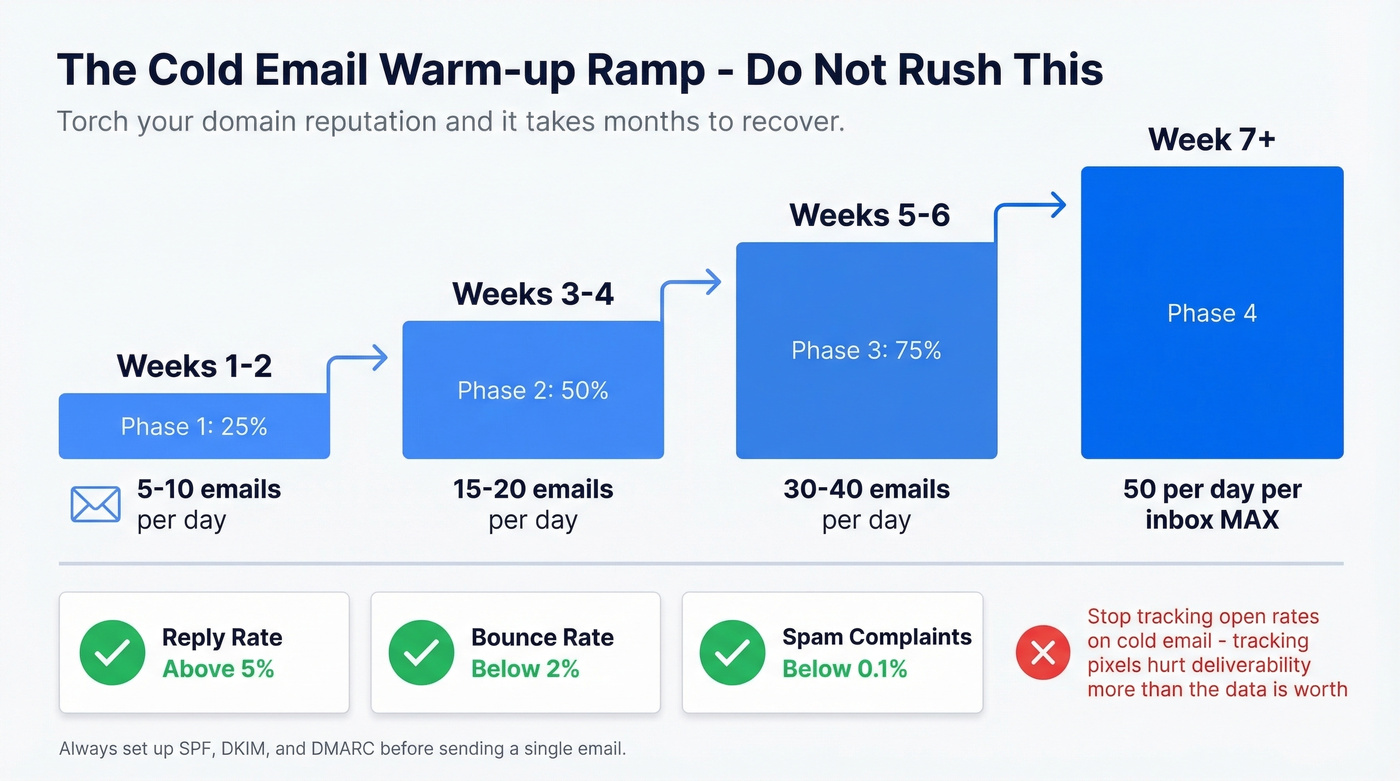
The warm-up ramp that works: start at 5-10 emails/day for weeks 1-2, scale to 15-20 by weeks 3-4, reach 30-40 by weeks 5-6, and cap at 50/day per inbox after week 7. Rush this and you'll torch your domain reputation in ways that take months to recover from.
Monitor weekly:
- Reply rate above 5%
- Bounce rate below 2%
- Spam complaints below 0.1%
Stop tracking open rates on cold email. Tracking pixels hurt deliverability more than the data is worth.
Your data source matters here more than your copywriting. Prospeo delivers 98% email accuracy, 125M+ verified mobile numbers with a 30% pickup rate, and refreshes data every 7 days versus the 6-week industry average. That's how you keep bounce rates low and protect your sending domains long-term.
Benchmarks Every Rep Should Know
| Metric | Average | Top Performer |
|---|---|---|
| Dial-to-meeting | 2-3% | 10-15% |
| Connect rate | 16-17% | 18-22%+ |
| Touches per account | 16 | 16+ across 3+ channels |
| Meetings/month | 5-25 | 15-25 |
| Quota attainment | 56-68% | 80%+ |
| Cold email reply rate | 1-5% | 8-12% |
| Pipeline from SDRs (outbound) | 46-53% | 60-73% |
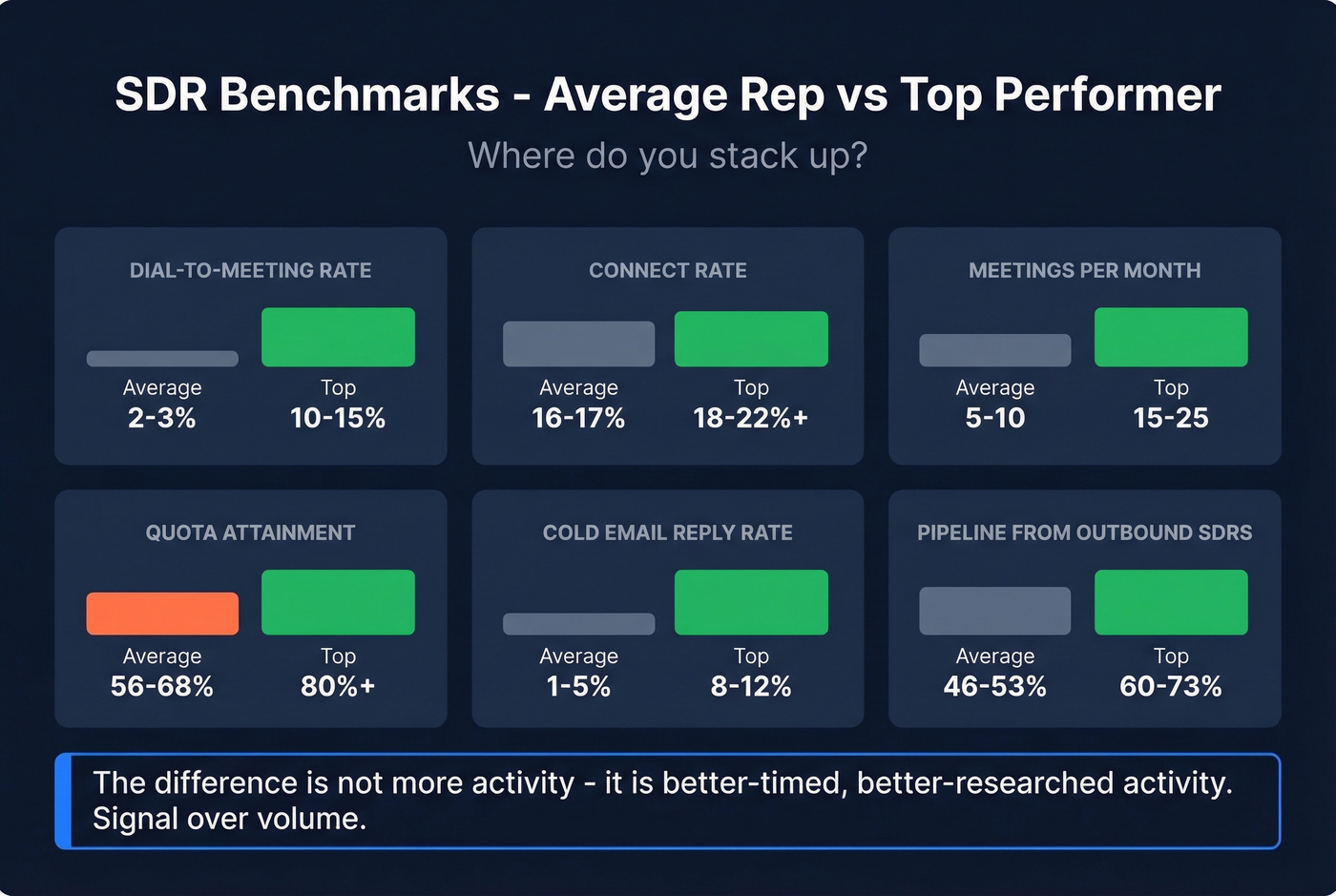
Top performers don't necessarily make more attempts per prospect. They make better-targeted attempts at better-timed moments. That's the whole point of The Signal Stack.
Habits That Save Hours Every Week
The biggest killer isn't lack of effort - it's misdirected effort.
New SDRs drown in information overload during onboarding, trying to memorize the entire product when they only need the top 3 buyer pain points and the 2 features that solve them. They lean too hard on scripts until they sound robotic, then abandon scripts entirely and ramble. The sweet spot is using a script as a guardrail while staying conversational enough to actually listen - and that balance takes about 3-4 weeks of deliberate practice to find.
A simple habit that pays off fast: 2-3 minutes of pre-call research - one personal insight, one trigger event - before you dial. It keeps you relevant without killing throughput.
The other common trap is qualifying too loosely or too strictly. Too lax and your AEs stop trusting your meetings. Too strict and you never book any. And if you're treating a demo request the same as a whitepaper download, you're ignoring intent signals that should change your entire approach. Gong's research on qualification frameworks is worth reading here.
Hot take: If your average deal size is under $10k, you probably don't need a 12-touch multi-channel sequence. Three well-timed, well-researched touches will outperform twelve lazy ones every time. Skip the elaborate cadence and focus on timing.
AI Tools - Use Them, Don't Trust Them
Look, 85% of salespeople report increased prospecting efficiency with AI. That's real.
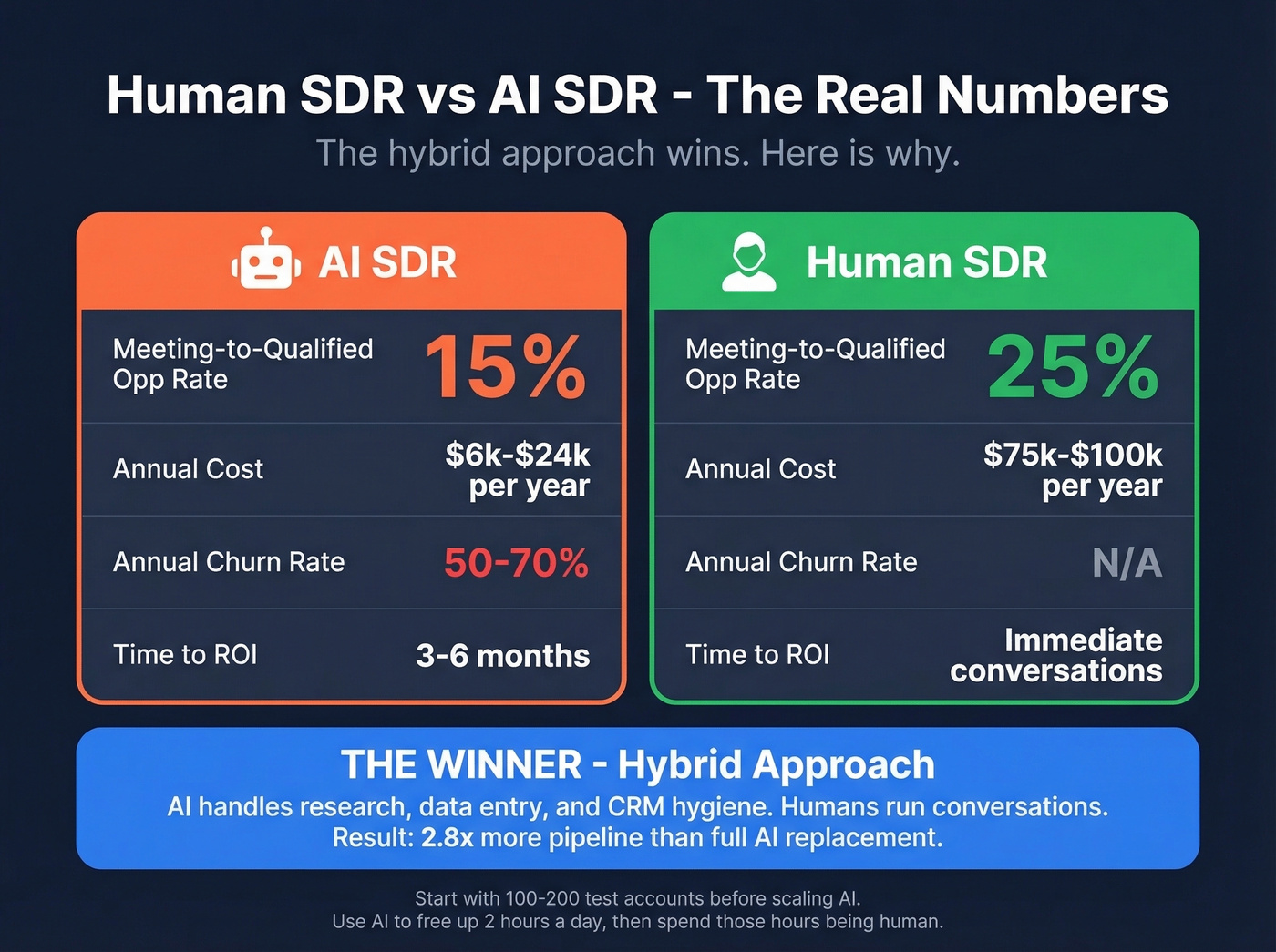
But AI SDRs convert meetings to qualified opportunities at just 15%, compared to 25% for humans. The hybrid approach - AI handling research, data entry, and CRM hygiene while humans run actual conversations - produces 2.8x more pipeline than full AI replacement.
The economics are tempting: a human SDR costs $75k-$100k/year fully loaded, while AI SDR platforms run $500-$2,000/month. But AI SDR tools churn at 50-70% annually, which tells you everything about the gap between the pitch and the reality.
Expect 3-6 months to see positive ROI, and start with 100-200 test accounts before scaling. Use AI to free up 2 hours a day on admin and research. Then spend those hours being human - that's still where deals actually get made.
The best SDR tips in 2026 come down to four things: signal over volume, protected calling blocks, verified data, and a hybrid approach to AI. Master those and you'll outperform the majority of reps still grinding through unresearched lists.
A bounce rate above 2% means your data is sabotaging your outreach - and your domain. Prospeo delivers 98% email accuracy with a 7-day refresh cycle, so every email in your sequence hits a real inbox. At $0.01 per verified email, bad data is a choice.
Protect your domain and your quota. Verify before you send.
FAQ
How many calls should an SDR make per day?
Target 50-80 dials to generate 3-4 quality conversations. Focus on mid-week, 4-5 PM timing and pre-call research over raw volume. Top performers convert at 10-15% dial-to-meeting versus the 2-3% average.
What's a good meeting-booked rate?
Strong outbound reps average 10-15 meetings per month. Track your dial-to-meeting conversion rate (aim for 4-8%) rather than total meetings - it's a better signal of skill improvement over time.
How do I keep cold emails out of spam?
Set up SPF, DKIM, and DMARC on every sending domain. Warm up new inboxes over 7 weeks starting at 5-10 emails/day, capping at 50. Keep bounce rate under 2% by verifying every address before sending.
What tools help new SDRs ramp faster?
A sequencer (Smartlead, Instantly, or Salesloft), a verified data source for accurate emails and direct dials, and a CRM with activity tracking. Skip the 10-tool stack - three reliable platforms beat a dozen mediocre ones.