

Sell the Sizzle, Not the Steak: What It Really Means and How to Do It
You're staring at a blank cold email draft. You type your product's name, its three best features, a pricing tier, and a calendar link. Nobody's clicking that. The features are accurate. The email is dead.
Here's the thing most people get wrong about "sell the sizzle not the steak": they treat it like you should only lead with emotion. Wheeler's actual method is sequencing - open with the sizzle, then bring in the technical points. The man who coined the phrase was explicit that the "cow" still matters.
The Core Idea (Quick Version)
Elmer Wheeler framed everything around one buyer question: "What will it do for me?" That's your audit.
Every sentence in your pitch should answer that question first. If a sentence describes what the product is instead of what it does for the buyer, you're selling steak. Wheeler's own examples made this visceral: sell the bubbles, not the champagne. The whiff, not the coffee. The tang, not the cheese. Lead with the sensory, emotional, outcome-driven hook - then bring in the technical details that close the deal.
Later in this piece, you'll find the Sizzle Audit framework: a four-step transformation that turns any feature into a benefit your buyer actually feels.
Origin of the Phrase
Most people treat "sell the sizzle" like folk wisdom - something a sales manager said once that stuck. It's not.
Elmer Wheeler was a bulky thirty-four-year-old running the Tested Selling Institute at 521 Fifth Avenue in New York when The New Yorker profiled him in 1938. He'd started selling vacuum cleaners door-to-door in Rochester at fifteen. By his mid-thirties, he'd built a whole business around a simple idea: don't guess what words sell. Test them.
Over ten years, Wheeler created 105,000 "Tested Selling Sentences" for 5,000 products - and threw away roughly 100,000 of them. He tested these sentences on 19 million people. This wasn't motivational speaking. It was large-scale message testing decades before the internet existed.
The numbers tell the story. Texaco paid Wheeler $5,000 for nine words: "Is your oil at the proper level today, sir?" That's $555.55 per word - in 1930s dollars. For Barbasol, he tested 141 different sentences before landing on "How would you like to cut your shaving time in half?" The result was a 300% sales lift. His square clothespin demo was even simpler: he'd hold one up and say "They won't roll." Two words. Millions of clothespins sold.
Wheeler wasn't a copywriter who got lucky once. He was a researcher who systematized persuasion. His great motif, as The New Yorker put it, was Wheelerpoint No. 1: "Don't Sell the Steak - Sell the Sizzle!" But he was careful to add: "The sizzle has sold more steaks than the cow ever has, although the cow is, of course, mighty important."
The cow matters. The sequencing matters more.
Wheeler's 5 Wheelerpoints
Different summaries float around, but these five ideas are the core of what Wheeler taught.
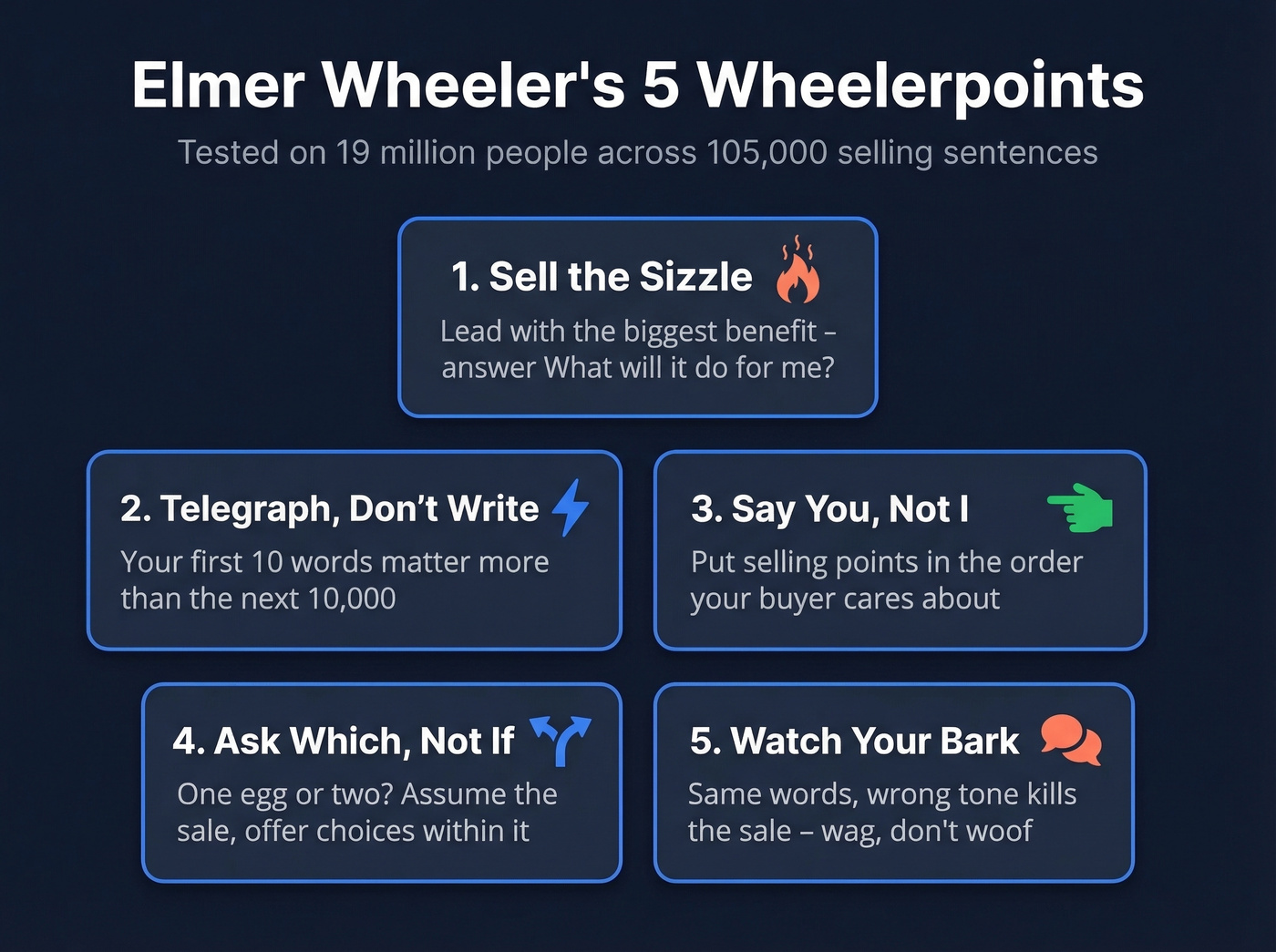
1. Don't Sell the Steak - Sell the Sizzle. Lead with the biggest benefit. Your subject line, your hero section, your opening sentence should answer "What will it do for me?" before anything else.
2. Don't Write - Telegraph. "Your first ten words are more important than your next ten thousand." Front-load value. In cold email, your first line decides whether the rest gets read.
3. Say "You," Not "I." Wheeler called this "you-ability." Put selling points in the order the customer cares about. "You'll close deals faster" beats "Our platform accelerates pipeline velocity."
4. Don't Ask If - Ask Which. At an Abraham & Straus soda fountain, Wheeler trained clerks to hold an egg in each hand and ask "One or two eggs today?" instead of "Would you like an egg?" Assume the sale and offer choices within it.
5. Watch Your Bark. Your tone has a "Woof" (aggressive) and a "Wag" (friendly). The same words delivered with the wrong tone kill the sale. A pushy follow-up email with perfect benefit language still feels pushy.
Why Benefits Outsell Features
The psychology behind Wheeler's framework is now well-documented, even if he was working on instinct in the 1930s. Harvard professor Gerald Zaltman's widely cited research suggests 95% of purchasing decisions happen subconsciously. Features speak to the rational brain. Sizzle speaks to what actually decides.
A 2022 peer-reviewed paper in the Journal of Personal Selling & Sales Management formally examined benefits, features, discounts, and value as distinct communication foci - evidence that the distinction Wheeler intuited is still a legitimate axis of sales research today.
Wheeler was running massive message tests on real buyers before A/B testing had a name. He didn't need the neuroscience. "Cut your shaving time in half" outsold 140 other sentences about the same product. That was all the proof he needed.

Wheeler tested 141 sentences to find one that converted. You don't need to guess which prospects to email - you need data accurate enough that every send reaches a real person. Prospeo's 98% verified email accuracy means your sizzle-packed cold emails actually land in inboxes, not bounce logs.
Your best subject line is worthless if it bounces. Fix the data first.
How to Find Your Sizzle
Take any feature and run it through four columns: Feature -> So What? -> Which Means -> The Sizzle. Each step pushes you closer to what the buyer actually cares about. Most feature-benefit exercises stop at two columns, and that's why the "benefits" still sound like features wearing a costume. The intermediate steps - "So What?" and "Which Means" - are what prevent you from writing benefits that are still too abstract to land.
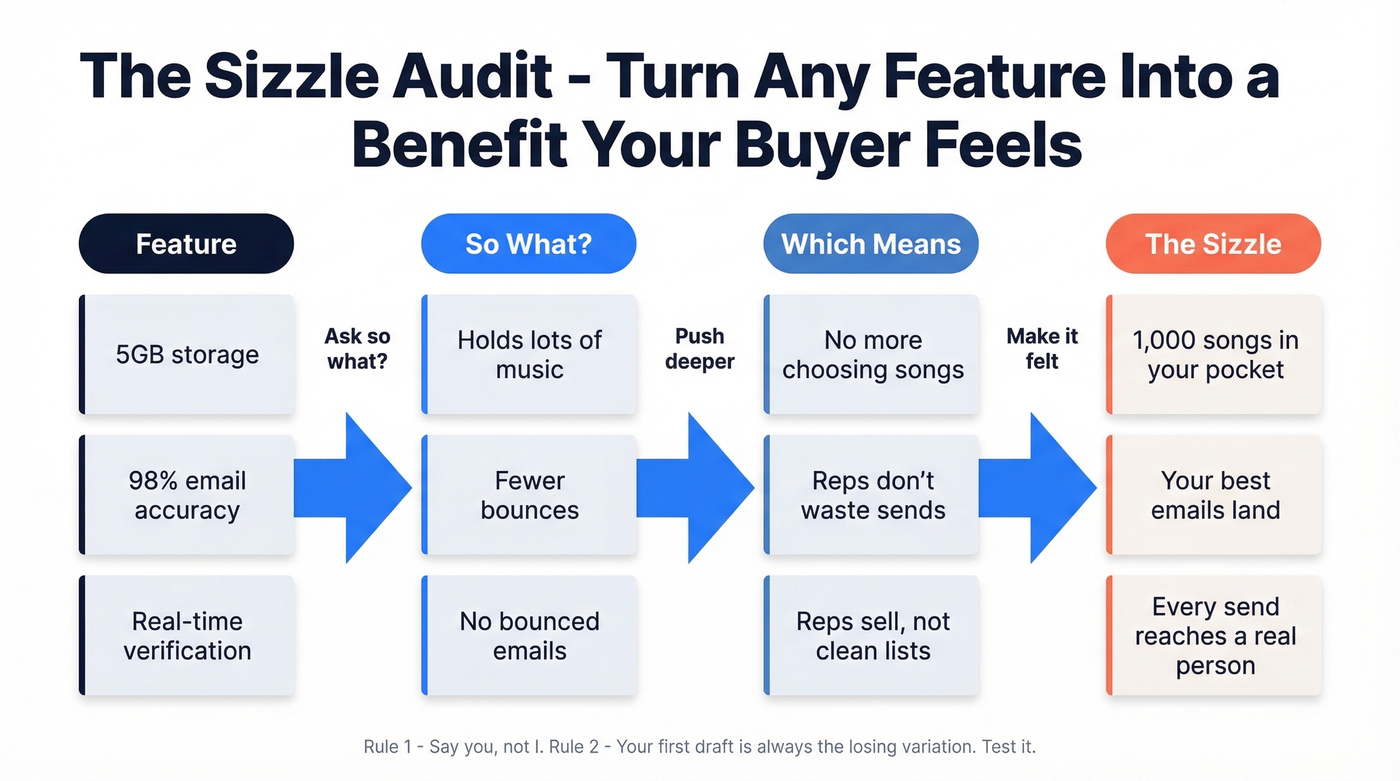
| Feature | So What? | Which Means | The Sizzle |
|---|---|---|---|
| 5GB storage | Holds lots of music | No more choosing songs | 1,000 songs in your pocket |
| 98% email accuracy | Fewer bounces | Reps don't waste sends | Your best emails land |
| Real-time email verification | No bounced emails | Reps sell, not clean lists | Every send reaches a real person |
Write down your top five features. For each one, ask "So what?" until you hit an emotional or practical outcome the buyer feels in their daily life. That's your sizzle.
Two rules make this work. First, use Wheeler's "you-ability" - say "you" not "I." Second, remember Joanna Wiebe's line: "The first iteration is always the losing variation." We've run this exercise with dozens of sales teams, and the first pass is always too abstract. Test it. Rewrite it. Wheeler tested 141 sentences for a single shaving cream. You can test five subject lines.
Modern Sizzle in Action
Apple iPod: the archetype. Steve Jobs didn't say "5GB of flash storage." He didn't even say "convenient music player." He said "1,000 songs in your pocket." That's not a spec - it's a daily reality you can picture on your commute. The sizzle paints the after-state of your life post-purchase.
#ShotOniPhone: selling identity. Apple's camera campaigns don't lead with megapixels or sensor sizes. They show what you create. The sizzle isn't the camera - it's the identity of being someone who makes beautiful things.
ClickUp: B2B sizzle. "One app to replace them all." Six words that don't mention a single feature. Instead, it sells the relief of consolidation - the exhale of closing twelve tabs.
Wheeler sold sensory hooks - the whiff, the tang. Modern benefit-led selling targets workflows and identities. Same principle, higher sophistication.
When Selling the Sizzle Backfires
A story from r/copywriting captures this perfectly. A B2B project management tool client insisted that every touchpoint include storytelling - password resets, billing emails, error messages. "Facts tell, stories sell," they kept saying. Support tickets exploded. Users were confused by transactional emails that read like memoirs. One ticket read: "Why is there a story about your childhood trauma on my billing page? I just want to pay you."
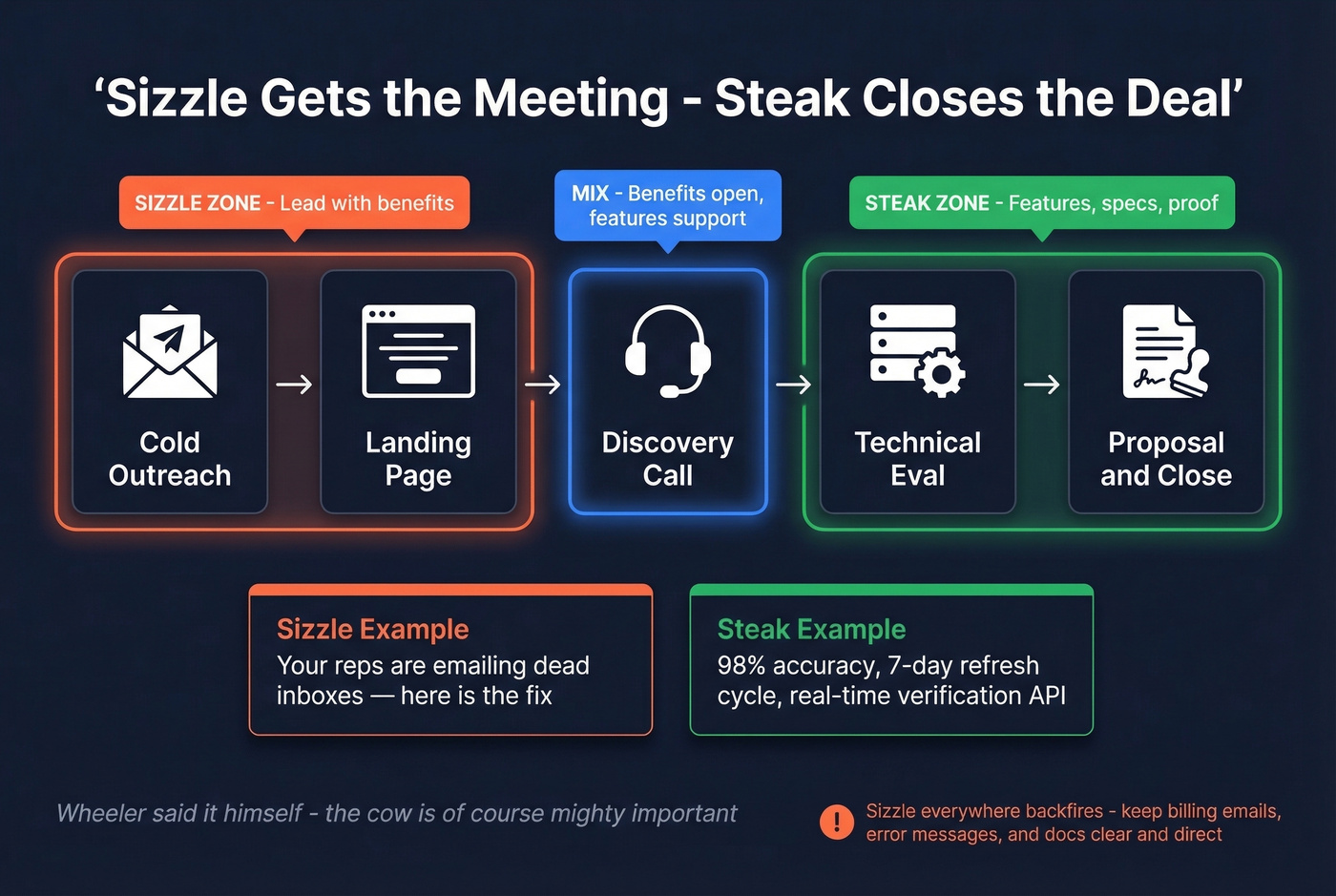
Let's be honest: if your average deal size is under five figures, you probably don't need sizzle in more than two touchpoints - your cold outreach and your landing page. Everything else should be clear, direct, and functional. We've seen this pattern repeatedly: teams that lead with sizzle everywhere end up confusing buyers who just need specs.
Skip the sizzle entirely in technical procurement contexts. When a buyer is evaluating nuts and bolts - maintenance costs, API documentation, security certifications - features take center stage. Internal champions need feature comparisons they can paste into a Slack thread for their VP, not poetry.
Sizzle gets the meeting. Steak closes the deal. A benefit-led subject line earns the open. A feature-rich proposal earns the signature. Wheeler knew this - "the cow is, of course, mighty important." The mistake isn't using sizzle. It's using only sizzle, everywhere, regardless of context.
Applying Sizzle to Cold Email
Wheeler's "Don't Write - Telegraph" maps directly to cold email. Your first ten words are more important than your next ten thousand. Your subject line and opening sentence carry the entire weight of whether someone reads or archives.
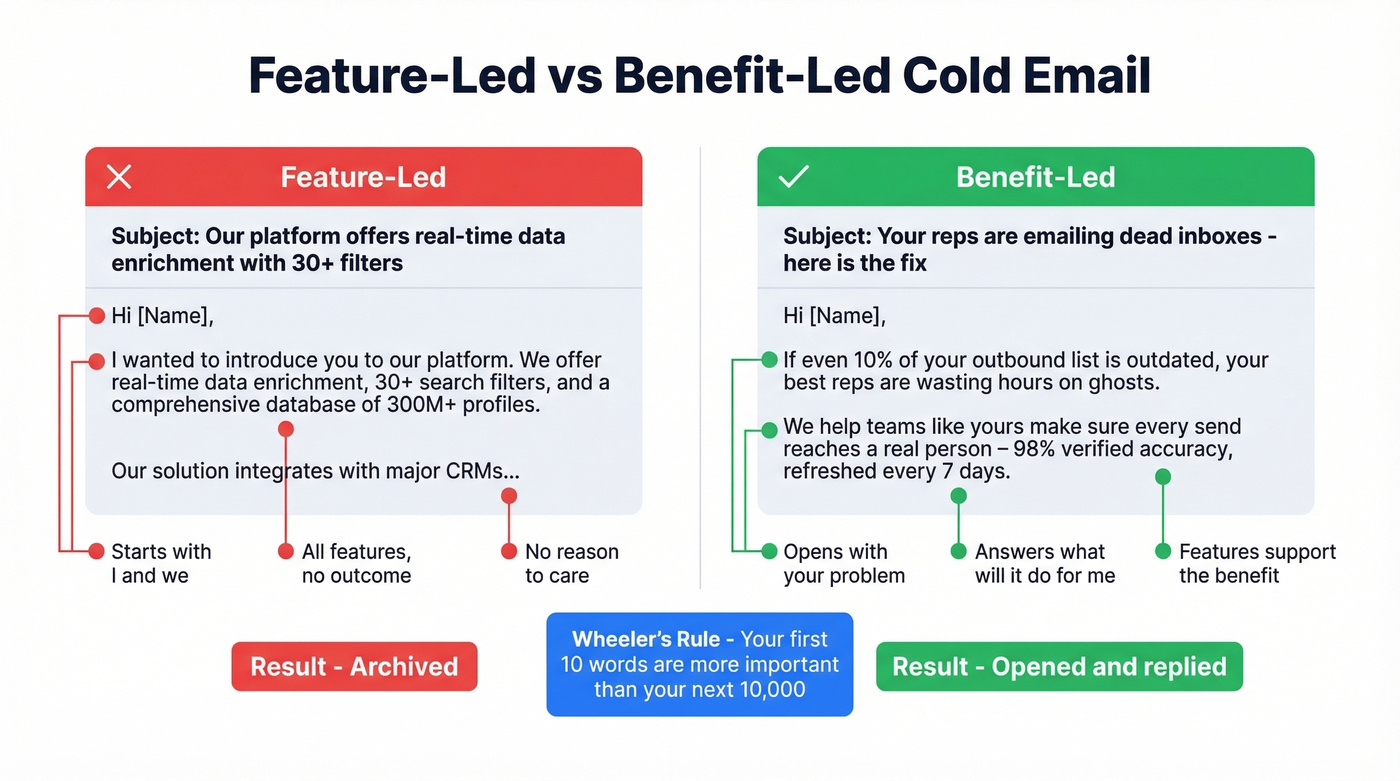
Compare these two subject lines:
- Feature-led: "Our platform offers real-time data enrichment with 30+ filters."
- Benefit-led: "Your reps are emailing dead inboxes - here's the fix."
The second version answers "What will it do for me?" in seven words. That's the sizzle principle at work.
But the best subject line in the world is worthless if it bounces. Your messaging sizzle needs data quality steak underneath it. Prospeo handles that layer - 98% email accuracy, a 7-day data refresh cycle, and real-time verification mean your benefit-led cold emails actually reach real people instead of dead inboxes.
You just built the perfect sizzle - an opening line that answers 'What will it do for me?' Now you need the right buyers to send it to. Prospeo gives you 300M+ profiles with 30+ filters including buyer intent, job changes, and tech stack - so your sizzle reaches people already in-market.
Find the buyers who are ready to hear your sizzle. Start free today.
FAQ
Who coined "sell the sizzle, not the steak"?
Elmer Wheeler, a sales researcher who ran the Tested Selling Institute in New York during the 1930s. He tested 105,000 selling sentences on 19 million people - making him arguably the first systematic A/B tester in sales history.
What's the difference between features and benefits?
Features describe what a product does - specs, capabilities, technical details. Benefits describe what it does for the buyer: the outcome, the feeling, the problem solved. Lead with benefits to earn attention, then support with features to close the deal.
Does benefit-led selling work in B2B?
Yes, but sizzle gets the meeting while steak closes the deal. Benefit-led openers earn attention in cold outreach. B2B buyers still need specs and ROI data to build an internal business case. The sequencing - not the choice of one over the other - is what matters.
How do you apply this to cold emails?
Lead with what the prospect gains, not what your product does. Your first ten words decide everything. Then make sure those emails reach verified inboxes - tools like Prospeo keep your messages from bouncing before they're read.