

How to Actually Make Money Selling AI Products in 2026
Everyone's building AI products. Templates, agents, SaaS tools, prompt packs - the creation part has never been easier. But selling AI products is the hard part nobody warns you about. AI compresses creation to near-zero, which means the bottleneck isn't making the thing. It's distribution. Distribution is the entire game now.
The digital goods market hit $124.32B in 2025 and is projected to reach $511.43B by 2031 at a 26.60% CAGR. Real money - but "upload once, earn forever" is a fantasy that sells guru courses, not your products. Here's what actually works, whether you're selling a $7 template or a six-figure AI service contract.
Reality Check
One creator on r/thesidehustle shared a breakdown showing $9,607 earned starting from September 2024 and $5,000+ in early 2025. Impressive - until you read that it took roughly three months to make the first sale, and posting content alone didn't convert. Sales only picked up after learning funnels, branding, and actual marketing.
On the other end, one Medium writer documented their AI journal experiment on Amazon KDP. Cost: $0. Time: two hours. Result: one copy sold for a $1.96 royalty. Crickets.
In our experience, the creators who clear $5k+/month all have one thing in common: a distribution engine. Most digital product sellers earn under $500/month. Top performers clear $5k-$50k+. The product is rarely the differentiator.
Which AI Products Convert Best
The consensus from practitioners on Reddit is clear: quick-win formats outsell everything else early on. Templates, checklists, swipe files, and short guides in the $1-$15 range convert better than premium courses or complex tools.
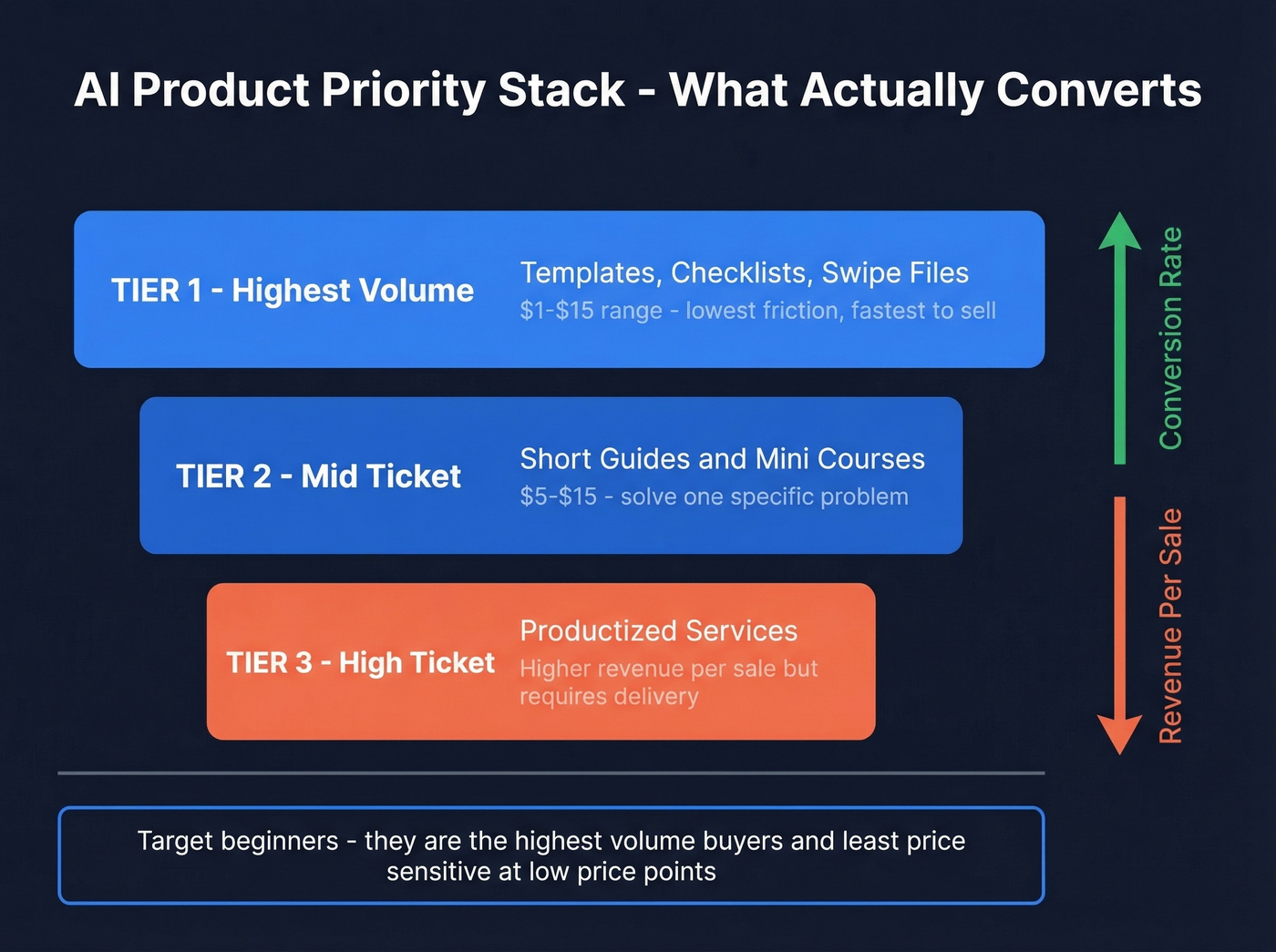
Here's the priority stack:
- Templates and checklists - lowest friction, highest volume
- Short guides ($5-$15) - solve one specific problem
- Productized services - higher ticket, but requires delivery
Target beginners. They're the highest-volume buyers and the least price-sensitive at low price points. Stop shipping 20 mediocre products and ship one validated offer instead.
Niches that tend to work well include finance/investing, productivity, tech and AI tools (prompts, automation guides), and creative/design templates.
Here's the thing: if your product takes less than an hour to build with AI, assume 500 other people built the same thing this week. The product itself is a commodity. Your edge is the niche you pick, the audience you build, and the distribution you control. Spend 20% of your time creating and 80% selling.
Platform Fees Compared
Where you sell matters more than most people think - especially at scale.
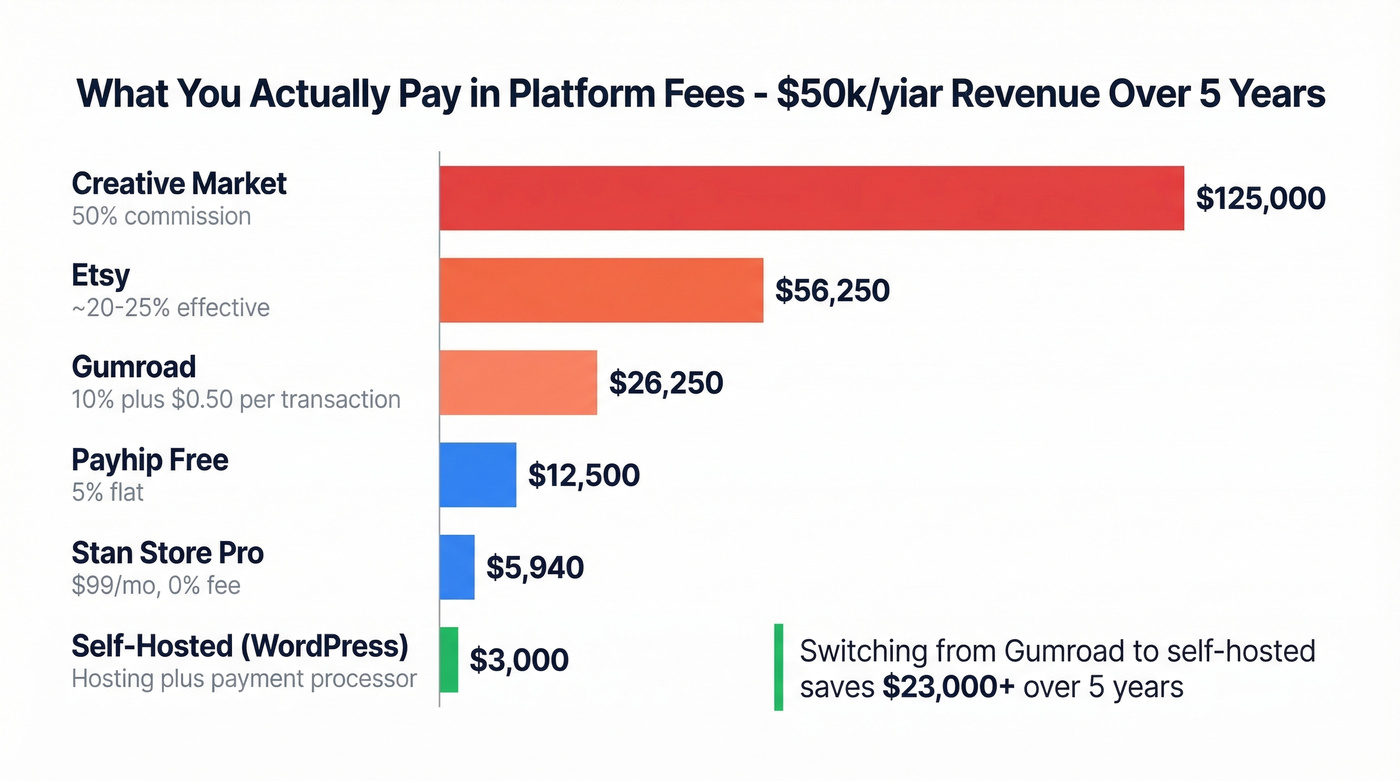
| Platform | Fee Structure | Effective Cut | Best For |
|---|---|---|---|
| Etsy | $0.20 + 6.5% + 3% + ads | ~20-25% | Built-in traffic, no audience |
| Gumroad | 10% + $0.50/txn | ~11-13% | Beginners, low volume |
| Payhip | 5% (free) / $99/mo Pro | 5% or flat | Scaling creators |
| Stan Store | $29/mo (5%) or $99/mo (0%) | 0-5% + monthly | Creators with social followings |
| Creative Market | 50% commission | 50% | Design-focused products |
| Ko-fi | 5% / $6-$12/mo Gold | 0-5% | Small creators, tips + products |
A creator earning $50k/year pays roughly $5,250 on Gumroad versus ~$600 self-hosted on WordPress. Over five years, that's a $23,000+ difference.
The decision is simple. Use a marketplace like Etsy or Creative Market if you have no audience and need built-in traffic. Move to your own site once you have consistent traffic and an email list. The fee savings compound fast.
AI-specific marketplaces are also emerging for agents and automation tools. These are early-stage, but worth watching if your product is an AI agent or workflow - the buyers there already understand what they're purchasing.

You said it yourself: 80% of selling AI products is distribution. Prospeo gives you direct access to 300M+ B2B profiles with 30+ filters - buyer intent, technographics, headcount growth - so you reach the exact companies stuck between AI pilot and production.
Stop guessing who to sell to. Build your buyer list in minutes.
Getting Customers Without an Audience
Eighty percent of your time should go to distribution, not creation. AI handles creation in hours. Finding buyers takes months.
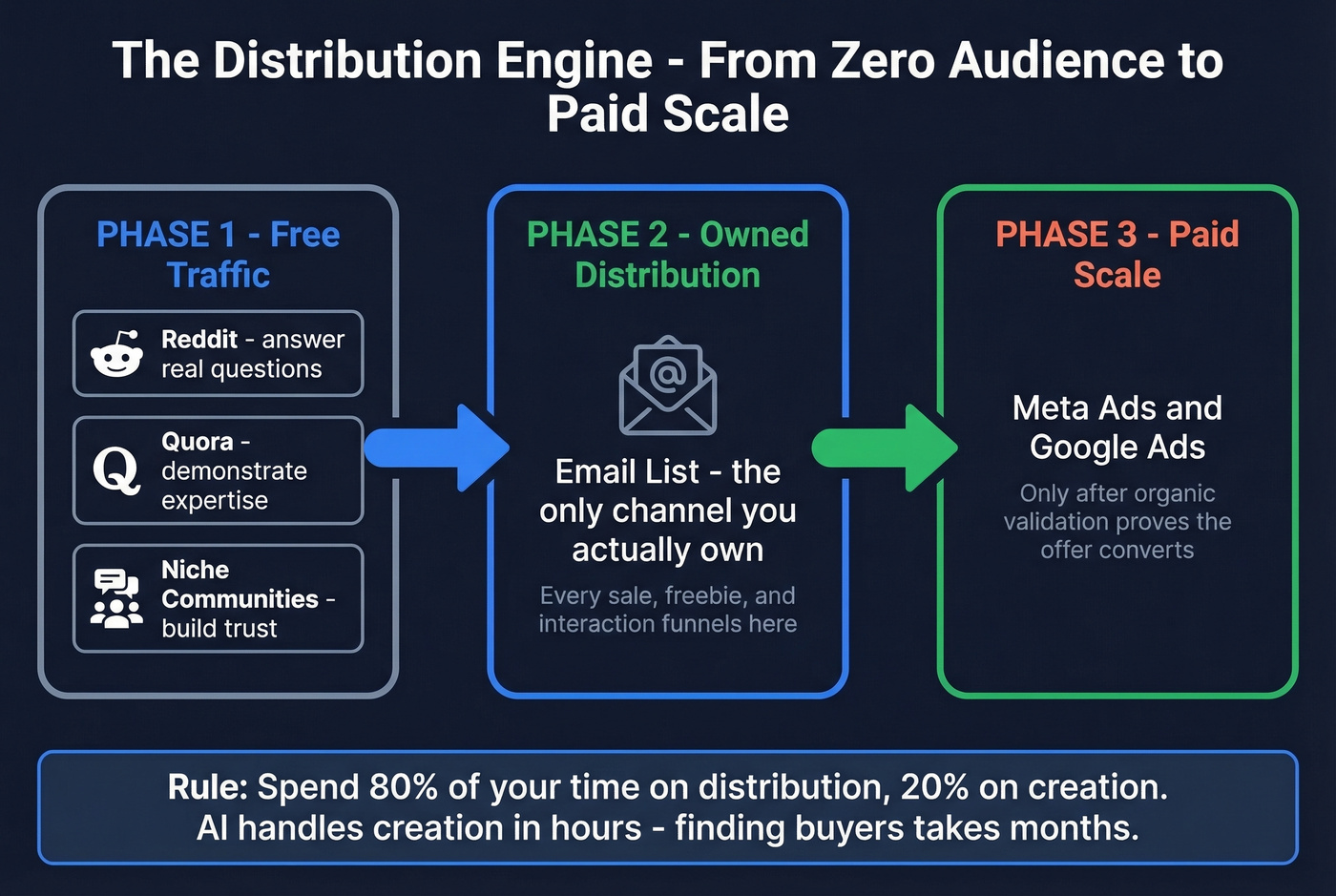
Start with one primary channel and one secondary. Reddit and Quora are the strongest free traffic sources for digital products right now - you can answer real questions, demonstrate expertise, and link to your offer without paying for ads. We've tested this across multiple product launches and the pattern holds: genuine, helpful answers outperform promotional posts by a wide margin.
But the real asset you're building toward is an email list. Social platforms change algorithms. Marketplaces change fees. Your email list is the one distribution channel you actually own. Every sale, every freebie download, every interaction should funnel toward capturing an email address.
Once you have a validated offer, paid ads on Meta or Google can scale distribution fast. One Business Insider case study documented a creator using an email list of 120,000+ people and scaling into six-figure ad campaigns - but only after validating organically first. Don't throw money at ads until you know the offer converts.
Legal and Compliance
Courts are drawing hard lines around AI training data, piracy, and market harm - and that spills over into how you source, package, and market AI-assisted products.
Use lawfully sourced training data. Recent rulings in the Anthropic and Meta cases (June 2025) held that fair use arguments are strongest with lawfully obtained data. Piracy and market harm are the hard stop.
Disclose AI use where required. Many marketplaces have rules around AI-assisted content and disclosures, and those policies change fast. Check your platform's terms quarterly.
Know the litigation landscape. There are 70+ infringement lawsuits against AI companies, including a $1.5B settlement in Bartz v. Anthropic tied to downloading pirated books. The Andersen v. Stability AI trial is set for September 2026, and the outcome will likely reshape what's permissible for AI-generated commercial products.
Don't replicate copyrighted work. Generating "in the style of" a specific artist or brand is a fast track to a takedown notice. Skip it entirely if you're selling commercially - the risk isn't worth the marginal creative shortcut.
Selling AI Products to Businesses
Selling AI to businesses is a completely different game than selling a $9 template on Gumroad. And it's where the biggest contracts are.
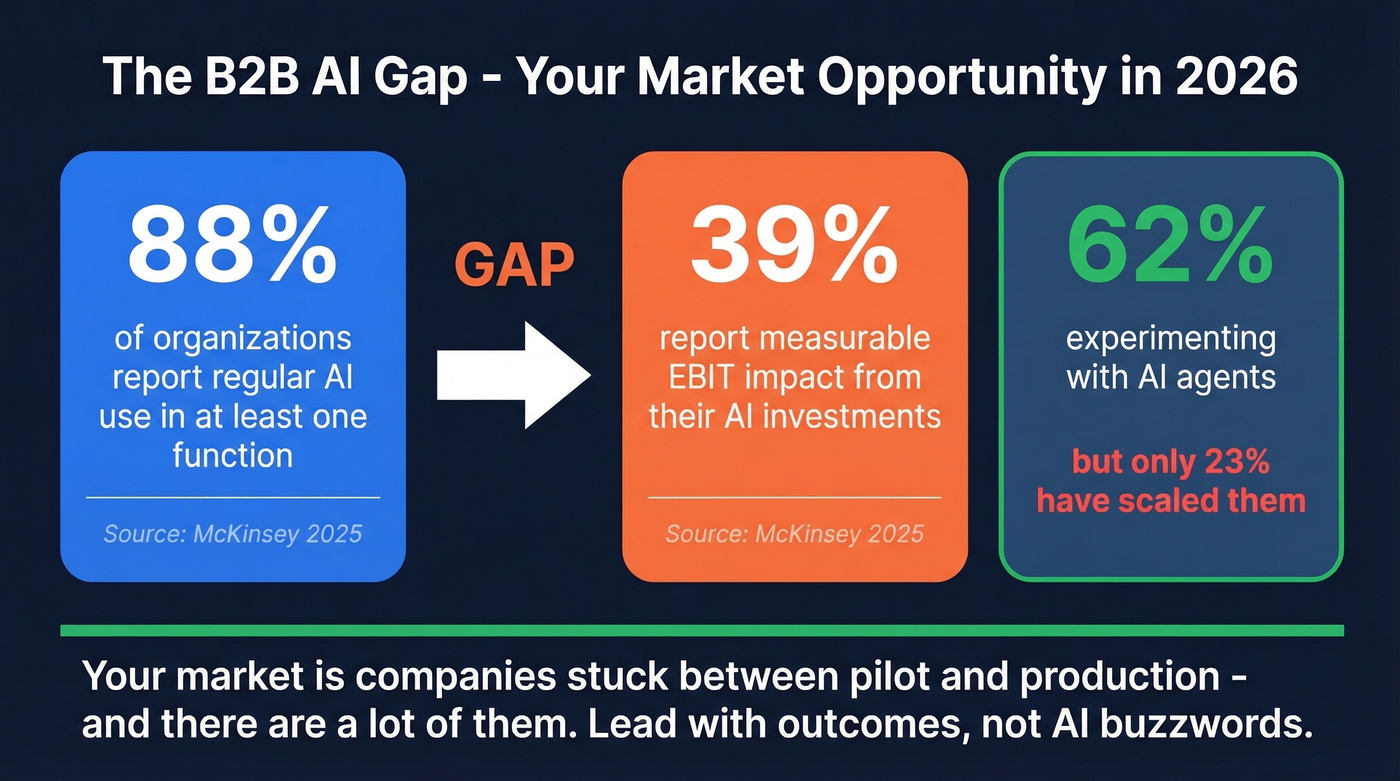
McKinsey's 2025 survey found that 88% of organizations report regular AI use in at least one function - but only 39% report measurable EBIT impact. That gap between "experimenting" and "seeing results" is exactly where B2B AI sellers live. Even more telling: 62% of organizations are experimenting with AI agents, but only 23% have scaled them. Your market is companies stuck between pilot and production, and there are a lot of them.
Don't lead with "AI." Buyers are fatigued by the buzzword. Lead with the outcome - time saved, revenue gained, errors eliminated. AI is the how, not the what. We've seen teams lose deals because they spent 30 minutes demoing model architecture when the buyer just wanted to know how many hours it would save their team per week. That's a frustrating way to blow a pipeline opportunity.
The top objections you'll face: cost/ROI justification, implementation complexity, build-vs-buy debates, and data portability concerns. When they say "too expensive," walk them through a 90-day ROI model with concrete dollar figures. When they say "we can build it ourselves," compare 3-year total cost including engineering salaries, maintenance, and opportunity cost. Every pitch needs to answer "what's the dollar impact in 90 days?"
Price by the unit of value delivered - per workflow automated, per report generated, per seat - not by "access to AI." Consumption-based pricing aligns your revenue with the buyer's ROI and makes the purchase easier to justify internally.
The Real Bottleneck: Finding Buyers
Let's be honest - the bottleneck isn't your product. It's booking qualified conversations with the right people. Define your ICP, build a verified contact list, and run targeted outreach. For teams doing this at scale, Prospeo handles verified email sourcing at roughly $0.01 per lead with a 98% accuracy rate and intent data across 15,000 topics, so you're targeting accounts actively researching your category. The free tier gets you started without a sales call or contract.
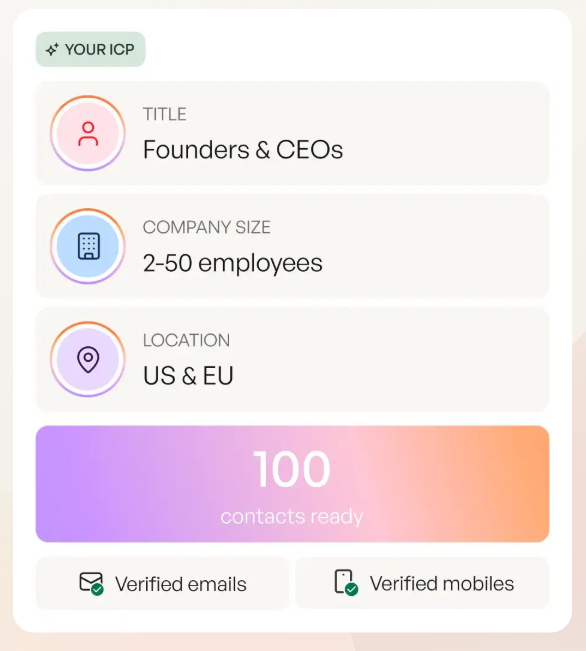
88% of organizations use AI but only 39% see results. That's your market - and Prospeo's intent data tracks 15,000 topics so you can identify companies actively researching AI solutions right now. Verified emails at 98% accuracy mean your outreach actually lands.
Reach in-market buyers before your competitors do.
Your 2-Week Launch Plan
Days 1-3: Validate. Pick one niche and one product format. Survey 5-10 people in your target audience. Confirm the problem exists and people will pay to solve it. Skip this step and you'll waste the next 11 days building something nobody wants.
If you're selling B2B, start by writing down your ICP and the minimum proof you need to validate demand.
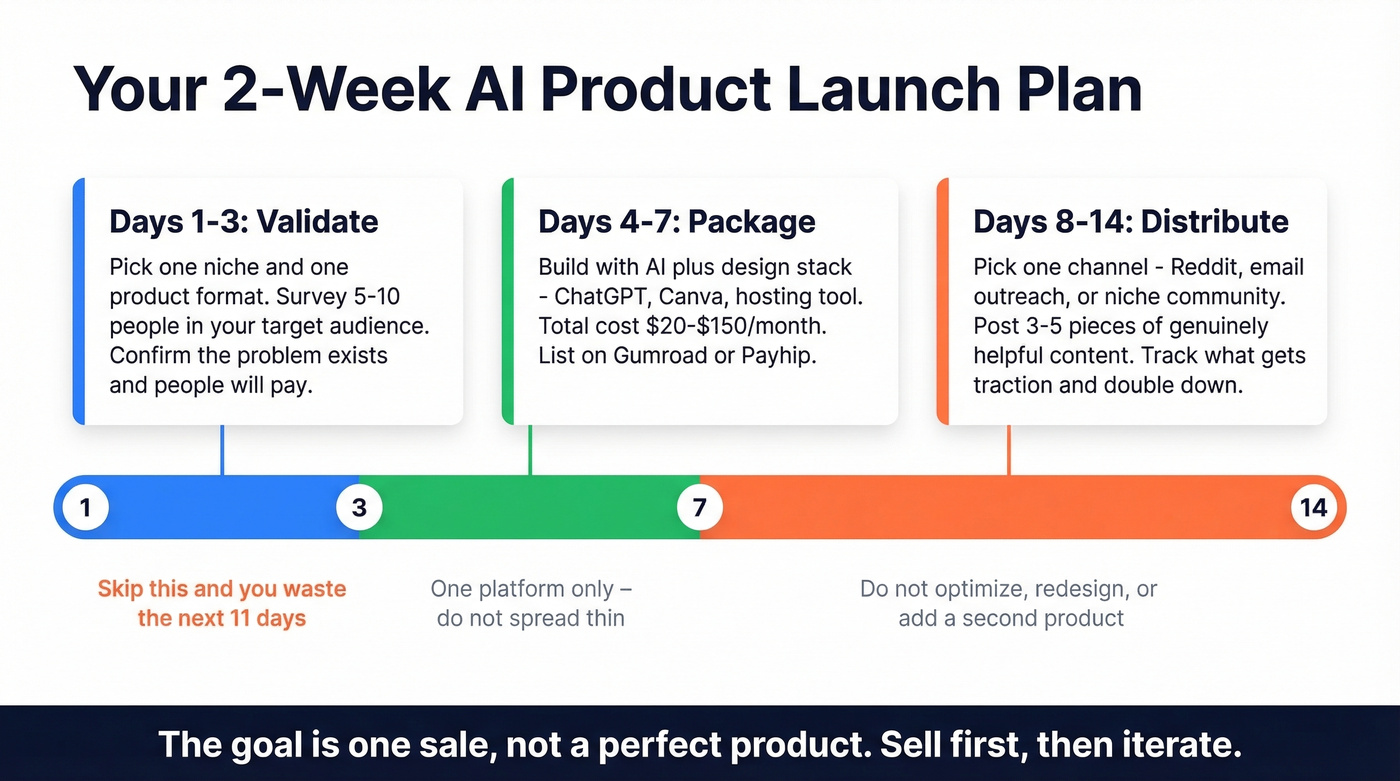
Days 4-7: Package. Build the product using your AI + design stack - ChatGPT, Canva, and a hosting tool run $20-$150/month total. List on one platform. Gumroad or Payhip if you're starting from zero.
Days 8-14: Distribute. Pick one channel: Reddit, email outreach, or a niche community. Post 3-5 pieces of genuinely helpful content that links back to your offer. Track what gets traction and double down. If you're doing outreach, use proven sales prospecting techniques and keep your messaging tight.
Don't optimize. Don't redesign. Don't add a second product. Sell the first one. Then iterate.
FAQ
Is it legal to sell AI-generated products?
Yes, but courts draw a hard line at piracy and market harm. Use lawfully sourced training data, disclose AI use where required by the platforms you sell on, and stay current on evolving marketplace requirements. The Andersen v. Stability AI trial in September 2026 will likely reshape the rules further.
What's the best platform for AI digital products?
Gumroad or Payhip for beginners - low fees let you test without overhead. Move to self-hosted once you hit $30k+/year. Etsy works for built-in traffic but expect 20-25% in total fees. Stan Store suits creators with existing social followings.
How long before I make my first sale?
Roughly three months from zero audience. Sales accelerate once you build a real distribution channel - an email list, active Reddit presence, or paid ads with a validated offer.
How do I find B2B buyers for an AI product?
Define your ICP by industry, company size, and job title. Build a verified contact list, then run targeted outreach layered with intent data to prioritize accounts actively researching your category. Expect 6-10% connect rates on well-targeted direct dials.