

How to Sell to CFOs - and Actually Get the Deal Approved
Your deal is at the 1-yard line. Legal's done, procurement's signed off, your champion is excited - and then the CFO asks three questions nobody prepared for. The deal stalls. Then it dies. Not because your product wasn't right, but because nobody built the financial case the CFO needed to say yes.
Stop rapport-building. Start math-building.
What You Need (Quick Version)
Lead with the cost of doing nothing, not your product. Build a one-page business case with payback math and explicit assumptions. Arm your internal champion with the five assets they need to sell for you when you're not in the room.
What CFOs Care About in 2026
The CFO's agenda has shifted. [50% of North American CFOs](https://www.cfo.com/news/enterprise-cfos-see-sharp-rise-in-confidence-ai-use-deloitte-2026-cfo-signals-survey-/809580/) say digital transformation of finance is their top priority for 2026, and 87% expect AI to be extremely or very important to finance operations this year. CFO confidence hit 6.6 in Q4 2025 - the highest since late 2021 - and 59% say it's a good time to take greater risks.
But here's the nuance most sellers miss. A late-2024 Gartner survey of 251 CFOs ranked metrics, analytics, and reporting as the #1 priority heading into 2025 - and that emphasis hasn't faded. While 59% of CFOs report using AI in finance, adoption has essentially flattened from 58% the prior year, with 91% reporting only low or moderate initial impact. Gartner also expects half of all finance employees to be digital talent by 2027, up from under 20% today. That shift shapes how CFOs evaluate every technology purchase they approve.
Put differently: CFOs want data-driven outcomes, not innovation theater. If you're selling to the CFO, your pitch will be evaluated through a lens of measurable returns - not technology for technology's sake.
Start With the Cost of Inaction
Most sellers lead with what their product does. CFOs care more about what happens if you do nothing.
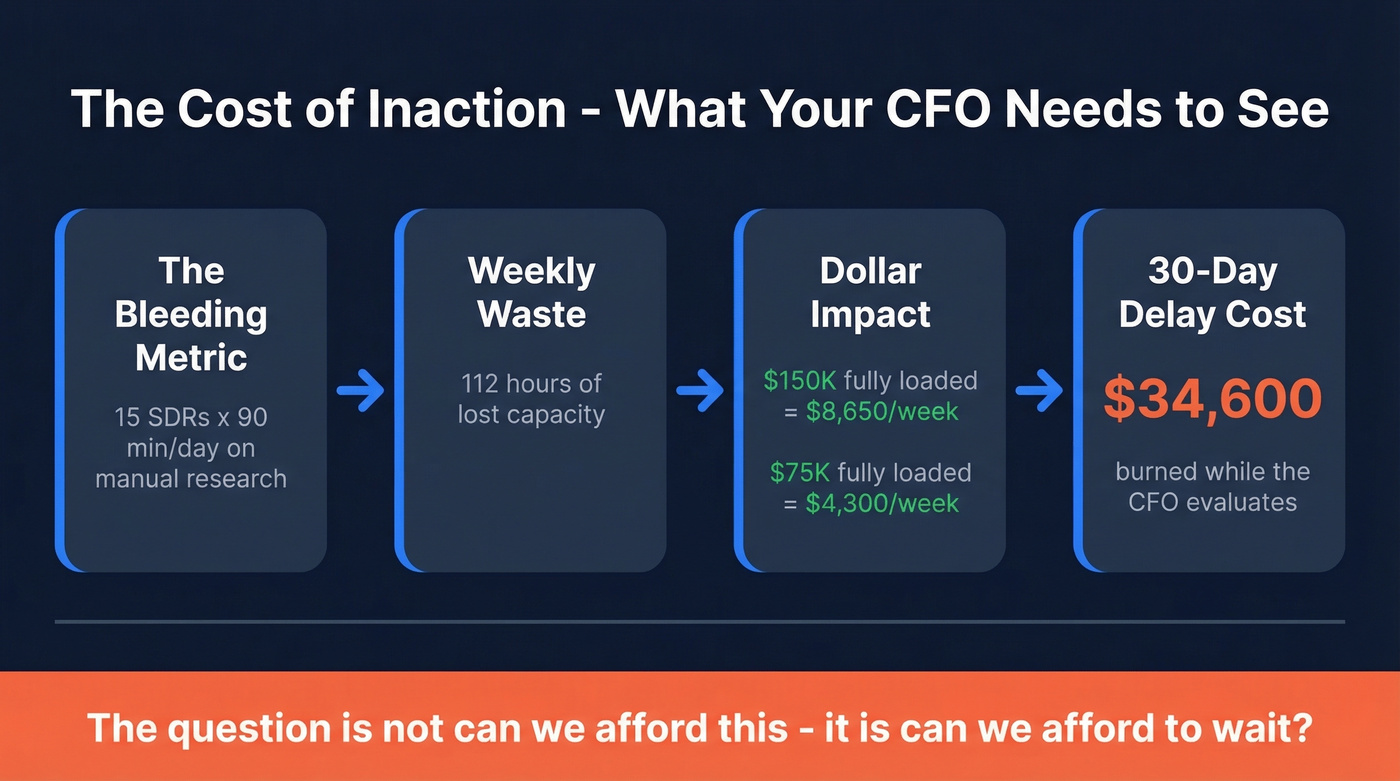
The cost-of-inaction framework flips the conversation from "why buy this" to "what are you losing every week you wait." Here's how it works: identify the bleeding metric, reverse-engineer the cost, do the math live, then compound it over 30/60/90 days.
Say you have 15 SDRs spending 90 minutes per day on manual prospect research. That's 112 hours per week of wasted capacity. Assuming a fully loaded cost of $150K per SDR, that's roughly $8,650 per week in burned productivity - and over the next month while the CFO "evaluates," that's $34,600 in wasted spend. At $75K fully loaded, it's still $4,300 per week. Either way, the number is big enough to reframe the conversation from "can we afford this?" to "can we afford to wait?"
We've seen this framework close deals that had been stalled for months. The moment you attach a dollar figure to inaction, the CFO's calculus changes.
The 5 Questions Every CFO Will Ask
Jim Kelliher, former CFO of Drift, distilled the CFO evaluation into five questions. If you can't answer all five without hesitation, you're not ready for the meeting.
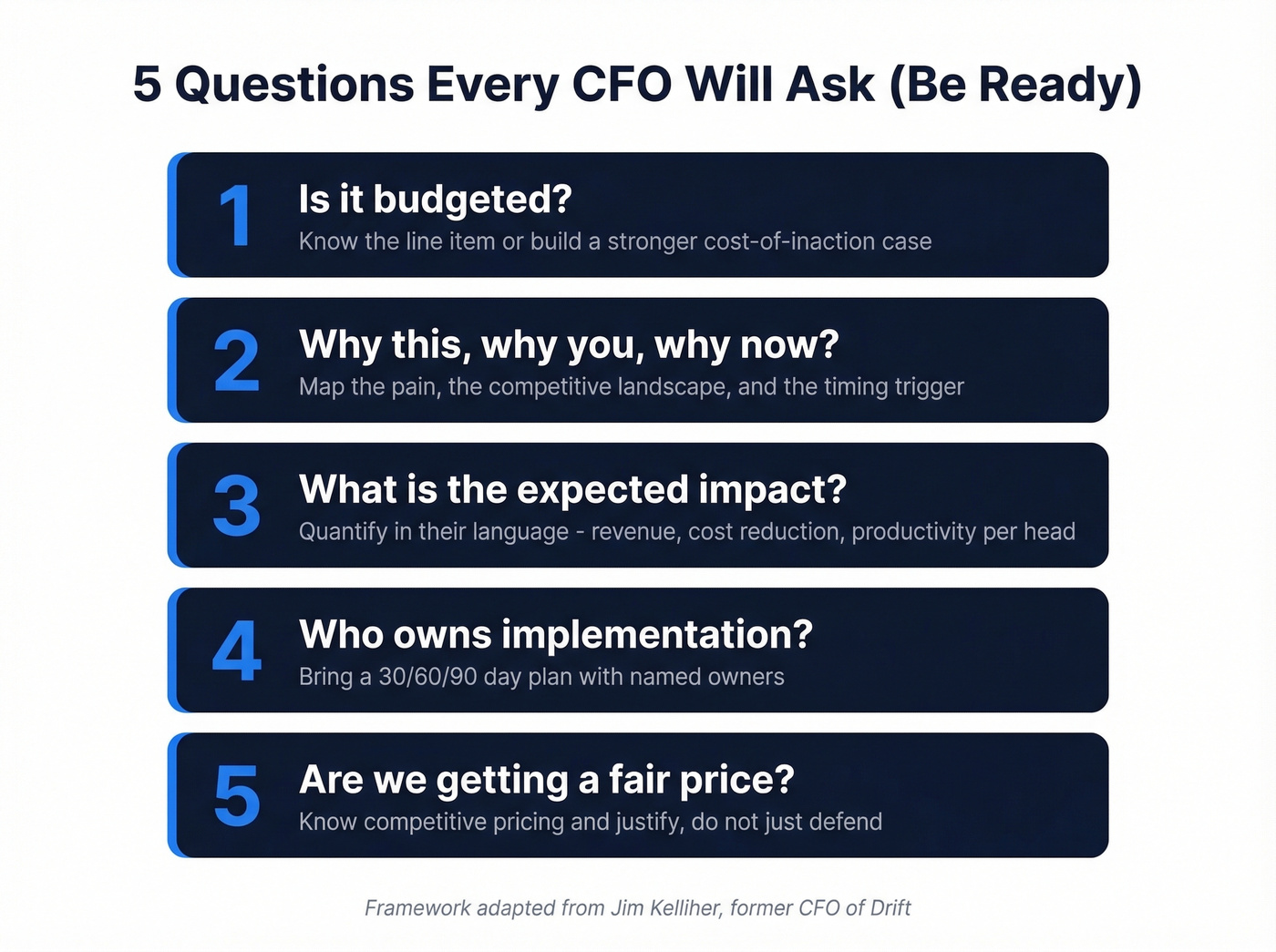
1. Is it budgeted? Know whether this falls within an existing line item or requires new approval. If it's unbudgeted, you need a stronger cost-of-inaction case - because budget approval hinges on proving the cost of delay exceeds the cost of the purchase.
2. Why do we need this - why you - why now? This is where research matters. You need to understand the company's specific pain, competitive landscape, and timing triggers. Mapping the full buying committee - CFO, chief of staff, VP of FP&A - requires accurate contact data before the meeting even happens. Prospeo's 98% email accuracy across 300M+ profiles helps ensure your outreach reaches the right stakeholders.
3. What's the expected impact? Quantify it in their language: revenue growth, cost reduction, productivity per headcount. Ranges are fine. CFOs distrust false precision more than honest estimates.
4. Who owns implementation and who does it affect? Have a 30/60/90-day plan with named owners. CFOs have been burned by software nobody adopts.
5. Are we getting a fair price? Know your competitive pricing landscape. Be ready to justify, not just defend.

Mapping the buying committee - CFO, VP of FP&A, chief of staff - starts with accurate contact data. Prospeo gives you 98% verified emails across 300M+ profiles and 30+ filters including job title, department, and company size. Build your CFO-ready prospect list in minutes, not days.
Stop guessing who to reach. Start building the business case that closes.
Build a CFO-Grade Business Case
CFOs screen purchases against four priorities: cost reduction and efficiency, productivity without adding headcount, revenue growth with controlled investment, and risk mitigation and compliance. Your business case needs to hit at least two explicitly.
One distinction that separates amateurs from pros: savings versus cost avoidance. Savings hit the P&L immediately - consolidating three tools into one, for instance. Cost avoidance prevents future spend, like avoiding a new hire by automating a workflow. CFOs value both, but they weight them differently. Know which one you're pitching.
Your one-page executive summary should include baseline metrics, projected improvements with explicit assumptions, payback period (6-12 months for SaaS, 12-24 for enterprise platforms), and strategic benefits tied to the company's current priorities. Include best-case, worst-case, and most-likely scenarios - CFOs expect ranges, not single-point estimates. Address risk categories head-on: data security, vendor stability, implementation risk.
Then add a kill-switch milestone. Pick a specific checkpoint - say, Month 4 - where you'll evaluate leading indicators and stop if they're not trending. This isn't weakness. It's risk reduction, and CFOs love it.
As Melissa Fisher, CFO of Outreach, put it: "Show your work... help me see how that ROI number can happen." Don't hand over a black-box ROI calculator. Show the assumptions. Show the ranges. That's the core of selling to the CFO - transparency, not persuasion.
How to Pitch a Technology Purchase
Lead with the ask. Then the ROI. Then the risk. Then the timeline.
Most sellers bury the ask on slide 14 and lose the CFO by slide 6. Don't do that.
The anti-patterns matter more than the playbook here. Don't ask questions you should've answered in pre-meeting research. Don't pitch features; pitch outcomes. Don't manufacture fake urgency - Fisher is blunt: "price rarely expires," so don't claim it does unless it genuinely does. And don't get defensive when challenged. A CFO poking holes in your business case is a buying signal, not an attack.
Before you walk in, pass the SBI meeting purpose test: "As a result of this meeting, the CFO will ___." If you can't finish that sentence with a specific next step, you're not ready.
Here's the thing: most sellers over-prepare the pitch and under-prepare for the interrogation. The CFO meeting isn't a presentation - it's a defense of your assumptions. Spend 80% of your prep time stress-testing your own numbers and 20% on the slides.
Arm Your Champion
Your champion is the person who sells for you when you're not in the room. But friendly doesn't equal champion.
Ask them: "What's your role in decisions like this?" and "How does this affect your KPIs?" If they can't answer with specifics, you've got a friendly contact - not someone who'll go to bat with the CFO. In our experience, the deals that close fastest are the ones where the champion can recite the payback period without checking their notes.
Ask any seller who's lost a deal at the CFO stage, and you'll hear the same thing: "I thought my champion had it handled." Don't be that seller.
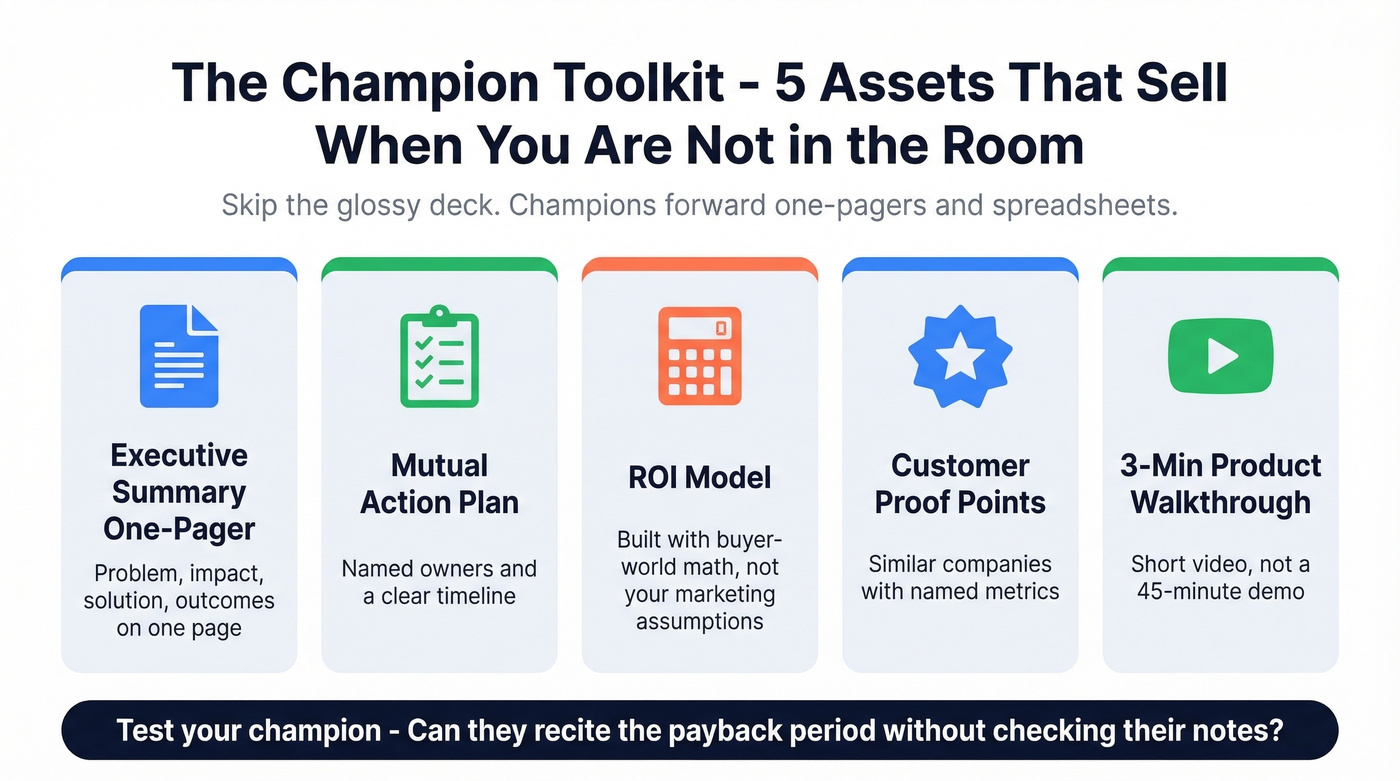
Once you've confirmed a real champion, arm them with five assets:
- Executive summary one-pager - problem, impact, solution, outcomes on a single page
- Mutual action plan with named owners and a timeline
- ROI model built with buyer-world math, not your marketing team's assumptions
- Customer proof points from similar companies, ideally with named metrics
- Short product walkthrough - a 3-minute video, not a 45-minute demo
Skip the glossy sales deck. Champions don't forward decks. They forward one-pagers and spreadsheets.
When the CFO Says "No Budget"
A budget objection is almost never about the budget. It's about financial priority.
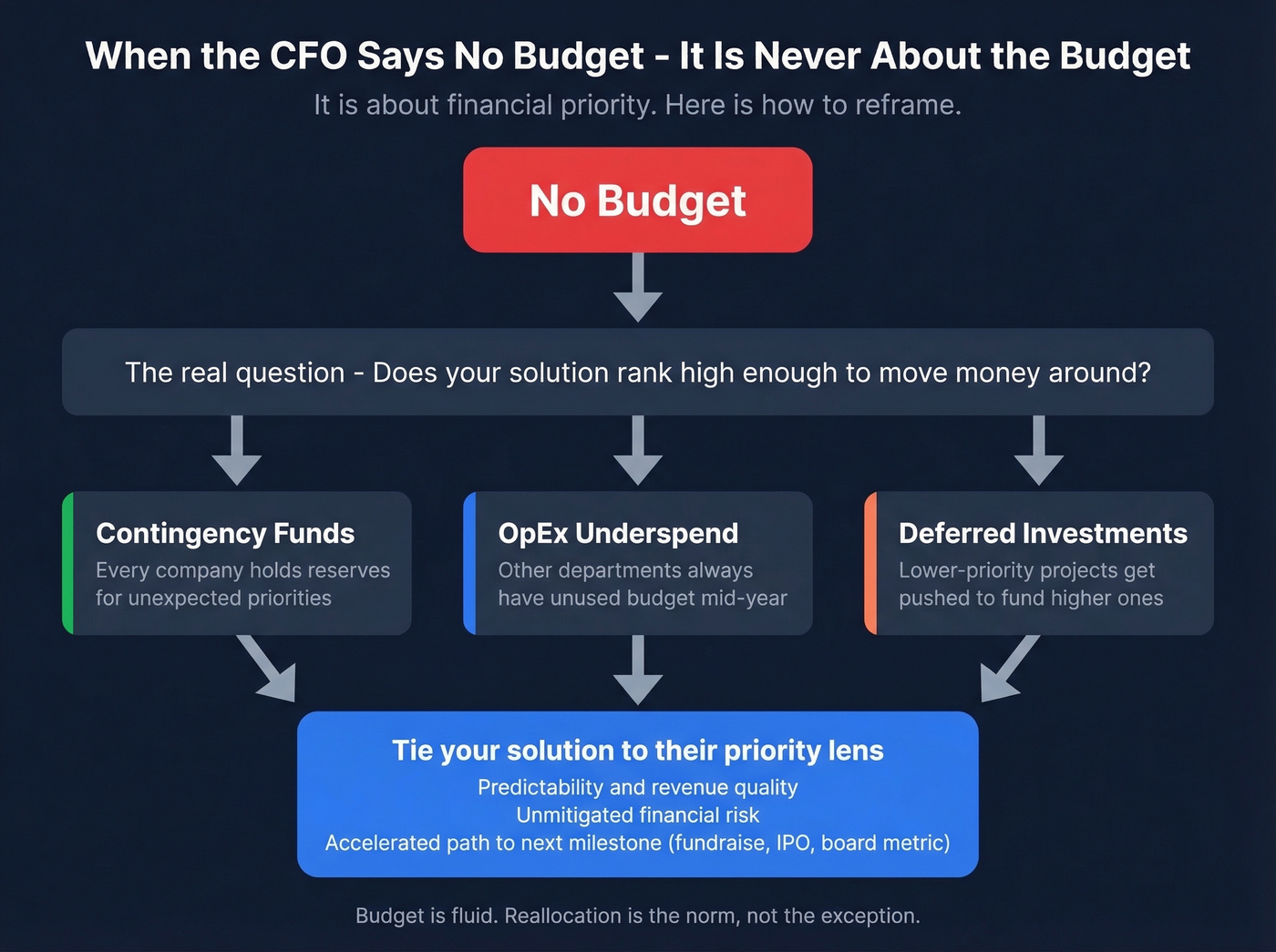
Annual budgets become obsolete within weeks of approval - every CFO knows this. The real question is whether your solution ranks high enough to justify moving money around. CFOs find money in three places: contingency funds, OpEx underspend from other departments, and deferred lower-priority investments. Your job isn't to accept "no budget" at face value. It's to make your solution the higher priority.
Let's be honest: if you're hearing "no budget" and walking away, you're leaving deals on the table. Frame your solution against the CFO's priority lens - predictability and revenue quality, unmitigated financial risk, or an accelerated path to the next company milestone. If you can tie your product to the company's next fundraise, IPO readiness, or a board-level metric, budget suddenly becomes available.
Selling to CFOs in B2B means understanding that budget is fluid and reallocation is the norm, not the exception.
CFOs want cost reduction and productivity without adding headcount. Show them the math: replace 90 minutes of daily prospect research per SDR with Prospeo at $0.01 per verified email. That's the kind of payback period that gets deals approved.
Give your CFO a cost-of-inaction number they can't ignore.
FAQ
How do you get a meeting with the CFO in the first place?
You usually don't - and shouldn't try to go direct early. Build your business case with a mid-level champion first, then ask them to bring you into the CFO conversation. If you do need direct outreach, lead with a one-paragraph cost-of-inaction hook tied to a specific dollar figure, not a product pitch. The consensus on r/sales is that cold-emailing a CFO without a number in the subject line is a waste of everyone's time.
What metrics do CFOs care about most?
Growth metrics like total bookings and net new logos, productivity metrics like revenue per employee and ramp time, and retention metrics like net revenue retention. Tie your pitch to whichever metric matches the company's current stage - growth-stage companies prioritize bookings velocity, while mature companies focus on efficiency and margin.
Should I send the business case before or during the meeting?
Before. Send the one-page executive summary 48 hours ahead so the meeting becomes a discussion, not a presentation. CFOs prefer to review numbers on their own time - arriving with pre-formed questions means you spend the meeting on substance, not setup.
What's the biggest mistake when selling to the CFO?
Leading with product capabilities instead of financial impact. The CFO doesn't care that your platform has 47 features - they care that it saves $200K in year one with a 4-month payback. Every sentence in your business case should connect to a number the CFO already tracks.
How long does a CFO-involved deal cycle typically take?
Expect 2-4 weeks added to your cycle once the CFO gets involved, sometimes more for unbudgeted purchases. Compress this by sending the business case early, pre-answering the five questions above, and giving your champion the assets to maintain momentum between meetings.