

How to Handle the "Send Me an Email" Objection on Cold Calls
You're fifteen seconds into a cold call. The prospect cuts in: "Just send me an email." You mumble "sure, what's your address?" and the call dies before it started. The average cold call lasts roughly 93 seconds, and the "send me an email" objection is one of the fastest ways to lose control of the conversation.
Here's the thing: this is a reflex, not a request. Don't comply blindly. Memorize one script - the Calendar Lock below - and you'll save more calls than any other single change to your outbound process.
Why This Objection Isn't About Email
About half of all cold call objections are dismissive - reflexive shutdowns, not real concerns. There's a critical difference between an objection and a brush-off. Objections come after your pitch (price, timing, fit). Brush-offs come before you've said anything meaningful.
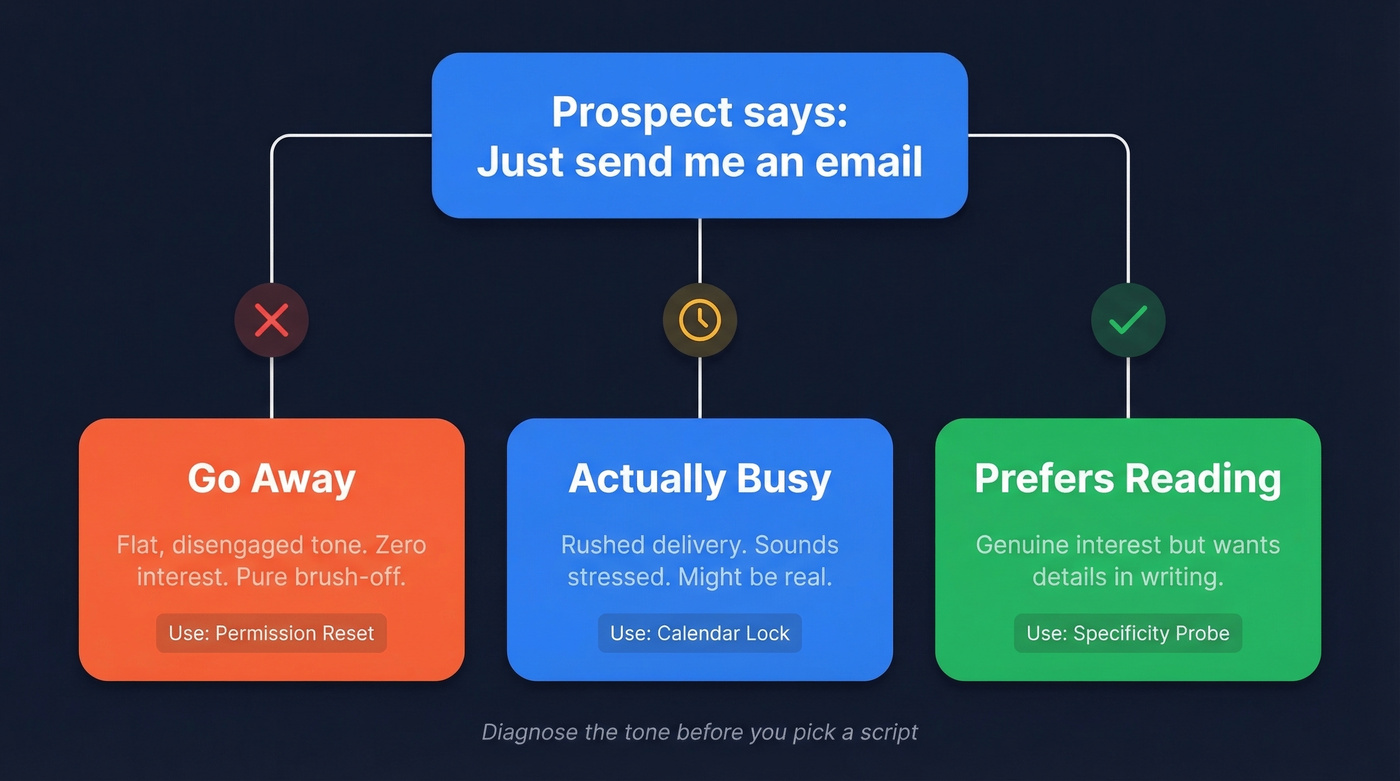
A prospect really only means one of three things when they say this: "Go away," "I'm genuinely slammed," or "I prefer reading over listening." Listen to their tone. A rushed delivery signals they're actually busy, while a flat, disengaged voice is almost always a brush-off. Your job is figuring out which one you're hearing, because each demands a different script, and handling this moment well starts with that diagnosis.
4 Scripts That Beat the Brush-Off
The Permission Reset
Use this when they cut you off in the first 10 seconds - pure reflex, before they've heard a word.
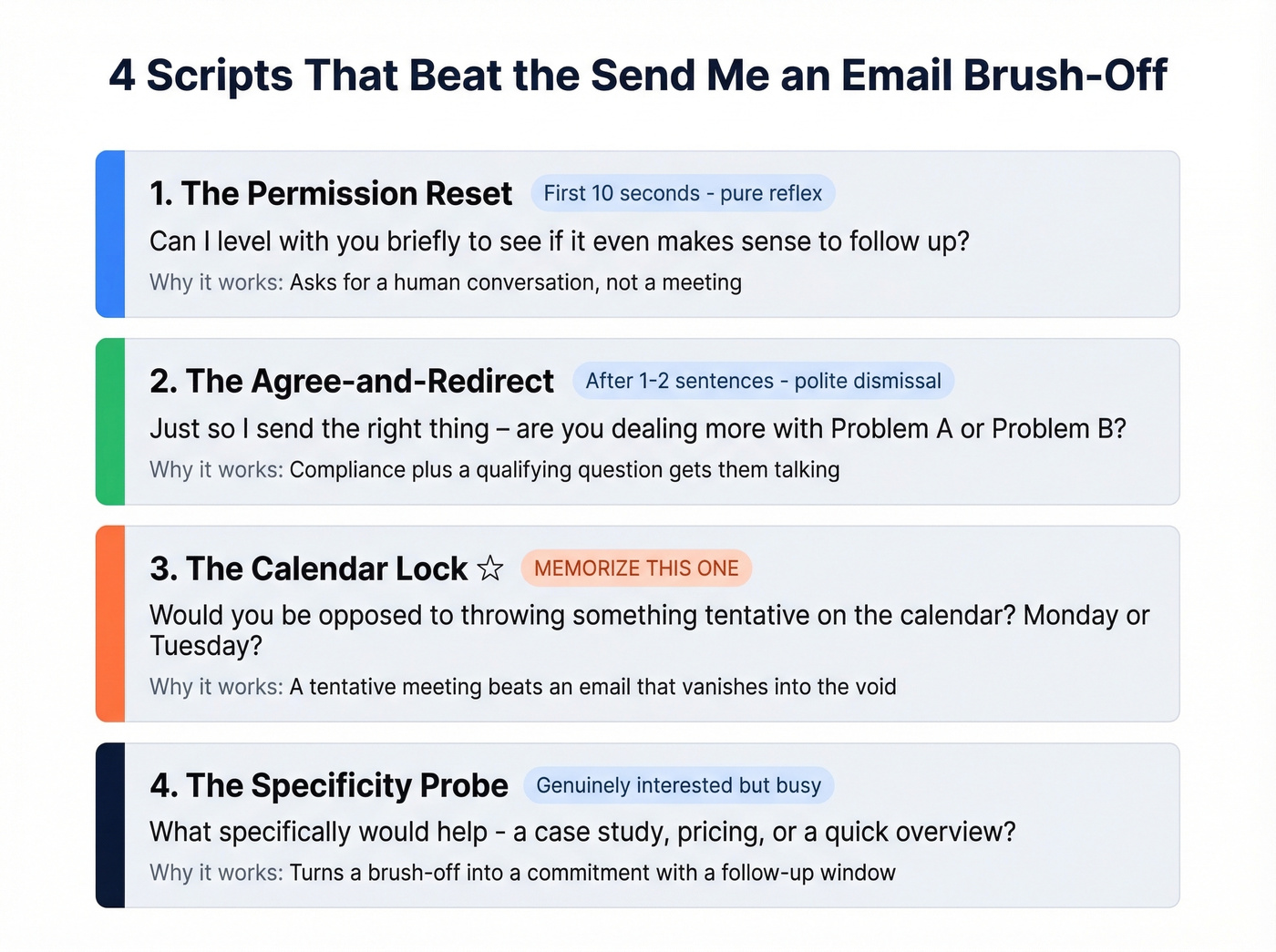
"I know I caught you cold. Can I level with you briefly to see if it even makes sense to follow up?"
You're not asking for a meeting. You're asking for a human conversation. The consensus on r/sales is that this line moves the call forward roughly 80% of the time, and we've seen similar results across our outbound teams. Want to go further? Give them an explicit out: "If it's not a fit, just tell me - I'd rather save us both the time." That permission to say no paradoxically makes them stay.
The Agree-and-Redirect
Use this after you've delivered a sentence or two. Don't resist - agree, then redirect with a jiu-jitsu move. This works especially well when you hear the classic "can you send an email" delivered in a polite but dismissive tone.
"Yes! Can I have your email? And just so I send the right thing - are you dealing more with [Problem A] or [Problem B] right now?"
Asking for the email feels like compliance. But the qualifying question gets them talking. Once they answer, you're in a real conversation, and you've earned the right to send something specific instead of a generic capabilities deck nobody reads.
The Calendar Lock (Memorize This One)
If you learn one script, make it this one.
"I'll send something over. Just so we skip the back-and-forth - would you be opposed to throwing something tentative on the calendar? Monday or Tuesday, mornings or afternoons?"
The exact words matter less than the structure: agree to email, ask for a tentative meeting, offer specific days. Yes, you'll get no-shows. But if you just fold and send the email, the no-response rate is effectively 100%. A tentative meeting beats an email that disappears into the void. "Email and pray" is the worst possible outcome for your pipeline - Reddit threads on r/sales hammer this point constantly, and they're right.
The Specificity Probe
This is the only scenario where complying is the right move - when the decision-maker seems genuinely interested but time-pressed.
"Of course! Just so I can make it useful, what specifically would help - a case study, pricing, or a quick overview of how we handle [their problem]?"
You're agreeing, but locking down a follow-up window. That turns a brush-off into a commitment. This reframe works equally well for the "send me some information" variation - the prospect thinks they're ending the call, but you're actually advancing it. Follow up with "What's the best time to circle back once you've had a chance to review?" and you've got a real next step.

You nailed the script. They gave you their email. Now what if it bounces? 35% of reps send follow-ups to bad addresses and wonder why nobody replies. Prospeo verifies emails with 98% accuracy so your hard-won follow-up actually hits the inbox - not the void.
Verify every email before you hit send. 75 free lookups a month.
Mindset Shift: Why Scripts Alone Aren't Enough
The scripts above cover what to say. But overcoming this objection consistently requires a framework, not just memorized lines.
Expect it on every dial. If you're surprised by the objection, you'll default to compliance. Treat it as a standard part of the call flow, not an interruption. We coach our reps to rehearse their response before the first dial of the day - thirty seconds of prep that pays off for hours.
Match energy, not words. A rushed prospect needs brevity. A disengaged prospect needs a pattern interrupt. The same script delivered two different ways produces two different outcomes, and the best SDRs we've worked with read tone before they pick a script.
Never argue. Pushing back on "just send me an email" with "I'd rather talk now" creates friction. Every script above agrees first, then redirects. That's the key mechanic.
The Follow-Up Email That Gets Replies
With a 4.82% cold call success rate, most calls won't convert on the spot. Let's be honest about something we see constantly: reps send 12 follow-ups, get zero replies, and discover three of those emails bounced. That's not a strategy problem - it's a data problem. People sometimes give mistyped or outdated addresses on calls. Verify the address before you send. Prospeo catches bad addresses in seconds with 98% email accuracy, and the free tier covers 75 verifications a month.
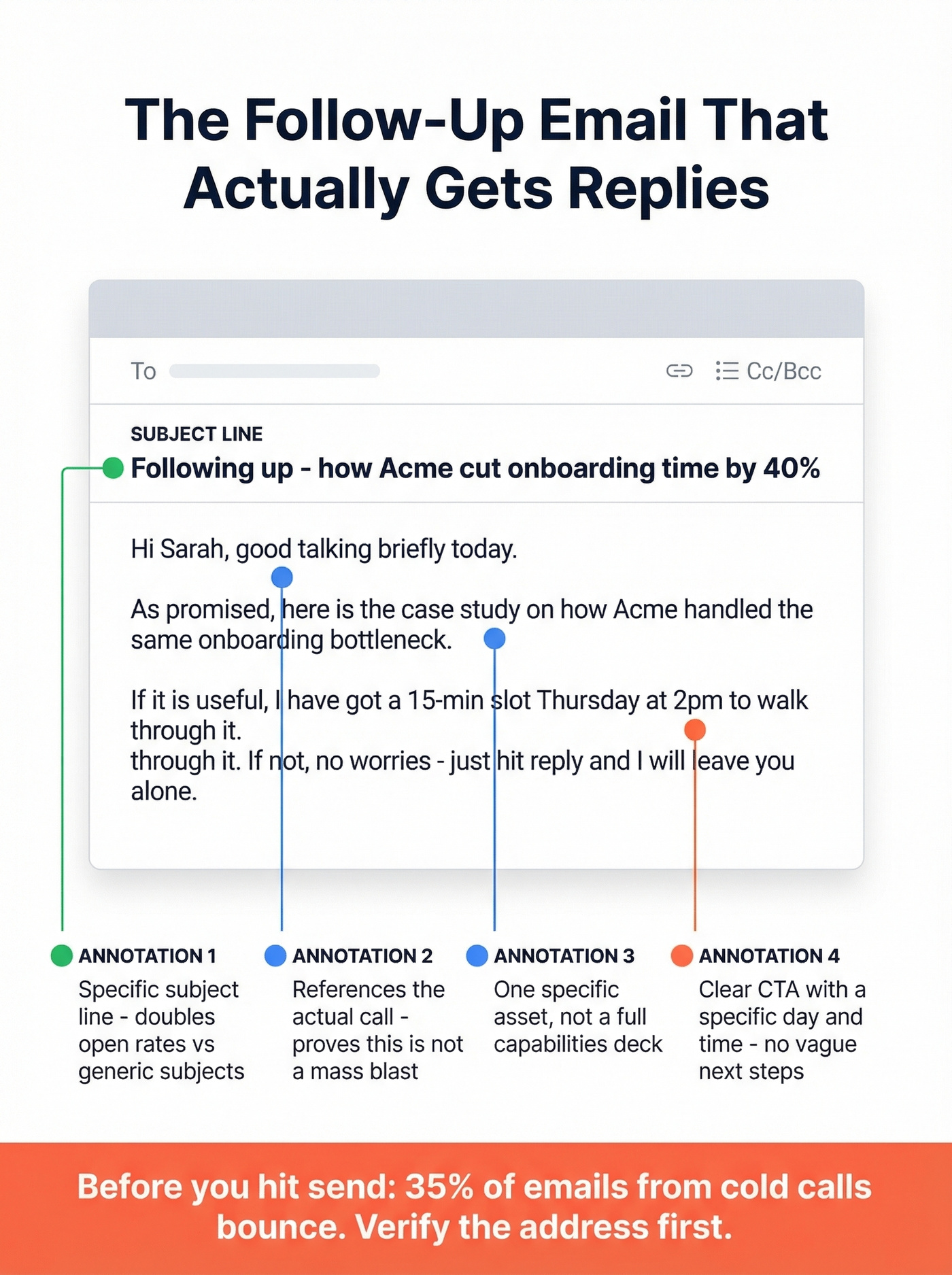
Here's a template that works:
Subject: Following up - [specific thing you discussed]
Hi [Name], good talking briefly today. As promised, here's [the specific resource/case study about their problem]. If it's useful, I've got a 15-min slot [day/time] to walk through how [Company] handled the same issue. If not, no worries - just hit reply and I'll leave you alone.
Three sentences, one clear CTA, referencing the actual conversation. Attach one specific asset like a case study or one-pager, never your company's full capabilities deck. According to Gong's research on follow-up emails, specificity in the subject line alone can double open rates compared to generic "following up" subjects.
When They Ghost After the Email
Don't panic. Don't send five emails in three days. Follow this cadence instead:
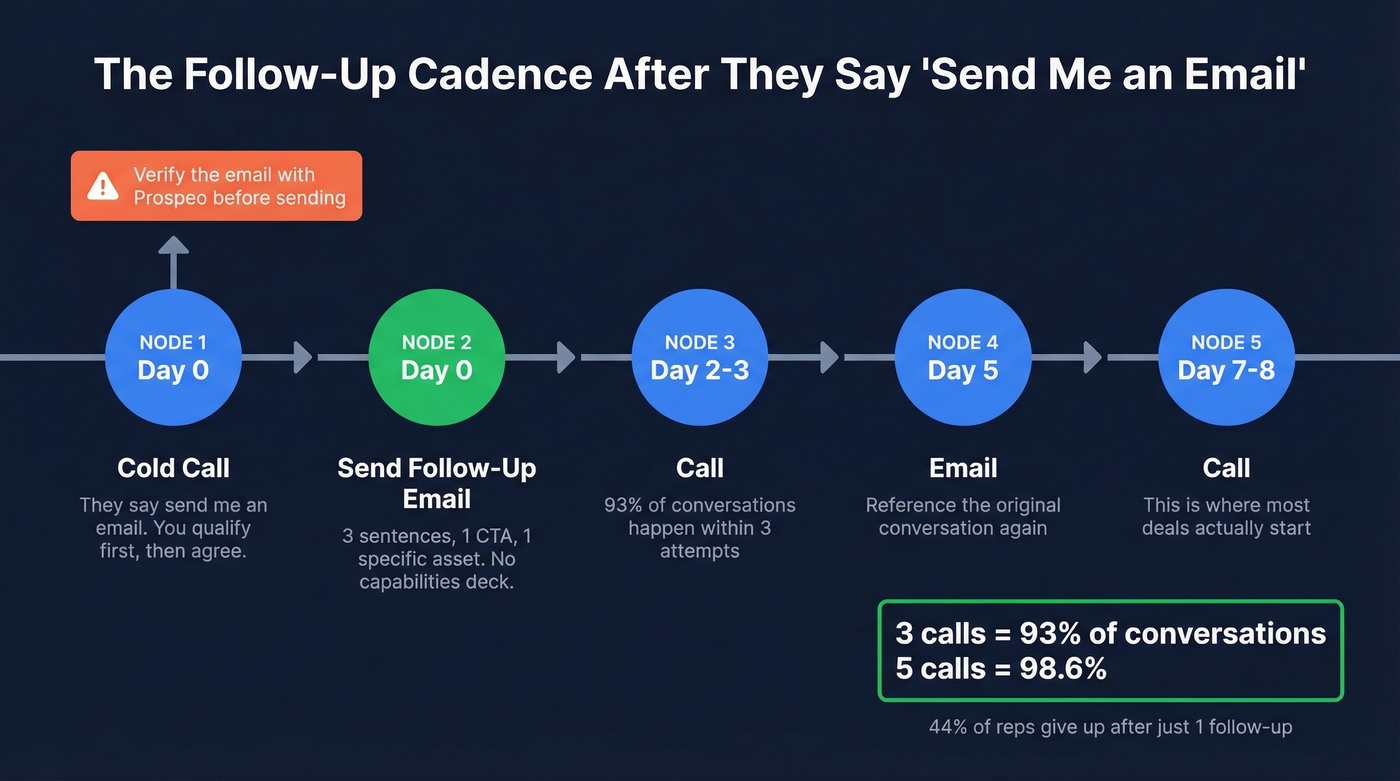
- Day 2-3: Call
- Day 5: Email
- Day 7-8: Call
Three calls capture 93% of total conversations. Five calls capture 98.6%. In our experience, the third call is where most deals actually start - not the first. A lot of BDRs quit after one follow-up. Don't be most BDRs.
If your follow-up bounced, the address was bad from the start. Use Prospeo's Email Finder to pull their real work email and try again. A bounced email isn't a dead deal - it's a data gap you can fix in seconds.
Skip the multi-week nurture sequence if your deal sizes are under $1K - the math doesn't work. But if you're selling anything north of $5K, every ghosted follow-up that bounced is money you lit on fire. Verify first, send second. Always. HubSpot's sales statistics page backs this up: 80% of sales require five follow-up calls, but 44% of reps give up after one.
Half the emails prospects rattle off on cold calls are outdated or mistyped. Prospeo's Email Finder pulls their real work email from 300M+ verified profiles - so your follow-up template lands where it matters. At $0.01 per email, one booked meeting pays for thousands of lookups.
Stop losing deals to bounced follow-ups. Find their real email in seconds.
FAQ
Should you ever just comply with the "send me an email" objection?
Yes - but only after qualifying. Ask what specifically would be useful, then send a targeted asset. Unqualified emails get ignored at near-100% rates. The Specificity Probe script above is built for exactly this scenario.
What if they won't give you their email address?
That's a hard no, not a brush-off. Thank them and move on. Reach a different stakeholder at the same company - sometimes the path in is through a peer, not the person who shut you down. RAIN Group's research shows that multi-threading into accounts through different contacts dramatically improves win rates.
How many follow-ups should you send after the call?
Three attempts capture 93% of conversations. Five capture 98.6%. Beyond that, diminishing returns hit hard. Most reps quit after one follow-up - that's why most reps miss pipeline hiding in plain sight.
Is "send me some information" different from "send me an email"?
Functionally identical - both are reflexive brush-offs designed to end the call. The same scripts apply. The only nuance: "send me some information" sometimes signals mild curiosity, so the Specificity Probe tends to work especially well there. Either way, qualify before you comply.