

SendFlock vs Apollo.io: Which One Actually Fits Your Outbound Stack?
Apollo's renewal is coming up at $79/seat for five reps, and someone just sent you a link to SendFlock because it's a fraction of the cost. Here's the thing: these aren't the same kind of tool. Apollo is a data platform with outreach bolted on. SendFlock is a sending platform with no native data. Before you start comparing feature checklists, you need to know which problem you're actually solving.
30-Second Verdict
Pick Apollo if you need a built-in lead database and can tolerate credit mechanics. Basic starts at $49/user/mo, and there's a Free plan too.
Pick SendFlock if you already have a data source and want low-cost sending with built-in warmup. Starts at $29/mo.
Skip this comparison entirely if data accuracy is your top priority. SendFlock doesn't provide data at all, and Apollo's accuracy varies wildly - so you'll need a verification layer either way.
What Each Tool Actually Does
Think of Apollo as the grocery store and SendFlock as the kitchen. You need both to cook, but they serve different functions.
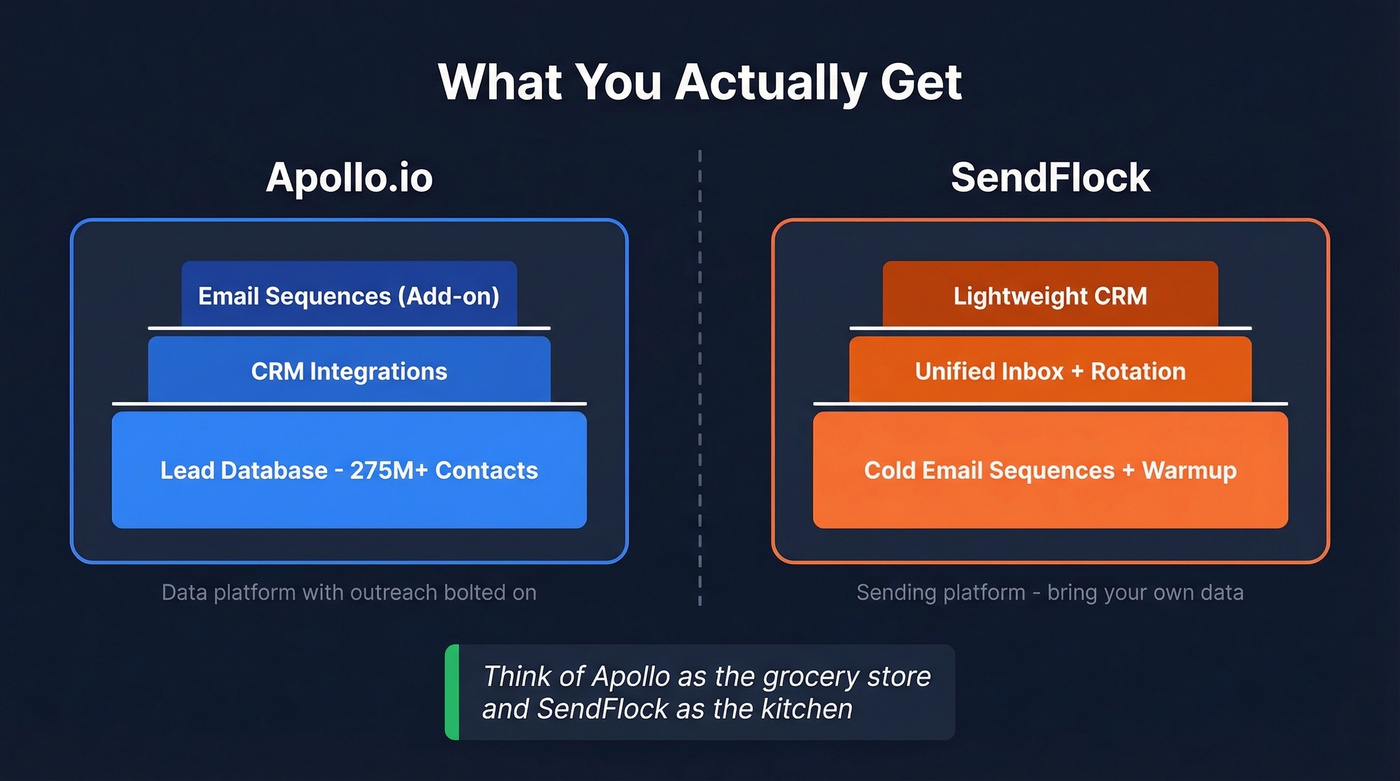
Apollo.io is a prospecting database first. Its 275M+ contacts across 60M+ companies give reps a searchable pool of leads with filters and CRM integrations. Sequences and email automation exist inside Apollo, but they're secondary to the data layer. The outreach features work, but they've always felt like an add-on rather than the core product.
SendFlock handles cold email sequences, automated follow-ups, a unified inbox, email rotation, support for multiple connected mailboxes, and built-in warmup. It includes a lightweight CRM. What it doesn't have is any contact database - you bring your own list.
One thing worth flagging: SendFlock has limited presence on major review sites. The G2 result people often find is for "Flock" (a team chat app), not SendFlock. That's not disqualifying, but it means you're relying more on vendor documentation than the kind of third-party validation Apollo has built over years.
Feature-by-Feature Comparison
| Feature | Apollo.io | SendFlock |
|---|---|---|
| Lead database | 275M+ contacts | None (BYO) |
| Email sequences | ✓ | ✓ |
| Native warm-up | ✗ (removed; replaced by "Inbox Ramp Up") | ✓ |
| Unified inbox | ✓ | ✓ |
| CRM | Integrations | Built-in |
| Inbox rotation | Limited | ✓ |
| Email verification | ✓ (91% accuracy claim) | None |
| Pricing model | Per-seat + credits | Tiered plans (not per-seat) |
| Starting price | $49/user/mo (Basic) | $29/mo (Solo) |
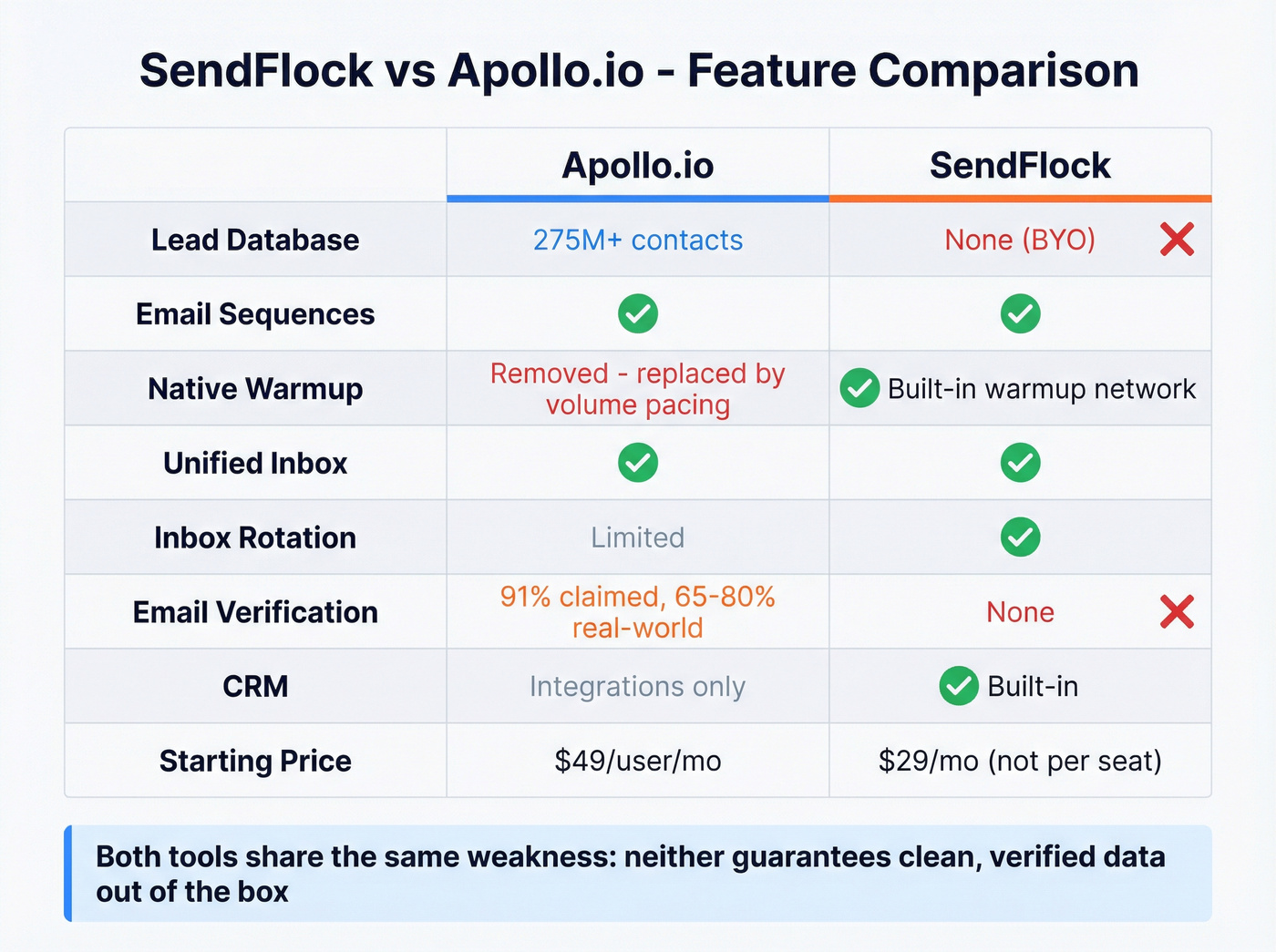
The warmup gap deserves attention. Apollo pulled its warmup feature and replaced it with "Inbox Ramp Up," which is essentially volume pacing - not the same thing as a real warmup network. If you're running Apollo sequences, you'll typically add a separate warmup tool, which adds cost and complexity.

Apollo's warmup gap and SendFlock's missing data layer both point to the same problem: unverified contacts tank deliverability. Prospeo's 5-step verification catches spam traps, honeypots, and catch-all domains - delivering 98% email accuracy across 143M+ contacts, refreshed every 7 days.
Stop debating senders. Fix the data that feeds them.
Pricing Breakdown
Here's what the pricing usually looks like in practice.
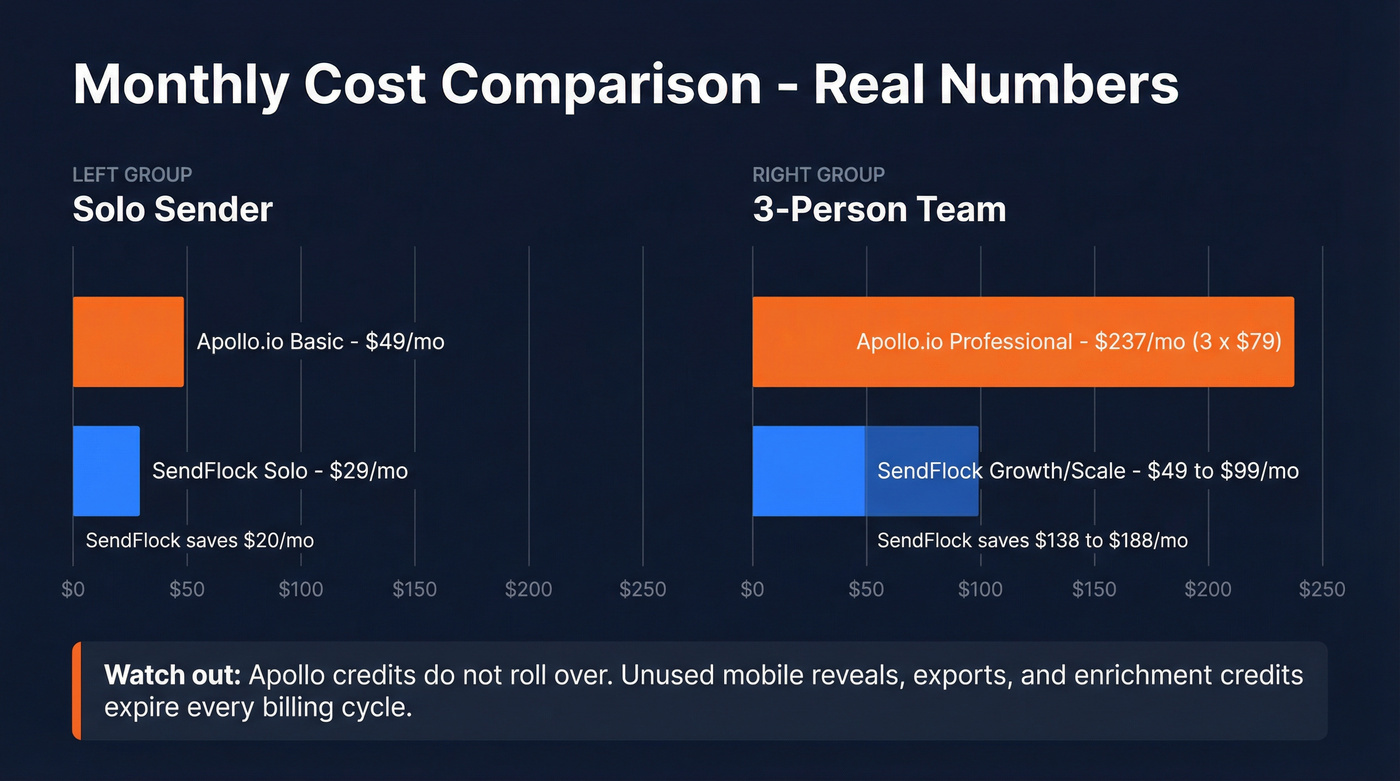
| Solo sender | 3-person team | |
|---|---|---|
| SendFlock | $29/mo (Solo) | $49-$99/mo (Growth/Scale) |
| Apollo.io | $49/mo (Basic, per user) | $237/mo (3x Professional at $79/user/mo) |
SendFlock's outreach plans are tiered, not per seat. The public plans include Solo ($29/mo), Growth ($49/mo), and Scale ($99/mo), and they cover core outreach features like warmup, unified inbox, and the ability to connect multiple email accounts.
Apollo's per-seat model scales fast. Basic runs $49/user/mo, Professional $79/user/mo, and Organization $119/user/mo with a minimum of three seats. The real kicker: credits don't roll over. Unused mobile reveals, contact exports, and enrichment credits expire each billing cycle. In our experience, the credit expiration mechanic is what catches most Apollo teams off guard - you end up either hoarding credits or losing them.
Data Quality & Deliverability
This is where both tools share a weakness, just from different angles.
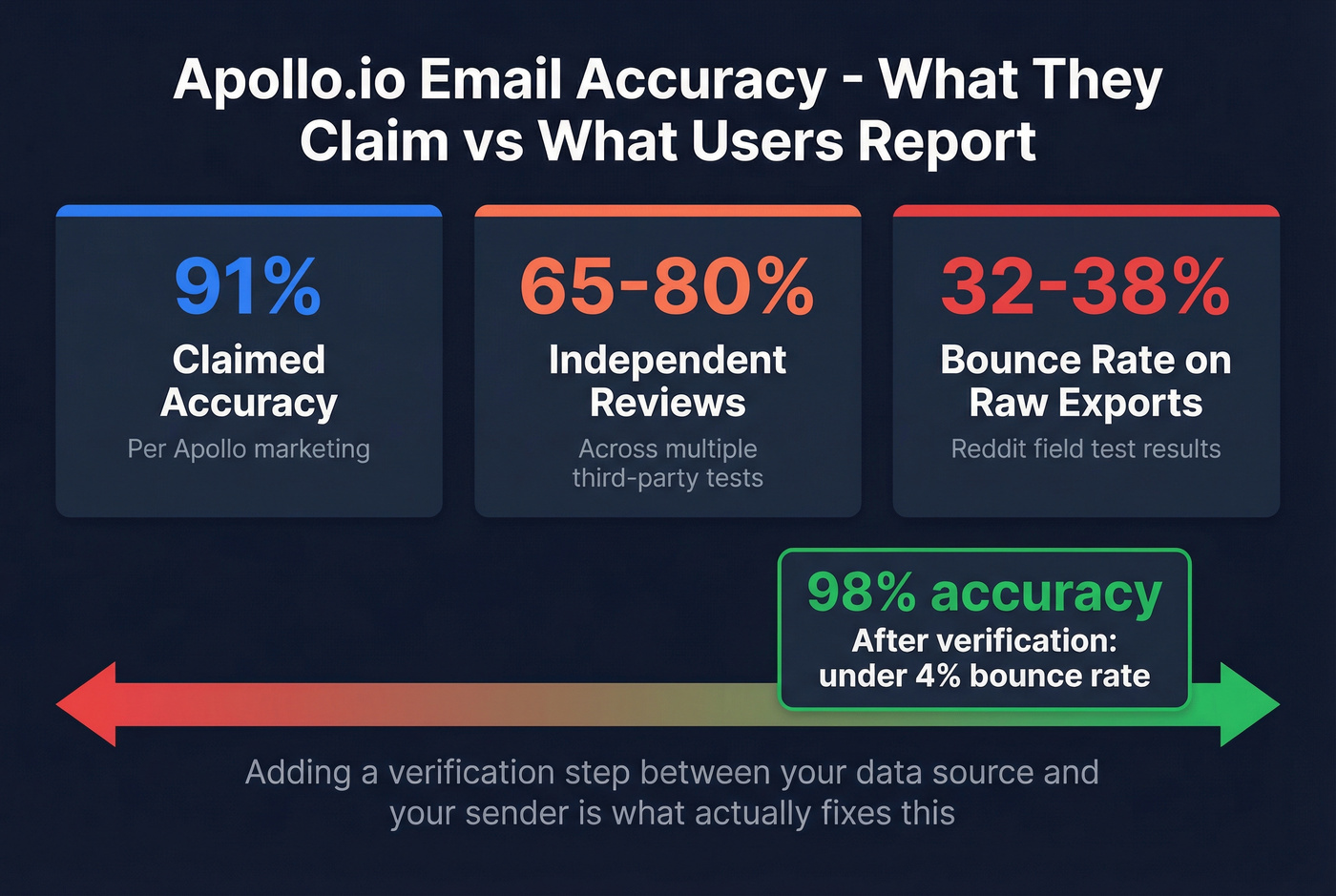
Apollo claims 91% email accuracy, but real-world results tell a different story. A detailed Reddit field test showed 32-38% bounce rates on raw Apollo exports. Independent reviews consistently peg actual accuracy at 65-80%, and another practitioner who's sent millions of cold emails estimates Apollo alone leaves a 30-40% coverage gap. The consensus on r/sales threads is pretty clear: don't trust any database's emails without verifying them first.
SendFlock's problem is simpler: no data layer at all. Your deliverability is only as good as the list you import.

Both tools assume you've set up SPF, DKIM, and DMARC. If you haven't, no warmup tool will save you. Microsoft began enforcing DMARC-aligned requirements in 2025, so this isn't optional anymore. Target >85% primary inbox placement before worrying about anything else.
Let's be honest: most teams agonize over which sender to pick when the real bottleneck is data quality. We've seen teams cut bounce rates from 35% to under 4% just by adding a verification step between their data source and their sender. The tool you send from matters far less than the data you send to.
The Fix: Verified Data
Whether you're pulling contacts from Apollo or importing a purchased list into SendFlock, running data through verification before you hit send is non-negotiable.
Prospeo's 5-step verification process - including catch-all handling, spam-trap removal, and honeypot filtering - delivers 98% email accuracy across 143M+ verified emails and 125M+ verified mobile numbers, with data refreshed every 7 days. The free tier gives you 75 emails/month to test, paid plans start around $39/mo, and per-email cost works out to roughly $0.01. At that price, verification pays for itself after preventing a single bounce.
Teams using Apollo report 32-38% bounce rates on raw exports. Prospeo users like Snyk cut bounce rates from 35% to under 5% and added 200+ new opportunities per month. At $0.01 per verified email, verification costs less than a single bounced send.
Your sender doesn't matter if your data is garbage.
Who Should Pick Which
You need data AND sending in one tool: Apollo. But verify everything before sending. A practical stack looks like Apollo Basic ($49) + Prospeo verification (~$39) + a dedicated sender ($29-39) = roughly $117-$127/mo for a fully verified, warmed-up outbound operation. That's still less than two Apollo Pro seats.
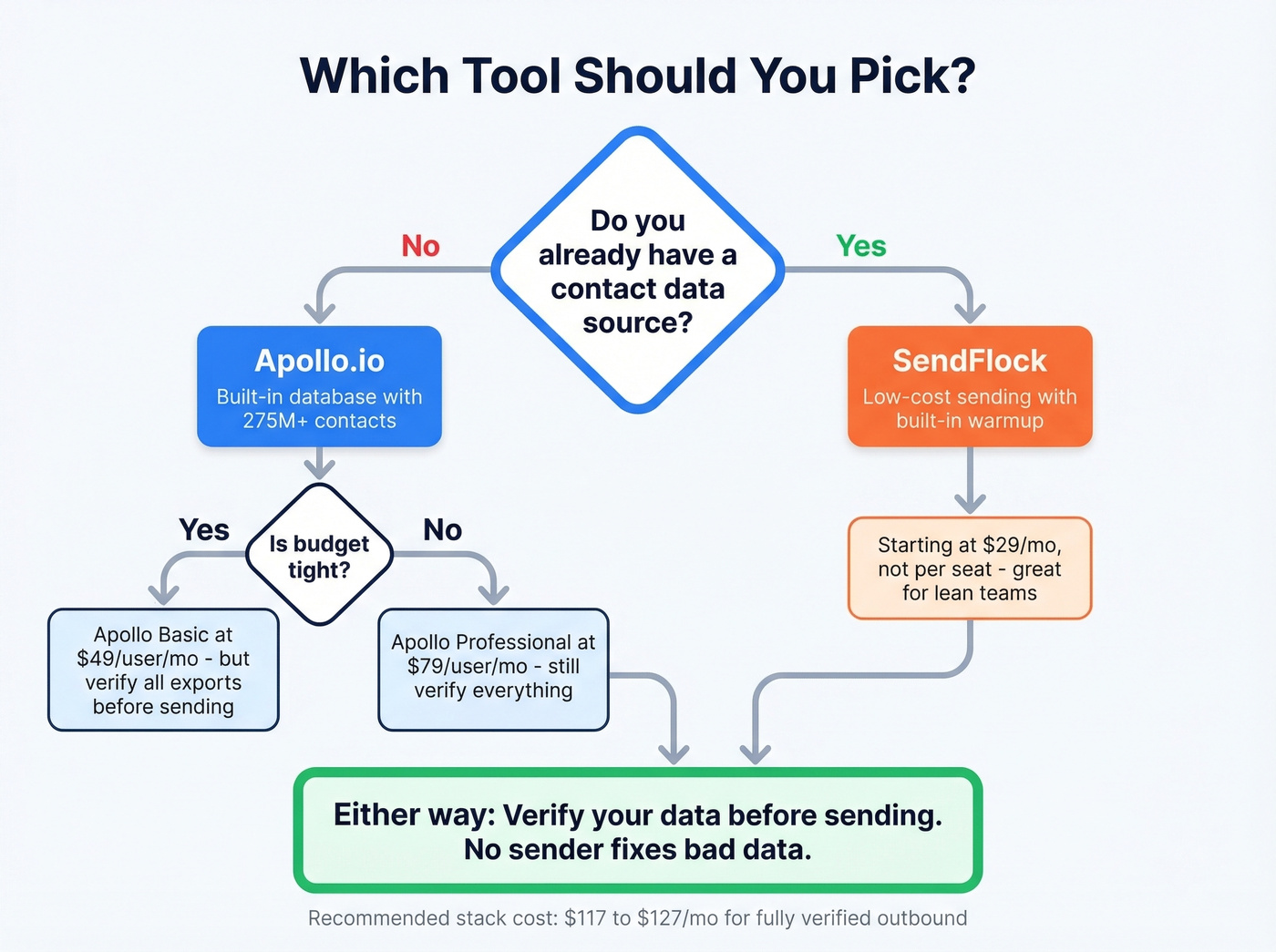
You already have a data source and want cheap, reliable sending: SendFlock. The built-in warmup and multi-mailbox support are genuine advantages for lean teams. Just know you're betting on a tool with limited third-party reviews - test it on a small campaign before committing.
FAQ
Does SendFlock have a lead database like Apollo.io?
No. SendFlock is purely a sending platform - sequences, warmup, unified inbox, and a lightweight CRM. You'll need a separate data source. Apollo includes 275M+ contacts but charges credits to access them.
Why are Apollo.io bounce rates so high?
No single database stays perfectly current. Field tests show 32-38% bounce rates on raw exports because contacts change jobs, emails get deactivated, and catch-all domains mask invalid addresses. Running lists through a verification tool with 98% accuracy before sending eliminates most bounces and protects your sender reputation.
Can I use SendFlock and Apollo together?
Yes, and many teams do. Use Apollo for prospecting, export your contacts, verify them through a dedicated verification layer, then import the clean list into SendFlock for sequencing. That verification step between export and send is what keeps bounce rates under the 2% threshold that matters for deliverability.
Which is cheaper for a small team?
SendFlock is significantly cheaper for sending alone. A solo user pays $29/mo versus Apollo's $49/mo Basic plan. For a three-person team, SendFlock's tiered plans ($49-$99/mo) cost roughly 60% less than three Apollo Professional seats ($237/mo). But if you need prospecting data, factor in a separate data provider cost with SendFlock - the total gap narrows fast.