

Shared IP vs Dedicated IP: The Only Guide With Actual Numbers
Your bounce rate just spiked, and your ESP is dangling a $50/month dedicated IP upgrade - except you're only sending tens of thousands of emails a month. Before you pull out the credit card, here's what nobody in the shared IP vs dedicated IP debate wants to admit: the choice between IP types is overblown. Domain reputation and data quality matter more than your IP setup in 2026.
What You Need (Quick Version)
| Use Case | Recommendation | Why |
|---|---|---|
| Email (<100k/mo) | Shared IP | Domain rep matters more |
| Email (100k+/mo) | Dedicated IP | Enough volume to build rep |
| Cold outreach | Shared SMTP default | Diversify lanes instead |
| VPN (privacy) | Shared IP | Blend in with other users |
| VPN (banking/work) | Dedicated ($2.50-$5/mo) | Fewer CAPTCHAs, stable access |
| Web hosting | Shared IP | SNI solved SSL years ago |
And before you touch your IP setup - verify your contact data. Bad emails destroy sender reputation faster than any shared pool ever will.
What's Actually Different
A shared IP means multiple senders or users share a single IP address through network address translation. Your reputation is pooled with everyone else on that address. A dedicated IP is single-tenant - you own the reputation, good or bad.
| Factor | Shared IP | Dedicated IP |
|---|---|---|
| Cost | Included (free) | $20-$50/mo (ESP) |
| Control | None - pooled rep | Full - you own it |
| Reputation risk | Bad neighbors | Only your mistakes |
| Warm-up needed | No (usually pre-warmed) | Yes (typically 2-4 weeks) |
| Best for | <100k/mo senders | 100k+/mo high-volume |
The definitions are simple. The decision isn't.
Domain Reputation Now Outweighs IP
Here's the thing: modern mailbox providers are putting domain reputation in the driver's seat over IP reputation. That shift changes the entire dedicated vs shared calculus.
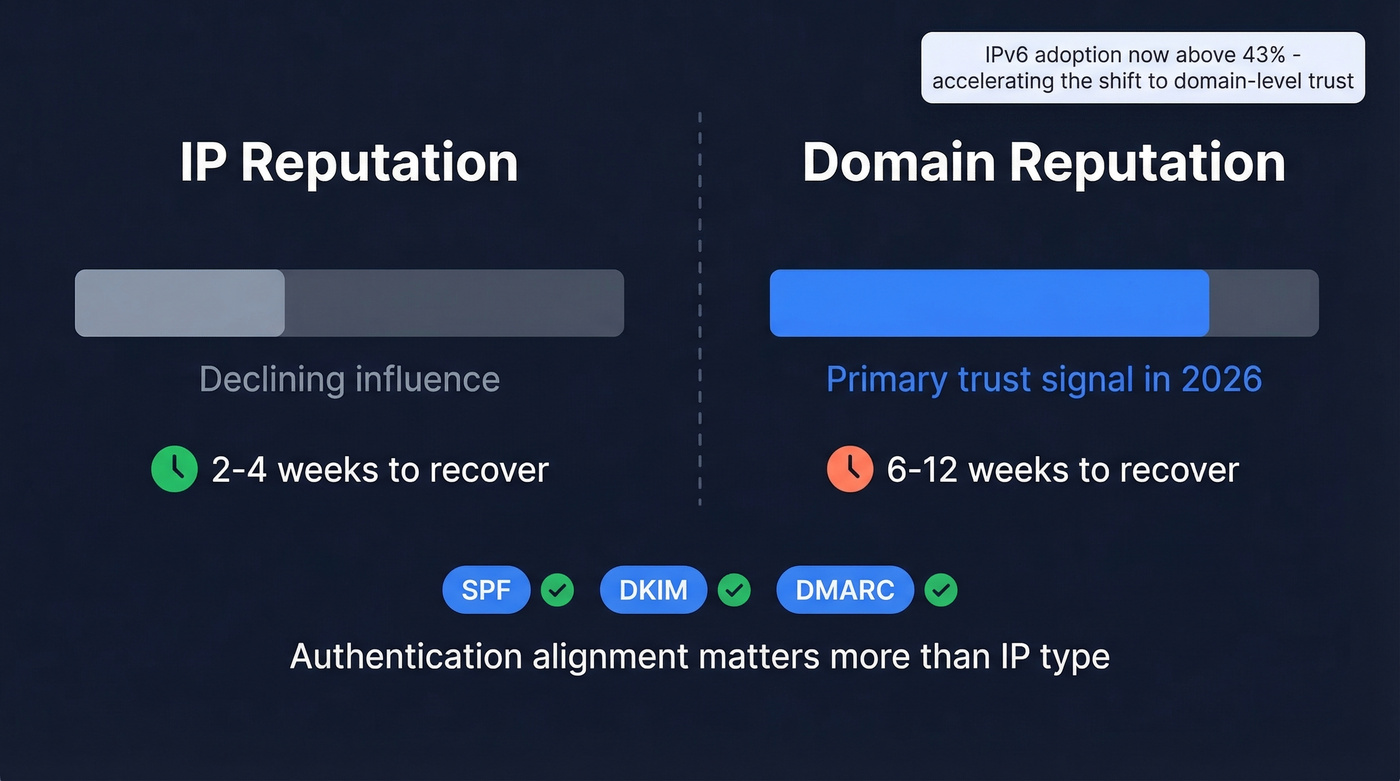
IP reputation scores run 0-100. Above 80 is good. Below 70 means deliverability problems. But if your IP reputation tanks, you can rebuild it in 2-4 weeks of clean sending. Domain reputation? That's a 6-12 week recovery - your domain follows you across ESPs and IP changes, while your IP doesn't.
SPF, DKIM, and DMARC alignment matter far more than whether you're on a shared or dedicated address. Monitor both through Google Postmaster Tools and Microsoft SNDS, but prioritize domain health. With global IPv6 adoption now above 43%, the IP picture is shifting anyway - the long-term trend points toward domain-level reputation as the primary trust signal.
We've seen teams spend months obsessing over dedicated IP warm-up while ignoring a failing DMARC policy. Fix the domain first.
Shared vs Dedicated IP for Email
Use shared IP if you send under 100,000 emails per month, your volume fluctuates, you don't have a dedicated deliverability person on staff, or your current metrics are healthy. Reputable ESPs monitor shared pools and rotate out IPs when they get into trouble - another reason shared works well for most senders. Some ESPs also offer allowlist certification programs like Validity Sender Certification that can boost deliverability on shared IPs even further.
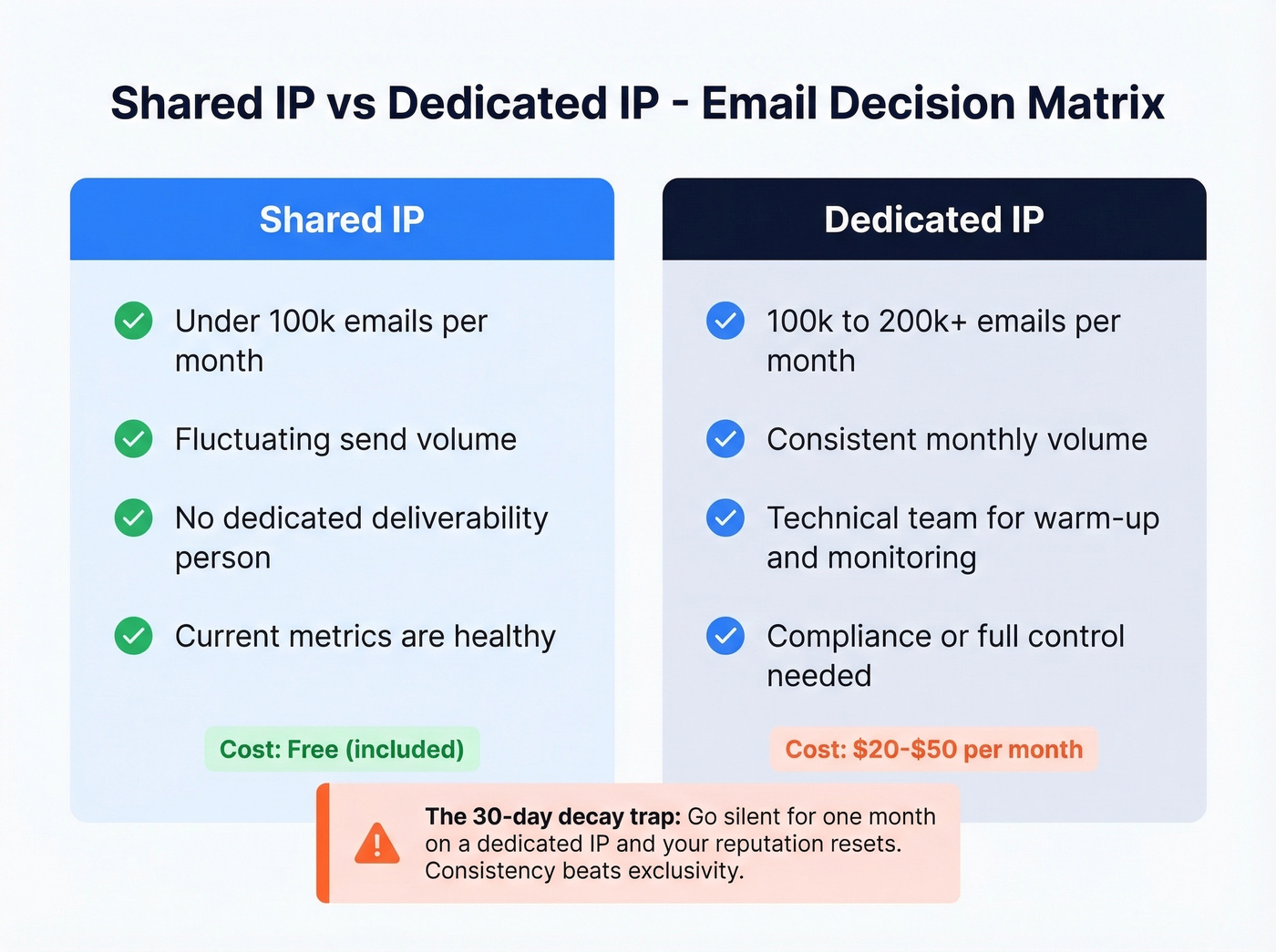
Use dedicated IP if you consistently send 100,000-200,000+ emails per month, can maintain that volume every single month (not quarterly spikes), have the technical chops to manage warm-up and blacklist monitoring, or need full control over sender reputation for compliance reasons.
The keyword here is consistency. Sending 200k once a quarter performs worse than sending 50k every month on a dedicated IP. Most reputation systems only store data for 30 days. Go silent for a month, and you're essentially starting over. That 30-day decay window is the single most underappreciated fact in the entire dedicated vs shared email debate - it catches more teams off guard than bad neighbors on a shared pool ever do.
Most ESPs charge $20-50/month for a dedicated IP. Mailchimp is the outlier with a $1,000 setup fee. For low-volume senders, shared IPs skip the warm-up entirely since your ESP handles reputation management across the pool.
One pattern worth noting: a Salesforce SE on Stack Exchange described a sender doing ~60k/month on a dedicated IP who considered switching to shared. The consensus? If it's working, don't change it. Solid advice - don't fix infrastructure that isn't broken.

Dedicated or shared, your IP won't save you from bad data. Prospeo's 5-step verification with spam-trap removal and catch-all handling delivers 98% email accuracy - on a 7-day refresh cycle so contacts don't go stale between sends.
Fix your bounce rate before you fix your IP setup.
Cold Email: Dedicated vs Shared
This is where the discussion gets genuinely interesting.
The 4-Lane Infrastructure Model
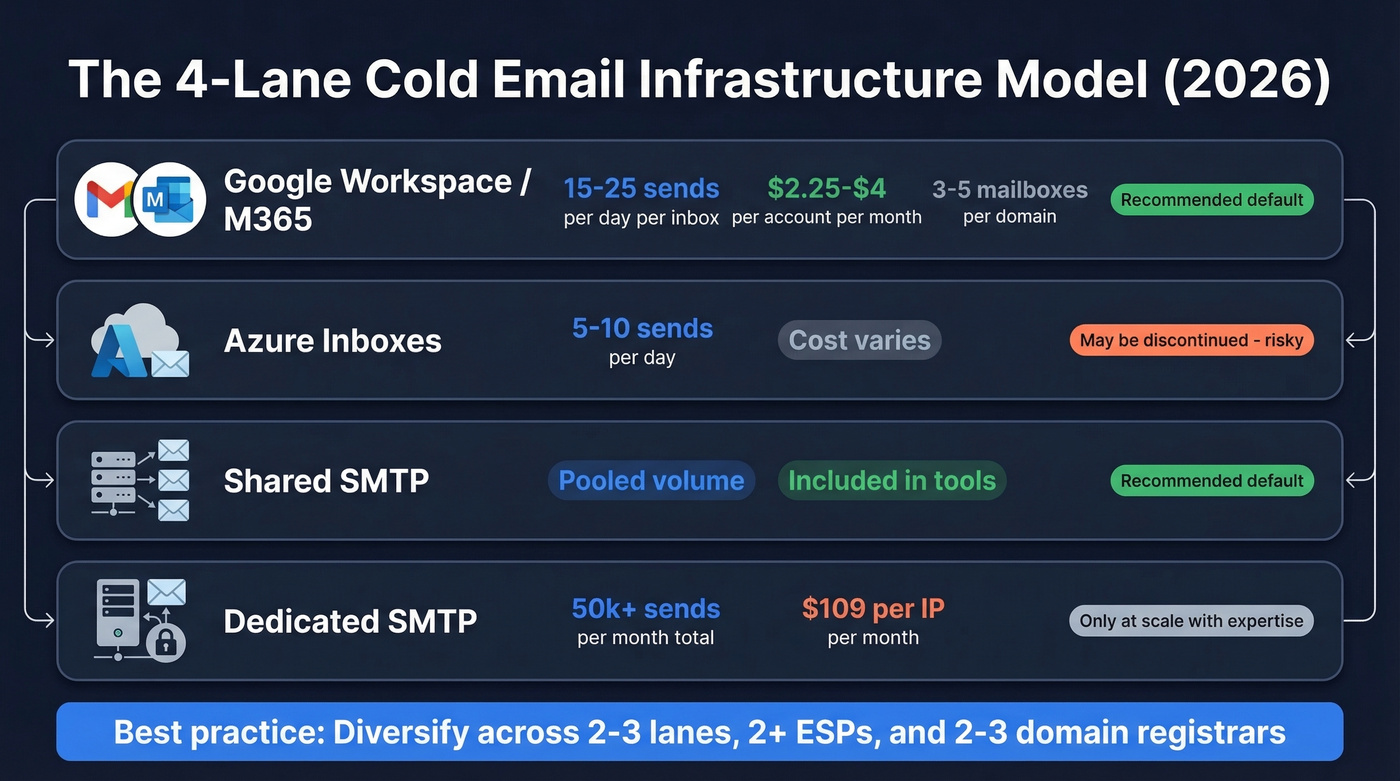
Cold email infrastructure in 2026 runs on four distinct lanes:
| Lane | Volume/Inbox | Cost | Notes |
|---|---|---|---|
| Google Workspace/M365 | 15-25 sends/day | ~$2.25-$4/acct/mo | 3-5 mailboxes per domain |
| Azure inboxes | 5-10 sends/day | Varies | Unsanctioned hack; may die |
| Shared SMTP | Pooled | Included in tools | Distributes risk across pool |
| Dedicated SMTP | 50k+/mo total | ~$109/IP/mo | Only at scale with expertise |
Operators on r/coldemail consistently recommend Google Workspace plus shared SMTP as the default combo. Dedicated SMTP only makes sense if you're pushing 50k+ sends per month and have the technical chops to manage blacklists and complaints yourself. Some operators worry that ultra-cheap shared infrastructure offerings cut corners on DNS setup and domain hygiene - vet your provider before committing. Diversify across 2 ESPs minimum and 2-3 domain registrars to reduce pattern-matching risk.
In our experience, teams that diversify across 2-3 sending lanes outperform those that dump everything into a single dedicated IP - even an expensive one.
Warm-Up Ramp Schedule
Whether you're warming a new domain or a dedicated IP, follow this ramp:
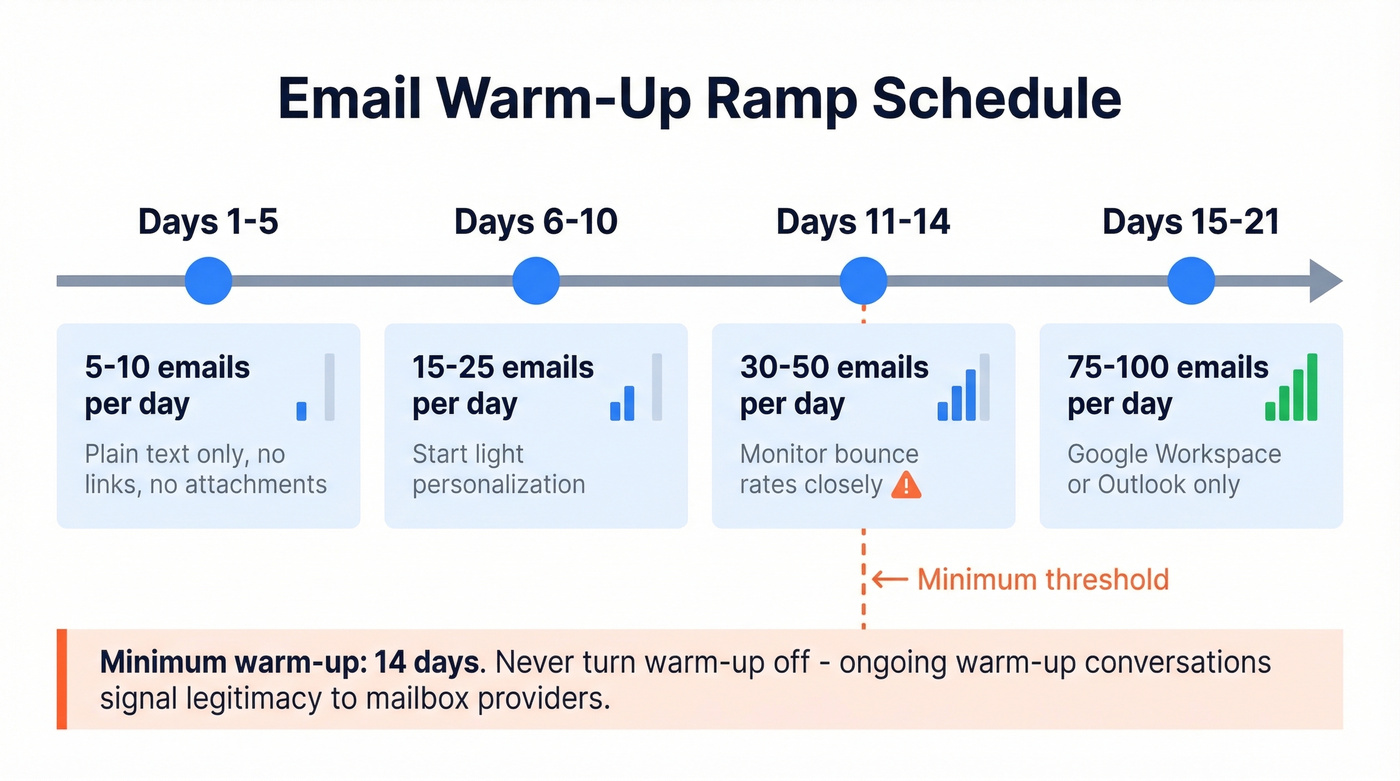
- Days 1-5: 5-10 emails/day. Plain text only, no links, no attachments.
- Days 6-10: 15-25/day. Start light personalization.
- Days 11-14: 30-50/day. Monitor bounce rates closely.
- Days 15-21: 75-100/day for Google Workspace or Outlook only.
Minimum warm-up period is 14 days. Never turn warm-up off - ongoing warm-up conversations signal legitimacy to mailbox providers.
Fix Your Data Before Your IP
Bounce rates are one of the fastest ways to damage sender reputation regardless of IP type. You can run the most sophisticated dedicated IP setup in the world, and it won't matter if 15% of your list is invalid.
This is the upstream problem most teams ignore. Before spending $50/month on a dedicated IP or $109/month on dedicated SMTP, verify your list. Prospeo runs a 5-step verification process with catch-all handling, spam-trap removal, and honeypot filtering - delivering 98% email accuracy on a 7-day refresh cycle so the contacts you pulled last week aren't already going stale. Snyk's outbound team saw their bounce rate drop from 35-40% to under 5% after switching, generating 200+ new opportunities per month. That's the kind of lift no IP configuration change will ever produce.
Hot take: If your average deal size is under $10k, you almost certainly don't need dedicated SMTP. The math favors adding more Workspace mailboxes across multiple domains over paying $109/month for a dedicated IP. Spend that budget on cleaner data instead.
VPN: Privacy vs Usability
The VPN tradeoff is cleaner than email.
Shared VPN IPs give you better anonymity because you blend in with hundreds or thousands of other users. The downside? More CAPTCHAs, temporary blocks, and access issues when other users on your IP misbehave. Dedicated VPN IPs give you a consistent address - fewer verification loops, stable access to financial services, and the ability to whitelist for business applications. The tradeoff is reduced anonymity, since that IP is now uniquely associated with you.
| Provider | Dedicated IP Add-On |
|---|---|
| PIA | $2.50/mo |
| NordVPN | $3.69/mo |
| Surfshark | $3.75/mo |
| ExpressVPN | $3.99-$7.49/mo |
| PureVPN | $4.45/mo |
| TorGuard | $14.29/mo (bundled) |
Budget $3-5/month for most mainstream VPNs. Skip this if you're only using a VPN for streaming or casual browsing - shared IPs are fine for that, and you'll save the monthly add-on fee.
Web Hosting: Shared Is Fine
You don't need a dedicated IP for web hosting in 2026. SNI solved the SSL-on-shared-IP problem years ago. Let's Encrypt provides free SSL certificates on shared hosting. Major hosts like WP Engine run shared IPs by default.
SEO impact? None. Google's John Mueller has confirmed shared IPs are standard and don't affect search rankings. Even a dedicated IP won't help if your host's entire netblock has a poor reputation - the IP's neighborhood matters more than its exclusivity. The only edge cases where a dedicated hosting IP matters: legacy systems requiring IP-based SSL, specific compliance requirements, or B2B applications that need IP allowlisting. If none of those apply, save your money.
When to Switch
Before changing anything about your IP setup, run through this:
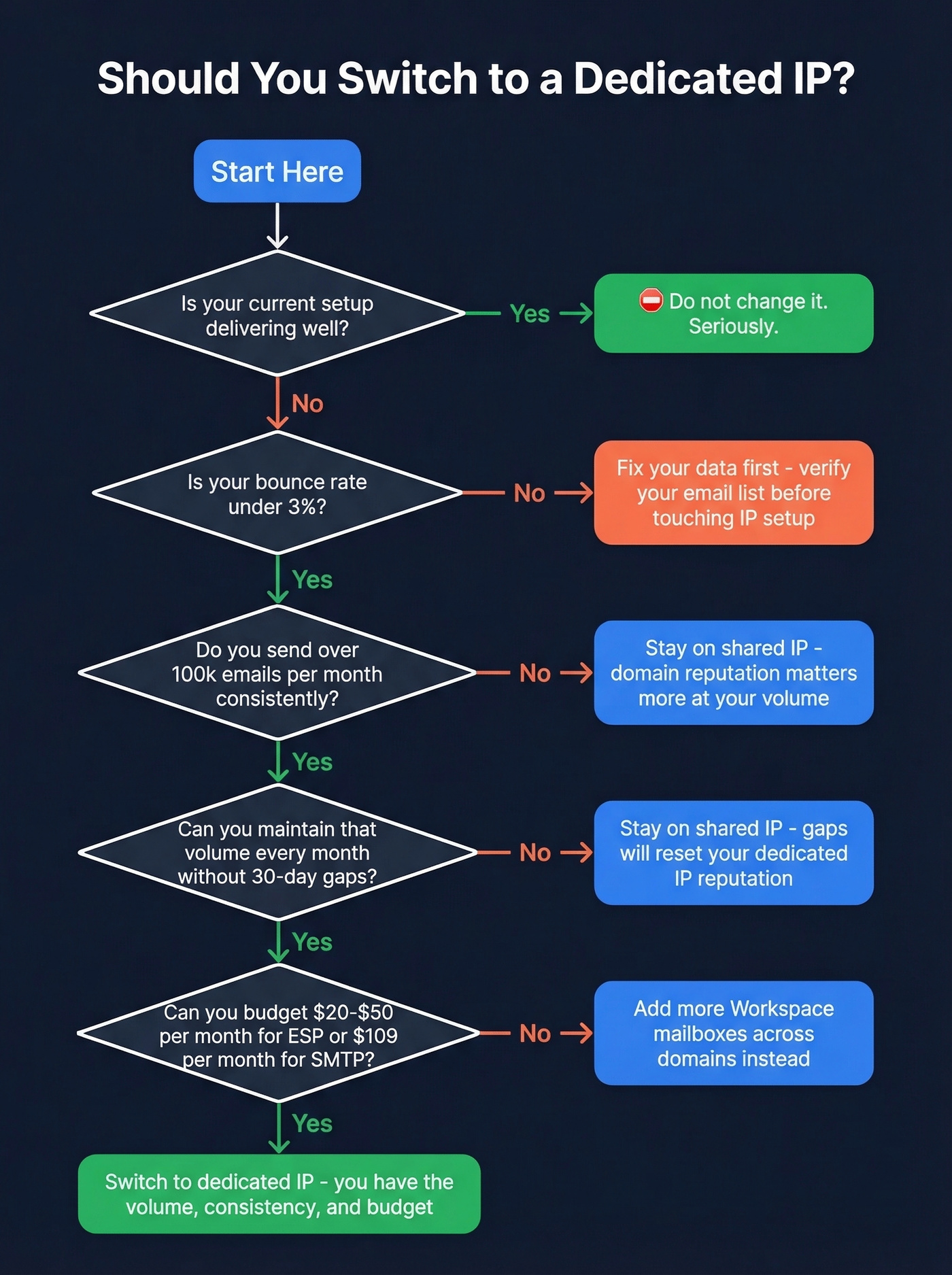
- Volume: Under 50k emails/month? Stay shared. 50k-100k? Maybe. Over 100k consistently? Consider dedicated.
- Consistency: Can you maintain that volume every month without gaps longer than 30 days? If not, shared is safer.
- Budget: Can you absorb $20-50/month for an ESP dedicated IP or $109/month for dedicated SMTP?
- Performance: Is your current setup delivering well? If yes, don't change it. Seriously.
- Data quality: Is your bounce rate under 3%? If not, fix that first - it's the highest-leverage move you can make. (Use these email reputation tools to monitor the impact.)
Let's be honest: step zero in any deliverability improvement project is verifying your contact data. Bad addresses, spam traps, and catch-all domains do more damage to sender reputation than any IP configuration ever will. If you're troubleshooting, start with email bounce rate benchmarks and then work backward into list hygiene and sending practices.
If you're scaling outbound, pair infrastructure decisions with sales prospecting techniques that keep volume consistent and targeted.
Snyk's 50 AEs dropped their bounce rate from 35-40% to under 5% and generated 200+ new opportunities per month - not by switching IPs, but by switching to verified data. At $0.01 per email, Prospeo costs less than one month of a dedicated IP.
Stop paying $50/month for an IP upgrade that won't move the needle.
FAQ
Does a shared IP hurt SEO?
No. Google's John Mueller has confirmed shared IPs don't affect search rankings. SNI handles SSL on shared hosting without issue, and major hosts run shared IPs by default.
How much does a dedicated IP cost?
Most ESPs charge $20-50/month, with Mailchimp's $1,000 setup fee as the outlier. VPN dedicated IPs run $2.50-$7.49/month. Cold email dedicated SMTP costs roughly $109/IP/month through providers like Inframail.
How long does IP warm-up take?
Typically 2-4 weeks. Start at 5-10 emails per day and ramp gradually. If you stop sending for 30+ days, most reputation systems reset and you'll need to warm up again from scratch.
Can I switch from shared to dedicated without downtime?
Yes, but you start with zero reputation on the new IP. Plan for a 2-4 week warm-up period where you gradually migrate volume. Don't move everything at once - stagger the transition to maintain deliverability.
What matters more - IP type or data quality?
Data quality, and it isn't close. Bouncing off invalid emails and hitting spam traps destroys sender reputation on any IP type. Cleaning your list before sending is a higher-leverage fix than any infrastructure change you'll make.