

What Is an SMB? Small & Medium Business Guide (2026)
Your company has 85 employees and $12M in revenue. Are you a small business? A medium business? In the world of SMB classification, it depends entirely on who's asking - the SBA, the EU, your CRM vendor, or the sales rep trying to figure out which pricing tier to quote you. Every source gives a different number, and most skip the context that actually matters.
The definition isn't just academic. It determines whether you qualify for government contracts, which software pricing tier you land in, and how investors categorize your growth stage. Let's sort it out.
Short answer: An SMB is a business with roughly 1-500 employees, and revenue thresholds that often land under ~$50M - but the exact cutoff depends on who's defining it and why. There's no single universal definition. The SBA uses industry-specific NAICS codes, the EU caps it at 250 employees, and B2B vendors make up their own numbers. If you need an official answer for government contracts or grants, use the SBA Size Standards Tool. For sales and marketing segmentation, use the go-to-market framework below.
What Does SMB Mean?
"Small and medium business" sounds straightforward until you try to pin it down. In the US, the most commonly used threshold is fewer than 500 employees - the SBA's general benchmark - though the real answer is far more nuanced. Revenue thresholds are often under ~$50M in common definitions, but they vary by industry and who's drawing the line.
The Census Bureau's 2022 data counted 5.52 million employer firms with 1-499 employees. Alongside those sit 29,811,495 nonemployer businesses - solo operators, freelancers, and gig workers with no paid staff. When someone tells you "99% of US businesses are small businesses," they're technically correct but practically useless. A one-person Etsy shop and a 400-person manufacturer aren't the same thing, and lumping them together obscures more than it reveals.
For practical purposes, an SMB is large enough to have real operational complexity - departments, payroll, a sales process - but small enough that a single bad quarter can threaten the whole operation. It's not a legal category. It's shorthand for "not enterprise, not a solo act."
SMB vs SME vs Mid-Market vs Enterprise
The table below reflects common go-to-market conventions, not legal definitions. These are the ranges most B2B sales and marketing teams use when segmenting their pipeline.
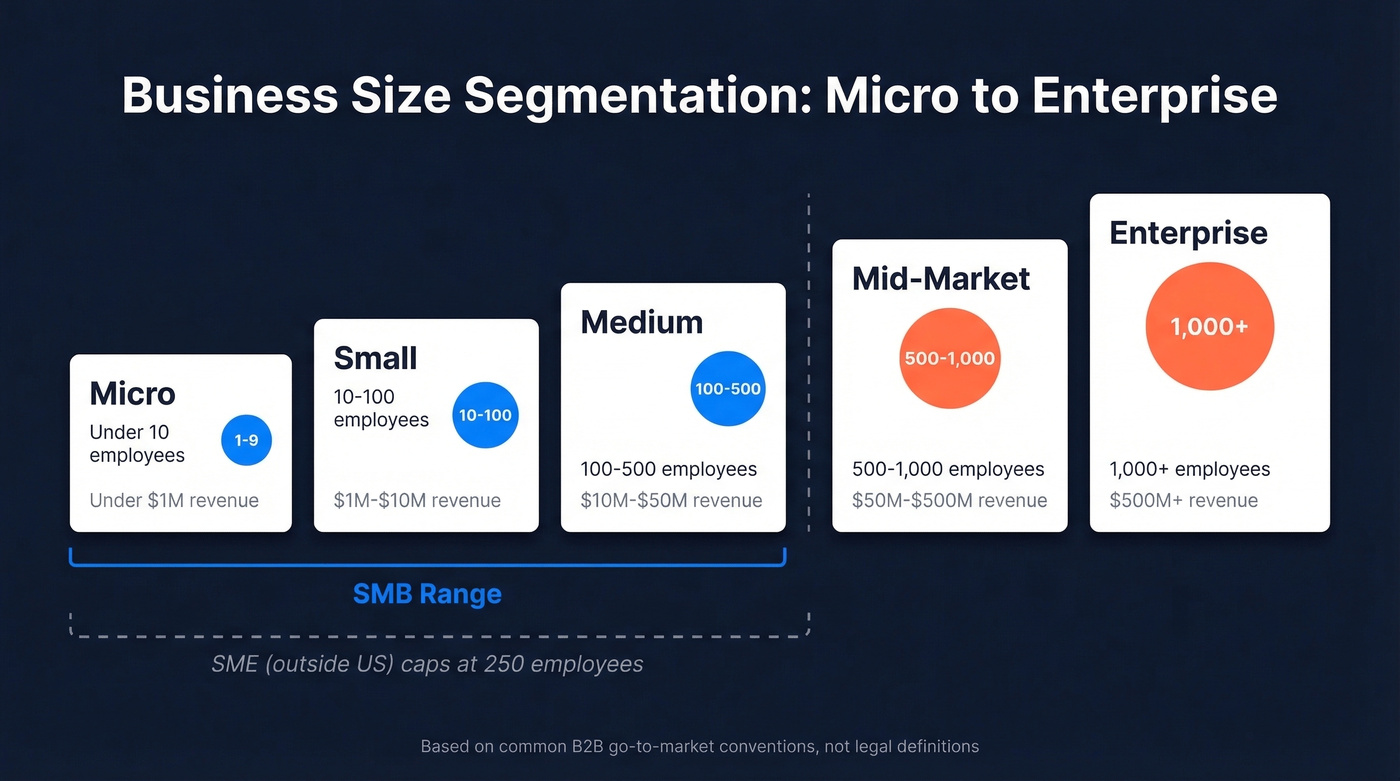
| Segment | Employees | Revenue | Common Usage |
|---|---|---|---|
| Micro | <10 | <$1M | Solopreneurs, freelancers |
| Small | 10-100 | $1M-$10M | Startups, local businesses |
| Medium | 100-500 | $10M-$50M | Regional firms, growth-stage |
| Mid-Market | 500-1,000 | $50M-$500M | Multi-office, complex ops |
| Enterprise | 1,000+ | $500M+ | Global orgs, Fortune 500 |
"SME" (small and medium enterprise) is the preferred term outside the US - particularly in Europe, the UK, and across OECD countries. The concepts overlap almost entirely; the thresholds just shift. SME sales teams in these regions typically target businesses under 250 employees, compared to the 500-employee benchmark common in the US. We cover those differences in the international section below.
Here's the thing about these categories: employee count alone tells you almost nothing about how a company operates. A 50-person SaaS company running $20M ARR operates nothing like a 50-person landscaping firm. Revenue, growth rate, and buying behavior matter more than headcount ever will.
How the SBA Defines "Small Business"
The SBA's definition is the one that matters for government contracts, grants, and federal programs. It's also the most rigorous - and the most confusing.
NAICS Codes and Industry Thresholds
The SBA doesn't use a single employee or revenue cutoff. Instead, it sets size standards by industry, keyed to NAICS codes. Some manufacturing categories can qualify as "small" with up to 1,000 employees (ice-cream and frozen dessert manufacturing, for example), while other industries use annual receipts caps in the tens of millions.
Annual receipts are calculated as total income (gross income) plus cost of goods sold, averaged over the latest five complete fiscal years. Employee counts are averaged over the latest 24 months. Here's the part that trips people up: affiliates must be included. If your company is 50%+ owned by another entity, or controlled through contractual arrangements, those employees and revenues count toward your size calculation. Affiliation rules live in 13 CFR 121.103, and they're worth reading if you're anywhere near a threshold.
Beyond size standards, the SBA ecosystem includes SBDCs for local advising, SCORE for mentoring, SBIR grants for R&D-stage companies, and 8(a) certification for disadvantaged businesses - all keyed to your size classification.
What's Changing in 2026
On August 22, 2025, the SBA published a notice of proposed rulemaking to increase revenue-based size standards for 263 industries. The proposed changes reflect inflation adjustments and market shifts:
- Engineering Services (NAICS 541330): $25.5M → $29.9M
- Admin Management Consulting (NAICS 541611): $24.5M → $27.0M
- Structural Steel Contractors (NAICS 238120): $19.0M → $19.5M
The SBA reviewed 513 revenue-based standards total, proposing increases for 263, retaining 249, and removing one exception. If you're near the current threshold in your industry, these changes could expand your eligibility for set-aside contracts - good news for businesses that were previously just above the line.
International SMB Definitions
Outside the US, "SME" is the standard term, and the thresholds shift considerably.
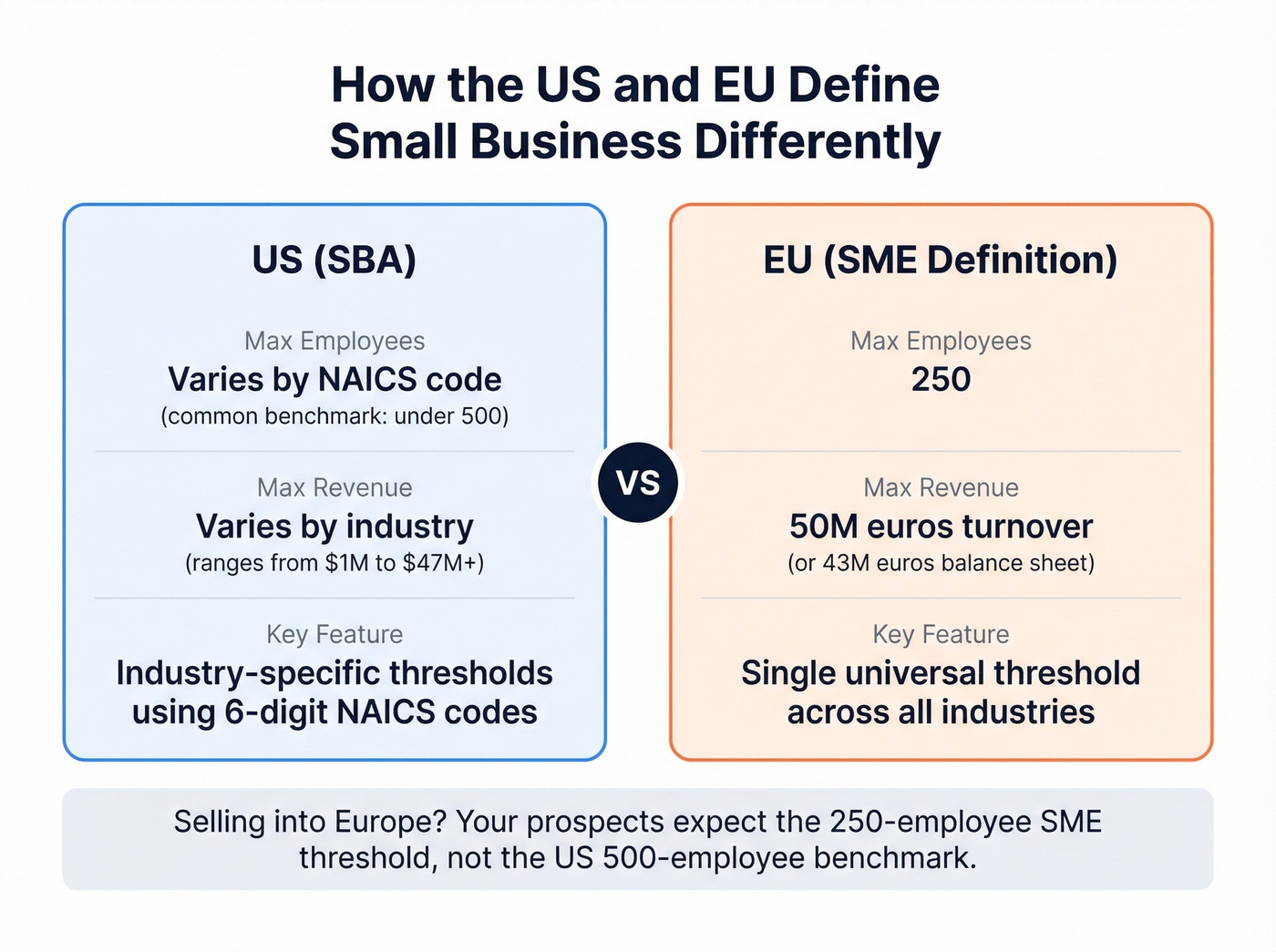
| Region | Max Employees | Max Revenue | Notes |
|---|---|---|---|
| US (SBA) | Varies by NAICS | Varies by NAICS | Common benchmark is <500 employees |
| EU | 250 | €50M turnover | Commonly used SME cap |
The EU definition is widely used in practice: fewer than 250 employees and annual turnover under €50M or balance sheet under €43M. If you're selling into European markets, this is the segmentation your prospects expect.

Segmenting your pipeline by SMB, mid-market, and enterprise is step one. Step two is actually reaching them. Prospeo's 30+ search filters - including headcount, revenue, funding, and department size - let you build targeted SMB lists that match your exact ICP. 98% email accuracy means your outreach actually lands.
Filter 300M+ profiles by company size and get verified contact data at $0.01 per email.
SMB Statistics That Matter
The US has 5.52 million employer firms with 1-499 employees as of 2022, up from 5.38 million in 2021. That's the number that matters for economic impact - businesses with payroll, employees, and operational infrastructure. The 29,811,495 nonemployer businesses alongside them are solo operators, and including them in "small business" statistics is how you get misleading headlines.
The scale of small is striking: 55.7% of employer establishments had fewer than 5 employees in 2022. Most "businesses" in America are genuinely tiny.
On job creation, the numbers are unambiguous. Small businesses (249 or fewer employees) accounted for 52.8% of total net job creation between Q1 2021 and Q2 2024. In Q2 2022, the split was even more dramatic: small firms created 324,000 of 329,000 net new jobs - 98.5% of the total. Women-owned employer firms hit 1,309,282 in 2022, up from 1,134,549 in 2017, and women-owned nonemployer businesses generated $411.6 billion in receipts that same year.
SMB Survival Rates
According to BLS data compiled by LendingTree, the failure trajectory for private-sector businesses looks like this:
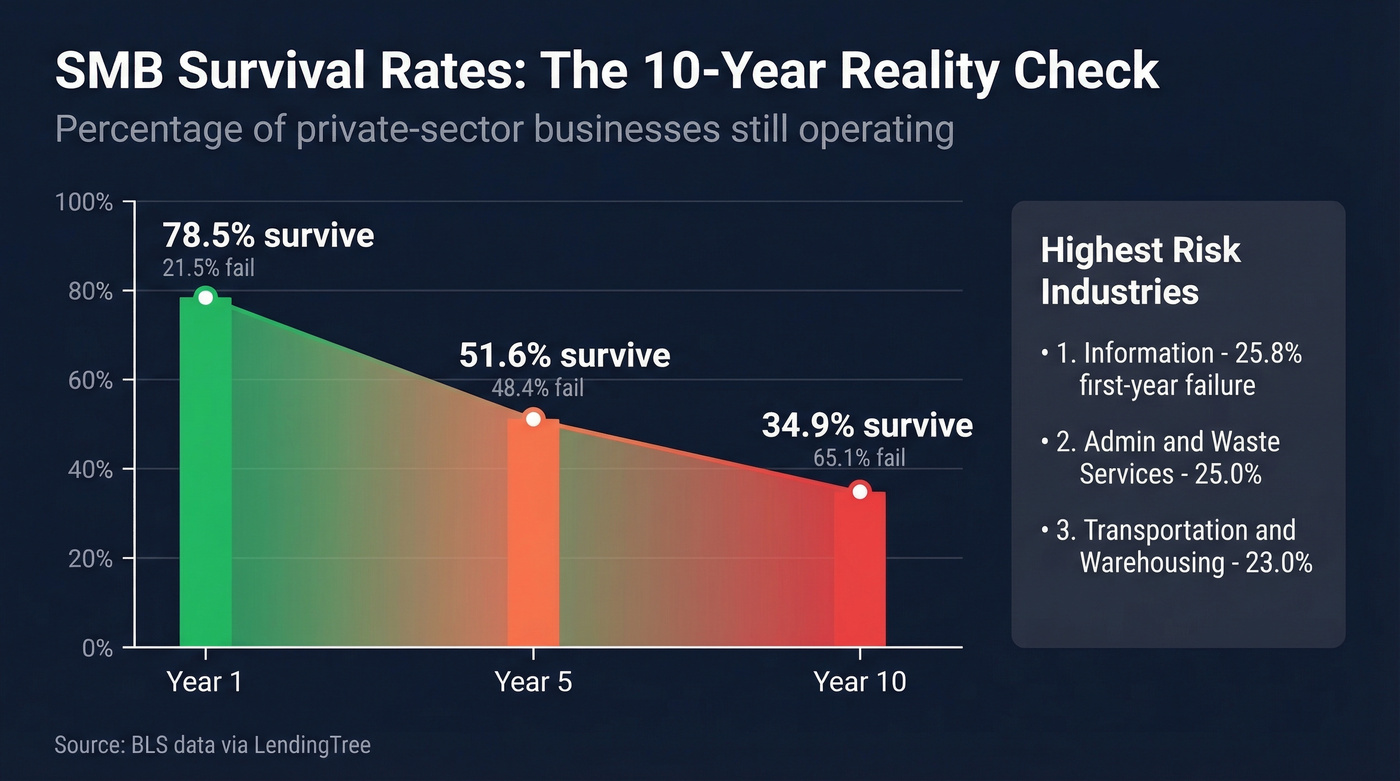
| Timeframe | Failure Rate | Survival Rate |
|---|---|---|
| Year 1 | 21.5% | 78.5% |
| Year 5 | 48.4% | 51.6% |
| Year 10 | 65.1% | 34.9% |
Industry matters enormously. The Information sector has the highest first-year failure rate at 25.8%, followed by Administrative and Waste Services at 25.0%, with Transportation and Warehousing and Utilities both at 23.0%. Geography matters too: Minnesota's first-year failure rate runs 27.7% (the highest), while Washington state sits at just 13.6%.
Roughly half of all businesses won't make it to their fifth birthday. That's not pessimism - it's the baseline you're planning against. The businesses that survive treat cash flow, hiring, and customer retention as existential priorities from day one, not things they'll "figure out later."
SMB Challenges in 2026
Financial Pressures
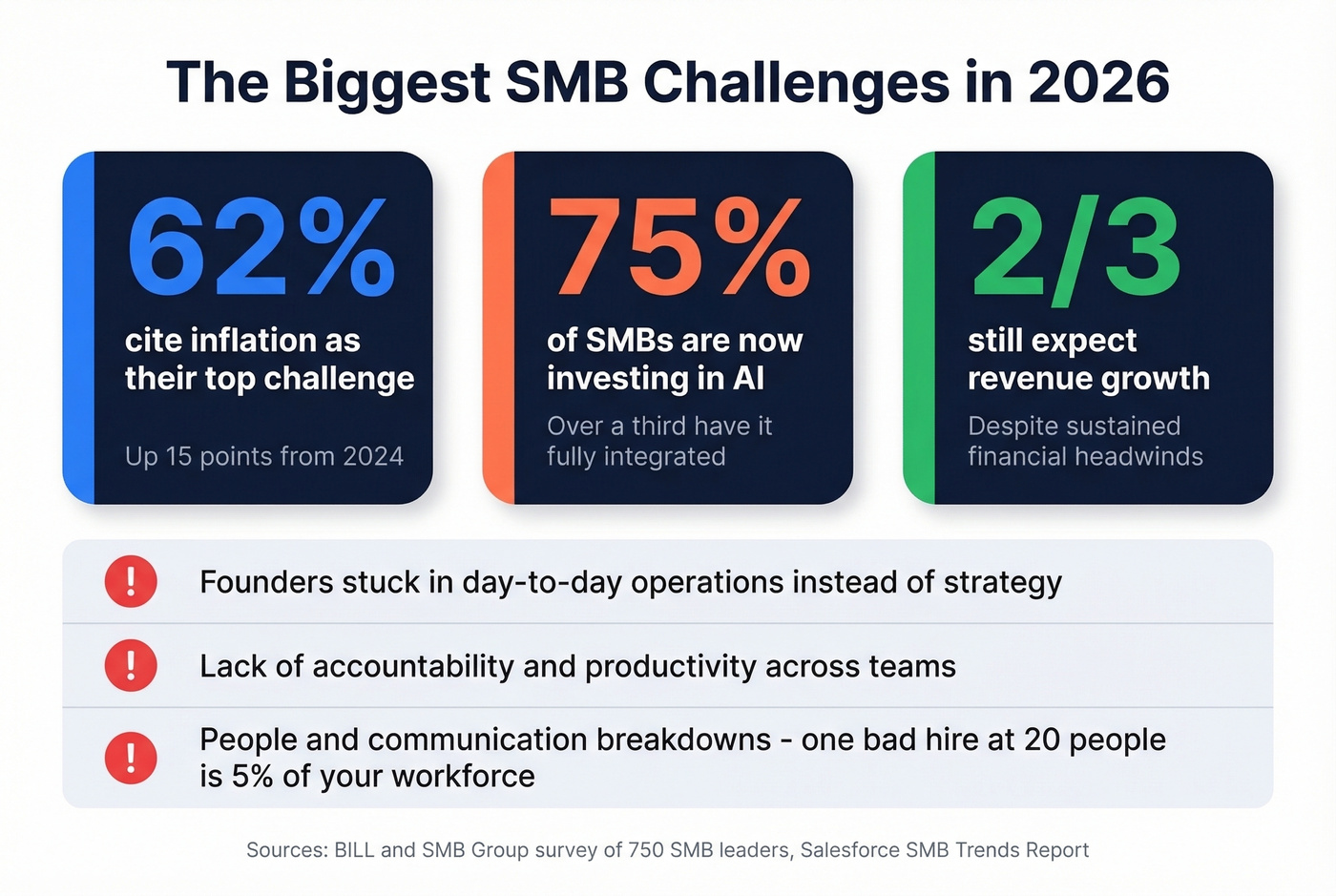
Inflation remains the dominant concern. A survey of 750 SMB financial decision-makers by BILL and SMB Group found that 62% cite inflation as their top challenge - up 15 points from 2024. That's not a blip; it's a sustained squeeze on margins, hiring budgets, and growth plans. Despite the headwinds, two-thirds of SMBs still expect revenue growth.
Operational Blockers
The same three issues keep surfacing in practitioner conversations: lack of accountability and productivity, founders stuck in day-to-day operations, and people-related communication breakdowns. A common operating benchmark is 70% of a founder's time working on the business vs 30% in it - and plenty of owners find themselves living the inverse.
We've seen this firsthand. The founder who's supposed to be driving strategy is instead approving invoices and mediating team conflicts. One wrong hire at a 20-person company is 5% of your workforce and a disproportionate drag on culture. Behind all of it sits the emotional toll that rarely makes it into business articles: isolation, burnout, and the mental health burden of being the person who can't afford to have a bad month.
What's Coming
Economic uncertainty and AI disruption are the two forces every owner is watching. Cybersecurity threats are growing as smaller companies adopt more cloud tools without enterprise-grade security teams, and a single breach can be existential at this scale.
Regulatory compliance churn - new data privacy rules, evolving tax codes, industry-specific mandates - eats time and money that should go toward growth. Skip the "we'll deal with compliance later" approach. By the time you're dealing with it, you're already behind.
Technology Trends for SMBs in 2026
75% of SMBs are now investing in AI, and over a third have it fully integrated into daily operations. According to Salesforce's SMB Trends Report (3,350+ SMB leaders worldwide), 71% plan to increase AI spending over the next year, with only 4% scaling back.
The most common use cases are marketing campaigns, content creation, customer service chatbots, and product recommendations - high-volume, repetitive tasks where AI delivers immediate time savings. Financial operations are another frontier: 93% of SMBs see moderate-to-high value in financial automation, and 87% are considering integrated financial software in the next 12-24 months. In our experience, the companies that adopt AI fastest aren't the ones with the biggest budgets - they're the ones with the fewest legacy systems to work around.
SMB Advantages Over Enterprises
It's easy to frame smaller businesses as underdogs fighting against resource constraints. That framing misses the point entirely.
Speed is the obvious advantage. A 50-person company can make a pricing decision in a day. An enterprise runs it through three committees and a legal review over six weeks. When markets shift - and they're shifting constantly - that speed gap is a competitive weapon, not just a nice-to-have.
Personalization is another. When your VP of Sales knows 40% of your customers by name, you don't need a $200K CDP to deliver personalized experiences. The feedback loops are shorter, the relationships are deeper, and the customer feels it. Enterprises hire consultants to build what SMBs do naturally. And 73% of customers now say companies treat them as individuals, up from 39% in 2023 - but 64% believe companies are reckless with data. Trust is the new moat, and businesses that handle data responsibly have a structural advantage regardless of size.
Employee count is a lazy proxy for business sophistication. The SMBs that win in 2026 will be the ones that stop apologizing for their size and start treating it as a strategic asset.
5.52 million US employer firms fit the SMB definition - but only a fraction match your ICP. Prospeo combines firmographic filters with buyer intent data across 15,000 topics so you target SMBs actively in-market, not just ones that fit a headcount range. Data refreshes every 7 days, not 6 weeks.
Stop spraying the entire SMB market. Reach the ones ready to buy.
FAQ
What's the difference between SMB and SME?
SMB (small and medium business) is the US term; SME (small and medium enterprise) is used in Europe, the UK, and most international contexts. Both describe businesses below the enterprise threshold, but the EU caps SMEs at 250 employees while the US commonly uses 500 as a benchmark, with SBA thresholds varying by industry.
How many employees does an SMB typically have?
No universal number exists. The SBA uses industry-specific thresholds, often under 500 employees. The EU caps SMEs at 250. In B2B go-to-market segmentation, "SMB" typically means 1-100 employees, while "mid-market" covers 100-1,000.
What percentage of US businesses are small businesses?
Small businesses make up 99.9% of all US firms. But 29,811,495 of the roughly 35 million total are nonemployer solo operators. The figure that matters for payroll impact is the 5.52 million employer firms with actual employees on staff.
How can SMBs compete with enterprises on outbound sales?
Self-serve data platforms have eliminated the enterprise pricing moat. Prospeo offers 300M+ professional profiles with a free tier and no contracts - at roughly $0.01 per lead versus $1+ on legacy platforms. Apollo has a strong free tier for smaller lists. HubSpot bundles prospecting into its CRM. The playing field has never been more level.
What's the failure rate for small businesses?
About 21.5% of private-sector businesses fail in the first year, 48.4% within five years, and 65.1% within ten years. Rates vary significantly by industry - the Information sector has the highest first-year failure rate at 25.8% - and by state, with Minnesota at 27.7% and Washington at 13.6%.