

The B2B Sales Pipeline Guide Your CRM Dashboard Won't Give You
It's Thursday afternoon. Your VP asks for a forecast update. You open the CRM, stare at $2.1M in "Stage 3" deals, and realize half of them haven't had a single activity logged in six weeks. You commit a number anyway. Everyone does.
Here's the problem: only 18.7% of sales orgs achieve forecast accuracy of 75% or better. Meanwhile, 84% of reps missed quota last year. Your pipeline isn't a revenue predictor - it's a graveyard of good intentions dressed up in stage labels.
Let's fix that.
What You Need (Quick Version)
If you don't read another word, do these five things:
- Define 6-7 stages with binary exit criteria. "Feels like they're interested" isn't a gate.
- Track pipeline velocity weekly - not just pipeline value. A $5M pipeline moving at zero velocity is worth exactly zero.
- Maintain 3-5x coverage against quota. If your quota is $500K and your pipeline is $600K, you're already behind.
- Purge stale deals older than 2x your average cycle length. Something sitting for 90 days when your average close is 45? Dead.
- Fix data quality before adding more outreach tools. If 20% of your emails bounce, no sequencer on earth saves you.
The rest of this article is the "how and why" behind each of those bullets.
What a B2B Pipeline Actually Is
A pipeline is the deal-level operating system your revenue runs on. Every opportunity lives in a stage, and every stage has rules for moving forward - or getting killed. It's not a metaphor. It's an opportunity management tool.
People confuse pipelines with funnels constantly. They're related but different:
| Pipeline | Funnel | |
|---|---|---|
| Unit | Individual deals | Aggregate cohorts |
| View | Rep/manager level | Marketing/RevOps level |
| Purpose | Manage & forecast | Measure & optimize |
| Moves by | Sales actions | Conversion rates |
You manage a pipeline; you analyze a funnel. Mixing them up is how you end up with dashboards that look healthy while quota attainment craters.
80% of B2B interactions are now digital, and buyers spend just 17% of their buying time actually talking to sellers. The rest is independent research, internal consensus-building, and committee deliberation. Your pipeline strategy needs to account for a buyer journey you can't see - which means your exit criteria matter more than ever, because they're the only objective signal you've got.
The 7 Pipeline Stages (With Exit Criteria)
Stop adding stages. Start enforcing the ones you have. Six to seven stages with binary exit criteria beat twelve stages with no enforcement every single time. Here's the framework - adapt the labels to your CRM, but keep the exit gates rigid.
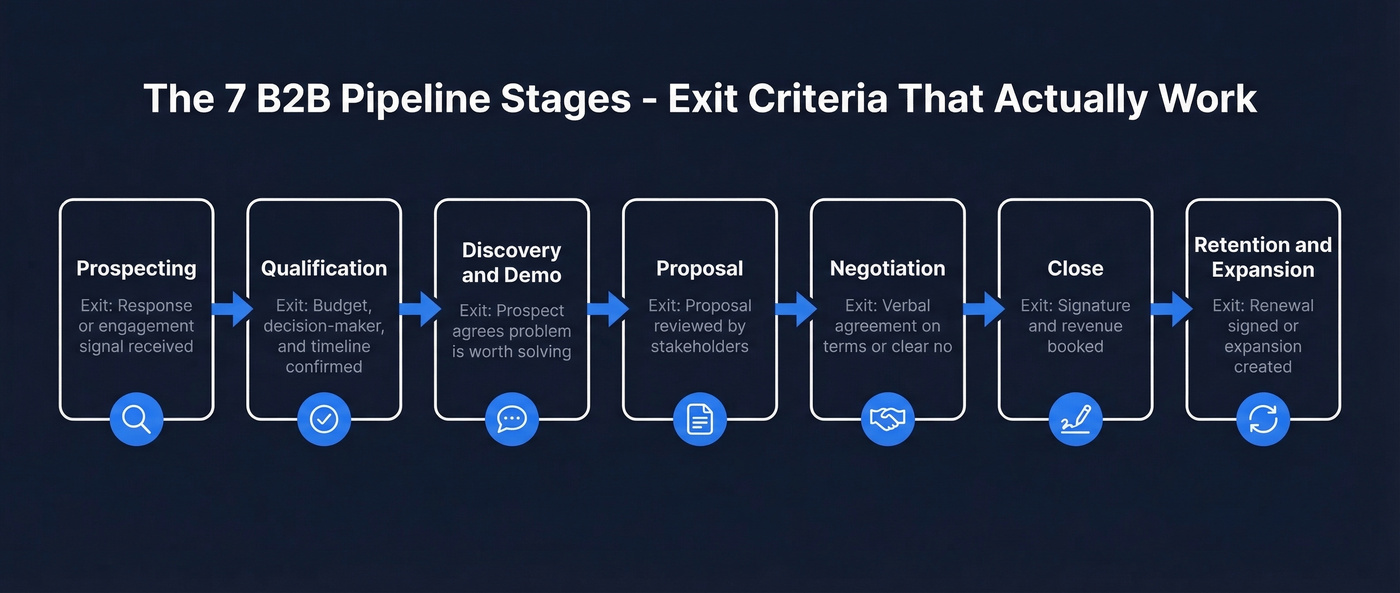
Getting these stages right is the single highest-leverage thing you can do for forecast accuracy.
Prospecting
You're identifying accounts and contacts that match your ICP. Entry: contact fits firmographic and technographic criteria. Exit: a response or engagement signal - an email reply, form fill, or accepted meeting request. If they don't match your ICP, they don't enter the pipeline. Period.
Qualification
Lead qualification is the #1 seller challenge in 2026, and it's easy to see why. This is where BANT or MEDDIC earns its keep. Entry: prospect has responded or engaged. Exit: confirmed budget path, identified decision-maker, and a stated timeline.
B2B buying committees now involve 6-10 stakeholders, so "who else is involved?" is a mandatory question. Disqualify aggressively - if there's no urgency or budget authority, or you're clearly RFP filler, kill the deal. Of all the B2B sales stages, qualification is where disciplined teams separate themselves from everyone else.
Discovery & Demo
The trap here is jumping straight to a product demo without understanding the business problem. Discovery isn't a monologue - reps who talk more than 60% of the call close less. Entry: qualified opportunity with a scheduled discovery call. Exit: prospect confirms the problem is worth solving and agrees to evaluate your solution.
Proposal
Here's the thing: sending proposals into a void is the #1 way deals die at this stage. If you don't know who's reviewing your proposal and by when, you don't have a real proposal stage - you have a PDF floating in someone's inbox.
Entry: mutual agreement on scope and general pricing range. Exit: prospect confirms they've reviewed the proposal with internal stakeholders. Consider enabling your champion with a stakeholder engagement deck they can circulate internally.
Negotiation
Terms, pricing, legal, procurement. Entry: prospect has engaged on proposal specifics with redlines, pricing questions, or legal review. Exit: verbal agreement on terms or a clear "no." If procurement hasn't responded in two weeks, the deal isn't in negotiation - it's stalled.
Close
Signed contract, PO issued, deal done. Entry: verbal agreement and final paperwork in motion. Exit: signature and revenue booked. Until the e-signature is timestamped, it's not closed. Verbal commits aren't revenue.
Retention & Expansion
Entry: customer onboarded and live. Exit: renewal signed or expansion opportunity created. Expansion pipeline is cheaper pipeline - treat it like a stage, not an afterthought.
Here's the summary table you can copy straight into your CRM or sales operations playbook:
| Stage | Entry Criterion | Exit Criterion | Where Teams Fail |
|---|---|---|---|
| Prospecting | Fits ICP firmographics/technographics | Response or engagement signal | Dumping every warm body into the pipeline |
| Qualification | Prospect responded/engaged | Budget, decision-maker, timeline confirmed | Not disqualifying fast enough |
| Discovery & Demo | Qualified opp with scheduled call | Prospect agrees problem is worth solving | Talking more than listening |
| Proposal | Mutual scope/pricing agreement | Proposal reviewed by stakeholders | No visibility into who's reviewing |
| Negotiation | Prospect engaging on specifics | Verbal agreement or clear "no" | Treating silence as negotiation |
| Close | Verbal agreement + paperwork in motion | Signature and revenue booked | Counting verbal commits as closed |
| Retention & Expansion | Customer onboarded and live | Renewal signed or expansion created | Handing off to CS and never looking back |
B2B Pipeline Benchmarks for 2026
Here's where most teams discover their pipeline is leaking. These stage-by-stage conversion benchmarks give you a baseline:
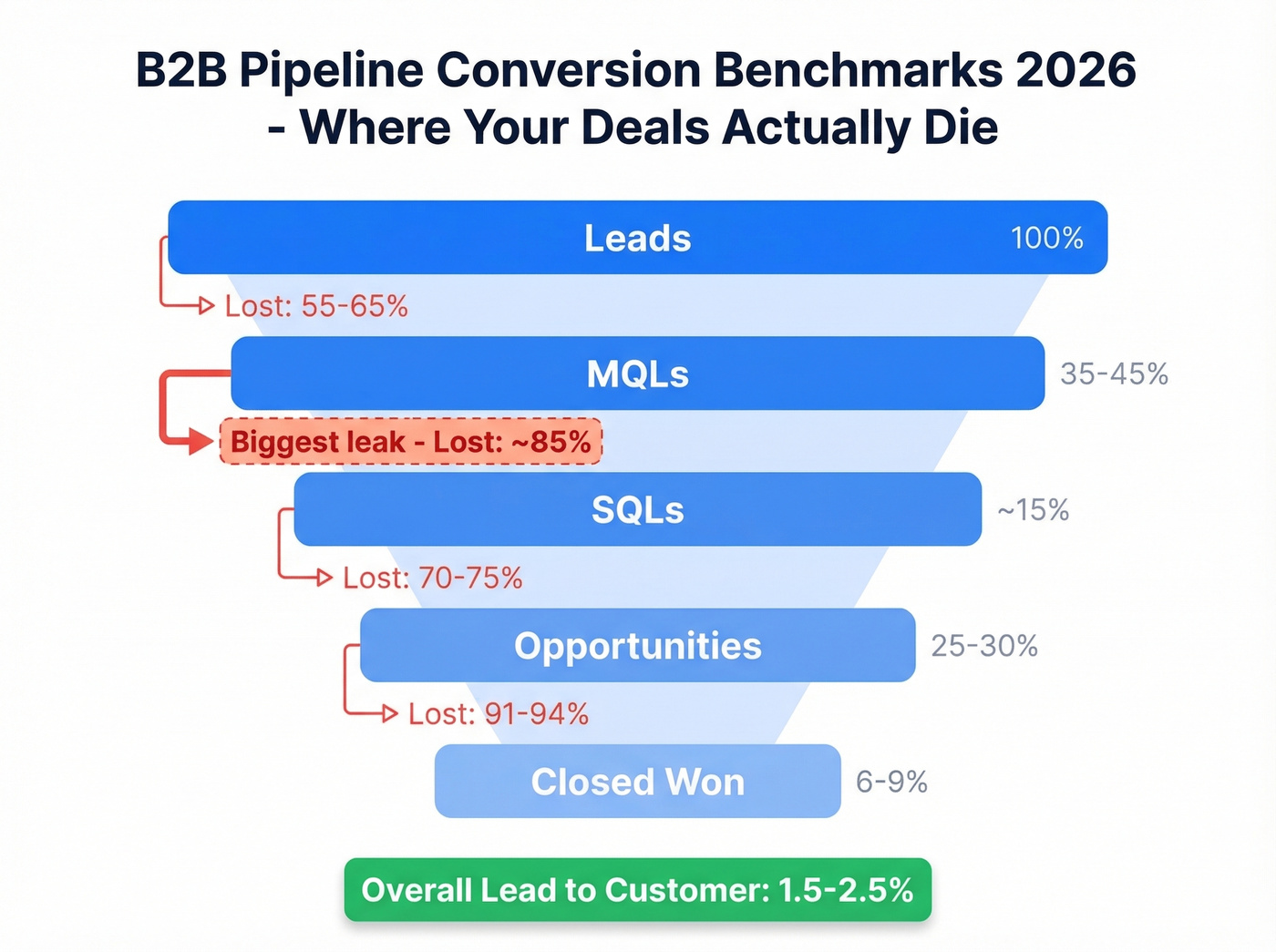
| Stage Transition | Benchmark Range |
|---|---|
| Lead to MQL | 35-45% |
| MQL to SQL | ~15% |
| SQL to Opportunity | 25-30% |
| Opp to Closed-Won | 6-9% |
| Overall Lead to Customer | 1.5-2.5% |
The MQL-to-SQL transition is the single biggest leakage point in most B2B pipelines. You go from 35-45% conversion to 15% in one step. That's where marketing and sales alignment either works or doesn't. If your MQL-to-SQL rate is below 10%, you don't have a pipeline problem - you have a qualification problem.
For B2B SaaS specifically, FirstPageSage benchmarks (2017-2026 dataset) show higher mid-funnel numbers: MQL-to-SQL around 38%, SQL-to-Opp around 42%. These reflect warmer inbound-heavy funnels. If you're running outbound, expect the lower end. Manufacturing and cybersecurity verticals tend to run lower still - check FirstPageSage for your specific vertical.
Ask any RevOps leader what kills their pipeline, and you'll hear the same answer: ghost deals that nobody has the courage to kill. If your overall lead-to-customer rate is above 3%, you're either very good at qualification or very bad at counting leads.

You just read that 20% email bounce rates kill pipelines before they start. Prospeo's 5-step verification delivers 98% email accuracy - the same data that took Snyk's bounce rate from 35% to under 5% and generated 200+ new opportunities per month across 50 AEs.
Stop filling your pipeline with dead emails. Start with data that connects.
Five Pipeline Metrics to Track Weekly
Dashboards with 30 KPIs are dashboards nobody uses. Track five metrics weekly. Everything else is monthly or quarterly.
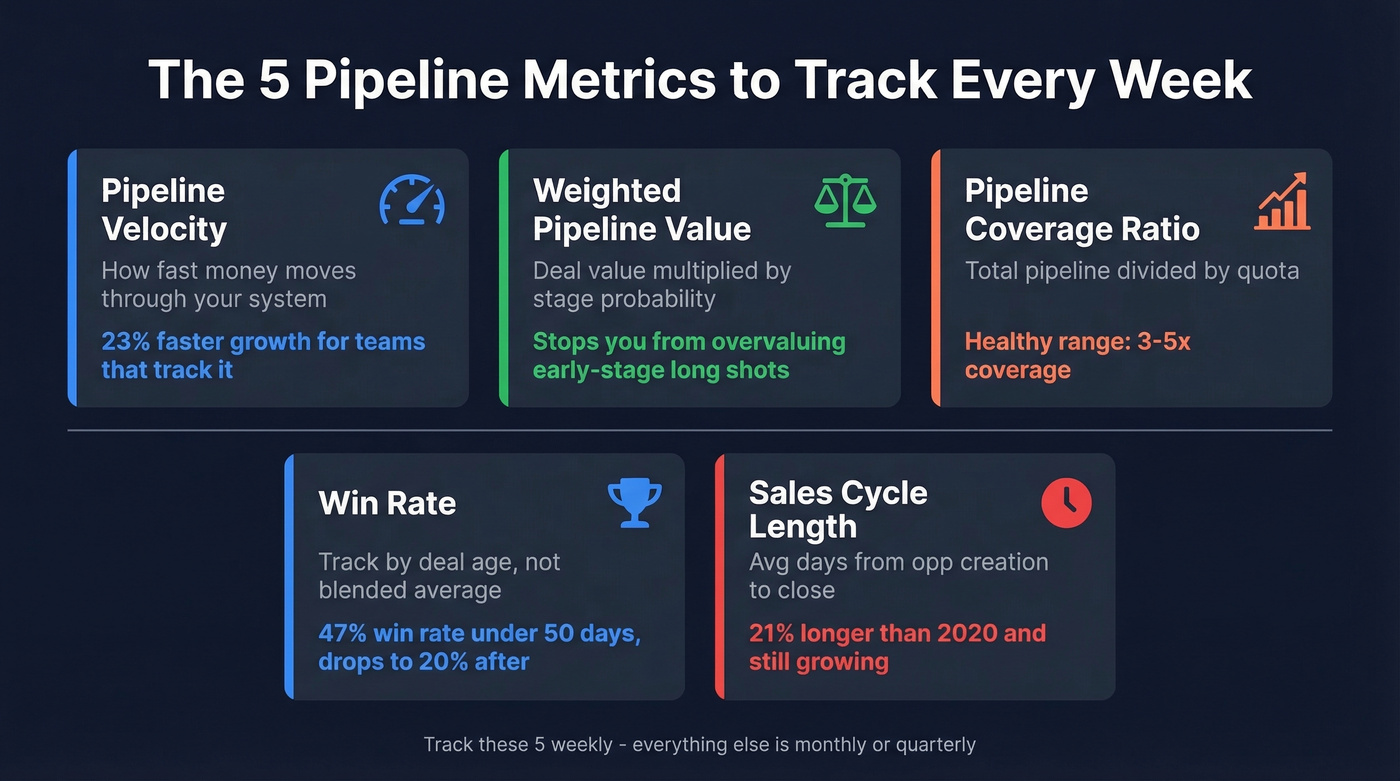
Pipeline Velocity
This is the one metric we'd pick if we could only track one. Formula: (Number of Deals x Average Deal Size x Win Rate) / Sales Cycle Length in Days.
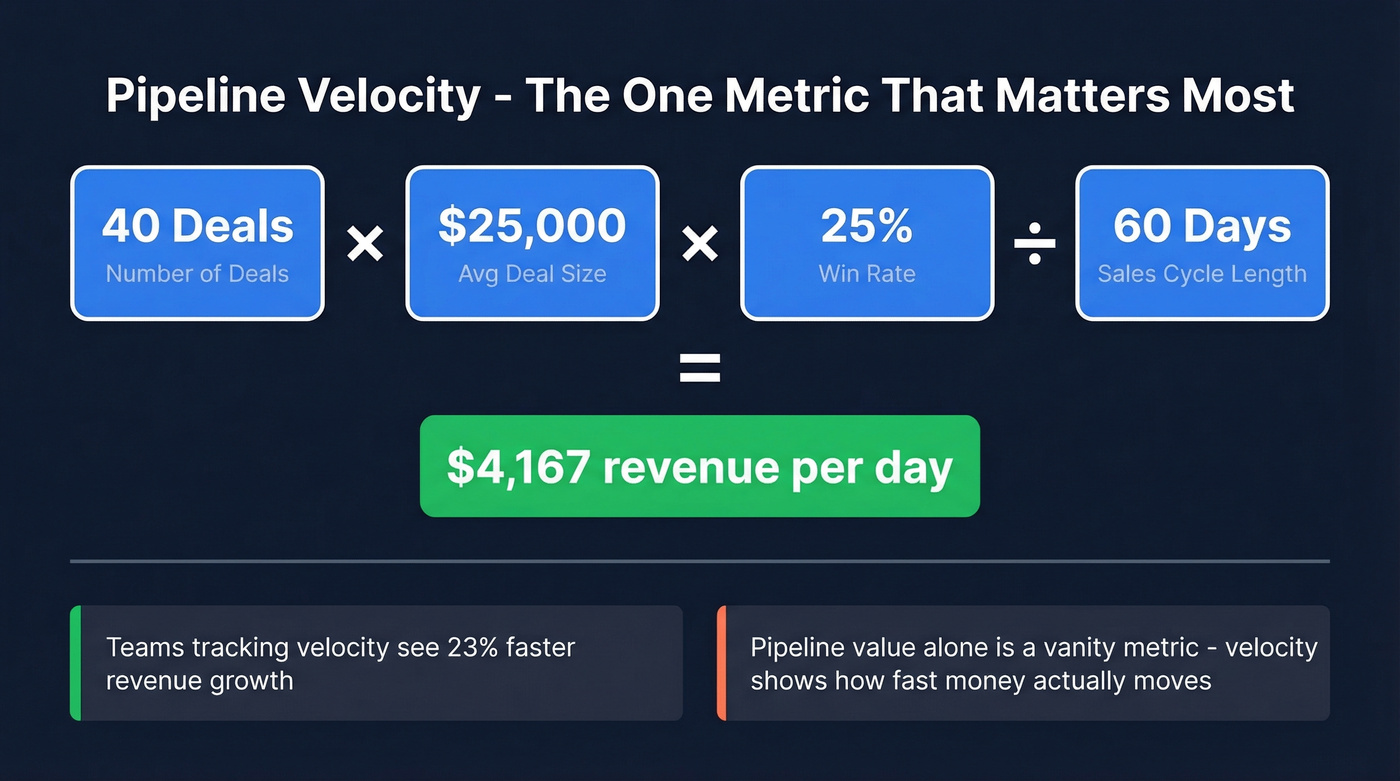
Worked example: 40 deals x $25,000 x 25% win rate / 60 days = $4,167 in revenue per day. Teams that track velocity see 23% faster revenue growth than those tracking only pipeline value. The number tells you how fast money moves through your system, not just how much is sitting there.
Weighted Pipeline Value
Raw pipeline value is a vanity metric. Weighted pipeline value applies probability by stage: Sum of (Deal Value x Stage Probability). A $50K deal at 60% probability = $30K weighted value. A $200K deal at 10% = $20K. The weighted view stops you from getting excited about a fat pipeline full of early-stage long shots.
Pipeline Coverage Ratio
Total pipeline value divided by quota. Healthy coverage runs 3-5x. If your quota is $500K and your pipeline is $1.5M, you're at 3x - the floor. Below 3x and you're relying on every deal to close, which they won't.
Win Rate
Deals closed within 50 days carry a 47% win rate. After 50 days, win rates drop to roughly 20%. Time kills deals. Track win rate by cohort age, not just as a blended average - the difference is night and day.
Sales Cycle Length
Average days from opportunity creation to close. Sales cycles are running 21% longer than in 2020, and the trend isn't reversing. Track this by segment. Your SMB cycle and your enterprise cycle are different animals entirely, and blending them produces a number that describes neither.
Pipeline Math - Working Backward from Revenue
Let's run the numbers on a $500K quarterly quota. At a 25% win rate, you need $2M in qualified pipeline. At a 30% SQL-to-opportunity conversion, that means roughly 267 SQLs. At a 15% MQL-to-SQL rate, you need about 1,780 MQLs. And at a 40% lead-to-MQL rate, you're looking at approximately 4,450 leads entering the top of the funnel.
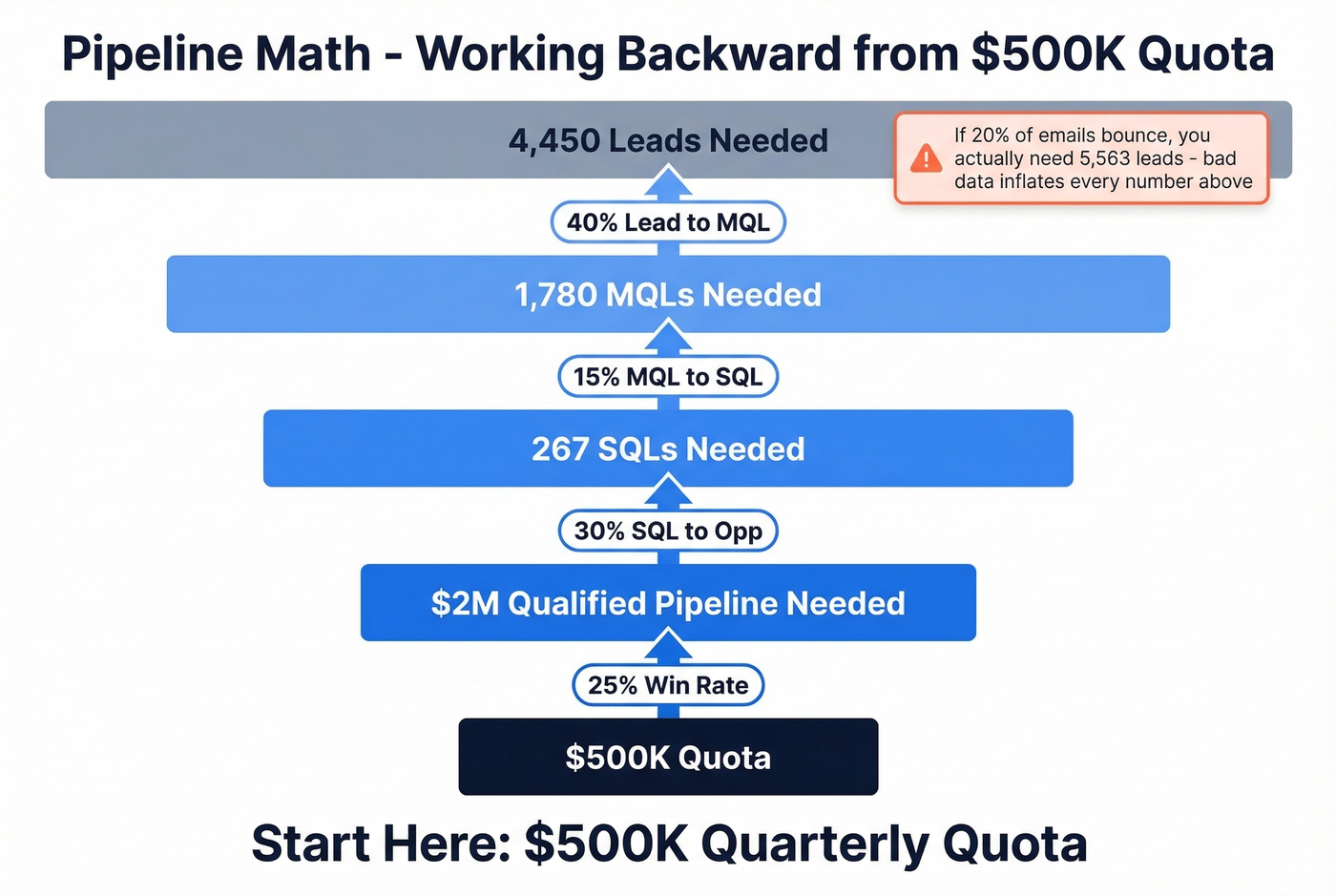
That math assumes every lead is reachable. If 20% of your emails bounce, you need 20% more leads just to break even - which is why data accuracy isn't a nice-to-have, it's a revenue forecasting variable. Bad data inflates the denominator in every calculation above.
Pipeline Mistakes That Kill Deals
We've seen the same mistakes across dozens of pipeline audits. Here are the ones that actually destroy revenue.
Ghost deals inflating forecasts. Deals without activity for 30+ days that still sit in Stage 3 or 4. Purge anything older than 2x your average cycle length - weekly. No exceptions.
No exit criteria enforcement. Reps advance deals because "the call went well." Without binary pass/fail gates, your pipeline stages are fiction. In our experience, this single issue accounts for more forecast misses than any other.
Ignoring data quality. This is the mistake that compounds fastest - and the one most pipeline reviews skip over entirely. If your SDR team sends 2,000 emails and 600 bounce, that's a data quality problem that cascades through every stage downstream.
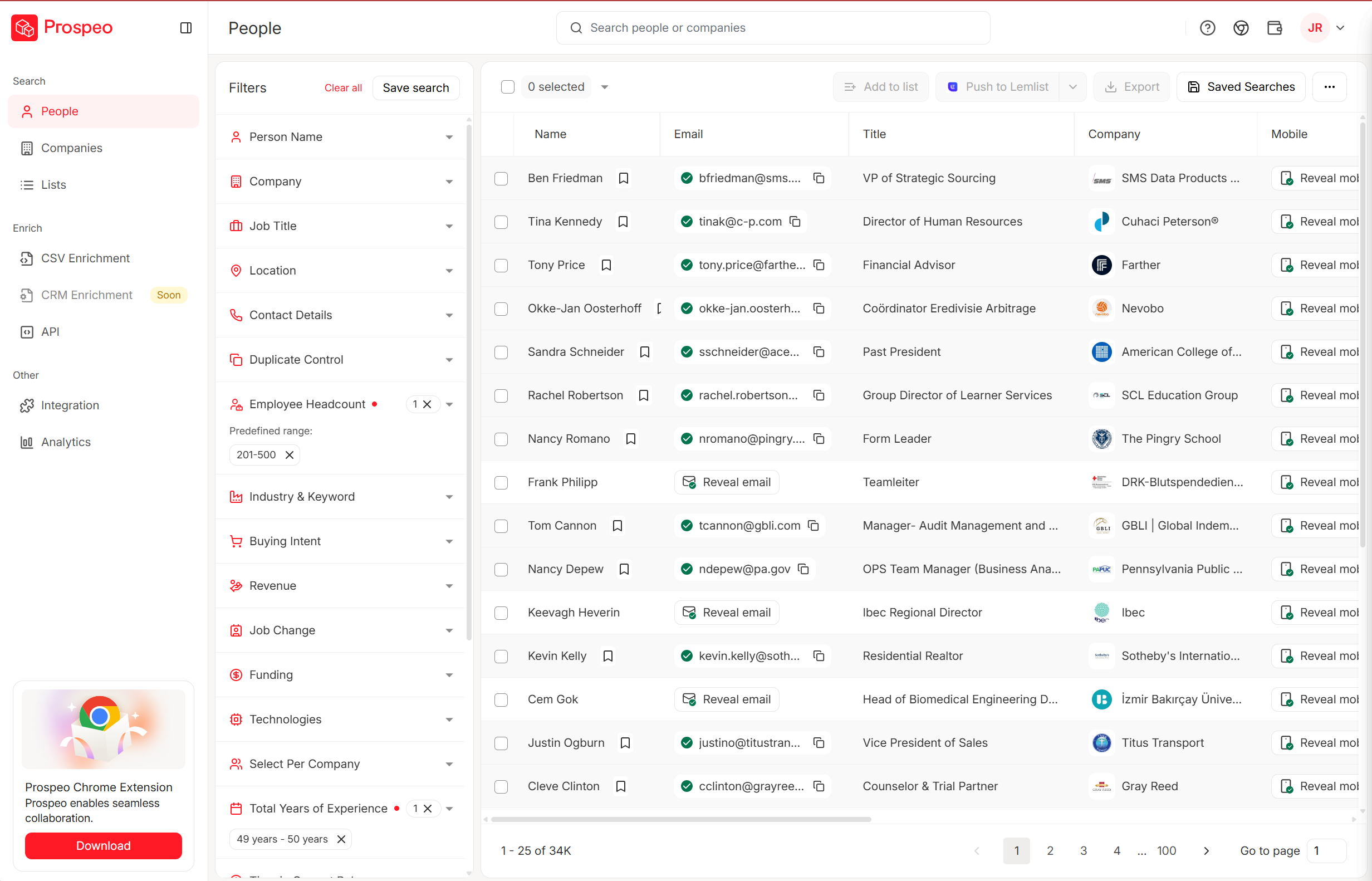
Prospeo fixes this at the source with 98% email accuracy and a 7-day data refresh cycle versus the 6-week industry average. One customer, Meritt, saw their bounce rate drop from 35% to under 4% after switching - and their pipeline tripled from $100K to $300K per week.
Skipping weekly reviews. Teams that review pipeline weekly hit 87% forecast accuracy. Ad-hoc review teams hit 52%. That gap is the difference between a predictable business and a quarterly fire drill. If you need a repeatable agenda, borrow a lightweight QBR structure and run it weekly.
Pitching the wrong stakeholders. Talking to a champion who can't sign is comfortable but useless. Map the buying committee by the proposal stage - skip this step and you'll wonder why "sure thing" deals stall for months.
No MQL-to-SQL SLA. Marketing generates leads. Sales ignores them for a week. Define a handoff SLA: 24 hours maximum for hot leads.
Pipeline Governance - The Weekly Cadence
85% of B2B firms miss their monthly forecast by more than 5%. Nearly 79% miss by more than 10%. The fix isn't better forecasting models - it's better pipeline governance.
Run a weekly pipeline review. Every week. Non-negotiable. Here's the agenda:
- Deal movement - what moved forward, backward, or entered the pipeline?
- Stale deal purge - anything past 2x average cycle length gets killed or re-qualified with a next step scheduled within 48 hours.
- Coverage check - is total weighted pipeline at 3-5x quota? If not, what's the prospecting plan this week?
- Velocity trend - up or down vs. last week, and why?
The frontline manager owns this meeting. Not the VP. Not RevOps. The person closest to the deals runs the review, and leadership reviews the output.
Tools for Pipeline Execution
You don't need fifteen tools. You need three layers working together.
CRM layer. HubSpot's free CRM tier handles pipeline management for early-stage teams, with paid plans starting around $20-$30/user/month. Salesforce runs $25-$330/user/month and remains the default for mid-market and up. Pipedrive at $15-$120/user/month is the simplest option if your pipeline is your entire sales workflow. Zoho CRM offers a strong mid-range option at $14-$65/user/month for teams that want Salesforce-level customization without the price tag. (If you're comparing options, start with a few examples of a CRM and narrow from there.)
Data and prospecting layer. This is where most pipelines break down - garbage in, garbage out. Prospeo sits here with 300M+ profiles, 143M+ verified emails, and a 7-day refresh cycle. Search with 30+ filters including buyer intent across 15,000 topics, technographics, and job change signals. Pricing starts free with 75 emails/month and scales at roughly $0.01 per email - no contracts, no sales calls required. If you're evaluating vendors, use a shortlist of data enrichment services and sanity-check accuracy before you scale outreach.
Engagement and forecasting layer. Outreach and Salesloft at ~$100-$200/user/month handle sequencing and cadence management. Clari and Gong are enterprise platforms typically $100+/user/month (often sold annually) for forecasting and conversation intelligence on top of your CRM data. If you're building a stack, start with a ranked list of SDR tools and pick only what supports your process.
Look, if your average deal size is under $10K, you probably don't need a $150/user/month engagement platform. A solid CRM, accurate data, and disciplined weekly reviews will outperform a bloated tech stack with dirty data every time. The consensus on r/sales backs this up - the threads about "which tools do I actually need" almost always land on "fewer tools, better data." If you need more top-of-funnel volume without new spend, use a few free lead generation tools to pressure-test channels.
Qualification is the #1 seller challenge because reps waste hours chasing contacts who don't match ICP. Prospeo gives you 30+ filters - buyer intent, technographics, headcount growth, funding - so every contact entering Stage 1 already belongs there. 300M+ profiles, refreshed every 7 days.
Fill your pipeline with qualified prospects, not good intentions.
FAQ
What's the difference between a sales pipeline and a sales funnel?
A pipeline tracks individual deals through stages you actively manage - each deal has a rep, a dollar value, and a next step. A funnel measures aggregate conversion rates across cohorts. You manage a pipeline; you analyze a funnel. They complement each other but serve different purposes.
How many pipeline stages should a B2B team have?
Six to seven with enforced binary exit criteria. More stages without enforcement just gives reps more places to park dead deals. Fewer than five usually means you're lumping distinct buyer actions into a single stage, which kills forecast granularity.
How do you calculate pipeline velocity?
Number of Deals x Average Deal Size x Win Rate / Sales Cycle Length in days. For example, 40 deals x $25K x 25% / 60 days = $4,167/day. Track it weekly - teams that do see 23% faster revenue growth.
How often should you review your pipeline?
Weekly, minimum. Teams with weekly reviews hit 87% forecast accuracy vs. 52% for ad-hoc reviews. The frontline manager should own the meeting, covering deal movement, stale deal purges, coverage ratio, and velocity trends.
How does data quality affect pipeline health?
Bad contact data inflates your pipeline with unreachable prospects, distorts conversion rates at every stage, and degrades forecast accuracy. If your bounce rate is above 10%, that's the first thing to fix - before adding new tools, new sequences, or new reps. Clean data compounds; dirty data compounds too, just in the wrong direction.