

The 7 Selling Process Steps (With Benchmarks, Mistakes, and 2026 Tactics)
84% of sales reps missed quota last year. Not because they couldn't list the selling process steps - every rep who's survived onboarding can do that - but because they couldn't pinpoint where deals were dying. Meanwhile, 80% of B2B buyer-seller interactions now happen through digital channels, buying committees average about seven people, and buyers spend just 17% of their time actually meeting with suppliers. The seven-step selling process is still the right skeleton. Treating it like a checklist instead of a diagnostic framework is why pipelines leak.
Quick Overview: 7 Steps at a Glance
The seven steps of the selling process, in order:
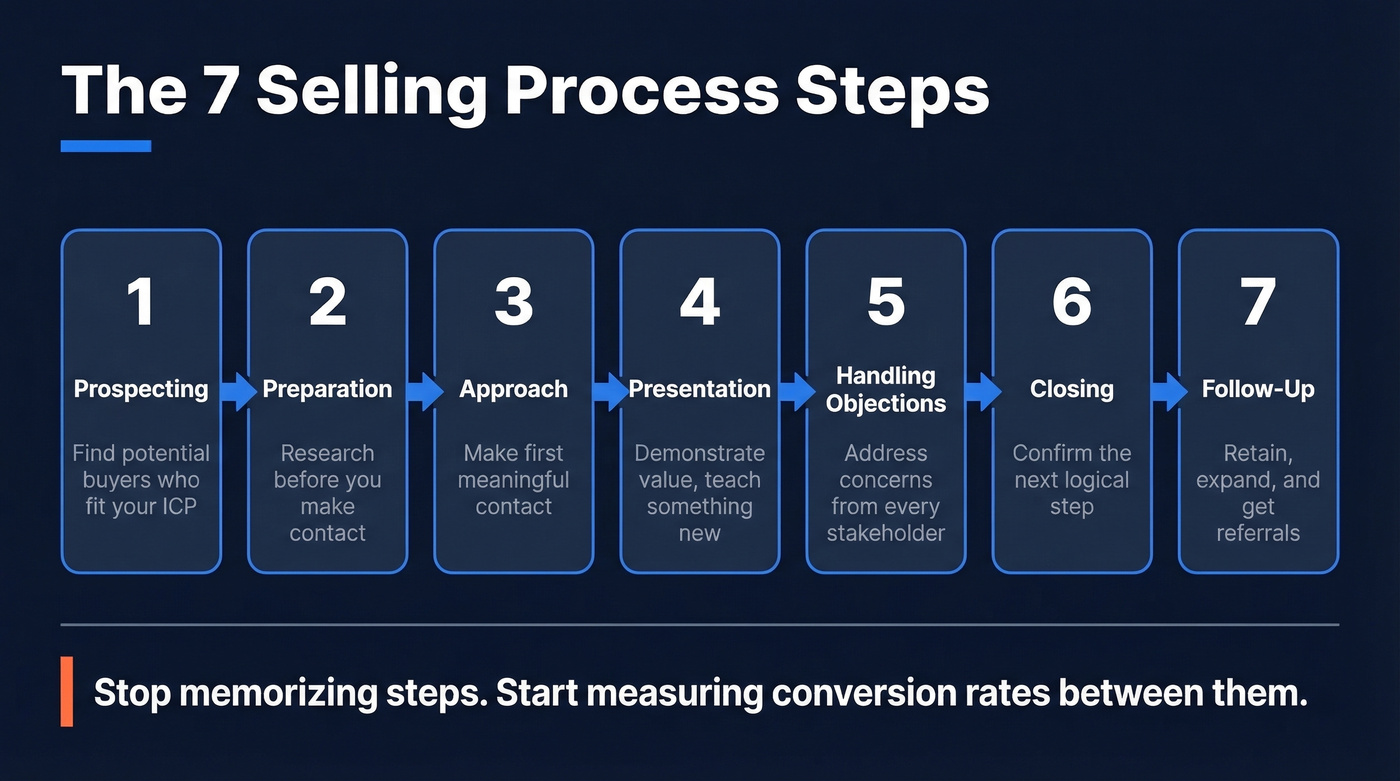
- Prospecting - find potential buyers
- Preparation - research before contact
- Approach - make first meaningful contact
- Presentation - demonstrate value
- Handling Objections - address concerns
- Closing - ask for the business
- Follow-Up - retain, expand, get referrals
Here's the contrarian take: stop memorizing steps and start measuring conversion rates between them. If you only fix one thing after reading this, measure your lead-to-customer conversion rate. In B2B SaaS, 2-5% is a common baseline - and it's where most pipelines quietly bleed out.
What Is a Selling Process?
A selling process is a repeatable sequence of stages that moves a prospect from initial contact to closed deal and beyond. Think of it as the "what" - the stages your deals pass through. A sales methodology (SPIN, Challenger, MEDDIC) is the "how" - the framework you use to execute within each stage. Salesforce draws this distinction clearly: process defines the path, methodology defines the technique.
The seven-step model is a baseline, not a rigid playbook. Real B2B deals don't move linearly through seven neat boxes. With ~6.8 stakeholders involved in a typical purchase, you'll loop through approach, presentation, and objection handling multiple times - once for each decision-maker with a different set of concerns. The stages are the same. The execution is messier than any diagram suggests.
The 7 Steps in Detail
To make this concrete, follow Jordan - an SDR at a mid-market SaaS company selling compliance software to financial services firms. Jordan's deal will thread through each step below.
Step 1: Prospecting
Finding potential buyers who match your ideal customer profile. This is where most processes break before they start.
The 2026 reality: spraying unverified lists doesn't work. If a third of your emails bounce - and we've seen teams running 30-40% bounce rates on purchased lists - your domain reputation tanks, your sequences die, and every subsequent step becomes irrelevant. Sending 5,000 unverified emails isn't prospecting. It's spam with a CRM attached.
Snyk's sales team faced exactly this problem: 35-40% bounce rates that cratered their outbound. After switching to Prospeo's verified data, they dropped bounces to under 5% and generated 200+ new opportunities per month. Layer in intent data to target prospects who are actually in-market, and you're reaching people ready to have a conversation - not just names that match a firmographic filter.

Jordan's move: instead of pulling 2,000 contacts from a stale list, Jordan builds a filtered search - compliance job titles, 200-1,000 employee financial firms, showing buyer intent for "regulatory compliance software." The list is 140 contacts. Every email is verified. That's prospecting.
Step 2: Preparation
Before any outreach, Jordan runs through a pre-call checklist:
- Prospect's tech stack (are they on a competitor's platform?)
- Recent funding, earnings, or leadership changes
- Org chart - who's the likely champion, who signs the check?
- Competitive landscape - what are they using today?
- Disqualification signals - is this actually a good-fit account?
That last item matters more than most reps think. Not all sales are good sales. Qualifying out a bad-fit prospect early saves more pipeline than qualifying in a marginal one. Jordan spots that one account just signed a 3-year deal with a competitor - that's a walk-away, not a "maybe later." Time saved goes to accounts that can actually close.
Buyers can tell within 30 seconds if you've done your homework. Walking into a call without knowing the prospect's stack, recent news, or competitive landscape is the fastest way to get ghosted.
Step 3: Approach
Do this: Match your channel to the buyer's preference. A VP of Engineering who lives in Slack and GitHub won't respond to the same outreach as a CFO who checks email religiously. Buyers now use ~10 interaction channels on average, up from five in 2016. McKinsey's rule of thirds still holds: at any given stage, roughly a third prefer in-person, a third prefer remote, and a third prefer digital self-serve. Social selling - engaging prospects through community discussions, commenting on their content, sharing relevant insights before pitching - is a legitimate first touch, not a gimmick.
Skip this: Leading with a pitch. The approach should open a conversation, not deliver a monologue. If your first message contains the word "demo," you've already lost.
Jordan finds the compliance director posting about upcoming regulatory changes on a professional forum. Jordan comments with a genuine insight, then follows up with a short email referencing the thread. The reply comes in four hours.
Step 4: Presentation
The Challenger research from CEB, based on 6,000+ sales reps, found that the highest-performing reps teach prospects something new about their own business. That's the bar. Your presentation should reframe how the prospect thinks about their problem, not just walk through your dashboard.
Jordan doesn't open with a feature tour. Instead, Jordan shows the compliance director data on how peer firms are handling the same regulatory change - and where the gaps are. The prospect leans forward. That's the moment the deal shifts from "evaluating a vendor" to "solving my problem."
The biggest mistake here is talking too much. The best presentations are conversations, not monologues. If you're speaking more than 40% of the time, you're pitching, not selling.
Step 5: Handling Objections
With 6.8 stakeholders per deal, you're not handling objections from one person. You're handling different objections from the CFO (budget), the end user (switching costs), the IT lead (security), and the champion's boss (risk).
Multi-threading - building relationships with multiple decision-makers - is the only way to surface and address objections before they kill your deal in a committee meeting you weren't invited to. Prepare for the top three objections per persona before you walk into any meeting.
Jordan's champion loves the product. But the CFO wants ROI numbers, and the IT lead is worried about integration with their existing stack. Jordan schedules separate conversations with each, armed with different talk tracks. The deal that would've stalled in committee moves forward because every stakeholder's concern was addressed directly.
Look, a prospect who pushes back is engaged. A prospect who goes silent is the one you should worry about. Treat objections as buying signals, not rejection.
Step 6: Closing
Here's the thing: if your discovery, presentation, and objection handling were solid, closing is just confirming the next logical step. You're not "pushing someone to open their wallet" - you're summarizing the value you've agreed on and proposing a clear path forward.
A lot of newer reps describe closing as awkward - like the whole sales process builds to this terrifying moment. The fix is simpler than most "closing techniques" suggest. Make the close a continuation of the agreement you already built. The best closes sound like: "Based on what we've discussed, here's what implementation looks like. Should I send over the agreement?" If you have to reach for a closing technique, your earlier steps probably failed.
Jordan sends a one-page summary: the problem, the agreed solution, the ROI math, and the implementation timeline. The compliance director forwards it to the CFO. The signature comes back two days later.
Step 7: Follow-Up
The step most reps skip entirely - and the one that determines whether your closed deal becomes a churned account or a referral engine.
89% of B2B buyers report a purchase deal stalling in the past year, and structured follow-up is what prevents stalls from becoming lost deals. After the signature, automate follow-up cadences in your CRM: onboarding check-ins, quarterly business reviews, expansion conversations. The deal isn't done at close. It's done when the customer renews, expands, and refers you to their network.
Jordan sets up a 30/60/90-day check-in sequence. At the 90-day QBR, the compliance director mentions a sister division with the same problem. That warm intro is worth more than 100 cold emails. The fastest path to churn is a customer who feels abandoned the moment the ink dries - and the fastest path to expansion is a customer who feels supported.

Prospecting is where most selling processes break. Snyk dropped bounce rates from 35% to under 5% and generated 200+ opportunities per month with Prospeo's verified data. 300M+ profiles, 30+ filters, intent data on 15,000 topics - build lists that actually convert.
Stop feeding bad data into a good sales process.
Benchmarks for Each Stage
Knowing the steps is baseline. Knowing what "good" looks like at each stage is what separates teams that hit quota from teams that wonder where their pipeline went.
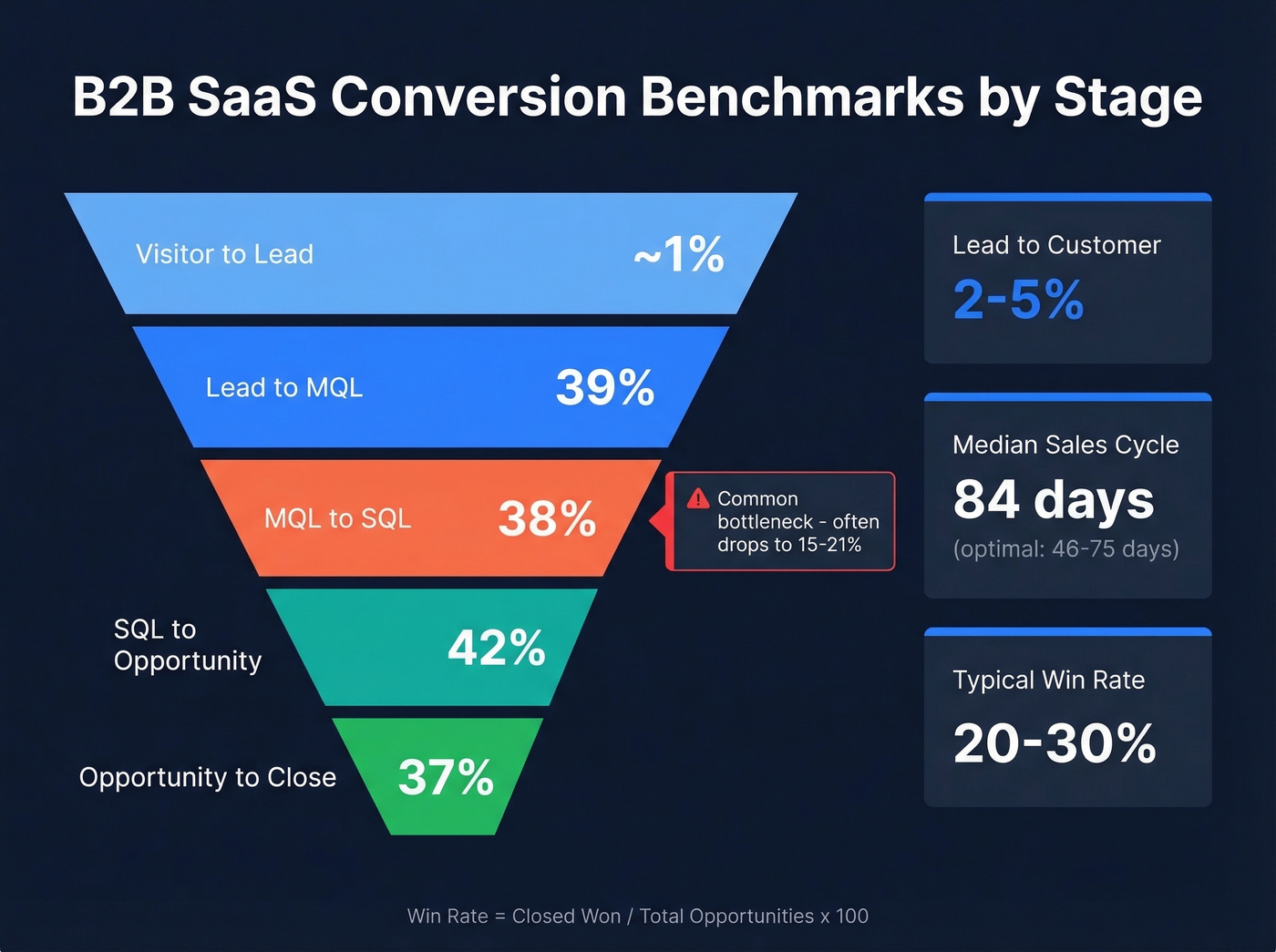
| Stage | SMB/Mid-Market | Enterprise | B2B SaaS Avg |
|---|---|---|---|
| Visitor-to-Lead | 1.4% | 0.7% | ~1% |
| Lead-to-MQL | 41% | 39% | 39% |
| MQL-to-SQL | 39% | 31% | 38% |
| SQL-to-Opportunity | 42% | 36% | 42% |
| Opp-to-Close | 39% | 31% | 37% |
The headline numbers: lead-to-customer conversion runs 2-5% in B2B SaaS, median sales cycle is 84 days (optimal range: 46-75), and typical win rates land between 20-30%. A common bottleneck we see is MQL-to-SQL at 15-21%. That's where qualification criteria, lead scoring, and data quality make or break your funnel.
Win Rate = Closed Won / Total Opportunities x 100. If yours is below 20%, the problem is almost always in qualification - you're advancing deals that shouldn't be in the pipeline.
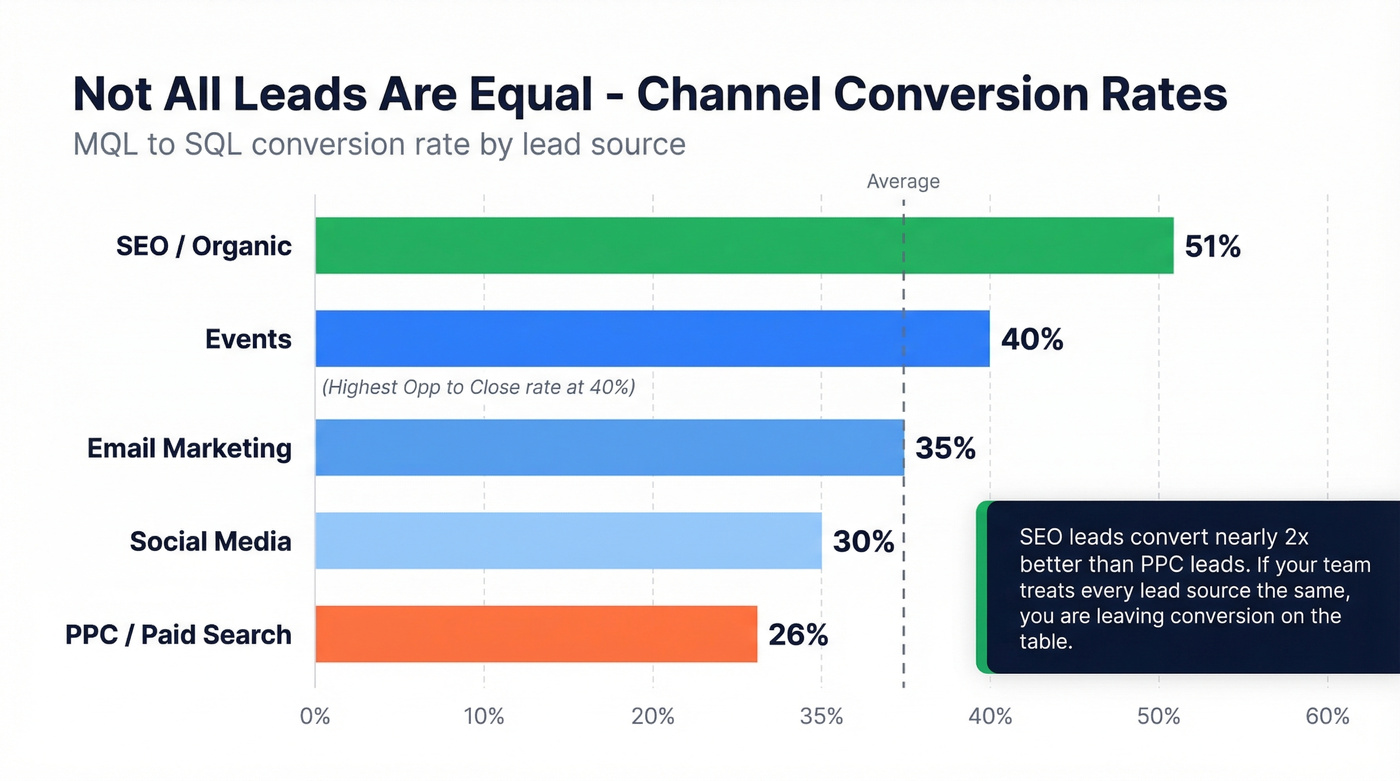
Channel Performance Worth Tracking
Not all leads are created equal. SEO-sourced leads convert MQL-to-SQL at 51% - nearly double the 26% from PPC. Events convert Opp-to-Close at 40%, the highest of any channel. If your team treats every lead source identically in your process, you're leaving conversion on the table.
B2B vs. B2C: Same Steps, Different Execution
The seven steps apply to both B2B and B2C. But the gap in execution is massive.
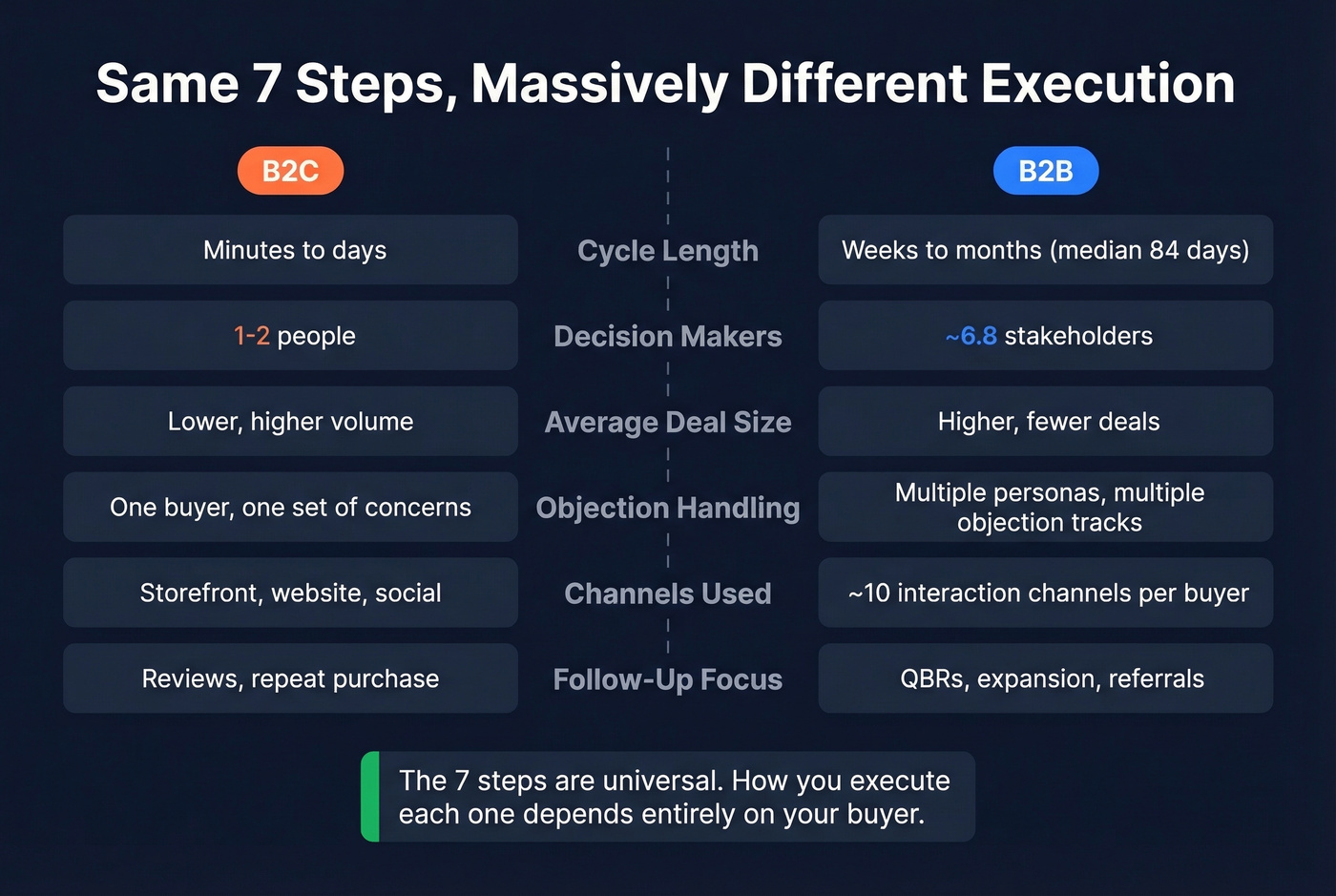
| Dimension | B2C | B2B |
|---|---|---|
| Cycle length | Minutes to days | Weeks to months (median 84 days) |
| Decision-makers | 1-2 | 7 avg. |
| Prospecting | Broad targeting | ICP-specific |
| Closing | Often self-serve | Multi-step approval |
| Follow-up | Automated retention | QBRs, expansion |
B2C can close in a single interaction. More than two-thirds of B2B sales take 3+ months. The steps that expand most in B2B are qualification, objection handling, and follow-up. The steps that compress in B2C are approach and closing - often collapsed into a single touchpoint.
Hot take: if your average contract value is under $5K, you probably don't need a seven-step process at all. Collapse steps 2-5 into a single self-serve demo flow and focus your human effort on follow-up. The seven-step model earns its complexity when deals involve multiple stakeholders and real switching costs. For everything else, it's overhead.
Sales Process vs. Sales Methodology
Your process is the stages. Your methodology is how you execute within them.
| Methodology | Research Basis | Best Step | Ideal For |
|---|---|---|---|
| SPIN | 35,000 calls, 12 yrs | Discovery | Consultative sales |
| Challenger | 6,000+ reps (CEB) | Presentation | Disruptive products |
| MEDDIC | Enterprise origin | Qualification | Enterprise, 6+ stakeholders |
| BANT | IBM classic | Qualification | High-volume |
| Sandler | Behavioral psych | Objection handling | Consultative |
The consensus on r/sales is blunt: "They all boil down to need, budget, stakeholders, timeline." There's truth in that - every methodology is ultimately a structured way to uncover the same four things. The difference is which step gets the most rigor and which selling context benefits from that emphasis.
Pick one methodology, commit to it for six months, and master the fundamentals before you start mixing frameworks. We've seen teams burn quarters trying to implement Challenger and MEDDIC simultaneously. The reps end up confused, the CRM fields go unfilled, and leadership blames "the process" when the problem was overcomplication.
How to Operationalize Your Process
A selling process that lives in a slide deck is worthless. Here's how to make it real.
Map each step to a CRM stage with exit criteria. "Qualified" isn't a stage - "SQL: confirmed budget, identified decision-maker, agreed to demo" is a stage. Every stage needs clear criteria for what moves a deal forward and what disqualifies it. Without exit criteria, your pipeline is just a list of hopes.
Automate stage transitions and follow-up reminders. A unified CRM beats a patchwork of tools - fewer data silos, consistent segmentation, and reporting that reflects reality. Set up automated tasks for stale deals, follow-up sequences for post-close, and alerts when deals sit in a stage too long.
Build your tool stack around three layers: CRM + verified data + one methodology. For CRM, HubSpot and Salesforce both offer entry-level plans and scale up with seats, features, and add-ons. For verified data, tools like Prospeo return 50+ data points per contact at a 92% match rate, feeding your CRM with accurate emails, verified mobile numbers, technographics, and intent signals - at roughly $0.01 per email. For enterprise pipeline visibility, platforms like Clari run ~$80K/year. Keep the stack tight. Every additional tool is another integration to maintain and another place for data to break.
Multi-threading 6.8 stakeholders requires verified contact data for every decision-maker - not just the champion. Prospeo returns 50+ data points per contact at 98% email accuracy and 30% mobile pickup rate, so you can reach the CFO, IT lead, and end user directly.
Reach every stakeholder in the buying committee for $0.01 per email.
FAQ
How many steps are in the selling process?
Seven is the standard framework: prospecting, preparation, approach, presentation, handling objections, closing, and follow-up. In practice, B2B deals loop through multiple steps repeatedly - with 6.8 stakeholders involved, you'll cycle through presentation and objection handling several times before reaching a close.
What's the difference between a sales process and a sales methodology?
A sales process defines the stages a deal moves through - the "what." A methodology defines how you execute within each stage - the "how." SPIN, MEDDIC, and Challenger are methodologies. Prospecting through follow-up is a process. You need both, but the process comes first.
How long does a typical B2B sales cycle take?
The median B2B SaaS sales cycle runs 84 days, with an optimal range of 46-75 days. More than two-thirds of B2B deals take 3+ months to close. Enterprise deals with larger buying committees skew longer; SMB deals with fewer stakeholders can close in weeks.
Where do most deals stall in the funnel?
MQL-to-SQL conversion is the most common bottleneck, often landing in the 15-21% range. This is where data quality hits hardest - if reps are chasing dead email addresses or wrong phone numbers, qualified leads never make it to a real conversation. Verified contact data and tight lead scoring criteria are the fix.
Which sales methodology should I use?
SPIN for consultative sales where discovery drives the deal. Challenger for disruptive products where you need to teach the buyer. MEDDIC for complex enterprise deals with long procurement cycles. BANT for high-volume qualification where speed matters. Pick one, commit for six months, and master the fundamentals before layering on complexity.