

Storytelling in Sales Presentations: Frameworks, Templates, and Data That Prove It Works
You just finished a 45-minute presentation. The prospect smiled, asked for a quote, and said they'd "circle back next quarter." Then silence. The deck had 18 slides of features, integrations, and logos - and only 17.5% of viewers made it to the last one. Your story never landed because there wasn't one.
Here's the pattern we see constantly: a rep runs solid discovery, builds a polished deck, presents it - and the prospect goes dark. The deal stays in "nice-to-have" territory because the presentation never created urgency. As one practitioner on r/sales put it, "the prospect gave you a blank canvas, but all you put up were disjointed bullet points." Feature-heavy decks don't fail because the features are bad. They fail because bullet points don't create a vivid cost of inaction.
Why Narrative Decks Outperform Feature Lists
You've seen the stat that stories are "22x more memorable than facts." It's everywhere. It's also unverifiable - no one can trace it to a real study.
We have better evidence. Vaccaro et al. (2021), a PubMed-indexed paper on narrative processing, links story "transportation" to patterns of functional brain connectivity involving regions like the anterior insula and posterior medial cortex. In plain English: when someone follows a story, their brain lights up differently than when they're scanning a feature grid.
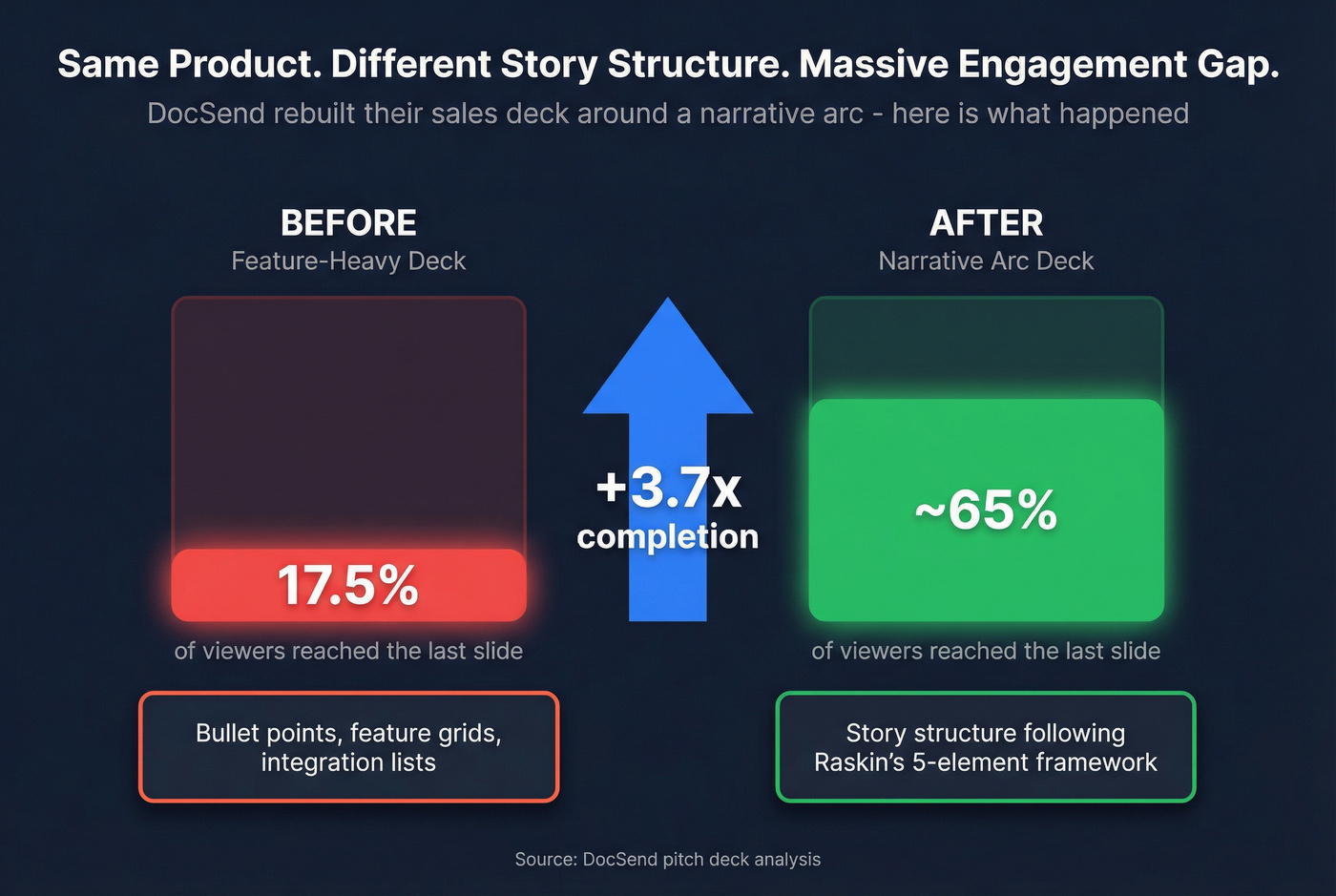
And on the sales side, we have hard engagement data. DocSend documented that their old, feature-heavy deck got weak engagement: 17.5% of viewers reached the last page. After they rebuilt the deck around a stronger narrative arc inspired by Andy Raskin's framework, last-slide completion jumped to around 65%. Same product. Different structure. That gap alone should settle the debate.
Raskin's 5-Element Framework (Mapped to Slides)
Andy Raskin analyzed Zuora's sales deck and extracted five elements that make a sales narrative work. DocSend rebuilt their deck using this framework and saw the results above. Here's how to map it to a typical slide sequence:
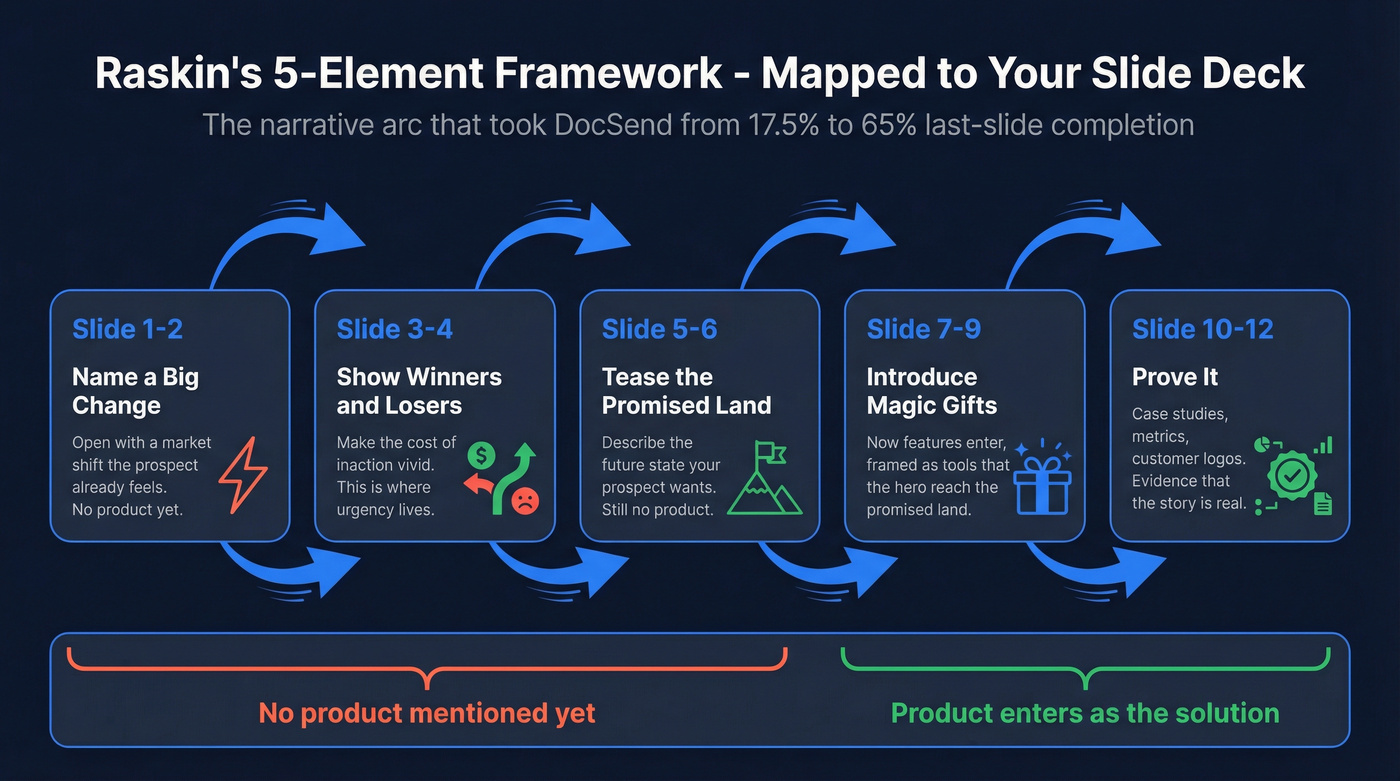
Name a big, relevant change. Don't open with your product. Open with a shift the prospect already feels - a market trend, a regulatory change, a buyer behavior shift that's reshaping their world.
Show winners and losers. Make the cost of inaction visible. This is where urgency lives.
Tease the promised land. Describe the future state. Still no product - this is about the destination, not the vehicle.
Introduce "magic gifts." Now features enter, framed as tools that help the hero reach the promised land.
Prove it. Case studies, metrics, logos.
Some reps prefer mapping problems to solutions in bullet form, but a narrative arc gives the prospect a story to follow, not a checklist to scan. Skip step one and you get what Harvard Business Review documented: a beverage company pitched their state-of-the-art production process for better shelf placement. The retailer said no - the product cost 50% more than similar offerings and sales were low. The story centered on the seller, not the buyer's world. That's the difference between a narrative and a monologue.

You just mapped your story to Raskin's 5-element arc. Now make sure it reaches the right inbox. Prospeo's 98% email accuracy and 7-day data refresh mean your carefully crafted narrative lands with decision-makers who are still at the company - not bounced into the void.
Great storytelling deserves an audience that actually exists.
Three Story Templates You Can Steal
Pick one, fill in the blanks, rehearse it under two minutes. Adapted from practitioner templates shared on Reddit.
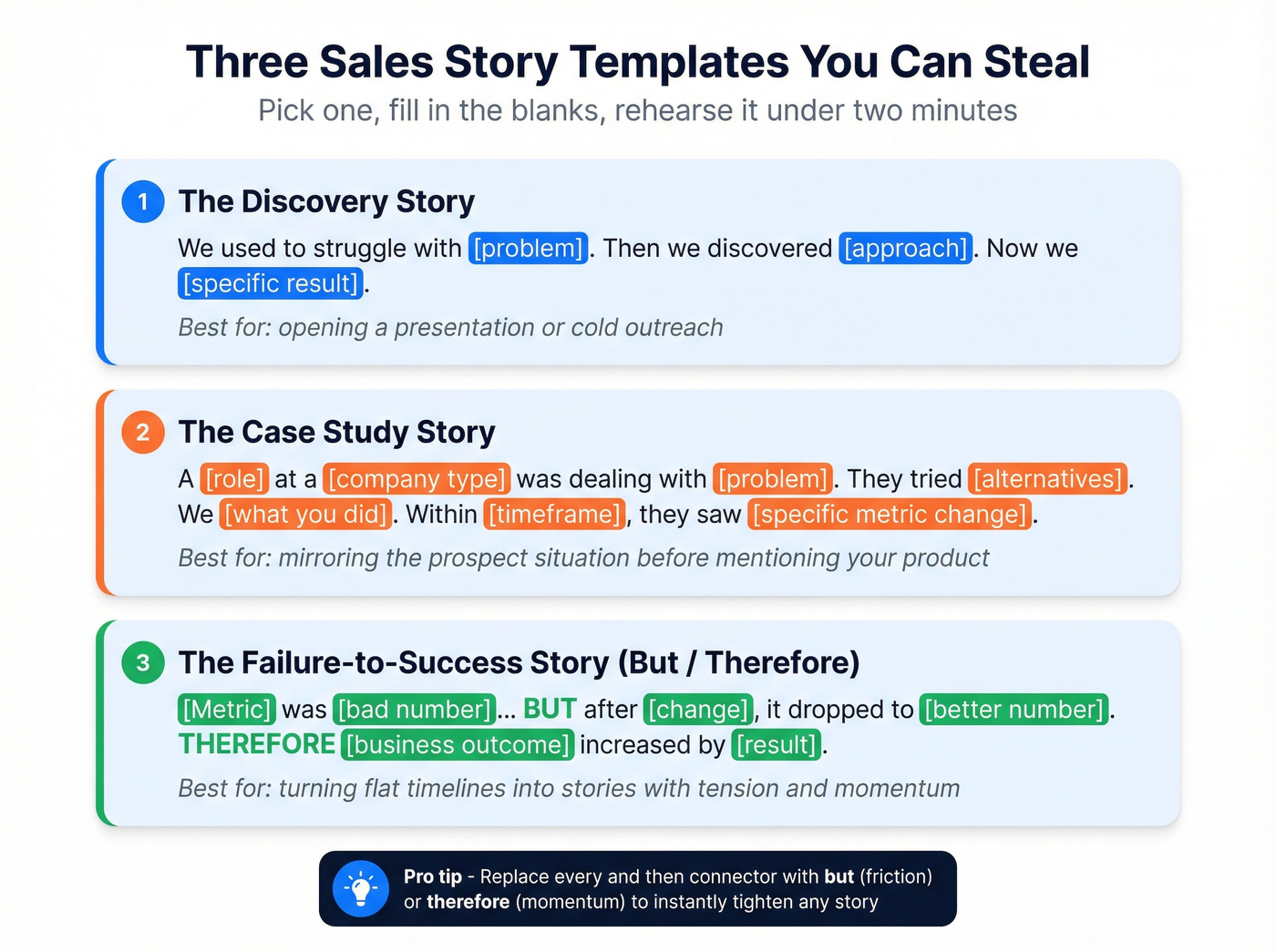
The Discovery Story
"We used to struggle with [problem]. Then we discovered [approach/insight]. Now we [specific result]."
Short, punchy, works great as an opener. We've used this format in our own outbound sequences and it consistently pulls better replies than feature-first messaging.
The Case Study Story
This one mirrors the prospect's situation before you ever mention your product. Open with it.
"A [role] at a [company type] was dealing with [problem]. They'd tried [alternatives]. We [what you did]. Within [timeframe], they saw [specific metric change]."
The Failure-to-Success Story (But / Therefore)
"[Metric] was [bad number]... but after [change], it dropped to [better number]. Therefore, [business outcome] increased by [result]."
Notice the "but/therefore" structure in that last template. It replaces the flat "and then... and then..." timeline with friction (but) and momentum (therefore). You can graft this connector pattern onto any of the three templates. Let's be honest - most sales stories fall flat not because the content is weak, but because the connectors are boring. Fix the connectors and the story tightens immediately.
Mistakes That Kill Your Story
Too long. Keep stories under two minutes. If you can't, you haven't edited enough.
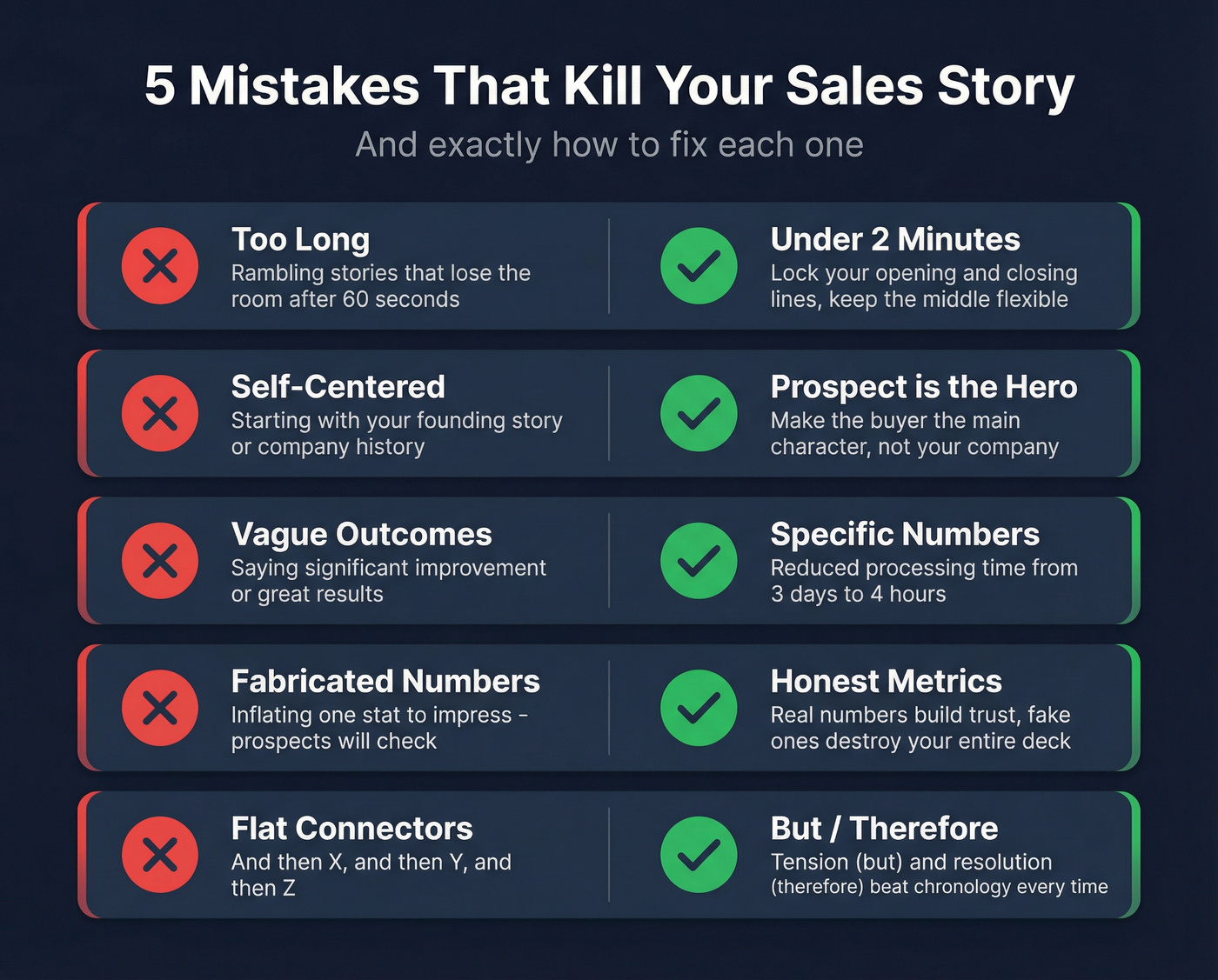
Self-centered. Skip the founding story. Nobody cares how you started. The prospect is the hero, not you.
Vague outcomes. "Significant improvement" means nothing. "Reduced processing time from three days to four hours" lands harder because it's specific enough to be believable and concrete enough to stick.
Fabricated numbers. Prospects check. One inflated stat tanks your credibility for the entire deck.
Wrong connectors. If your story sounds like "and then X, and then Y, and then Z," replace those connectors with "but" and "therefore." Tension and resolution beat chronology every time.
Your Story Needs a Clean List
Here's a frustration we hear from reps all the time: they spend hours crafting the perfect narrative deck, nail the structure, rehearse the delivery - and then the email bounces. Or it reaches someone who left the company six months ago. The best story in the world is worthless if it never gets heard.
Data quality is a storytelling prerequisite. If you're building prospect lists for outbound, Prospeo's 98% email accuracy and 7-day data refresh cycle mean the contacts you're presenting to are current and reachable. The free tier gives you 75 verified emails a month - enough to test whether cleaner data changes your reply rates before you commit to anything.
If you're tightening the rest of your outbound system, pair this with better sales prospecting techniques and a repeatable B2B cold email sequence.

Reps who nail the narrative structure still lose deals when their prospect lists are stale. Prospeo refreshes 300M+ profiles every 7 days - not every 6 weeks like competitors. At $0.01 per email, cleaning your presentation list costs less than the coffee you'll drink rehearsing it.
Stop perfecting decks for contacts who left the company months ago.
FAQ
How long should a story be in a sales presentation?
Under two minutes. Lock your opening and closing lines, keep the middle flexible. Replace "and then" connectors with "but" (friction) and "therefore" (momentum) to maintain tension throughout.
What's the best story structure for a sales deck?
Raskin's 5-element framework: name a market shift, show winners and losers, tease the promised land, introduce your product as "magic gifts," then prove it with evidence. It works across industries and deal sizes - DocSend saw last-slide completion jump from 17.5% to ~65% after adopting it.
How do I make sure my sales stories reach the right people?
Start with verified contact data so your deck lands in the right inbox. Pair clean data with a strong narrative and your close rates will reflect both. Tools like Prospeo's Chrome extension let you verify contacts before you ever hit send, which saves you from wasting a great presentation on a dead address.