

Company Introduction Email Subject Lines That Actually Get Opened
You sent 200 emails after the last trade show. Fourteen got opened. The problem wasn't your offer or your timing - it was the subject line. And probably your deliverability, but let's start with what you can fix in five minutes.
This guide covers choosing the right subject for a company introduction email to prospects, partners, and investors - not writing a "Hi, I'm John" self-introduction. The tactics are different. The average email open rate across 183,000+ brands sits at 31%, and you can beat that with the right formula and clean data.
What You Need (Quick Version)
You don't need 100 templates. You need three formulas and a verified list.
- Pain point + outcome: "Losing leads after demos? Try this."
- Mutual connection + context: "[Name] suggested I reach out about [topic]"
- Specific metric + company name: "Cut [Company]'s reporting time by 50%"
If your open rates are under 10%, skip straight to the email deliverability checklist before rewriting a single subject line.
Three Formulas That Work
Formula 1: Pain point + outcome. This works because it makes the email about the recipient, not you. Westfield Creative documented open rates jumping from 28% to 46% when teams switched from generic subject lines to pain-point + curiosity framing. Before: "Introducing our analytics platform." After: "Struggling with demo drop-offs? Here's what's working now." That's an 18-point lift from changing seven words.
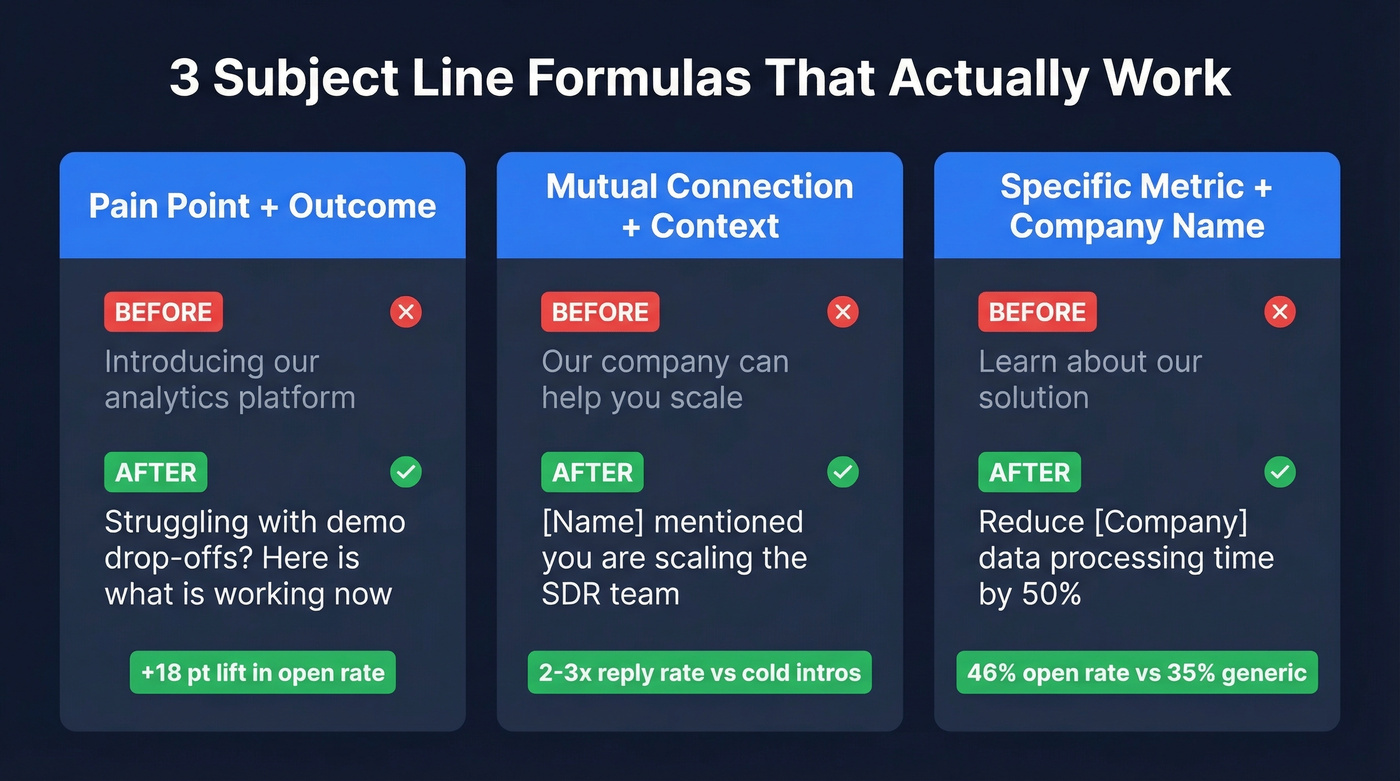
Formula 2: Mutual connection + context. Referral-based introductions skip the trust problem entirely. "[Name] mentioned you're scaling the SDR team" outperforms "[Company] can help you scale" every time - the connection does the heavy lifting. We've seen referral-based subject lines pull 2-3x the reply rate of cold intros, even when the underlying offer is identical.
Formula 3: Specific metric + company name. Numbers create curiosity. "Reduce [Company]'s data processing time by 50%" beats "Learn about our solution" because it's concrete and impossible to ignore. Personalized subject lines reach 46% open rates vs 35% without, and this is consistently the strongest approach for introduction email campaigns targeting named accounts.
Here's the thing: short and boring beats clever and creative. Lowercase, 1-4 word subject lines that read like a colleague's message consistently outperform marketing-style copy. The consensus on r/sales backs this up - anything that "sounds like marketing" gets ignored.
Introduction Email Subject Line Examples
Cold Prospect Introduction
- quick question about [department]
- [Company]'s [specific metric] caught my eye
- idea for [Company]'s [pain point]
- reducing [problem] by 40%
- saw your [recent event/news] - thought of this
- better way to handle [process]
- [Company] + [Your Company] - worth 5 min?
- cutting [pain point] in half
Partnership or Co-Marketing Pitch
- collab idea: [your audience] + [their audience]
- partnership that benefits [their company name]
- [mutual audience] - let's share the stage
- joint webinar idea - [topic]
Post-Event Follow-Up
Following up from a conference or trade show is the easiest introduction email you'll ever write - the recipient already knows your face. Lead with the event name and something specific you discussed: "the [topic] we talked about at [event]" or "[event name] follow-up: [specific thing discussed]." Vague follow-ups like "[event] was great!" get buried. Specific ones get replies.
Referral-Based Introduction
- [Name] said we should connect
- [Mutual contact] recommended I reach out
- [Name] thought you'd want to see this
- [Mutual contact] mentioned [their pain point]
Vendor or Supplier Introduction
For vendor pitches, lead with savings or pain removal. "Saving [Company] 30% on [service]" and "replacing [current tool] without the migration headache" both work because they're concrete. Nobody opens "innovative solutions for your business." Your email subject for a business introduction in vendor contexts should always quantify the benefit.
Investor Introduction
Skip this if you aren't fundraising. Investors skim hundreds of cold emails weekly, so front-load traction. "[Company]: $[metric] ARR, raising [round]" or "[traction metric] - seeking [round type] partners" tells them in five words whether to keep reading.

The best subject line in the world won't save you if you're sending to dead inboxes. Prospeo's 98% email accuracy and under-2% bounce rates mean your carefully crafted introduction emails actually reach real people - not spam folders.
Fix your list before you fix your subject line. Start free.
Ideal Subject Line Length
Twilio SendGrid's data is clear: 2-4 words perform best. The average subject line runs 6 words, which means most people are writing too long.
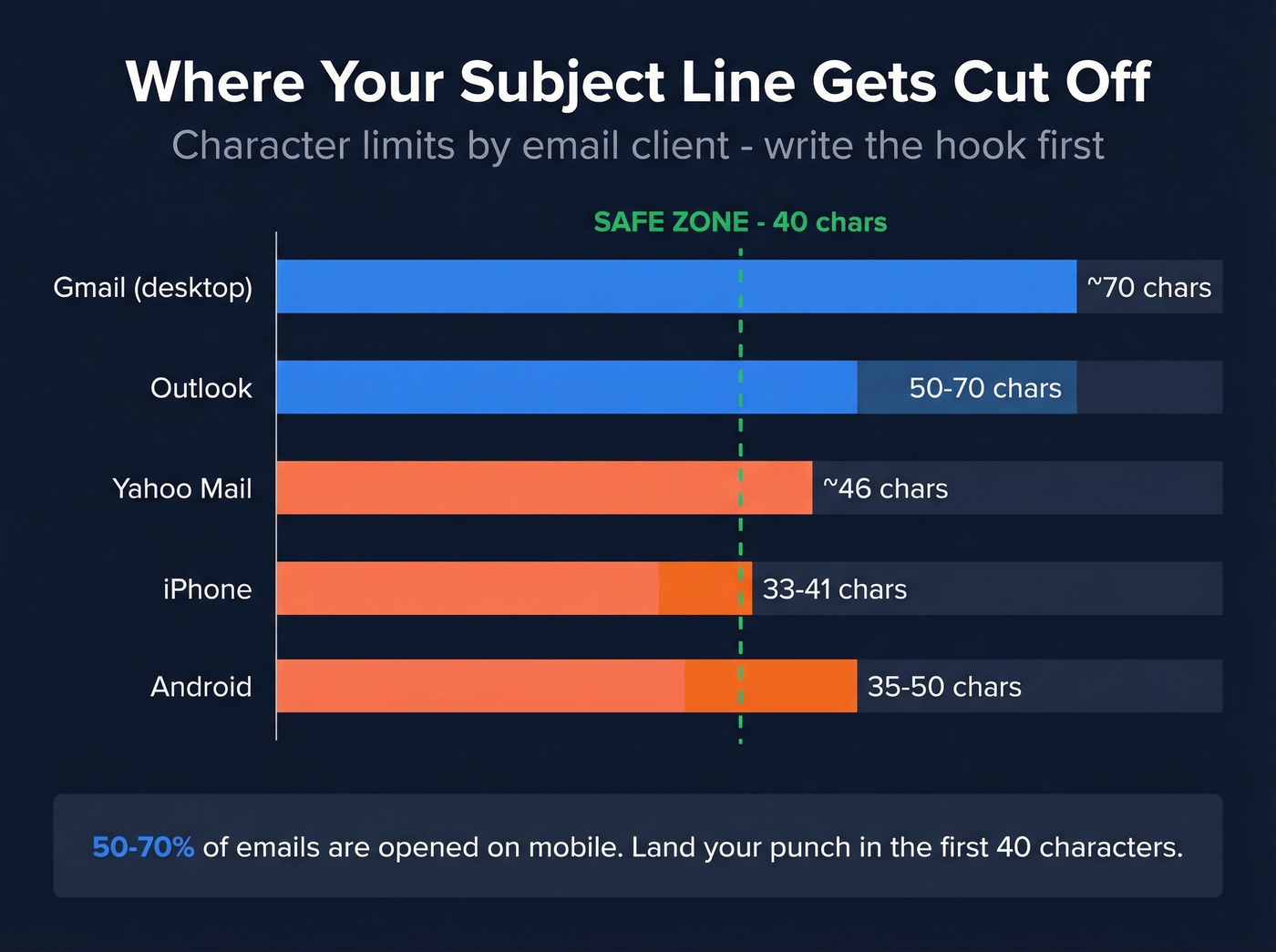
Length in words matters less than length in characters, because email clients truncate at fixed pixel widths:
| Client | Characters Shown |
|---|---|
| Gmail (desktop) | ~70 |
| Outlook | 50-70 |
| Yahoo Mail | ~46 |
| iPhone | 33-41 |
| Android | 35-50 |
Around 50-70% of emails are opened on mobile. Your subject line needs to land its punch within ~40 characters - anything after that is invisible. Write the important words first.
One caveat worth knowing: Apple Mail Privacy Protection inflates open rates by pre-loading tracking pixels. If your list skews Apple Mail users, open rate becomes unreliable. Track click-through rate instead - 2%-5% is the healthy range for marketing emails.
Mistakes That Kill Open Rates
Too vague. "Check this out" tells the reader nothing. "New feature: schedule posts in advance" gives them a reason to click. Outreach's research documents this pattern repeatedly.
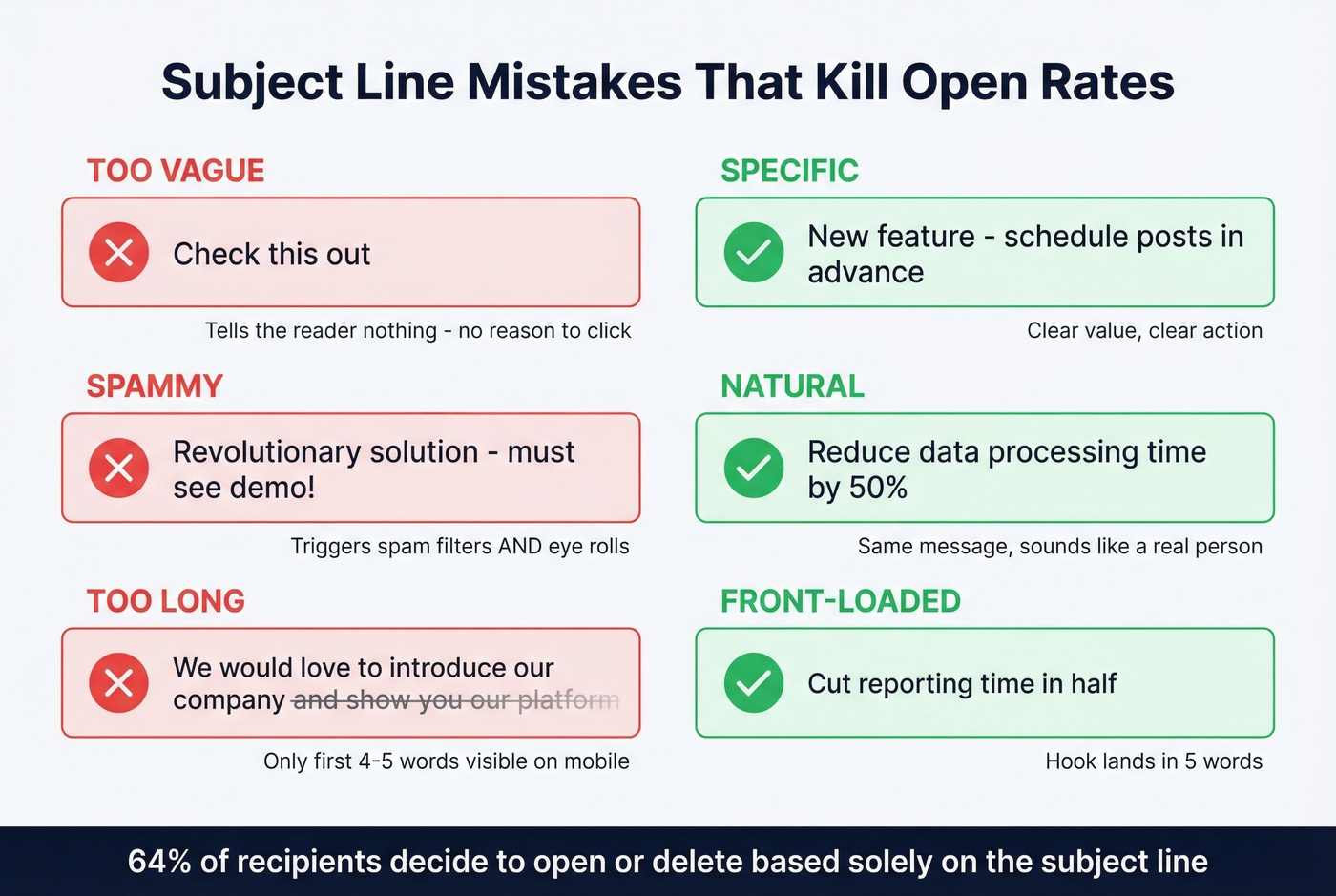
Spammy language. "Revolutionary solution: must-see demo!" triggers spam filters and eye-rolls simultaneously. "Reduce data processing time by 50%" does the same job without the cringe. Avoid these words entirely: guarantee, act now, limited time, free, exclusive offer. The best company introduction subject lines sound like a person wrote them, not a marketing team.
Too long. If your subject line is 12 words, only the first 4-5 are visible on mobile. Put the hook first, context second.
64% of recipients decide to open or delete based solely on the subject line. You get one shot. Make the first three words count.
The Deliverability Checklist Most Guides Skip
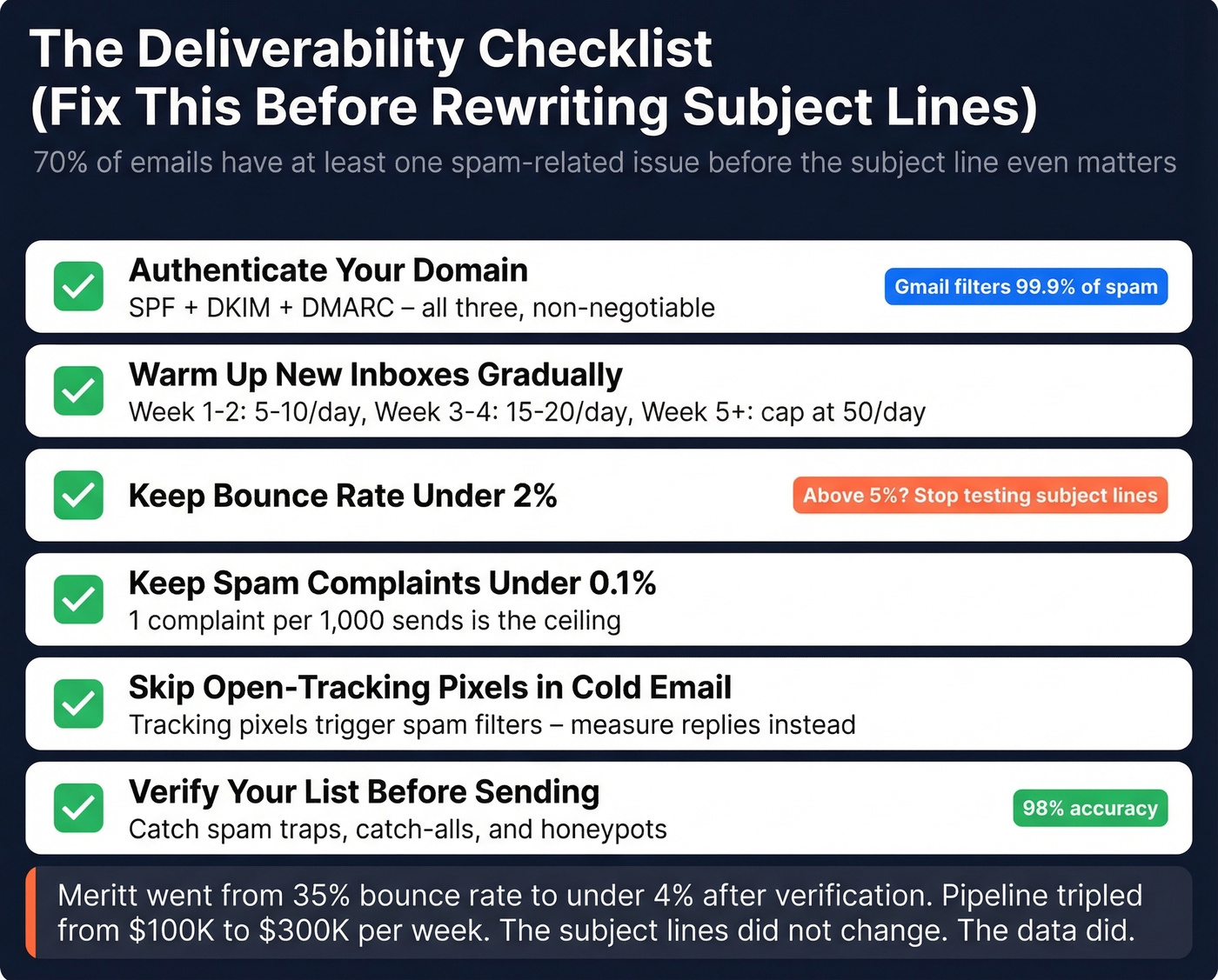
Look - 70% of emails have at least one spam-related issue before the subject line even matters. In our experience, teams that fix authentication and list quality before rewriting subject lines see bigger open-rate gains than any copywriting trick delivers. We've watched teams obsess over A/B testing word choices while half their emails landed in spam folders.
Here's the checklist:
- Authenticate your domain. SPF, DKIM, and DMARC - all three, non-negotiable. Gmail filters ~99.9% of spam. Without authentication, you look like spam.
- Warm up new inboxes gradually. Week 1-2: 5-10 emails/day. Week 3-4: 15-20/day. Week 5+: cap at 50/day per inbox. Skipping warm-up is the fastest way to torch a domain.
- Keep bounce rate under 2%. Anything higher signals to providers that you're sending to garbage lists.
- Keep spam complaints under 0.1%. One complaint per thousand sends is the ceiling.
- Skip open-tracking pixels in cold email. Tracking pixels can trigger spam filters and reduce deliverability. Measure replies instead. (If you want the technical why, see tracking pixels.)
- Verify your list before sending. Prospeo's 5-step verification with 98% email accuracy catches spam traps, catch-alls, and honeypots that destroy sender reputation.
Quick distinction: "delivery" means the server accepted your email. "Deliverability" means it hit the inbox, not spam. A 95% delivery rate can still mean 40% of your emails land in junk.
Meritt went from a 35% bounce rate to under 4% after running their lists through proper verification - and their pipeline tripled from $100K to $300K per week. The subject lines didn't change. The data did.
If your bounce rate is above 5%, stop A/B testing subject lines. You're optimizing the paint color on a house with no foundation. Fix your list first, then worry about copy. (Benchmarks and fixes: bounce rate.)
Personalized subject lines hit 46% open rates - but only if you have the data to personalize. Prospeo gives you 50+ data points per contact, from job titles to department size, so every introduction email subject line lands with context.
Stop guessing. Personalize every subject line with real prospect data.
FAQ
How many words should a company introduction email subject line be?
Two to four words perform best, based on Twilio SendGrid data. Keep under 46 characters to avoid truncation on mobile. Front-load the most important word so it's visible even on smaller screens.
What's the best subject line formula for introducing a company?
Pain-point + outcome formulas consistently outperform generic introductions. Focus on the recipient's problem, not your product. "Struggling with [pain point]?" beats "About [Your Company]" every time - personalized lines hit 46% open rates vs 35% for generic ones.
Should I use the company name in the subject line?
Only if it adds context - like a referral or a recognized brand. "Saving Acme 30% on fulfillment" works because it's specific. Leading with your own unknown company name wastes precious characters. Lead with the problem you solve instead.
How do I stop introduction emails from going to spam?
Set up SPF, DKIM, and DMARC on your sending domain, then verify your email list to catch invalid addresses and spam traps. Pair that with a 5-7 week inbox warm-up and you'll stay out of junk folders.
How do I write a subject for company introduction email outreach at scale?
Start with the recipient's biggest challenge, add a specific number or outcome, and keep it under four words if possible. Test two to three variations per campaign and measure reply rates, not just opens. At scale, verified contact data matters more than copy - bad emails never reach anyone.