

Technical Sales: What It Is, What It Pays, and How to Break In
You're staring at a job posting. OTE: $180K. The title says "Sales Engineer" and the description reads like a hybrid of consultant, product expert, and dealmaker. You're wondering if this is real - and whether you could actually do it.
It's real. Technical sales is one of the highest-paying career paths in tech that doesn't require you to be a software engineer. The presales software market alone is projected to grow from $94B to $179B by 2031, and demand for people who can bridge the gap between product and buyer keeps climbing.
What You Need (Quick Version)
What is it? The practice of selling complex products - software, hardware, infrastructure - by combining deep product knowledge with consultative selling skills.
What does it pay? The BLS 2024 median for sales engineers is $121,520/year. PayScope's March 2026 ladder puts the Entry median at $62,168 and the Leader median at $158,301, with top earners above $200K.
How do you get in? The fastest path is often an SDR role at a SaaS company. Self-paced training programs can get you job-ready in 1-3 months. No CS degree required.
What Is Technical Sales?
Think of it as the bridge between the engineering team that built the product and the buyer who needs to understand why it matters. General sales is transactional - you're moving units, hitting volume targets, working a script. Technical selling is consultative. You're diagnosing problems, mapping solutions to complex environments, and often spending weeks or months on a single deal.
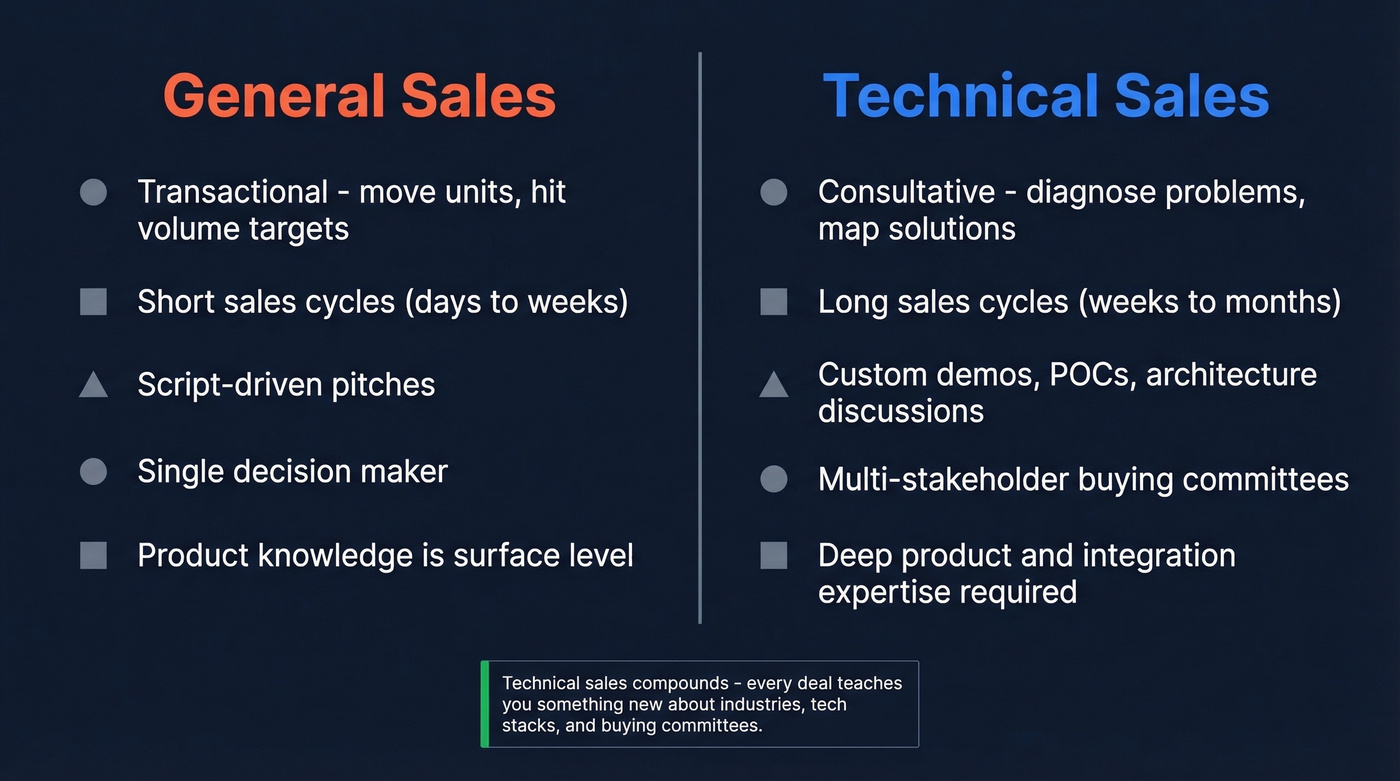
The role exists wherever the product is too complex for a standard sales pitch. That means SaaS (often the highest-paying segment), but also manufacturing, medical devices, telecom, cybersecurity, and industrial automation. If the buyer needs to understand architecture, integrations, compliance, or technical ROI before signing, there's a technical seller in the room.
Here's the thing about career trajectory: general sales roles can plateau in comp and skill development. Technical roles compound. Every deal teaches you something about a new industry, a new tech stack, or a new buying committee. That knowledge becomes your competitive edge and your bargaining chip in salary negotiations.
Roles and Comp Structures
Not every role is the same. The title on the offer letter determines your day-to-day, your comp structure, and your career trajectory.
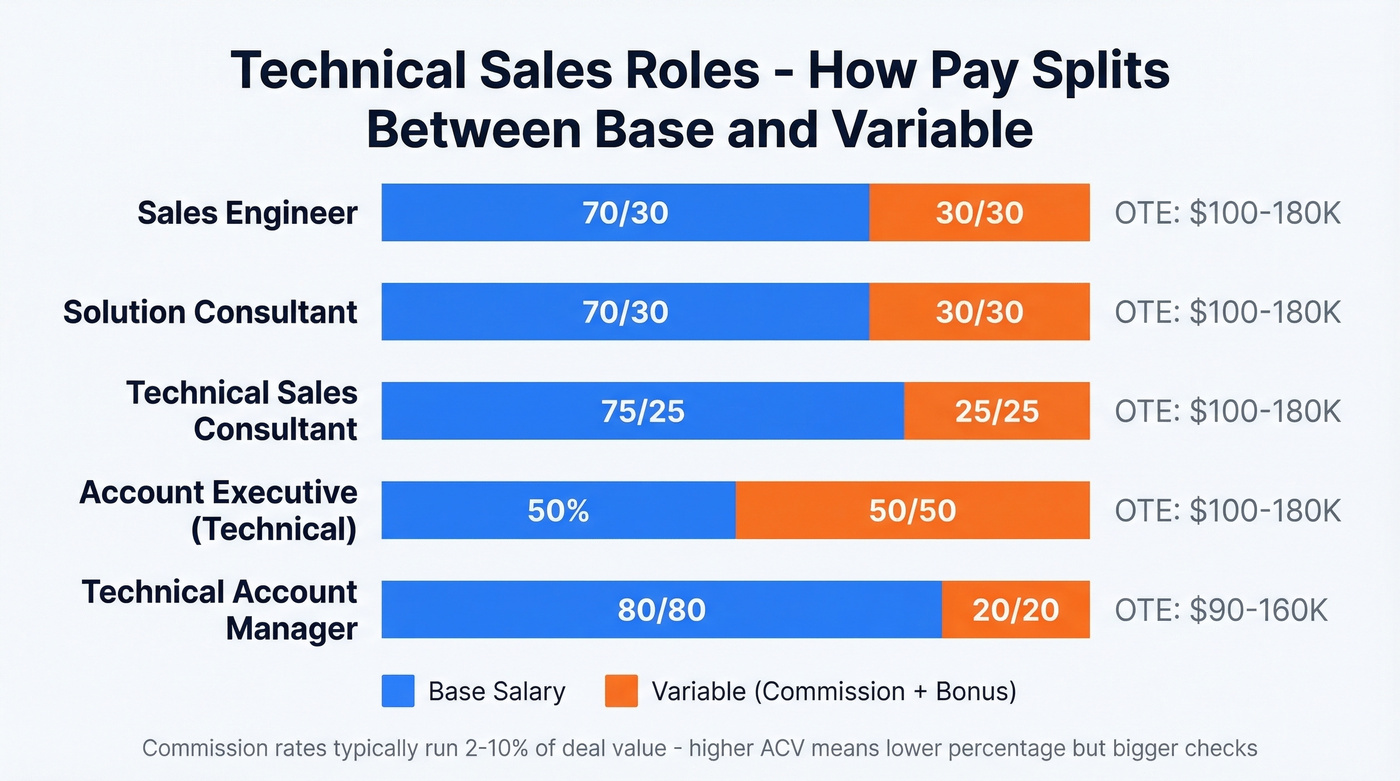
| Role | Primary Focus | Base:Variable | Entry OTE |
|---|---|---|---|
| Sales Engineer | Demos, POCs, architecture | 70/30 or 75/25 | $100-180K |
| Solution Consultant | Business case, ROI, design | 70/30 | $100-180K |
| Technical Sales Consultant | Hybrid SE + SC | 70/30 or 75/25 | $100-180K |
| Account Executive (technical) | Full-cycle deal ownership | 50/50 or 60/40 | $100-180K |
| Technical Account Manager | Post-sale expansion | 80/20 | $90-160K |
Commission rates typically run 2-10% of deal value, depending on complexity and deal size. Higher ACV means a lower percentage - but a bigger check.
At a startup, you'll wear all these hats. The "Sales Engineer" at a 30-person company is running demos, writing proposals, configuring trial environments, and occasionally hopping on support tickets. At an enterprise vendor, each of these is a separate, specialized role. Startups build breadth. Enterprise builds depth. Pick based on where you are in your career.
What You Actually Do Day-to-Day
The day-to-day shifts dramatically by seniority. At entry level, you're running demos, shadowing discovery calls, and learning how your product fits into real environments. At senior level, you're architecting multi-product solutions and presenting to C-suite buying committees. Regardless of level, the core work revolves around discovery and proof.
The Discovery Framework
Discovery is where deals are won or lost. The best technical sellers we've observed follow a three-phase structure:
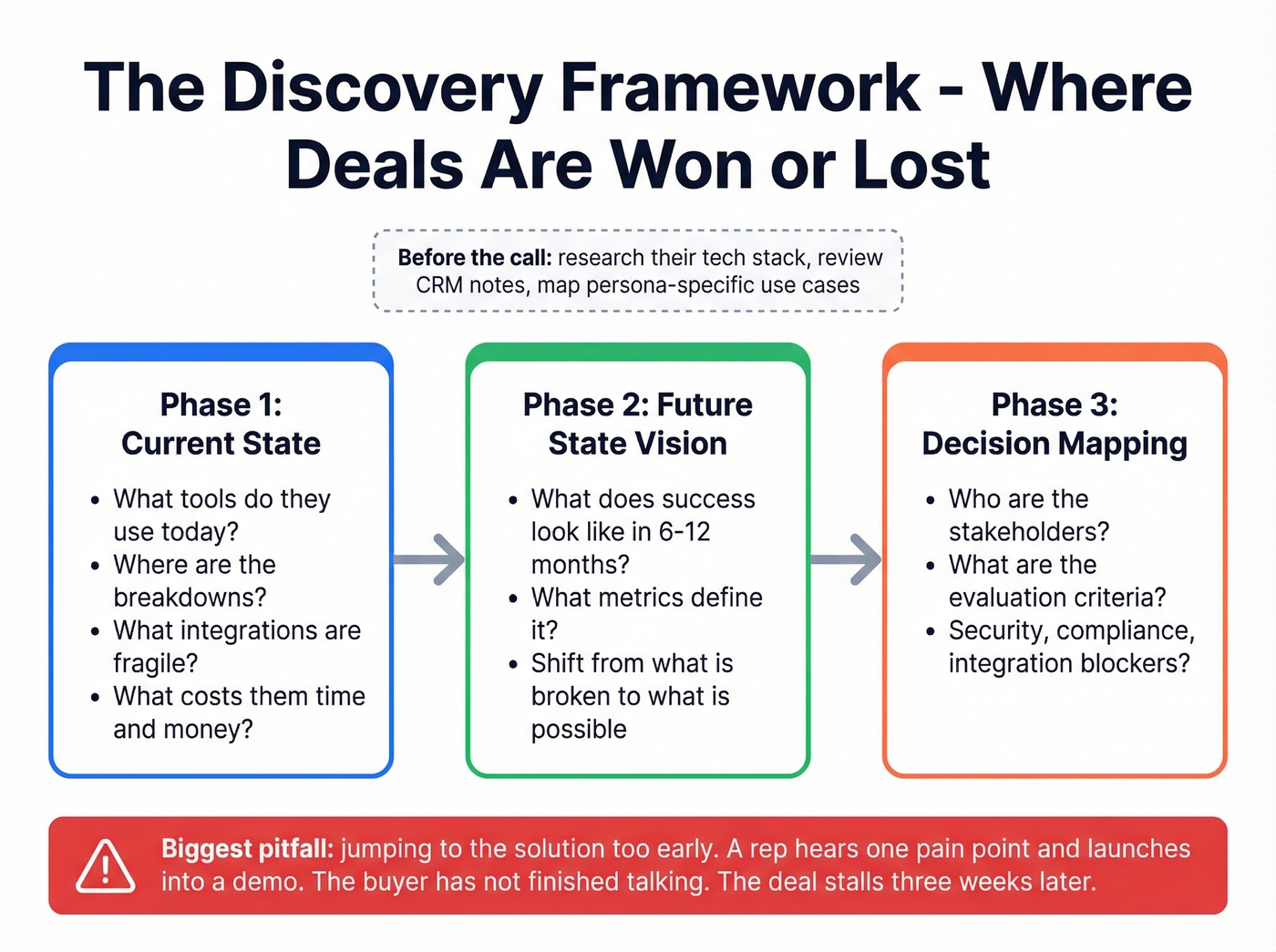
Current state assessment. What tools does the buyer use today? Where are the breakdowns? What integrations are fragile? What's costing them time and money?
Future state vision. What does success look like in 6-12 months? What metrics define it? This is where you shift from "what's broken" to "what's possible."
Decision process mapping. Who are the stakeholders? What are the evaluation criteria? Are there security, compliance, or integration requirements that could kill the deal in legal review?
Before any discovery call, research the prospect's tech stack, review prior notes from your CRM, and map persona-specific use cases.
The biggest pitfall? Jumping to the solution too early. A rep hears one pain point and launches into a demo. The buyer hasn't finished talking. The deal stalls three weeks later because you missed the CFO's real concern. The other common mistake is ignoring non-technical stakeholders entirely - the VP of Engineering might love your architecture, but if the procurement lead doesn't understand the business case, you're dead.
Demo vs POC vs POV
These three terms get used interchangeably, and they shouldn't.
| Format | Duration | Who Drives | Purpose |
|---|---|---|---|
| Demo | 30-60 min | Seller | "Show what it does" |
| POC | 2-6 weeks | Buyer | "Prove it works here" |
| POV | 4-8+ weeks | Both | "Prove the business case" |
Demos are cheap. POCs are expensive. A mis-scoped POC with unclear success criteria is the fastest way to burn weeks and lose the deal anyway. Before agreeing to a POC, nail down exactly what you're proving, who's evaluating, and what "success" looks like - in writing. If the buyer can't articulate success criteria, they're not ready for a POC. They need another demo.
Salary Breakdown - Real Numbers
Pay by Seniority
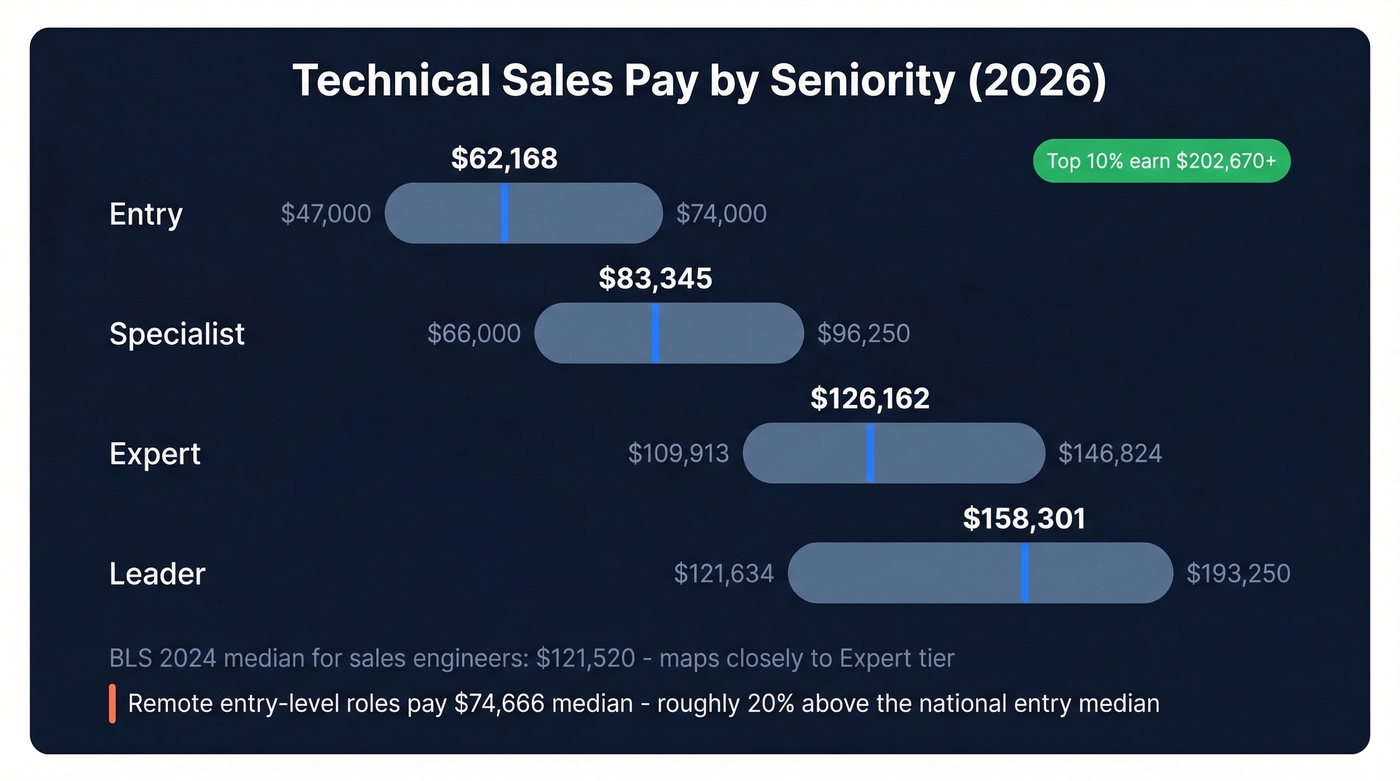
PayScope's March 2026 dataset (3,772 active roles, 30+ data sources) breaks it down:
| Level | Median | P25 | P75 |
|---|---|---|---|
| Entry | $62,168 | $47,000 | $74,000 |
| Specialist | $83,345 | $66,000 | $96,250 |
| Expert | $126,162 | $109,913 | $146,824 |
| Leader | $158,301 | $121,634 | $193,250 |
The BLS 2024 median for sales engineers sits at $121,520, which maps closely to the "Expert" tier. Top 10% earners clear $202,670+. Glassdoor's total pay figures - which include commission and bonus - tell the progression story well: $117K at 0-1 years, $126K at 1-3 years, $143K at 4-6 years, $160K at 7-9 years, and $180K at the 10-14 year mark.
That leader-level P25-to-P75 spread of $71,616 tells you something important: outcomes vary a lot at senior levels. The same title can land near $121,634 or closer to $193,250 depending on company, territory, and variable comp.
One stat worth highlighting: remote entry-level roles pay a median of $74,666 - roughly 20% above the national entry median. Remote tech sales is one of the few entry-level paths where location arbitrage works in your favor.
Pay by Industry
Where you sell matters as much as what you sell:
| Industry | BLS 2024 Median |
|---|---|
| Software publishers | $137,650 |
| Wholesale trade agents | $134,990 |
| Computer systems design | $131,810 |
| Merchant wholesalers | $109,150 |
| Manufacturing | $101,940 |
Target SaaS if you want the highest pay and the most transferable skills. A sales engineer who's sold enterprise software can move between companies, industries, and verticals with relative ease. Someone who's spent a decade selling industrial valves has deep domain expertise but a narrower market. Both are valid - just know the tradeoff before you commit.
Highest-Paying Cities
BLS metro medians (all levels):
| Metro Area | Median |
|---|---|
| San Jose | $173,640 |
| Nashville | $170,400 |
| Phoenix | $169,560 |
| NYC metro | $156,170 |
PayScope leader medians:
| Metro Area | Leader Median | P75 |
|---|---|---|
| Austin | $181,000 | - |
| Boston | $181,000 | $264,000 |
Boston's P75 of $264K at the leader level is eye-catching. It's not typical - but it's not fantasy either.

Discovery calls only work when you're talking to the right people. Prospeo gives technical sellers 300M+ verified profiles with 30+ filters - including tech stack, buyer intent, and department headcount - so you walk into every call knowing exactly who you're selling to and why they should care.
Skip the research grind and start every discovery call with an edge.
Job Market and Outlook
The BLS projects 5% growth for sales engineers from 2024 to 2034 - faster than average. That translates to about 3,100 net new roles on top of the current 56,800, plus roughly 5,000 openings per year from turnover and retirement.
The competitive reality is tighter than those numbers suggest. PayScope's data shows 14,910 professionals competing for 3,772 open positions - a 3.95:1 supply-to-demand ratio. Competitive, but not brutal.
The largest employing industries break down as merchant wholesalers (21%), computer systems design (20%), and manufacturing (18%), with software publishers at just 5%. That last number surprises people. SaaS pays the most but employs a relatively small share of total sales engineers. The bulk of the market is in traditional industries that need technical expertise to sell complex physical and digital products.
Let's be honest: if your deals are simple and low-touch, you probably don't need a dedicated sales engineer. But the moment evaluations involve security reviews, integrations, or multi-stakeholder buying committees, a technical seller pays for themselves fast. The role isn't going anywhere.
Essential Skills
Stop obsessing over whether you're "technical enough." The best technical sellers we've worked with come from support, implementation, and teaching - not engineering.
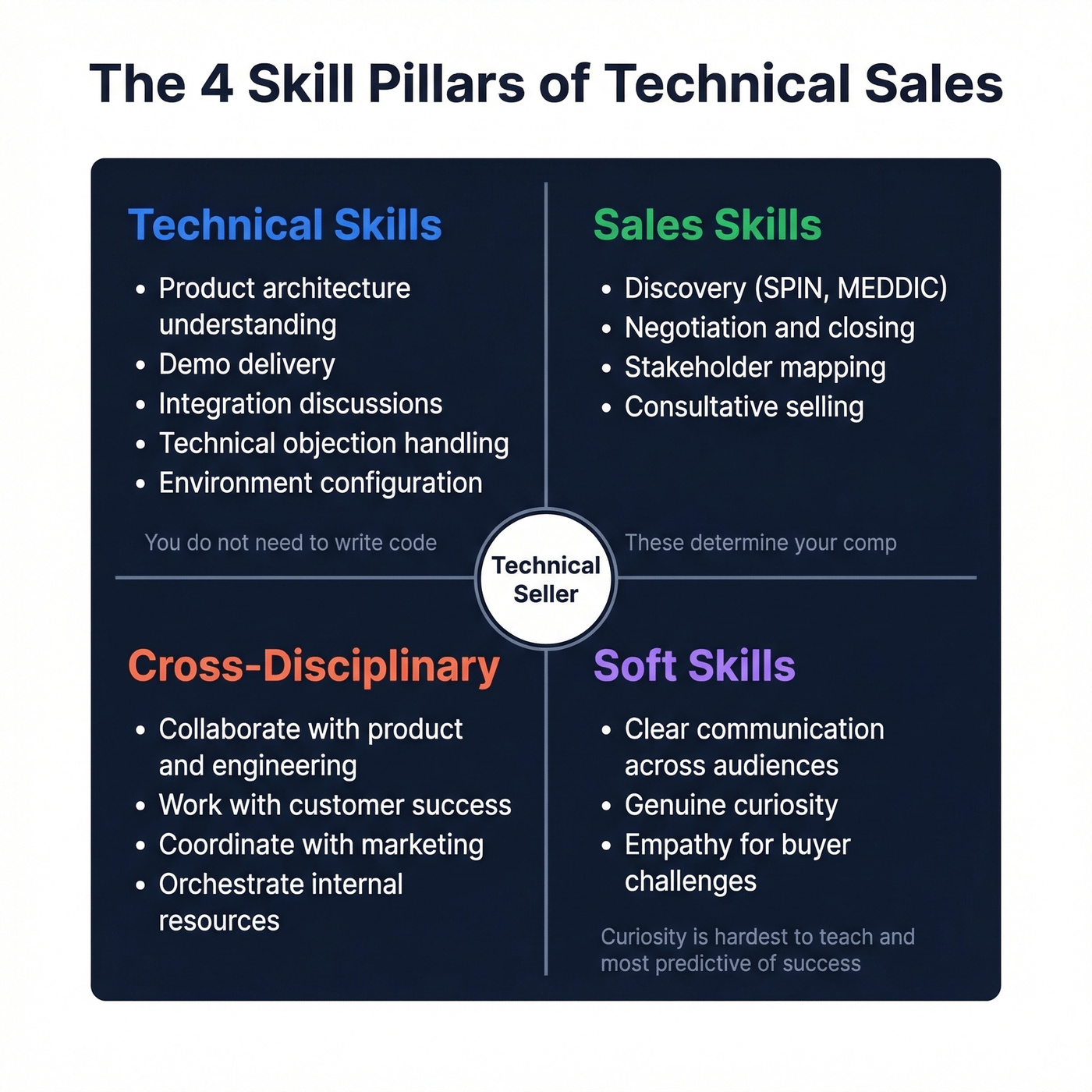
Technical skills. Product architecture understanding, demo delivery, integration discussions, technical objection handling, environment configuration. You don't need to write code. You need to understand how systems connect and where they break.
Sales skills. Discovery methodology like SPIN or MEDDIC, negotiation, closing, stakeholder mapping, consultative selling. These are the skills that actually determine your comp. A mediocre demo with great discovery wins more deals than a perfect demo with no context.
Cross-disciplinary skills. The ability to collaborate across product, engineering, customer success, and marketing is increasingly what separates good sellers from great ones. You're not just selling - you're orchestrating internal resources to build a compelling business case.
Soft skills. Clear communication across technical and non-technical audiences, and genuine curiosity. Curiosity is the one trait that's hardest to teach and most predictive of success. If you don't naturally want to understand how a buyer's environment works, this role will grind you down.
The Tool Stack
Technical sellers touch a lot of tools. Here's the standard stack in our experience:
| Category | Tools |
|---|---|
| CRM | Salesforce, HubSpot, Zoho CRM, Dynamics 365 |
| Outreach/Sequencing | Outreach, Salesloft, Smartlead |
| Prospecting & Data | Prospeo, ZoomInfo, Cognism |
| Conversation Intelligence | Gong, Chorus |
| Interactive Demos | Reprise, Loom |
| CPQ/Proposals | PandaDoc, DocuSign CPQ |
| Sales Enablement | Highspot, Guru, Mindtickle |
| RFP/Security | Loopio, RFPIO |
| Forecasting | Clari, InsightSquared |
| Workflow | Asana, Jira |
The tools you'll use most depend on your role. Sales engineers live in demo platforms and CRMs. AEs live in sequencing tools and forecasting dashboards. But everyone needs clean contact data - bad emails and disconnected phone numbers waste hours every week and damage your sender reputation. The consensus on r/sales is pretty clear: your outbound is only as good as the data feeding it.
Prospeo's free tier includes 75 verified emails per month, which is enough to learn the workflow before your team commits budget.

Building pipeline in technical sales means reaching decision-makers directly - not gatekeepers. Prospeo delivers 98% accurate emails and 125M+ verified mobile numbers with a 30% pickup rate, all at $0.01 per lead. That's the kind of data that turns a $62K entry role into a $180K career.
Stop bouncing emails and start booking demos that actually happen.
How to Break Into Technical Sales
The SDR Fast Track
The most common entry point is a Sales Development Representative role at a SaaS company. You're booking meetings, not closing deals - but you're learning the tools, the language, and the rhythm of B2B sales. Our take: startups if you want to accelerate learning, enterprise if you want structured training and a recognized brand on your resume.
Programs like CourseCareers offer structured training for $499 (or four payments of $150). The curriculum covers Salesforce, HubSpot, SalesLoft, Outreach, and Vidyard, plus qualification frameworks like BANT and SPIN. Typical completion time is 1-3 months, self-paced. Their graduate data shows an average starting salary around $68K.
Career Switchers
You don't need a CS degree. You need genuine curiosity about how things work. Many successful career switchers come from customer support, implementation consulting, IT administration, and teaching. If you can demonstrate product curiosity and communication skills, you're competitive.
Skip this path if you hate ambiguity. Technical sales involves long deal cycles, shifting requirements, and buyers who ghost you after three great calls. If that sounds miserable rather than challenging, a more structured technical role is probably a better fit.
Engineers Moving to Sales
The engineer-to-SE path is the highest-ceiling move in this field. You bring deep technical credibility that takes non-technical sellers years to develop. Your gap is sales methodology - discovery skills, commercial awareness, and the ability to tie technical capabilities to business outcomes.
In most entry and mid-level roles, expect a 60-90 day ramp before full quota exposure. Use that time to shadow experienced AEs, sit in on discovery calls, and learn your company's sales methodology cold. The technical knowledge is your advantage. The sales skills are the investment.
Tips for Landing the Job
Technical sales interviews typically run four rounds:
Round 1: Recruiter screen. They're evaluating communication skills and genuine interest. Prepare crisp answers for "tell me about yourself," "why sales," and "why this company." Keep each under two minutes.
Round 2: Sales manager interview. Your background, how you handle adversity, and whether you've done your homework on the product and customer base. Come with specific examples of times you've solved complex problems or influenced decisions - I once watched a candidate win a final round by walking through a real customer escalation she'd handled in a support role, mapping it to how she'd run a discovery call.
Round 3: Sales task or culture interview. You might draft a cold email, run a mock cold call, or do a peer screen. Understand the persona you're targeting, tie everything to their pain points, and stay conversational. Don't feature dump.
Round 4: Final panel or presentation. You'll deliver a product presentation or run a mock discovery call with objections thrown at you. Evaluators want to see how you handle pushback and whether you can stay composed under pressure.
One tactic that consistently works: close the interview. End every round with "Is there anything that would prevent you from moving me forward?" It demonstrates sales instinct and gives you real-time feedback. Most candidates don't do this. The ones who do stand out immediately.
If you're building your first outreach system, start with proven sales prospecting techniques and a simple 30-60-90 day plan so you ramp faster.
FAQ
Is technical sales stressful?
Income and job security depend directly on quota attainment, so the pressure is real. But median pay sits at $121,520 with top earners clearing $200K+, and the consultative nature of the work means you're solving problems - not just dialing. The stress is real; so is the paycheck.
Do I need a degree?
No. Many successful sellers come from support, implementation, or non-technical backgrounds. Curiosity and the ability to learn products deeply matter more than credentials. Domain expertise - understanding the buyer's industry, workflows, and pain points - often outweighs formal education.
What does OTE mean?
On-Target Earnings - total expected compensation (base plus commission) at 100% quota. A $150K OTE with a 70/30 split means $105K base and $45K variable. Most technical sales roles skew toward a heavier base than pure closing roles.
Sales engineer vs account executive?
Sales engineers focus on pre-sales technical work - demos, POCs, architecture - on a 70/30 or 75/25 comp split. Technical AEs carry full-cycle quota on a 50/50 or 60/40 split. SEs support deals; AEs own them.
What prospecting tools do technical sellers use?
Most teams run Salesforce or HubSpot as their CRM, Outreach or Salesloft for sequencing, and a data platform like Prospeo for verified contacts. Layer in Gong for conversation intelligence and Reprise for interactive demos.