

Technology Sales: What It Pays, What It Takes, and Whether It's Worth It in 2026
You've heard technology sales pays six figures. Your friend just posted their OTE on social media. You want in. But the market has shifted hard since 2021, and nobody's being honest about how much.
What You Need (Quick Version)
Tech sales still pays well. SDR median OTE sits at $85,000, and enterprise AEs pull a median $265,000 - with top performers clearing $627,527. Fewer than half of AEs actually hit quota in most segments, though, and the gap between "OTE" and "what you'll actually earn" is the thing every career guide conveniently skips.
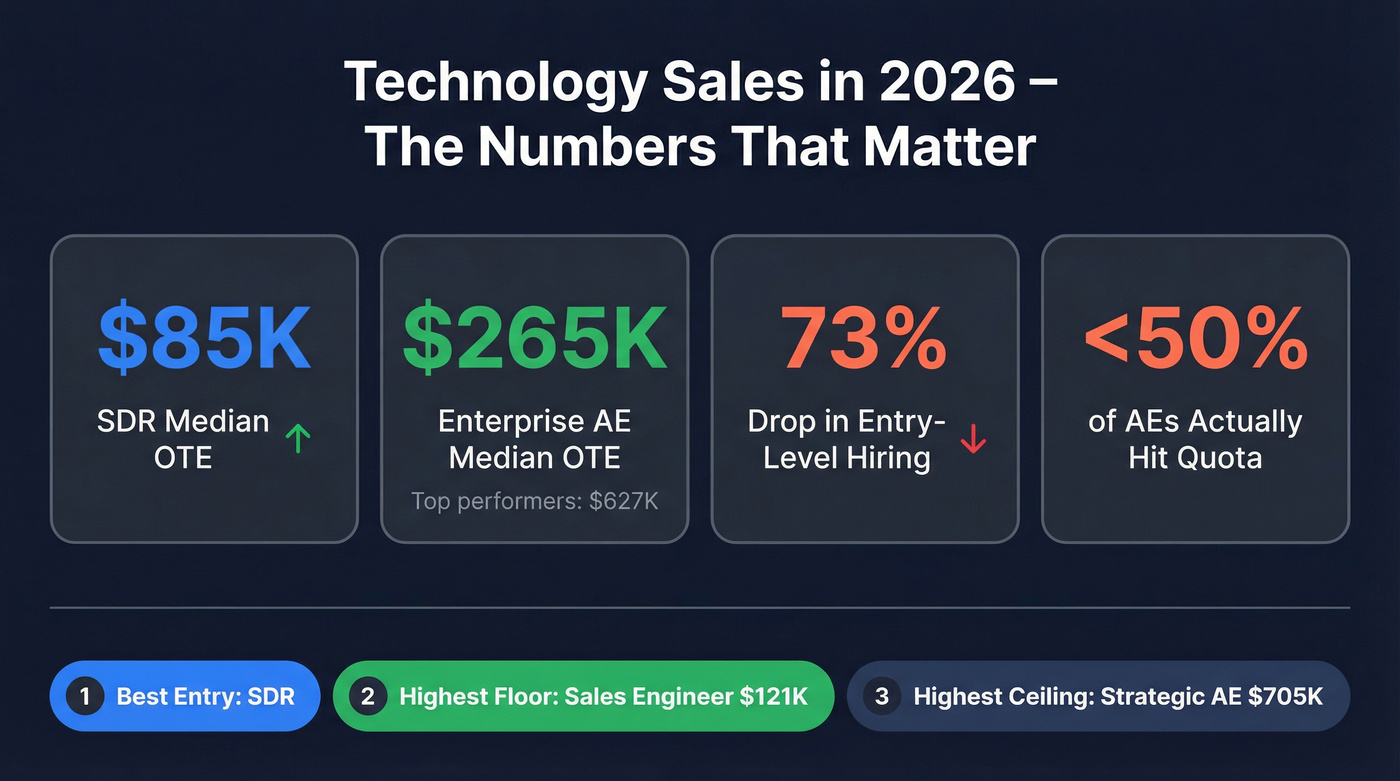
Here's the harder truth: entry-level hiring is down 73% across European tech markets. You're not competing against other career-switchers for SDR seats anymore - you're competing against laid-off reps with two to three years of experience who are willing to take a step back just to get back in.
Three roles worth targeting: SDR (easiest entry point, highest volume of openings), Sales Engineer (highest floor - $121,520 median with 5% projected growth), and Account Executive (highest ceiling, but you'll earn your way there first).
What Is Technology Sales?
Technology sales is the business of selling software, hardware, cloud infrastructure, cybersecurity solutions, and IT services to other businesses. The B2B distinction matters. You're not working a retail floor. You're selling to procurement teams, VPs of Engineering, CISOs, and CFOs who evaluate products over weeks or months, not minutes.
The product categories you'll encounter break down roughly like this:
- SaaS - CRMs, marketing platforms, HR tools, dev tools. This is where most SDR and AE roles live.
- Cloud infrastructure - AWS, Azure, GCP, and the ecosystem of companies built around them.
- Cybersecurity - Firewalls, endpoint protection, identity management. One of the fastest-growing segments.
- Hardware and networking - Servers, storage, networking equipment. Longer sales cycles, bigger deals.
- IT services and consulting - Implementation, managed services, digital transformation projects.
One quick distinction worth making: "tech sales" and "IT sales" overlap but aren't identical. IT sales typically refers to infrastructure and services sold to IT departments. Tech sales is broader - it includes selling marketing software to CMOs, HR platforms to CHROs, and developer tools to engineering leads. The buyer isn't always technical, but the product usually is. Compared to medical devices, financial services, or industrial manufacturing, selling technology stands out for its pace of change and the sheer variety of products you can sell.
Is Tech Sales Worth It in 2026?
Yes - but with a much bigger asterisk than it carried three years ago.
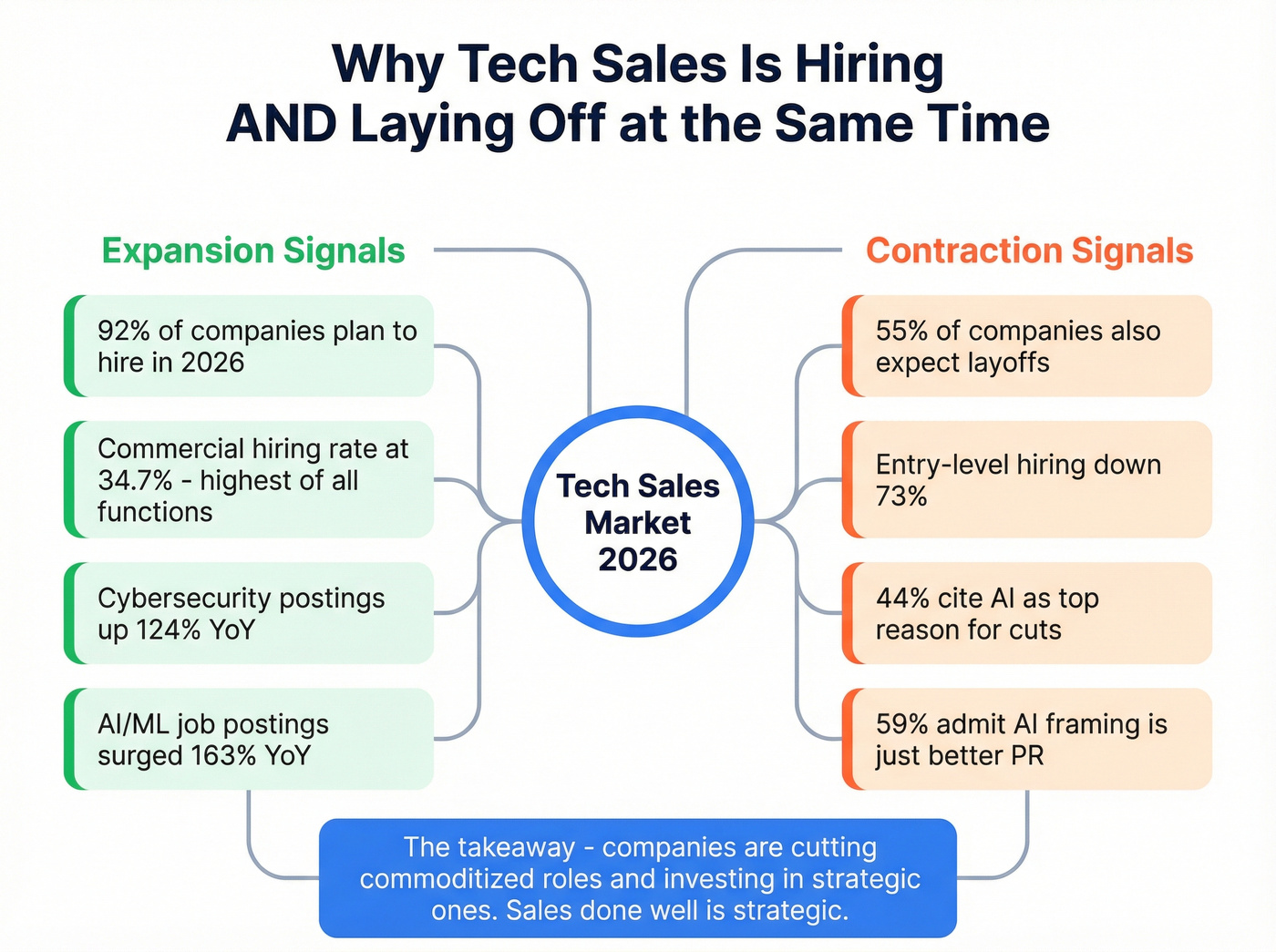
The data pulls in two directions. 92% of companies plan to hire in 2026, but 55% also expect layoffs. Those numbers aren't contradictory - they reflect a market simultaneously expanding in some areas and contracting in others. AI is the biggest driver: 44% of companies cite it as the top reason for layoffs, while AI/ML job postings surged 163% year-over-year in 2025.
For sales specifically, the numbers are encouraging. Commercial hiring rates climbed to 34.7% - the highest across all functions. Companies are cutting in some departments and investing in revenue-generating roles. That's good news if you're in sales. The bad news is that entry-level positions bore the brunt of the contraction, with that 73% decrease in hiring rates for junior roles.
The segments where money is flowing tell you where sales opportunities will concentrate. US employers posted nearly 1.1 million technology jobs in 2025. Cybersecurity postings hit 66,800 (up 124% YoY), and AI/ML roles reached 49,200. If companies are hiring engineers in those areas, they're building products that need to be sold. Reps who understand AI, security, or cloud infrastructure will have a structural advantage over generalists.
Reality check: 59% of companies admit that framing layoffs as "AI-driven" plays better with stakeholders than citing financial constraints. Take every "AI is replacing jobs" headline with a grain of salt. The real story is rebalancing - companies are cutting roles they consider commoditized and investing in roles they consider strategic. Sales, when done well, is strategic.
Let's be honest about one thing the industry doesn't talk about enough: if your average deal size is under $15K, you probably don't need to work at a company with enterprise-level tooling or a 50-person sales org. Some of the best tech sales careers right now are at 20-100 person startups selling into cybersecurity or AI - smaller teams, faster promotion paths, and equity that might actually be worth something.
Tech sales remains one of the highest-paying careers you can enter without a specialized degree. But the easy-entry window that existed in 2020-2022 has closed. You need to be more deliberate about how you break in and which segment you target.
Roles and Comp Explained
| Role | Entry Difficulty | Typical OTE | Day-to-Day Focus |
|---|---|---|---|
| SDR/BDR | Lowest | $85K | Outbound prospecting |
| Account Executive | Medium | $130K-$300K | Demos, negotiation |
| Sales Engineer | Medium-High | $200K | Technical demos |
| Account Manager/CSM | Medium | $80K-$110K | Retention, expansion |
| Sales Manager | High | $150K-$250K | Team leadership |
SDR/BDR
This is where most people start. The job is straightforward: generate qualified meetings for Account Executives. You'll make 40-80 calls per day in a high-velocity org, send 50-100 emails, and aim to book 3-8 meetings per week depending on your segment and target market.
Median OTE is $85,000, with a base around $60,000 and variable compensation making up the rest. Top performers push past $127,955. The 57.3% quota attainment rate is one of the highest among common tech sales roles - which makes sense, since SDR metrics are more controllable than closing revenue. Think of this role as a launchpad, not a destination. Eighteen months is the sweet spot before you should be moving up or out.
Account Executive
AEs close deals. You'll run product demos, manage a pipeline, negotiate contracts, and coordinate with Sales Engineers and leadership on complex deals. The role splits into segments that dramatically affect your comp and lifestyle.
SMB AEs carry smaller deals with shorter cycles - median OTE of $130,000, but only 44.8% hit quota. Mid-market AEs earn a median $175,000 OTE with similar attainment at 43.9%. Enterprise AEs jump to $265,000 median OTE, with top performers clearing $627,527 - but only 40.9% hit their number. The pattern is clear: higher ceiling, lower probability. Strategic AEs at the top pull $300K median OTE, with the best earning $705,215.
Sales Engineer
This is the hybrid role that doesn't get enough attention. Sales Engineers handle the technical side of the sales process - running deep product demos, answering architecture questions, building proof-of-concept environments, and translating business requirements into technical solutions.
The Bureau of Labor Statistics puts median pay at $121,520 with 5% projected growth from 2024-2034 and roughly 5,000 openings per year. RepVue data shows Sales Engineers earning a median $200K OTE with 56.8% quota attainment - one of the highest floors in the industry. If you have an engineering or CS background and don't want to code full-time, this is the path.
Account Manager / CSM
Post-sale roles focused on keeping customers happy and expanding revenue within existing accounts. The transition from SDR to CSM typically takes 15-20 months, with total comp in the $80K-$110K range. Less volatile than closing roles, but the ceiling is lower. Good fit if you prefer relationship management over cold outreach.
Sales Manager / Leadership
The path from top-performing AE to frontline manager. You'll coach reps, run forecasting calls, and own a team number. Comp typically ranges from $150K-$250K OTE depending on team size and segment. Not every great seller makes a great manager - it's a fundamentally different skill set.

SDRs booking 3-8 meetings per week need verified contact data, not bounced emails. Prospeo delivers 98% email accuracy and 125M+ verified mobile numbers - so every dial and send counts.
Stop burning activity on bad data. Start your tech sales career with contacts that connect.
What You'll Actually Earn
Real numbers from RepVue, which tracks self-reported comp across thousands of SaaS companies:
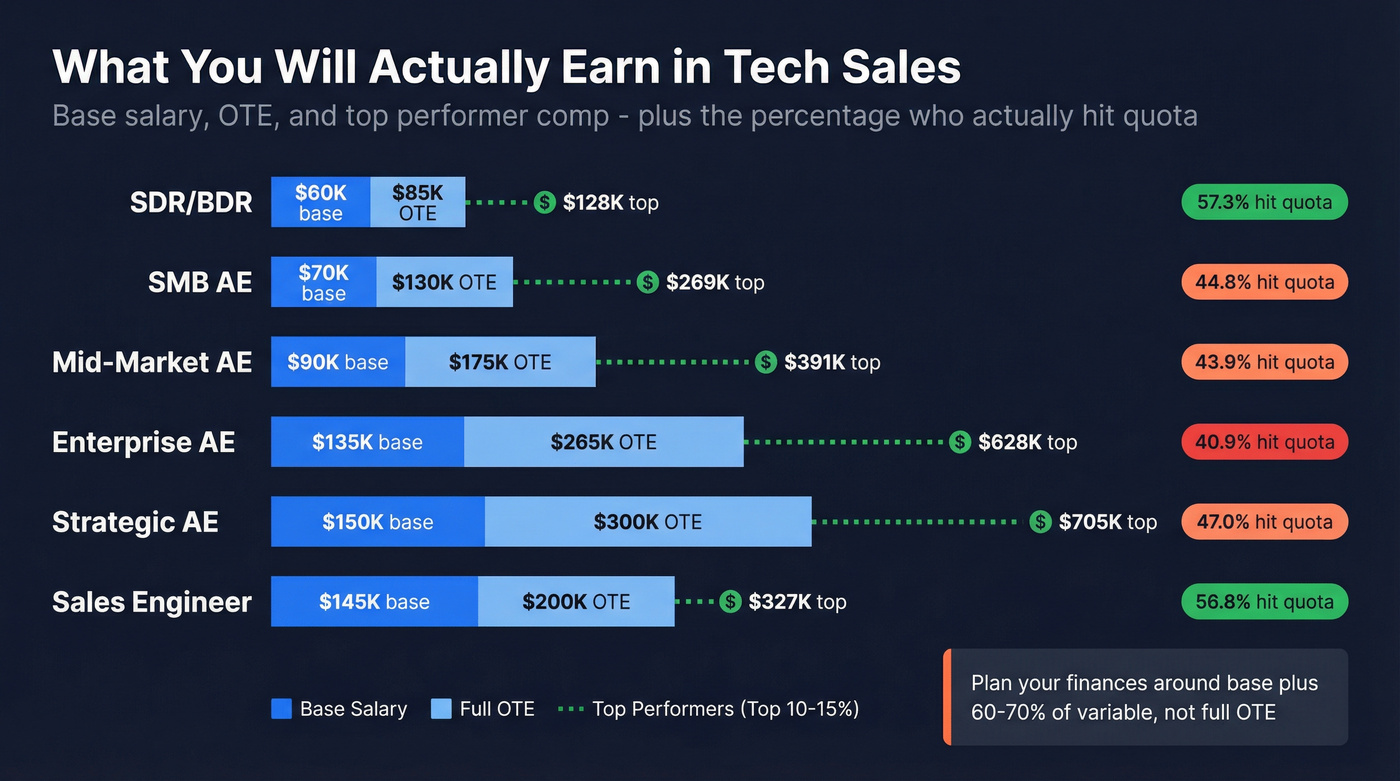
| Role | Base | OTE | Top Performers | % Hitting Quota |
|---|---|---|---|---|
| SDR/BDR | $60K | $85K | $127,955 | 57.3% |
| SMB AE | $70K | $130K | $269,489 | 44.8% |
| Mid-Market AE | $90K | $175K | $391,399 | 43.9% |
| Enterprise AE | $135K | $265K | $627,527 | 40.9% |
| Strategic AE | $150K | $300K | $705,215 | 47.0% |
| Sales Engineer | $145K | $200K | $327,388 | 56.8% |
Cross-reference with Glassdoor: SDR median total pay is $102K across 10,000+ submissions, and AE median total pay is $124K across 173,000+ submissions. Glassdoor is cross-industry, while RepVue is SaaS-focused - so use RepVue for SaaS benchmarks and Glassdoor for broad market context.
Now, the base/variable split - because this trips up every newcomer. Most tech sales comp uses a percentage split, typically 50/50 for AEs and 60/40 or 70/30 for SDRs. That means an SDR with $85K OTE has roughly $60K guaranteed and $25K tied to hitting quota. An enterprise AE at $265K OTE has about $135K base and $130K variable.
Here's the thing most guides won't say plainly: fewer than half of AEs hit full OTE. Look at those quota attainment numbers again. At the enterprise level, 40.9% of reps hit their number. The majority earn somewhere between their base and their OTE - not above it. The top performer numbers are real, but they represent the top 10-15% of the distribution. Plan your finances around base salary plus 60-70% of variable, not full OTE.
The Career Ladder
SDR to AE (The Main Path)
The standard progression: spend 12-18 months as an SDR, hit 90%+ quota for two consecutive quarters, and build your case for promotion. High performers make the jump in 10-12 months. The key metric isn't just quota attainment - it's the quality of meetings you set and whether AEs actually want to work with you.
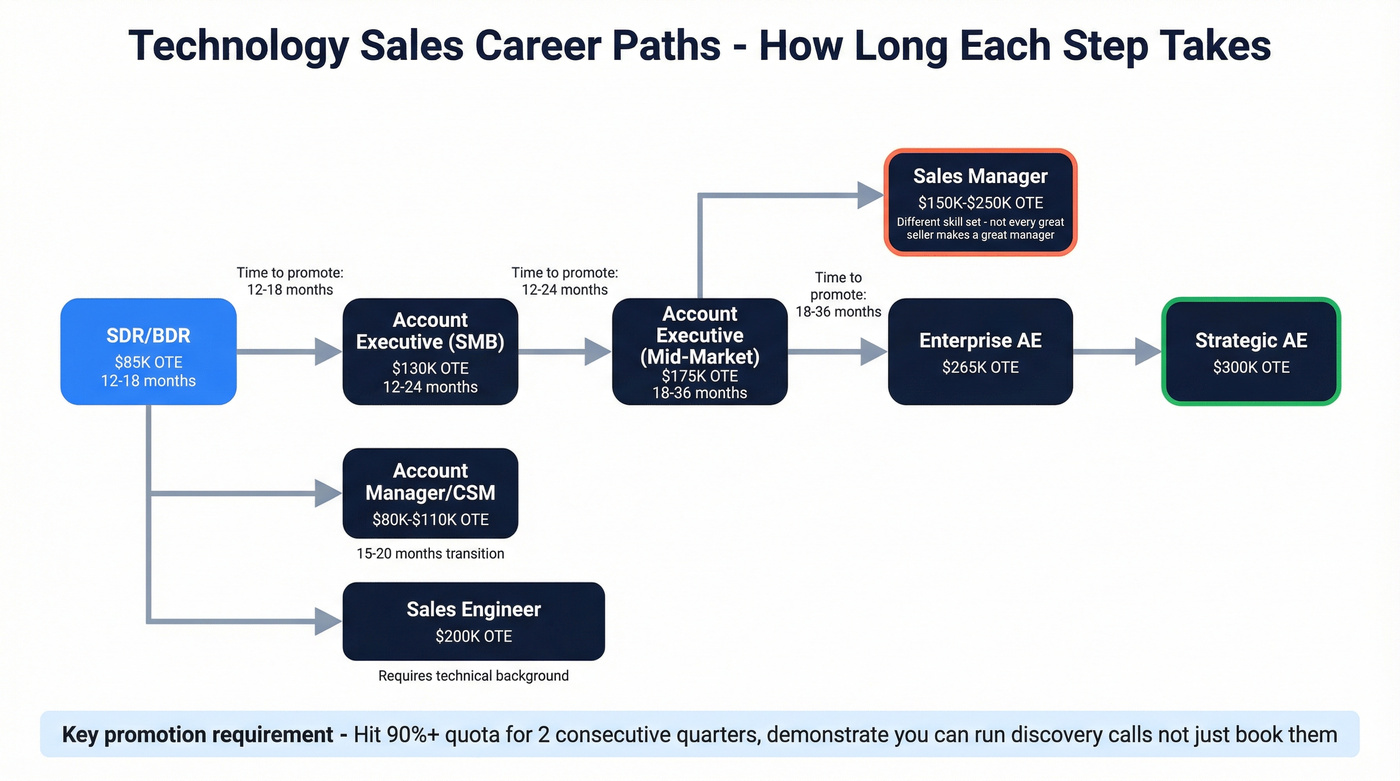
The AE promotion isn't automatic. You'll need to demonstrate that you can run a discovery call, not just book one. Most companies require you to shadow AE calls, pass an internal certification, and sometimes interview for the role like an external candidate. Strong SDRs get stuck when they never invest time in learning the closing side of the business.
The r/sales community has a saying for this: "Book meetings like an SDR, think like an AE." The reps who get promoted fastest are the ones who study the deals they source - what happened after the meeting, why it closed or didn't, what the AE did differently. That curiosity is what hiring managers look for.
Alternative Exits
Not everyone wants to be an AE, and that's fine.
SDR to Customer Success Manager takes 15-20 months. Total comp ranges from $80K-$110K. You'll manage a book of existing accounts, run QBRs, and focus on retention and expansion. Lower stress than closing roles, more predictable income, but the ceiling is lower too.
SDR to Revenue Operations takes 18-24 months and usually requires developing skills in Salesforce administration, data analysis, and process design. Comp ranges from $90K-$130K total. RevOps is one of the fastest-growing functions in SaaS, and the demand for people who understand both the sales process and the technical infrastructure behind it is strong.
SDR to Sales Management usually goes through AE first. You'll need 3-5 years of closing experience and a track record of consistent quota attainment before most companies will consider you for a frontline manager role. The exception: some high-growth startups promote top SDRs directly into SDR management roles, which is a faster path to leadership but skips the closing experience that makes managers credible.
Skills That Get You Promoted
Forget the generic "communication and teamwork" advice.
54% of employers rank problem-solving as their top hiring priority. In sales, this means diagnosing a prospect's real problem - not just the one they tell you about - and mapping your product to it. The next most valued skill is the ability to learn new tools quickly, at 44%. You'll touch 8-12 tools in your first year, and the rep who figures out Salesforce, Outreach, and a data provider in week one has a structural advantage over the rep still fumbling with filters in month three.
Communication comes in at 43%, but "communication" in sales means something specific: the ability to ask sharp questions, listen actively, and articulate value in the prospect's language, not yours. Pair that with technical literacy - you don't need to code, but you need to understand APIs, integrations, and product architecture at a surface level. When a prospect asks "does this integrate with our Snowflake instance?" you need to know what that means.
Two more skills that rarely appear on job postings but determine who gets promoted: data hygiene discipline and consultative selling methodology. Keeping your CRM clean, logging activities, and maintaining accurate pipeline data separates reps who advance from reps who get managed out. And learning MEDDIC or BANT gives you a structured way to qualify deals and avoid wasting time on prospects who'll never close.
How to Break In
The Honest Picture
Entry-level tech sales hiring is down 73% in European markets. Companies that used to hire 20 SDRs per quarter are hiring 5 and expecting them to be productive faster. You're competing against laid-off reps with real experience who are willing to take SDR seats to get back in the game.
"Just apply on job boards" isn't a strategy anymore. You need to differentiate.
Best Tech Sales Bootcamps
Bootcamps are the fastest path to credibility if you don't have sales experience. The ones with the strongest track records, per Course Report:
| Program | Rating | Reviews | Format | Notable Detail |
|---|---|---|---|---|
| Elevate | 4.75 | 163 | 10-week online | SDR-focused curriculum |
| SV Academy | 4.80 | 226 | 4-week FT / 8-week PT | Largest review base |
| Hyrise Academy | 4.96 | 25 | Online, self-paced | Free + job guarantee |
| Sales Platoon | 4.95 | 19 | 6-week + apprenticeship | Veteran-focused |
| Fuel Sales Academy | 4.45 | 22 | 8-week earn-while-learn | Teaches Outreach, Salesforce |
A bootcamp won't guarantee you a job, but it compresses months of self-teaching into weeks and gives you a credential hiring managers recognize. SV Academy and Elevate have the most reviews, which means the most hiring manager exposure. Hyrise is worth a look if budget is a constraint - free with a job guarantee is hard to beat, though the smaller review count means less market validation.
Other Entry Paths
The Salesforce SDR Professional Certificate on Coursera is a solid alternative if you can't commit to a full bootcamp. It won't carry the same weight as a placement-focused program, but it demonstrates initiative and CRM literacy.
Transferable experience matters more than most people realize. Retail, hospitality, and customer service roles build the exact muscles SDR work requires: handling rejection, managing high-volume interactions, and staying organized under pressure.
One move that sets you apart in interviews: build a sample prospect list for the company you're applying to. Use a free prospecting tool to pull together a targeted list of 20-30 prospects, then walk into the interview with a prospecting plan, not just a resume. We've seen candidates land offers specifically because they demonstrated they understood the workflow before day one.
Tools Reps Use Every Day
Your employer will hand you a tech stack on your first day. Understanding what each tool does - and why it matters - gives you a head start.
| Category | Tool | Starting Price | Notes |
|---|---|---|---|
| CRM | Salesforce | $25/user/mo | Industry standard, steep learning curve |
| CRM | HubSpot | Free | Intuitive UI, Sales Hub from $20/user/mo |
| Engagement | Outreach | ~$100-150/user/mo | Sequences, calls, multi-channel |
| Engagement | Salesloft | ~$100-150/user/mo | Strong coaching features |
| Prospecting | Prospeo | Free (75 emails/mo) | 98% accuracy, $0.01/email on paid |
| Prospecting | ZoomInfo | ~$15K+/yr | Enterprise-grade, needs dedicated admin |
| Prospecting | Apollo | Free-$49/user/mo | Large database, lower email accuracy |
| Intelligence | Gong | ~$100-150/user/mo | Call recording and analysis |
CRM
Salesforce ($25-$300/user/month) and HubSpot (free CRM tier, Sales Hub from $20/user/month) dominate. You don't pick your CRM - your company does. But learning Salesforce basics before you start will save you weeks of ramp time. HubSpot is more intuitive out of the box; Salesforce is more powerful but has a steeper learning curve.
Sales Engagement
Outreach and Salesloft manage your email sequences, call tasks, and multi-channel cadences. These are the tools you'll live in daily as an SDR. They automate the repetitive parts of outreach so you can focus on personalization and live conversations.
Prospecting and Data
This is where most reps' workflows break down - and honestly, it's the part that frustrates us the most when we talk to new SDRs. Your CRM is only as good as the data in it. Bad emails mean bounced sequences, which mean burned domain reputation, which mean even your good emails start landing in spam. It's a death spiral that tanks productivity faster than anything else.
For individual reps, startups, and small teams, Prospeo covers 300M+ professional profiles with 98% email accuracy and a 7-day data refresh cycle. At $0.01 per email, the cost-to-accuracy tradeoff is strong compared to enterprise tools like ZoomInfo ($15K-$40K+/year) or Apollo (79% email accuracy on its free and lower tiers). The free tier gives you 75 verified emails per month - enough to build real prospect lists before you've even started your first SDR role.

Skip ZoomInfo unless your company is paying for it. It's built for enterprise teams with dedicated admins, and the pricing reflects that.
Conversation Intelligence
Gong records and analyzes your sales calls. It's invaluable for coaching - your manager can review calls, flag patterns, and help you improve without sitting in on every meeting. As a new rep, Gong recordings of top performers are the fastest way to learn what good sounds like.
Skip the Tool Sprawl
More tools don't equal better results. One poster on r/techsales captured it perfectly - 19% open rates, 2.3% reply rates, and the feeling of "fighting with the tech" instead of it helping. The consensus across r/sales is consistent: a clean, tight stack with accurate data beats twelve tools fed with garbage contacts. Start with CRM + engagement platform + one good data provider. Add tools only when you've maxed out what those three can do.
If you want a tighter day-one stack, start with SDR tools and a few sales prospecting techniques that still work when hiring is tight.
Enterprise AEs closing $265K+ OTE deals can't afford to chase wrong numbers. Prospeo's 30% mobile pickup rate and 7-day data refresh mean you're always reaching real decision-makers - CISOs, VPs, CFOs - with current info.
Teams using Prospeo book 26% more meetings than ZoomInfo users. See why.
FAQ
Do you need a degree for tech sales?
No. Most SDR roles don't require one - bootcamps, certifications like the Salesforce SDR Professional Certificate, and transferable experience from customer-facing roles are sufficient. Employers prioritize problem-solving ability (54%) and communication skills (43%) over credentials.
What does OTE mean?
On-Target Earnings: your total expected compensation if you hit 100% of quota. Fewer than half of AEs hit full OTE in most organizations. Plan your budget around base plus 60-70% of variable, not the full number.
How long does the SDR-to-AE promotion take?
Typically 12-18 months; high performers make the jump in 10-12. The benchmark is hitting 90%+ quota for two consecutive quarters while demonstrating you can run discovery calls, not just book them.
How do you break into tech sales with no experience?
The fastest path is a sales bootcamp like SV Academy or Elevate combined with a free CRM certification. Target SDR roles at mid-stage startups where hiring managers value hustle over pedigree. Build a sample prospect list before your interview - showing you understand the workflow carries more weight than any resume bullet.
What's the best free prospecting tool for new reps?
Prospeo offers 75 verified emails per month free with 98% accuracy - enough to practice building prospect lists before your first day. Pair it with HubSpot's free CRM and a sequencing tool and you've got a functional technology sales stack at zero cost.