

Telemarketing Appointment Setting: The 2026 Playbook
80% of B2B sales interactions now happen in digital channels. And yet, the phone still books more qualified meetings per hour than any other single channel. Telemarketing appointment setting remains the highest-leverage activity in most B2B pipelines - but only when the fundamentals are right. The average cold call success rate sits at 4.8%, and the average conversion rate is just 2.23%. Most teams never beat those numbers.
Here's how to double them.
Why the Phone Still Works
A phone conversation creates a two-way exchange that no email sequence can replicate. You hear hesitation, curiosity, objections - and you respond in real time. That feedback loop is irreplaceable.
The numbers aren't glamorous. A 4.8% success rate means 95 out of 100 dials don't convert. Tech companies often run closer to 1%; professional services can push past 5% and occasionally hit 12%+. But those averages include every team dialing from a stale spreadsheet with no script and no follow-up cadence. A disciplined operation with verified data, a tested talk track, and multi-channel persistence can double or triple the average.
Here's the thing: if your average deal size is under $10K, you probably don't need outsourced appointment setting or a fancy parallel dialer. You need two hungry SDRs, verified phone numbers, and the scripts in this article.
What Appointment Setting Actually Is
This isn't about closing deals on the phone. It's about confirming fit, sparking curiosity, and earning the next step - a scheduled meeting between the prospect and a closer.
The appointment setter qualifies; the AE sells. The goal is to confirm the prospect matches your ICP, surface enough interest to justify a meeting, and get a calendar invite accepted. No pricing discussions, no product demos, no closing. In the sales process, appointment setting is the bridge that turns a name on a list into a human sitting across from your AE.
When it doesn't work, it's usually a data problem - not a script problem.
Benchmarks Before You Dial
You can't improve what you don't measure. Set baselines for these metrics before your team makes a single outbound call.
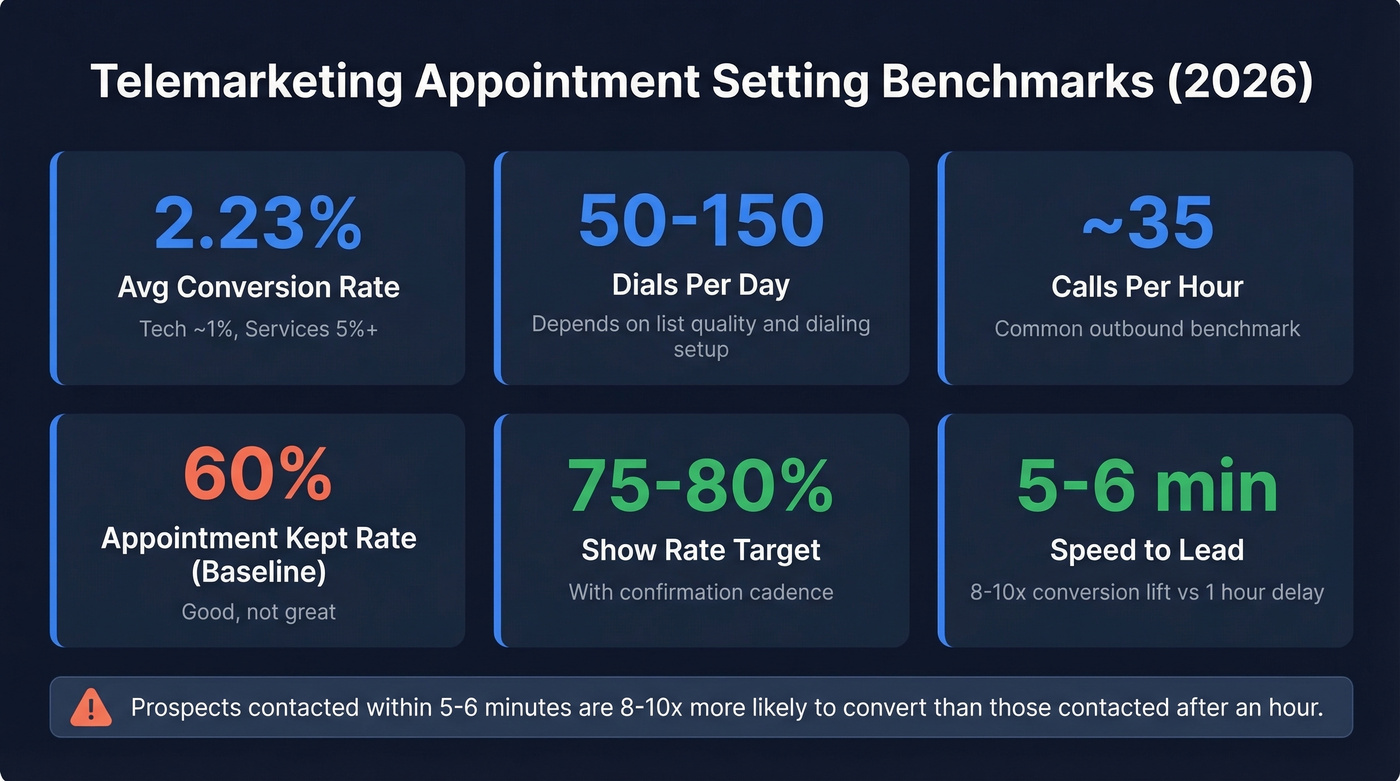
| Metric | Benchmark | Notes |
|---|---|---|
| Conversion rate | 2-5% (avg 2.23%) | Tech ~1%, services 5%+ |
| Dials per day | 50-150 | Depends on list quality, call length, and dialing setup |
| Calls per hour | ~35 | Common outbound benchmark |
| Appointment kept rate | 60% baseline | Good, not great |
| Show rate target | 75-80% | With confirmation cadence |
| Speed to lead | 5-6 minutes | 8-10x conversion lift |
The speed-to-lead stat deserves its own emphasis. Prospects contacted within 5-6 minutes of showing intent are 8-10x more likely to convert than those contacted after an hour. If your team is batching callbacks, you're leaving meetings on the table.
Industry matters enormously. A team selling cybersecurity SaaS to mid-market should expect 1-2%. A consulting firm targeting professional services can realistically target 5%+. Set your benchmarks accordingly.
The Appointment-Setting Process
Each step matters, but the first one matters most.
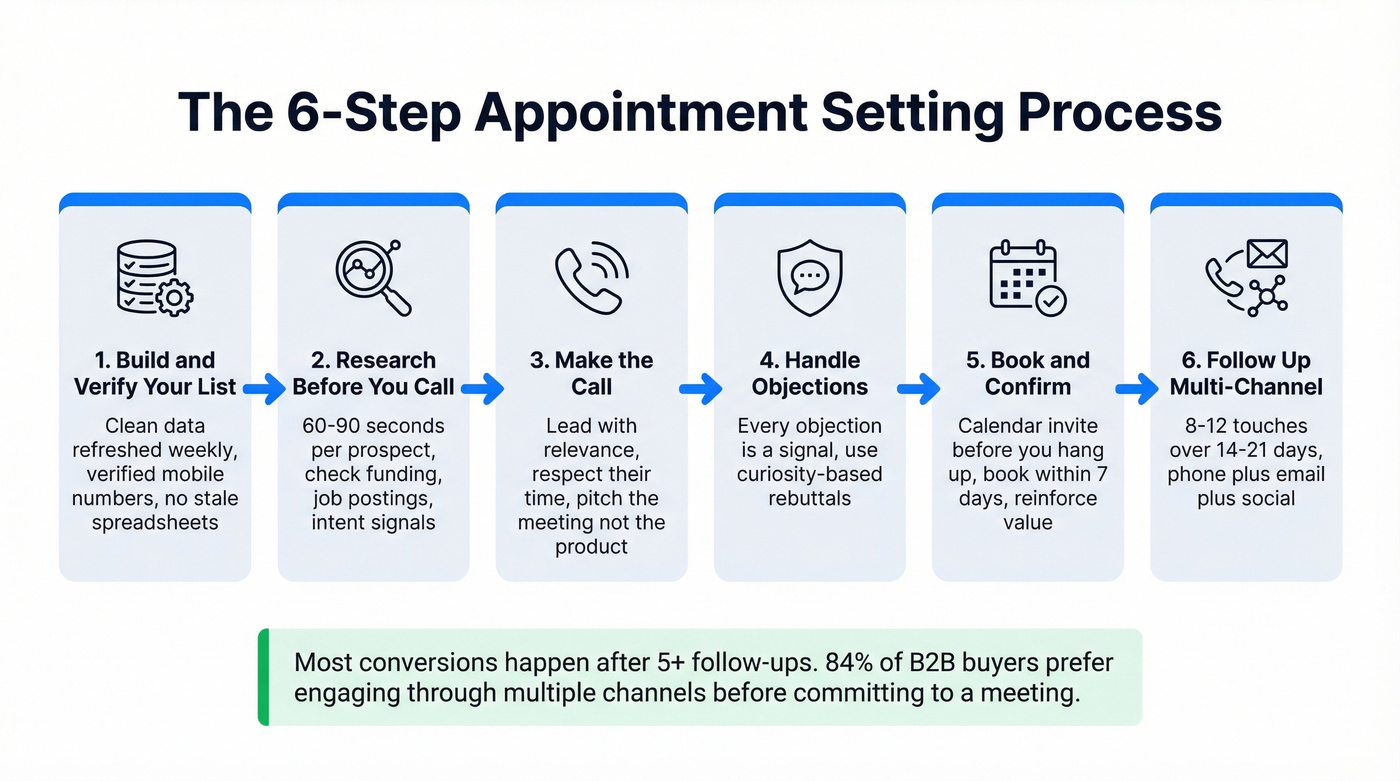
Build and Verify Your List
Bad data is the silent killer of appointment-setting campaigns. Every disconnected number wastes rep time and chips away at morale. Multiply that across 100 dials a day and you've lost momentum before lunch.
We've seen teams burn entire weeks dialing numbers that haven't been verified in months. A B2B data platform with a fast refresh cycle fixes this - Prospeo, for example, refreshes records every 7 days (the industry average is 6 weeks) and carries 125M+ verified mobile numbers with a 30% pickup rate. That kind of data quality is the difference between a productive calling day and a demoralizing one.

Research Before You Call
A cold call doesn't have to be blind. Spend 60-90 seconds per prospect before dialing: recent funding rounds, leadership changes, job postings that signal pain, or intent signals showing they're actively researching your category.
Intent data platforms can flag accounts actively researching your category, so you prioritize warm accounts over cold alphabetical lists. The difference between calling someone who's in-market and someone who isn't is the difference between a 2% and a 6% conversion rate.
Make the Call
Scripts are below - but the principle is simple. Respect the prospect's time, lead with relevance, and earn the right to keep talking. "I've got 30 seconds of context - if it's not relevant, I'll hang up" works because it gives the prospect control. Don't pitch the product. Pitch the meeting.
Handle Objections
Every objection is a signal, not a rejection. "I'm too busy" means "you haven't earned my attention yet." See the full objection playbook below.
Book and Confirm
When you get the yes, lock it down:
- Send a calendar invite before you hang up - not after lunch, not tomorrow
- Book within 7 days; distant meetings have terrible show rates
- Reinforce the WIIFM in your confirmation: "Here's what we'll cover and why it's worth 15 minutes of your Tuesday"
Follow Up Multi-Channel
One call isn't a campaign. 84% of B2B buyers prefer engaging through multiple channels before committing to a meeting. Build a cadence of 8-12 touches over 14-21 days across phone, email, and social.
Most conversions happen after 5+ follow-ups. The reps who give up after two calls are leaving the majority of their meetings on the table.
Scripts You Can Steal
We've tested all three of these frameworks across SaaS and services campaigns. They're adapted from practitioner-shared scripts on r/sales and proven cold-calling frameworks. Customize the bracketed fields for your business.
The Consultation Offer
"Hi [Name], this is [Your Name] from [Company]. We've been selected by more than [number] companies to help with [outcome]. Is this a bad moment?"
[If busy]: "That's fine - we offer a complimentary [consultation/audit] to see if there's a fit. Is there an email I can send our information to?"
[Budget qualifier]: "Our base engagement starts at [price]. Is that in your range?"
[Close]: "Would Tuesday at 2 work for a quick 15-minute call? I'll send a calendar invite right now."
The consensus on r/sales is that "Is this a bad moment?" works when delivered with confidence, not apology. If it feels unnatural to you, swap it for "Did I catch you at a decent time?" or skip it entirely and lead with your value statement.
The 3-Minute Pitch
"Hi [Name], this is [Your Name] with [Company]. In just three minutes, I can share how we help businesses like yours [achieve outcome]. Does that sound fair?"
[If yes]: "Great. Most [job titles] we talk to are dealing with [pain point]. How are you currently handling that?"
[Pivot to meeting]: "Based on what you're describing, I think a 15-minute deep-dive would be worth your time. Does Thursday afternoon work?"
The time-box is the key move. "Three minutes" feels low-risk. Once they say yes, you've earned permission to have a real conversation.
The Gatekeeper Script
"Hi, I need to speak with whoever handles [department/function] at [Company]. Can you transfer me, or share their direct line?"
[If asked what it's regarding]: "I need to send some information about [relevant topic] to the right person. Who would that be?"
Don't pitch the gatekeeper. Don't over-explain. Treat it like a logistics question.

Bad numbers kill appointment-setting campaigns before they start. Prospeo's 125M+ verified mobile numbers refresh every 7 days - not every 6 weeks - so your SDRs dial live prospects, not voicemail graveyards. At $0.01 per lead, you get enterprise-grade data without the enterprise contract.
Turn every dial into a real conversation. Start with data that picks up.
Objection Handling Playbook
The goal is curiosity and fit, not a close. These rebuttals are designed for setting appointments, not closing deals - the distinction matters.
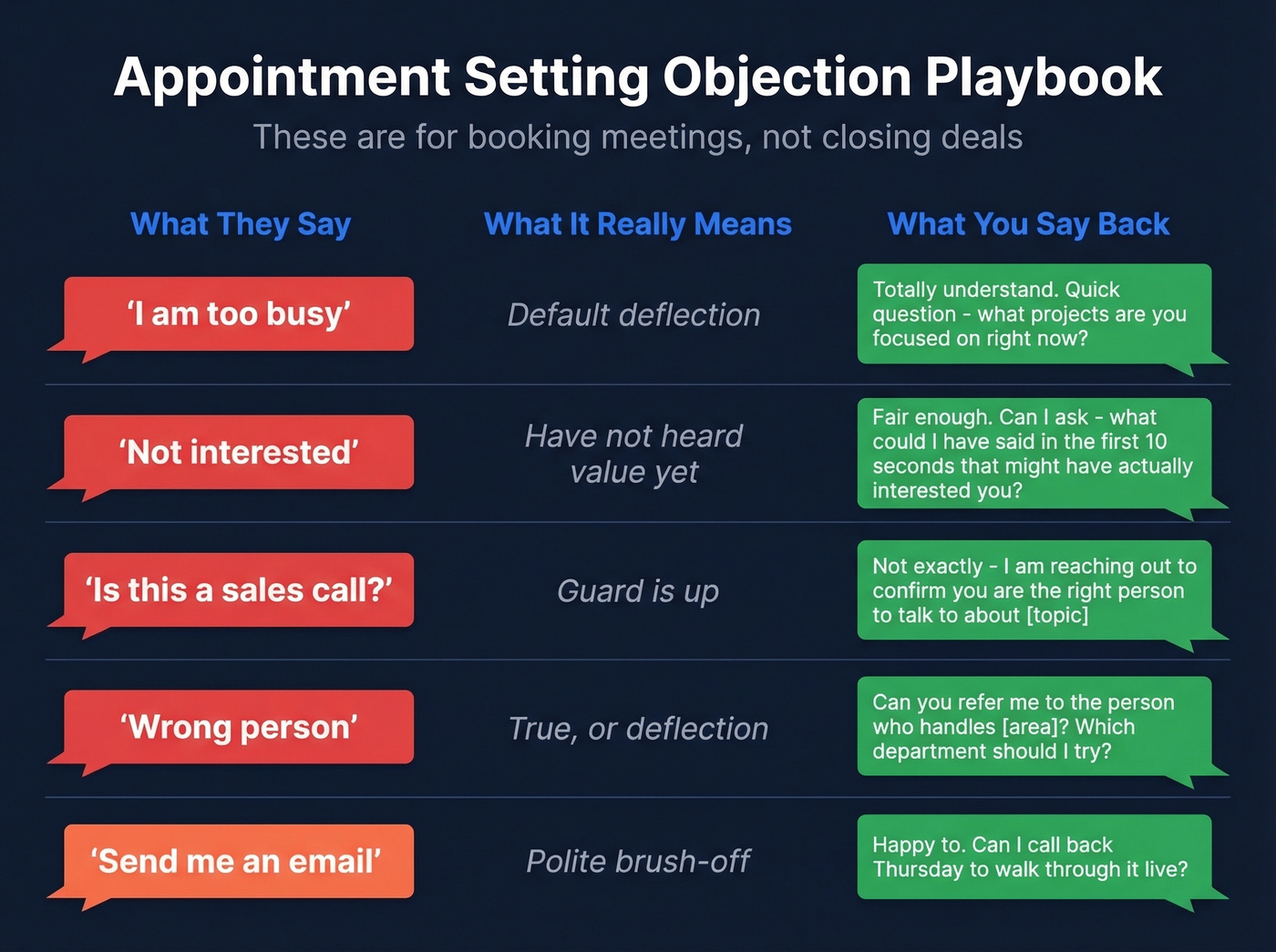
| Objection | Why They Say It | Your Response |
|---|---|---|
| "I'm too busy" | Default deflection | "Totally understand. Quick question - what projects are you focused on right now?" |
| "Not interested" | Haven't heard value yet | "Fair enough. Can I ask - what could I have said in the first 10 seconds that might've actually interested you?" |
| "Is this a sales call?" | Guard is up | "Not exactly - I'm reaching out to confirm you're the right person to talk to about [topic]." |
| "Wrong person" | True, or deflection | "Can you refer me to the person who handles [area]? Which department should I try?" |
| "Send me an email" | Polite brush-off | "Happy to. Can I call back Thursday to walk through it live?" |
The "not interested" rebuttal is counterintuitive but effective. Asking for feedback disarms the prospect and sometimes reopens the conversation entirely.
Reducing No-Shows
A set appointment that doesn't show is worse than no appointment at all - it wastes your AE's time and creates false pipeline. Here's how to push from a 60% kept rate to 75-80%.
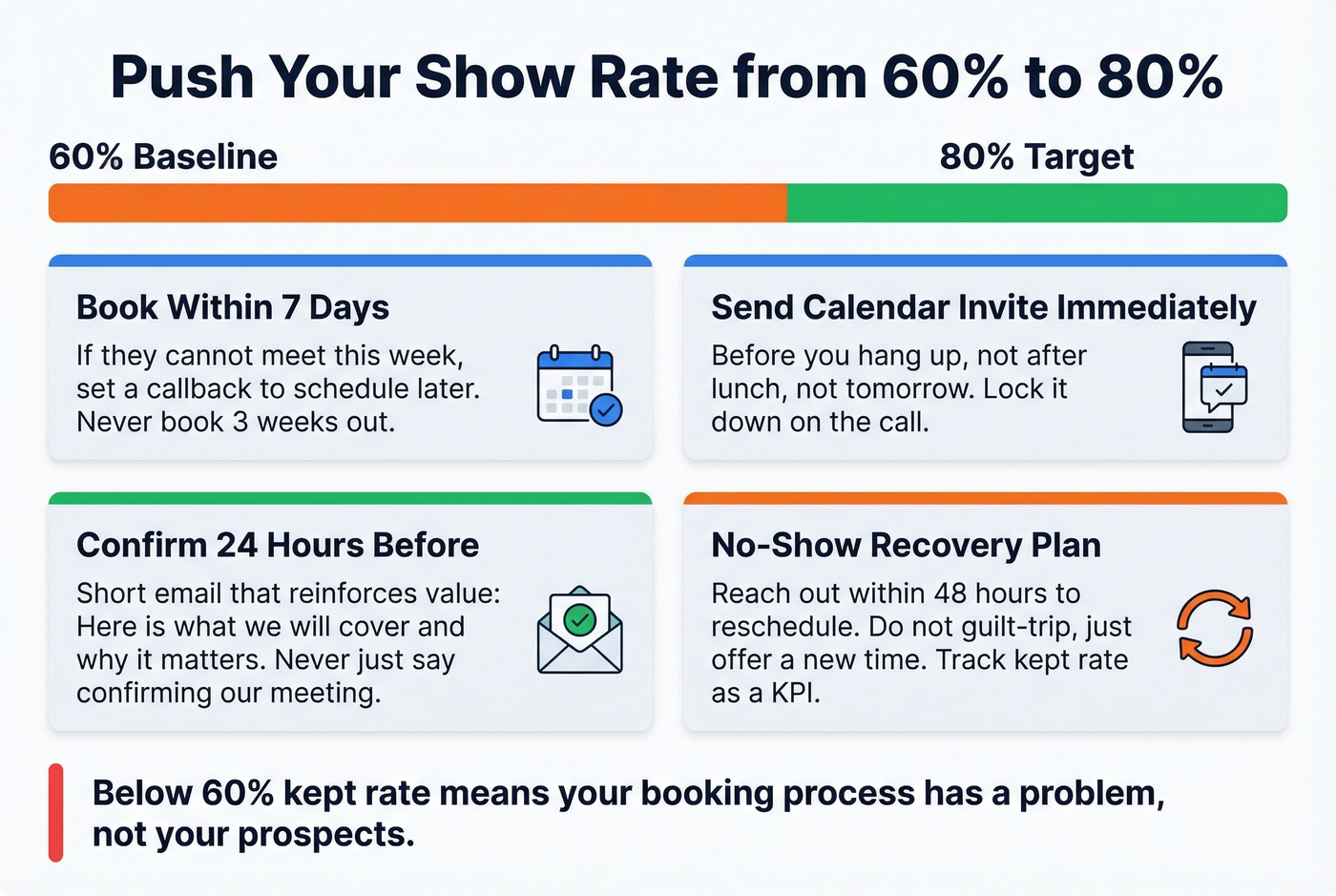
Book within 7 days. If the prospect can't meet this week, set a callback to schedule later rather than booking 3 weeks out. Send a calendar invite immediately - before you hang up. Confirm 24 hours before with a short email that reinforces value: "Looking forward to tomorrow at 2. Here's what we'll cover: how [similar company] cut [metric] by [number]."
Don't just say "confirming our meeting." Every touchpoint should remind the prospect why they said yes in the first place.
Have a no-show recovery plan. Reach out within 48 hours to reschedule - don't guilt-trip, just offer a new time. And track your kept rate as a KPI. Below 60% means your booking process has a problem, not your prospects.
Dialing down no-shows is one of the fastest ways to improve ROI on your appointment-setting campaigns without increasing dial volume.
TCPA and DNC Compliance
Compliance isn't optional. TCPA violations run $500 per call, up to $1,500 for willful violations. One bad campaign can cost more than your entire annual data budget. Here's the compliance checklist:
- Calling windows: 8 a.m. to 9 p.m. in the recipient's local time zone. No exceptions.
- DNC scrubbing: Scrub your list against the National Do Not Call Registry every 31 days minimum. Federal fines can reach $50,120 per illegal call.
- Prior Express Written Consent: Required for autodialed or prerecorded calls to mobile phones - even in B2B. An existing business relationship isn't a substitute.
- Manual dialing distinction: Manual calls to business landlines have fewer restrictions, but DNC scrubbing still applies.
- AI voice disclosure: If you're using AI-generated or synthetic voices, the FCC requires disclosure and consent under the same rules as prerecorded calls.
- State-level rules: Florida, Oklahoma, Indiana, North Dakota, Louisiana, and Washington have stricter requirements than federal law.
- TCPA vs. TSR: The TCPA allows private right of action - individuals can sue you directly. The TSR is enforced by the government. You need to comply with both.
The safest approach is manual dialing to verified business numbers with proper DNC scrubbing. Autodialing to mobiles without written consent is where most teams get burned.
Outsource or Build In-House?
Outsourcing Costs
| Model | Cost Range | Best For |
|---|---|---|
| Hourly | ~$16/hr | Testing a new market |
| Per appointment | $75-$500/meeting | Performance alignment |
| Subscription | $2K-$4.5K/mo | Predictable pipeline |
| Retainer | $2K-$5K/mo | Dedicated team access |
| Cost per qualified appt | $550-$1,700 | Enterprise/mid-market |
Year-one economics are brutal. For mid-market and enterprise B2B, expect $3,000-$5,000 per meeting booked in the first year. That drops to ~$2,000 in year two, ~$1,000 in year three, and can eventually reach ~$250 as the agency optimizes.
When to Outsource vs. Build
For teams with average contract values below $15K, build in-house first. The economics of outsourcing don't pencil out when your deal size can't absorb $550-$1,700 per qualified meeting. Hire one or two SDRs, give them verified data and the scripts from this playbook, and iterate.
Skip outsourcing entirely if you haven't validated your messaging and ICP yet - you'll be paying premium rates for an agency to run experiments you should be running yourself.
Outsourcing makes sense when you've nailed your talk track but need to scale faster than you can hire. If you go pay-per-appointment, define "qualified meeting" with surgical precision. Otherwise you'll get calendar fills that waste your AEs' time.
The Data Quality Problem
Every section of this playbook assumes your reps are dialing real numbers that reach real people. If they aren't, nothing else matters.
Lists go stale fast. In our experience, teams that refresh data monthly still see 15-20% of their numbers go dead between refreshes. That's a full day of wasted dials every week. GreyScout cut rep ramp time from 8-10 weeks to 4 weeks after switching to verified data with a weekly refresh cycle - that's the kind of impact clean data has on a telemarketing appointment setting operation.
The free tier at Prospeo gives you 75 emails and 100 Chrome extension credits per month, which is enough to test data quality before committing a dollar. At ~$0.01 per email, verified data costs pennies. A single TCPA violation costs $500.
If you want a repeatable outbound motion, start with a cold calling system and treat list hygiene like a daily habit, not a quarterly project.
Your reps make 100+ dials a day. Every disconnected number wastes 30 seconds of momentum and morale. Prospeo delivers a 30% mobile pickup rate - nearly 3x the industry average - because every number passes 5-step verification before it reaches your dialer.
Triple your connect rate and double your booked meetings this quarter.
FAQ
How many dials does it take to set one appointment?
At a 2.23% average conversion rate, expect roughly 45 dials per appointment. Top teams with verified data and a tested script target 25-30. The variance comes down to list quality and whether you're reaching decision-makers directly.
What's a good show rate for booked meetings?
60% is the baseline - anything below that signals a process problem. Aim for 75-80% by booking within 7 days, sending an immediate calendar invite, and confirming 24 hours before with a value-reinforcing message.
How much does outsourced appointment setting cost?
It ranges from $75-$500 per appointment on a pay-per-meeting model to $2,000-$4,500/month on subscription. The average cost per qualified B2B appointment runs $550-$1,700. Year-one costs for mid-market campaigns can hit $3,000-$5,000 per meeting before optimization brings that down.
Do TCPA rules apply to B2B cold calls?
Yes. TCPA applies to calls to mobile phones regardless of B2B context. Autodialed or prerecorded calls to mobiles require prior express written consent. Manual dialing to business landlines has fewer restrictions, but DNC scrubbing every 31 days is mandatory. Penalties run $500-$1,500 per violation.
What's the best way to build a calling list?
Use a B2B data platform with verified mobile numbers and a fast refresh cycle. Layer in intent data and technographic filters so your reps aren't just dialing by job title and industry - they're calling people whose companies are actively in-market for what you sell.