

The Data City vs Apollo.io: Different Tools, Different Jobs
Comparing The Data City to Apollo.io is like comparing a telescope to a rifle. One maps entire sectors of the economy; the other targets individual people so you can send them cold emails. They aren't in the same category, and knowing the difference saves you from buying the wrong tool.
30-Second Verdict
The Data City is a sector intelligence platform. It uses AI-powered Real-Time Industrial Classifications (RTICs) to map companies into 400+ emerging sectors - AdTech, Life Sciences, Advanced Manufacturing - replacing outdated SIC codes that haven't kept up with how industries actually work. Its buyers are policymakers, economists, and investors.
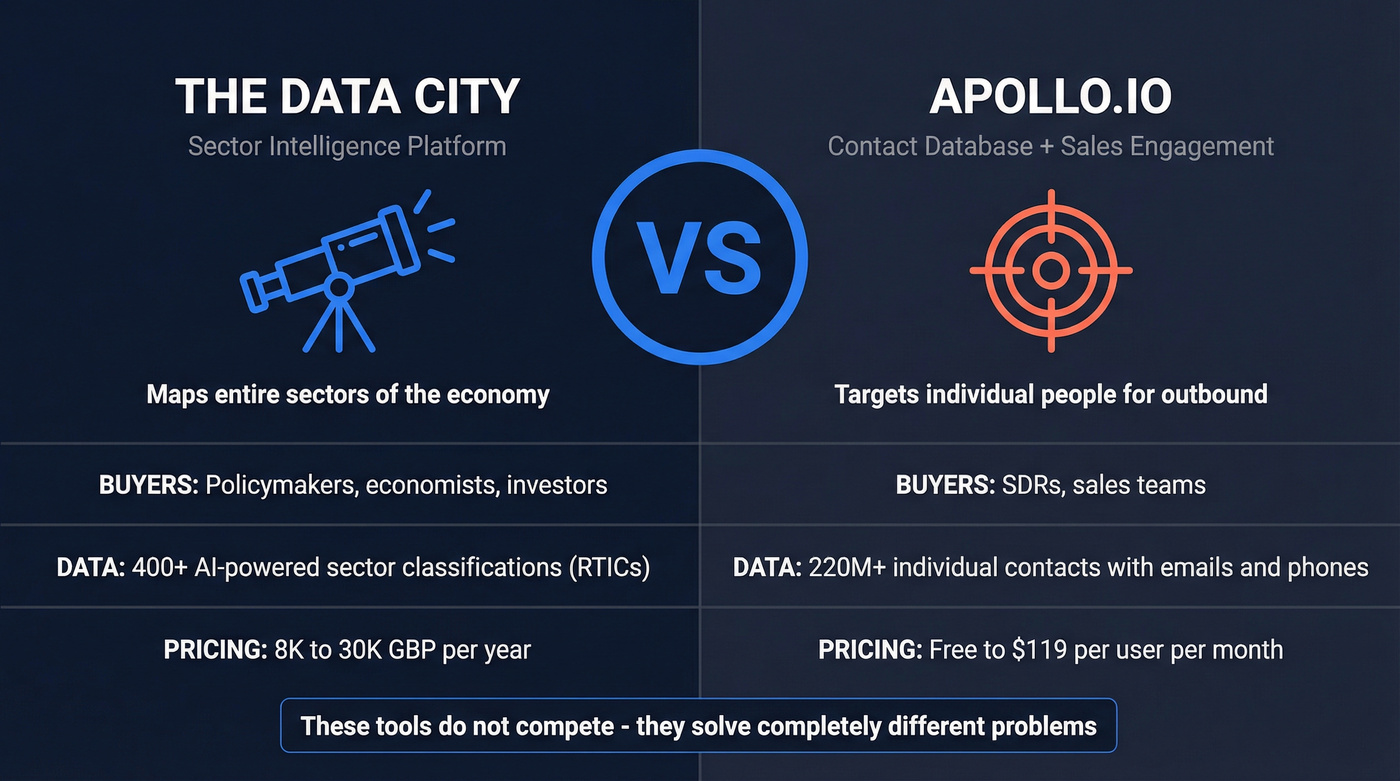
Apollo.io is a B2B contact database and sales engagement tool. It finds individual emails and phone numbers so SDRs can run outbound sequences. Its buyers are sales teams.
They don't compete. But if you landed here because you need better contact data - verified emails and direct dials - that's a different problem entirely, and we cover the best option for that below.
What Is The Data City?
The Data City builds what SIC codes should've been by now. Its RTICs classify companies based on what they actually do on the web, not what someone selected from a dropdown during company registration a decade ago. The UK government's own DSIT Innovation Clusters Map uses sectors based on The Data City's classification system because standard SIC codes can't accurately reflect emerging industries. That DSIT use case references around 49 RTICs.
Over 100 public sector organisations access the data.
The platform delivers 22+ data points per company via a RESTful JSON API. LYVA Labs integrated it into HubSpot for automated monthly enrichment, pulling in fields like female founder flags, Innovate UK grant status, and growth metrics. That's economic intelligence, not sales prospecting data. RTIC sponsorship - where you fund the creation of a new sector classification - runs £20,000-£25,000/year. Platform licences are tiered: Solo (1 seat) at £8,000/year, Team (5 seats) at £18,000/year, and Department (15 seats) at £30,000/year, with a 10% discount on multi-year commitments. API access is priced separately on a bespoke basis.
What Is Apollo.io?
Use Apollo if you're an SDR team that needs to build prospect lists fast, run multi-step email sequences from one platform, and you've got a process for verifying contacts before they hit your sequences. Apollo's 4.7/5 rating from 9,511 G2 reviews isn't an accident - the filters are genuinely good, and list-building is fast.
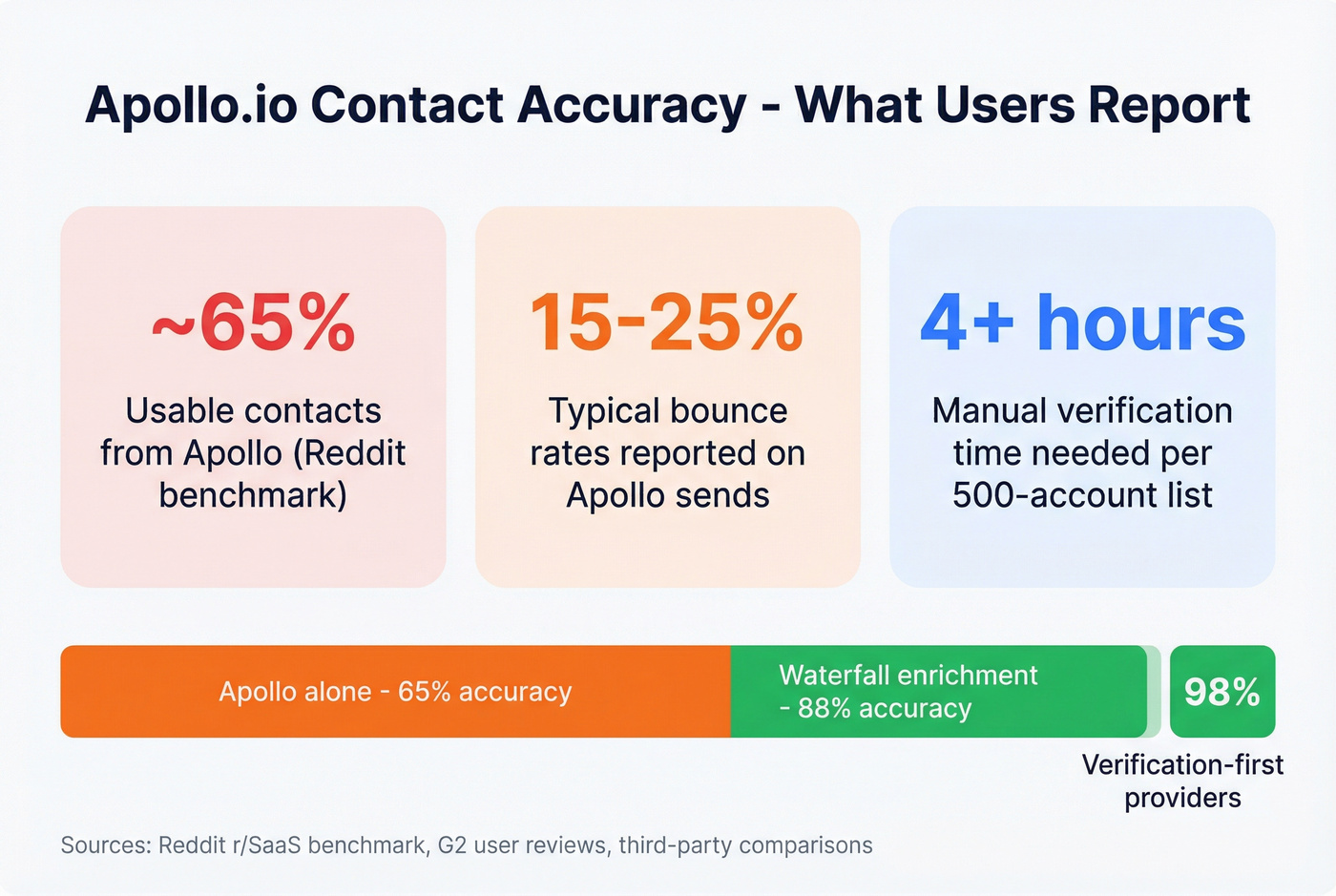
Skip Apollo if you can't tolerate a ~65% usable contact rate. A Reddit benchmark comparing Apollo, ZoomInfo, and waterfall enrichment found Apollo delivered roughly 65% good contacts - fast to build, but requiring 4+ hours of verification for a 500-account list. Third-party comparisons commonly cite 15-25% bounce rates on Apollo sends, and threads like "When did Apollo become unusable?" show the topic comes up frequently on r/sales and r/SaaS. Credits don't roll over between billing cycles, and paid plans run $49-$119/user/month with the Organization tier requiring a minimum of three seats.
For context, that same Reddit benchmark showed waterfall enrichment hitting 88% accuracy - better than Apollo alone, but still below what a dedicated verification-first provider can deliver.

Apollo's ~65% usable contact rate means 1 in 3 emails bounce or miss. Prospeo delivers 98% email accuracy across 300M+ profiles, refreshed every 7 days - not every 6 weeks. That's why teams like Snyk cut bounce rates from 35-40% to under 5% and grew AE-sourced pipeline 180%.
Stop verifying Apollo contacts for 4 hours - start with data that's already accurate.
Side-by-Side Comparison
| Dimension | The Data City | Apollo.io |
|---|---|---|
| Category | Sector intelligence | Contact database + sequences |
| Data type | Company-level sectors | Individual emails & phones |
| Core product | 400+ RTICs | 220M+ contacts + sequencing |
| API | RESTful JSON, 22+ data points/company | REST API, CRM integrations |
| Pricing | £8K-£30K/yr platform; £20K-£25K/yr RTIC sponsorship; API bespoke | Free-$119/user/mo |
| Accuracy | Gov-validated RTIC sectors | ~65% usable contacts (user benchmark) |
| Review footprint | Trustpilot: 1 review | 9,511 G2 reviews (4.7/5) |
| Best for | Economists, investors, policymakers | SDRs, outbound teams |
| Provides contacts? | No | Yes (with bounce-rate caveats) |
When to Use Which
Choose The Data City for mapping emerging sectors for economic development, building investment theses around sector growth, enriching CRM records with sector classifications and grant data, or running cluster analysis for regional innovation strategies. The DSIT use case remains the gold standard here.
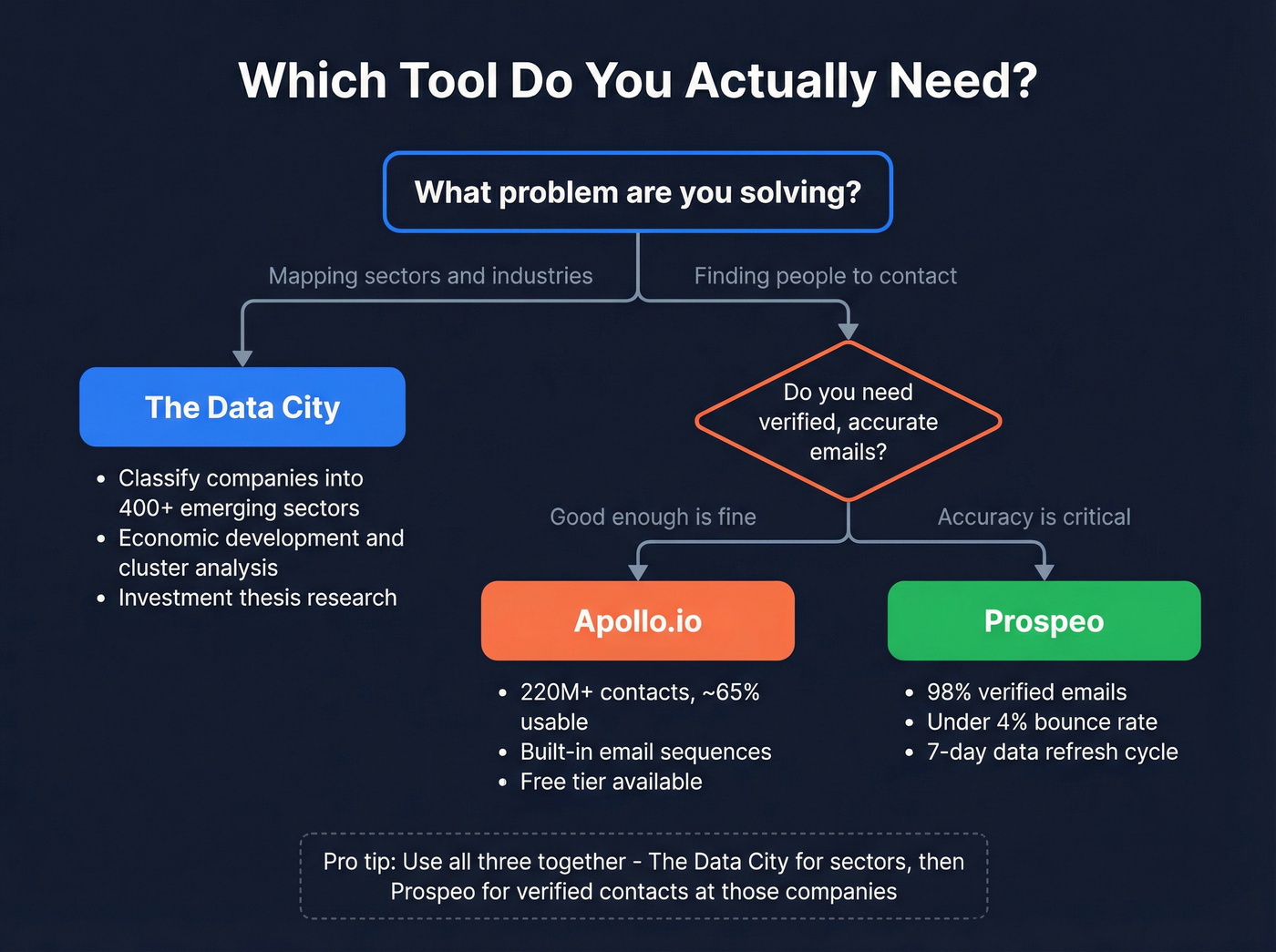
Choose Apollo for building outbound prospect lists by job title and company size, running cold email sequences at scale, or getting started on an SMB budget with a free tier.
Here's the thing: most people who search "The Data City vs Apollo.io" aren't actually comparing these two tools. They've confused sector intelligence with contact data. If what you really need is verified emails for decision-makers, neither of these is the right answer on its own.
Filling the Contact Data Gap
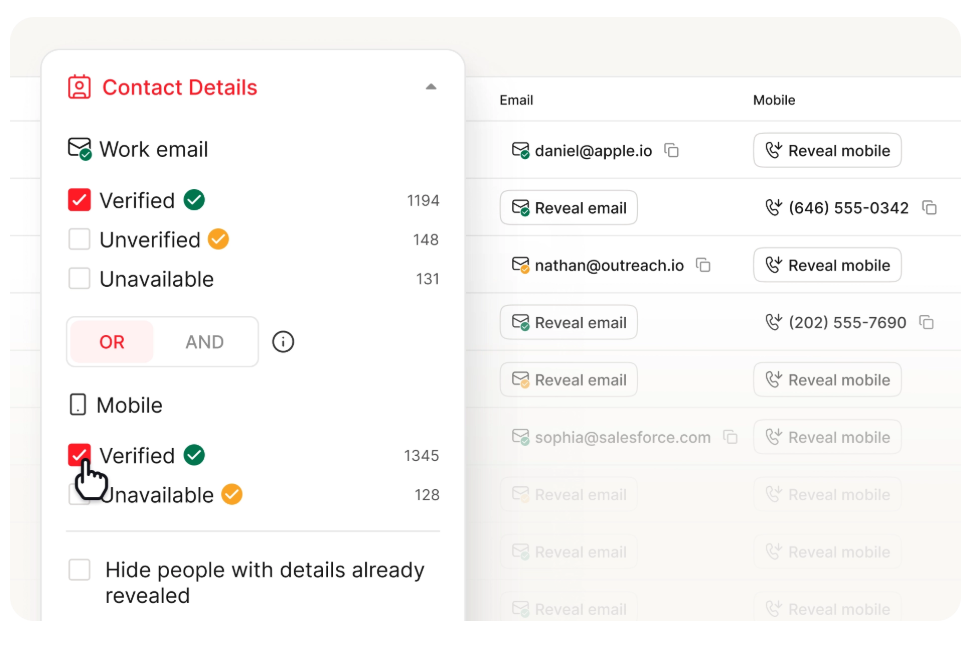
The Data City doesn't provide individual contacts. Apollo provides them at roughly 65% accuracy. We've tested the gap between Apollo and a verification-first provider, and it's stark - the difference compounds across every campaign you run.
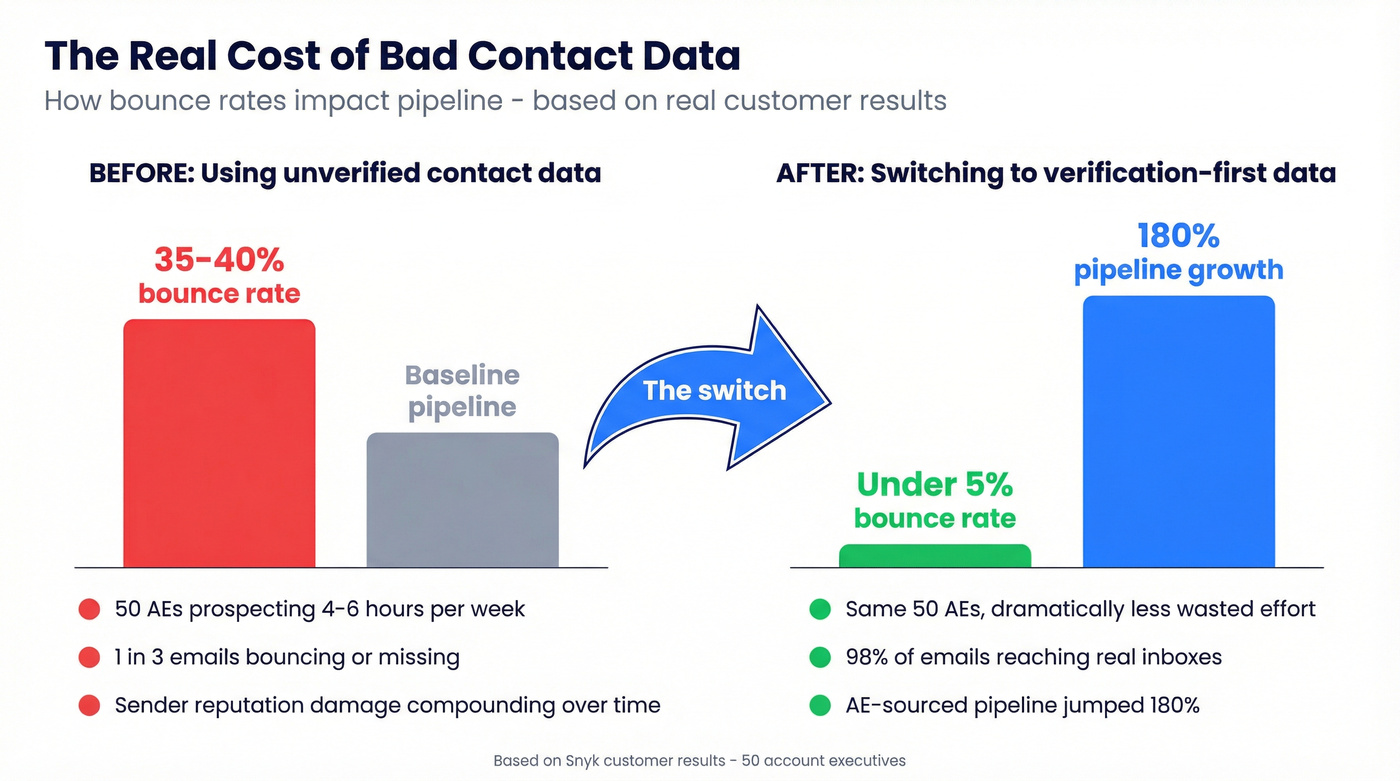
Let's be honest about what this looks like in practice: one of our customers, Snyk, had 50 AEs prospecting 4-6 hours per week. Their bounce rate dropped from 35-40% to under 5% after switching, and AE-sourced pipeline jumped 180%. That's not a marginal improvement.
The Data City maps sectors. Apollo builds lists. Neither solves the accuracy problem. Prospeo's 5-step verification and proprietary email infrastructure deliver under 4% bounce rates at $0.01/email - 90% cheaper than ZoomInfo with higher accuracy than both alternatives.
Bridge the gap between sector intelligence and contacts that actually connect.
FAQ
Can The Data City replace Apollo.io?
No. The Data City classifies companies into sectors using AI-powered RTICs - it doesn't provide email addresses or phone numbers. You'd use The Data City for sector mapping and a separate contact data tool for finding people at those companies.
Is Apollo.io accurate enough for outbound?
Users report roughly 65% usable contacts, and "data inaccuracy" is one of the most common complaints on G2. You'll need to verify contacts before sending sequences - or use a provider like Prospeo that delivers 98% verified emails on a 7-day refresh cycle, which means bounce rates under 4% instead of 15-25%.
Can I use The Data City and Apollo together?
Yes, though a verification layer improves results. Use The Data City's API to identify companies in emerging sectors, then use a contact data tool to find decision-makers at those companies. The Data City enriches your CRM with sector classifications while a separate tool handles contact discovery with verified emails and direct dials - giving you sector intelligence and accurate outreach data in one workflow.