

Time to Value: The Metric Nobody Measures Correctly (With Benchmarks)
Time to value (TTV) - the elapsed time between a user's first product interaction and their first meaningful outcome - averages 1 day, 12 hours, and 23 minutes across SaaS. Most teams don't know their own number. That's a problem, because shorter TTV correlates with lower churn, making it one of the highest-leverage metrics you can optimize.
Here's how to measure it correctly, with benchmarks and six patterns that compress the timeline.
The Quick Version
- Benchmark: Average SaaS TTV is 1d 12h 23m. Median is 1d 1h 54m.
- Track median, not averages. Validate your value event with a 30-day retention split - if users who hit it early don't retain better, you picked the wrong event.
- Under 30 minutes median TTV? You're ready for self-serve. Measured in days? You need guided onboarding. A reasonable first goal: cut your median by 30-50% within one quarter.
What TTV Actually Means
TTV is the elapsed time between a user's first interaction and the moment they experience a meaningful outcome. Teams fight about two things: when the clock starts and what counts as "value."
The clock-start debate is real. Some teams start at contract signature, others at first login, others at onboarding kickoff. The r/CustomerSuccess community confirms definitions are fuzzy and inconsistent across orgs - which means your internal alignment matters more than picking the "right" answer.
Then there's the value event itself. Onboarding completion isn't value. License activation isn't value. An observable outcome - first opportunity created in a CRM, first campaign delivered, first customer interaction resolved - that's value. Some frameworks break TTV into subtypes like immediate, short, long, basic, and full. These are useful for internal alignment, but the measurement method stays the same regardless. Pick the right value event first.

The article says CRM & Sales tools have the fastest TTV at 1d 4h. Prospeo beats that by orders of magnitude - sign up, apply 30+ filters, and export 98%-accurate emails in minutes. No onboarding calls, no implementation queue. Free tier, no contract.
Go from signup to your first verified contact list in under five minutes.
TTV Benchmarks: What Good Looks Like
By Industry
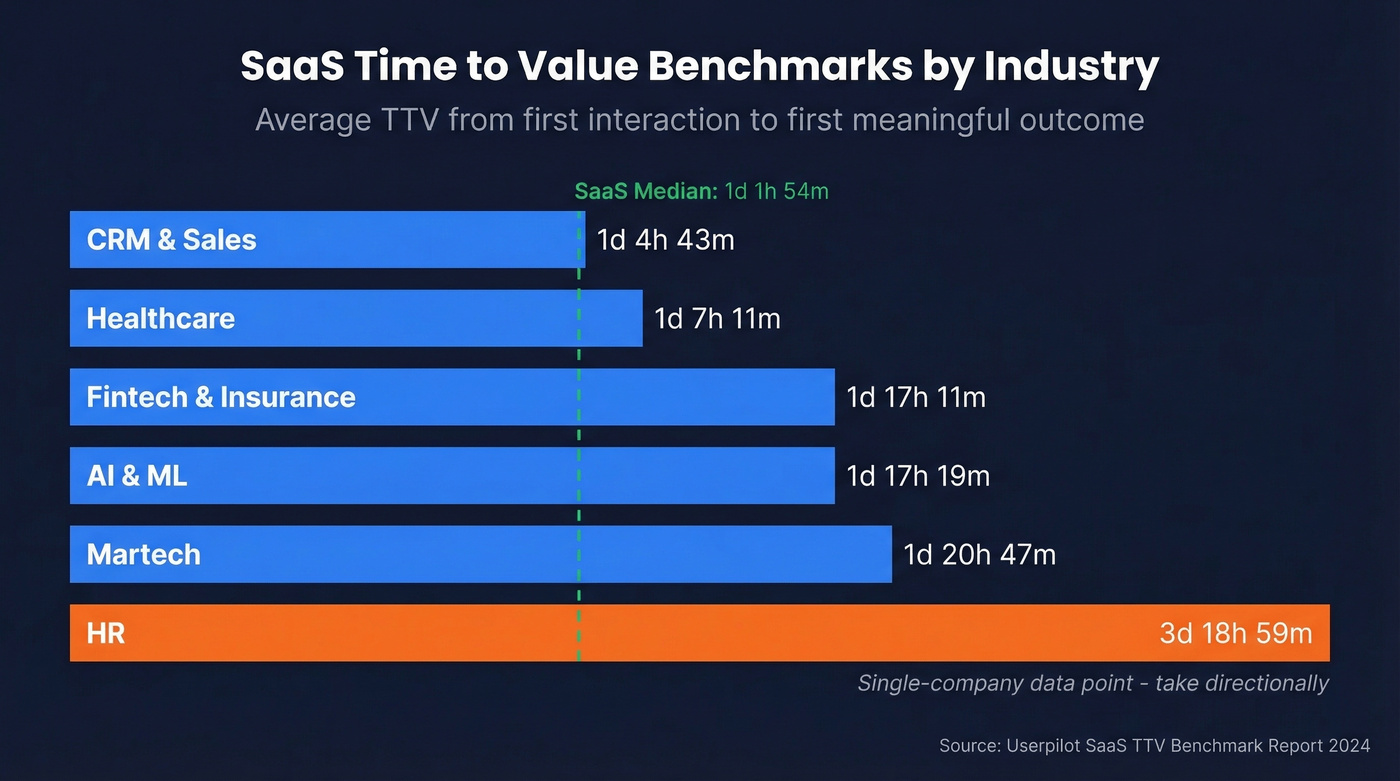
Based on Userpilot's SaaS TTV benchmark report:
| Industry | Average TTV |
|---|---|
| CRM & Sales | 1d 4h 43m |
| Healthcare | 1d 7h 11m |
| Fintech & Insurance | 1d 17h 11m |
| AI & ML | 1d 17h 19m |
| Martech | 1d 20h 47m |
| HR | 3d 18h 59m* |
*Single-company data point - take it directionally.
CRM & Sales products trend fastest because the core job - create a deal, log an activity - is concrete and immediate. Martech and AI products take longer since value often depends on data accumulation or model training.
By Company Size
| Annual Revenue | Average TTV |
|---|---|
| $1M-$5M | 1d 4h 54m |
| $5M-$10M | 1d 6h 56m |
| $10M-$50M | 2d 0h 3m |
| $50M+ | 1d 16h 8m |
The mid-market ($10M-$50M) is the slowest segment. Enough complexity to slow onboarding, but not yet the implementation infrastructure enterprise teams have built.
PLG vs Sales-Led
The Userpilot data shows PLG products average 1d 12h to activation; sales-led products average 1d 11h. Nearly identical headline numbers, which surprised us.
Extruct's research across 474 Series A startups found 39% enable self-serve, with 50% of DevTools companies going PLG. If your median TTV is under 30 minutes for the core job, you're probably ready to shift toward self-serve. If it's hours or days, guided onboarding will get users to value faster.
How to Measure Time to Value
The Formula
TTV = First Value Event Timestamp - Start Timestamp
A user signs up Monday at 9:00 AM, generates their first report Tuesday at 11:00 AM. TTV = 1 day, 2 hours. Track median and P75/P90 percentiles - one user who takes 45 days to activate will wreck your average but won't move your median.
Pick the Right Value Event
Most teams get this wrong. The CraftUpLearn validation method is the most rigorous approach we've found: compare 30-day retention for users who performed a candidate event within 24 hours versus those who didn't. No meaningful retention gap? Wrong event.
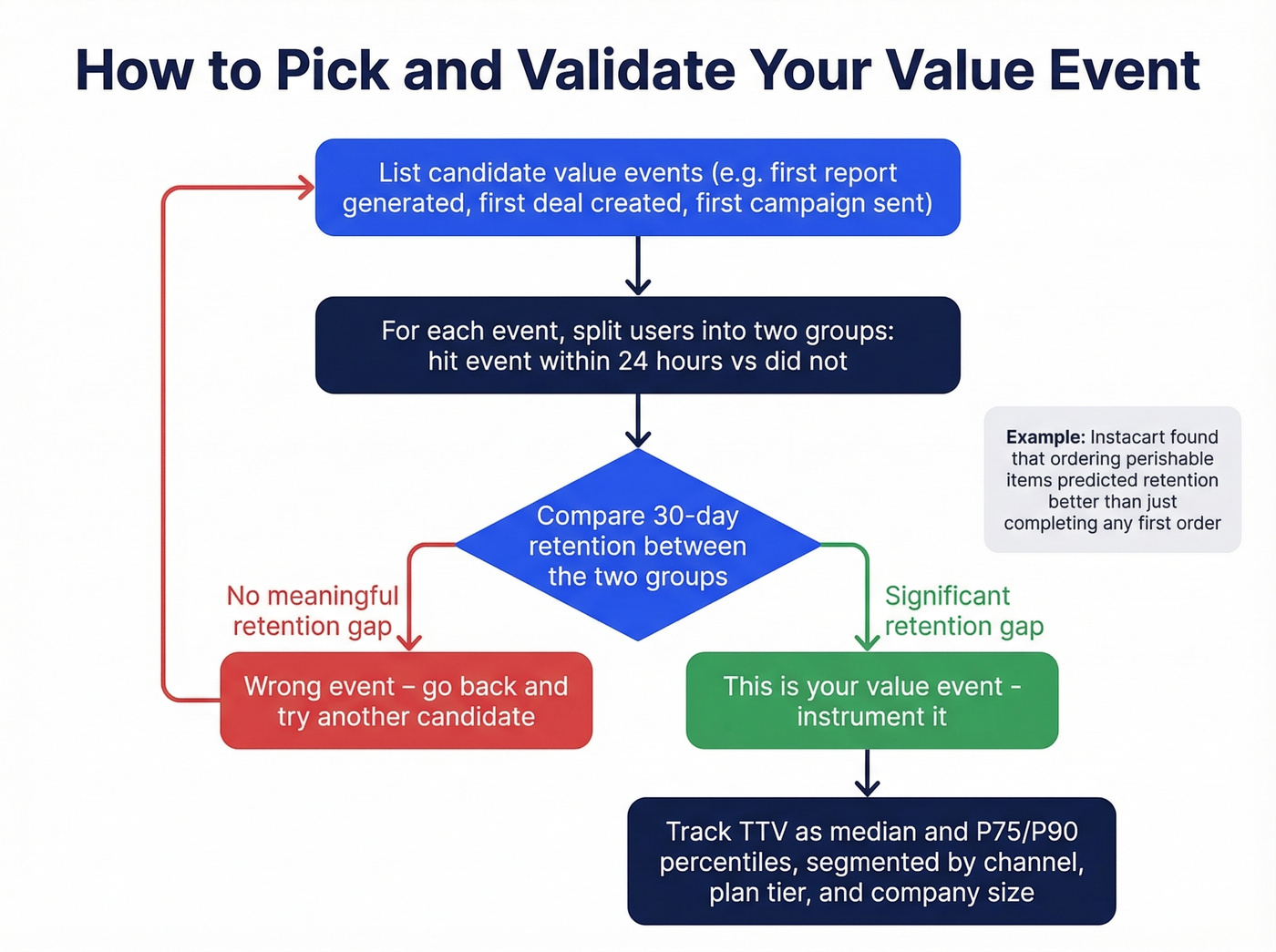
The classic Instacart example illustrates this well. "First order completed" seemed like the obvious value event, but ordering perishable items was the behavior that actually predicted retention. Observable outcomes beat proxy metrics every time.
Instrument It
Use consistent naming: user_signed_up, first_report_generated, first_deal_created. Don't track everything - define your value events deliberately and skip vanity interactions. For each event, capture timestamp, time since signup, user segment, and error states before success.
SELECT [PERCENTILE_CONT(0.5)](https://www.postgresql.org/docs/9.4/functions-aggregate.html) WITHIN GROUP (
  ORDER BY EXTRACT(EPOCH FROM first_value_event_at - signed_up_at)
) / 3600 AS median_ttv_hours
FROM user_activation
WHERE first_value_event_at IS NOT NULL;
Run this segmented by channel, plan tier, and company size.
How to Reduce Time to Value
Stop Training Users Like Employees
Here's the most common onboarding anti-pattern: front-loading configuration, team setup, and feature walkthroughs before any value. The r/startups community nails this - teams try to create power users on day one.
Audit how many steps happen before genuine value. If it's more than three, your onboarding is overcomplicated. Deliver a small win immediately, then introduce complexity later. This also shapes perceived TTV - the right UX can make value feel faster even before the full outcome arrives.
Six Patterns That Work
We've seen these patterns compress TTV across dozens of products:
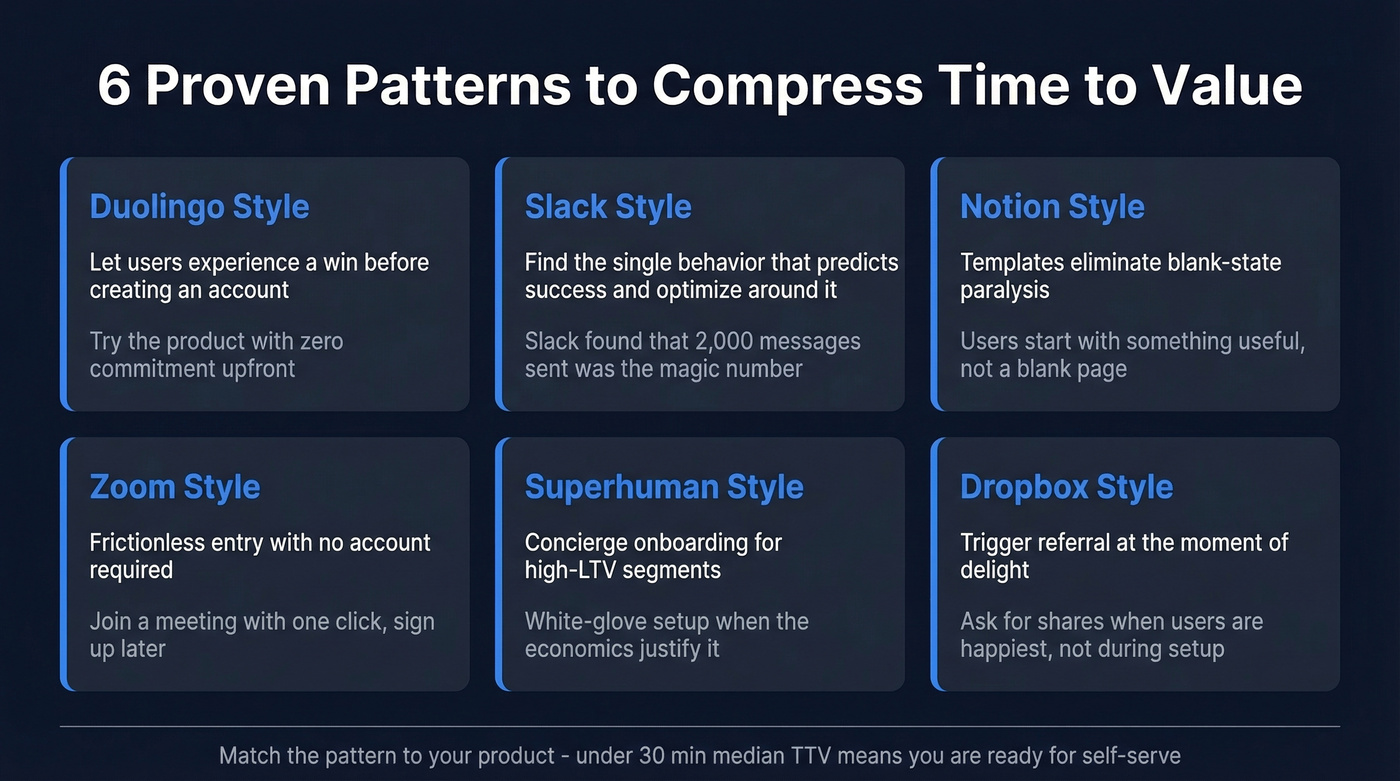
- Duolingo-style: Let users experience a win before they even create an account.
- Slack-style: Identify the single behavior that predicts success and optimize everything around it.
- Notion-style: Templates eliminate blank-state paralysis - users start with something, not nothing.
- Zoom-style: Frictionless entry. Join without creating an account first.
- Superhuman-style: Concierge onboarding for high-LTV segments where the economics justify white-glove treatment.
- Dropbox-style: Trigger referral at the moment of delight, not during setup.
This isn't just consumer product wisdom. In B2B prospecting, for example, Prospeo lets users sign up, apply 30+ search filters, and get verified emails in minutes - free tier, no implementation, no sales call. That's what frictionless entry looks like when you're selling to sales teams. Compressing the gap between signup and first verified contact list gives reps a faster path to revenue than waiting weeks for a legacy platform to onboard their entire team.
Let's be honest about something: most B2B products obsess over TTV for the wrong reason. They want a faster number to put on a slide. The real question is whether your value event actually predicts retention. A 5-minute TTV to a meaningless milestone is worse than a 2-day TTV to genuine value. Measure the right thing first, then compress it.
When TTV Can't Be Instant
Some products have inherently delayed value - social listening tools need data to accumulate, security platforms prove value by showing what they prevented. A founder on r/SaaS described this as "pay and wait."
The fix isn't faking instant value. It's delivering intermediate signals: progress indicators, early insights from partial data, setup confirmations that build trust. If your product falls into this category, skip the "instant aha moment" playbook and focus on reducing anxiety during the wait instead.
If your current data provider takes days to deliver value, your TTV problem isn't onboarding - it's the tool. Prospeo gives reps instant access to 300M+ profiles, 125M+ verified mobiles, and intent data across 15,000 topics. Self-serve from minute one.
Stop measuring TTV in days when it should be measured in minutes.
FAQ
What's a good TTV for SaaS?
Median SaaS TTV is 1 day, 1 hour, 54 minutes according to Userpilot's benchmark data. CRM products trend faster at roughly 1d 5h; complex verticals like HR can exceed 3 days. If your median is above 2 days, prioritize onboarding friction audits.
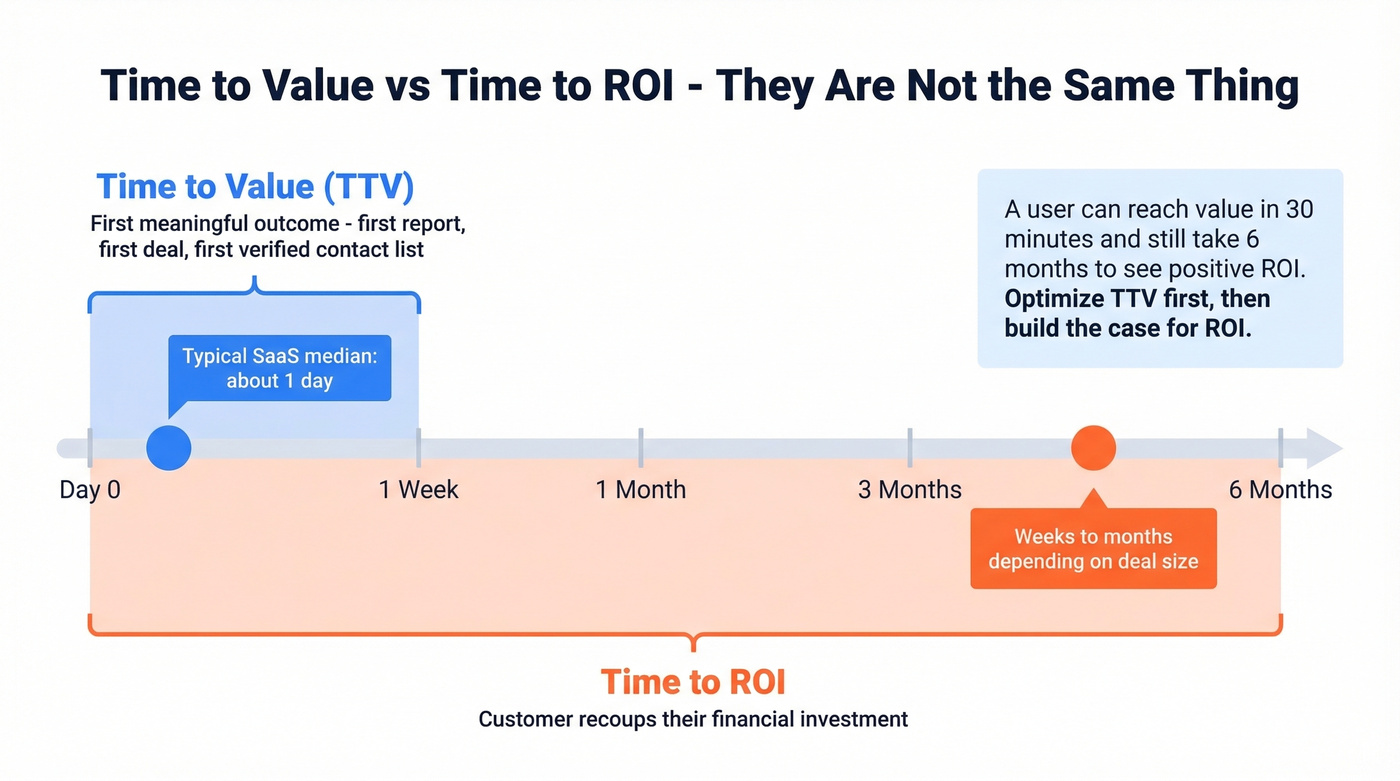
How is TTV different from time to ROI?
TTV measures time to first meaningful outcome, typically days. Time to ROI measures when the customer recoups their financial investment, typically weeks or months. A user can reach value in 30 minutes and still take 6 months to see positive ROI - related but fundamentally different milestones.
What tools measure TTV?
Amplitude and Mixpanel handle product analytics and activation tracking natively. Pair them with FullStory for session replay to diagnose friction points. For B2B data tools where the value event is "first verified contact list," built-in usage dashboards often suffice.
Can you have a TTV that's too fast?
Yes. If your value event is trivially easy but doesn't predict retention, a sub-minute TTV is meaningless. Always validate your activation metric with a 30-day retention split before optimizing speed. A 2-day TTV tied to genuine outcomes beats a 5-minute TTV tied to a vanity milestone every time.