

11 Better Alternatives to "To Whom It May Concern" (and How to Pick the Right One)
It's 11 PM. You've rewritten the second paragraph of your cover letter three times. But you're still stuck on the very first line - staring at "To Whom It May Concern" and wondering if there's a better option than a phrase that makes you sound like you're filing a complaint with a utility company in 1997.
You're right to hesitate. A Zety survey of 753 recruiters found that 81% have rejected candidates based solely on their cover letter, and 87% say cover letters are a key factor in interview decisions. The greeting is the first thing they read. A generic one sets the wrong tone before your experience gets a chance.
The fix isn't memorizing a list of fancier phrases. It's a system: figure out what you know about the recipient, then pick the greeting that matches.
Quick Decision Framework
Match your situation to the right greeting:
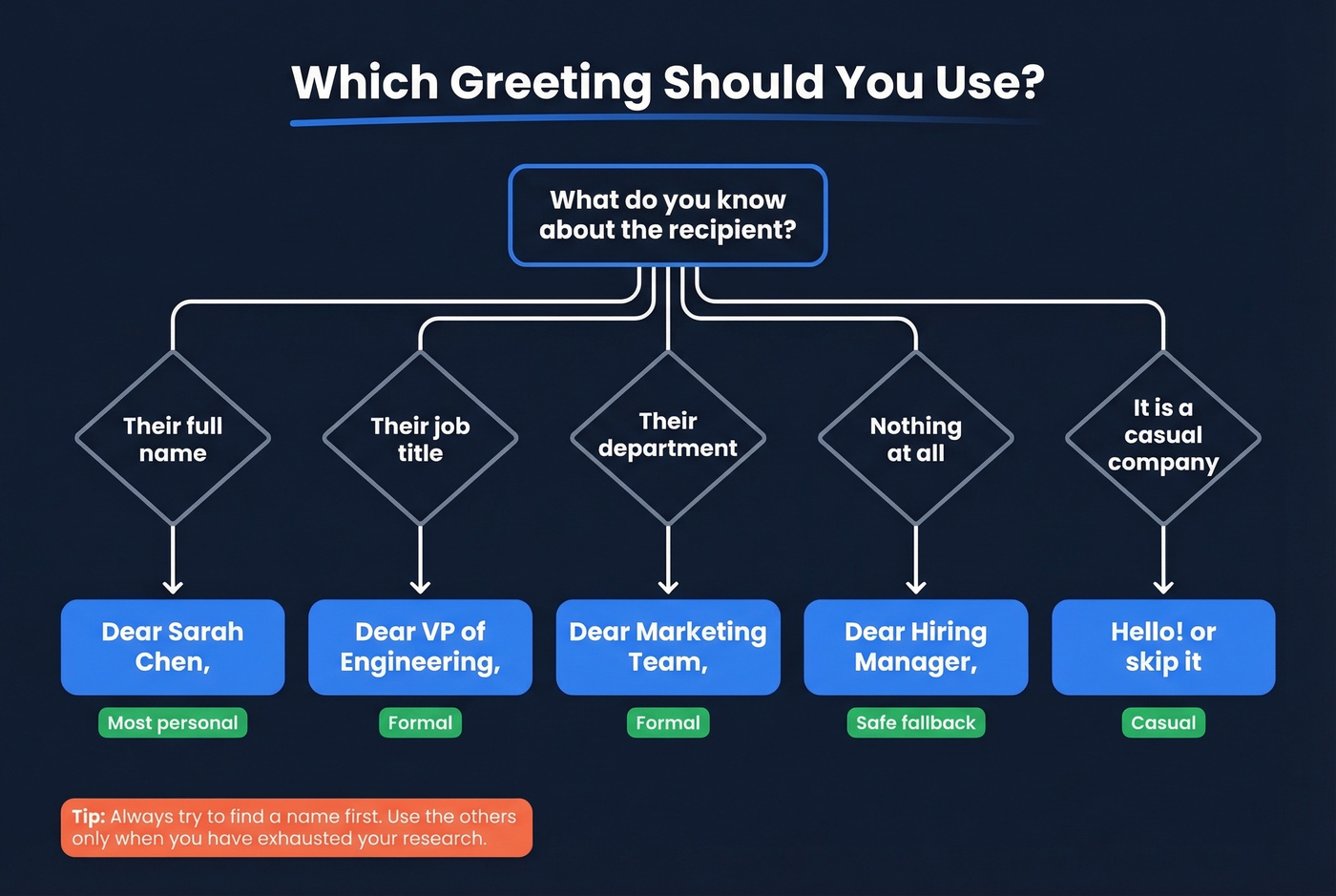
| Situation | Recommended Greeting | Example |
|---|---|---|
| You know their name | Dear [First Last] | Dear Sarah Chen, |
| You know the title | Dear [Job Title] | Dear VP of Engineering, |
| You know the dept | Dear [Department] Team | Dear Marketing Team, |
| Truly unknown | Dear Hiring Manager | Dear Hiring Manager, |
| Casual / startup | Hello or skip it | Hello! |
| Group / committee | Dear [Role] Committee | Dear Search Committee, |
That's the framework. Full breakdown below.
11 Professional Salutations That Actually Work
These are grouped by formality. Pick the cluster that matches your context, then choose the specific greeting that fits.
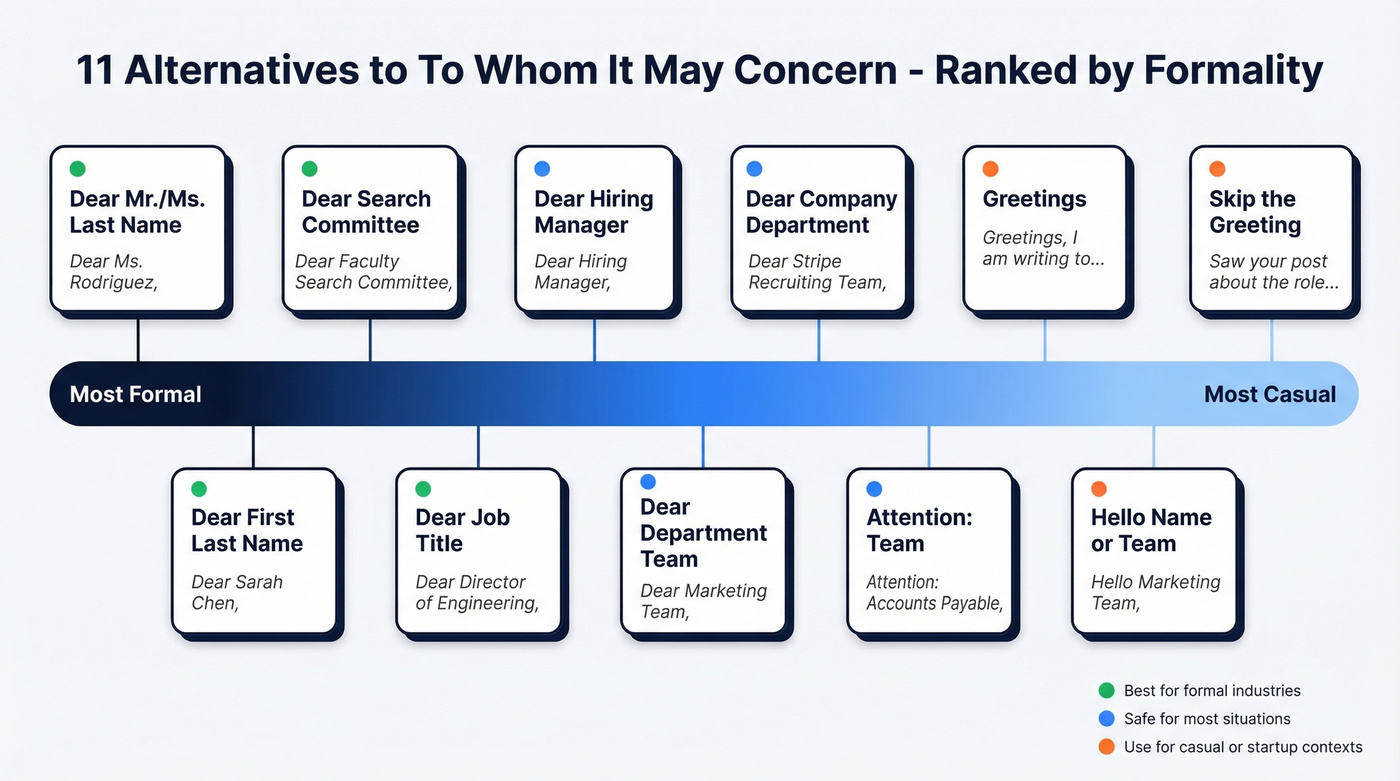
Formal
Dear [First Name Last Name]
The gold standard - nothing beats using someone's actual name. It tells the reader you did your homework before you asked for their time.
"Dear Sarah Chen, I'm writing to express my interest in the Senior Product Manager role at Acme Corp."
Here's what the recruiter hears when you use a generic greeting instead: "I couldn't be bothered to spend 30 seconds finding your name." This greeting eliminates that problem entirely.
Dear Mr./Ms. [Last Name]
A step more formal. Common in legal, finance, and government contexts.
"Dear Ms. Rodriguez, your team's work on the Q3 infrastructure migration caught my attention."
Skip this one if you're unsure about the recipient's gender or preferred title - getting it wrong is worse than being slightly less formal.
Dear [Job Title]
We've used this one more than any other when we can identify the role but not the person filling it. It works especially well when the job posting names a department or title.
"Dear Director of Engineering, I'd like to discuss how our platform handles the scaling challenges your team posted about last month."
Dear Hiring Manager
The safest fallback when you genuinely can't find a name. It's specific enough to show you understand a real person is reading this, without pretending you know who they are.
"Dear Hiring Manager, I'm applying for the Data Analyst position listed on your careers page."
Common mistake: People jump to this greeting before doing any research. Exhaust your options first - it should be your last resort, not your default.
Dear [Department] Team vs. Dear [Company] [Department]
These two serve the same purpose - addressing a group - but the second version signals more familiarity with the company. Compare:
- "Dear Customer Success Team, I'm reaching out about the Account Manager opening."
- "Dear Stripe Recruiting Team, I've followed your developer tools evolution since the v3 API launch."
Use the company-name version when you want to show you're not copy-pasting the same letter to 40 companies. Use the plain department version when the posting references a team rather than an individual.
Dear [Role] Search Committee
Common in academia, government, and nonprofit hiring. Use it when the posting explicitly mentions a committee or panel review process.
"Dear Faculty Search Committee, I'm submitting my application for the Assistant Professor of Economics position."
Semi-Formal
Hello [Name or Team]
Warmer than "Dear" and common in tech, startups, and creative industries. Check the company's careers page - if their tone is casual, "Hello" matches better than "Dear." For more traditional workplaces, save it for clearly casual threads.
"Hello Marketing Team, I came across the Content Strategist role and wanted to share why I'd be a strong fit."
Greetings
A neutral option that avoids both the stiffness of "Dear" and the casualness of "Hello." It reads a bit like a form letter, but it's inoffensive. Best for non-job contexts: vendor outreach, general inquiries, formal complaints.
"Greetings, I'm writing to inquire about partnership opportunities with your events division."
Good Morning / Good Afternoon
Adds a human touch. The risk is that you don't know when they'll read it - "Good morning" at 4 PM feels slightly off. In our experience, most people don't notice or care.
"Good morning, I'm following up on the proposal we discussed at the SaaStr conference last week."
Unconventional
Skip the Greeting Entirely
This one surprises people, but it works in specific contexts: internal emails, Slack-to-email follow-ups, casual startup cultures, and situations where a greeting would feel performative. Don't do this on a cover letter for a Fortune 500 company.
"Saw your post about the engineering lead role - wanted to share a few thoughts on why I'd be a fit."
Attention: [Team or Title]
Borrowed from formal memo style, this works for official correspondence directed at a specific department - procurement requests, compliance inquiries, or formal business proposals where you need to route the letter to the right desk.
"Attention: Accounts Payable Department - I'm writing regarding invoice #4471, submitted on March 15."
Skip this for cover letters and anything relationship-driven. It's functional, not warm.
When "To Whom It May Concern" Still Works
It's not always wrong. A few situations genuinely call for it:
Reference letters where you're writing for an unknown future audience and the formality fits. Formal complaints to a company in general where no individual is named. And gender-neutral name situations where you can't determine the recipient's preferred title and want to avoid misgendering - this can be a safer default.
Outside these cases, you've got better options.
How to Find the Right Name
Here's the actual workflow most articles skip.
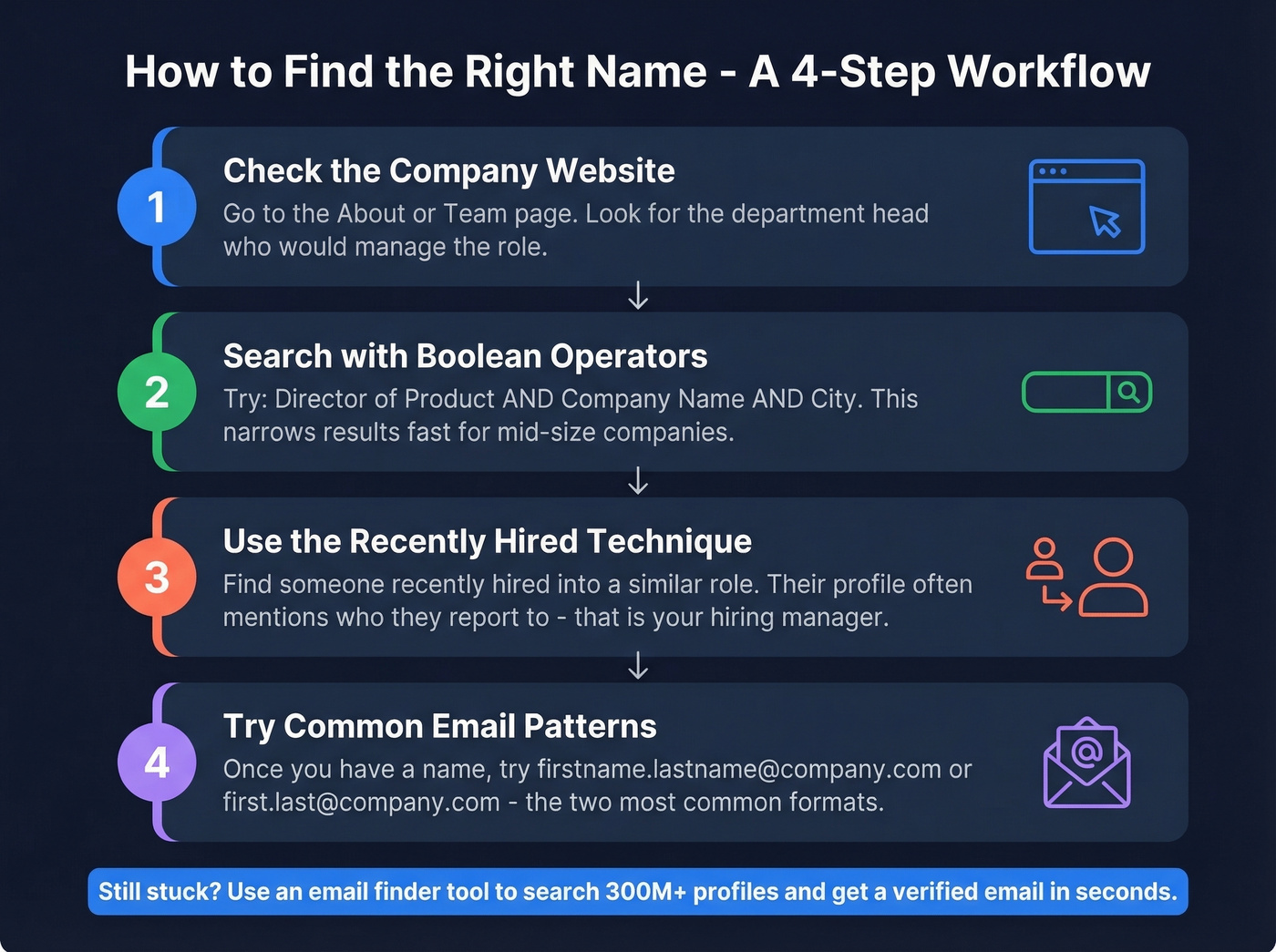
1. Check the company website. Go to the About or Team page. Look for the department head who'd manage the role you're applying for. This is fast and often works when the company publishes a real org view.
2. Search professional profiles with Boolean operators. Try a query like: "Director of Product" AND "Company Name" AND "San Francisco". This narrows results fast, especially for mid-size companies where titles are standardized.
3. Use the "recently hired" technique. Find someone who was recently hired into a similar role at the company. Their profile often mentions who they report to - that's your hiring manager.
4. Try common email patterns. Once you have a name, the email is often firstname.lastname@company.com or first.last@company.com. Two of the most common corporate email formats.
We've used this exact workflow to find hiring managers at companies that don't even list team pages.
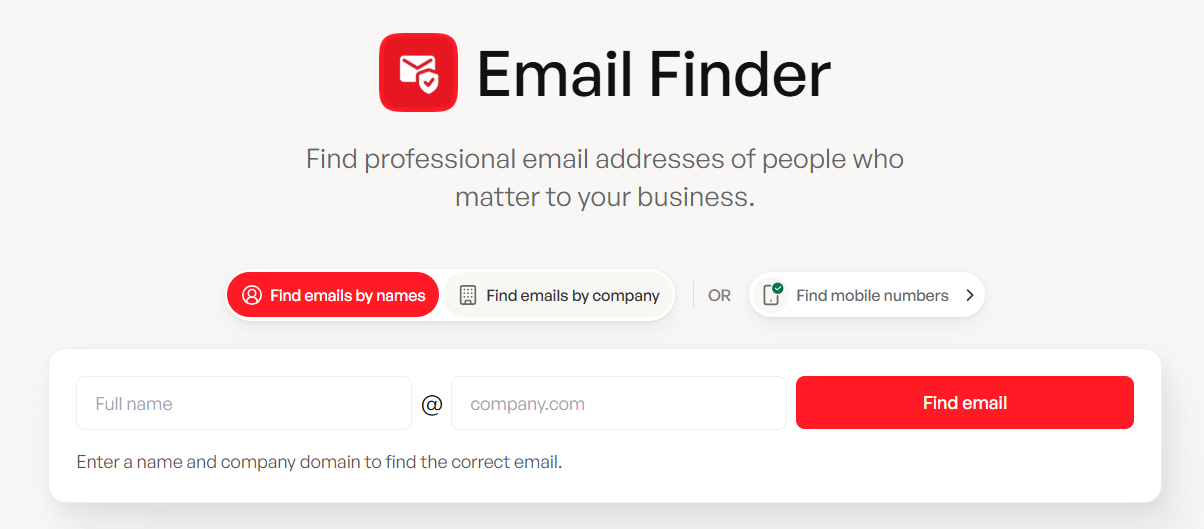

The best alternative to "To Whom It May Concern" is using someone's actual name. Prospeo's database of 300M+ professional profiles with 30+ search filters lets you find the exact hiring manager, department head, or decision-maker - with a 98% accurate verified email attached.
Never send a generic greeting again. Find the right name in seconds.
Why "Dear Sir or Madam" Is Even Worse
Let's be honest: if "To Whom It May Concern" is outdated, "Dear Sir or Madam" is outdated and exclusionary. It carries the same impersonal quality - you clearly don't know who you're writing to - but adds a gender binary assumption on top. It assumes your recipient identifies as either "Sir" or "Madam," which can alienate or misidentify them.
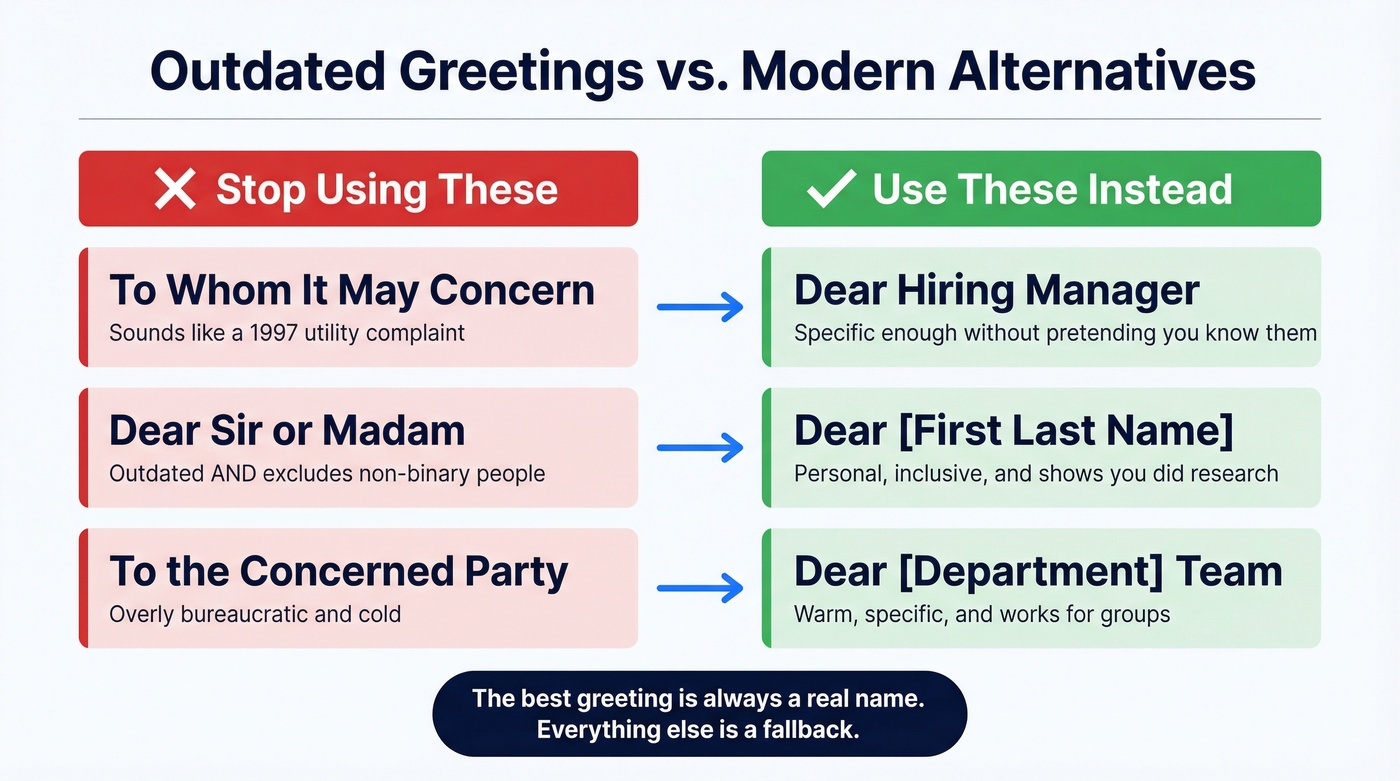
"Dear Sir or Madam" is the greeting equivalent of a fax machine - everyone knows it's obsolete, but some people keep using it because they saw someone else do it. In 2026, "Dear Hiring Manager" does the same job without the baggage. Every alternative listed above is a better choice.
Formatting and Punctuation
Small details signal professionalism.
Colon vs. comma. A colon is the most formal punctuation after a salutation ("Dear Ms. Chen:"). A comma works for casual contexts where you already have a relationship ("Hi Sarah,"). When in doubt, go with the colon - it's rarely a mistake.
Capitalization. If you do use "To Whom It May Concern," capitalize every word. It's a fixed phrase treated as a proper salutation.
Comma placement within greetings. "Good morning, Mrs. Johnson" - the comma separates the greeting from the name. Skip this comma and it reads like you're calling her "Morning Mrs. Johnson."
Beyond Cover Letters
Every time you write to someone you don't know, you face the same greeting problem. Choosing the right salutation matters just as much in email as it does for printed letters.
Cold sales emails. There are 14 people in the department. A vague opening guarantees your email gets deleted. "Dear [Specific Name]" or "Dear [Department] Team" at least signals you did homework. In cold outreach, personalization isn't optional - it's the difference between a reply and the spam folder. The consensus on r/sales is pretty clear: generic openers tank reply rates, and the data backs it up. If you're building a repeatable outbound motion, sales prospecting techniques help you systematize the research.
Vendor outreach. Writing to a company's procurement team? "Dear Procurement Team" or "Dear [Company] Partnerships" works better than a generic catch-all. For outreach that needs a second touch, keep a few sales follow-up templates handy.
Formal complaints. "Dear Customer Service Manager" is more likely to reach someone with authority than a vague salutation. Even in complaint letters, specificity helps.
Reference letters. This is the one context where "To Whom It May Concern" genuinely makes sense. You're writing for an unknown future reader, and the formality matches the purpose.
International Considerations
Your greeting doesn't exist in a vacuum. What reads as professional in New York might land differently in Seoul or Sao Paulo.
US business writing tends toward directness - short greetings, fast pivots to the point. But a BBC Worklife study found that 40% of Korean academics considered Australian emails impolite, compared to 28% the other way around. The gap isn't about language - it's about expectations around formality and warmth.
If you're writing across cultures, one practical tip from Instructional Solutions: look at how formal local institutions open their correspondence. Banks, government agencies - that gives you a baseline for the expected level of formality in that market. When in doubt, err on the side of more formal. You can always loosen up once you've established a relationship.
Step 4 of your research workflow - finding email patterns - is where most people waste hours guessing. Prospeo's Email Finder verifies contacts in real time at $0.01 per email, so you skip the guesswork and land in the right inbox with the right name.
Skip the guessing. Get verified names and emails from 143M+ contacts.
FAQ
Is "Dear Sir or Madam" still acceptable?
No - it's impersonal and assumes a gender binary, which can alienate recipients. "Dear Hiring Manager" or "Dear [Department] Team" are the most reliable replacements for any professional context in 2026.
Should I use a colon or comma after my greeting?
Use a colon for formal correspondence ("Dear Ms. Chen:") and a comma for casual contexts ("Hi Sarah,"). When you're unsure, default to the colon - it's never wrong in professional writing.
What if the job posting is completely anonymous?
Default to "Dear Hiring Manager." If even the department is unclear, "Greetings" works as a neutral fallback. Exhaust research first - check the company website and search professional profiles with Boolean queries before settling for a generic option.
How do I find and verify a hiring manager's email?
Search the company website and professional profiles using Boolean queries like "Head of Marketing" AND "Company Name". Once you have the name, verify their email with Prospeo's Email Finder - 98% accuracy, 75 free lookups per month.
Can I skip the greeting entirely?
In casual email contexts - startups, follow-ups, internal messages - yes. For cover letters or first-contact formal correspondence, always include a greeting. Match the formality to the medium and the relationship.