

Top Alternative Data Providers: A Buyer's Guide for 2026
Your PM asked you to evaluate three alt-data vendors by Friday. You've read four listicles and still don't know what anything costs.
That's the alternative data market in a nutshell - 445+ providers, a market worth an estimated $15.4B as of 2026, and vendors who won't give you a number until the third sales call. Hedge funds spent $2.8B on alternative data in 2025, up 17% year-over-year, and 95% of buyers expect budgets to grow. The demand is real: teams want signals that move faster than consensus. The supply side? A mess. Let's sort it out, starting with what top alternative data providers actually charge.
Our Picks at a Glance
| Use Case | Pick | Why |
|---|---|---|
| B2B contacts & buyer intent | Prospeo | 98% email accuracy, ~$0.01/lead, no contracts |
| Transaction & consumer spending | YipitData | Deep point-in-time history; hedge fund standard |
| AI-powered market intelligence | AlphaSense | One of the broadest document coverage stacks; accessible tiers |
| Budget-conscious analysts | Quiver Quantitative | Free tier; $25/mo for political & insider trades |
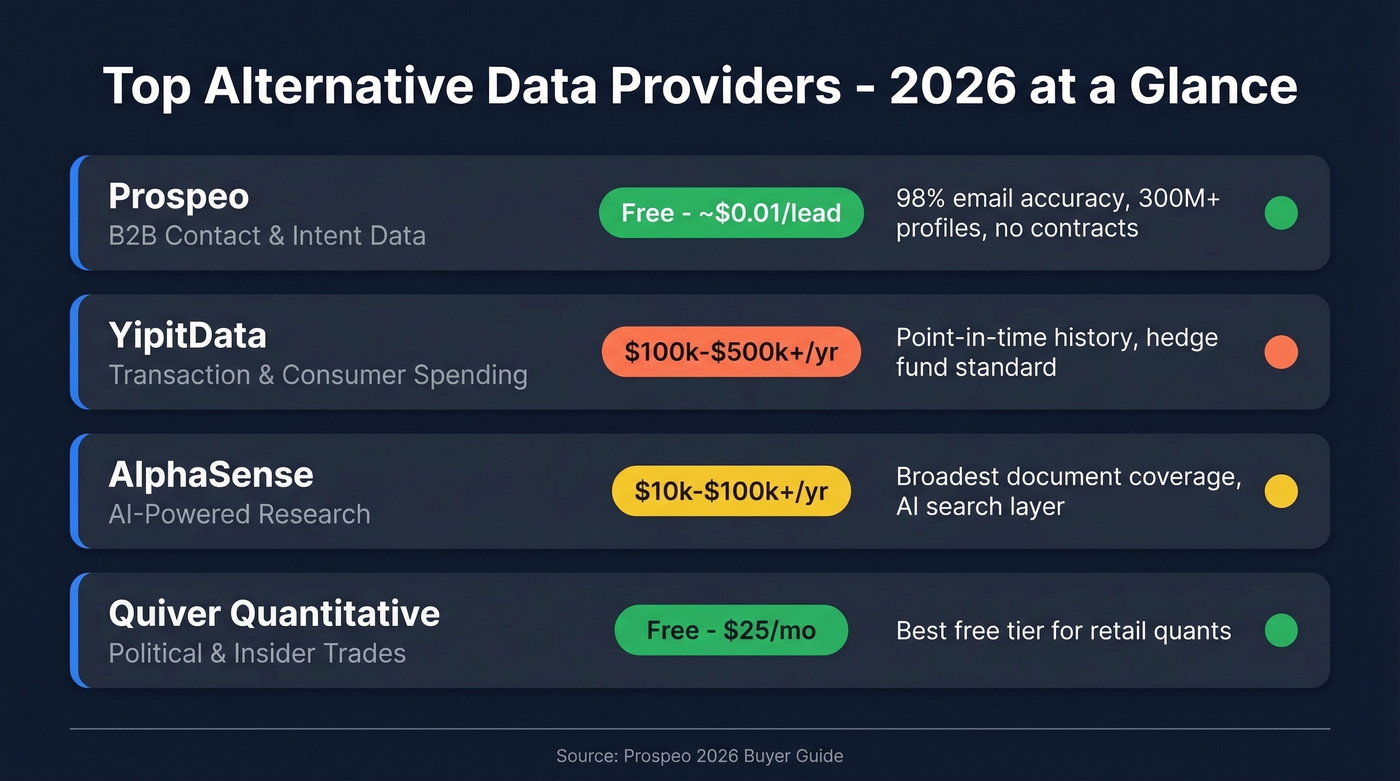
Alternative Data Providers by Category
Prospeo - B2B Contact & Intent Data
Use this if you need verified B2B contacts with buyer intent signals for deal sourcing or corporate strategy without a $200k enterprise contract.
Skip this if you need consumer transaction panels or satellite imagery.
Prospeo covers 300M+ professional profiles and verifies emails at 98% accuracy, with 125M+ verified mobile numbers hitting a 30% pickup rate. The platform tracks 15,000 intent topics via Bombora, so you get signals on who's actively researching topics relevant to your thesis - not just static firmographic snapshots. Thirty-plus search filters cover technographics, job changes, headcount growth, funding rounds, and revenue, which makes it genuinely useful for PE deal sourcing and competitive intelligence alongside traditional outbound sales.
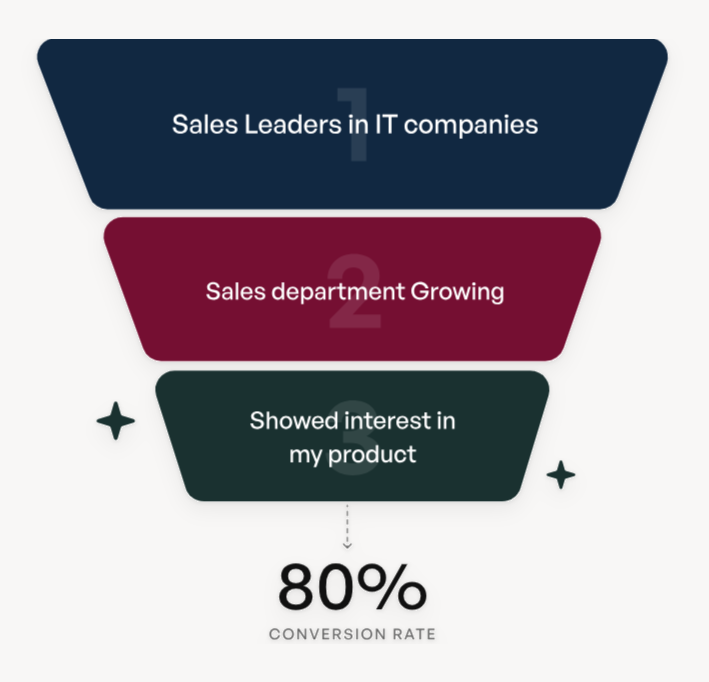
A free tier gives you 75 verified emails per month plus 100 Chrome extension credits. Paid plans run roughly $0.01 per lead with no annual contracts. Compare that to institutional vendors charging $100k+ per year for a single dataset. Data refreshes every 7 days versus the six-week industry average - a gap that matters when you're tracking fast-moving hiring signals or funding rounds.
YipitData - Transaction & Consumer Data
YipitData is the institutional standard for consumer transaction and web-scraped spending data. If you're a quant or fundamental hedge fund tracking same-store sales, app downloads, or credit card panels, this is already on your shortlist.
The strength is depth of point-in-time history. For teams that need to backtest signals cleanly, point-in-time integrity is non-negotiable - and it's where many datasets fall apart during evaluation. We've seen multiple funds disqualify otherwise-promising vendors during pilot because their historical data had been retroactively adjusted, which destroys any backtest validity. If you're an individual analyst or a small team without a six-figure data budget, look elsewhere.
Pricing: $100k-$500k+ per year.
AlphaSense - AI-Powered Research
AlphaSense isn't a raw dataset vendor. It's an AI search layer across earnings calls, SEC filings, expert transcripts, broker research, and news - a growth intelligence layer on top of your data stack that surfaces signals about where companies and markets are heading.

For fundamental analysts and PE due diligence teams, AlphaSense compresses hours of document review into minutes. Where it falls short is on the quantitative side: if you need structured, machine-readable datasets for backtesting, this isn't the tool. AI-native research assistants like Hebbia and Aiera are emerging as adjacent alternatives worth watching.
Pricing: ~$10k-$100k+ per year depending on seats and modules.
Similarweb - Digital Intelligence
Web traffic estimates, app analytics, and competitive benchmarking. The free tier handles quick competitive checks. Enterprise contracts at $50k-$200k+/year unlock granular data, historical depth, and API access. Traffic estimates have improved but remain directional for smaller sites - treat them as relative rankings, not absolute numbers.
Dataminr - Real-Time Event Detection
Built for speed: macro traders, risk teams, and corporate security that need supply chain disruptions or geopolitical events before they hit Bloomberg. Pricing sits at $50k-$250k+/year. Skip this if you do fundamental research on a weekly cadence. You'd be paying for latency you won't use.
Orbital Insight - Geospatial Analytics
Satellite imagery for commodity traders and supply chain analysts counting cars in parking lots or measuring oil storage fill rates. Genuinely unique data, but expensive at $100k-$500k+/year. We've seen teams extract tremendous value from supply chain monitoring and others struggle with retail foot traffic signals - the ROI depends heavily on your specific thesis.
Earnest Research - Transaction Data
Competes directly with YipitData on consumer spending data at similar pricing ($100k-$500k+/year). If you're choosing between transaction providers, run a bake-off. Request overlapping coverage periods and compare signal consistency on the same tickers.
Thinknum - Web Intelligence
Job postings, product pricing changes, app store reviews, and employee counts scraped from public sources. Runs $50k-$200k+/year. Niche but valuable for tracking hiring velocity or pricing strategy shifts at specific companies.
Quiver Quantitative - Political & Insider Data
Free tier covers political trades, insider transactions, and lobbying data. Premium is $25/mo. If you're an individual analyst or small fund wanting political and insider trade signals without a five-figure commitment, Quiver is the obvious starting point. The r/algotrading community regularly recommends it as one of the best free data sources for retail quants.
Exploding Topics - Trend Detection
Trend detection at $99/mo for Pro. Lightweight, self-serve, useful for identifying emerging categories before mainstream coverage. Not institutional-grade, but a solid complement to heavier datasets.

Most alternative data providers gate pricing behind sales calls and six-figure annual contracts. Prospeo gives you 300M+ verified B2B profiles, 15,000 intent topics, and 30+ search filters at ~$0.01 per lead - with a free tier to evaluate before you spend a dollar.
Run your own bake-off with 75 free verified emails today.
How to Evaluate Alternative Data Vendors
Don't buy a dataset because the sales deck looked good. Run a structured evaluation.
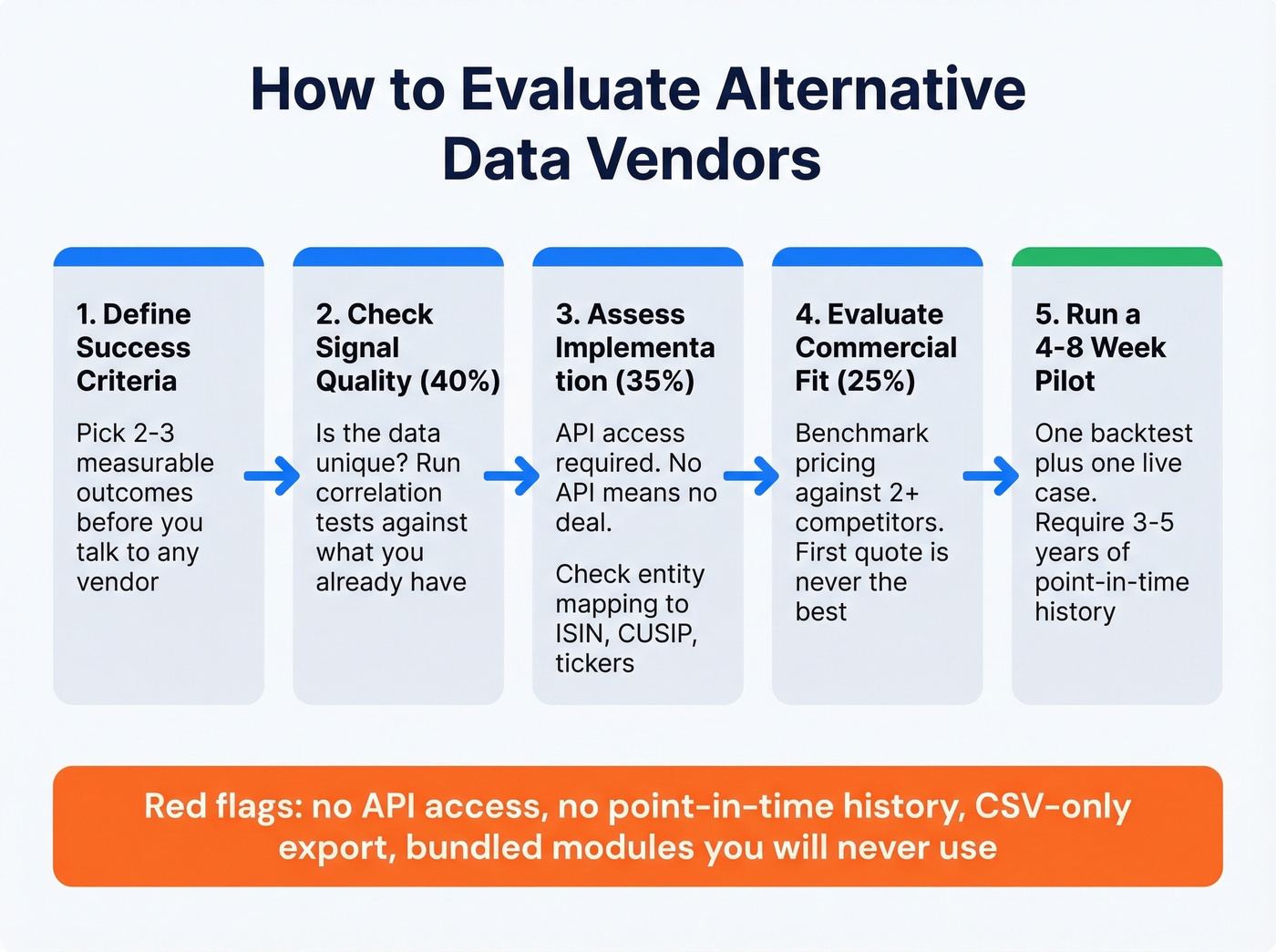
| Criterion | Weight | What to Check |
|---|---|---|
| Signal quality | 40% | Unique alpha, not 0.9 correlated with existing data |
| Implementation cost | 35% | API access, entity mapping, engineering lift |
| Commercial fit | 25% | Pricing, contract flexibility, renewal terms |
Run a 4-8 week pilot with measurable success criteria. Include one historical backtest and one live monitoring case. Require 3-5 years of point-in-time history - vendors without it get disqualified by most quant buyers, and for good reason.
Here's the thing: datasets requiring manual CSV export get abandoned within weeks. Insist on programmatic access via API with entity mapping to standard identifiers like ISIN, CUSIP, and tickers. If a vendor can't give you an API, that's a red flag. Benchmark pricing against at least two competitors before signing - we've seen pricing vary by up to 20% among peers for identical products, and the first number a vendor quotes is almost never the best one.
Compliance and Provenance
Any dataset touching investment decisions needs a compliance review. The SEC expects policies under Section 204A of the Investment Advisers Act to prevent misuse of material non-public information. Practically, that means:
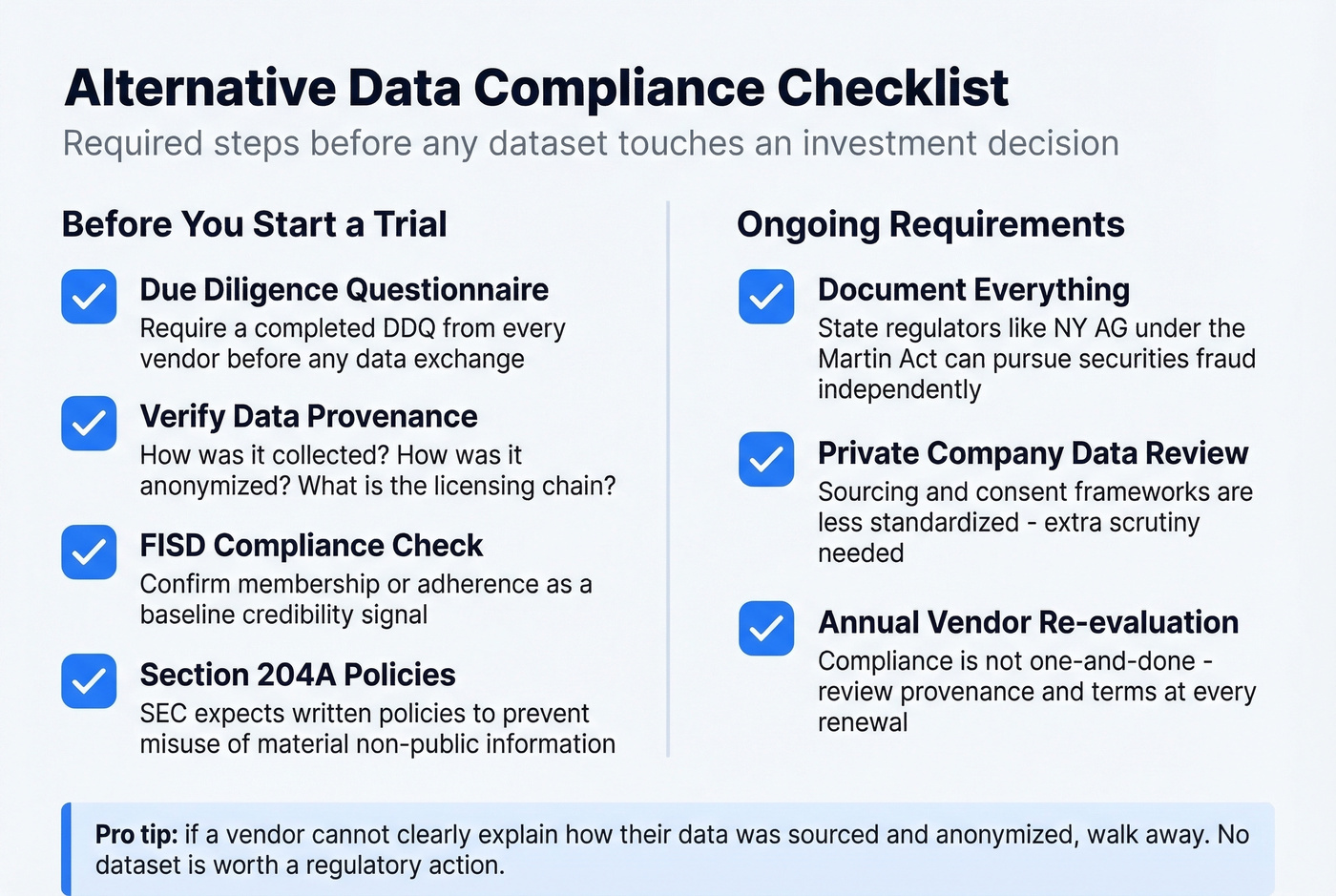
- Require a due diligence questionnaire from every vendor before trial
- Verify data provenance - how was it collected, anonymized, and licensed?
- Confirm FISD compliance as a baseline credibility signal
- Document everything - state-level regulators like the NY AG under the Martin Act can pursue securities fraud independently
This is especially critical when working with private company data, where sourcing and consent frameworks are less standardized than with public-company datasets.
What This Actually Costs
Most teams overspend on alternative data because they buy enterprise platforms when they need two specific signals. Building an in-house alt-data team starts at $1.5M-$2.5M per year according to Neudata's 2025 industry survey, which is why most funds buy rather than build. But buying smart means matching the tool to the actual use case, not the aspirational one. Some vendors now bundle multiple data types under one contract - convenient, but make sure you're not paying for modules you'll never touch.
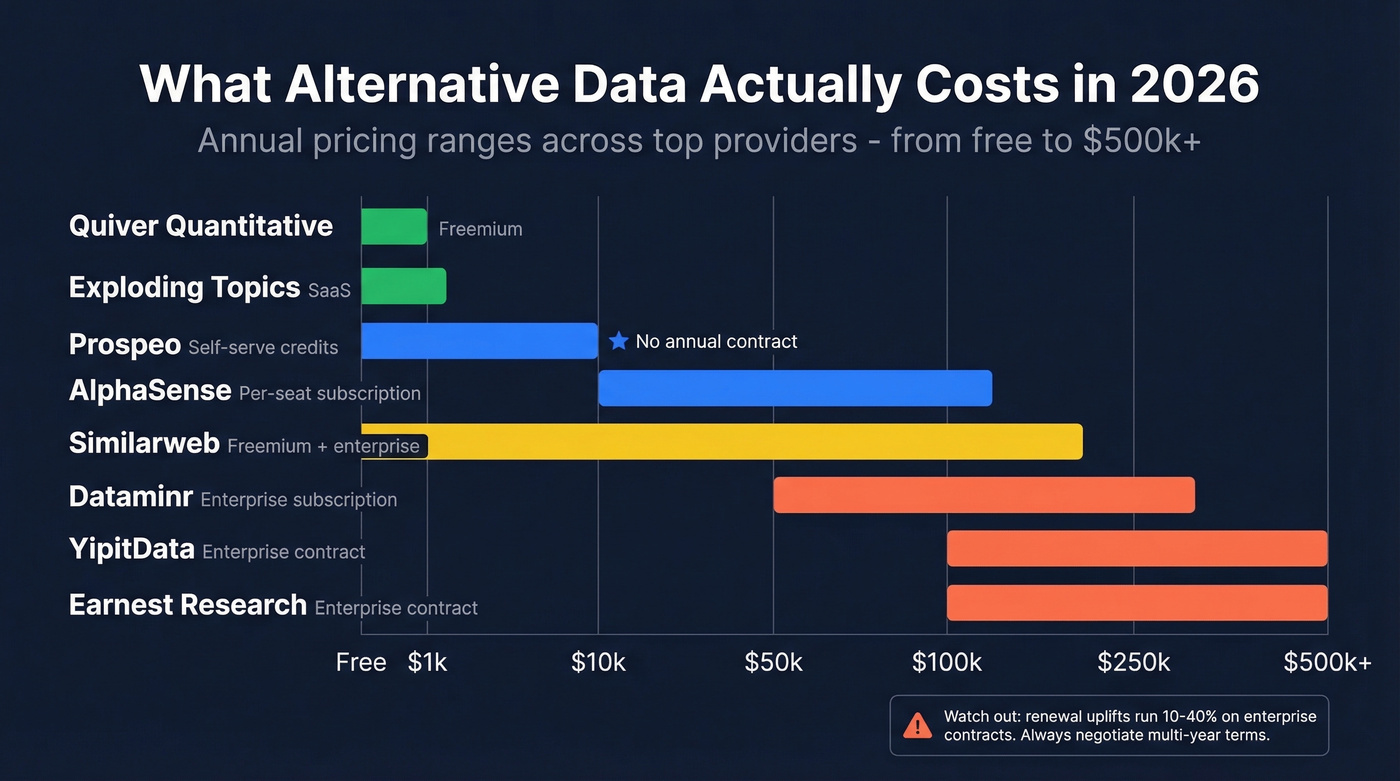
| Provider | Annual Cost | Model |
|---|---|---|
| YipitData | $100k-$500k+ | Enterprise contract |
| AlphaSense | $10k-$100k+ | Per-seat subscription |
| Dataminr | $50k-$250k+ | Enterprise subscription |
| Similarweb | Free-$200k+ | Freemium + enterprise |
| Prospeo | Free-~$0.01/lead | Self-serve credits |
| Quiver Quant | Free-$25/mo | Freemium |
| Exploding Topics | Free-$99/mo | SaaS subscription |
Renewal uplifts run 10-40% on contracts already in the $100k-$1M range. Always benchmark against at least two vendors before signing, and negotiate multi-year terms to cap annual increases. One frustrating pattern we keep seeing: vendors quoting a "platform fee" separately from data access fees, effectively doubling the real cost. Ask for all-in pricing upfront.
FAQ
What is alternative data?
Any dataset used for investment or business decisions outside traditional financial sources - transaction panels, satellite imagery, web traffic, app usage, and B2B contact data with intent signals. The market spans 445+ providers and is valued at roughly $15.4B in 2026.
How much does alternative data cost?
Most enterprise contracts fall between $50k-$300k per dataset, with renewal uplifts of 10-40%. Self-serve tools like Quiver Quantitative (free-$25/mo) and Exploding Topics ($99/mo) offer entry points under $100/month for teams that don't need full institutional feeds.
How do I run an alternative data pilot?
Define 2-3 success criteria upfront. Run one backtest and one live case over 4-8 weeks. Require API access and entity mapping to standard identifiers like ISIN, CUSIP, and tickers. Benchmark pricing against two competing vendors before committing.
Which alternative data providers offer free tiers?
Prospeo (75 verified emails/month), Quiver Quantitative (political and insider trade data), Similarweb (basic traffic estimates), and Exploding Topics (limited trend searches) all offer functional free plans.