

The 8 Types of Competitive Intelligence That Actually Matter in 2026
Your VP of Sales just asked why the team lost three enterprise deals to the same competitor this quarter. Nobody can explain what changed - not pricing, not product, not messaging. That's not a sales problem. That's a competitive intelligence gap, and it's bleeding revenue.
Sellers go head-to-head with competitors in 68% of deals. The average team rates its competitive readiness 3.8 out of 10, and that gap costs roughly $2-$10M per year in winnable deals. Most companies know they need CI. Very few know which types actually move the needle.
Which CI Types Drive Revenue Fastest?
Most CI taxonomies list 9 or 11 types with no rationale for why one matters more than another. The number doesn't matter. Revenue connection does.
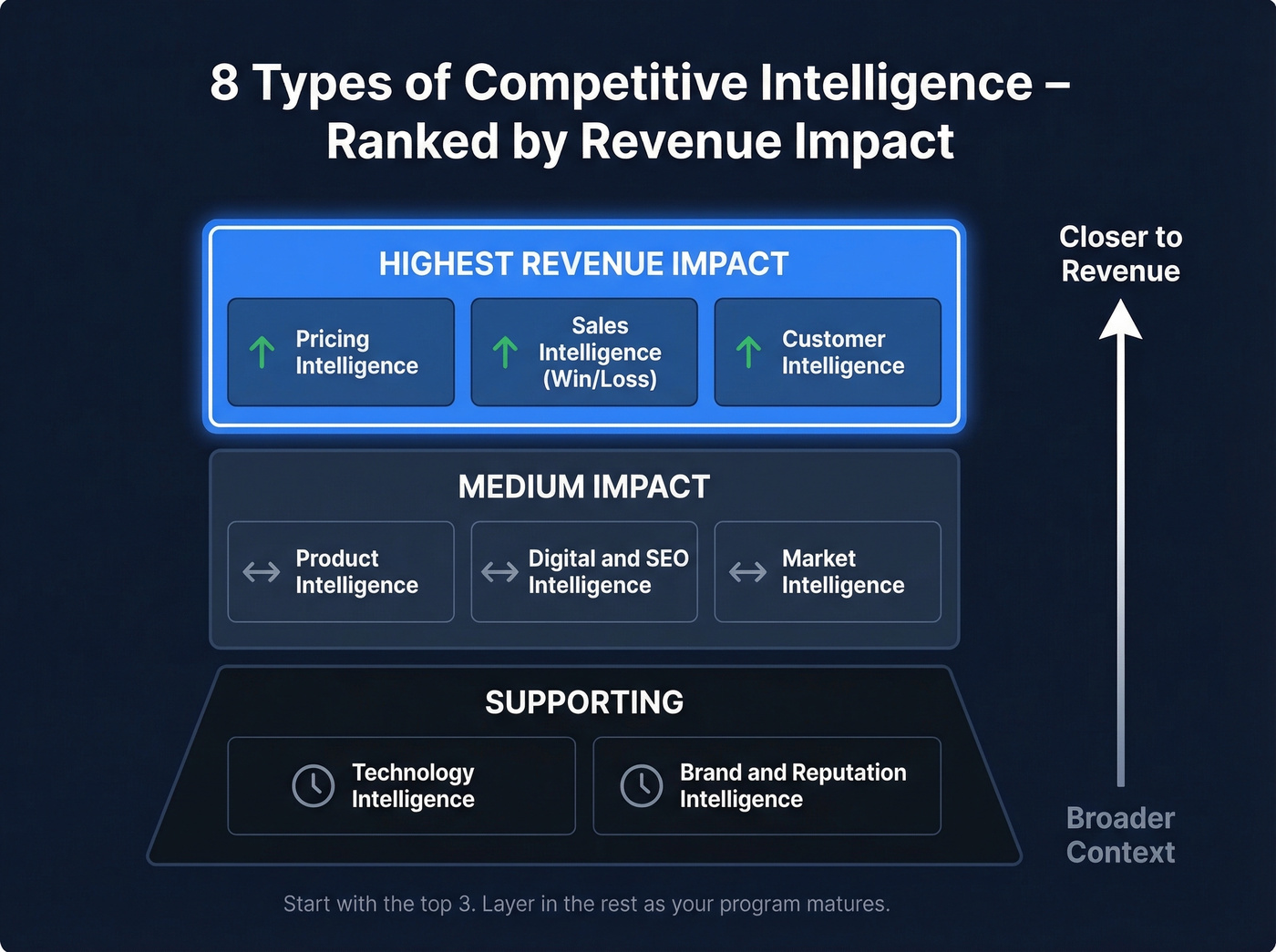
The three types that move deals fastest are pricing intelligence, sales intelligence, and customer intelligence. Start there. The rest matter, but only after you've nailed the three that directly impact whether reps win or lose.
What Is Competitive Intelligence?
Competitive intelligence is the systematic, ethical collection and analysis of information about competitors using publicly available sources - industry reports, pricing pages, job postings, product reviews. The CI market reached roughly $50.9B in 2025 and is projected to hit ~$122.8B by 2033. Gartner predicts that by 2026, 40% of tech and service providers will use commercial CI tools, up from around 10%.
That's not hype. It's a structural shift in how companies compete.
The 8 Types Explained
Market Intelligence
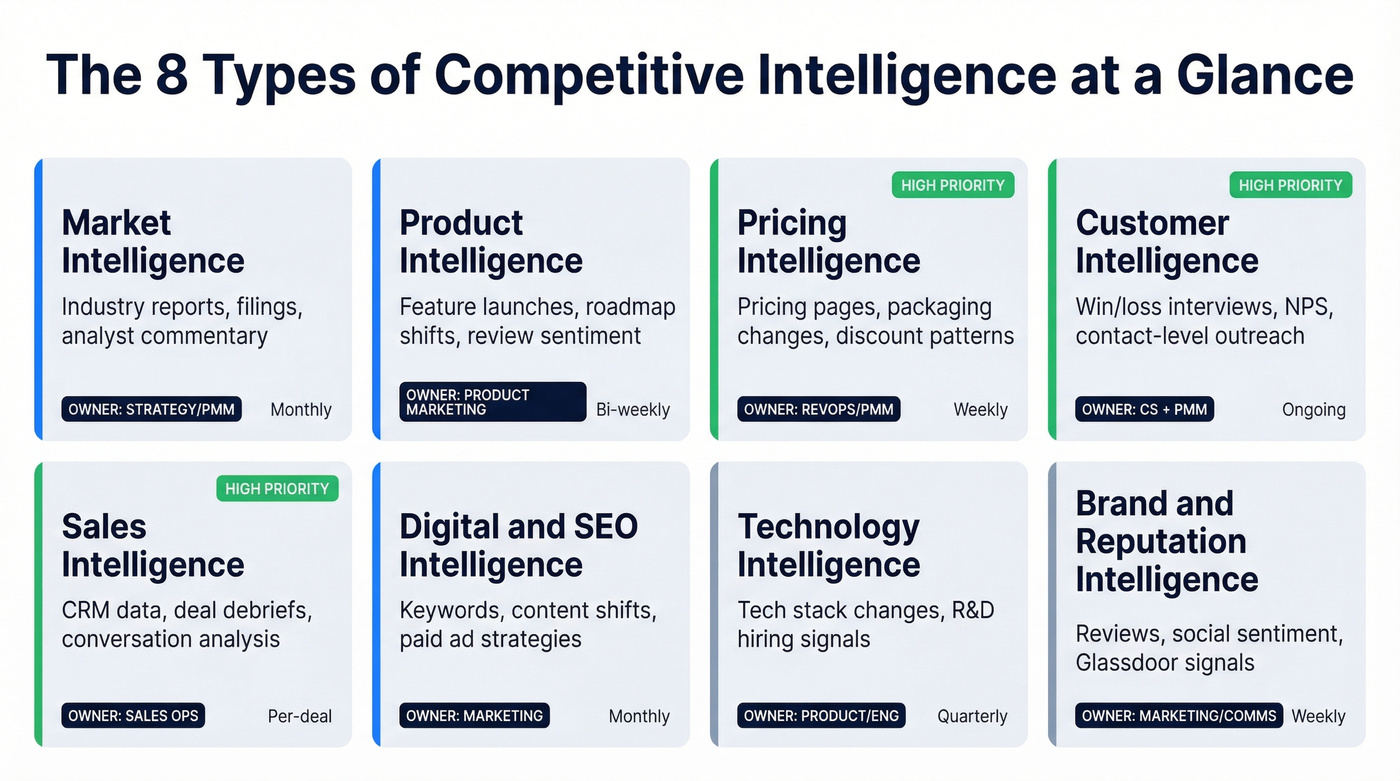
Market intelligence tracks the macro forces shaping your category - industry reports, public filings, analyst commentary, regulatory shifts. It's the broadest type and the one most teams default to first, often at the expense of more actionable work. Feedly (from $6/mo) or free Google Alerts cover the basics. Don't overlook partner and supplier signals, which can reveal market moves before press releases do. Strategy or product marketing typically owns this on a monthly cadence.
Product Intelligence
Feature-level tracking: what competitors launch, deprecate, and how their roadmap shifts quarter over quarter. Mine G2 and Capterra reviews for feature sentiment - what users love, what they're begging for. A bi-weekly manual review works if you're disciplined. Product marketing owns this, and the output feeds directly into battlecards.
Pricing Intelligence
Here's the thing: pricing intelligence has the most direct impact on win rates, and it's the easiest type to collect. CI teams consistently prioritize pricing and packaging monitoring as one of the highest-ROI activities - and we've seen the same pattern across every team we've talked to. Monitor competitor pricing pages weekly for packaging changes, tier restructuring, and discount patterns. Visualping (free tier available) catches page changes automatically. If you need a full CI platform, Crayon runs ~$20-40K/yr.
If you're only doing one kind of CI, do this one. RevOps or product marketing should own the cadence.

Customer Intelligence
The most underrated type, and the one where we've seen the biggest gap between "we should do this" and "we actually do this."
Customer intelligence combines win/loss interviews, review sentiment, NPS benchmarking, and contact-level data for competitive outreach. The problem isn't collecting insights - it's reaching the people who hold them. Churned prospects, lost-deal contacts, and former champions at competitor accounts have gold-standard intelligence, if you can get them on the phone or in their inbox.
Stale contact data kills most win/loss programs before they start. Prospeo's bulk verification at 98% accuracy on a 7-day refresh cycle lets you upload lost-deal contacts, verify them same-day, and start scheduling conversations that week at roughly $0.01 per verified email. Customer success and product marketing co-own this.
Sales Intelligence (Win/Loss)
Deal-level competitive data lives in your CRM - if reps actually fill in the competitive fields. Sales intelligence means structured win/loss analysis, rep debriefs, and conversational intelligence from tools like Gong (~$1,600/user/yr). Teams using conversational intelligence for compete see an 82% increase in sales effectiveness. Sales ops owns the process; product marketing owns the insights.
Skip Gong if your team is under 10 reps. A structured Google Form after every lost deal gets you 80% of the value at zero cost.
Digital & SEO Intelligence
Track competitors' organic and paid keyword strategies, content shifts, and backlink changes. When a competitor suddenly bids on your brand terms or publishes content around a new use case, that's a signal worth catching early. SEMrush (from $139/mo) covers the full picture; SpyFu (from $39/mo) is a solid budget alternative. Marketing owns this monthly.
Technology Intelligence
Tech stack changes and R&D hiring signals reveal where competitors are investing before they announce anything. A competitor hiring multiple machine learning engineers tells you more about their roadmap than their blog does. AI adoption in CI teams has surged 76% year-over-year, with 60% now using AI daily. BuiltWith (free tier available) and job board monitoring are your starter tools. Product or engineering leadership tracks this quarterly.
Brand & Reputation Intelligence
Review monitoring, social sentiment, and Glassdoor signals paint a picture of how competitors are perceived - by customers and by their own employees. A spike in negative Glassdoor reviews often precedes talent attrition, which precedes product quality issues. Google Alerts (free) and G2 cover the basics. Marketing and comms own this weekly.
| CI Type | What to Monitor | Starter Tool | Cadence | Priority |
|---|---|---|---|---|
| Pricing | Pages, packaging | Visualping (free+) | Weekly | High |
| Customer | Win/loss, contacts | Prospeo (~$0.01/email) | Ongoing | High |
| Sales | CRM, deal debriefs | Gong (~$1,600/user/yr) | Per-deal | High |
| Product | Launches, reviews | G2 + manual | Bi-weekly | Medium |
| Digital/SEO | Keywords, content | SpyFu ($39/mo) | Monthly | Medium |
| Market | Reports, filings | Feedly ($6/mo) | Monthly | Medium |
| Technology | Stack, hiring | BuiltWith (free+) | Quarterly | Low |
| Brand | Reviews, social | Google Alerts (free) | Weekly | Low |
Ownership: High-priority types sit with PMM, RevOps, or Sales Ops. Medium types with Marketing or Product Marketing. Low types with Product/Eng or Comms.

Customer intelligence is only as good as the contacts you can actually reach. Prospeo gives you 98% verified emails on a 7-day refresh cycle - so your win/loss interviews, churned-prospect outreach, and competitive research hit real inboxes, not dead ends.
Verify your lost-deal contact list today for ~$0.01 per email.
Tactical vs. Strategic CI
Every one of the eight types operates in two modes. Tactical CI tracks short-term signals - a pricing page change on Tuesday, a new VP of Sales hired last week, a messaging pivot on the homepage. These are the triggers that warrant real-time alerts and immediate battlecard updates.
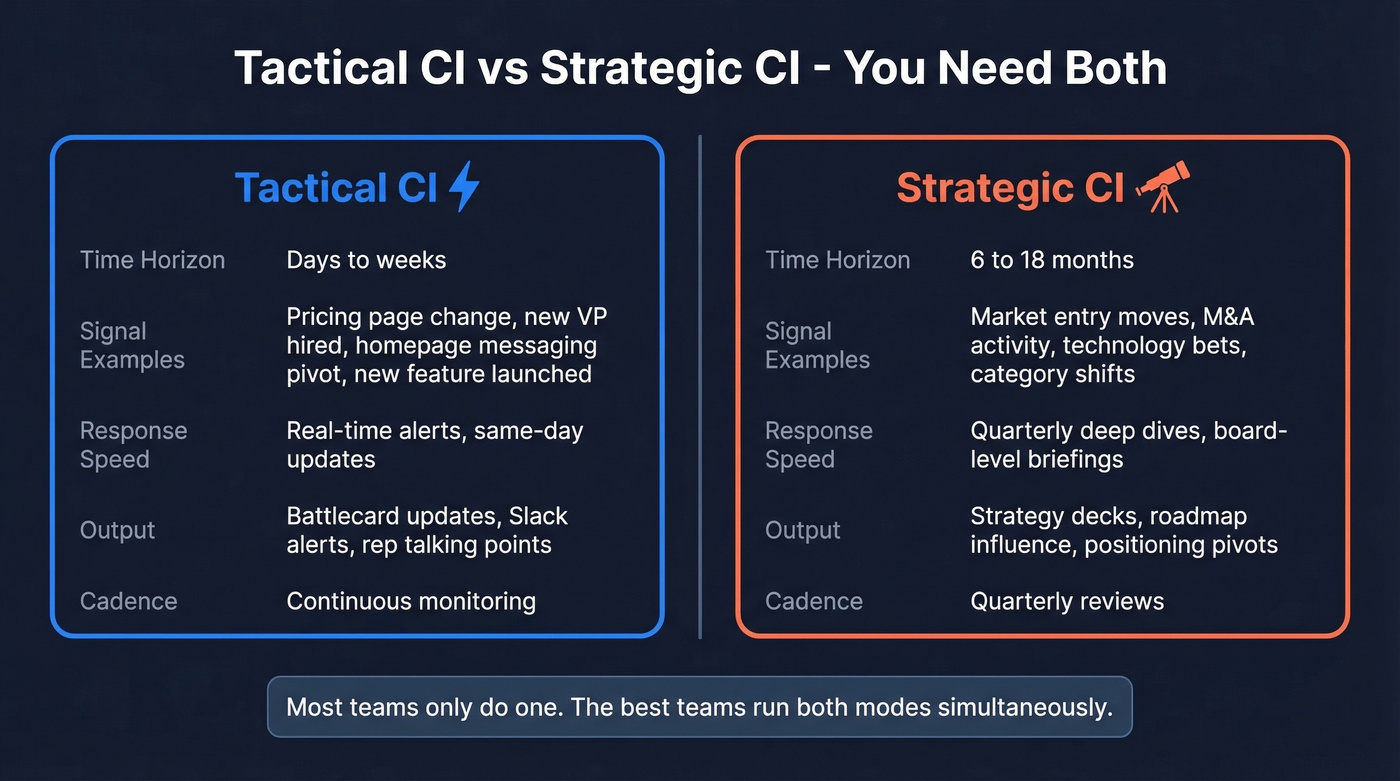
Strategic CI looks at long-term patterns: market entry moves, M&A activity, technology bets that won't pay off for 18 months. Signal volume is exploding, and agentic AI is starting to automate the capture-and-interpret loop, but governance around privacy laws and platform terms of service is a constraint many teams underestimate. Set up real-time alerts for tactical signals and quarterly reviews for strategic patterns. Both modes matter. Most teams only do one.
Why CI Programs Fail
We've seen CI programs die the same three ways, over and over.
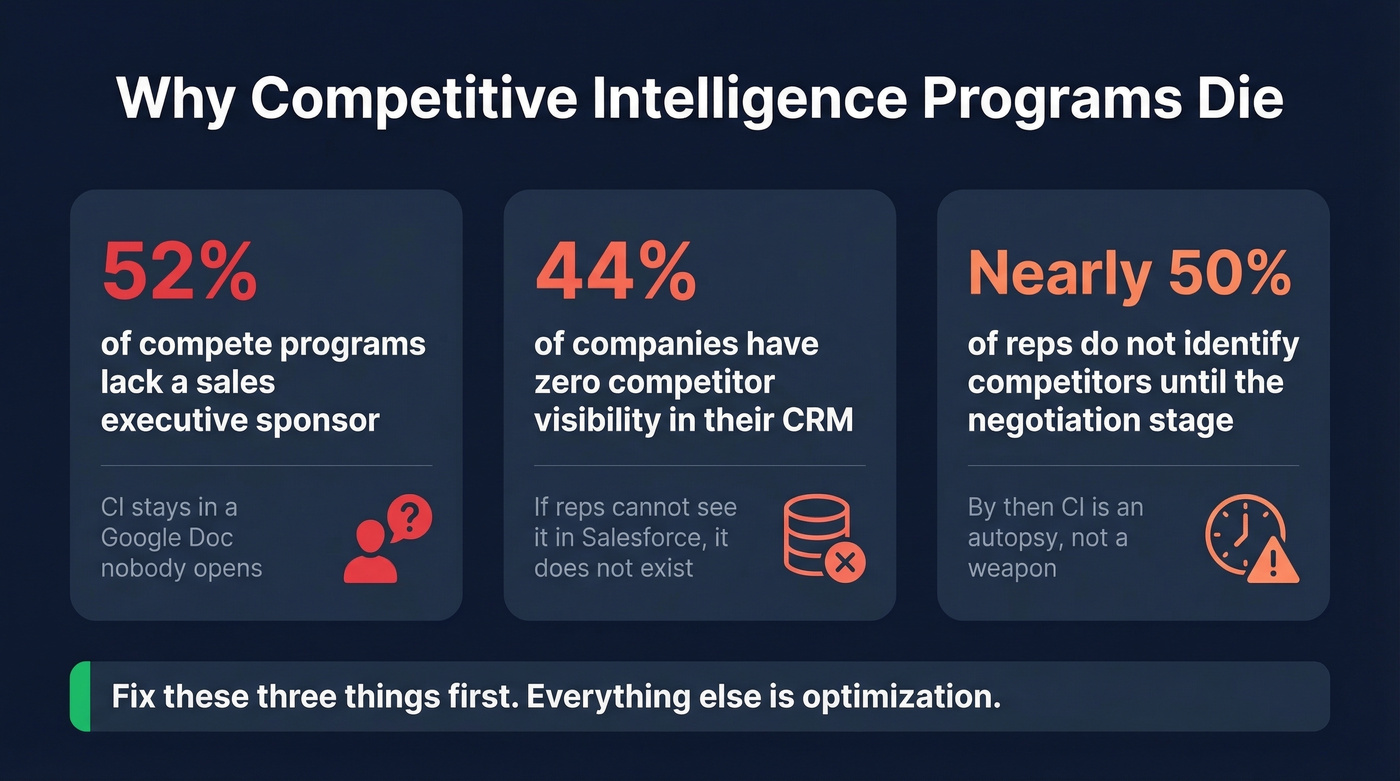
No executive sponsor. 52% of compete programs lack a sales executive sponsor. Without one, CI stays in a Google Doc that nobody opens - the 40-slide quarterly deck that nobody acts on.
No CRM visibility. 44% of companies lack competitor visibility within their CRM. If reps can't see competitive context inside Salesforce or HubSpot, the intelligence doesn't exist at the moment it matters.
Too late in the cycle. A Klue survey of 300+ revenue leaders found that nearly half of reps don't identify who they're competing against until the negotiation stage. By then, CI is an autopsy, not a weapon.
Building a CI Practice That Sticks
Let's be honest: if your average deal size is under $15K, you probably don't need a $40K CI platform. You need discipline. Google Alerts for monitoring, clean CRM competitive fields for capture, and a weekly review habit gets you most of the value. Reps using CI tools save 8-12 hours per month on competitor research - that's real pipeline time recovered.
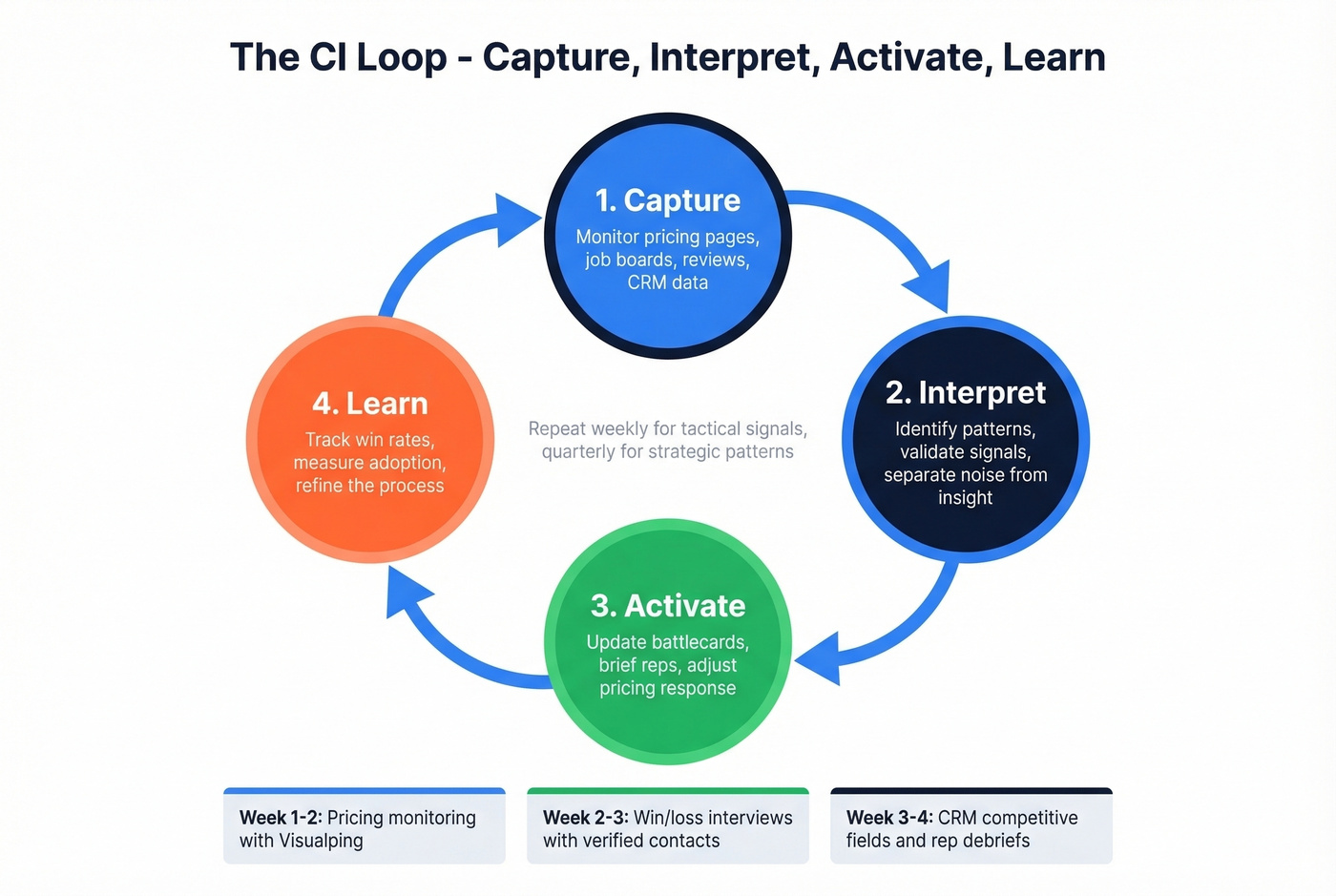
We've watched teams go from zero CI to functional programs in under a month by starting with pricing intelligence, win/loss analysis, and customer intelligence - the three types closest to revenue. Layer in the rest as your program matures and earns budget. The capture, interpret, activate, learn loop is the right framework. Keep the tools simple until the process proves itself.
One team we worked with ran their first win/loss sprint in two weeks: they pulled 200 lost-deal contacts from Salesforce, verified them in bulk, and booked 34 interviews within 10 days. The patterns they found - a competitor was offering 18-month contracts at a 40% discount to lock out renewals - changed their entire pricing response strategy. That's what CI looks like when it actually works.
The best competitive intelligence comes from people - churned customers, lost-deal contacts, former champions at rival accounts. Prospeo's 300M+ profiles and 125M+ verified mobiles help you reach them directly, not guess at outdated data.
Stop losing CI interviews to bounced emails and disconnected numbers.
FAQ
What's the difference between competitive intelligence and market research?
Market research studies your buyers and total addressable market. Competitive intelligence studies your competitors - their moves, pricing, positioning, and strategy. They overlap on market intelligence, but CI is adversarial by nature and feeds directly into sales enablement.
Which CI type should I start with?
Pricing intelligence. It has the most direct impact on win rates, it's the easiest to collect with a free tool like Visualping, and it gives your sales team ammunition for the very next call. Layer in customer and sales intelligence within the first 30 days.
How do I build accurate contact lists for win/loss interviews?
Stale contact data is the #1 reason win/loss programs die. Bulk verification at 98% accuracy on a 7-day refresh cycle lets you upload lost-deal contacts, verify them same-day, and start scheduling conversations that week - at roughly a penny per verified email.