

Types of Salespeople: What the Research Actually Says
Every listicle ranking the types of salespeople gives you a different number - 4 types, 7 types, 11 types - with zero research behind most of them. The truth is simpler. The most widely cited large-scale taxonomy is the Challenger study from CEB/Gartner, and it tells a story most sales managers don't want to hear.
Sales fuels nearly 13% of all US jobs, and CEB's research found that 53% of customer loyalty comes down to the sales experience - not the product, not the brand, not the price. So the type of salesperson you are (or hire) matters enormously. But personality type isn't the variable that predicts success. Role fit is.
Key Takeaways
The only large-scale research most people cite on salesperson types is the Challenger study - 54% of top performers fit the Challenger profile, while Relationship Builders account for just 7%.
The most practical distinction is hunter vs. farmer, which maps directly to modern org roles: SDR, AE, AM, CSM.
Personality type doesn't predict sales success. MBTI and DISC measure behavior, not quota attainment. Ask r/sales whether personality type matters and you'll get contradictory answers - which is exactly the point.
The Challenger Framework: Where the Real Data Lives
Brent Adamson and Matthew Dixon's research team had managers evaluate sellers against each other on 44 attributes. The results clustered into five distinct profiles.
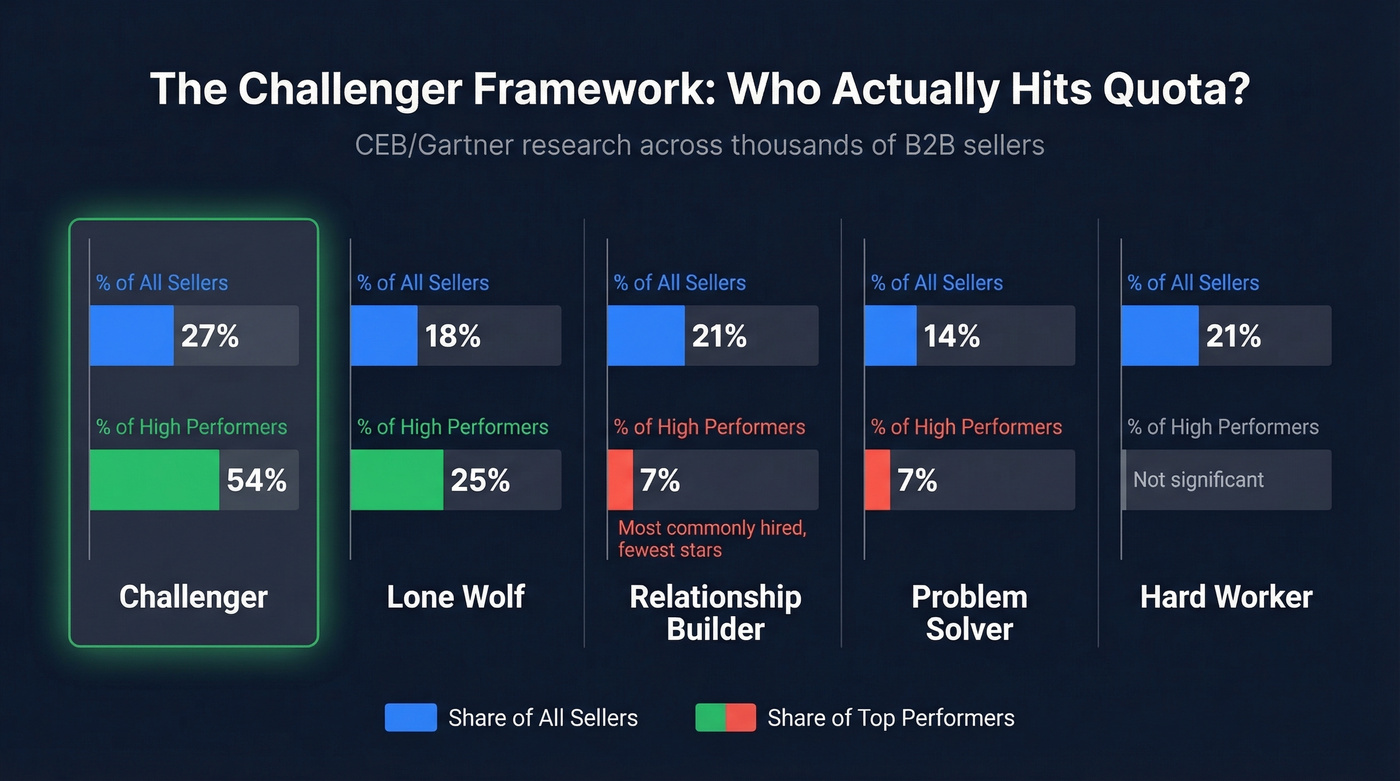
| Profile | % of All Sellers | % of High Performers |
|---|---|---|
| Challenger | 27% | 54% |
| Lone Wolf | 18% | 25% |
| Relationship Builder | 21% | 7% |
| Problem Solver | 14% | 7% |
| Hard Worker | 21% | Not significant |
Let that sink in. 54% of high performers are Challengers. Relationship Builders - the profile most sales managers instinctively hire for - produce the fewest stars at just 7%.
What separates Challengers is the Teach/Tailor/Take Control triad. They teach prospects something new about their business, tailor their message to the stakeholder, and take control of the commercial conversation. They create constructive tension. They're not afraid to push back.
This doesn't mean you should fire every Relationship Builder on your team. It means that in complex B2B sales, the ability to challenge a buyer's assumptions matters more than likability. The Lone Wolf numbers reinforce this - independence and conviction outperform agreeableness. Other frameworks exist. Sandler Training breaks sellers into three types: The Giver, The Teller, and The Sense Maker. Rory Vaden describes four categories: hunters, gatherers, farmers, and planters. Both are useful mental models, but neither has the same performance distribution data behind it.
Hunter vs. Farmer in B2B Sales
If the Challenger framework explains how top sellers behave, the hunter/farmer split explains how to structure your org. This distinction actually shows up on your org chart.
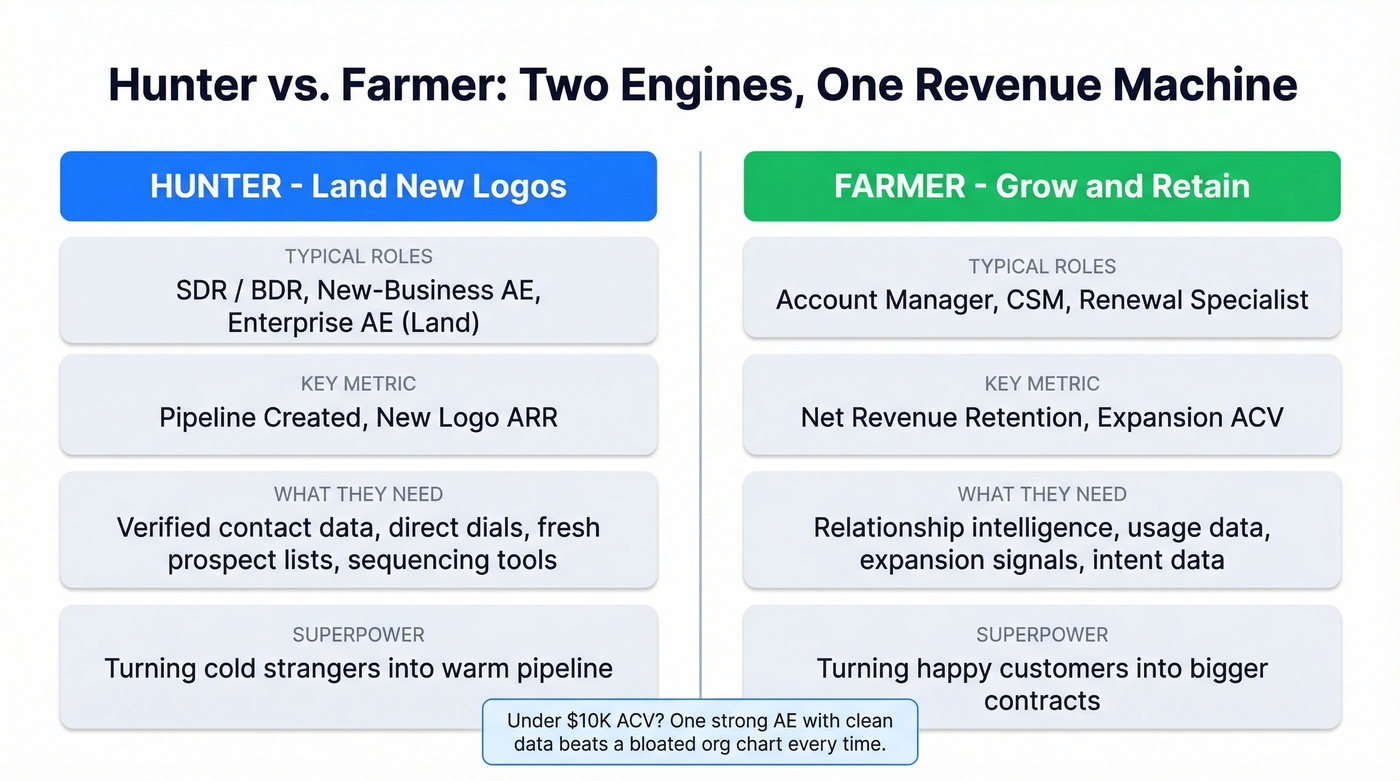
The Alexander Group identifies four coverage models in modern SaaS companies, ranging from single account ownership to fully bifurcated models where hunters land new logos and farmers expand and renew them. Only about 15% of SaaS/subscription companies run a fully bifurcated model, but those that do produce more than $2.3MM in growth ACV bookings per seller.
| Hunter Roles | Farmer Roles |
|---|---|
| SDR / BDR | Account Manager |
| New-business AE | CSM |
| Enterprise AE (land) | Renewal Specialist |
Hunters live and die by pipeline. They need verified contact data, direct dials, and fresh prospect lists. Farmers need relationship intelligence, usage data, and expansion signals. The tooling requirements are completely different, even though both roles sit under the same CRO.
Here's the thing: if your average deal size is under $10K, you probably don't need a fully bifurcated hunter/farmer model. One strong AE with clean data and a good sequencer will outperform a bloated org chart every time.
And if your manager hired you as a hunter but handed you a book of existing accounts, they don't have a hiring problem. They have a sales execution problem.

Hunters need fresh pipeline. Farmers need expansion signals. Both need verified contact data that actually connects. Prospeo gives every seller type 300M+ profiles with 98% email accuracy and 125M+ verified mobiles - refreshed every 7 days, not every 6 weeks.
Stop debating seller types and start giving your team data that converts.
Three Selling Styles Worth Hiring For
Beyond frameworks and org charts, Venator Sales Group identifies three selling styles. Use this if you're building a team - skip it if you're self-assessing (there's a better tool for that below).
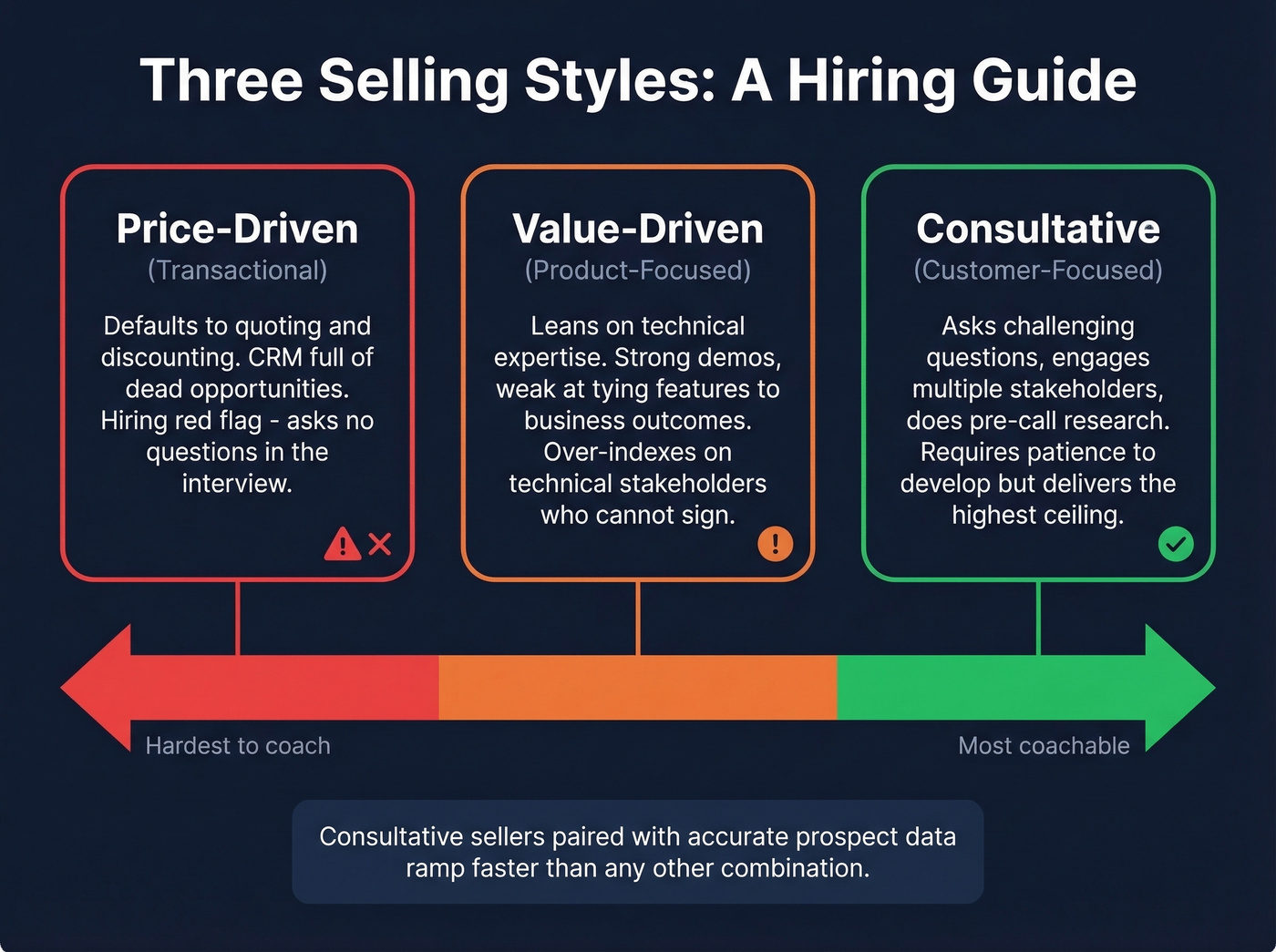
Price-driven (transactional). Defaults to quoting and discounting. CRM fills up with quoted opportunities that inevitably fall apart. Hiring red flag: lack of questions during the interview. This is the hardest style to coach out of someone.
Value-driven (product-focused). Leans on technical expertise. Strong in demos, weak at connecting features to business outcomes. Vulnerable to long sales cycles because they over-index on technical stakeholders who can't sign.
Consultative (customer-focused). Asks challenging questions, engages multiple stakeholders, does pre-call research. Most coachable. The style every sales leader says they want - and the one that requires the most patience to develop. We've found that consultative sellers paired with accurate prospect data ramp faster than any other combination, because they actually prepare for calls instead of winging them.
The Org Chart View
Sales "types" also map to a career ladder most reps climb in a predictable sequence. The entry point is SDR/BDR - prospecting, qualifying, booking meetings - with a typical tenure of 12-18 months before promotion. From there, reps move into Account Executive roles running demos and closing deals, then into Senior or Enterprise AE positions with larger accounts and longer cycles.
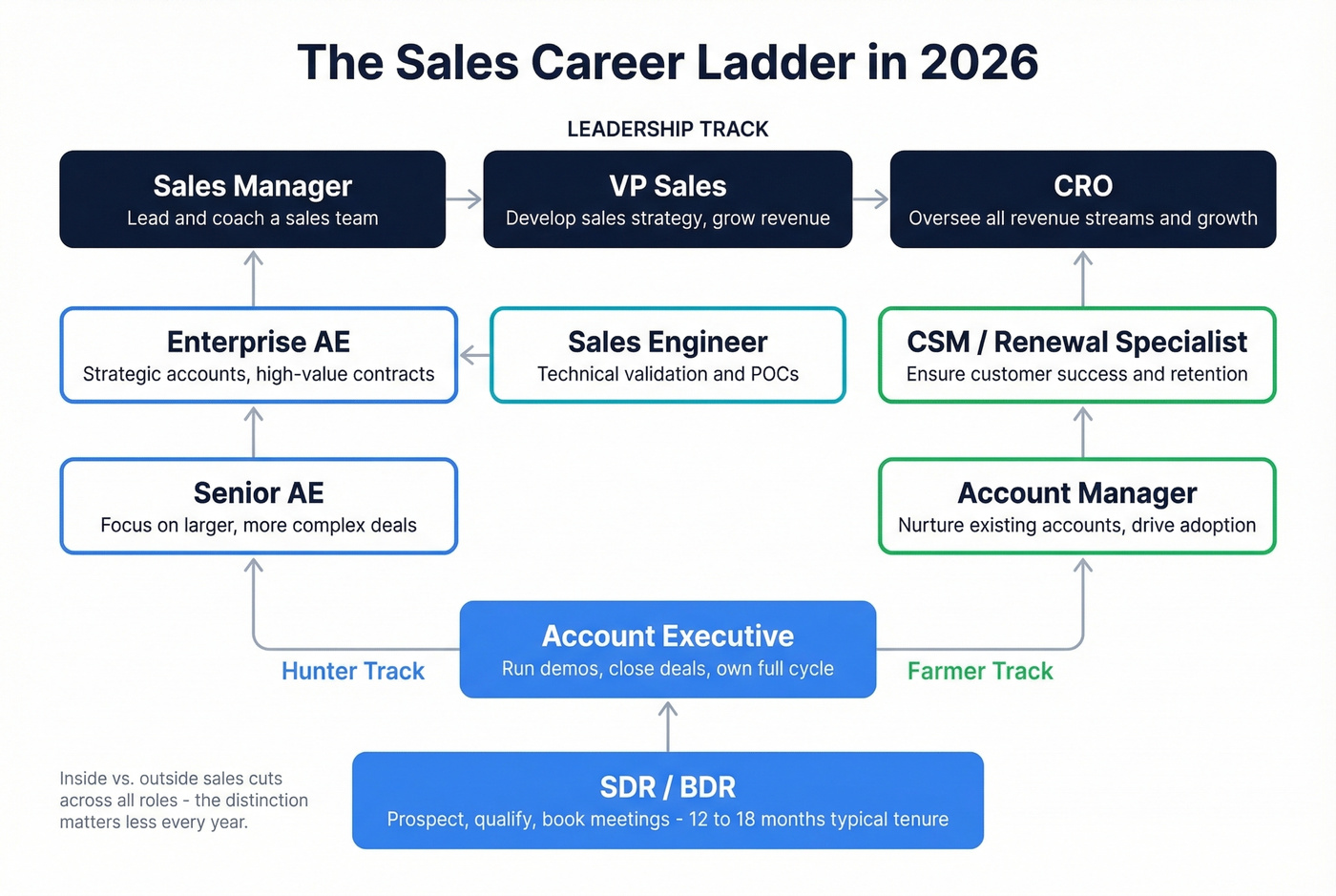
The farmer track branches into Account Manager and Customer Success Manager roles focused on expansion and retention. Sales Engineers handle technical validation and POCs. The leadership track runs Sales Manager to VP Sales to CRO.
Inside sales and outside sales cut across all of these roles. The distinction matters less every year - we've seen fully remote Enterprise AEs closing seven-figure deals - but some industries still require face time.
What Top Performers Actually Do in 2026
Forget the archetypes for a moment. Across every framework, top performers in modern B2B sales share a handful of concrete behaviors:
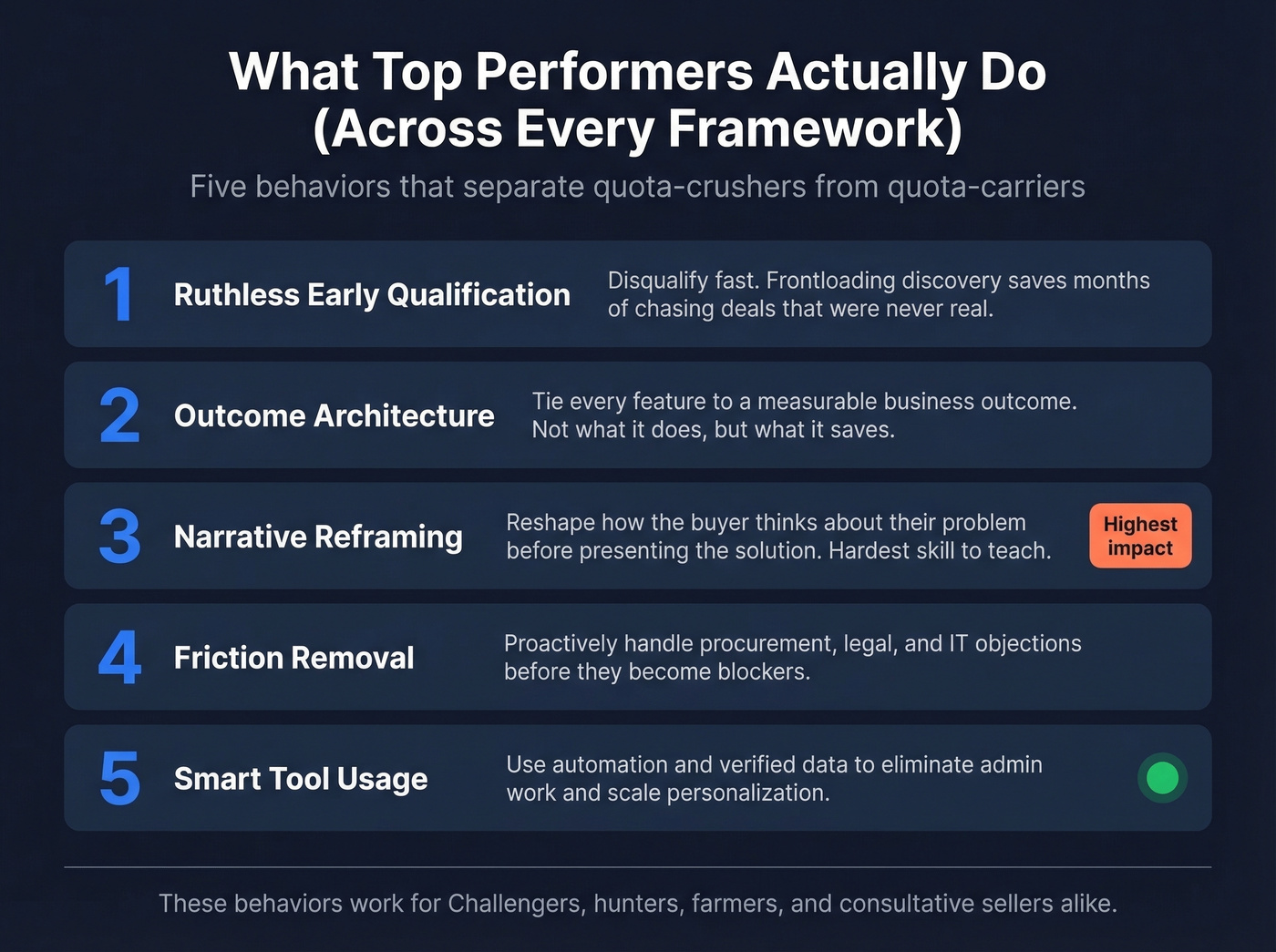
Ruthless early qualification. They disqualify fast. Frontloading discovery saves months of chasing deals that were never real.
Outcome architecture. They tie every feature to a measurable business outcome the buyer cares about. Not "our platform does X" but "this saves your team 12 hours a week, which means you don't need that extra hire in Q3."
Narrative reframing. Challenger-adjacent: they reshape how the buyer thinks about their problem before presenting the solution. This is the single hardest skill to teach, and the one that separates quota-crushers from quota-carriers.
Friction removal. They proactively handle procurement, legal, and IT objections before those teams become blockers.
Smart tool usage. They use automation and verified data to eliminate admin work and scale personalization. Every seller type - Challenger, hunter, farmer, consultative - depends on reaching the right person with accurate contact information. Prospeo's database spans 300M+ professional profiles, including 143M+ verified emails at 98% accuracy and 125M+ verified mobile numbers, all refreshed every 7 days. The free tier gives you 75 verified emails per month - enough to test whether clean data changes your connect rates.
Consultative sellers who prep for calls ramp faster than any other type. But prep is useless if your contact data bounces. Prospeo's 5-step verification and proprietary email infrastructure keep bounce rates under 4% - so every Challenger, hunter, and farmer on your team reaches real buyers.
Accurate data is the one advantage every salesperson type needs.
Quick Self-Assessment
HubSpot's selling styles framework offers a four-quadrant model worth five minutes of your time:
Repairperson: Diagnoses before prescribing. Technical background, consultative instinct. Prefers solving problems to pitching products.
Shopkeeper: Service-oriented, responsive. Thrives when buyers know what they want. Common in inbound roles.
Hunter: Chases new logos. Aggressive, energized by the close. Risk: leaving half-alive deals behind.
Farmer: Relationship-first, team-oriented. Grows accounts better than opening them.
For a secondary lens, the DISC model maps sellers on pace (fast vs. cautious) and orientation (questioning vs. accepting). D-styles want speed and ROI. S-styles want sincerity and low pressure. Knowing your buyer's style matters as much as knowing your own - maybe more.
FAQ
Which type of salesperson is most successful?
Challengers. CEB/Gartner's research shows 54% of high performers fit the Challenger profile. They teach, tailor, and take control of the sales conversation rather than defaulting to relationship-building. Relationship Builders - the most commonly hired profile - account for only 7% of top performers.
What's the difference between a hunter and a farmer in sales?
Hunters (SDRs, new-business AEs) prospect and close new accounts. Farmers (AMs, CSMs) grow and retain existing customers. About 15% of SaaS companies fully separate these roles, and those that do average $2.3MM+ in growth ACV per seller.
Does personality type predict sales success?
No. Role fit, process discipline, and data quality matter far more than MBTI or DISC profiles. There's no magic personality type for sales - Challengers succeed through learned behavior, not innate traits.
What tools help different sales rep types perform better?
Hunters need verified contact data and direct dials to fill pipeline. Farmers need intent signals and enrichment for expansion plays. Prospeo covers both with 143M+ verified emails at 98% accuracy, 125M+ mobile numbers, and Bombora-powered intent data across 15,000 topics - starting with a free 75-credit tier.