

How to Validate a Yahoo Email Address in 2026 (And Why Most Validators Fail)
Your verification tool says the address is safe. You add it to your sequence. Three days later, Yahoo bounces it with a "550 high-probability spam" error and your domain reputation takes the hit.
If you need to validate a Yahoo email address, you're dealing with one of the trickiest domains in outbound. Yahoo Mail has 225M+ monthly active users - a massive chunk of any prospect list. You'll also see plenty of addresses on related domains like ymail.com, rocketmail.com, and aol.com. Yet Yahoo's mail servers are specifically designed to prevent mailbox enumeration, which breaks the verification methods most tools rely on.
The Short Version
Yahoo's SMTP behavior makes mailbox-level validation unreliable. Your best approach: syntax check, MX lookup, third-party verifier, then a low-volume test send. Segment Yahoo-family addresses into a separate sending pool with tighter throttling.
No single tool solves Yahoo verification completely. The smartest move is starting with pre-verified data so you skip the problem upstream.
Why Yahoo Addresses Are So Hard to Verify
Most email verification works by connecting to the recipient's mail server and asking "does this mailbox exist?" via the SMTP RCPT TO command. For many providers, a 250 response means yes and a 550 means no.
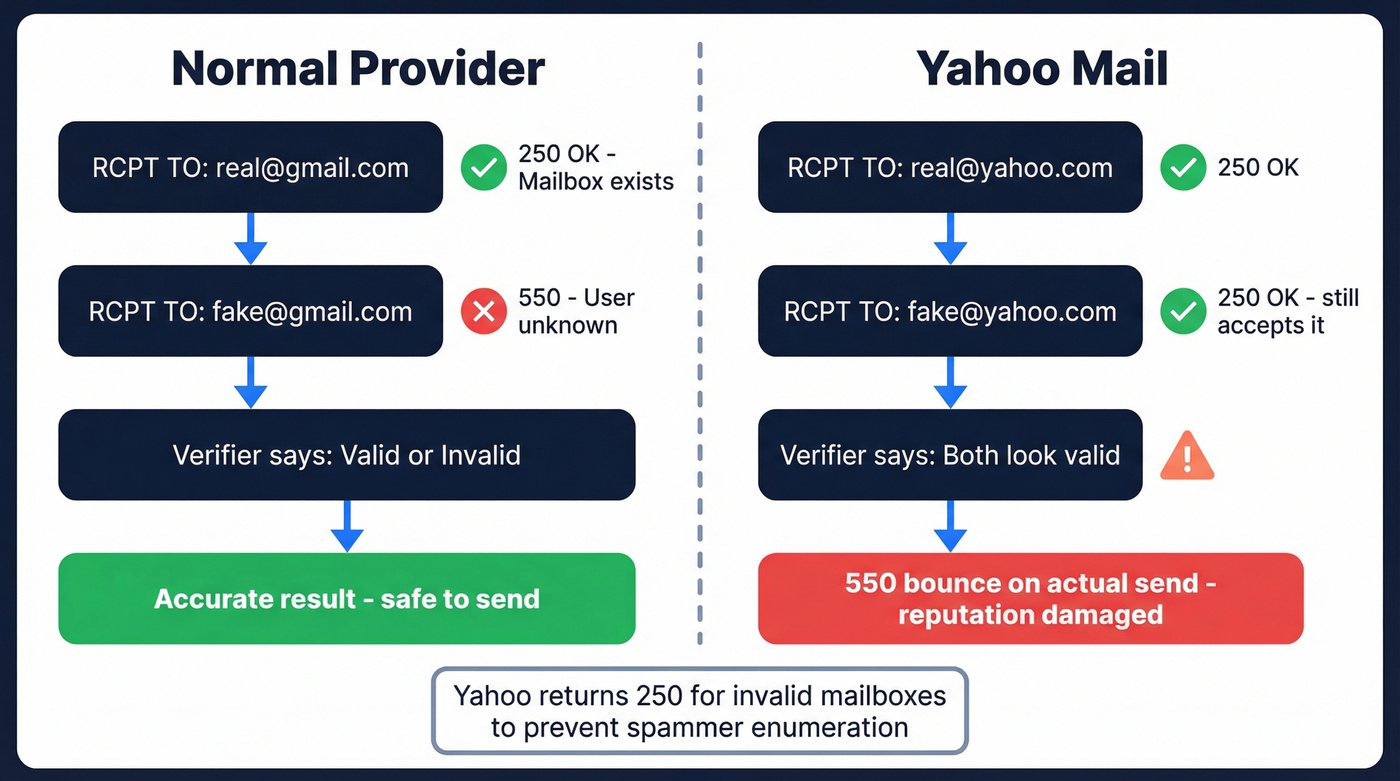
Yahoo breaks this model. In practice, SMTP checks for @yahoo.com can indicate an address is valid, but real sends later bounce. That's catch-all-like behavior designed to prevent spammers from scraping valid addresses, and it means your verification tool can't reliably tell real from fake using SMTP alone. We've seen this firsthand across dozens of client campaigns - a "verified safe" Yahoo address bouncing hard on the first send.
Then there are disposable addresses. Yahoo Mail Plus subscribers can create up to 500 disposable addresses in the format nickname-keyword@yahoo.com, while free accounts get up to 3. Messages route to the user's main inbox, but the disposable address can be deleted at any time - meaning an address that worked last month bounces today.
The 5-Step Yahoo Validation Process
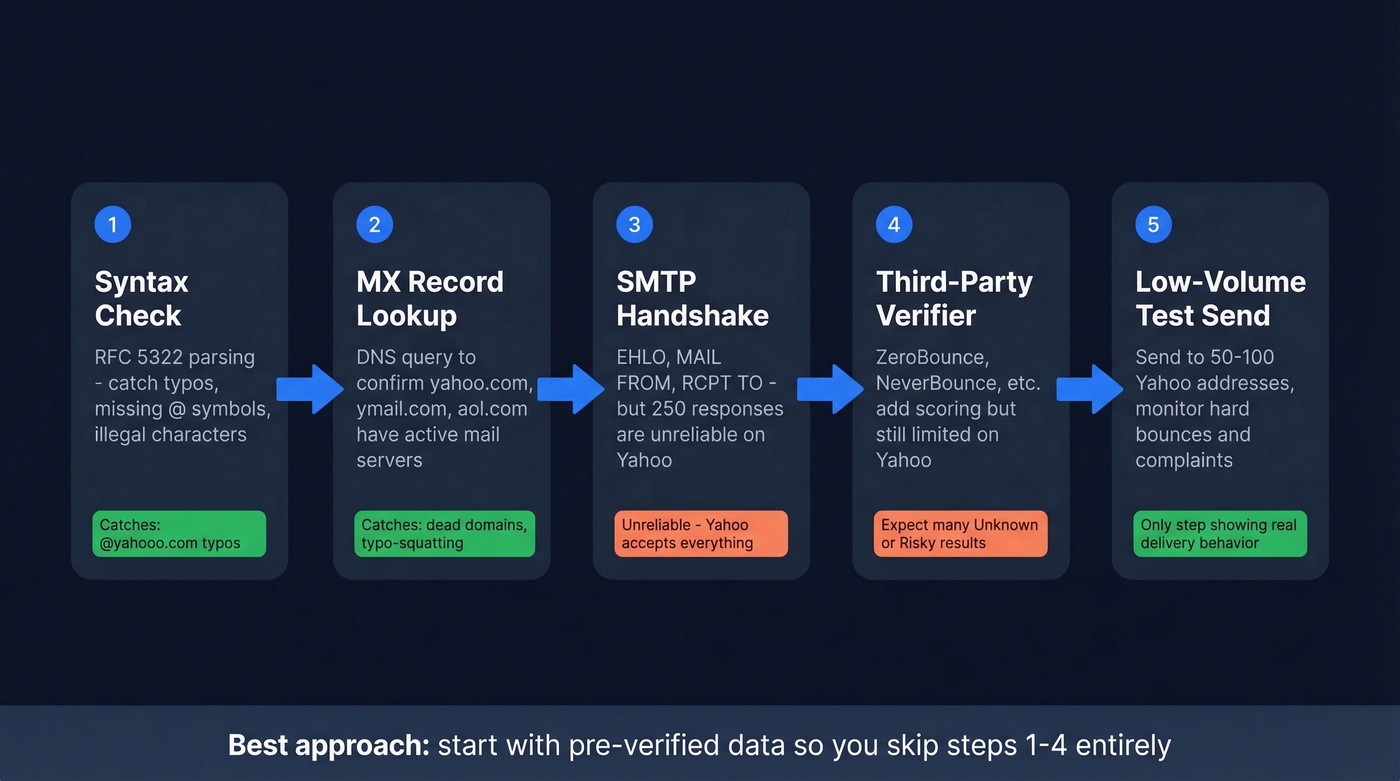
Step 1 - Syntax Check
Start with RFC 5322 parsing. This catches malformed addresses, typos like @yahooo.com, missing @ symbols, and illegal characters. Most programming languages have built-in parsers - Go's mail.ParseAddress, Python's email.utils - that handle this better than regex.
Step 2 - MX Record Lookup
Run a DNS MX lookup to confirm the domain has active mail servers. This verifies that yahoo.com, ymail.com, rocketmail.com, or aol.com is actually configured to accept mail. It won't tell you about the specific mailbox, but it catches dead domains and typo-squatted variants. Use MX record lookups specifically - not A or AAAA records, which can give misleading results.
Step 3 - SMTP Handshake
The standard flow is EHLO → MAIL FROM → RCPT TO. You'll still catch some failures - a 550/551/553 means permanent rejection, and 421/450 means temporary issues - but on Yahoo-family domains, a 250 isn't enough to trust as "mailbox exists."
| Response Code | Meaning | Reliable for Yahoo? |
|---|---|---|
| 250 | Accepted | No - can still bounce later |
| 550/551/553 | Permanent reject | Yes |
| 421/450 | Temporary / retry | Yes - wait 15-30 min |
Quick catch-all test: send a RCPT TO for a random gibberish address like xq7z9k2m@yahoo.com. If it returns 250, treat all 250 responses from that session as "unknown."
Step 4 - Third-Party Verifier
Bring in a dedicated verifier. Tools like ZeroBounce and NeverBounce layer scoring and categorization on top of SMTP checks, which helps - but doesn't solve the fundamental problem. For Yahoo-family addresses, expect more results to come back as "Unknown" or "Risky" than you'd like.
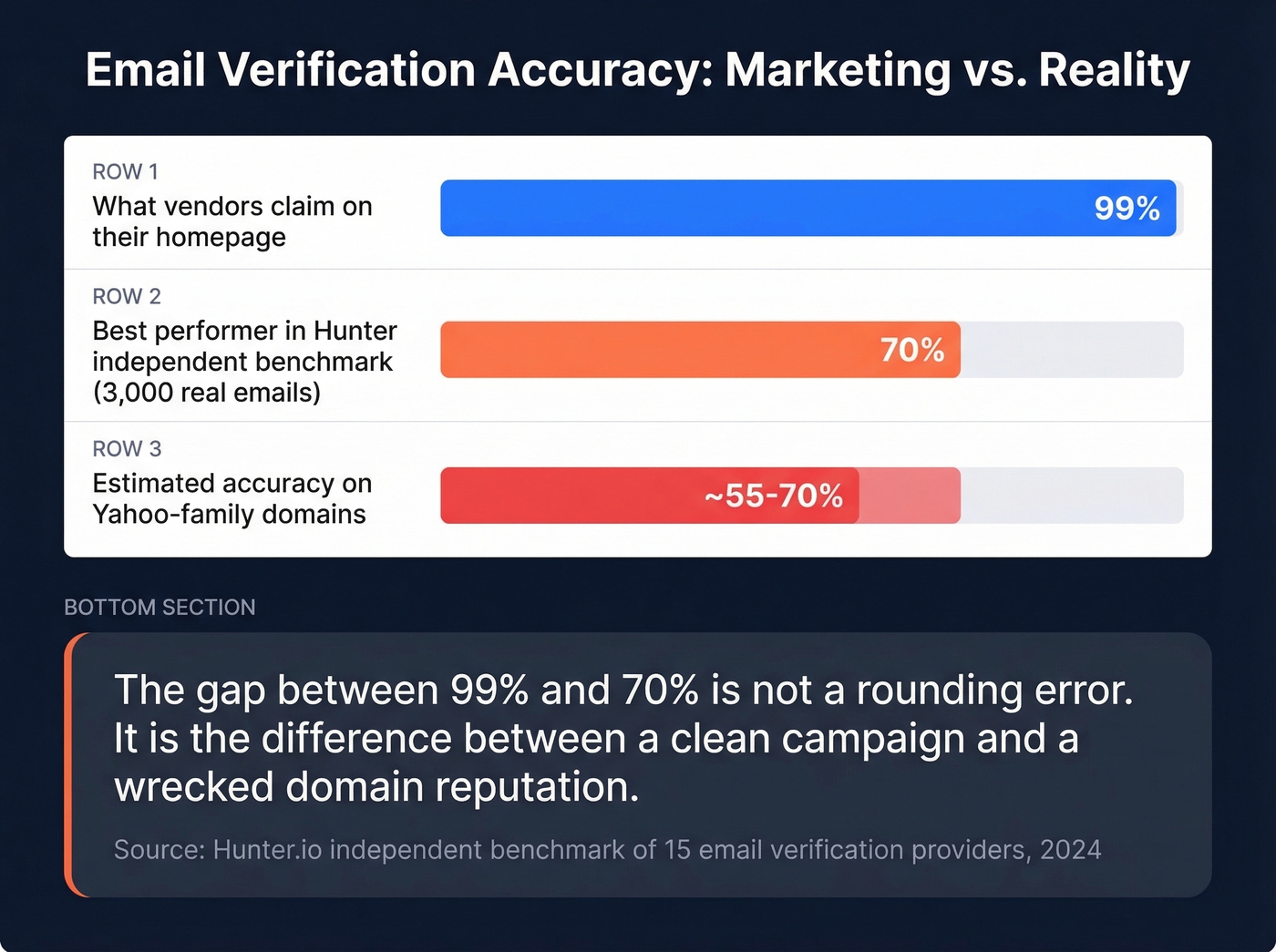
Any tool advertising "99% accuracy" on its homepage is quoting an aggregate marketing number, not a Yahoo-specific guarantee.
Step 5 - Low-Volume Test Send
Send to a small batch of 50-100 Yahoo-family addresses before blasting your full segment. Monitor hard bounces, soft bounces, and complaint signals. If your hard bounce rate exceeds 2%, pull back and re-clean. This is the only step where you see actual delivery behavior.

Yahoo's accept-all behavior breaks every SMTP-based verifier. Prospeo sidesteps the problem entirely - 143M+ emails are pre-verified through a 5-step process with catch-all handling and spam-trap removal, refreshed every 7 days. 98% accuracy across all domains, including Yahoo.
Stop validating Yahoo addresses. Start with emails that already work.
Why "99% Accuracy" Fails on Yahoo
Vendor accuracy claims are built on aggregate numbers across all domains. When Hunter ran an independent benchmark of 15 email verification providers using 3,000 real business emails, the top performer hit 70% accuracy. Not 99%. Seventy percent. Hunter ran this on their own dataset, which likely favors their tool - but the gap between marketing claims and reality is still enormous.
For Yahoo specifically, accuracy drops further. One r/coldemail user reported that Yahoo-family addresses marked "safe" by verifiers still bounced, and asked whether others just filter out Yahoo entirely. The consensus was mixed, but the frustration was universal.
Let's be honest: the "99% accuracy" number on a vendor's homepage is a marketing claim. On Yahoo, you're lucky to get 85%.
Best Verification Tools for Yahoo
| Tool | Cost per 1K | Yahoo Handling | Best For |
|---|---|---|---|
| Prospeo | ~$10 | Pre-verified, catch-all handled | Clean lists from scratch |
| ZeroBounce | ~$10 (2K min) | SMTP + scoring | Post-hoc list cleaning |
| NeverBounce | ~$8 | Standard SMTP check | High-volume batch jobs |
| Bouncer | ~$8 PAYG / ~$6.40 sub | SMTP + deliverability kit | Real-time verification |
| MillionVerifier | ~$3.70 | Basic SMTP check | Budget batch cleaning |
Prospeo - Skip Validation Entirely
The best way to handle Yahoo validation is to avoid the problem upstream. Prospeo's database of 143M+ verified emails runs a 5-step verification process with catch-all handling, spam-trap removal, and honeypot filtering before you ever download a contact. The 98% email accuracy rate holds across domains because Prospeo uses proprietary email-finding infrastructure rather than relying on third-party providers. Data refreshes every 7 days, so you aren't working with stale addresses. Free tier gives you 75 emails/month to test it.
Running Yahoo addresses through verifiers that top out at 70% accuracy costs you bounces, reputation, and pipeline. Prospeo's proprietary email infrastructure delivers 98% accuracy at ~$0.01/email - no third-party providers, no stale data, no catch-all guesswork.
Replace your 5-step workaround with one source of clean data.
ZeroBounce - Popular for Yahoo/AOL
ZeroBounce is the name that comes up most in practitioner discussions about Yahoo/AOL deliverability. It layers scoring on top of standard SMTP checks, which helps but doesn't solve the fundamental problem. One practitioner on r/coldemail said they used ZeroBounce with full SPF/DKIM/DMARC and still couldn't land in Yahoo's primary inbox after 5-6 weeks of warming. Pricing runs ~$10 per 1,000 verifications with a 2,000-email minimum. Solid tool, but don't expect miracles on Yahoo.
NeverBounce, Bouncer, MillionVerifier
NeverBounce (~$8/1K) is a go-to for high-volume batch verification. Fast processing, clean API, same Yahoo limitations as everyone else.
Bouncer (~$8/1K PAYG, ~$6.40 on subscription) adds a deliverability toolkit from $25/month - useful if you're verifying on form submission in real time.
MillionVerifier (~$3.70/1K) is the budget pick for teams cleaning large lists where cost matters more than edge-case accuracy.
None of these solve Yahoo's anti-enumeration problem. They'll catch syntax errors, dead domains, and known-bad addresses, but Yahoo "Unknown" results will still slip through.
Skip Yahoo entirely? If Yahoo and AOL addresses make up less than 10% of your list and your average deal size is under $15k, you're probably better off excluding them. The domain reputation risk isn't worth the handful of extra replies. We've seen teams waste entire weeks trying to salvage a segment that represents 6% of their pipeline.
Yahoo's Sender Requirements
Even a perfectly validated Yahoo email address will bounce your message if your sending infrastructure isn't compliant. Since February 2024, Yahoo has enforced stricter sender requirements for bulk mail:
- SPF, DKIM, and DMARC configured and passing
- Spam complaint rate under 0.3%
- One-click unsubscribe enabled and honored within 2 days
- Bulk sender thresholds around 5,000+ emails/day, with stricter alignment expectations at higher volumes
Teams with clean lists still get hit with Yahoo's "550 high-probability spam" bounce when authentication alignment is off. Validation gets you to the door. Authentication gets you through it.
The Yahoo Operational Playbook
Segment Yahoo/AOL addresses into a separate sending pool. Don't mix them with Gmail or Outlook recipients - their deliverability profiles are completely different, and a Yahoo bounce spike shouldn't tank your entire campaign.
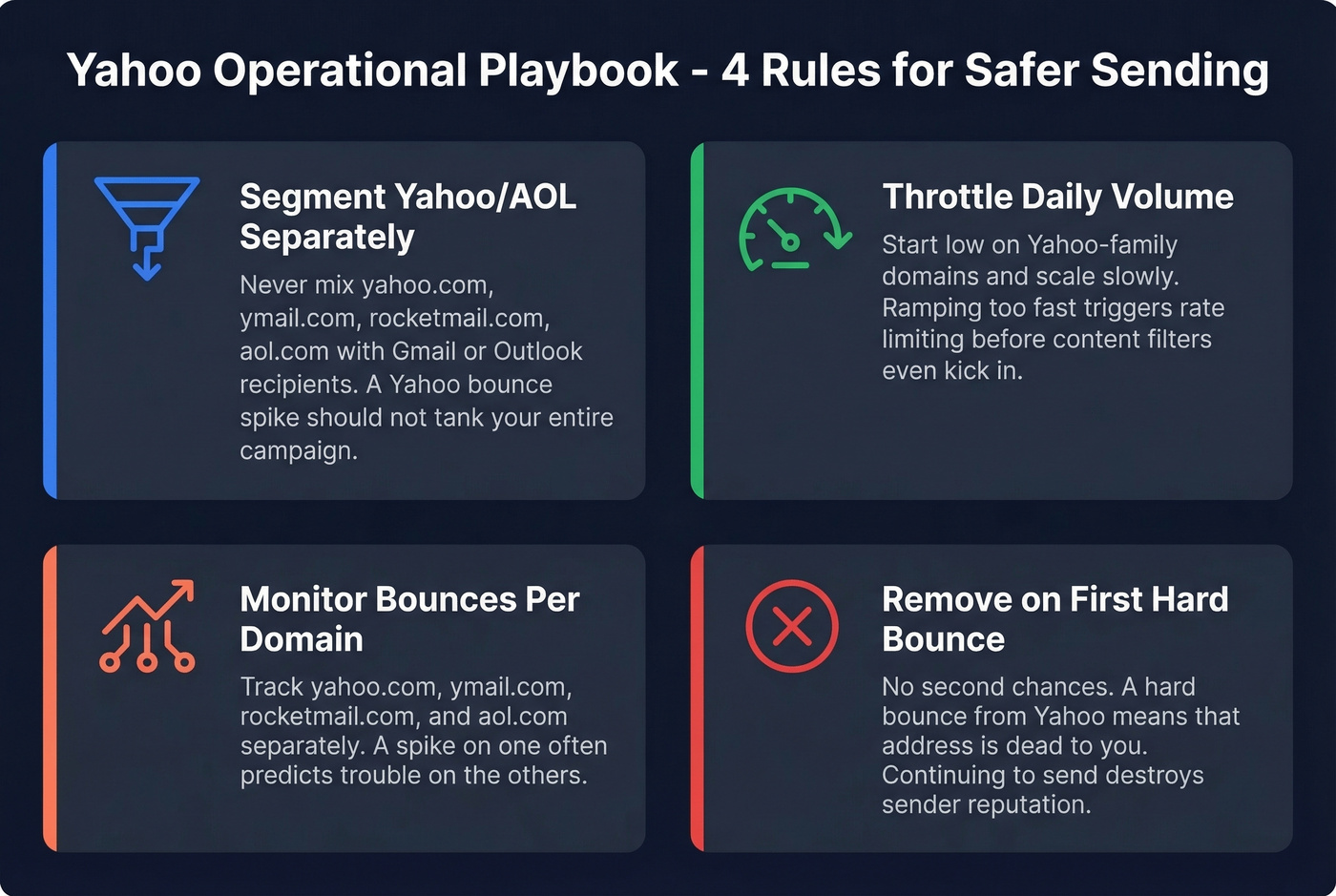
Throttle daily volume. Start lower for Yahoo-family domains and scale slowly. In our experience, ramping too fast on Yahoo triggers rate limiting before you even hit content-based filters. If you're unsure what "safe" looks like, use an email velocity framework.
Monitor bounce rates per domain family. Track yahoo.com, ymail.com, rocketmail.com, and aol.com separately. A spike on one often predicts trouble on the others - especially if you’re not watching your overall email bounce rate.
Remove on first hard bounce. No second chances. A hard bounce from Yahoo means that address is dead to you. If you suspect traps are involved, follow a dedicated spam trap removal process.
FAQ
Can you validate a Yahoo email without sending a message?
Partially. Syntax checks and MX lookups work without sending anything, but SMTP verification is unreliable because Yahoo prevents mailbox enumeration. Full confidence requires a low-volume test send to observe actual delivery behavior.
Why do verified Yahoo addresses still bounce?
Yahoo's anti-enumeration defenses return positive SMTP responses even for invalid mailboxes. Verifiers can't reliably distinguish real from fake, so a "safe" label doesn't guarantee delivery. Expect 5-15% false positives on Yahoo-family domains.
Does ymail.com use the same servers as yahoo.com?
They behave similarly for validation purposes in most real-world checks, which is why teams typically segment and throttle all Yahoo-family domains together.
What's a reliable alternative to SMTP-only Yahoo validation?
Start with a data provider that pre-verifies emails with catch-all handling before delivery. For existing lists, combine ZeroBounce or NeverBounce with low-volume test sends and per-domain bounce monitoring.
What's email validation vs. Yahoo account verification?
Email validation checks whether an address can receive mail. Yahoo account verification - 2FA, recovery codes, identity confirmation - proves you own the account. Different problems entirely.