

How to Verify a Contact's Email in 2026 (+ Tools)
A 2026 report analyzing nearly 1 billion email addresses across 23 industries found only 80.94% were valid. That means one in five contacts in your database is dead weight right now - and sending to them doesn't just waste sequences, it torches your sender reputation. Bounce rates above 5% trigger reputation damage, and recovering a burned domain takes 6-12 weeks of careful warmup.
The kicker: only 23.6% of B2B marketers verify their lists before campaigns. That's a staggering number of teams setting their own domains on fire for no reason.
What You Need (Quick Version)
- Prospeo - 98% accuracy with catch-all handling and spam-trap removal. ~$0.01/email. 75 free verifications + 100 Chrome extension credits per month.
- ZeroBounce - 100 free monthly checks (business email required). Good for occasional one-off lookups.
- Bouncer - Solid bulk verifier at ~$80/10k emails. No frills, just list cleaning.
How Email Verification Actually Works
Most people think verification means "check if the email looks right." It's actually a multi-layer process, and each layer catches problems the previous one missed:
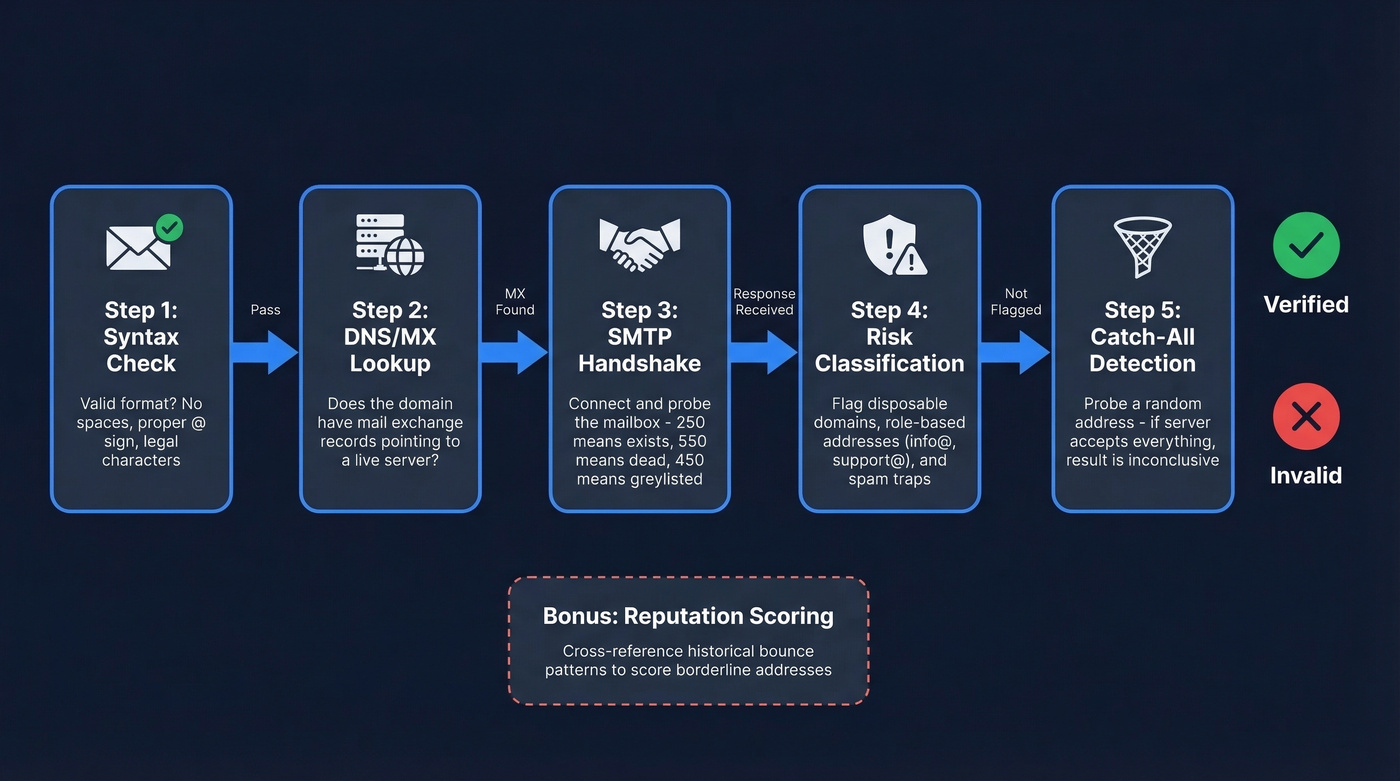
- Syntax check - Valid formatting? No spaces, proper @ placement, legal characters.
- DNS/MX lookup - Does the domain have mail exchange records pointing to a live server?
- SMTP handshake - The verifier connects and issues a
RCPT TOcommand. A250means the mailbox exists;550means it doesn't;450is greylisting. - Risk classification - Flag disposable domains (Guerrilla Mail, Mailinator), role-based addresses (info@, support@), and known spam traps.
- Catch-all detection - Probe a random address at the domain. If the server accepts everything, individual verification becomes inconclusive.
Most advanced tools add a sixth layer - reputation scoring - cross-referencing historical bounce patterns to score borderline addresses.
Greylisting is the sneaky one. It returns a temporary 450 code that looks like a failure but isn't. Cheap tools treat this as "invalid" and move on, which means you lose perfectly good contacts. Better tools retry from different IPs and time windows, treating patterns across multiple attempts as more reliable than any single response.
The Catch-All Problem
Here's the thing: 30-40% of B2B domains use catch-all configurations. On a 10,000-contact list, that's 3,000-4,000 addresses where standard SMTP verification simply can't tell you if the mailbox is real.
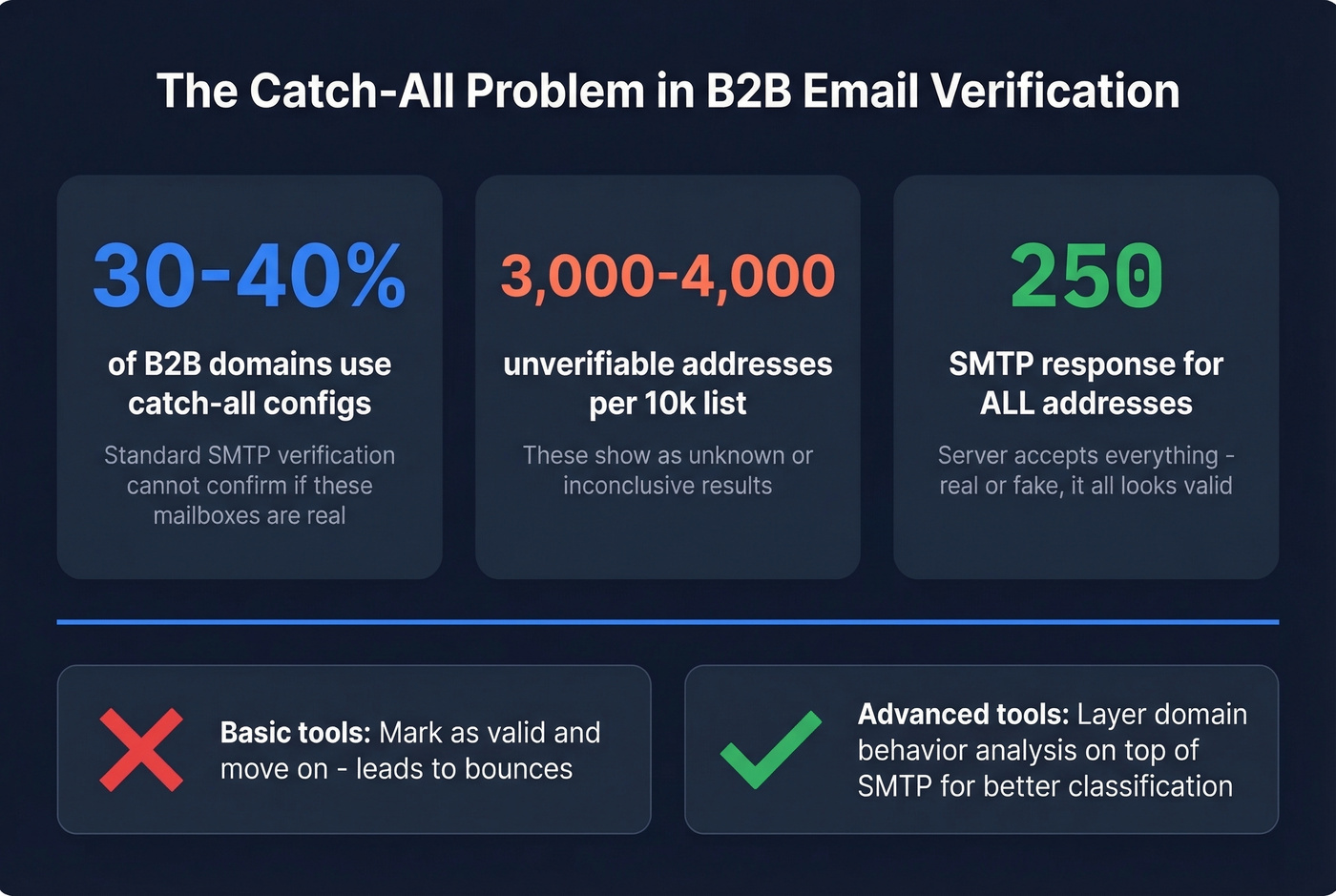
Catch-all servers accept mail for any address at the domain, so the RCPT TO probe returns 250 whether the person exists or not. Enterprise gateways like Proofpoint and Mimecast make this worse - they block verification probes entirely. In our experience, catch-all domains are the single biggest source of "unknown" results, which is why tools that layer domain behavior analysis on top of SMTP produce meaningfully better results on enterprise-heavy lists. The r/coldemail community talks about this constantly - if you're prospecting into mid-market and enterprise accounts, catch-all handling isn't optional.

30-40% of B2B domains are catch-all - and most verifiers give up on them. Prospeo's 5-step verification handles catch-all domains, strips spam traps, and removes honeypots using proprietary infrastructure. 98% accuracy at ~$0.01/email. Meritt dropped their bounce rate from 35% to under 4%.
Verify 75 emails free and see what your current tool is missing.
Best Tools to Verify Contact Email Addresses
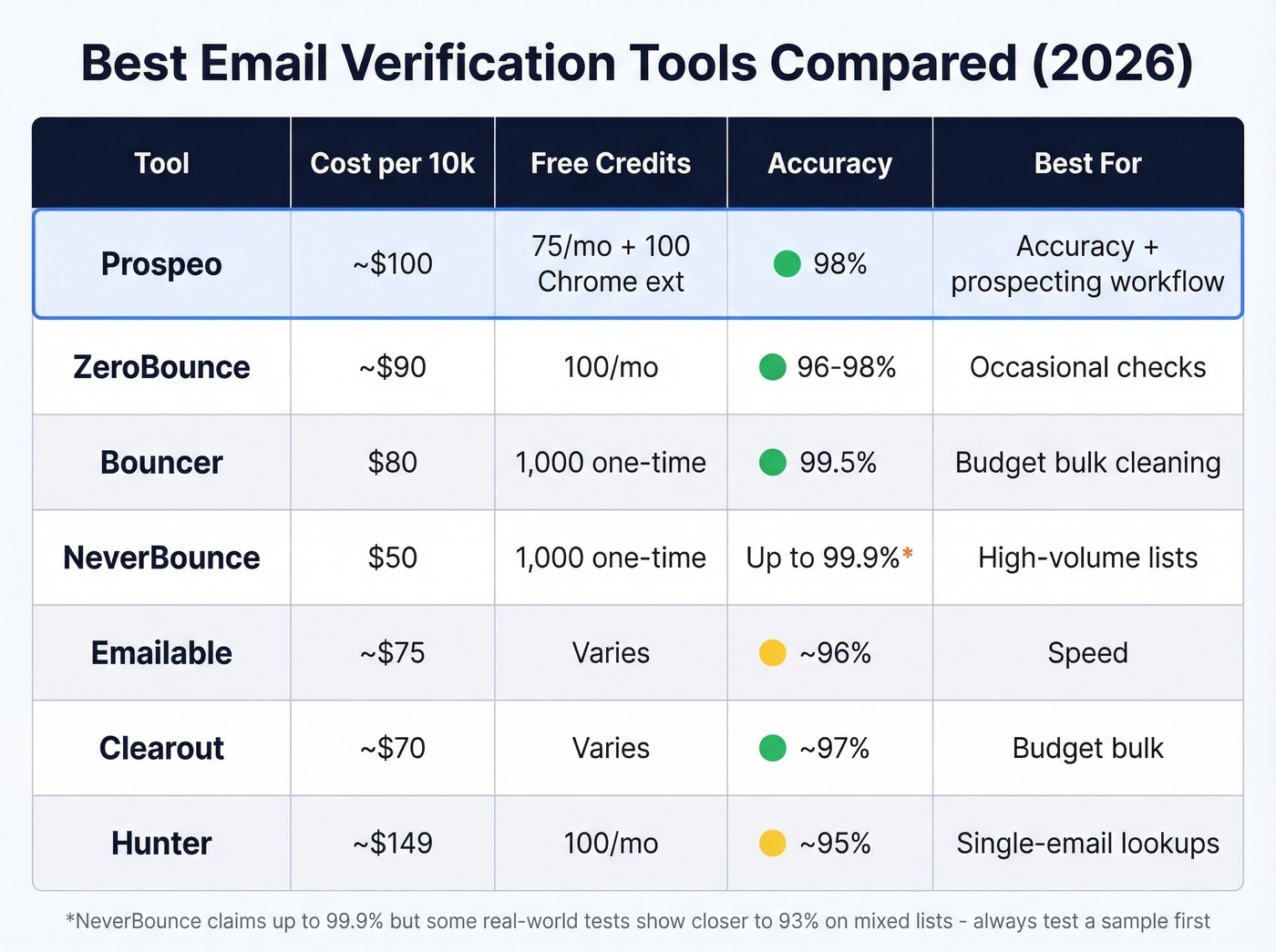
| Tool | Price/10k | Free Credits | Claimed Accuracy | Best For |
|---|---|---|---|---|
| Prospeo | ~$100/10k | 75/mo + 100 Chrome ext. credits | 98% | Accuracy + prospecting |
| ZeroBounce | ~$90 | 100/mo | 96-98% | Occasional checks |
| Bouncer | $80 | 1,000 one-time | 99.5% | Budget bulk cleaning |
| NeverBounce | $50 | 1,000 one-time | Up to 99.9% | High-volume lists |
| Emailable | ~$75 | Varies | ~96% | Speed |
| Clearout | ~$70 | Varies | ~97% | Budget bulk |
| Hunter | ~$149 | 100/mo | ~95% | Single-email lookups |
Prospeo
Use this if you want verification baked into your prospecting workflow so you never export an unverified address. Prospeo combines email finding with built-in 5-step verification - syntax, DNS, SMTP, catch-all handling, and spam-trap removal - all on proprietary infrastructure that doesn't rely on third-party email providers. At 98% email accuracy and ~$0.01 per email, it's the cheapest high-accuracy option on this list. The 7-day data refresh cycle means contacts don't go stale between campaigns, which matters more than most teams realize - we've seen lists degrade 3-5% per month without refreshes. Real-world proof: Meritt dropped their bounce rate from 35% to under 4% after switching. You get 75 free verifications + 100 Chrome extension credits per month to test it yourself.
ZeroBounce
ZeroBounce's free tier is the real draw: 100 monthly verifications, credits that never expire, and unknown results don't cost you anything. That last detail matters - on catch-all-heavy lists, you won't burn credits on inconclusive results. At scale (~$90/10k), it's competitive but not the cheapest. 60+ integrations cover most marketing stacks. Skip this if you're running high-volume outbound; per-email cost climbs fast past the free tier.
Bouncer
Bouncer is the "just clean my list" option. No prospecting features, no enrichment, no CRM integrations - just verification at $80/10k with 1,000 free credits to start. Independent tests generally support their 99.5% accuracy claim for standard domains, though catch-all performance is less impressive. The tradeoff: you'll export, clean, and re-import every time, which adds friction to every campaign. If that workflow doesn't bother you, Bouncer is the budget pick.
Hot take: NeverBounce markets "up to 99.9%" accuracy, but some comparisons peg real-world accuracy closer to ~93% for mixed lists. We've seen teams get better results from cheaper tools. Always test a sample before committing to a bulk plan.
Re-verifying before every send only works if your data isn't already stale. Prospeo refreshes all 300M+ profiles every 7 days - not the 6-week industry average - so contacts stay valid between campaigns. Built-in verification means you never export an unverified address.
Start with 75 free verifications. No credit card, no contract.
How Often to Re-Verify
At least 25% of email databases decay annually. We've seen teams cut bounce rates by 80%+ just by adding verification before every send - not quarterly, every single send. The practical minimum: re-verify every 3-4 months, or before any major campaign.
Add real-time validation at every data entry point - forms, CSV imports, CRM integrations. Catching bad addresses on the way in is always cheaper than cleaning them out later. One team we worked with was importing 2,000 contacts per week from webinar registrations, and roughly 8% were disposable or misspelled addresses that would've tanked their next nurture sequence.
Common Mistakes
Treating verification as one-time cleanup. This is the big one. Data decays constantly - people change jobs, companies rebrand, domains expire. Schedule quarterly re-verification at minimum and automate it through your CRM or data enrichment workflow.
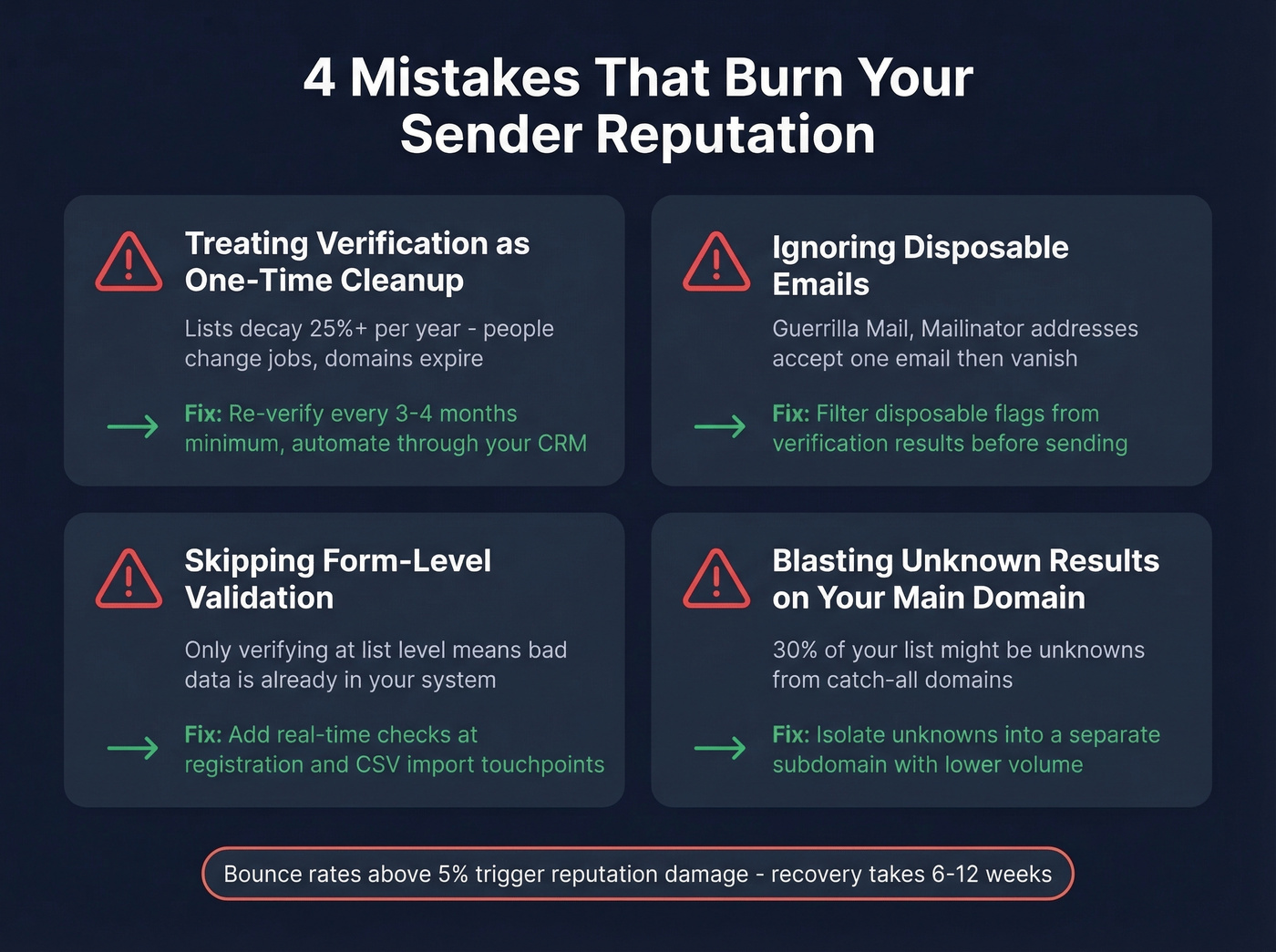
Ignoring disposable emails. Guerrilla Mail, Mailinator, and dozens of similar throwaway services generate addresses that'll accept your first email and then vanish. Any decent verification tool flags these, but you need to actually filter them out instead of sending anyway.
Skipping form-level validation. If you're only verifying at the list level, you're already behind. Add real-time checks at registration and import touchpoints so bad data never enters your system in the first place.
Sending to "unknown" results without segmenting. Look, we get it - you don't want to throw away 30% of your list. But blasting unknowns through your primary sending domain is reckless. Isolate them into a lower-volume stream with a separate subdomain to protect your main reputation.
FAQ
Is email verification the same as validation?
Practically, yes. "Validation" typically emphasizes syntax and formatting checks, while "verification" implies the full SMTP mailbox probe. Most tools use the terms interchangeably and perform both steps. Don't get hung up on the terminology.
Can I verify contact email addresses for free?
Yes. Prospeo offers 75 free monthly verifications plus 100 Chrome extension credits, ZeroBounce gives 100 free monthly checks, and Bouncer provides 1,000 one-time credits. For teams checking fewer than 100 addresses per month, these free tiers cover most needs without spending a dollar.
What's a safe bounce rate?
Keep hard bounces under 2%. Above 5%, you risk reputation damage - and recovery takes 6-12 weeks. Building a habit to verify contact email data before every send is the simplest way to stay well below that threshold, and it's far less painful than explaining to your VP of Marketing why your domain got flagged by Google.
How do I handle catch-all domains?
Segment catch-all results into a separate sending stream with lower daily volume. Tools that layer domain behavior analysis on top of SMTP do better at classifying these addresses, but no tool can guarantee 100% accuracy on catch-all domains. Throttle sends and monitor bounces in real time - if a catch-all domain starts bouncing above 5%, pull it immediately.