

Vibe Selling: What It Is and How to Start in 2026
A RevOps lead we know came back from a conference last month with a new mandate from the VP of Sales: "We need to start vibe selling." No definition. No budget. No plan. Just a buzzword scribbled on a napkin next to a booth number for a tool nobody had heard of.
Sound familiar? One founder on r/buildinpublic shared the numbers that drove him to search for the concept: 2 conversions from 500 cold calls, 4 from 30,000 cold emails. The average sales rep spends only 29% of their time actually selling - the rest vanishes into CRM updates, research, and meeting prep. That's the problem vibe selling is trying to solve, and the gap between the hype and the reality is worth understanding before you spend a dollar.
It isn't a methodology. It's a permission slip. Here's what that means, what the data says, and how to act on it this week.
The Short Version
- AI handles the admin so you can focus on human conversations. It's a workflow shift where AI does research, writing, CRM updates, and prep - and you invest that reclaimed time in live buyer trust.
- The data says it works. AI-augmented sales teams generate 41% more revenue per rep ($1.75M vs. $1.24M) while doing fewer activities. Conversion rates jump from 24.2% to 34.1%.
- It fails if your contact data is garbage. AI-personalized emails sent to unverified addresses can wreck your domain reputation faster than manual outreach ever could. Fix the data first, then automate.
Where Vibe Selling Came From
The term traces directly back to Andrej Karpathy's coinage of "vibe coding" in February 2025. His now-famous framing: "fully give in to the vibes, embrace exponentials, and forget that the code even exists." Describe what you want in natural language, let AI generate the code, iterate conversationally instead of line-by-line.
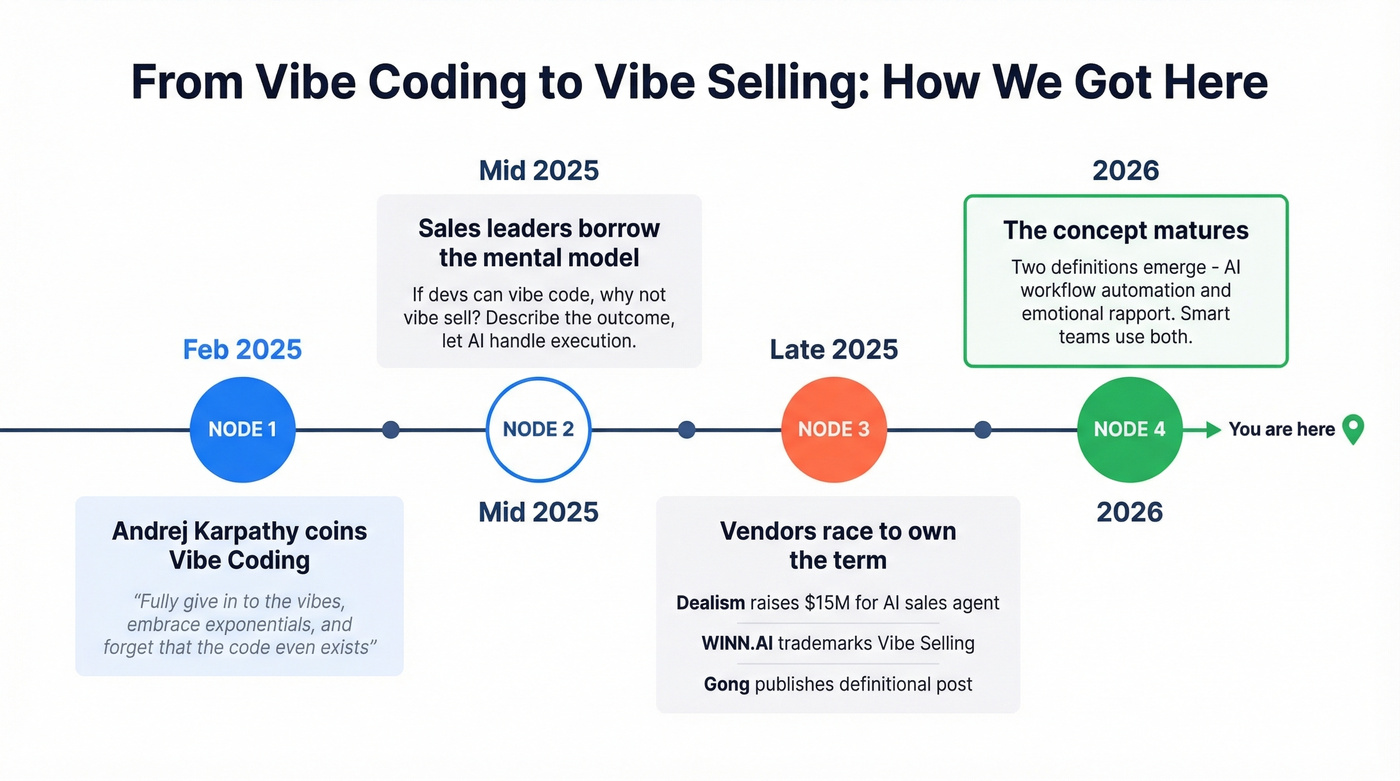
Within months, sales leaders started borrowing the mental model. If developers could "vibe code," why couldn't sellers do the same? Describe the outcome you want - a personalized email sequence, a competitive battlecard, a meeting prep brief - and let AI handle execution.
The market picked up the concept fast. Dealism announced a [$15M angel funding round](https://www.prnewswire.com/news-releases/dealism-launches-the-first-ai-sales-agent-built-on-vibe-selling - transforming-how-businesses-sell-and-build-trust-302614507.html) while positioning itself as the "first AI sales agent built on vibe selling." WINN.AI brands the term as Vibe Selling™. Gong published a definitional post on the concept. The land grab is on.
What Is Vibe Selling, Actually?
The definition depends on who you ask. Two distinct interpretations are circulating, and most articles mash them together.
The AI-Workflow Definition
This is Gong's framing: it means "less writing, more reacting." You tell AI what you need - an account research brief, a follow-up email, a competitive positioning doc - and review the output instead of building it from scratch. Gong explicitly calls this a "breakthrough framing, not a breakthrough technology." The underlying tech is existing genAI, but the mental model is new.
The critical boundary: enterprises can't vibe through live conversations yet. AI handles writing and research. Humans handle live buyer trust. Gong distinguishes semi-agentic workflows, where humans prompt and approve at each stage, from true agents that operate independently. Most enterprise teams are firmly in the semi-agentic camp. That's the right call for now.
The Emotional-Rapport Definition
Victor Antonio takes a different angle. His VIBE Selling framework centers on "talking to your data to discover new revenue opportunities" - using conversational AI integrated into revenue intelligence platforms to surface insights during live deals. Think negotiation support, intent signal detection, stakeholder mapping.
On r/VibeSelling, the concept gets framed more simply: matching energy, prioritizing emotional intelligence over scripts, leading with curiosity over control. DealHub frames it as a modern approach centered around connection and shared energy - focusing on how the buyer feels rather than leading with features. Salesforge's guide goes further, arguing reps should be more conversational and human, because polished AI-generated copy is now the baseline everyone ignores.
The Synthesis
Here's our take: both definitions are correct. They just describe different layers of the same shift.
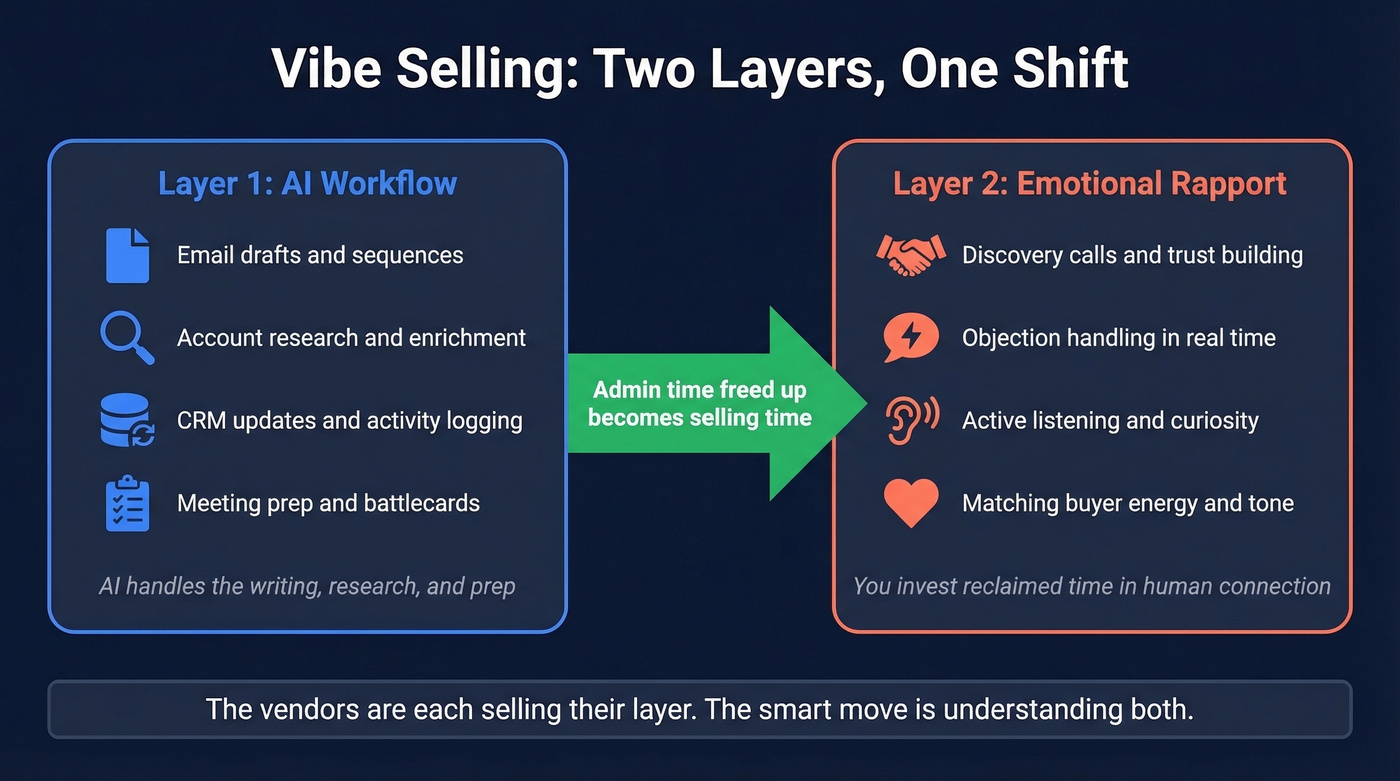
The AI-workflow layer frees you from admin. The emotional-rapport layer is what you do with that freed time. AI handles the writing, research, and prep. You invest the reclaimed hours in genuine human connection - the discovery calls, the objection handling, the trust-building that no LLM can replicate yet. The vendors fighting over the definition are each selling their layer. The smart move is understanding both.
Does AI-Augmented Selling Work?
An Optifai benchmark of 938 B2B companies (Q1-Q3 2025) compared AI-augmented teams against traditional ones. The results are hard to ignore:
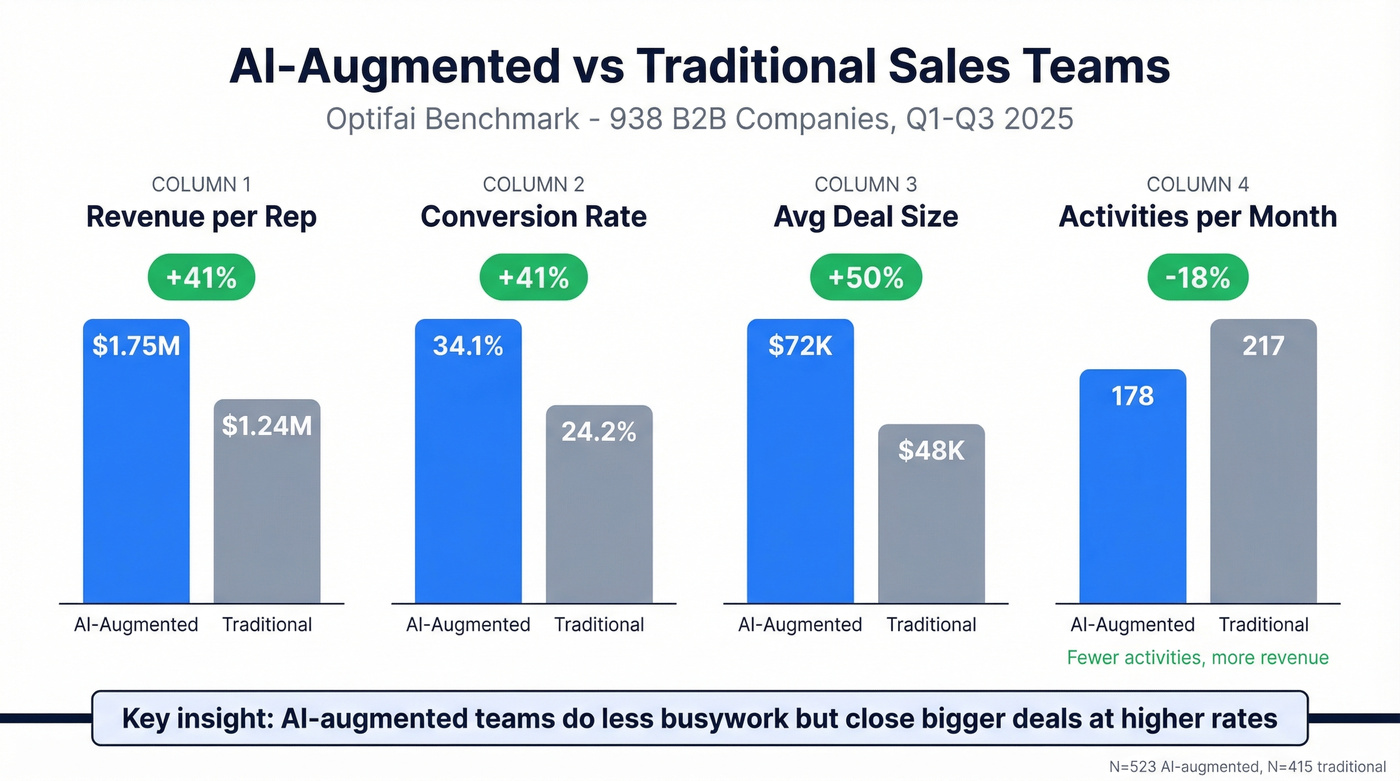
| Metric | AI-Augmented (N=523) | Traditional (N=415) | Difference |
|---|---|---|---|
| Revenue/rep | $1.75M | $1.24M | +41% |
| Conversion rate | 34.1% | 24.2% | +41% |
| Avg deal size | $72K | $48K | +50% |
| Activities/month | 178 | 217 | -18% |
Fewer activities, more revenue. That's the core promise, and this data supports it directionally - even accounting for the fact that Optifai has skin in the game.
Platform data from Outreach tells a similar story. Deals supported by their Kaia coaching assistant close 11 days faster on average. For deals over $50K, sellers using Kaia see up to a 10-percentage-point win-rate lift. Their baseline finding: opportunities closed within 50 days have a 47% win rate; after that threshold, it drops to roughly 20% or lower.
Let's be honest about the caveats, though. McKinsey's 2025 State of AI report found that while 88% of organizations use AI in at least one function and 62% are experimenting with AI agents, only 23% have scaled agentic AI anywhere in the enterprise. Most companies reporting EBIT impact from AI say it's under 5%. The lift is real. Scaling it is still the hard part.
Here's the thing: if your average deal closes under five figures, you probably don't need a $100K revenue intelligence platform. A verified contact database and one AI writing tool will get you 80% of the benefit at 5% of the cost. The remaining 20% is for teams running complex, multi-stakeholder enterprise deals where real-time coaching and deal analytics actually move the needle.

Vibe selling only works when AI-personalized emails reach real inboxes. Prospeo gives you 98% email accuracy with a 7-day refresh cycle - so your AI workflows don't burn your domain sending to dead addresses. At $0.01/email, it's the data layer that makes the whole vibe selling stack actually convert.
Fix the data first. Automate everything else second.
A Phased Playbook for 2026
Here's what we'd recommend for any team starting from scratch.
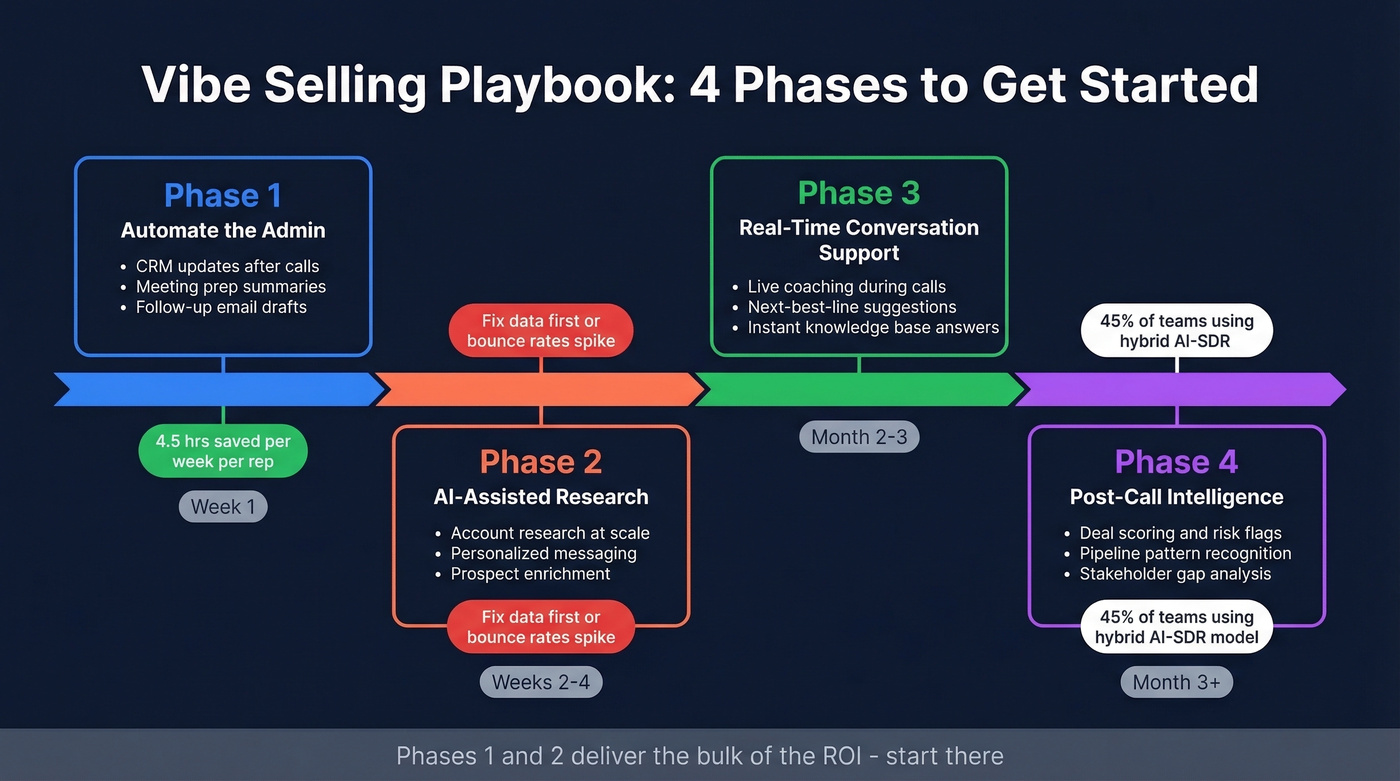
Phase 1 - Automate the Admin
Start here. This is the highest-ROI, lowest-risk move.
CRM updates after calls, meeting prep summaries, follow-up email drafts, activity logging - these are the tasks eating your reps' time. AI-driven automation saves sales professionals 4.5 hours weekly. That's over 200 hours per year per rep, redirected from data entry to actual selling.
Most teams can implement this in a week with tools they already own. If your CRM has AI features, turn them on. If it doesn't, a tool like WINN.AI or Gong can handle the capture-and-update loop.
Phase 2 - AI-Assisted Research
This is where the gains multiply. AI-generated account research, personalized messaging at scale, prospect enrichment before outreach - teams using AI for research and personalization report a 90% reduction in time spent on those tasks.
But this is also where the approach collapses if your contact data is stale. We've seen this pattern repeatedly: a team automates personalized outreach, sends 10,000 AI-crafted emails in a week, and watches bounce rates spike to 35%. Domain reputation tanks. Deliverability craters. The AI was brilliant - the data underneath it was garbage.
Snyk's sales team saw bounce rates drop from 35-40% to under 5% after switching to a verified data source, with AE-sourced pipeline up 180%. Fix the data first, then automate. The order matters.

Phase 3 - Real-Time Conversation Support
This is the frontier. Live coaching during calls, next-best-line suggestions, instant answers pulled from your knowledge base while you're on the phone with a prospect. WINN.AI is built around this real-time, in-call guidance model, and Gong is a major platform for call insights, coaching, and deal execution workflows.
Most teams aren't here yet, and that's fine. Phases 1 and 2 deliver the bulk of the ROI.
Phase 4 - Post-Call Intelligence
After the conversation ends, AI shifts to analysis. Deal scoring, pipeline pattern recognition, risk flagging. This is Victor Antonio's "talk to your data" vision in practice - asking your revenue intelligence platform which deals are stalling, which stakeholders haven't been engaged, which pricing objections are trending across the team.
Already, 45% of teams are using a hybrid AI-SDR model that blends automated prospecting with human follow-up. The post-call layer makes that hybrid smarter over time, surfacing patterns no individual rep would catch across hundreds of deals.
Tools to Know
This isn't a full buyer's guide - the category is too new for that. But here are the tools worth tracking.
Prospeo
Every AI sales tool assumes your contact data is accurate. Prospeo is the foundation layer that makes that assumption true. 143M+ verified emails at 98% accuracy, 125M+ verified mobile numbers with a 30% pickup rate, a 7-day refresh cycle, and intent data tracking 15,000 topics via Bombora - so you're reaching verified contacts who are actively in-market. The free tier gives you 75 verified emails per month plus 100 Chrome extension credits. Paid plans start at roughly $0.01 per email.
WINN.AI
The most literal interpretation of vibe selling as a product. They brand "Vibe Selling(TM)" and built their platform around real-time in-call guidance: live playbook prompts, instant answers from your knowledge base, coaching nudges, plus post-call CRM automation and Slack handoffs. AI joins the call and helps you stay in flow. Expect demo-based pricing; comparable tools often land around $20-50/user/month.
Gong
Already in Gong's ecosystem? Their AI features are an incremental add, not a new purchase. Gong's positioning is semi-agentic: AI handles writing, research, and deal analysis while humans stay on live conversations. Their tools draft emails, summarize calls, flag deal risks, and surface coaching insights. Enterprise pricing typically runs $30-100K+/year depending on seats and modules. The depth of deal intelligence is unmatched, but the onboarding cost makes it a harder sell for teams not already committed.
Outreach + Kaia
Best for teams that need sequencing and coaching in one platform. Kaia is the coaching layer that produced those 11-day-faster-close numbers. It listens to calls, surfaces relevant content, and provides real-time guidance. The broader platform handles sequencing, analytics, and pipeline management. Expect around $100-130/user/month for the full stack.
Dealism
The $15M angel round is the signal here. Dealism positions itself as the first AI sales agent built on this philosophy - adaptive, emotionally intelligent responses across WhatsApp Web, Instagram DMs, and mobile. The channel strategy is messaging-first, not email-first, which makes it interesting for teams selling through conversational channels. No public pricing yet; too early to evaluate performance, but worth a demo if your sales motion lives in messaging apps. Skip this if you're running a traditional email-and-phone outbound motion.
Where It Goes Wrong
The hype is real, but so are the risks. Here's where we've seen teams stumble.
Hallucinated personalization. AI-generated emails that congratulate a prospect on a promotion they never got, reference a company initiative that doesn't exist, or cite a blog post the prospect didn't write. One hallucinated detail destroys credibility faster than a generic template ever would. Always review AI-generated personalization before it ships.
TCPA compliance. The FCC's February 2024 declaratory ruling classified AI-generated voice calls as "artificial or prerecorded voice" under TCPA. They're legally robocalls and require prior express written consent. If your strategy includes AI voice outreach, your legal team needs to sign off before a single call goes out.
Deliverability collapse. The safe ceiling for cold outbound is roughly 200 emails per SDR mailbox per day (50 new, 150 follow-ups). Spam complaint thresholds sit at 0.3%, with best practice under 0.1%. AI makes it trivially easy to blow past these limits. Verify every email before it enters your sequence - a 5-step verification process with catch-all handling and spam-trap removal catches the contacts that would otherwise tank your sender reputation.
Data leakage. Samsung's 2023 ChatGPT leak is the cautionary tale every sales leader should know. Reps pasting pricing sheets, contract terms, and competitive intel into public LLMs is a real and ongoing risk. If your team uses AI for deal prep, they need approved tools with enterprise data handling - not consumer ChatGPT.
Silent failure at scale. A CNBC investigation documented a beverage manufacturer whose AI system misread holiday labels and triggered repeated production runs - hundreds of thousands of excess cans before anyone noticed. The sales equivalent is an autonomous agent approving discounts outside policy or sending sequences to the wrong segment for weeks. You need a kill switch, and you need humans monitoring patterns over time, not just approving individual outputs.
Skill atrophy. This one frustrates us the most. If AI handles every objection, drafts every email, and preps every call, reps lose the discovery and negotiation muscle that makes them effective in the first place. AI-augmented selling should sharpen human skills, not replace the need to develop them.
How to Start This Week
Five concrete actions for Monday morning:
- Audit your contact database. Run your active prospect list through an email verification tool. If bounce rates are above 5%, fix that before you automate anything else.
- Automate CRM updates and meeting prep first. Highest ROI, lowest risk. Turn on the AI features in your existing stack.
- Pick one AI tool for writing and research, not five. Tool sprawl kills adoption. Choose one, get the team comfortable, then expand.
- Set a deliverability baseline. Measure your current bounce rate, spam complaint rate, and reply rate. You can't improve what you don't track, and scaling AI outreach without a baseline is flying blind.
- Keep humans on every live buyer conversation. No exceptions. The technology isn't ready for autonomous deal-closing, and your buyers aren't ready for it either.
Vibe selling is about reclaiming the hours AI can handle and reinvesting them where humans still win - live conversations, genuine rapport, and creative deal-making. The teams getting results aren't chasing the buzzword. They're fixing their data, automating the drudgework, and spending more time actually talking to buyers.
You don't need a $100K platform to vibe sell. Prospeo's 300M+ verified profiles with 30+ filters - buyer intent, technographics, job changes, funding - give your AI tools the accurate inputs they need. Teams using Prospeo book 35% more meetings than Apollo users because the data actually connects.
Reclaim your selling time with data that doesn't bounce.
FAQ
What is vibe selling?
Vibe selling is an AI-augmented sales approach where artificial intelligence handles administrative tasks - research, writing, CRM updates, and meeting prep - so reps can redirect that time into live buyer conversations and trust-building. The term emerged in 2025, derived from Andrej Karpathy's "vibe coding" concept. AI-augmented teams generate 41% more revenue per rep in benchmark studies.
How is it different from vibe coding?
Vibe coding means describing what you want and letting AI generate the code. The sales equivalent applies the same logic: describe the outcome, let AI handle research, writing, and prep. The key difference is the human boundary - in sales, humans stay on every live buyer conversation where trust is built. Code can ship autonomously; deals can't.
What tools do I need to get started?
Start with a verified contact database like Prospeo (75 free emails/month, 98% accuracy) and one AI writing or research tool. Add call coaching platforms like Gong or WINN.AI once your team is comfortable with AI-assisted prep. Clean data and one well-adopted tool deliver the majority of the lift before you invest in enterprise platforms.
Can AI fully replace salespeople?
Not yet. Fully autonomous AI selling is 3-5 years away for enterprise deals, and even that timeline assumes major advances in trust-building and negotiation. The right model today is semi-agentic: AI drafts, researches, and preps while humans approve outputs and handle live conversations. The teams winning right now aren't replacing reps - they're making each rep dramatically more productive.