


9 Best Vonage Alternatives - With Real Pricing and No Vendor Spin
You signed up for Vonage at $13.99/user/month on the 12-month promo. Then the promo expired, the price jumped to $19.99, and you realized call recording costs an extra $49.99/month. Now you're hunting for Vonage alternatives.
You're not alone. Vonage has racked up 81 BBB complaints in the last three years, and the most common themes are billing disputes and cancellation friction. Let's find you something better.
Our Picks (TL;DR)
Most guides list 15+ tools to pad word count. That's SEO filler. Your real shortlist should be two or three - we've tiered these nine so you know which ones to actually trial.
Zoom Phone - $15/user/mo for unlimited US/Canada calling. The cheapest full-featured option if your team already lives in Zoom. No-brainer for cost-conscious teams.
Dialpad - Plans start around $15/user/mo, but the Standard tier at $27/user/mo is where you get the full AI suite: transcription, coaching, sentiment analysis, automated summaries. No add-on fees for the features that matter. (If you want more options, see our Dialpad alternatives.)
Nextiva - $15/user/mo (annual) for the Core plan makes it look cheap, but Engage is $25/user/mo annually vs. $50/user/mo monthly. Commit to annual billing or get punished. Strong UCaaS suite if you go in with eyes open.
What Vonage Actually Costs
The confusion starts on Vonage's own pricing page. They show promo pricing and standard pricing side by side, and most people only register the lower number.
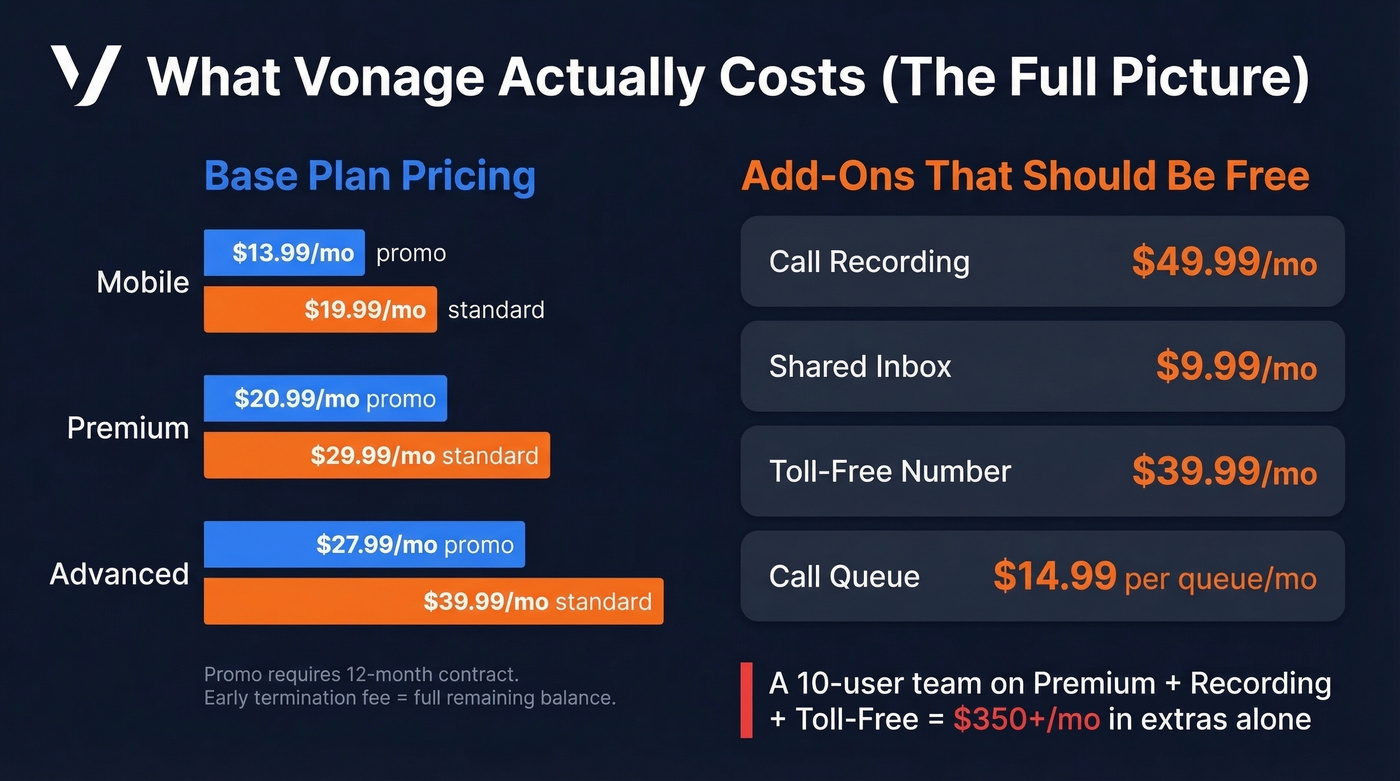
| Plan | Promo (12-mo contract) | Standard Price |
|---|---|---|
| Mobile | $13.99/user/mo | $19.99/user/mo |
| Premium | $20.99/user/mo | $29.99/user/mo |
| Advanced | $27.99/user/mo | $39.99/user/mo |
Those promo rates require a minimum one-year contract. Rates drop at 5+ and 20+ user tiers - for example, Mobile falls to $17.99 (5-19 users) and $14.99 (20-99 users) at standard pricing. And if you cancel early? Vonage's terms state that early termination fees "can range up to the total price of your service contract." That's not a slap on the wrist. It's the full remaining balance.
Then there are the add-ons that should be included but aren't:
| Add-On | Monthly Cost |
|---|---|
| Call Recording | $49.99 |
| Shared Inbox | $9.99 |
| Toll-Free Number | $39.99 |
| Call Queue | $14.99/queue |
Here's the thing: charging $49.99/month for call recording is indefensible in 2026. Every serious competitor includes it. Vonage is nickel-and-diming you on table-stakes features.
If your average contract value is under $25k/year, you probably shouldn't be paying for Vonage's Premium or Advanced tiers. The ROI math doesn't work when cheaper alternatives include the features Vonage charges extra for. (If you're pressure-testing ROI, use these pipeline benchmarks to sanity-check payback.)
Why People Leave Vonage
Vonage's core product is solid - 4.3/5 on G2 across 494 reviews, 4.5/5 on Gartner Peer Insights from 381 ratings. Call quality and ease of use earn genuine praise. But the complaints follow a pattern.
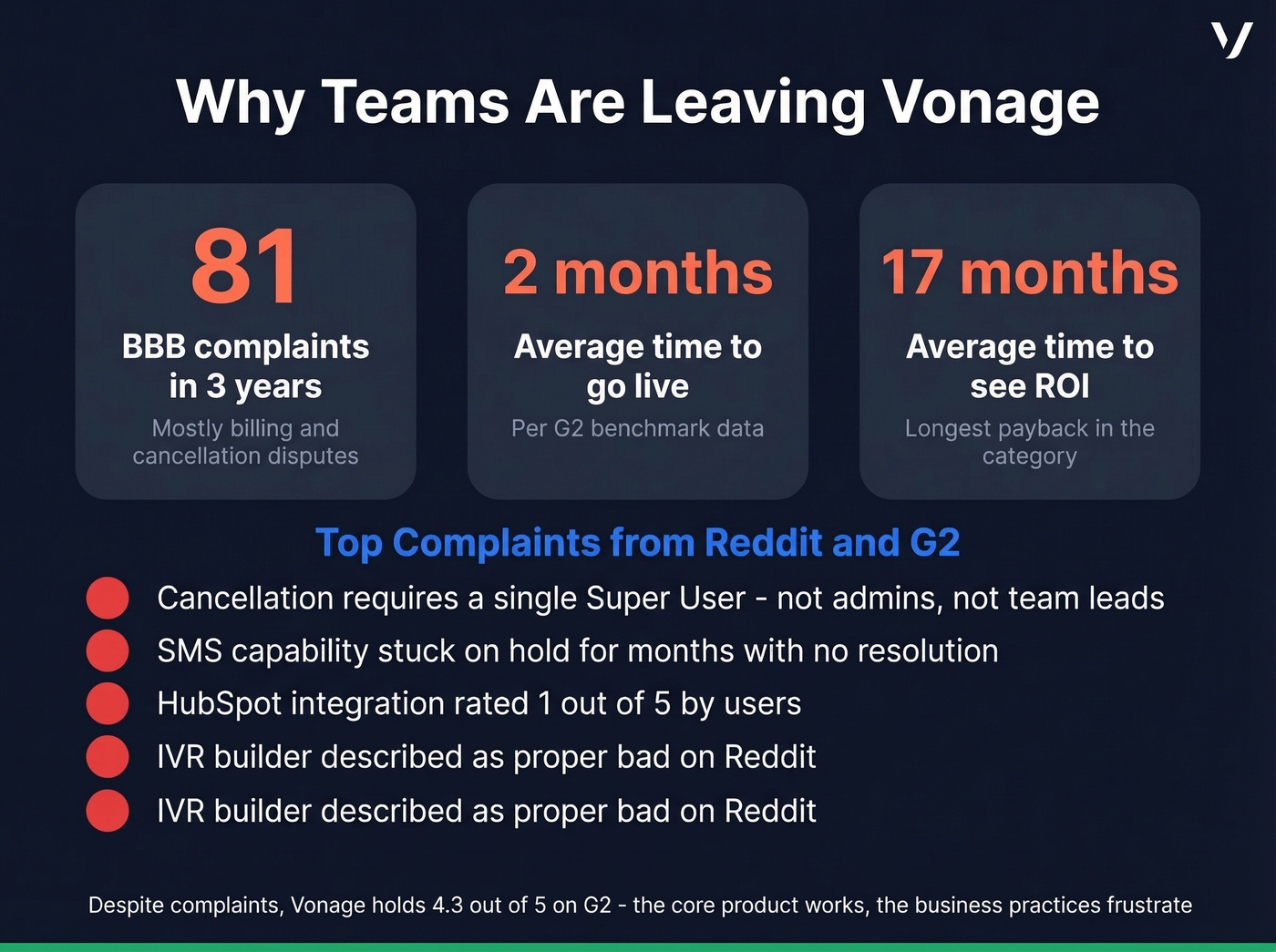
G2's con themes cluster around texting limitations, call drops, and connection issues. The BBB logged 25 complaints in the last 12 months alone, mostly billing and cancellation disputes.
Reddit paints a sharper picture. One r/VOIP poster described cancellation as a "nightmare" - extensions can't be canceled unless tied to a number, numbers can't be managed in the dashboard, and only a single "Super User" can cancel unused lines. Not account admins. Not team leads. One person. That same poster reported their SMS capability had been "on hold for months" with no resolution, called the HubSpot integration essentially unusable (1/5 rating), and described the IVR builder as "proper bad."
Another r/smallbusiness poster called Vonage's SMS situation "unacceptable" and found that even migrating to Zoom Phone hit SMS approval roadblocks, which underscores how messy the SMS landscape has become across providers. (If you're considering SMS outreach, read this first: cold texting.)
G2's benchmarks tell the implementation story: 2 months to get up and running, 17 months to see ROI. That's a long payback period for a phone system. If you're already past that window and still frustrated, switching costs are mostly psychological at this point.

New phone system won't fix pipeline if your reps are calling wrong numbers. Prospeo gives you 125M+ verified mobile numbers with a 30% pickup rate - 3x higher than ZoomInfo. Stop paying for better call quality and then dialing dead numbers.
Pair your new VoIP with direct dials that actually connect.
Best Vonage Alternatives Compared
| Tool | Annual Price | Monthly Price | SMS Limits | Best For |
|---|---|---|---|---|
| Zoom Phone | $15/user/mo | $15/user/mo | Included (plan-dependent) | Cost-first teams |
| Dialpad | ~$15/user/mo | $27/user/mo | Varies by plan | AI-forward orgs |
| Nextiva | $15/user/mo | $23/user/mo | 100/user/mo (Core) | Full UCaaS suite |
| RingCentral | $20/user/mo | $30/user/mo | 25/user/mo (Core) | Enterprise safe pick |
| Ooma | $19.95/user/mo | $19.95/user/mo | Included (plan-dependent) | Simple small teams |
| GoTo Connect | Not public | Not public | Included (plan-dependent) | Intl. calling |
| 8x8 | Not public | Not public | Included (plan-dependent) | Global enterprises |
| Grasshopper | $18/mo (flat) | $18/mo (flat) | - | Solopreneurs |
| Phone.com | $15/user/mo | $21/user/mo | Varies by plan | Budget minimum |
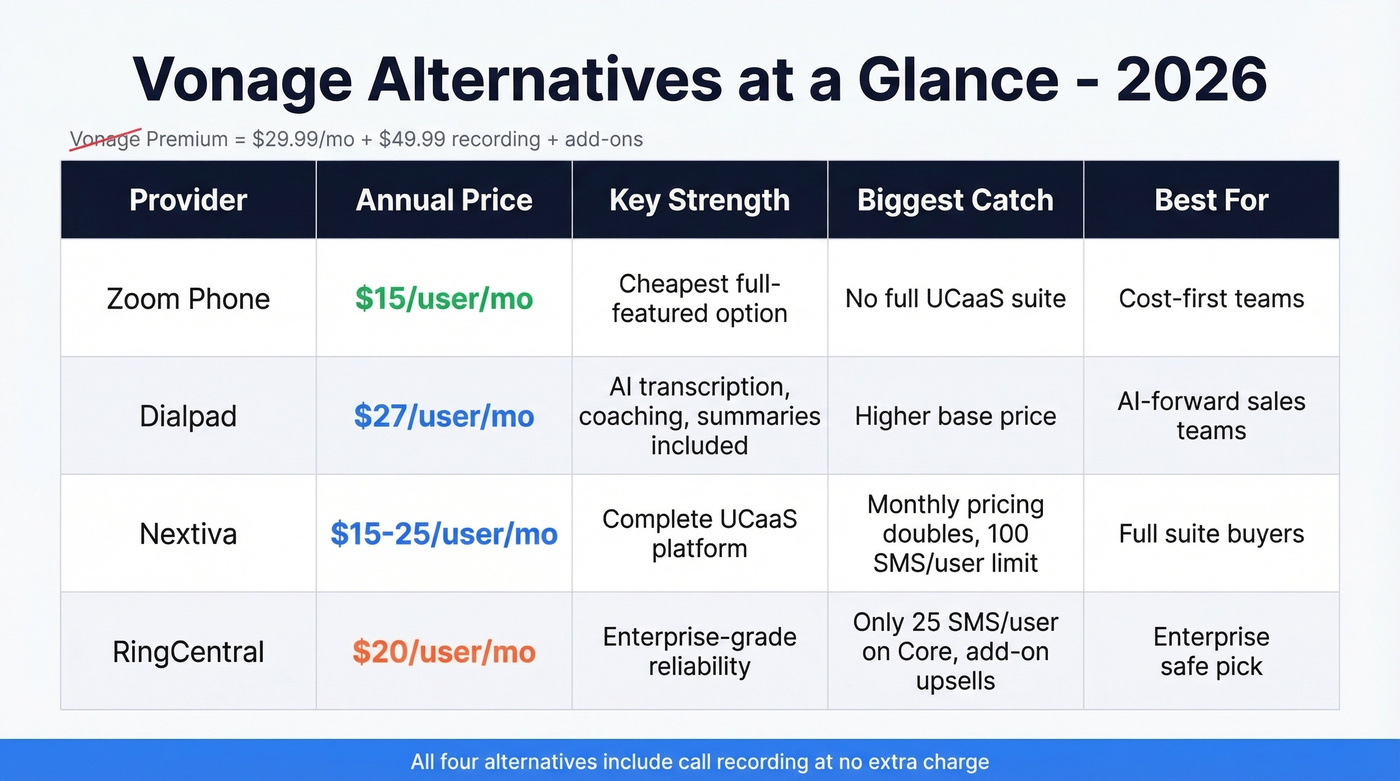
We left out Microsoft Teams Phone. If your org is already deep in Microsoft 365, you've probably already considered it. It typically runs $10-$17/user/mo as an add-on to your existing subscription and works well enough, but it's a phone bolt-on to a collaboration platform, not a standalone VoIP solution.
Zoom Phone
Use this if your team already uses Zoom for meetings and you want the simplest, cheapest path to a business phone system. The $10/user/mo metered plan works if reps make fewer than ~160 outbound minutes per month (outbound runs around $0.03/min). Above that, the $15/user/mo unlimited plan is the breakeven. The $20/user/mo Global Select tier adds international calling to one country of your choice.
Skip this if you want a full UCaaS suite with contact center features. Zoom Phone's integration ecosystem is thinner than RingCentral's or Nextiva's. It's a phone system, not a platform - and that's fine if a phone system is what you need.
Dialpad

Dialpad is the dark horse in this market. Plans start around $15/user/mo for the basic tier, but the Standard plan at $27/user/mo is where it gets interesting: real-time transcription, call coaching, sentiment analysis, and automated post-call summaries all come standard. No add-on fees. No enterprise-only gates.
That $27 price tag looks steep next to Zoom Phone's $15, but stack up Vonage's base plan plus the add-ons you'd need to match Dialpad's feature set and the math flips fast. We've seen teams switch from Vonage to Dialpad specifically because Vonage charges $49.99/month for call recording that Dialpad bundles in.
Dialpad doesn't have RingCentral's brand recognition, but the product is ahead on AI - and it's not close. If your team cares about conversation intelligence, this is the pick. (For more dialing stack ideas, see our guide to a cold calling system.)
Nextiva
Use this if you want a full UCaaS suite - phone, video, team messaging, and customer engagement tools in one platform. Nextiva's Core plan at $15/user/mo (annual) is competitive, and the Power Suite CX at $75/user/mo is a legitimate contact center alternative.
Skip this if you're not ready to commit to annual billing. Core jumps from $15 to $23 month-to-month. Engage is the real sticker shock: $25/user/mo annual vs. $50/user/mo monthly. Also watch the SMS limits - Core only gives you 100 texts per user per month. If your team texts clients regularly, you'll hit that ceiling fast.
RingCentral
The safe enterprise choice. $20/user/mo (annual) for Core, $25 for Advanced, $35 for Ultra.
The downsides are real, though. SMS limits are stingy: Core gives you just 25 texts per user per month, and even Ultra caps at 200. Toll-free minutes are pooled (100 on Core, 10,000 on Ultra), so high-volume teams burn through them. Monthly pricing adds a clean $10/user on each tier. RingCentral also sells add-ons like an AI receptionist. It's the safe choice, but you pay a premium for that safety. (If you're comparing more providers, check Ringover alternatives too.)
Ooma
Straightforward pricing at $19.95/$24.95/$29.95 per user per month. No annual discount games - what you see is what you pay.
Simple setup for small teams that don't need enterprise features. No AI features, basic analytics, and a thin integration library. Ooma is a phone system for people who just want a phone system. If you're growing fast, you'll outgrow it.
GoTo Connect
Free international calling to 50+ countries is a real differentiator. GoTo Connect also includes video meetings for up to 250 participants and 1,000 shared toll-free minutes, with a 99.999% reliability claim.
The catch: GoTo doesn't publish self-serve pricing in 2026. You'll talk to a rep, get a custom quote, and have less leverage because you can't comparison-shop transparently. Expect ~$27-35/user/mo based on historical market positioning.
8x8
A common pick for globally distributed teams. Enterprise-grade compliance and security features round out the package, with strong contact center alignment for larger deployments.
Pricing isn't public - expect ~$24-44/user/mo depending on tier and seat count. The platform has shifted heavily toward enterprise, so teams under 50 seats will find the onboarding and configuration heavier than needed. If you're a 15-person team, there are simpler options.
Grasshopper
A virtual phone system, not a UCaaS platform. Flat pricing at $18/$32/$70 per month - not per user - which makes it surprisingly economical for solopreneurs and freelancers who just need a business number on their cell phone. No video, no team messaging, no call center features. It does one thing and does it fine.
Phone.com
Budget VoIP starting at ~$15/user/mo annually, ~$21 month-to-month. You get the basics - voice, video, messaging - but the feature set is thin compared to full UCaaS platforms. Most teams outgrow it once they pass 10-15 users or need CRM integrations. (If you're tightening your stack, start with contact management software before adding more tools.)
How to Switch From Vonage
Switching phone systems sounds harder than it is. We've walked teams through this process, and the biggest delays are almost always self-inflicted - poor planning, not technical complexity. Here's the checklist:
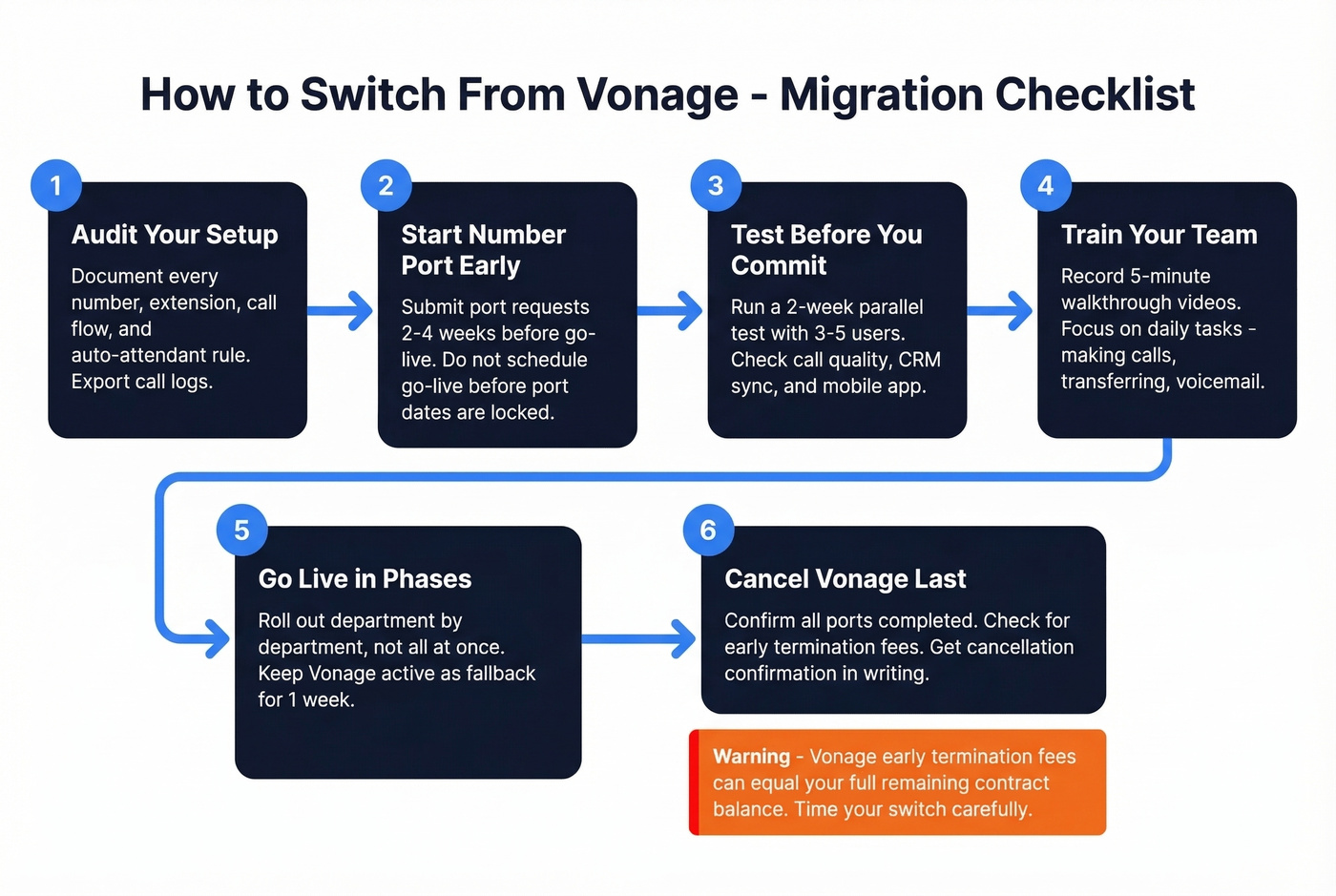
Audit your current setup. Document every number, extension, call flow, and auto-attendant rule in Vonage. Export call logs for configuration on the new platform.
Start the number port early. Submit port requests 2-4 weeks before your target go-live date. Don't schedule go-live before port dates are locked - one missed port can delay your entire rollout.
Test your network. Budget ~100 kbps upload/download per concurrent call. Configure QoS on your router to prioritize voice traffic.
Run a phased rollout. Pick one department as a pilot group. Let them run for a week before migrating everyone.
Keep Vonage active in parallel. Run both systems for 1-2 weeks after migration. Forward calls if needed. This is your safety net.
Clean your contact data. Your contact database has been sitting in Vonage for years - stale emails, disconnected numbers, and outdated records waste time on any platform. Before importing contacts into your new system, run them through a bulk verification tool. Prospeo checks 143M+ verified emails at 98% accuracy and validates mobile numbers against 125M+ verified records globally. Free tier available, no contracts required. (If you're building a cleaner outbound engine, pair this with data enrichment services.)

You're cutting Vonage to save on hidden fees. Apply that same logic to your prospecting data. Prospeo delivers verified emails at $0.01 each with 98% accuracy and direct mobile numbers - no contracts, no add-on surprises, cancel anytime.
No promo pricing tricks. No early termination fees. Just accurate data.
Vonage Alternatives FAQ
Is Vonage going away?
No. Ericsson acquired Vonage, and the company continues investing in CPaaS and communications APIs. The UCaaS product (Vonage Business Communications) still exists and receives updates.
Can I keep my phone number when switching?
Yes - number porting is standard across all major VoIP providers. Start the port request 2-4 weeks before your target go-live date. Porting is the single most common migration delay, and rushing it causes more problems than any other step.
What's the cheapest Vonage alternative?
Zoom Phone Metered at $10/user/mo if your team makes fewer than ~160 outbound minutes per user. For unlimited calling without annual discount games, Ooma at $19.95/user/mo is one of the cleanest options.
Does Vonage charge early termination fees?
Yes. Per Vonage's terms, ETFs "can range up to the total price of your service contract." If you're 6 months into a 12-month contract, you could owe the remaining 6 months in full. Check your specific contract terms before canceling.
How do I clean my contact data after switching?
Run your contact list through a verification tool before importing it into a new system. Dead data wastes rep time regardless of which phone system you're on - and it's the kind of thing that's easy to fix before migration but painful to untangle after.