


Webbula Pricing, Reviews, Pros and Cons: Is It Worth the Sales Call?
ZeroBounce shows you $39 for 2,000 credits right on their pricing page. Webbula shows you a "Get a Quote" button. That gap tells you almost everything you need to know before you even start evaluating - whether you'll spend your afternoon in a demo or actually verifying emails. Invalid emails cost B2B companies roughly $847 per rep annually, so the tool you pick matters. But so does being able to pick it without a procurement cycle.
30-second verdict: Webbula is a legitimate email hygiene platform with genuinely strong spam trap and threat detection. But it's sales-led, custom-quoted, and has a grand total of 8 public reviews. If you need transparent pricing and self-serve onboarding, skip the sales call. If you're sending 500K+ emails a month and need deep threat intelligence, Webbula's worth a conversation.
What Is Webbula?
Webbula isn't just an email verification tool - it's an email hygiene platform.
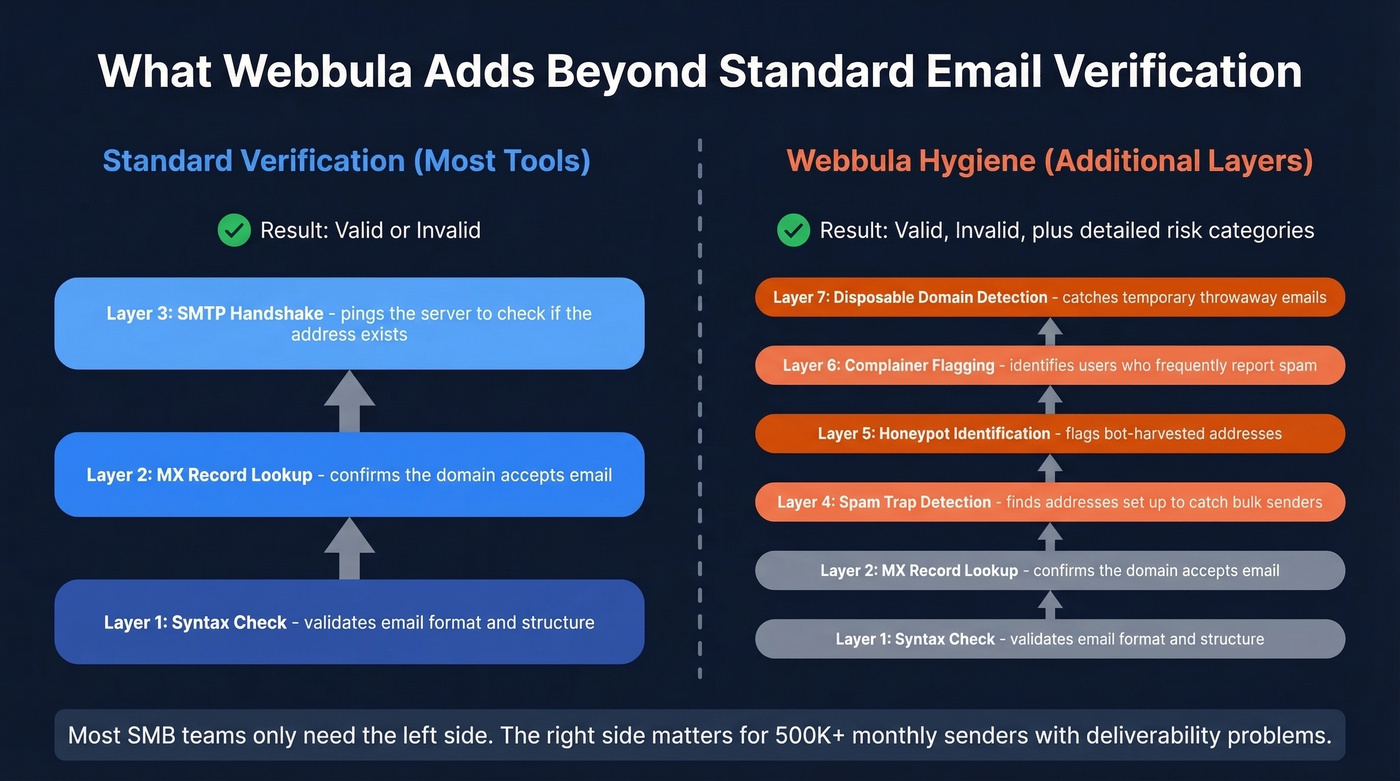
Standard verification typically includes MX record checks plus a partial SMTP handshake. Webbula goes further: it identifies spam traps, honeypots, frequent complainers, disposable domains, and bot-generated addresses that can pass basic verification but still wreck your sender reputation. That distinction matters if you're a high-volume sender, though most teams won't need it.
They also run a secondary business in programmatic audience data, with B2B audience targeting covering 390M+ individuals for advertising use cases.
What Does Webbula Cost in 2026?
Webbula doesn't publish pricing. You get 100 free credits to test the platform, and after that, you're talking to sales. Capterra lists a "Basic" plan at $1,000 per feature per year, but that directory-normalized field probably doesn't reflect how Webbula actually structures its deals.
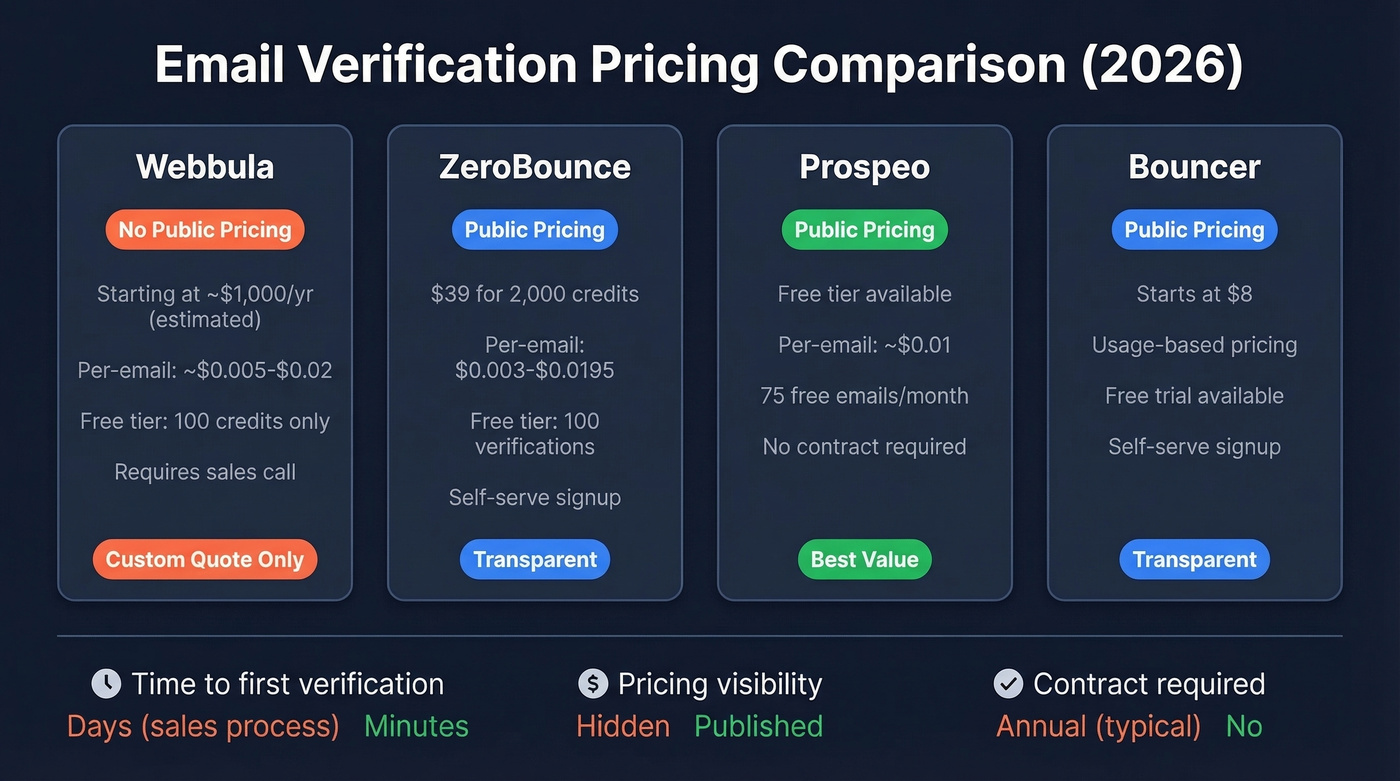
In our experience with custom-quoted hygiene tools, expect per-email costs in the $0.005-$0.02 range depending on volume, with annual contracts as the norm.
| Tool | Starting Price | Per-Email Cost | Free Tier | Public Pricing? |
|---|---|---|---|---|
| Webbula | ~$1,000/yr (est.) | ~$0.005-$0.02 | 100 credits | No |
| ZeroBounce | $39 for 2K credits | $0.003-$0.0195 | 100 free verifications | Yes |
| Prospeo | Free tier available | ~$0.01 | 75 emails/mo | Yes |
| Bouncer | $8 usage-based | Varies | Free trial | Yes |
If you need to compare costs before getting on a call, Webbula makes that nearly impossible. Every other tool on this list lets you sign up and start verifying in under five minutes.

Why wait on a custom quote when you can verify emails right now? Prospeo delivers 98% email accuracy with built-in spam-trap removal and honeypot filtering - the same hygiene Webbula gates behind a sales call - at ~$0.01 per email with fully transparent pricing.
Sign up free and verify your first list in under ten minutes.
User Reviews: What 8 People Actually Said
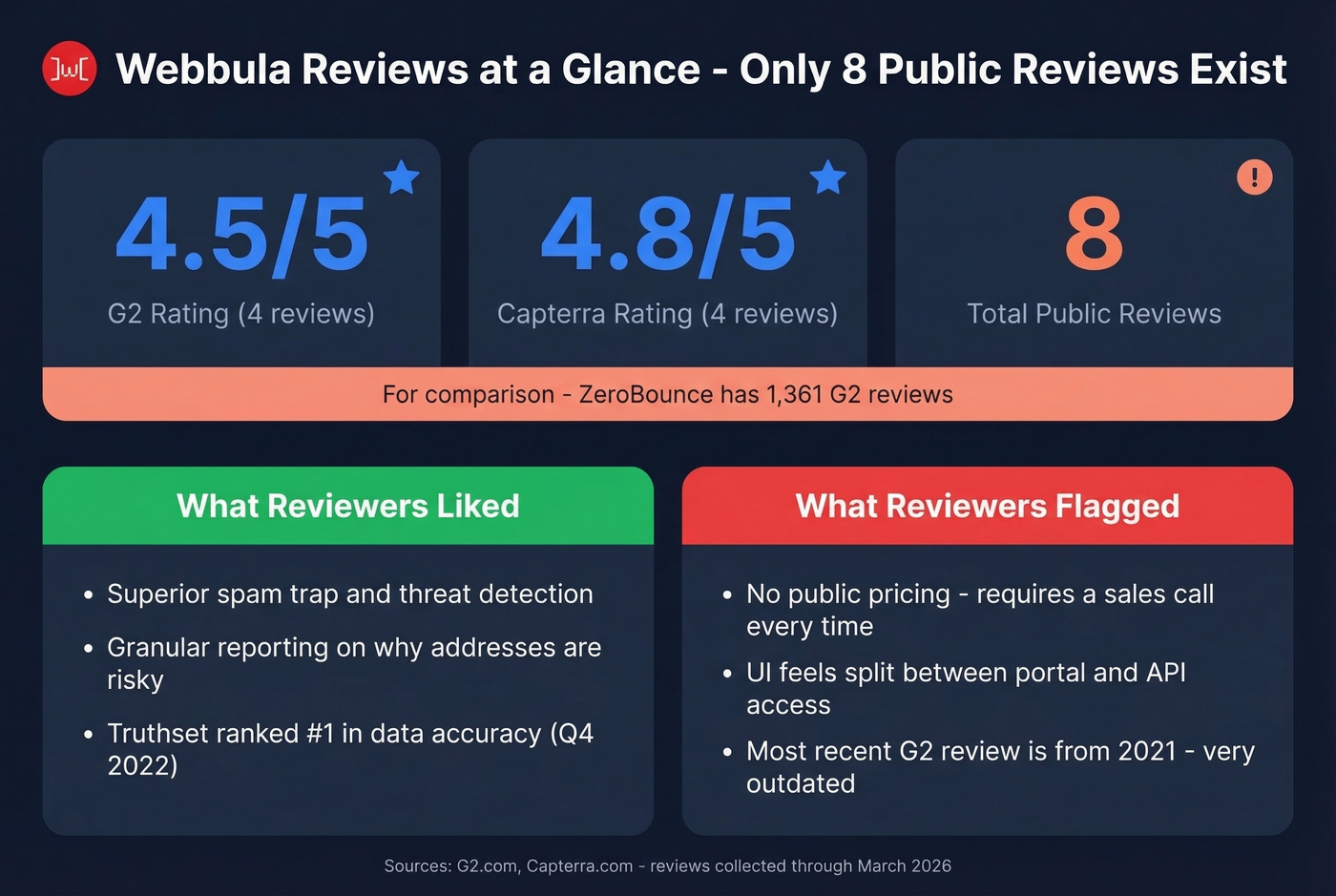
We synthesized all 8 public reviews - 4 on G2 at 4.5/5 and 4 on Capterra at 4.8/5 - so you don't have to. The sample is tiny, but the themes are consistent.
| Pros | Cons |
|---|---|
| Superior spam trap & threat detection | No public pricing - requires sales call |
| Granular reporting on scrub reasons | G2 review history is thin (2019-2021) |
| Goes beyond standard verification | UI split between portal and API |
| Truthset #1 data accuracy in 20 attribute categories (Q4 2022) | ~22 tracked customers per 6sense |
One G2 reviewer called Webbula "head and shoulders better" at identifying risky addresses and spam traps compared to other tools they'd tested. Capterra reviewers consistently highlight the detailed breakdown of scrub reasons - you don't just get "valid" or "invalid," you get granular categories explaining why an address is risky. With bounce rates above 2% commonly considered high, that granularity matters for teams managing large sender reputations.
The downsides are real, though. The UI feels inconsistent - some features live in the portal, others require API access. One reviewer flagged credit expiration as a concern, though Webbula disputed this. And with just ~22 tracked customers versus ZeroBounce's 1,361 G2 reviews, the visibility gap is stark. Here's the thing: when a tool has 8 total reviews and the most recent G2 review is from 2021, you're making a buying decision with almost no community signal to lean on.
Who Should (and Shouldn't) Use Webbula
Use Webbula if you're an enterprise sender pushing 500K+ emails per month and you need threat detection beyond basic bounce prevention. Their case studies include removing a major national retailer from email blocklists and improving deliverability for companies like ReachMail and Webroot - real results for teams where spam traps are actively damaging sender reputation.
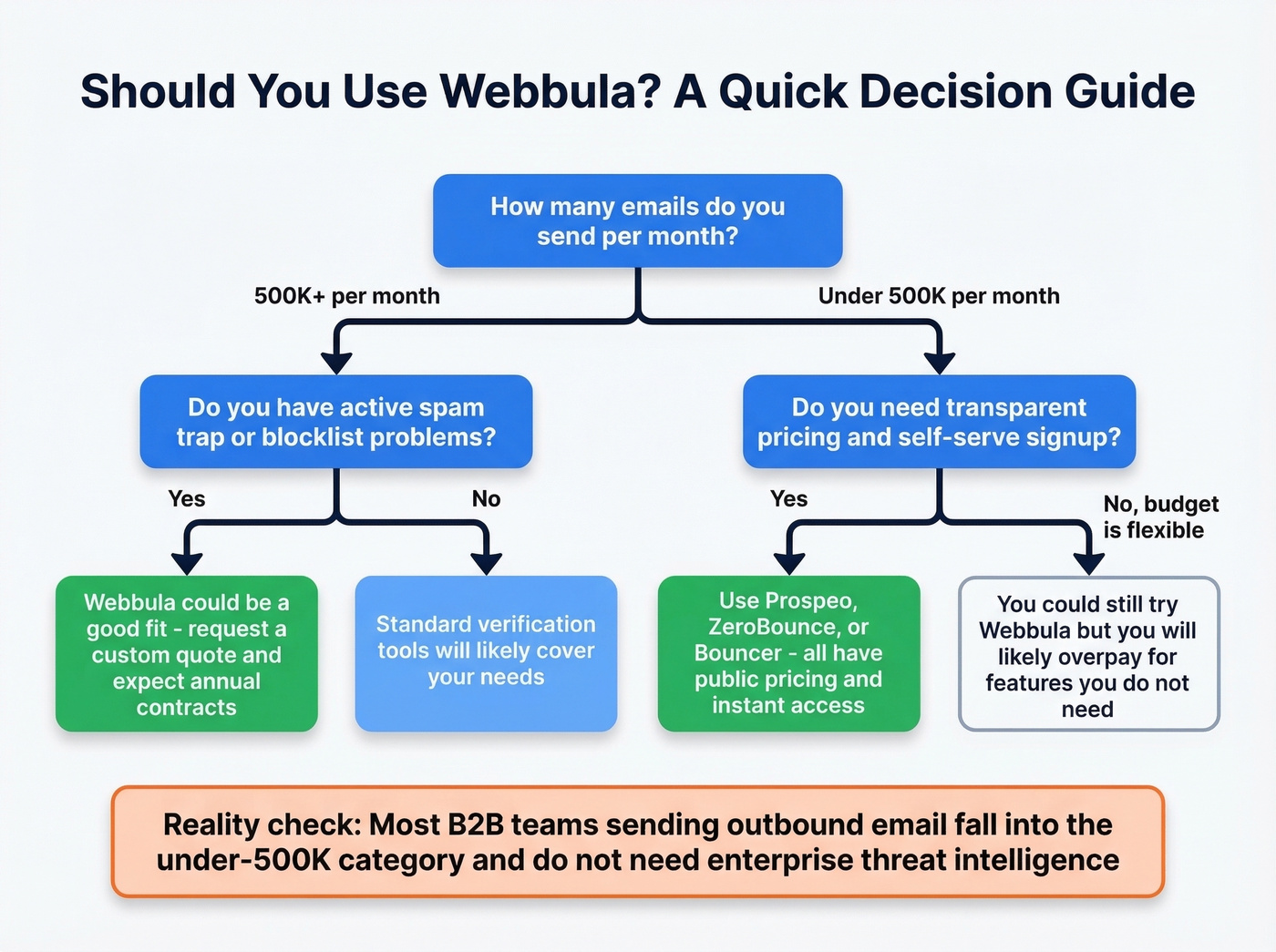
Skip Webbula if you're an SMB, a startup, or anyone sending under 50K emails a month. The custom-quote process, annual contracts, and lack of self-serve onboarding make it a poor fit for teams that need to move fast. You'll burn a week on demos and procurement before verifying a single email beyond those 100 free credits.
Let's be honest: most teams searching for email hygiene tools don't actually need enterprise-grade threat intelligence. They need accurate emails and transparent pricing. Webbula solves a real problem, but it's a problem that affects a small fraction of email senders.
Better Alternatives to Consider
Prospeo
If your real need is accurate email data for outbound without a procurement process, Prospeo delivers 98% email accuracy across 143M+ verified emails on a 7-day data refresh cycle. Its 5-step verification includes catch-all handling, spam-trap removal, and honeypot filtering - covering much of the hygiene ground Webbula targets, but built into the sales prospecting workflow itself. Pricing runs ~$0.01 per email with a free tier of 75 emails per month and zero contracts. Self-serve from minute one, and we've seen teams go from signup to first verified list in under ten minutes.

ZeroBounce
With 1,361 G2 reviews, ZeroBounce is one of the most community-validated email verification tools available. You start at $39 for 2,000 credits and scale down to about $0.003/email at high volume, or pay $99/month for 10,000 credits on a subscription. It won't match Webbula's spam trap depth, but for pure verification with zero pricing surprises, it's the safe pick. The Reddit consensus on r/Emailmarketing tends to favor ZeroBounce for exactly this reason - predictable costs, solid accuracy, no gatekeeping.
Bouncer
Starts at $8 with usage-based pricing and a free trial. Good for small-to-mid lists where you don't need enterprise threat detection. It handles standard verification cleanly at a price that won't require budget approval. Not much to say beyond that - it does one thing and does it well.
FAQ
Does Webbula offer a free trial?
Yes - 100 free credits to test email hygiene, no credit card required. Beyond that, you need a custom quote from sales. There are no published plan tiers or self-serve upgrade paths.
How accurate is Webbula's data?
Webbula ranked #1 for data accuracy across 20 attribute categories in Truthset's Q4 2022 TruthScore Index. Those attributes cover demographic data like age, gender, and DMA - not email verification accuracy specifically. No independent email-specific accuracy benchmarks exist for Webbula, which makes it hard to compare directly against tools that publish their numbers.
Is there a self-serve alternative with transparent pricing?
Prospeo offers 98% email accuracy with pricing starting free at 75 emails per month and ~$0.01/email on paid plans. No sales call, no contract, no annual commitment.
How does Webbula compare to standard verification tools?
Standard tools check MX records and run SMTP handshakes to confirm an address exists. Webbula adds spam trap detection, honeypot identification, and complainer flagging - layers that matter for high-volume senders above 500K emails/month but are overkill for most SMB teams running outbound campaigns.
Webbula's 100 free credits run out fast. Prospeo gives you 75 free emails every month, 143M+ verified addresses on a 7-day refresh cycle, and 5-step verification that catches spam traps - no sales call, no annual contract, no procurement headaches.
Get enterprise-grade email hygiene without the enterprise buying process.