

What Does Sales Enablement Actually Do? (And Why Most Programs Fail)
Everyone defines sales enablement as "giving reps the resources they need to close deals." That's not wrong - it's just useless. Your VP of Sales told you to "build out enablement" without defining what that means, and now you're trying to figure out what the job actually looks like day-to-day.
So what does sales enablement do in practice? It's project management for your sales leadership team. It handles the training, coaching, content, and process-building that sales leaders don't have bandwidth for. Reps spend only 30% of their time actually selling. If your reps spend more time searching for decks than having conversations, enablement is broken.
The Day-to-Day Reality
The role means something different at every company - as one practitioner put it, "sales enablement is more of a discipline than any individual role." But the daily rhythm follows a pattern.
Ben Straker, a sales enablement specialist, describes a typical day: check the sales ops inbox for questions and requests, follow up with new hires for 1:1 coaching, build job aids and learning content, partner with Sales Engineering on workshops, and run quarterly sessions with regional teams on discovery, demos, and negotiation. It's part coach, part content creator, part process auditor.
And increasingly, it extends beyond sales. 64% of organizations now run enablement across all revenue teams - customer success, solutions engineers, deal desk - not just AEs.
Enablement vs. Sales Ops
These two get confused constantly. Katie Drury, Head of Revenue Enablement at PandaDoc, draws the line clearly: "Operations creates the system and structures for our team to work and Sales Enablement owns making sure Account Executives and managers have the knowledge and skills to execute against this structure."
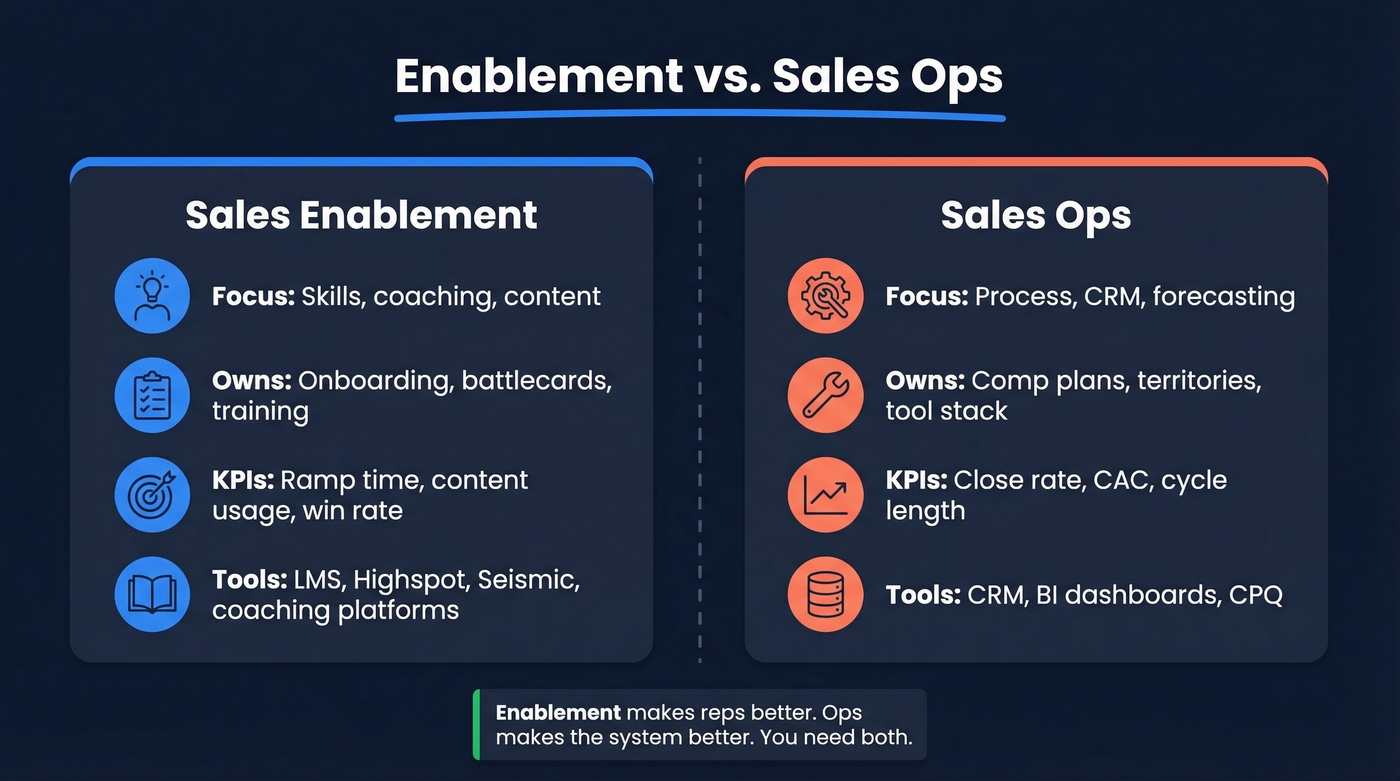
| Enablement | Sales Ops | |
|---|---|---|
| Focus | Skills, coaching, content | Process, CRM, forecasting |
| Owns | Onboarding, battlecards, training | Comp plans, territories, tools |
| Key KPIs | Ramp time, content usage, win rate | Close rate, CAC, cycle length |
| Tools | LMS, Highspot/Seismic, coaching | CRM, BI, CPQ |
Enablement makes reps better. Ops makes the system they work in better. Neither replaces the other.

You just read that reps lose 440 hours a year to non-selling activities. Bad contact data makes it worse - every bounced email is wasted enablement. Prospeo delivers 98% email accuracy on a 7-day refresh cycle, so the reps you trained actually reach the buyers you targeted.
Snyk cut bounce rates from 35% to under 5% and grew AE-sourced pipeline 180%.
Why Enablement Matters
Companies with formal enablement programs see win rates on forecasted deals rise from 42.5% to 49%. 84% of reps hit quota when their employer uses best-in-class enablement strategies. The sales enablement platform market was valued at $5.23B in 2024 and is projected to reach $12.78B by 2030, growing at 16.3% CAGR - adoption up 343% over five years.
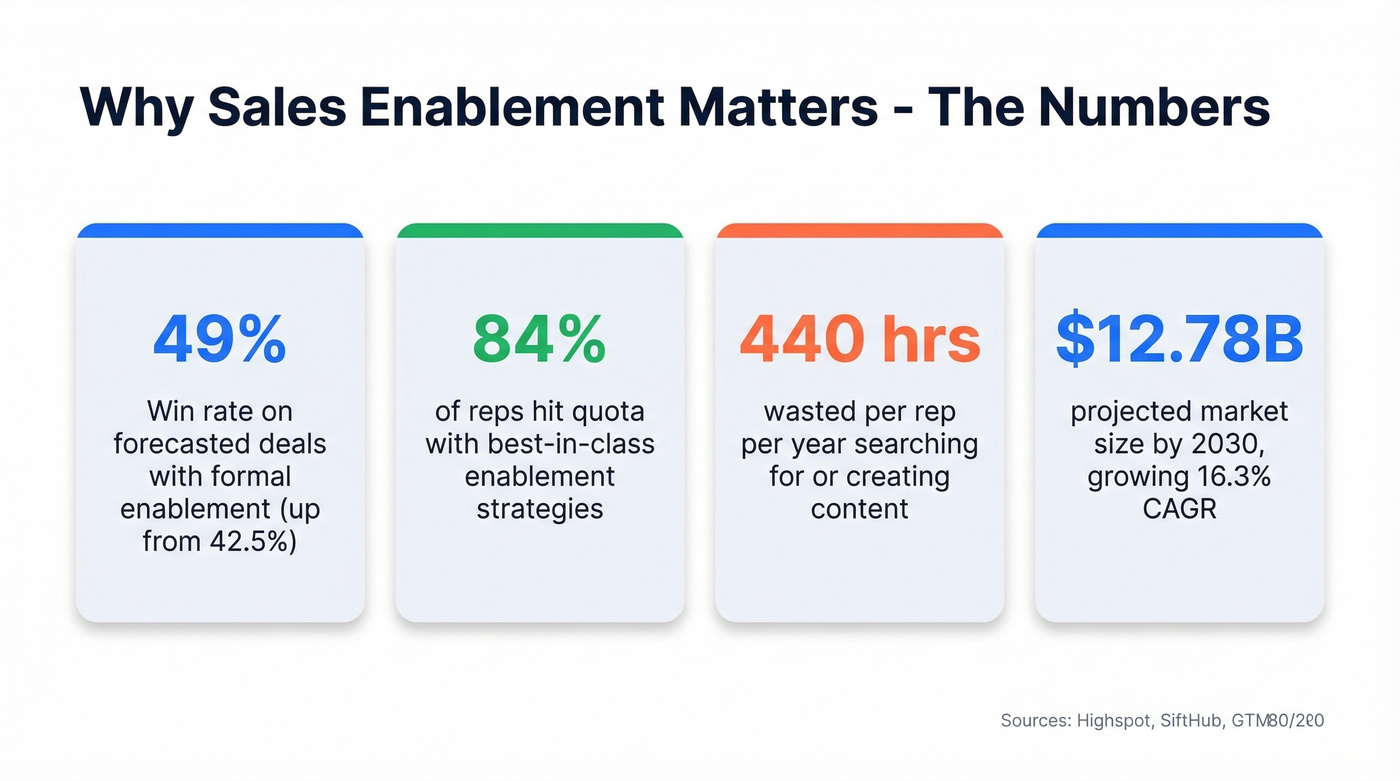
The cost of not having enablement? Revenue teams waste 440 hours per year - eleven full work weeks - searching for or creating content instead of selling. That's not a rounding error. That's a quarter of a rep's productive capacity gone.
Why Most Programs Fail
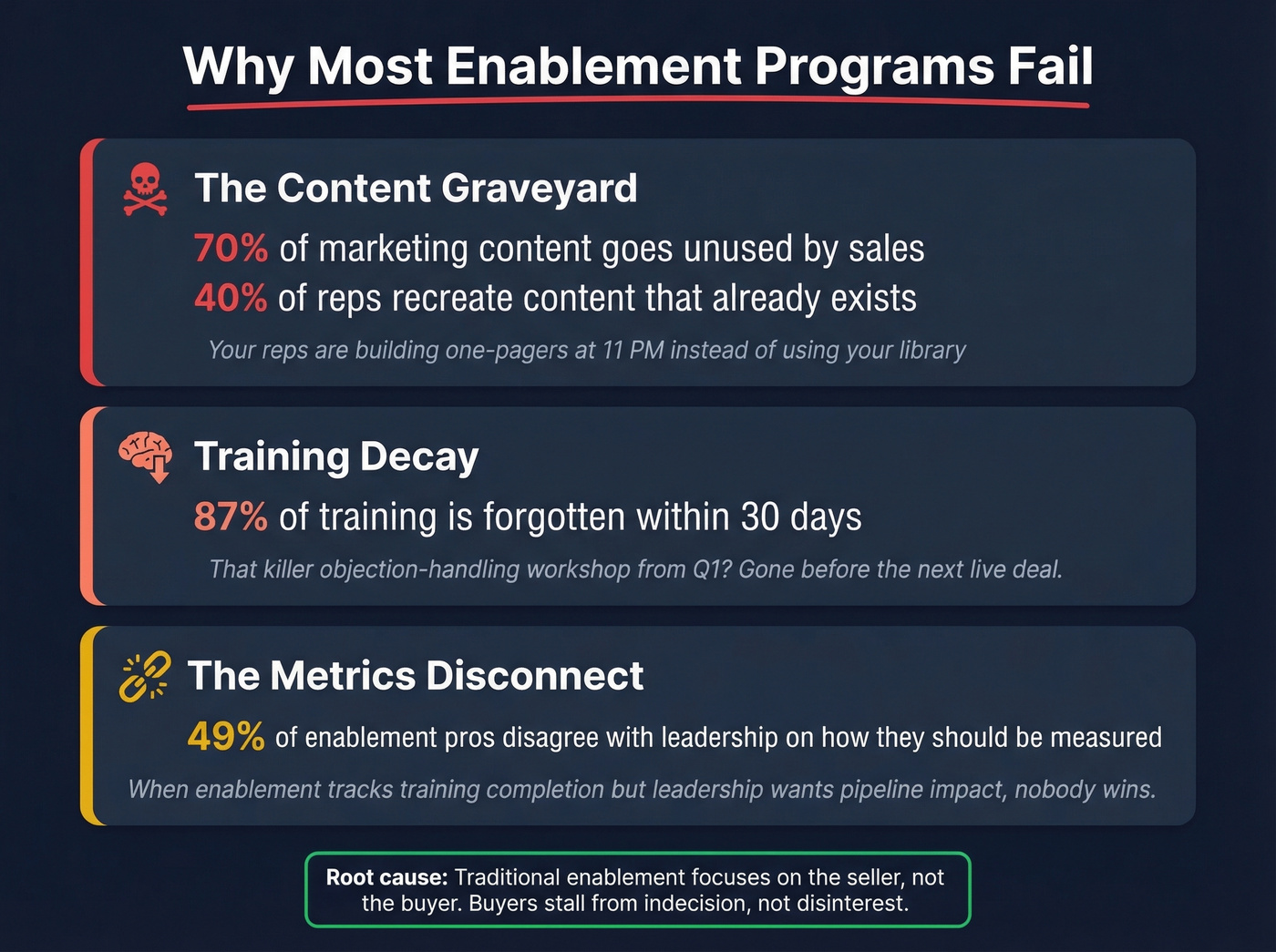
Here's the uncomfortable truth. Ask enablement practitioners on r/sales what the job actually looks like and you'll hear a version of this: "Everyone agrees it's important, but in practice it often turns into docs and trainings that reps don't use." Three failure modes kill most programs before they deliver ROI.
The content graveyard. Only 30% of marketing-created content gets used by sales. Reps recreate content that already exists 40% of the time. You've got an enablement content library packed with assets and reps are still building one-pagers in Google Docs at 11 PM before a demo.
Training decay. 87% of training is forgotten within 30 days. That killer objection-handling workshop from Q1? Gone by the time a rep faces the objection in a live deal.
The metrics disconnect. 49% of enablement professionals disagree with their own leadership on what metrics they should be assessed on. When enablement is measured on training completion and leadership wants pipeline impact, nobody wins.
Underneath all three sits a deeper problem: traditional enablement focused on the seller rather than the buyer. The #1 reason deals stall isn't lack of interest - it's indecision. Buyers can't align internally, quantify value, or de-risk their choice. Enablement optimized for presentation, not persuasion, misses this entirely.
There's a layer we see teams overlook constantly: data quality. You can build the best training and the sharpest coaching cadence, but if reps work from stale contact data, none of it reaches real buyers. Snyk ran into exactly this - bounce rates running 35-40% meant reps were burning hours on dead-end outreach. After switching to Prospeo, bounces dropped under 5% and AE-sourced pipeline jumped 180%.
Look, if your contact data bounce rate is above 10%, don't invest another dollar in enablement content until you fix the data. Everything downstream depends on it.
Key Responsibilities and Team Structure
Forget budgets - enablement-to-rep ratios determine what's actually possible:
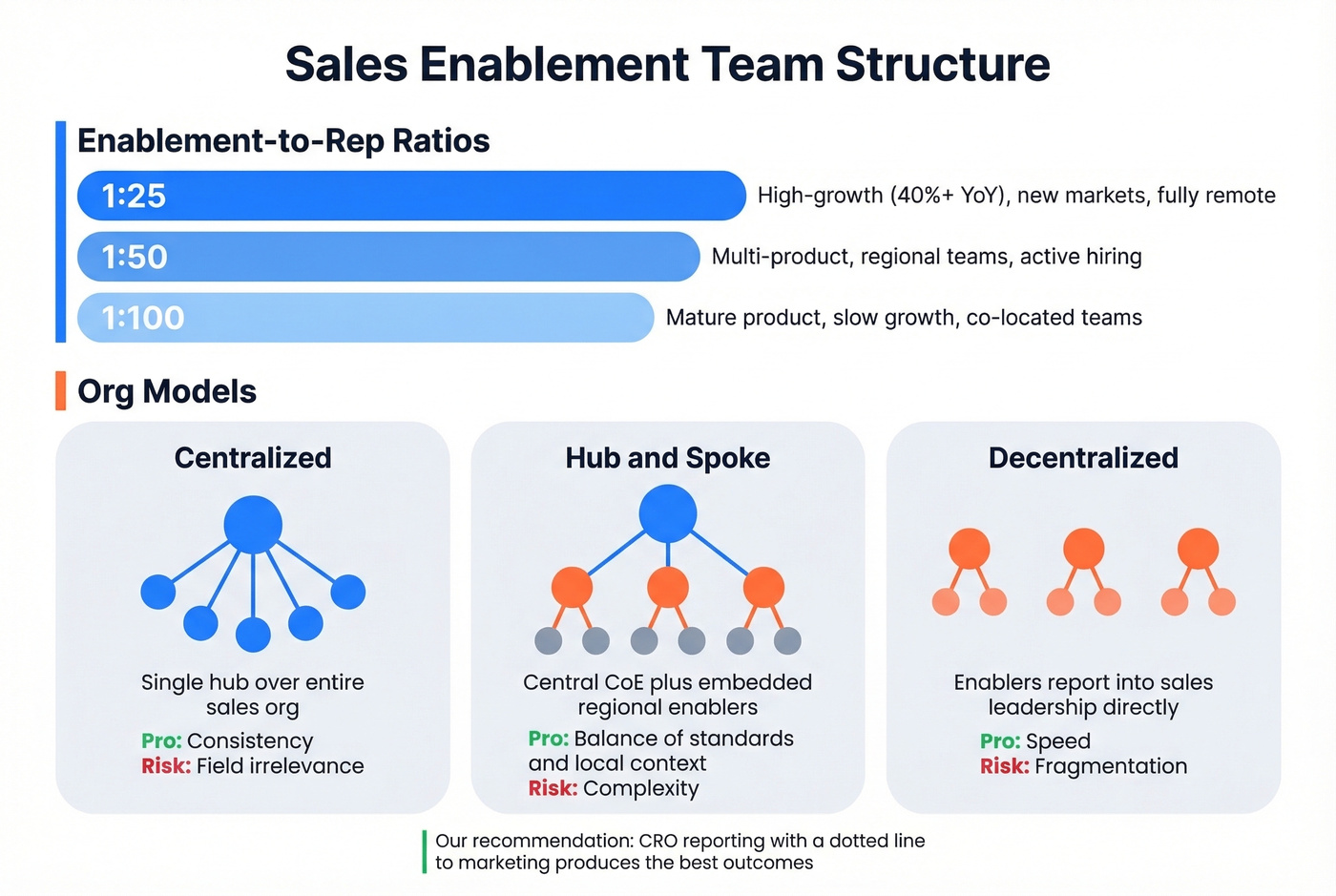
- 1:25 - High-growth companies (40%+ YoY), new markets, fully remote teams
- 1:50 - Multi-product orgs with regional teams and active hiring
- 1:100 - Mature product, slow growth, co-located teams
| Model | How it works | Best for |
|---|---|---|
| Centralized | Single hub over the entire sales org | Consistency; risks field irrelevance |
| Hub-and-spoke | Central CoE + embedded regional enablers | Balance of standards and local context |
| Decentralized | Enablers report into sales leadership directly | Speed; risks fragmentation |
Where should enablement report? To the CRO for revenue alignment, but you risk short-term thinking. To marketing for content quality, but you risk sales misalignment. To sales leadership to stay close to reps, but you limit your executive seat. There's no perfect answer, but in our experience, CRO reporting with a dotted line to marketing produces the best outcomes. Regardless of reporting structure, sales enablement responsibilities should be clearly documented so every stakeholder - from frontline managers to the C-suite - knows who owns what.
Where Enablement Is Heading in 2026
Fluint's redefinition captures the shift well: "Sales enablement is the systematic removal of friction in live deals - the just-in-time injection of execution support exactly when the deal is at risk." Train, equip, and pray is dead.
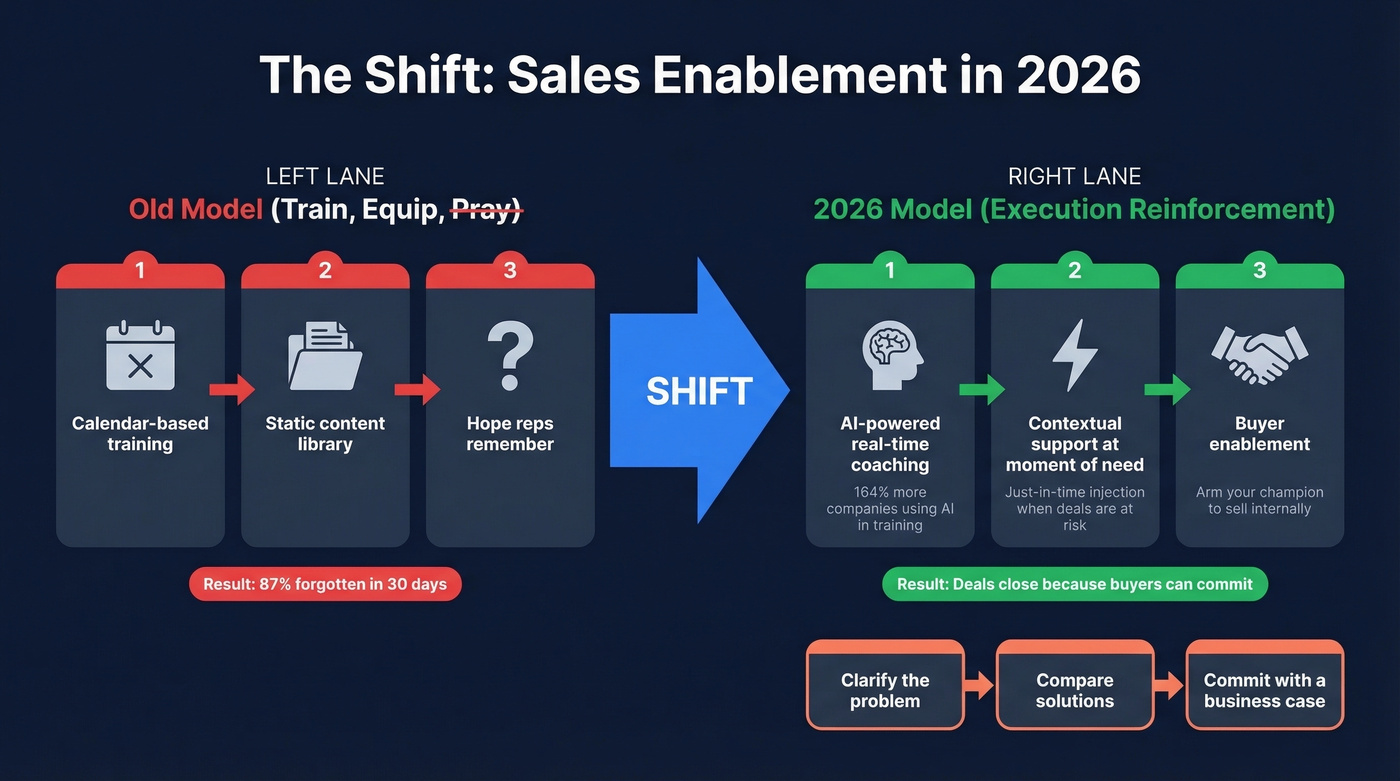
Calendar-based training is giving way to execution reinforcement - contextual support at the moment of need. 164% more companies are using AI in sales training compared to the prior year. AI tools now analyze hours of call recordings in minutes, flag stuck conversations, and suggest alternative phrasing in near real-time. The enablement practitioner's role is shifting from trainer to calibrator - tuning AI outputs to match the company's methodology and voice.
The biggest shift is buyer enablement. Your champion needs to sell internally, and most of them aren't great at it. Ironpaper frames this as three stages: Clarify the problem, Compare solutions, Commit with a business case. If your enablement team isn't producing ROI calculators and executive summaries your champion can forward to their CFO, you're leaving deals on the table.
Let's be honest about where we'd start if we were building enablement from scratch in 2026: enable managers, not just reps. Reps leave. Managers stay and perpetuate culture. A great frontline manager who coaches consistently will outperform any content library you build.
No enablement program survives a 30%+ bounce rate. Before you invest in another training module or battlecard, make sure your reps are working from verified contact data. Prospeo gives you 300M+ profiles with 30+ filters - buyer intent, job changes, technographics - so every rep conversation starts with a real decision-maker.
Stop enabling reps to reach voicemail. Start enabling them to reach buyers.
FAQ
How do you measure sales enablement success?
Track ramp time for new hires (best-in-class teams cut it from 10 months to 6-7), win rate on forecasted deals, content usage rates, and quota attainment. Average training ROI across organizations runs 353%. Align your metrics with leadership before you launch - that 49% disagreement stat is a program killer.
What are the core enablement functions?
Five buckets: onboarding and training, content creation and management, coaching and skill development, tool and process optimization, and performance measurement. Most mature programs also add buyer enablement - arming your champion with the internal business case they need to get a deal signed.
How does data quality affect enablement ROI?
Even the best training fails if reps prospect with stale contacts. Teams using verified data platforms with 98%+ email accuracy and weekly refresh cycles report bounce rates under 5% and significantly higher pipeline generation. Snyk saw AE-sourced pipeline jump 180% after fixing data quality alone.
What's the difference between enablement and sales training?
Training is one component - the knowledge transfer piece. Enablement is the full system: training plus coaching, content management, tool optimization, process design, and measurement. A training team runs workshops. An enablement team ensures those workshops change behavior in live deals.