

What Is a Go-to-Market Plan? Template & Guide (2026)
Your VP asked for a GTM plan by Friday. You've got a strategy deck from last quarter, a half-finished positioning doc, and a target account spreadsheet nobody's touched since January. That's not a plan - it's a pile of artifacts.
So what is a go-to-market plan, exactly? It's the operational document that turns strategic choices into coordinated action across product, marketing, sales, and customer success. Bain surveyed 2,300 global companies and found only 9% achieved 5.5%+ annual revenue and profit growth (while earning cost of capital) from 2000 to 2010. The other 91% had strategies. They lacked the plan.
Quick version: A GTM plan isn't a GTM strategy - the plan has owners, dates, budgets, and KPIs. It needs eight sections: overview, personas, positioning, channels and budget, timeline, KPIs, risks, and launch checklist. Most plans fail from bad validation, siloed teams, or stale data, not bad ideas.
Plan vs. Strategy vs. Marketing Plan
These three documents get conflated constantly, and the confusion kills execution.
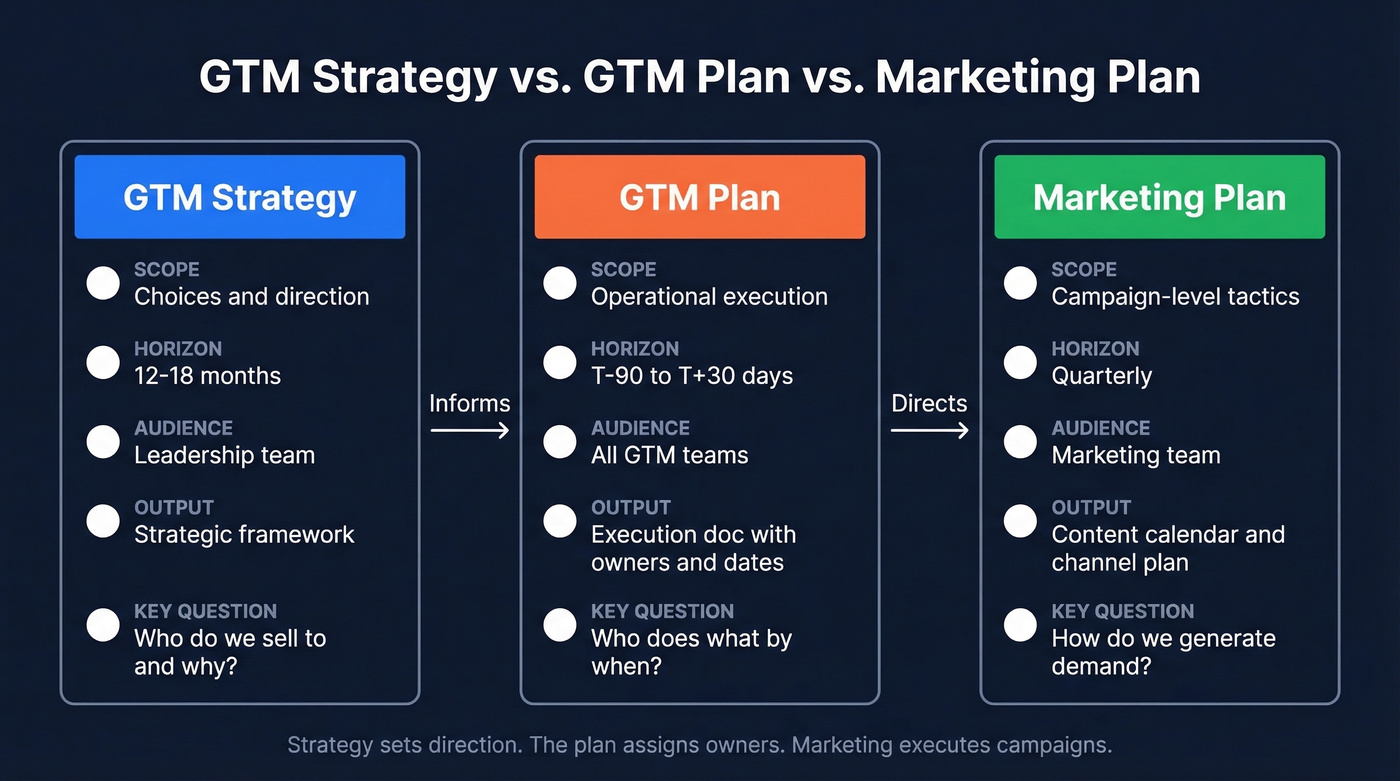
A GTM strategy is the set of choices - who you sell to, why they buy, how you reach them. It spans 12-18 months and requires leadership buy-in. A GTM plan turns those choices into action with owners, dates, and readiness gates. Think of it as the blueprint for execution. A marketing plan is the campaign-level layer: content calendar, channel tactics, lead targets - quarterly, owned by marketing.
| GTM Strategy | GTM Plan | Marketing Plan | |
|---|---|---|---|
| Scope | Choices & direction | Operational execution | Marketing tactics |
| Horizon | 12-18 months | T-90 to T+30 | Quarterly |
| Audience | Leadership | All GTM teams | Marketing team |
| Output | Strategic framework | Execution doc with owners | Campaign calendar |
The 8-Section GTM Template
PMMs on Reddit constantly ask for structured GTM docs they can hand to cross-functional teams - not another strategy deck. We've seen this template work across dozens of launches, and it draws from the Entasher GTM framework and patterns from Gartner's product launch research. Here's what that doc actually contains.
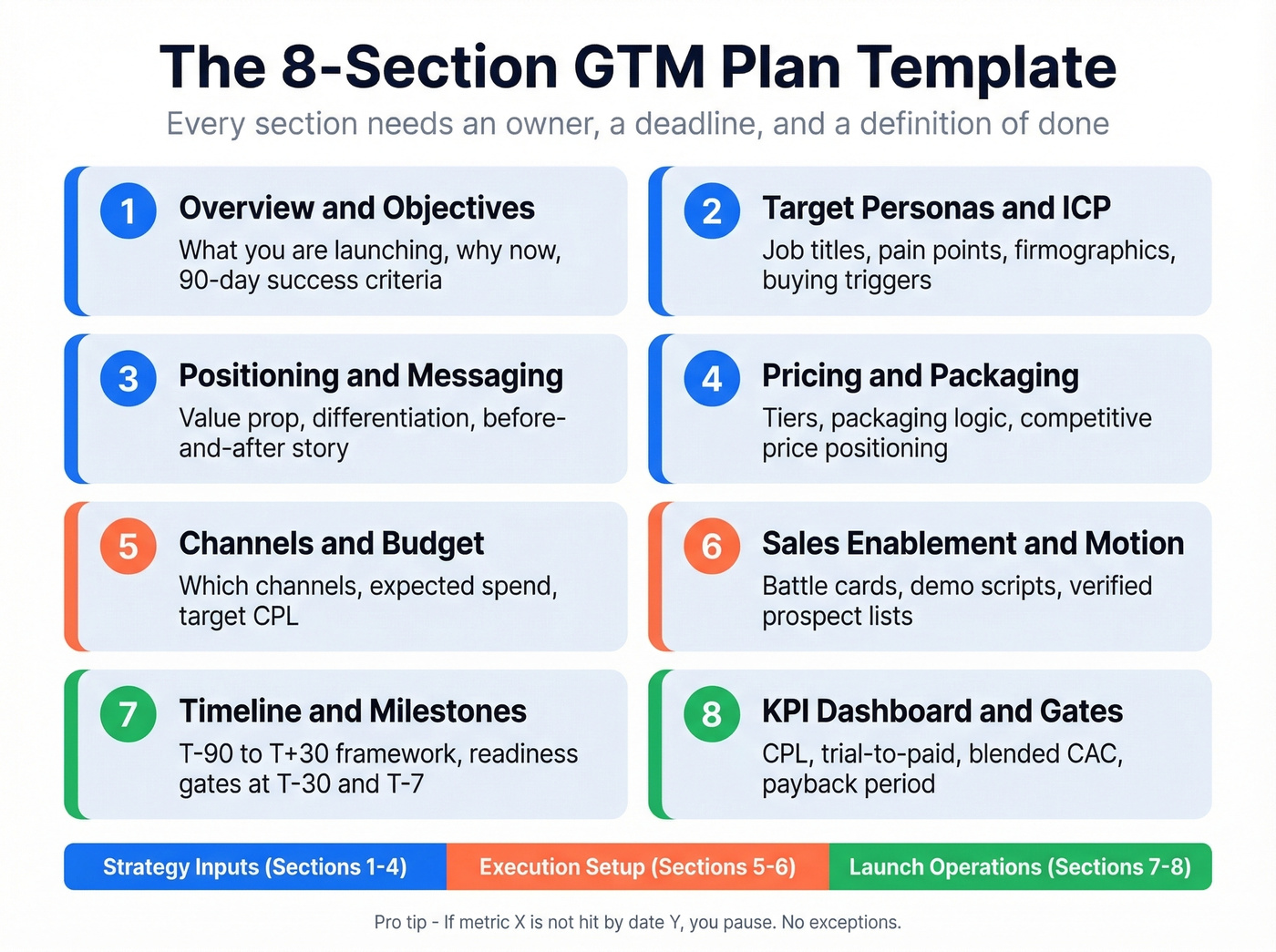
1. Overview & Objectives. One page. What you're launching, why now, what success looks like in 90 days. If you can't explain the "why now" in two sentences, you're not ready.
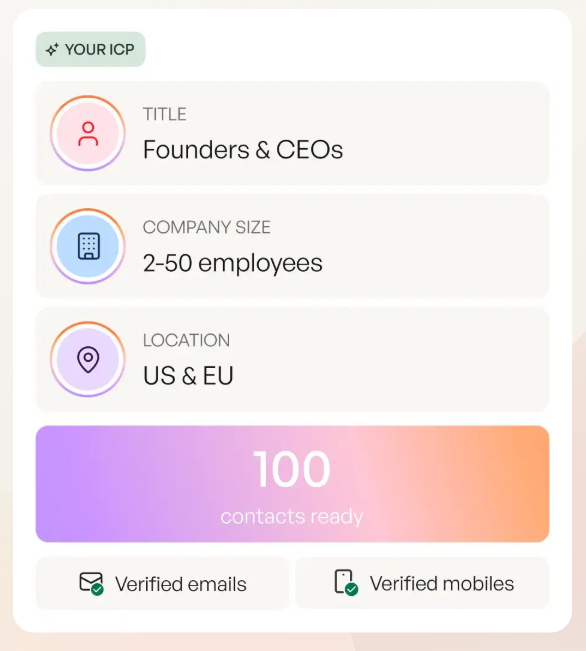
2. Target Personas & ICP. Two to three buyer personas with job titles, pain points, buying triggers, and objections. Include firmographic filters - industry, company size, tech stack, funding stage. Make it specific enough that a rep could build a list from this section alone.
3. Positioning & Messaging. Value prop, competitive differentiation, and messaging by persona. Include the "before and after" story. Test messaging with 5-10 real prospects before you lock it in - five customer interviews isn't validation, it's confirmation bias.
4. Pricing & Packaging. Tiers, packaging logic, competitive positioning. Document the "why" behind your pricing, not just the numbers.
5. Channels & Budget. Which channels, expected spend, target CPL. Three channels done well beats eight done poorly.
6. Sales Enablement & Motion. Battle cards, demo scripts, objection handling. Here's the thing: this is where most plans fall apart. Your outbound motion depends on verified contact data for the ICP you just defined, and stale CRM data means reps chase dead emails on day one. We've watched teams burn their first two weeks of launch momentum on bounced sequences because nobody verified the list.
7. Timeline & Milestones. Use a T-90 to T+30 framework. Map every deliverable to a date and an owner. Include readiness gates at T-30 and T-7.
8. KPI Dashboard & Readiness Gates. Define metrics before launch. Track CPL, trial-to-paid conversion, blended CAC, and payback period. If metric X isn't hit by date Y, you pause. No exceptions.
B2B vs. B2C: How the Plan Changes
The template works for both, but the inputs change dramatically. A go-to-market plan for a B2B SaaS product looks nothing like one for a DTC brand.
| B2B | B2C | |
|---|---|---|
| Buyers | 6-10 stakeholders | Individual |
| Sales cycle | 6-12 months | Minutes to days |
| Decision driver | ROI & risk mitigation | Emotion & convenience |
| Key channels | ABM, webinars, direct sales | Social, influencers, SEO |
B2B plans need stakeholder mapping - the CFO, IT lead, and legal all evaluate differently. B2C plans need speed and emotional resonance. Don't try to force one framework onto both.

Your GTM plan defined the ICP. Now you need verified contacts to execute it. Prospeo gives you 300M+ profiles with 30+ filters - buyer intent, technographics, funding stage, headcount growth - so reps build lists directly from your persona doc. 98% email accuracy means no bounced sequences on launch week.
Turn your ICP section into a verified prospect list in minutes.
Pick One GTM Motion
Don't try to run three motions at once.
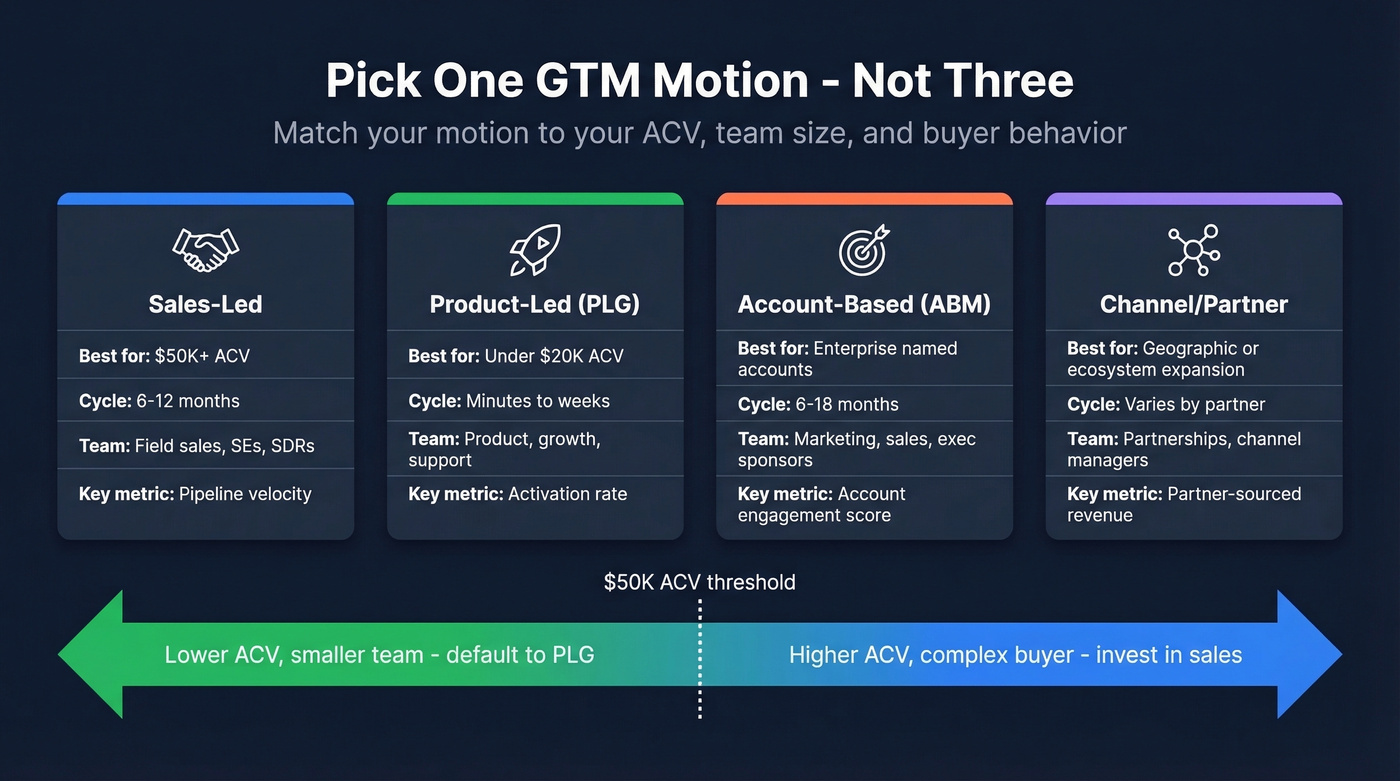
- Sales-led: High ACV, complex deals, long cycles. Usually makes sense above $50K ACV.
- Product-led (PLG): Self-serve, freemium or free trial. Track time-to-value, activation rate, and retention.
- ABM: Enterprise, multi-threaded. Named accounts with personalized campaigns across buying committees.
- Channel/Partner: Geographic expansion or ecosystem plays using someone else's distribution.
Let's be honest: many B2B SaaS teams under 50 employees should default to PLG or inside sales. Field sales usually only pencils out at $50K+ ACV - don't build a field team for a $12K deal. The consensus on r/SaaS leans the same way: go product-led until you have clear evidence that your deal size demands a sales team.
Benchmarks Worth Setting
Without real numbers, your KPI dashboard is decoration.
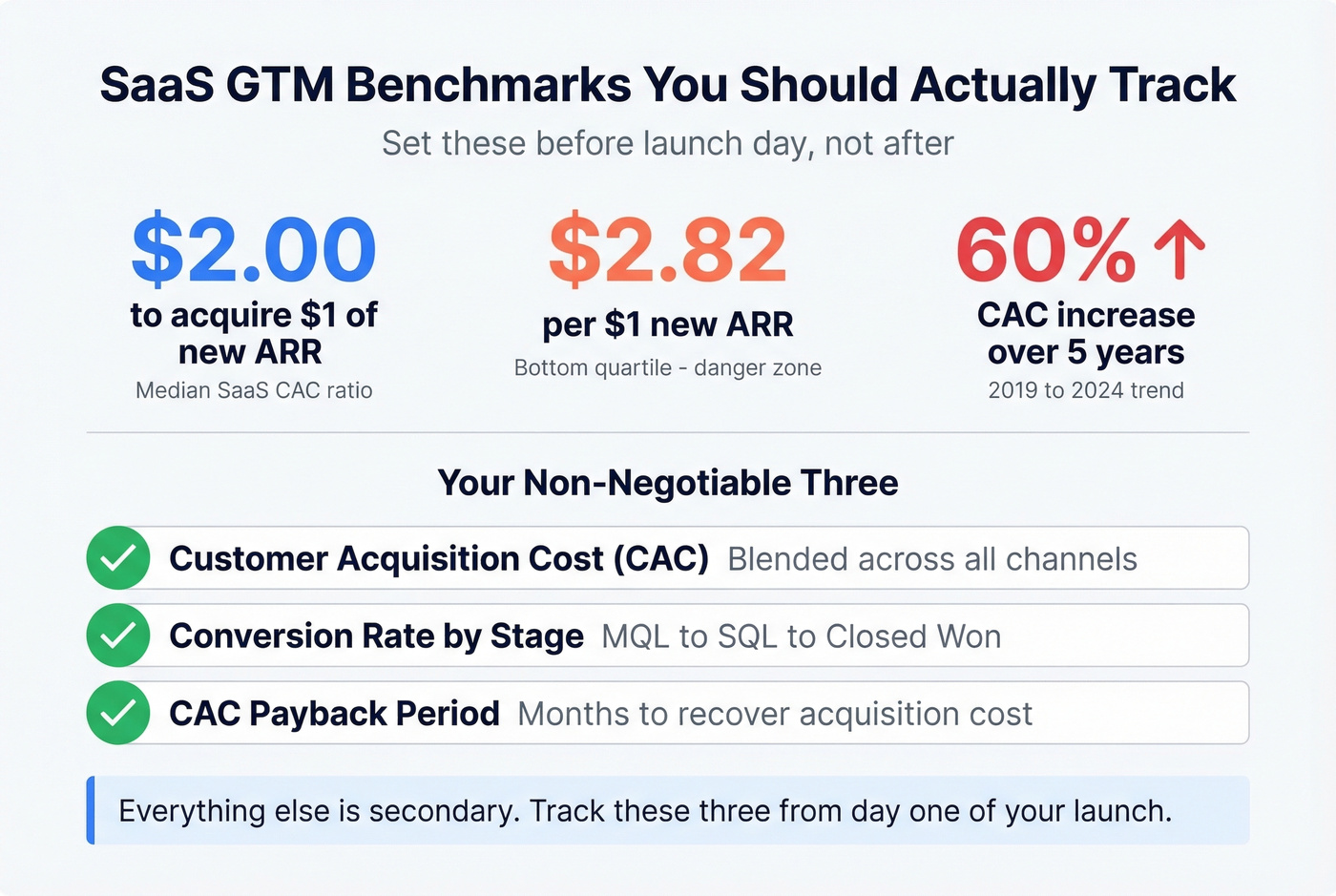
| Metric | Benchmark |
|---|---|
| CAC ratio (median SaaS) | $2.00 to acquire $1 new ARR |
| CAC ratio (bottom quartile) | $2.82 per $1 new ARR |
| B2B startup avg CAC | ~$84 per customer |
| CAC trend | Up 60% over five years (2019-2024) |
Track CAC, conversion rate by stage, and payback period as your non-negotiable three. Everything else is secondary.
5 Mistakes That Kill GTM Plans
Most GTM plans don't fail because of bad ideas. In our experience, mistake #2 is the one that kills the most plans that otherwise had solid strategy behind them.
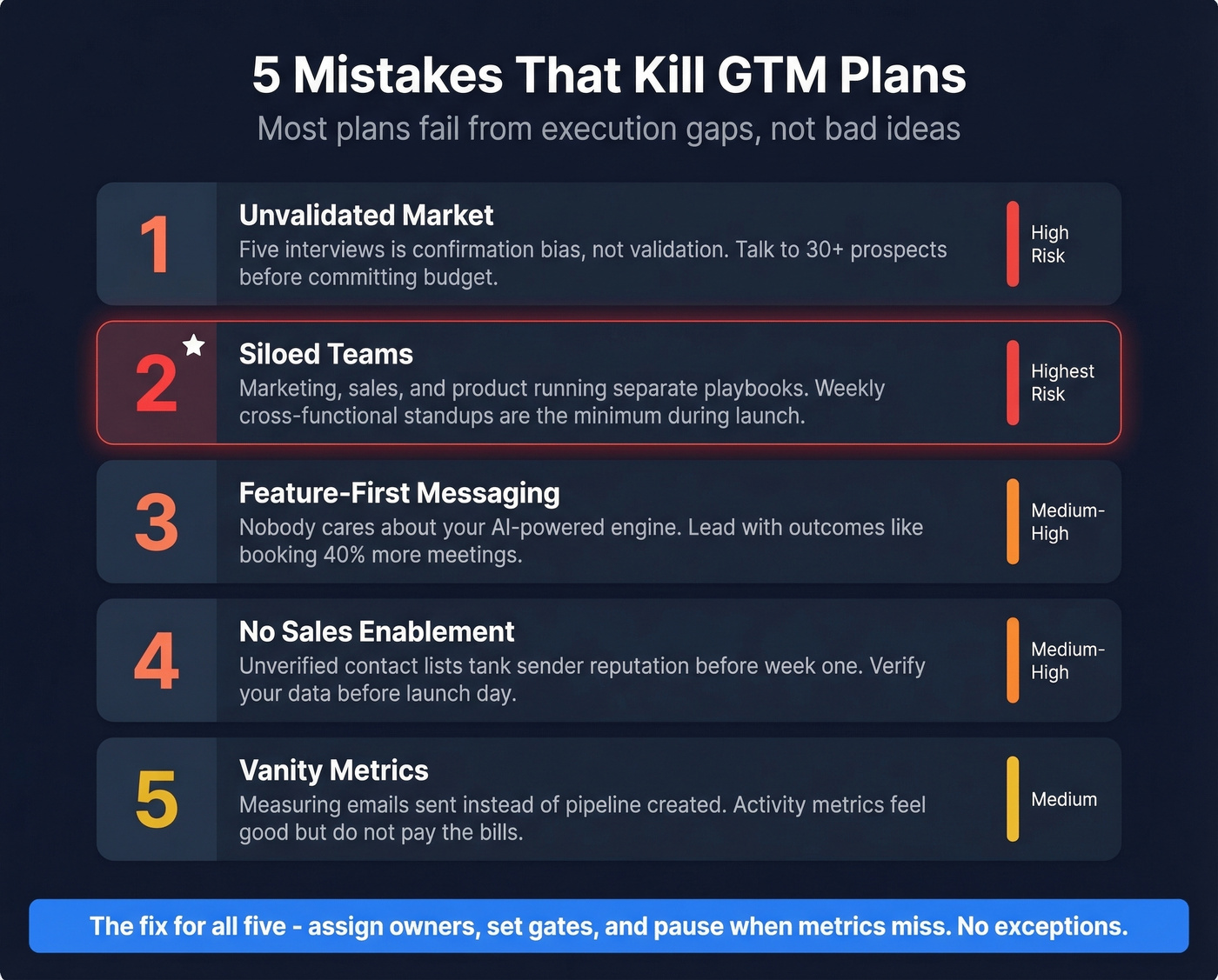
1. Unvalidated market. Five customer interviews isn't validation - it's confirmation bias. Talk to 30+ prospects before committing budget. Skip this step and you're building on sand.
2. Siloed teams. Marketing, sales, and product aligned "on paper" but running separate playbooks in practice. Weekly cross-functional standups aren't optional during launch - they're the minimum. We've seen launches where the sales team didn't even know the messaging had changed until a prospect quoted the old tagline back to them.
3. Feature-first messaging. Nobody cares about your "AI-powered engine." They care about booking 40% more meetings. Lead with the outcome.
4. No sales enablement. Bounce rates spike when lists aren't verified. One Prospeo customer, Snyk, saw bounce rates drop from 35-40% to under 5% after switching to verified data, and their AE-sourced pipeline jumped 180%. Verify your list before launch day, not after your domain reputation takes a hit.

5. Vanity metrics. Measuring emails sent instead of pipeline created. Activity metrics feel good. They don't pay the bills.
Snyk's 50 AEs cut bounce rates from 35-40% to under 5% and grew AE-sourced pipeline 180% with Prospeo's verified data. Your GTM plan has owners, dates, and KPIs - don't let stale contact data be the thing that kills momentum on day one. Data refreshed every 7 days, starting at $0.01 per email.
Launch your GTM motion on data that actually connects to real buyers.
FAQ
What's the definition of a go-to-market plan?
A go-to-market plan is the operational document that assigns owners, deadlines, budgets, and KPIs to each element of your GTM strategy so cross-functional teams can execute a coordinated launch. The classic 4 Ps - Product, Price, Place, Promotion - are often the starting framework, but modern plans expand to include personas, sales motion, and competitive positioning.
Who owns the GTM plan?
The product marketing manager typically owns it, with input from sales, product, and customer success. A plan that lives only in marketing's drive dies on launch day - cross-functional accountability isn't optional.
How do you build a prospect list for a GTM launch?
Define your ICP first - job titles, industries, company size, buying signals. Then use a B2B data platform to find verified contacts matching those filters and push them into your sequencer or CRM. The key is verification: an unverified list will tank your sender reputation before you've even gotten through week one.
How long does it take to create a GTM plan?
Expect 4-6 weeks for a thorough plan covering all eight sections. The biggest time sink is persona validation and messaging testing - rushing those steps is the top reason launches underperform. Budget at least two weeks for cross-functional review before finalizing.