

What Is a Salutation in an Email? (And the Only Two You Actually Need)
You're drafting a cold email to a VP of Engineering. The cursor blinks after the first line. "Hey Sarah" feels too loose. "Dear Ms. Chen:" feels like you're mailing a court summons. You delete both and stare at the screen.
So what is a salutation in an email, and which one should you actually use? You don't need twenty options. You need two.
Email Salutation, Defined
A salutation is the opening greeting before the body of your message - the "Hi Sarah," or "Dear Mr. Chen:" line, and the first thing a recipient reads after the subject line. That's it. You'll sometimes hear it called an opening greeting, but the concept is the same regardless of the label.
One useful distinction: the salutation isn't the same as your opening line. As Scribbr's email guide explains, the greeting ("Hi Sarah,") and the opening sentence ("Thanks for the quick reply on the proposal") are separate elements. The salutation sets the tone. The opening line sets the agenda.
With 392.5 billion emails sent per day in 2026, your greeting has under three seconds to signal "this is worth reading" before the recipient moves on.
Why Your Salutation Matters
Most people treat the salutation as a throwaway line. It's not.
A Babbel survey of 2,000 U.S. office workers found that 88% regretted an email's contents or language right after sending, and 28% said an email had actually hurt their career. Meanwhile, 48% of professionals judge typos more harshly in email than in Slack or Teams - and tone starts at the very first word. Personalized emails see 29% higher open rates and 41% higher click-through rates compared to generic blasts. Your salutation is the first personalization signal a recipient encounters.
We've sent thousands of cold emails across our team, and the pattern is clear: get the greeting right and you earn a few more seconds of attention. Get it wrong and you're already fighting uphill.
Email Salutation Examples by Formality
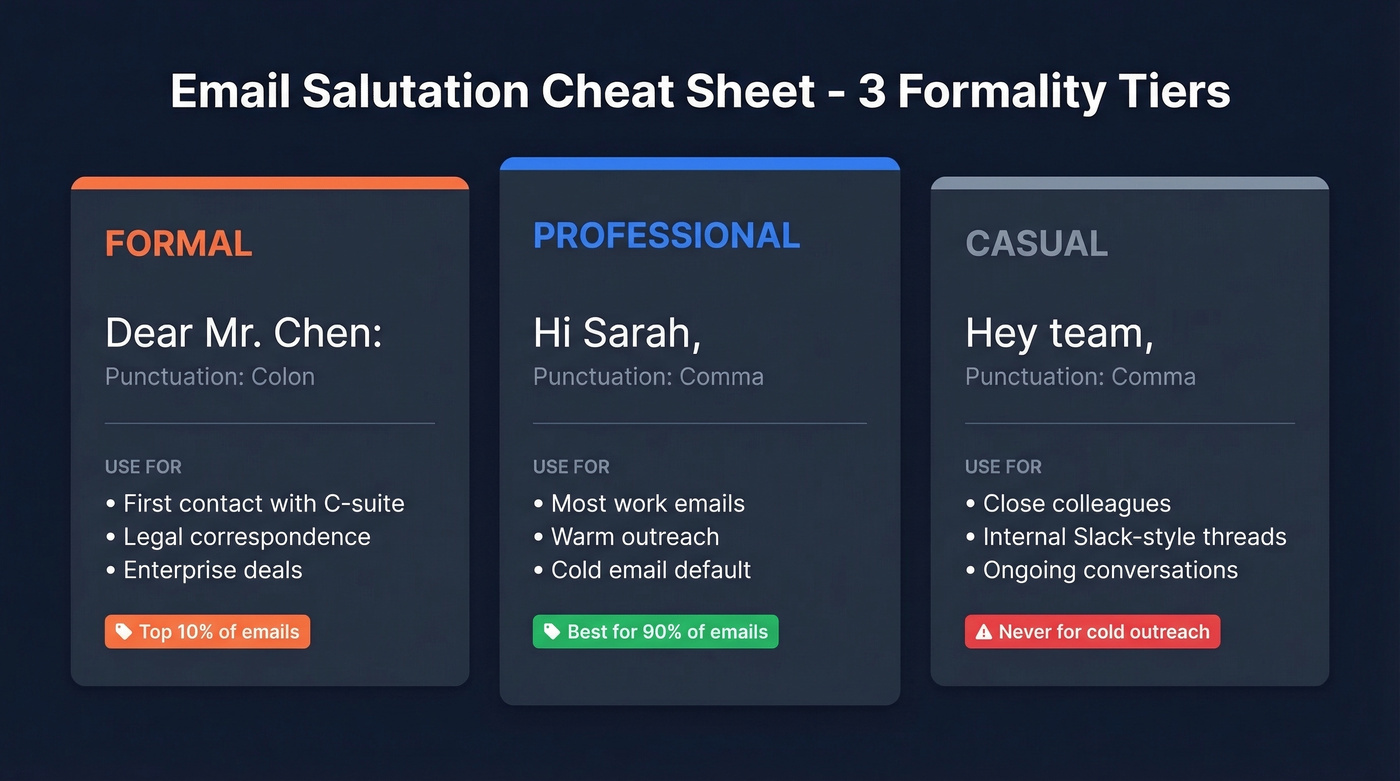
Three tiers, three use cases. That's the whole framework.
| Formality | Salutation Example | When to Use | Punctuation |
|---|---|---|---|
| Formal | Dear Mr. Chen: | First contact, legal, C-suite | Colon |
| Professional | Hi Sarah, | Most work emails, warm outreach | Comma |
| Casual | Hey team, | Close colleagues, internal threads | Comma |
"Hi [First Name]," is the right default for 90% of professional emails. It's warm without being sloppy, and it works whether you're emailing a peer or a director you've spoken with before. In our experience, it outperforms everything else in cold outreach - and we've A/B tested this more times than we'd like to admit. "Dear [Title + Last Name]:" is your formal option for first contact with a C-suite exec, legal correspondence, or any situation where you'd rather err on the side of respect.
"Hey" belongs in Slack and among close colleagues. Never in cold outreach.
Here's the thing: if your average deal size is under five figures, "Hi [First Name]," is the only greeting you'll ever need. "Dear" is for enterprise deals and lawyers. Everyone else is overthinking this.

A personalized salutation is useless if you're emailing the wrong person. Prospeo gives you verified emails from 300M+ professional profiles at 98% accuracy - so every "Hi Sarah," actually reaches Sarah.
Stop guessing names. Start verifying contacts at $0.01 per email.
Salutation Mistakes to Avoid
"Good morning" sent at 4 PM. Time-of-day greetings are a trap. You draft at 9 AM, get pulled into meetings, and hit send after lunch. Now your greeting is wrong. Reddit's r/auslaw flagged this exact problem - just use "Hi" and sidestep it entirely.
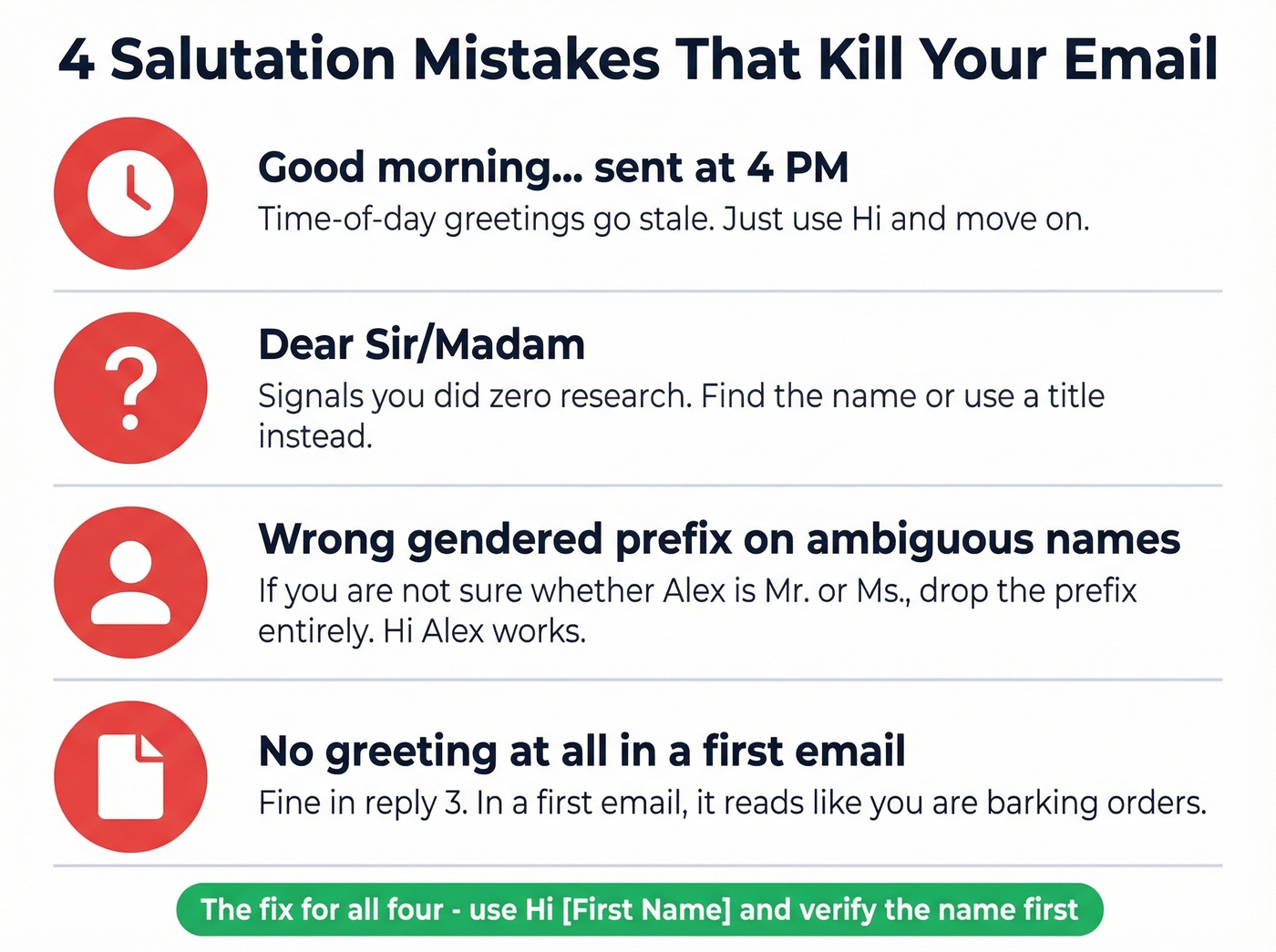
"Dear Sir/Madam" or "To Whom It May Concern." These don't signal respect. They signal you didn't bother finding out who you're writing to. There's no reason for a generic greeting when you can find the person's name in seconds. Prospeo's Email Finder lets you look up verified contact details from 300M+ professional profiles, so you can address your email to an actual human instead of a placeholder.
Gendered assumptions when a name is ambiguous. If you're unsure whether "Alex" is Mr. or Ms., drop the prefix. "Hi Alex," works perfectly. Using the wrong honorific is worse than using none at all.
No greeting in a first email. In ongoing threads, dropping the salutation is fine - everyone does it by reply three. But in a first email, jumping straight into your ask reads like you're barking orders.
Pairing Greetings with Sign-Offs
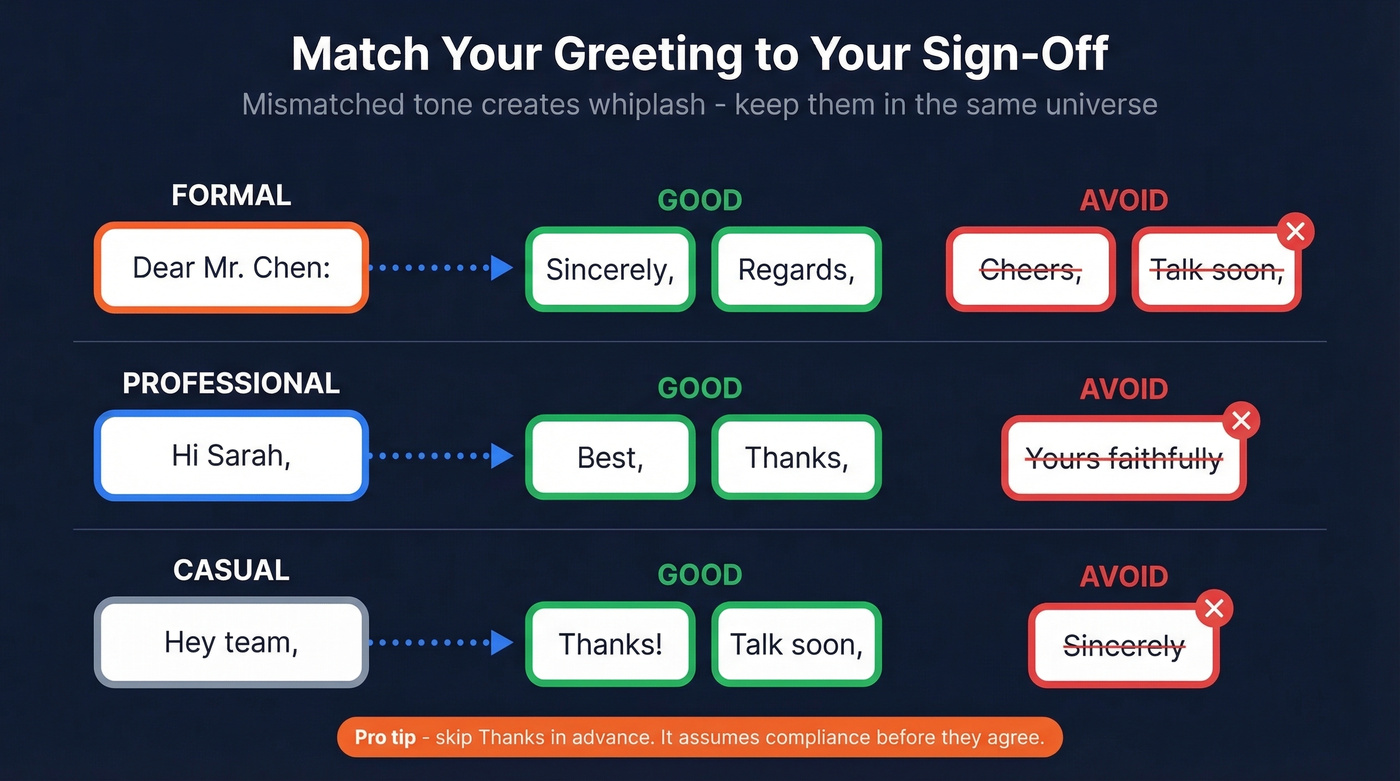
Your greeting and closing should live in the same formality universe. A "Dear Mr. Chen:" followed by "Cheers!" creates tonal whiplash that undermines whatever professionalism you built with the opening. Match them:
| Salutation | Sign-Off | Avoid |
|---|---|---|
| Dear Mr. Chen: | Sincerely, / Regards, | Cheers, Talk soon |
| Hi Sarah, | Best, / Thanks, | Yours faithfully |
| Hey team, | Thanks! / Talk soon, | Sincerely |
Skip "Thanks in advance" - it assumes compliance before they've agreed. Skip emoji sign-offs in professional contexts. And don't skip the sign-off entirely in a first email. As Grammarly's guide notes, dropping the closing reads as brusque even when you don't mean it.
If you're building a repeatable outreach motion, keep your sales communication consistent across templates.
Cross-Cultural Salutations
One rule covers most international email situations: default to the highest formality level until the recipient mirrors something more casual.
If you're emailing a contact in Germany or Japan for the first time, "Dear [Title + Last Name]:" is a safe opener. Match their tone once they set it - not before. Let's be honest, most salutation blunders in cross-cultural emails come from assuming everyone communicates the way your home office does. Reviewing greetings from colleagues who regularly correspond across borders is one of the fastest ways to calibrate your own approach.
This matters even more in enterprise B2B sales, where formality expectations vary by region and seniority.
"Dear Sir/Madam" tells your prospect you didn't do the work. Prospeo's Email Finder surfaces the right name, title, and verified email in seconds - so you never send a generic greeting again.
Kill every "To Whom It May Concern" in your outbox forever.
FAQ
Is "Hi" too casual for a professional email?
No. "Hi [First Name]," is the standard professional greeting in 2026. Reserve "Dear [Title + Last Name]:" for formal first contact with executives or legal correspondence. In cold outreach tests, "Hi" consistently outperforms "Dear" on reply rates for mid-market deals.
What punctuation goes after an email salutation?
Use a comma after professional and casual greetings ("Hi Sarah,"). Use a colon after formal ones ("Dear Mr. Welsh:"). This follows standard American business convention - mixing them up signals carelessness.
What should I use instead of "Dear Sir or Madam"?
Use the recipient's name, job title, or team name - "Hi Alex," "Dear Hiring Manager," or "Hello Marketing Team." If you're doing outreach and don't have a name, an email finder tool can surface the right contact so you never need a generic greeting.
Does the email salutation affect deliverability?
Not directly - spam filters don't flag specific greetings. Generic salutations like "Dear Customer" do correlate with mass-blast templates that trigger spam filters, though. Personalizing your greeting with the recipient's actual name signals a one-to-one message, which improves engagement metrics and sender reputation over time.