

What Is Channel Management? The Practitioner's Guide for 2026
Your distributor carries 15 competing product lines. Yours isn't in their top five. The reps who are supposed to sell your solution can't remember your pricing model, let alone pitch your differentiators. So what is channel management, really? It's the work of making external organizations care enough about your product to actually sell it - and it's why 97% of channel leaders say driving partner-led pipeline is their top strategic priority over the next 12-24 months.
It isn't a strategy deck or a partner portal. It's the daily grind of recruitment, enablement, measurement, and optimization. Most companies are terrible at it - not because the strategy is wrong, but because execution breaks down at recruitment, measurement, or both.
The Short Version
Channel management is how you recruit, enable, measure, and optimize the partners who sell your product. Most programs fail not from bad strategy but from bad data and bad measurement. This guide covers the definition, the full process, the KPIs that matter, the mistakes that kill programs, and the software that holds it all together.
Definition and Scope
Channel management is the complete process of selecting, recruiting, enabling, and optimizing the external partners who bring your product to market. That includes distributors, resellers, VARs, affiliates, system integrators, and any other third party that touches your revenue. Think of it as orchestrating four things: processes, people, policies, and platforms - all aimed at making your go-to-market motion work through organizations you don't control.
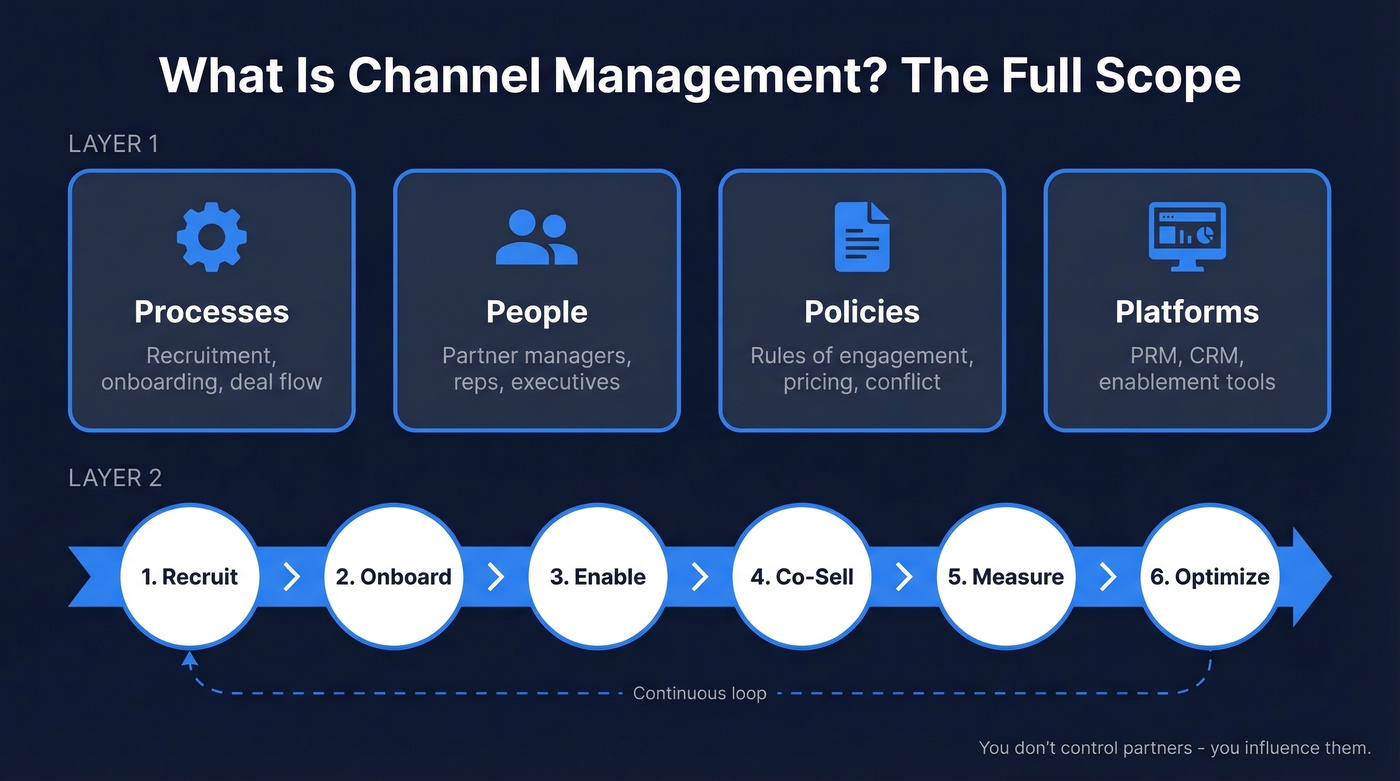
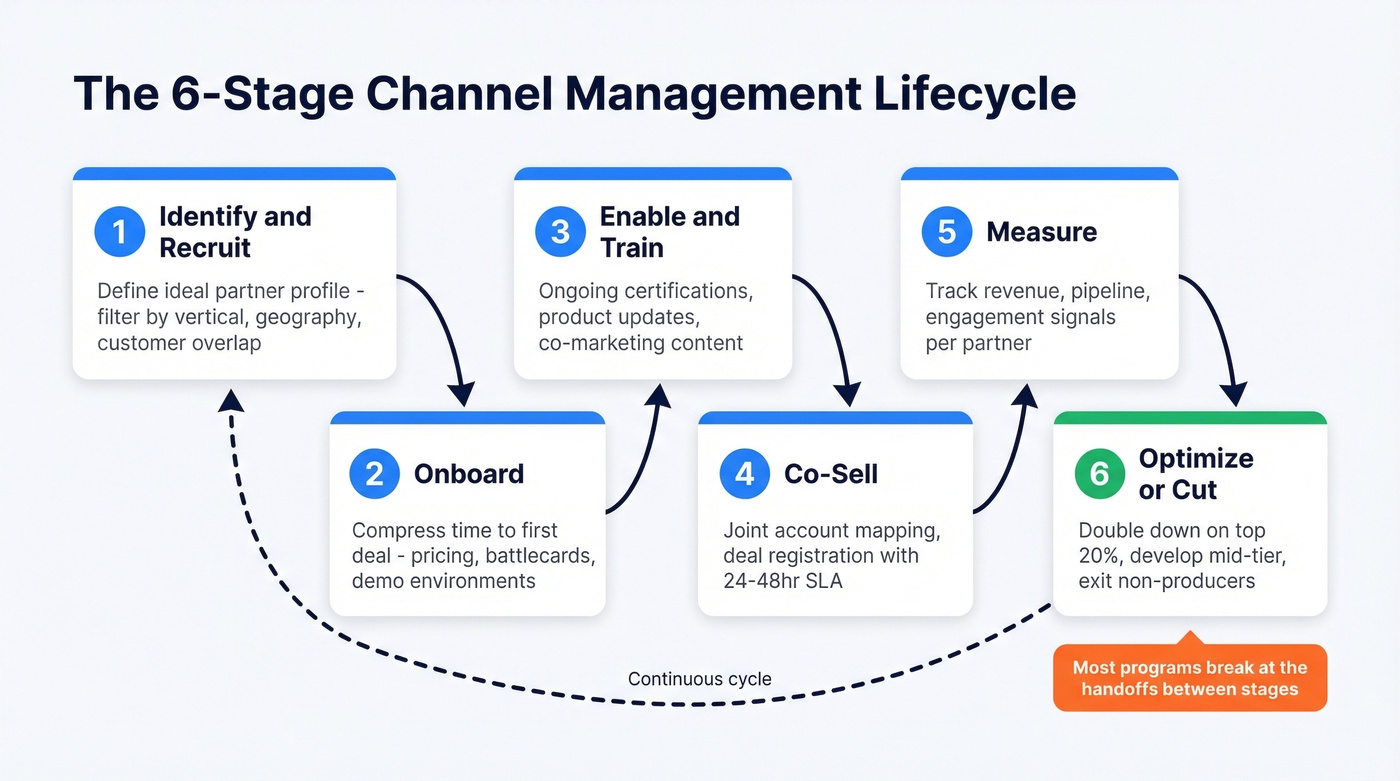
The scope is broader than most people realize. It's not just "partner sales." It covers recruitment to find the right partners, onboarding to get them productive quickly, enablement through training and deal support, co-selling on joint accounts, measurement to separate performers from coasters, and optimization to double down on winners while cutting dead weight. Each stage has its own failure modes. Most programs break at the handoffs between them.
Here's the distinction that trips people up: sales management governs your internal reps. Channel management governs external organizations with their own priorities, their own P&L, and their own reasons to ignore you. You don't control these people. You influence them. That's a fundamentally different skill set.
The types of channels matter too. Direct channels mean you're selling straight to the customer. Indirect channels route through partners. Single-channel strategies bet on one path to market. Multi-channel strategies layer several - and introduce the conflict management headaches we'll cover later.
Why It Matters in 2026
The economics of partner-sourced revenue are hard to argue with. Partner-sourced deals carry a 35% higher win rate and 25% lower CAC compared to direct sales motions. Direct sales benchmarks are moving the wrong direction - win rates down 18% year-over-year, deal values down 21%, sales cycles up 16%.
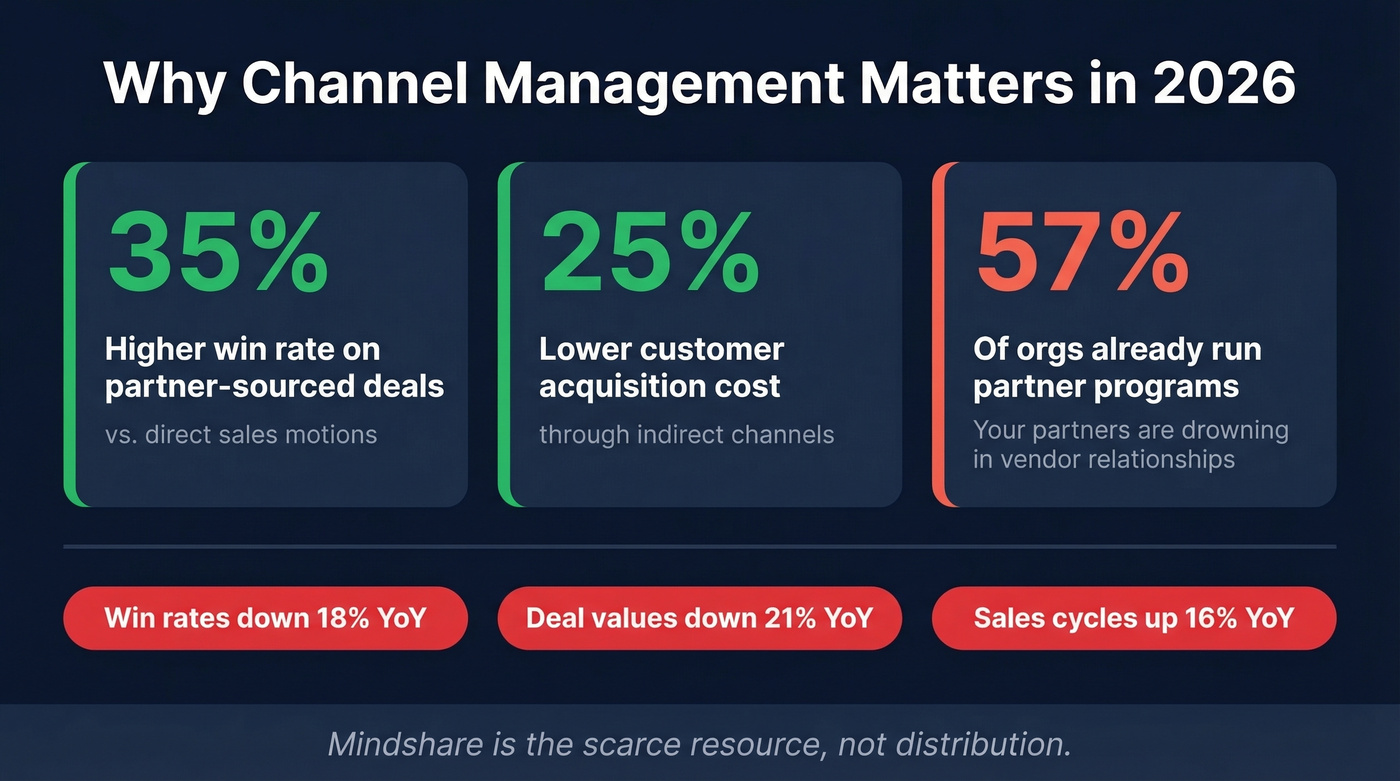
That's the macro case. The micro case is just as compelling: 57% of organizations already use channel partner programs, so your partners are drowning in vendor relationships. Mindshare is the scarce resource, not distribution. When you're an Industrial Automation manufacturer competing for attention on a distributor's line card with 15 other vendors, the fight isn't about having a partner. It's about being the partner they actually remember to pitch.
Reseller margins typically run 20-40%, which means partners are financially motivated to sell - if you make it easy enough. The companies that nail their partner strategy in 2026 will compound that advantage for years. The ones still running programs on spreadsheets and quarterly check-ins will keep wondering why their partners sell the competitor's product instead.
Types of Channels
Not all channels work the same way, and picking the wrong model wastes years.
| Type | How It Works | Typical Margin Impact | Best For |
|---|---|---|---|
| Direct | You sell to the customer | Full margin retained | High-ACV, complex sales |
| Indirect | Partners sell for you | 20-40% to partner | Scale, geographic reach |
| Single-channel | One path to market | Simpler ops, less reach | Niche or early-stage |
| Multi-channel | Multiple paths layered | Higher reach, more conflict | Mature products |
Direct gives you full control over pricing, messaging, and customer relationships. CrowdStrike runs direct sales alongside Amazon Marketplace - keeping the high-touch enterprise motion in-house while using the marketplace for velocity deals.
Indirect is where the real orchestration lives. You're trading margin for reach, and the trade only works if partners actually sell. Adobe's evolution tells the story well: they started with resellers, shifted toward direct, then moved to subscription. Each transition required rethinking the entire strategy.
Multi-channel is where most mature companies land, and it's where conflict gets real. Beardbrand's decision to exit Amazon is the counter-example worth studying. Amazon represented roughly 10% of their revenue, but leaving the platform actually increased sales by 20%+ and gave them back pricing control. Sometimes fewer channels means better outcomes.
The Six-Stage Process
The lifecycle has six stages. Skip one and the whole thing wobbles.
1. Identify and Recruit
Define your ideal partner profile by industry vertical, geography, customer overlap, and technical capability. Then go find them. This is where most programs stall - finding the right contacts at target partner organizations is harder than it sounds. You can't just cold-call a distributor's main line and hope someone transfers you. A B2B data platform like Prospeo lets you filter 300M+ professional profiles by company size, industry, and headcount growth to build a targeted list of partnership decision-makers with verified emails, then push those contacts directly into your CRM.

2. Onboard
Get partners productive fast. Provide a clear playbook with pricing, positioning, competitive battlecards, and demo environments. The faster a partner closes their first deal, the more likely they are to stick around. We've seen programs where onboarding takes 90 days and partners churn before they ever sell anything. Compress that timeline ruthlessly.
3. Enable and Train
This isn't a one-time event. Ongoing enablement means regular product updates, certification programs, and co-marketing content. Partners who feel supported sell more. Partners who feel abandoned sell your competitor.
4. Co-Sell
Joint account mapping is the highest-leverage activity in the entire process. Sit down with your top partners quarterly, compare target account lists, and identify overlaps. Then run joint calls. Deal registration with a 24-48 hour SLA keeps things clean and gives partners confidence their pipeline is protected.
5. Measure
Track everything we'll cover in the KPIs section below. If you can't tell which partners are performing and which are coasting, you're flying blind.
6. Optimize or Cut
Double down on top performers. Give mid-tier partners a clear path to the next level. And have the hard conversation with partners who aren't producing. Sometimes the best decision is ending a relationship that's consuming resources without generating revenue. Let's be honest - most channel managers avoid this step for too long.

Your channel program is only as strong as your partner recruitment pipeline. Prospeo gives you 30+ search filters to pinpoint partnership decision-makers at distributors, VARs, and resellers - with 98% verified email accuracy and 7-day data refresh so you're never pitching stale contacts.
Stop cold-calling distributor front desks. Reach the right partner contacts directly.
KPIs That Actually Matter
The 80/20 rule applies brutally here: 20% of your partners generate 80% of your revenue. The KPIs you track should help you identify which 20% to invest in and which 80% to either develop or drop.
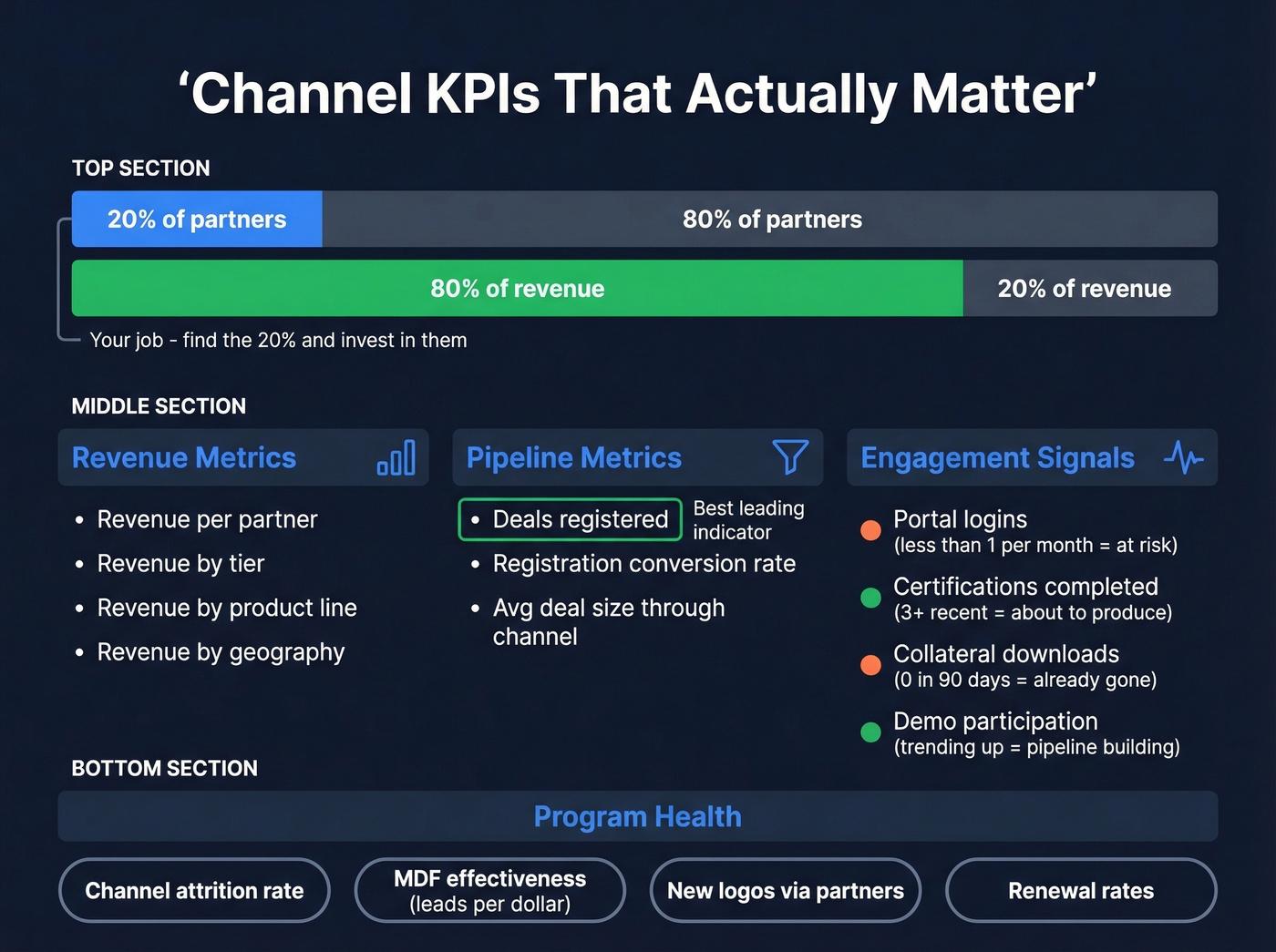
Revenue metrics - Revenue per partner, revenue by tier, revenue by product line, revenue by geography. Slice it every way you can. A partner crushing it on one product but ignoring your new launch needs a different conversation than one underperforming across the board.
Pipeline metrics - Number of deals registered, deal registration conversion rate, average deal size through channel. We've watched programs die because leadership tracked revenue but ignored pipeline. Deal registration volume is the single best leading indicator of future channel revenue - by the time revenue dips, you're already six months behind.
Engagement signals - This is where most programs under-invest, and it's where the real predictive power lives.
| Signal | What It Tells You | Action Threshold |
|---|---|---|
| Portal logins | Active vs. dormant | < 1/month = at risk |
| Certifications completed | Ramp trajectory | 3+ recent = about to produce |
| Collateral downloads | Selling activity | 0 in 90 days = already gone |
| Demo participation | Deal-stage engagement | Trending up = pipeline building |
A partner whose reps just completed three certifications is about to ramp. A partner who hasn't logged into your portal in 90 days is already gone. These behavioral signals predict future revenue better than any lagging indicator.
Program health metrics - Channel attrition rate, MDF effectiveness measured as leads generated per dollar spent, new customer logos sourced through partners, and renewal rates. MDF effectiveness is particularly important because it tells you whether your co-marketing spend is actually working or just subsidizing partner events that don't generate pipeline.
Five Mistakes That Kill Programs
1. Not enough coverage. Here's a counterintuitive truth from Manufacturing.net: if your partners never compete with each other, you probably don't have enough of them. Some channel conflict is healthy - it means you have real market coverage. The goal is to manage conflict, not eliminate it.
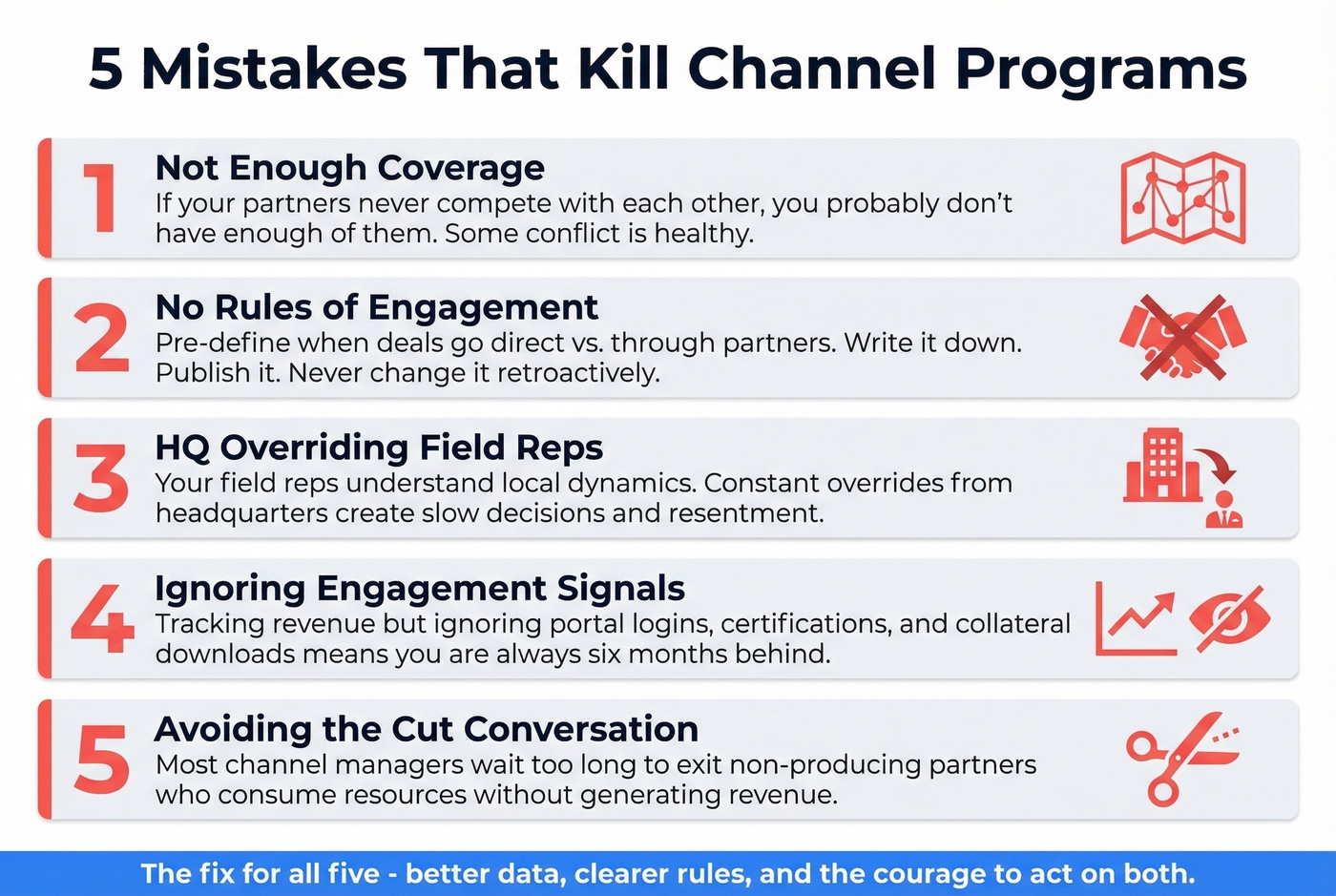
2. No rules of engagement. Pre-define when you'll take deals direct versus routing through partners. Write it down. Publish it. Never make retroactive changes. The fastest way to destroy partner trust is to swoop in on a deal they sourced because it's big enough to matter to your direct team.
3. HQ overriding field reps. Your field reps understand the local dynamics. When headquarters constantly overrides their judgment on partner conflicts, you get slow decisions and demoralized reps. Push conflict resolution authority down to the people closest to the situation - this matters even more in global programs where norms vary significantly by region.
4. Lack of trust and transparency. If you're not in your distributor's top five suppliers, don't try to be their strategic partner overnight. Focus on being easy to do business with: fast quotes, clean deal registration, responsive support. Trust compounds over time.
5. Relying on spreadsheets. Manual MDF tracking creates a 12% discrepancy rate in claims. Legacy incentive calculations carry 15-20% error rates. Companies lose 10% of allocated MDF and rebate funds to duplicate claims, unauthorized discounts, and clerical mistakes. On top of that, 70% of channel managers lack accurate inventory data at point of sale - which means partners are quoting wrong availability and losing deals you'll never even hear about. That's not a rounding error. It's a program-killing leak.
How to Handle Channel Conflict
Channel conflict happens when two or more partners in your sales channel oppose each other - or when your own direct motion competes with your partners. The California Management Review breaks this into two types: vertical conflict between different levels of the channel, like manufacturer vs. distributor, and horizontal conflict between partners at the same level, like two resellers fighting over the same account.
The triggers are predictable. Price differences across channels. One partner getting product access before another. A manufacturer launching direct-to-consumer that undercuts existing partners. Harry's handles this well - they maintain standard pricing across all channels, removing the most common source of retailer-versus-manufacturer tension.
The instinct is to avoid conflict entirely. That's wrong. The better approach is to embrace and manage it. Establish clear rules of engagement before conflict happens. Define territory boundaries, deal registration protocols, and escalation paths. When conflict does arise, resolve it quickly and locally - don't let it fester while committee reviews drag on.
Real-time inventory and data sharing also reduces friction. When partners can see accurate stock levels and pricing in real time rather than waiting for monthly updates, the information asymmetry that breeds conflict disappears. ERP integrations and API-connected partner ecosystems that sync every 15 minutes rather than once a month make a measurable difference.
Real-World Examples
Beardbrand made the bold call to exit Amazon entirely. The marketplace represented about 10% of revenue, but it was eroding pricing control and brand experience. After leaving, sales increased by 20%+ and they regained full control over customer relationships. Not every company should leave Amazon, but Beardbrand proves that fewer channels can sometimes mean better outcomes.
DISH Network operates through 4,000+ retailers globally, enabling partners with co-op programs, digital marketing bundles, digital asset management tools, and local marketing support. It's a strong example of scaling enablement without losing consistency - every dealer gets the same assets, but local customization keeps the programs relevant.
Bobcat manages 700+ dealers and improved participation by simplifying enrollment - adding a 3-month commitment option alongside the standard 6-month term. Lower barriers to entry drove higher co-op fund utilization and more active dealer engagement. Small operational changes, big behavioral shifts.
Software Compared
PRM (Partner Relationship Management) software handles the operational backbone - deal registration, incentive management, partner portals, reporting.
PRM Comparison Table
| Tool | Starting Price | G2 Rating | Best For |
|---|---|---|---|
| Kiflo | Free, paid from $249/mo | 4.6/5 | Starting from zero |
| Salesforce PRM | $25/user/mo | 4.3/5 | Existing SF orgs |
| Channeltivity | From $1,399/mo | 4.5/5 | Mid-market complexity |
| PartnerStack | ~$1K-$3K/mo | 4.7/5 | SaaS ecosystems |
| Impact.com | From $30/mo | - | Affiliate + partner |
| ZINFI | ~$2K-$5K+/mo | - | Enterprise full-stack |
| Impartner | ~$2K-$5K+/mo | 4.5/5 | Global enterprise |
Kiflo's free tier is the obvious first step if you're building a partner program from scratch. Salesforce PRM is the path of least resistance if you're already on the Salesforce ecosystem - the CRM integration alone saves weeks of data plumbing. PartnerStack owns the SaaS partner ecosystem space, particularly for referral and affiliate-style programs. ZINFI and Impartner are the enterprise plays - complex, powerful, and priced accordingly.
Skip Impartner and ZINFI if you're under 50 partners. You'll pay enterprise prices for features you won't use for two years.
Here's the thing most channel consultants won't tell you: PRM software is table stakes, not a competitive advantage. Every vendor in this table handles deal registration and portal management just fine. The programs that actually outperform don't win because of better PRM - they win because they recruit better partners, enable them faster, and measure the right things. If your partner recruitment pipeline is dry, the fanciest PRM in the world just manages an empty room.
That's why the data layer underneath your PRM matters more than most teams realize. PRM manages partners you already have. Recruiting new partners and enriching your existing partner database with verified contacts requires a different tool entirely. Prospeo fills that gap with 98% email accuracy and native Salesforce and HubSpot integrations, so you can build your partner prospect list, verify contact data, and push those contacts into your PRM for ongoing management.

Joint account mapping with partners requires clean, current data on both sides. Prospeo's CRM enrichment returns 50+ data points per contact at a 92% match rate - so when you sit down for quarterly account mapping, your overlap analysis is built on verified contacts, not outdated records.
Power your co-selling motion with data that's refreshed every 7 days.
What's Changing in 2026
The measurement game is shifting fast. According to Zeta Global, channel marketers are moving away from channel-only metrics toward incremental lift, iROAS, value per subscriber, and multitouch attribution. First-click and last-click models are finally dying - and that changes how you evaluate which partners actually drive revenue versus which ones just touch deals that were already closing.
Email deliverability rules keep tightening. After Google and Yahoo's DMARC requirements in 2023 and Microsoft's 2025 requirements, expect 2026 to push DMARC policies toward p=quarantine for large senders. If your partners are sending co-branded emails on your behalf, their authentication setup is now your problem.
ML-based fraud detection is reducing fraudulent rebate payouts by up to 25%. That's real money recovered - especially for programs running eight-figure MDF budgets where manual auditing missed duplicate claims and unauthorized discounts for years.
We've seen this pattern repeatedly with partner portal UX too: companies that invest in portal redesigns see roughly 25% adoption lifts within six months. If you make the portal actually usable, partners will actually use it. The best enablement content in the world doesn't matter if partners can't find it.
FAQ
What's the difference between channel and sales management?
Sales management governs your internal reps - quotas, coaching, pipeline reviews, compensation. Channel management governs external partners, distributors, and resellers, including recruitment, enablement, conflict resolution, and performance measurement. The control dynamics are fundamentally different because you influence partners rather than direct them.
Do I need PRM software?
If you manage more than 10 active partners, yes. Below that, a CRM plus manual processes works fine. Above it, spreadsheet-based tracking creates a 12% discrepancy rate and 15-20% incentive calculation errors. The cost of those errors exceeds PRM software costs surprisingly fast.
How do I measure program ROI?
Track revenue per partner by tier, deal registration volume, MDF effectiveness as leads per dollar spent, attrition rate, and new customer logos sourced through partners. The 80/20 rule applies - focus measurement energy on understanding why top partners outperform and replicating those conditions across your program.
How do I find the right partners?
Define your ideal partner profile by industry, geography, and customer overlap. Then use a B2B data platform to build a target list with verified contact data - filter by company size, headcount growth, and industry to find partnership decision-makers. Direct outreach to qualified prospects outperforms waiting for inbound partner applications every time.
What causes channel conflict?
Price differences across channels, timing advantages where one partner gets product access before another, and manufacturers launching direct-to-consumer motions that compete with existing partners. Prevention starts with clear rules of engagement, pricing parity, and fast local conflict resolution rather than slow headquarters escalation.