

slug: what-is-meddic-sales-process
What Is the MEDDIC Sales Process? (It's Not What You Think)
It's Thursday pipeline review. A rep calls a $180K deal "Commit." You ask who the economic buyer is. Silence. That deal isn't a commit - it's a hope, and MEDDIC exists to kill hope before it kills your forecast.
Quick Version
What most people call the MEDDIC sales process is actually a qualification framework - not a process, not a methodology. Use it for complex B2B sales deals where multiple stakeholders and budget justification can stall or kill a deal. For cycles under three months, standard MEDDIC is enough. For enterprise B2B sales deals with legal, security, and competitive bake-offs, upgrade to MEDDPICC. Implementation is straightforward: a 1-4 scorecard per deal, required CRM fields, and two discovery questions per letter.
What MEDDIC Actually Is
Your sales process is your pipeline stages - Discovery, Demo, Proposal, Closed Won. A methodology is how you sell (Challenger, SPIN, Sandler). MEDDIC is neither. It's a qualification framework - a lens you apply at each stage to decide whether a deal is real or a mirage.
MEDDIC was created at PTC in the 1990s, commonly credited to John McMahon and closely associated with Dick Dunkel and Jack Napoli, who helped document and spread it inside the company. During the period PTC used it, annual revenue grew from $300M to over $1B in four years. That's the kind of result that gets a framework adopted industry-wide.
Today, 73% of SaaS companies selling above $100K ARR use some version of MEDDIC or MEDDPICC. MEDDPICC adoption doubled from 11% to 21% among B2B sales organizations between 2021 and 2022, and organizations that fully adopt it report 18% higher win rates and 24% larger deal sizes. That's not a fad - it's infrastructure. It works best when it becomes a shared language across sales, enablement, and marketing, not just a rep-level tool.
The MEDDIC Acronym Explained
| Letter | Stands For | What It Means | Example |
|---|---|---|---|
| M | Metrics | Quantified business outcome | "Reduce ramp from 6 to 4 months" |
| E | Economic Buyer | Person who approves budget | "Who signs the PO?" |
| D | Decision Criteria | How the buyer evaluates options | "Must-haves vs nice-to-haves?" |
| D | Decision Process | Steps to signed contract | "Walk me through approvals" |
| I | Identify Pain | Problem driving urgency | "Cost of not fixing this by Q3?" |
| C | Champion | Internal advocate with power | "Who's staking their reputation?" |
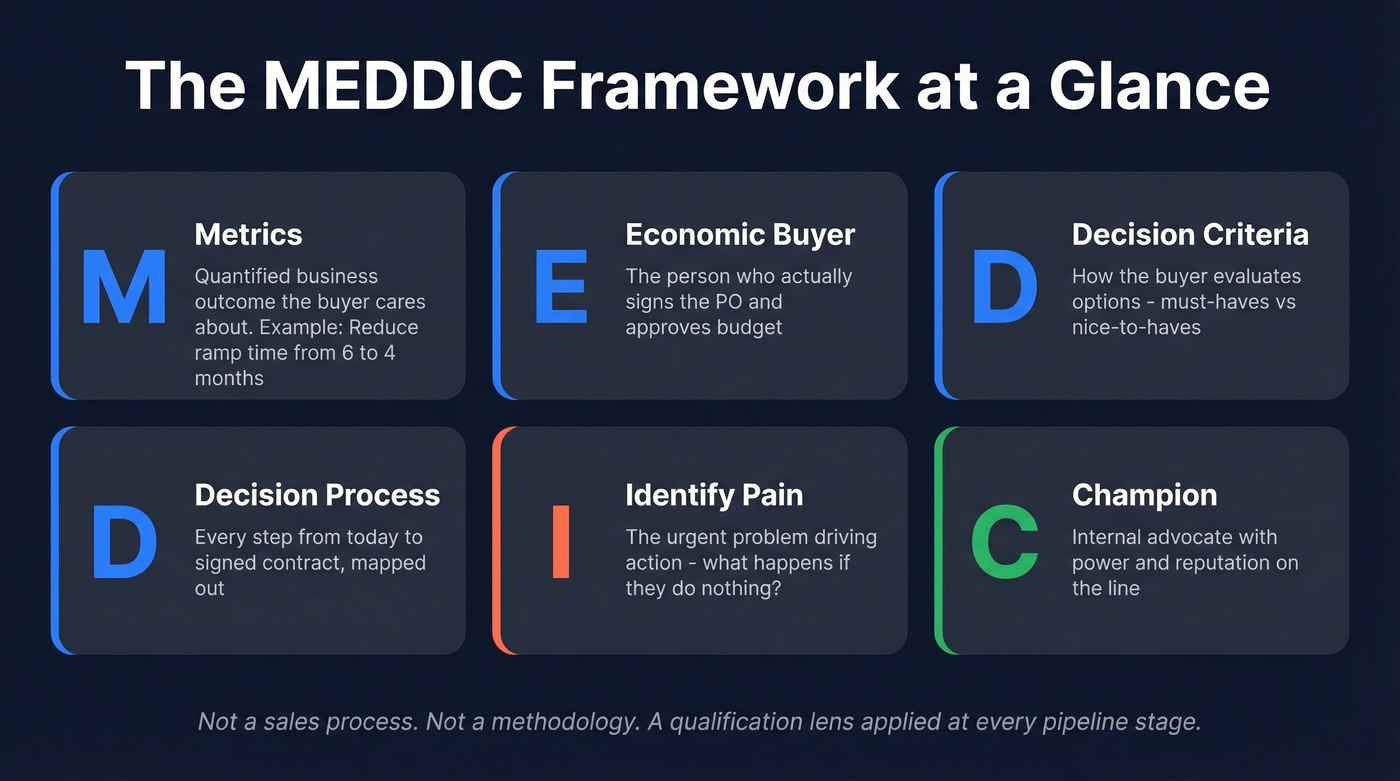
Every metric needs a number and a timeframe. "Improve efficiency" isn't a metric. "Increase close rate by 20% within two quarters" is. If your champion can't articulate the metric to their CFO, you don't have one yet.
Here's the thing: buying committees have expanded from 3-5 stakeholders to 8-12, and buyers complete nearly 80% of their research before talking to sales. This framework forces you to map that complexity instead of pretending your single-threaded champion controls the deal.
MEDDIC vs MEDDPICC vs MEDDICC
| Variant | Adds | Best For |
|---|---|---|
| MEDDIC | - | Short cycles, simple procurement |
| MEDDICC | Competition | Multi-vendor evaluations |
| MEDDPICC | Paper Process + Competition | Enterprise: legal + procurement |
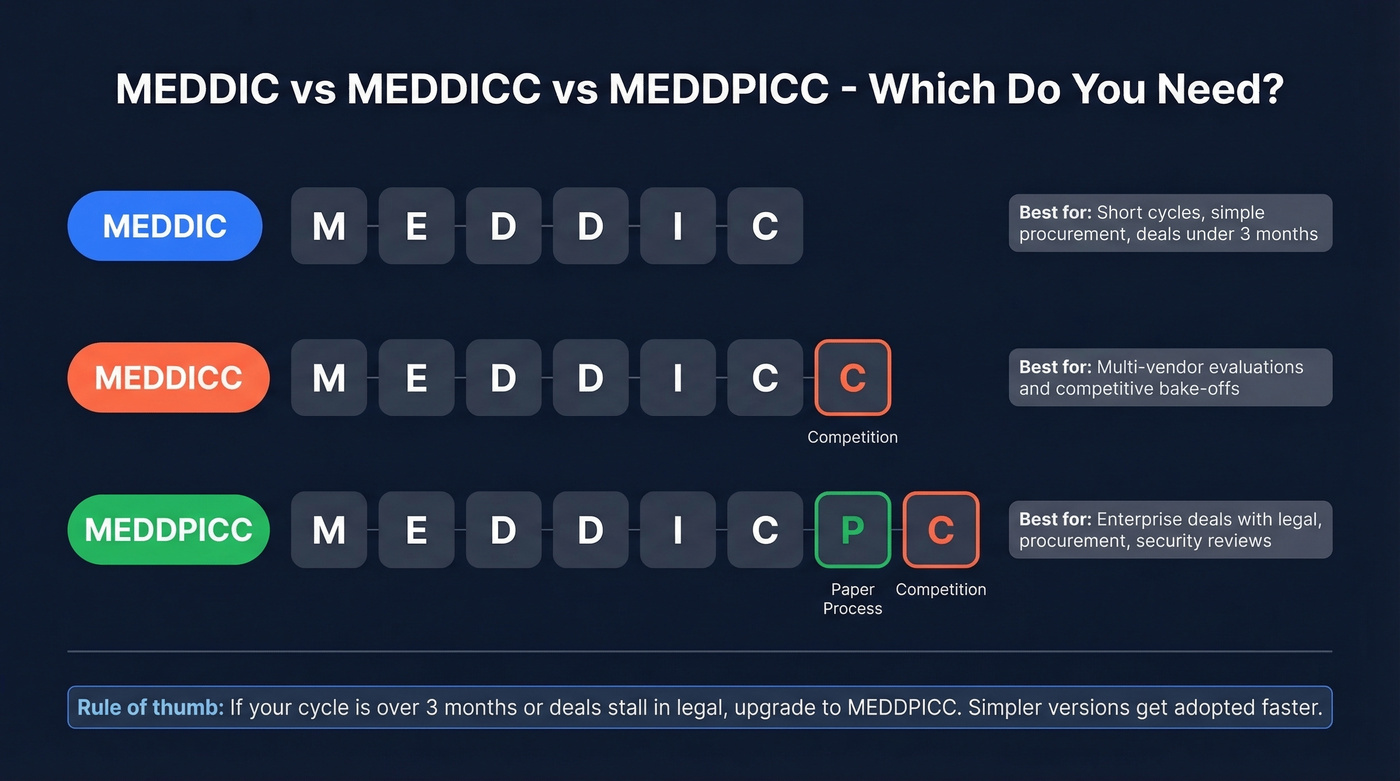
If your average cycle exceeds three months, or deals routinely stall in legal and procurement, you need the extra letters. MEDDPICC's Paper Process covers MSAs, DPAs, and security questionnaires - the stuff that kills deals after you've "won" them. But if procurement is a rubber stamp at most of your accounts, stick with the base framework. Simpler versions get adopted faster, and adoption is the whole game.

MEDDIC only works if you can actually reach the economic buyer and champion. Prospeo gives you 98% verified emails and 125M+ direct dials on a 7-day refresh cycle - so you multi-thread into accounts with real contact data, not guessed email formats.
Stop single-threading deals because you can't find the buying committee.
MEDDIC vs BANT, SPIN, Challenger
A common take on r/sales is that all frameworks boil down to need, budget, stakeholders, and timeline. The difference is granularity.
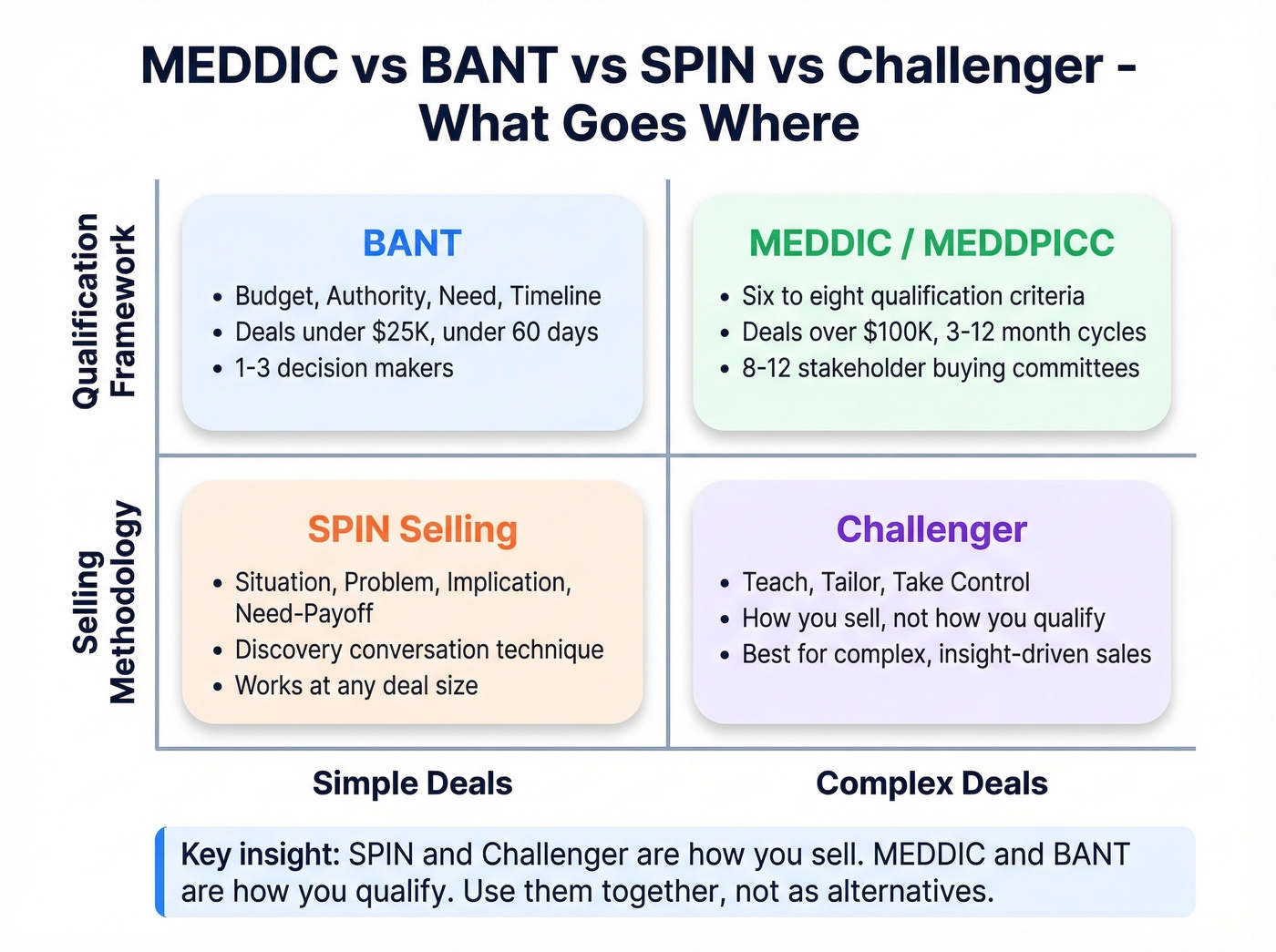
Use BANT for transactional deals under 60 days with one to three decision-makers. Using BANT for a six-figure enterprise deal with a 12-person buying committee is irresponsible - you'll qualify deals that should've been disqualified in week two. We've seen teams waste entire quarters chasing "qualified" pipeline that was never real because they stopped at "yes, we have budget" and never mapped the decision process.
SPIN and Challenger aren't qualification frameworks at all; they're selling methodologies. Run Challenger selling with MEDDIC qualification. They're complementary, not competing.
Discovery Questions That Work
MEDDIC should be invisible to the buyer. You're not reading from a checklist - you're using it as an internal compass to know what you still need to learn. One to two questions per letter is enough:
- Metrics: "How will you justify this purchase in six months?"
- Economic Buyer: "Who has the final say on budget - and can I meet with them?"
- Decision Criteria: "What are your must-haves versus nice-to-haves?"
- Decision Process: "Walk me through the steps from today to signature."
- Identify Pain: "What's the cost of doing nothing for another quarter?"
- Champion: "Who internally is sponsoring this - and what do they need from us?"
For MEDDPICC deals, add questions about contract review timelines, legal and compliance checks, and what alternatives the buyer is evaluating - including doing nothing or building internally.
None of these questions matter if you can't reach the economic buyer and champion in the first place. We've found that Prospeo's 98% verified email accuracy and 125M+ verified mobile numbers on a 7-day refresh cycle make a real difference when you're trying to multi-thread into an account and reach the right stakeholders instead of guessing at email formats. Find your contacts here.
Scorecard and CRM Setup
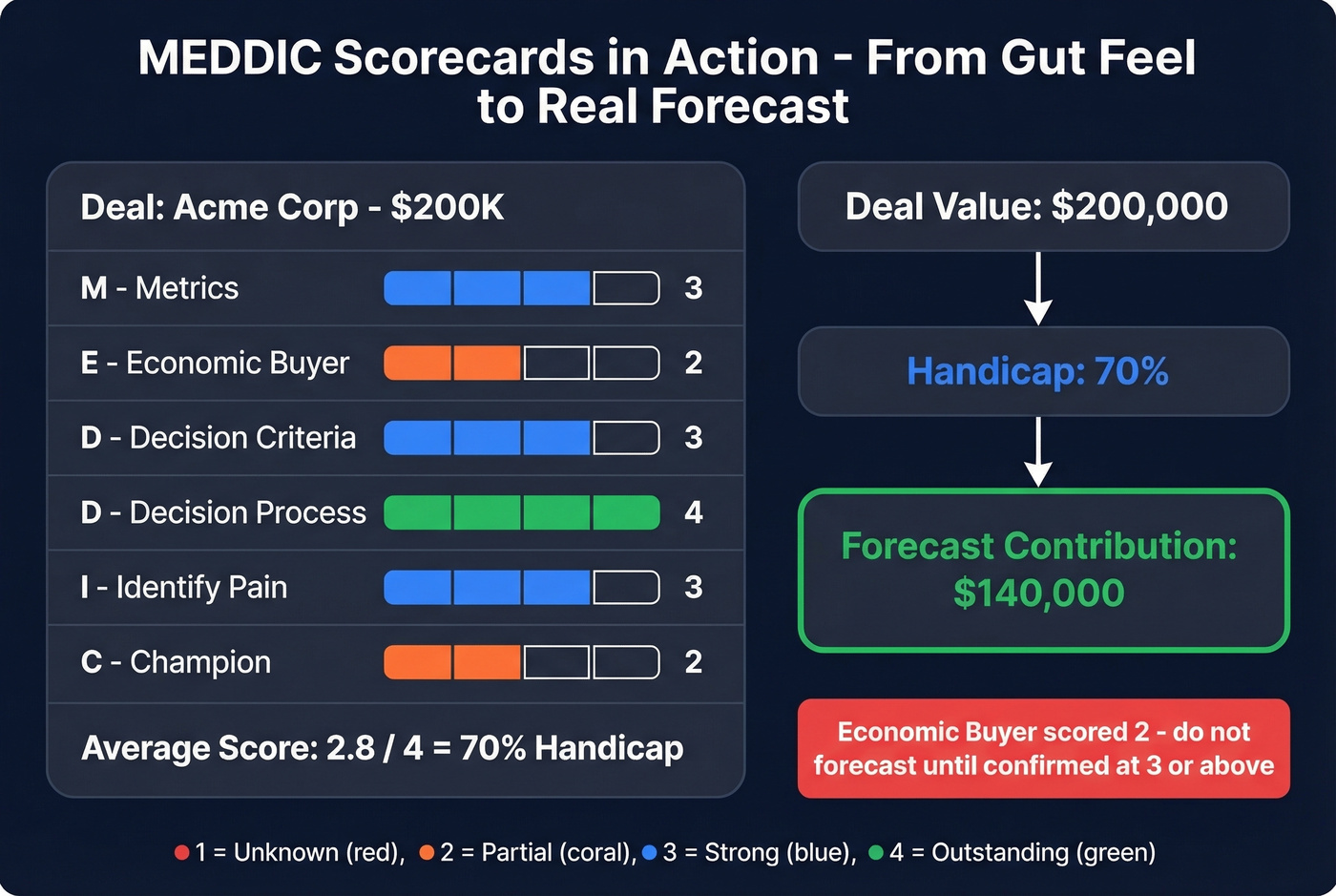
A scorecard turns MEDDIC from a concept into a forecasting tool. Score each letter 1-4:
| Score | Meaning | Evidence Level |
|---|---|---|
| 1 | Unknown | Assumptions only |
| 2 | Partial | Some evidence, gaps remain |
| 3 | Strong | Buyer-validated, confirmed |
| 4 | Outstanding | CFO/GC-grade proof |
Average the scores to get a MEDDPICC Handicap percentage. Then forecast: Deal Value x Handicap % = Forecasted Value. A $200K deal at 60% handicap is a $120K forecast contribution - more honest than gut-feel commit calls.
For CRM implementation, create dropdown properties for each letter and make them required to advance deal stages. One HubSpot-specific gotcha: you can't natively require a contact association to move a deal forward, so build a workflow that flags deals missing a champion or economic buyer contact.
Our qualification threshold: don't forecast a deal unless Economic Buyer, Decision Process, and Paper Process are all confirmed at a 3 or above. Everything else is pipeline, not forecast.
Common Mistakes
Most implementations fail because managers turn MEDDIC into theater. The consensus on r/sales is that it becomes a CRM checkbox exercise - reps fill out fields to survive pipeline reviews, nobody uses the data to change what happens next. If a field doesn't change your next action, delete it.
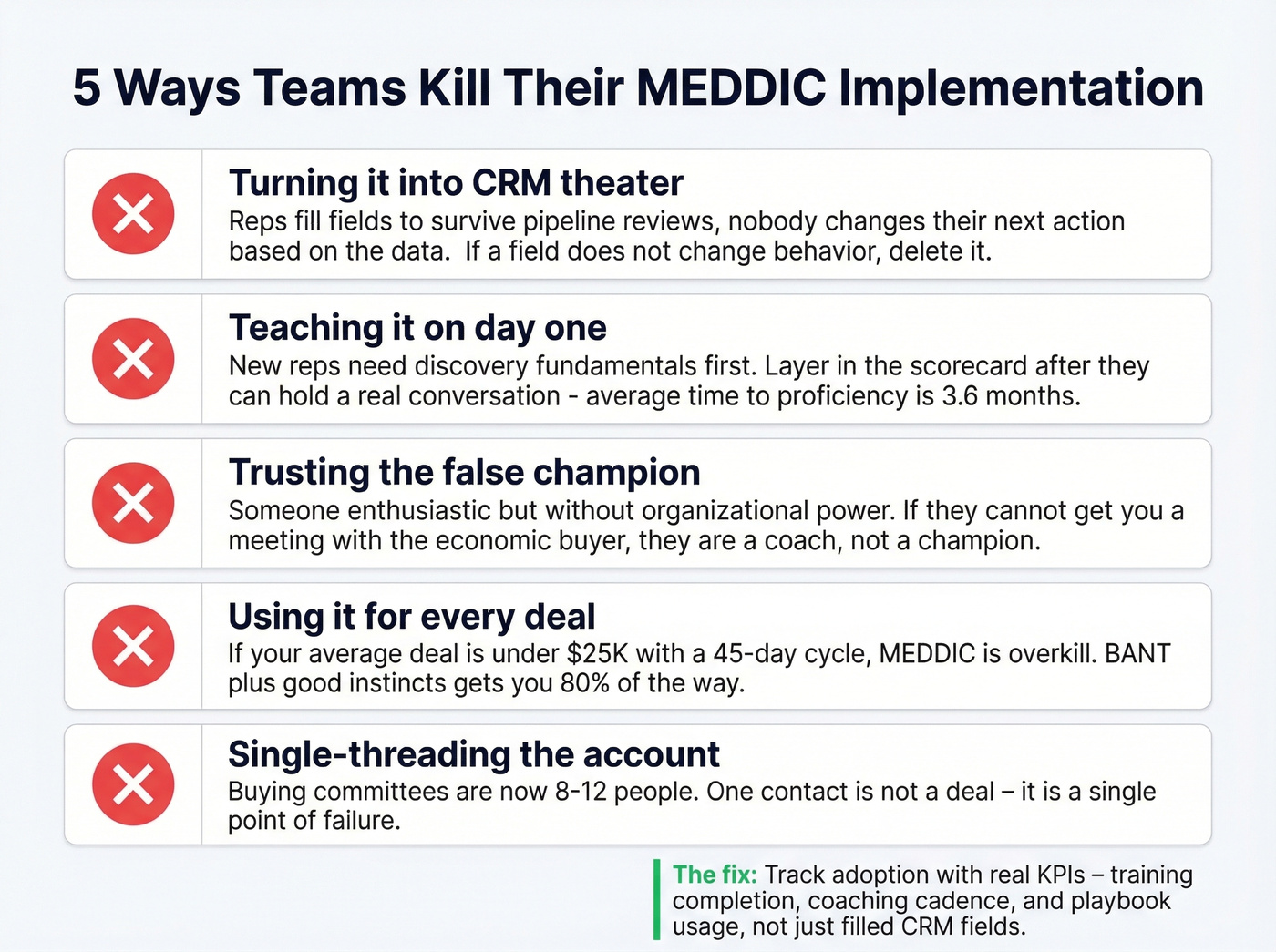
Don't teach the framework on day one. New reps need discovery fundamentals first. Layer in the scorecard after they can hold a conversation - average time to proficiency is 3.6 months. Track adoption with concrete KPIs: training completion rate, manager coaching cadence, and playbook access rate - not just whether CRM fields are filled.
Let's be honest: MEDDIC is the best qualification framework available for complex B2B sales. But if your average deal is under $25K and your cycle is under 45 days, skip it. BANT plus good instincts will get you 80% of the way there. The framework earns its keep on the deals where a single missed stakeholder costs you six figures.
One more pitfall worth flagging: the false champion. Someone enthusiastic but without organizational power. If your "champion" can't get you a meeting with the economic buyer, they're a coach at best. Score them accordingly and keep looking.
If you want a deeper playbook, start with MEDDIC sales qualification and keep a bank of MEDDIC discovery questions for coaching.
Your MEDDIC scorecard flags gaps. Prospeo fills them. With 300M+ profiles, 30+ filters including job changes and department headcount, you identify and reach every stakeholder - from the champion to the economic buyer - at $0.01 per verified email.
Score a 4 on every letter by reaching the right people first.
FAQ
Is MEDDIC a sales process or a qualification framework?
It's a qualification framework, not a sales process. Your sales process defines pipeline stages (Discovery, Demo, Proposal, Close). MEDDIC is the scoring lens you apply at each stage to determine whether the deal is real, winnable, and worth forecasting.
How long does it take to roll out MEDDIC?
Expect roughly 3.6 months to reach team-wide proficiency. Start with core selling skills, then layer in the scorecard and required CRM fields once reps can hold quality discovery conversations without a script.
What's the best way to find economic buyer contacts?
Multi-threading into buying committees requires accurate contact data. Tools like Prospeo verify emails and direct dials in real time with a 7-day refresh cycle and 98% email accuracy, covering 300M+ professional profiles with 30+ search filters including job title, seniority, and department. Try it free.
When should I upgrade from MEDDIC to MEDDPICC?
Upgrade when your average sales cycle exceeds three months, deals involve legal or procurement review, or you regularly compete against multiple vendors. MEDDPICC adds Paper Process and Competition tracking - critical for enterprise deals above $100K where post-verbal stalls are common.