

ZoomInfo Intent Data: What It Costs, Where It Fails, and Whether It's Worth It in 2026
You're staring at a prospect list filtered by intent score. Half the accounts show 90+. Your reps call them, and the response is some version of "never heard of you, not looking." One Reddit user put it bluntly: prospects with a perfect 100 ZoomInfo intent score "weren't interested or weren't searching for it."
That's not an isolated case - it's the core tension with this product. The signal exists. The question is whether you can extract value from it without burning $24K+ and your reps' trust.
30-Second Verdict
Worth it if: You're running enterprise ABM with 20+ reps, a $30K+ data budget, and the operational maturity to validate intent signals against first-party CRM data. ZoomInfo's multi-signal approach and Streaming Intent are genuinely powerful in that context.
Skip it if: You don't have dedicated headcount for signal validation, your team is under 10 reps, or you can't commit to acting on signals within 48 hours of a spike.
How ZoomInfo Intent Works
ZoomInfo's intent engine pulls from four data sources: content consumption tracking, bidstream advertising data, IP-based web tracking via their WebSights product, and third-party review platform partnerships. The pitch is that combining these signals produces a richer picture than any single source alone.
The scale is real. ZoomInfo processes 1.5B+ data points per day and captures 58M intent signals weekly. They earned a Leader position in The Forrester Wave for Intent Data Providers For B2B, Q1 2025 - a recognition that carries weight in enterprise procurement conversations.
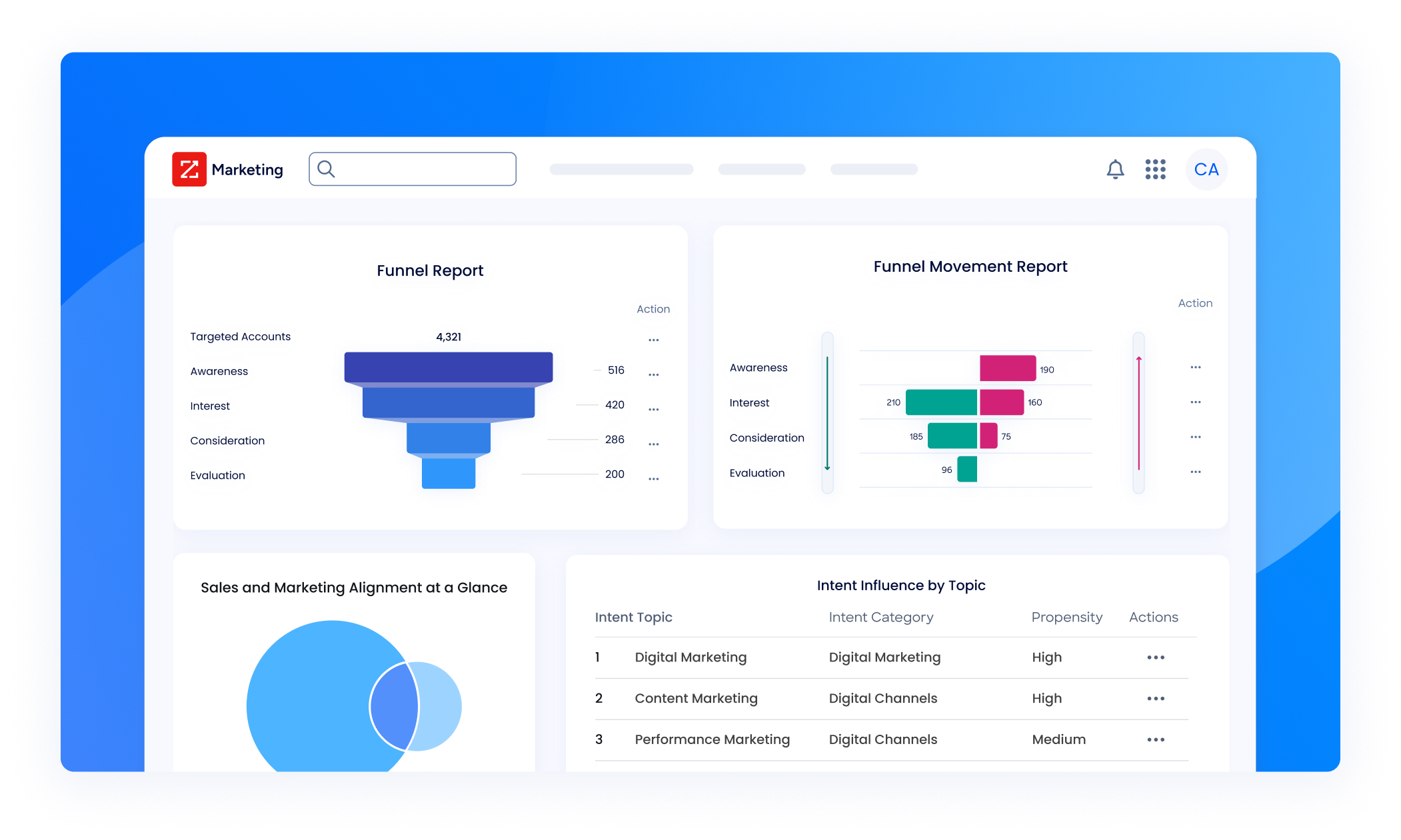
Two features define the product. Guided Intent uses AI to recommend topics correlated with your historical closed-won deals, removing the guesswork of manual topic selection. Streaming Intent delivers real-time signals as accounts spike, pushing alerts into your workflow rather than waiting for a weekly batch report.
Intent is available on ZoomInfo Sales Advanced or Elite packages. Streaming Intent is typically packaged on higher tiers or sold as an add-on depending on your contract, which is why many teams end up at $24K+ before they see meaningful value. The technology is sophisticated. The problem isn't what it can do - it's what it actually does for most teams that buy it.
Where ZoomInfo Intent Falls Short
False Positives and IP Misattribution
The numbers aren't pretty. 52% of sales professionals report frequent false positives with intent data, and 29% cite misattributed IP data as a key challenge. Remote work and VPN usage have made IP-to-company matching increasingly unreliable. When a big chunk of your target accounts have employees working from home or through corporate VPNs, resolving an IP address to a specific company is closer to guessing than science.
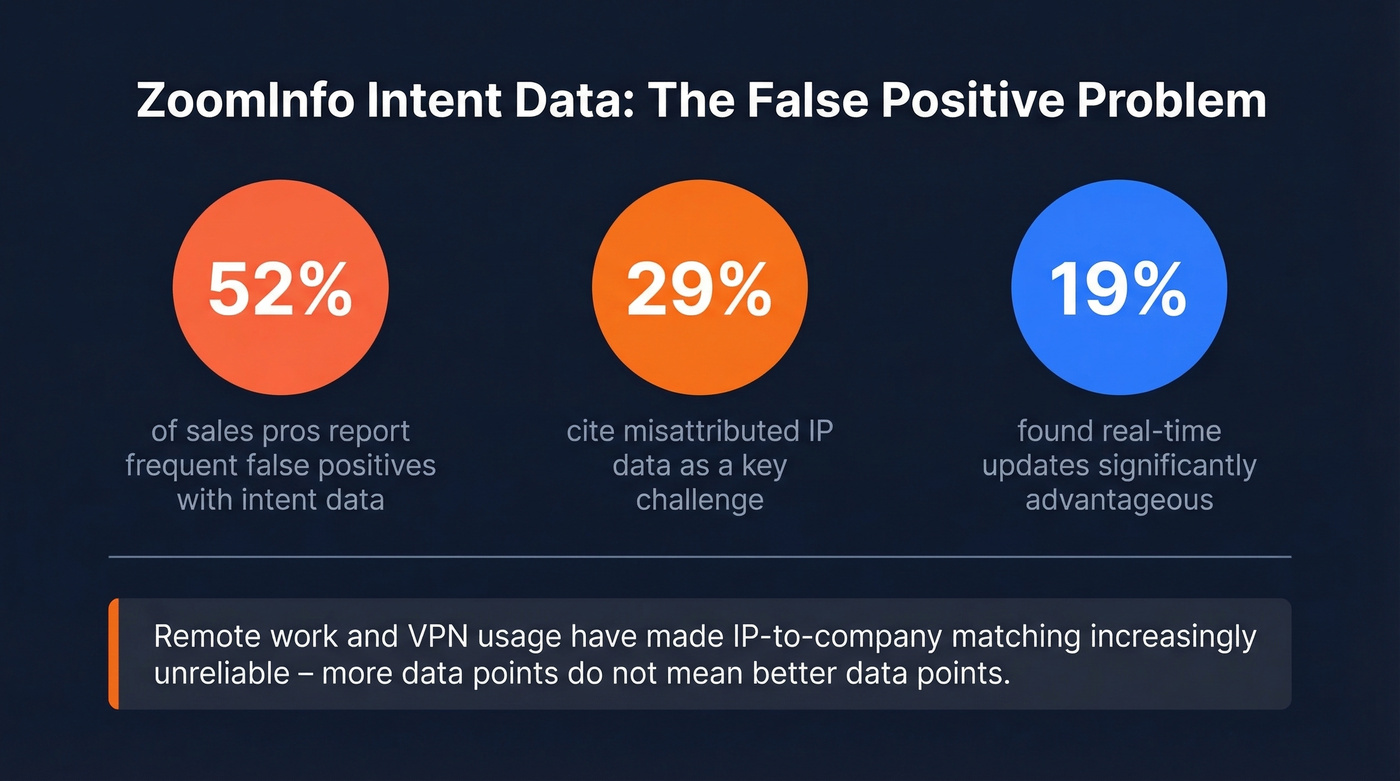
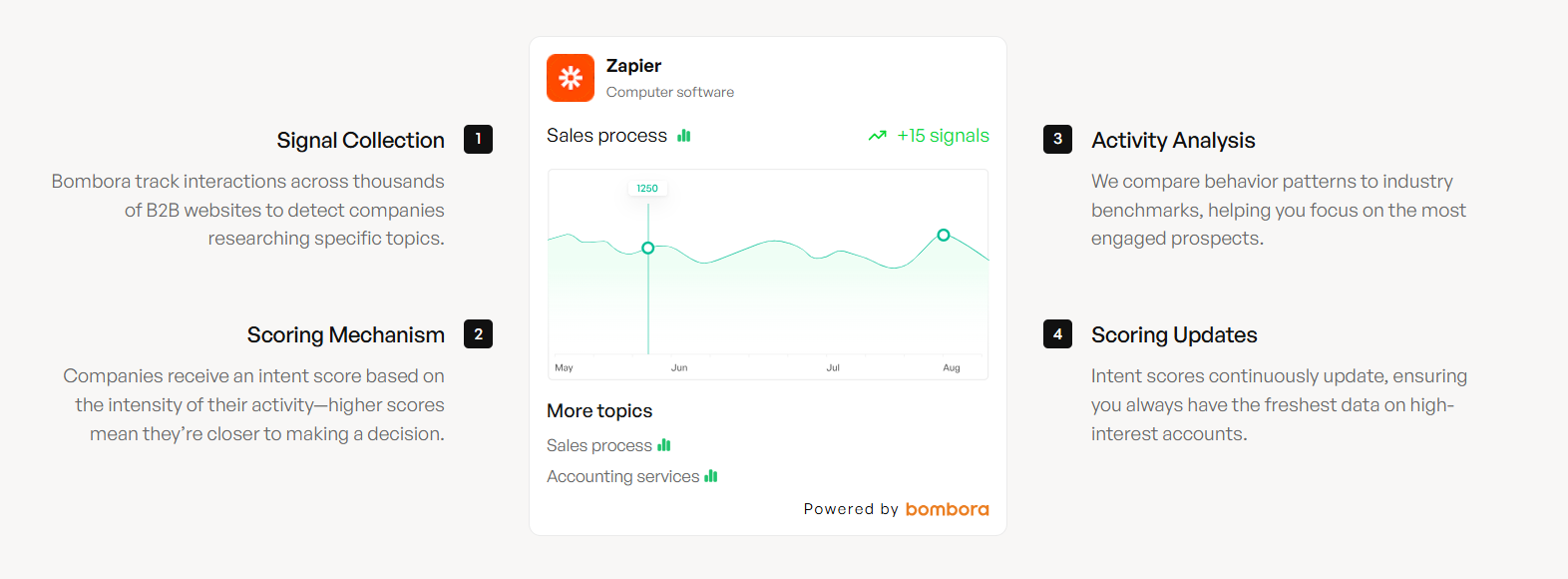
ZoomInfo markets daily updates via Streaming Intent as a major advantage over Bombora's weekly refresh. But only 19% of users found real-time updates "significantly advantageous." Daily signals can also increase noise - more data points don't mean better data points when the underlying matching is shaky.
Bidstream Compliance Risk
Bidstream data - signals captured from real-time ad exchange bidding - is ZoomInfo's weakest and riskiest signal source. Ad exchanges share IP addresses, browsing history, location, and interest data to dozens of parties within roughly 100 milliseconds. The consent framework governing this process took a direct hit in 2022 when Belgium's Data Protection Authority ruled IAB Europe's Transparency and Consent Framework unlawful under GDPR.
If you're selling into the EU, bidstream-derived intent carries real legal exposure. Consent-based models like Bombora's publisher co-op reduce this risk significantly.
The Attribution Loop Problem
Here's the thing: there's a skeptical argument worth taking seriously. Intent vendors often take credit for deals already in your pipeline. An account shows high intent, your reps were already working it, the deal closes, and intent gets the attribution. The black-box scoring makes this nearly impossible to disprove. We've seen teams celebrate "intent-influenced pipeline" that was really just their existing accounts showing up in a different dashboard.

Intent is useless when the contacts are stale. Prospeo refreshes data every 7 days and verifies emails at 98% accuracy, so your “in-market” list reaches real decision-makers fast.
Activate intent signals with contacts you can actually reach.
What ZoomInfo Intent Costs
ZoomInfo doesn't publish pricing, but the market has a clear picture at this point.
| Tier | Annual Cost | Intent Included? |
|---|---|---|
| Professional | $15K-$18K | No |
| Advanced | $22K-$28K | Yes |
| Elite | $35K-$45K+ | Yes, full features |
| Streaming Intent | $7,200-$36,000 | Standalone option |
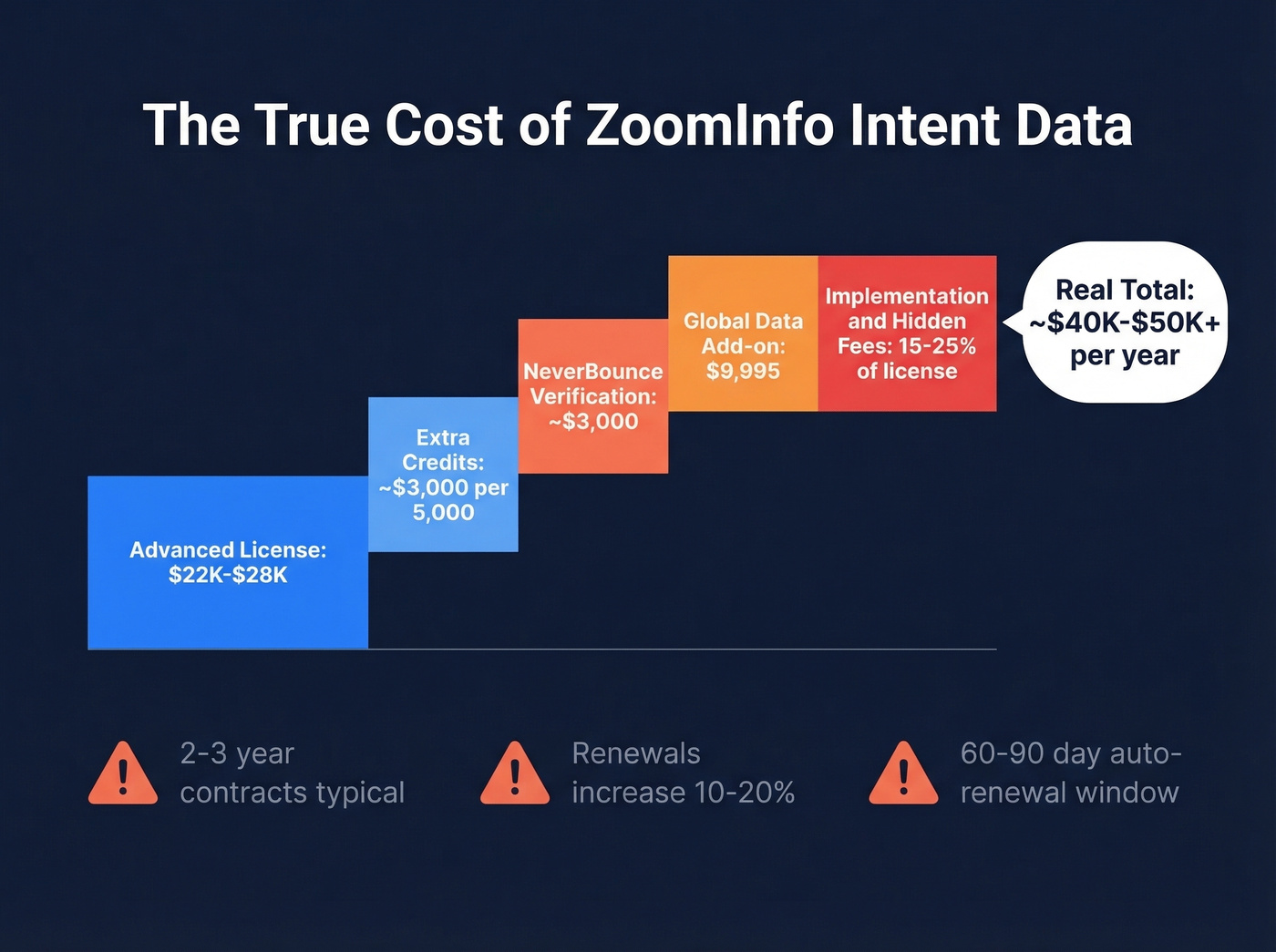
Those are base prices. The real cost climbs fast with add-ons: extra credits at ~$3,000 per 5,000, NeverBounce email verification at ~$3,000, and Global Data at $9,995. Teams routinely end up close to $50,000/year after the full stack is assembled.
Two contract dynamics to watch: ZoomInfo often pushes 2-3 year commitments, and renewals typically increase 10-20%. The auto-renewal window is 60-90 days, meaning you need to flag cancellation months before your contract ends. Budget 15-25% above your license cost for implementation and hidden fees.
What Users Actually Say
ZoomInfo Sales carries a 4.5/5 rating on G2 from 9,035 reviews - an enormous sample size that lends credibility to the aggregate score. Average implementation time runs about one month.
The praise clusters around contact information quality, data accuracy, and ease of use. Reps like the search interface and the depth of the contact database. The complaints land squarely on data freshness: Outdated Data, Inaccurate Data, and Outdated Contacts are the top negative tags across thousands of reviews. Multiple community threads echo this - users describe contacts that changed roles months ago still appearing as current.
The pattern we see repeatedly: teams buy ZoomInfo for intent, then realize the contact data underneath those intent signals is stale. A cybersecurity firm reported a 32% increase in booked meetings, and a financial services company saw 19% pipeline growth - but both cases involved rigorous validation against first-party data. Without that validation step, intent scores are just expensive noise.
How ZoomInfo Intent Compares
ZoomInfo previously licensed Bombora's intent data. That partnership ended in early 2020, followed by a lawsuit that settled in June 2022. Since then, ZoomInfo has built its own multi-signal approach while Bombora continues powering intent for other platforms through its consent-based co-op model.
Let's be honest: ZoomInfo is still the most complete all-in-one sales intelligence platform. But most teams paying $24K+ for intent data don't need all-in-one. They need accurate intent signals paired with verified contacts - and that combination is available for a fraction of the cost.
| Provider | Topics | Pricing | Refresh | Best For |
|---|---|---|---|---|
| Prospeo | 15,000 | ~$0.01/lead, free tier | 7-day | Intent + verified contacts |
| ZoomInfo | ~4K-5K | $24K-$45K+/yr | Daily | Enterprise already on ZoomInfo |
| Bombora | 17,210+ | Starting ~$25K/yr | Weekly | Pure signal quality |
| 6sense | Proprietary | $35K-$150K+/yr | Varies | Full-funnel ABM orchestration |
| Demandbase | Proprietary | $40K-$120K+/yr | Varies | ABM + ad targeting |
| Cognism | Bombora topics | ~$1K-$3K/mo | Weekly | GDPR-compliant EU sales |
| UpLead | Limited | Starting ~$99/mo | Varies | SMB prospecting + basic intent |
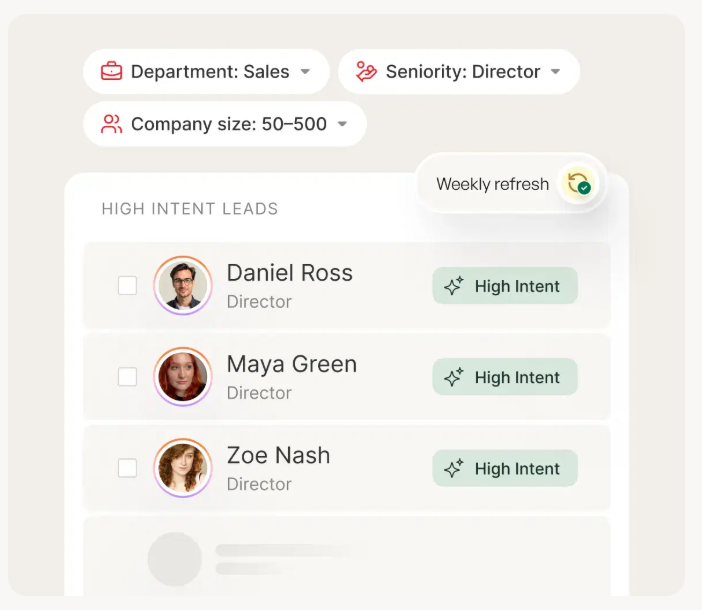
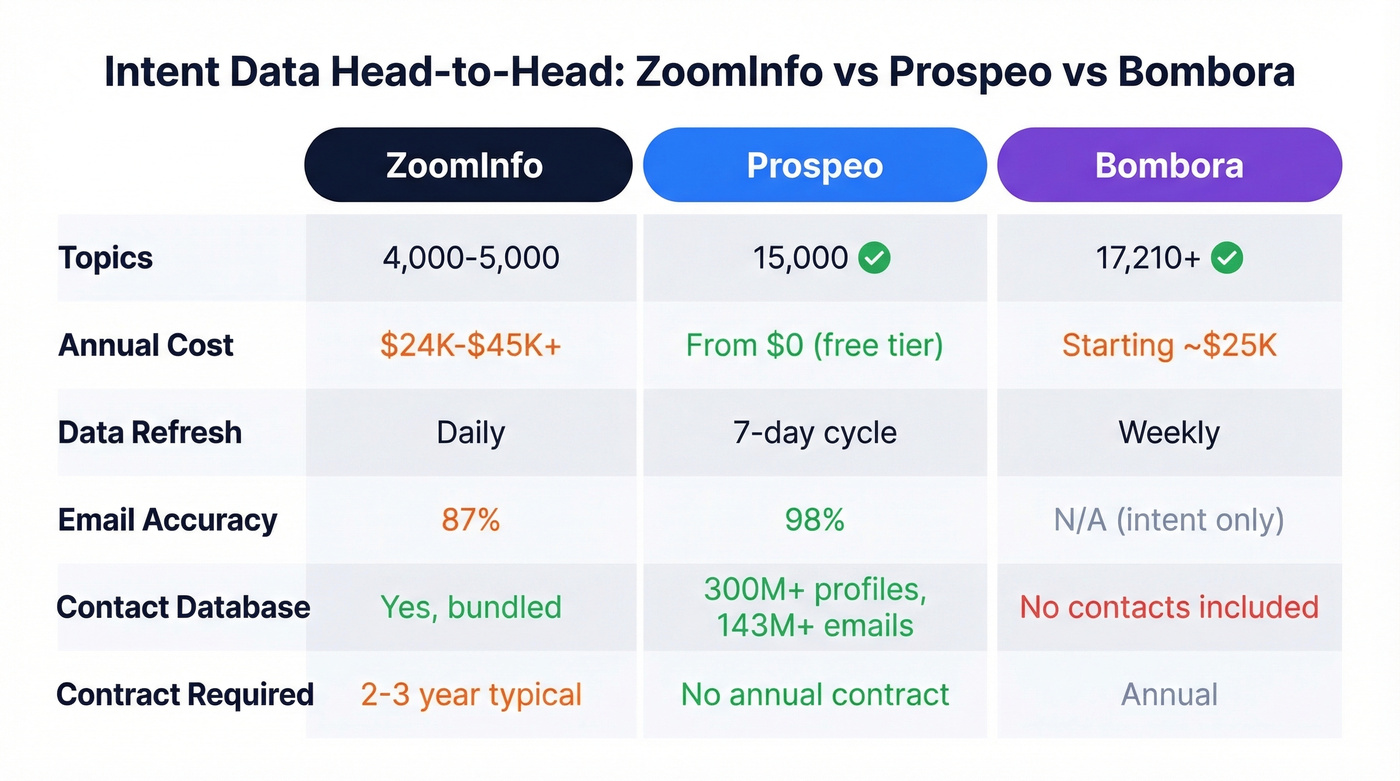
Prospeo runs Bombora-powered intent across 15,000 topics - roughly 3x ZoomInfo's topic coverage - bundled with 300M+ professional profiles, 143M+ verified emails, and 125M+ verified mobile numbers on a 7-day refresh cycle. At ~$0.01 per lead, it's 90% cheaper with 98% email accuracy versus ZoomInfo's 87%. No $24K minimum, no annual contract, no talking to sales.
If you already own Bombora, you don't need ZoomInfo for intent. Bombora is the gold standard for pure signal quality. Their consent-based co-op with 17,210+ topics and 5,000+ publisher sites processes 17B interactions monthly, resolving to 2.8M+ businesses. Companies with high Bombora surge scores are 70% more likely to purchase within six months - that's the stat that justifies consent-based intent over noisier bidstream alternatives. The tradeoff: Bombora is intent-only, starting around $25K/year.
Skip 6sense unless you need full-funnel orchestration. It goes beyond intent into predictive buying-stage modeling, and it's powerful for enterprise ABM. But at $35K-$150K+ with complex implementation, buying 6sense just for intent signals is like buying a semi-truck to deliver groceries.
Demandbase makes sense when your marketing team runs programmatic ABM campaigns alongside sales outreach. At $40K-$120K/year, you're paying for the ad targeting integration as much as the intent data.
Cognism delivers Bombora-powered intent with GDPR-compliant contacts at $1K-$3K/month. Strong pick for EU-focused teams that need phone-verified mobile numbers in European markets.
For SMB teams that want something lighter, UpLead offers basic intent signals bundled with its prospecting database at a fraction of ZoomInfo's cost, though the topic coverage and signal depth are significantly more limited.
Skip the $24K+ black box and build a cleaner intent workflow. Layer Bombora-powered intent (15,000 topics) with 30+ filters, then enrich your CRM with 50+ data points per lead.
Filter, verify, and enrich - then route accounts to reps in minutes.
Making Intent Data Work
Intent data doesn't fail because the technology is broken. It fails because teams treat high scores as buying signals instead of research signals. Here's the playbook that actually produces results.
Narrow Your Topics
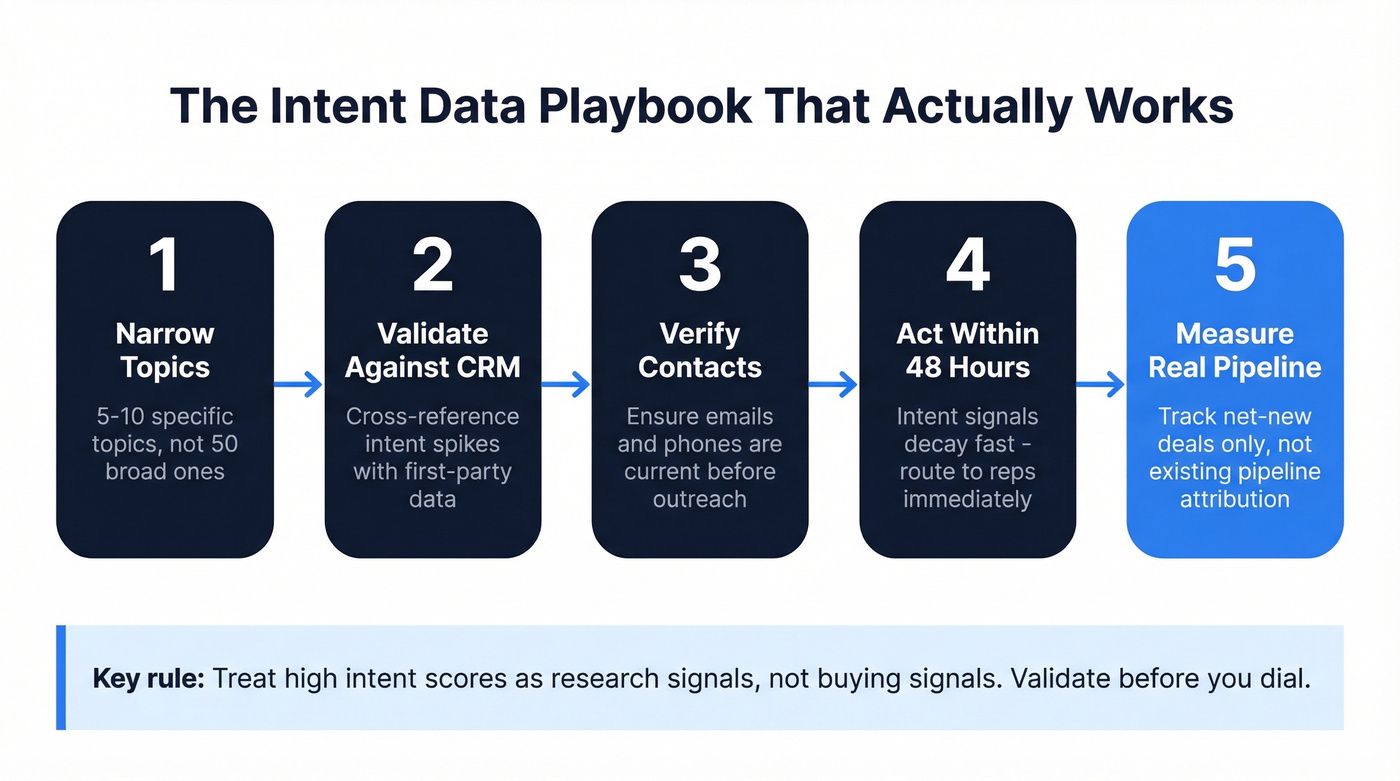
Five to ten highly specific topics beat fifty broad ones. "Cloud security compliance" outperforms "cybersecurity." The more specific the topic, the higher the signal-to-noise ratio. We've found that teams who start with their last 20 closed-won deals and reverse-engineer the topics those accounts were researching get dramatically better results than teams who pick topics from a dropdown menu.
Validate Against First-Party Data
Cross-reference intent spikes with CRM activity, website visits, and email engagement. An account showing high intent and visiting your pricing page is worth calling. High intent alone isn't.
Set Meaningful Score Thresholds
Don't treat every score above 50 as a hot lead. Establish tiers: 80+ gets immediate outreach, 60-79 goes into a nurture sequence, below 60 gets monitored but not actioned.
Real talk: if your average deal size sits below $15K, you probably don't need ZoomInfo-level intent data at all. The ROI math doesn't work when your deal size can't absorb the data cost. Focus on verified contact data and strong outbound sequences first, then layer intent on top once you've proven the motion.
Act Within 48 Hours
Intent signals decay fast. A spike on Monday that gets actioned on Friday is worthless. Build workflows that route high-intent accounts to reps the same day - our team has seen response rates drop by roughly 40% when outreach lags more than two business days behind the initial signal.
FAQ
Does ZoomInfo intent work for small teams?
Rarely. The $24K+ minimum most teams hit for meaningful intent access and the operational overhead of signal validation make it cost-prohibitive below 10 reps. Bombora-powered alternatives offer the same underlying methodology with self-serve pricing and free tiers - no enterprise contract required.
What's the difference between Guided Intent and Streaming Intent?
Guided Intent uses AI to recommend topics correlated with your historical closed-won deals, removing manual topic selection. Streaming Intent delivers real-time alerts as accounts spike. Guided Intent helps you pick what to track; Streaming Intent determines when you see it. Both require Advanced or Elite packaging.
Is bidstream intent data GDPR compliant?
It's legally gray at best. Belgium's DPA ruled IAB Europe's Transparency and Consent Framework unlawful in 2022, directly challenging the consent mechanisms bidstream data relies on. Teams selling into the EU should prefer consent-based sources like Bombora's publisher co-op, which powers platforms including Cognism and Prospeo.