

The 8 Steps of the Selling Process (+ 2026 Benchmarks)
You pull your pipeline report on Monday morning. 47 deals sitting in "Discovery." Twelve have been there for 90 days. Nobody can tell you what's actually happening with any of them.
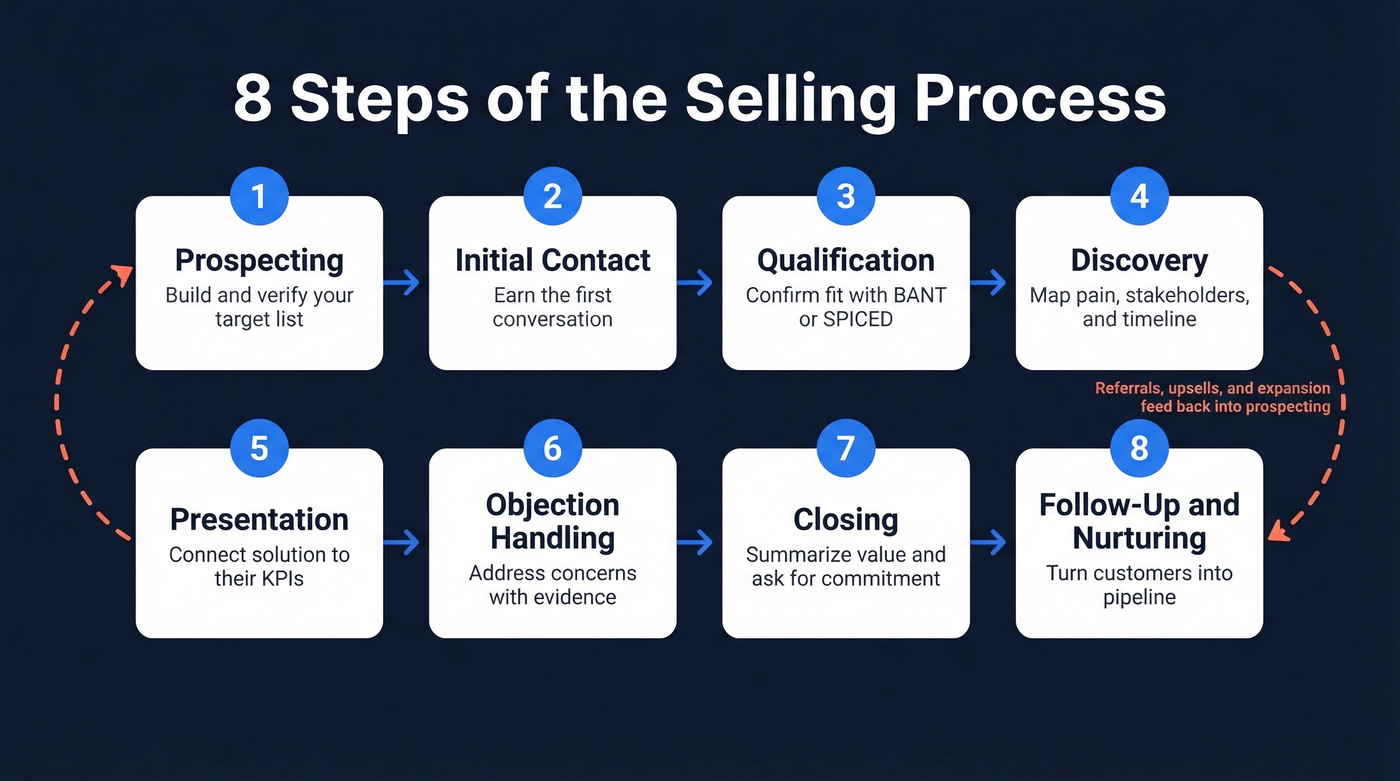
That's not a pipeline - it's a graveyard with optimistic labels. And the root cause isn't lazy reps. It's a process without exit gates. Understanding the 8 steps of the selling process is table stakes - what separates quota-crushing teams from the rest is how they enforce those steps with real criteria, real benchmarks, and verified data feeding the top of the funnel.
Three stats worth anchoring to before we get into the stages: companies with a formal sales process generate more revenue (Jordan & Kelly, HBR). Teams with a documented process see 18% more revenue growth than those winging it. And right now, roughly 60% of sales teams are on track to meet or surpass revenue targets - meaning 40% aren't. Process is the difference.
Why a Defined Sales Process Matters
Most guides list eight steps and call it a day. That's a poster, not a process.
A real sales process tells reps what to do at each stage, defines when a deal is ready to advance, and gives leadership a diagnostic framework when numbers slip. Without those three elements, you've got a CRM with pretty stage names and zero predictive power.
HubSpot's 2026 State of Sales survey - 1,000 global sales pros - found that 91% report win rates are stable or improving, and 68% say lead quality has improved year over year. But those numbers only hold for teams with disciplined execution. The same report shows 42% of leaders say ARR is their most important metric, which means closing quality matters more than closing volume. A process without exit criteria optimizes for volume. Exit gates optimize for quality.
The 8 Steps of the Selling Process
Step 1 - Prospecting
Prospecting is where your pipeline lives or dies, and most teams get it wrong - not because they skip it, but because they feed it bad data.
The channel mix still matters. 37% of reps say phone calls produce their most leads during cold outreach. But 96% of prospects research your company before they ever take a call, and 71% prefer independent research over talking to a rep. By the time someone picks up, they've already formed an opinion.
Meanwhile, 69% of cold email senders report performance declining year-over-year. Spam filters are tighter, AI fatigue is real, and 48% of teams report bounce rates between 2-5%. Before you build a list, verify the data. Tools like Prospeo deliver 98% email accuracy on a 7-day refresh cycle - compared to the 6-week industry average - which means your outreach hits real inboxes instead of bouncing into oblivion.

Step 2 - Initial Contact
By the time you reach out, the buyer has already Googled you. Your first touch needs to prove you've done the same homework on them.
Before any outreach, research the prospect's recent activity, company news, and industry context. Personalization beyond {first_name} isn't optional anymore - it's the baseline. Reference a specific trigger like a job change, a funding round, or a tech adoption signal. That's what earns the reply.
The goal of initial contact isn't to pitch. It's to earn the next conversation.
Step 3 - Qualification
Qualification is where you answer one question: are we a fit? The Digital Sales Institute frames this as AWAF - "Are We A Fit?" - and it's the most honest framing I've seen.
BANT works here as a starting framework, though it breaks down for complex deals. We'll compare it to SPICED and MEDDIC shortly. For now, the exit criteria matter most: budget confirmed, authority identified, need articulated, timeline stated. If any are missing, the deal stays in qualification. No exceptions.
Step 4 - Discovery / Needs Analysis
Discovery is where you earn the right to present. Skip it and your pitch is a guess.
Before you leave this stage, you need documented answers to four things: What's the technical environment? Who are the champions, sponsors, and blockers? What's the real timeline - not the aspirational one? And what does "success" look like in their words?
I've watched reps walk out of discovery calls saying "it went well" without a single documented answer. That's not discovery - that's a conversation. Every call should end with written answers in your CRM, not vibes.
Step 5 - Presentation / Value Proposition
A generic deck is a wasted meeting. Your presentation should map directly to the pain uncovered in discovery - their words, their metrics, their priorities. Connect your solution to the prospect's stated KPIs, not your marketing team's favorite talking points.
Here's the thing: 93% of sales pros say deal sizes are holding steady or growing. Buyers will pay if the value is clear and specific. They won't pay for a feature tour.
Step 6 - Objection Handling
Look - objections aren't rejection. They're buying signals wrapped in uncertainty. A prospect who pushes back is engaged. A prospect who goes silent is gone.
The real problem? 25% of sales pros say getting direct contact with decision-makers is their biggest challenge. Many objections come from non-decision-makers who can't say yes but can absolutely say no. Before you try to overcome the objection, figure out who you're actually talking to. Acknowledge the concern, clarify what's really behind it, then respond with evidence - but only to the person who can actually move the deal forward.
Step 7 - Closing
Three techniques that consistently work.
The assumptive close - where you proceed as if the decision is already made - works when discovery was thorough and the prospect has been nodding along. The summary close recaps agreed value and asks for commitment directly. And the urgency close, with a major caveat.
Bryan Vasquez, Head of Sales at LinkBuilder.io, found that replacing urgency-based CTAs with data-backed proposals improved win rates by 20% over two quarters. Pressure tactics feel productive in the moment but destroy trust over time. If your only closing tool is manufactured scarcity, your discovery wasn't deep enough.
Step 8 - Follow-Up & Nurturing
The process is a loop, not a line.
Post-sale onboarding, regular check-ins, and strategic upsell conversations feed directly back into Step 1. Referrals, case studies, and expansion revenue all come from this stage. The best reps treat every closed deal as the starting point for the next three.
Qualification Frameworks Compared
BANT is fine for SMB deals. It falls apart the moment you're selling to a buying committee. If your average deal size is under $10k and you're selling to a single decision-maker, BANT will serve you well. For anything more complex, you need a framework that accounts for multiple stakeholders, competing priorities, and organizational inertia.
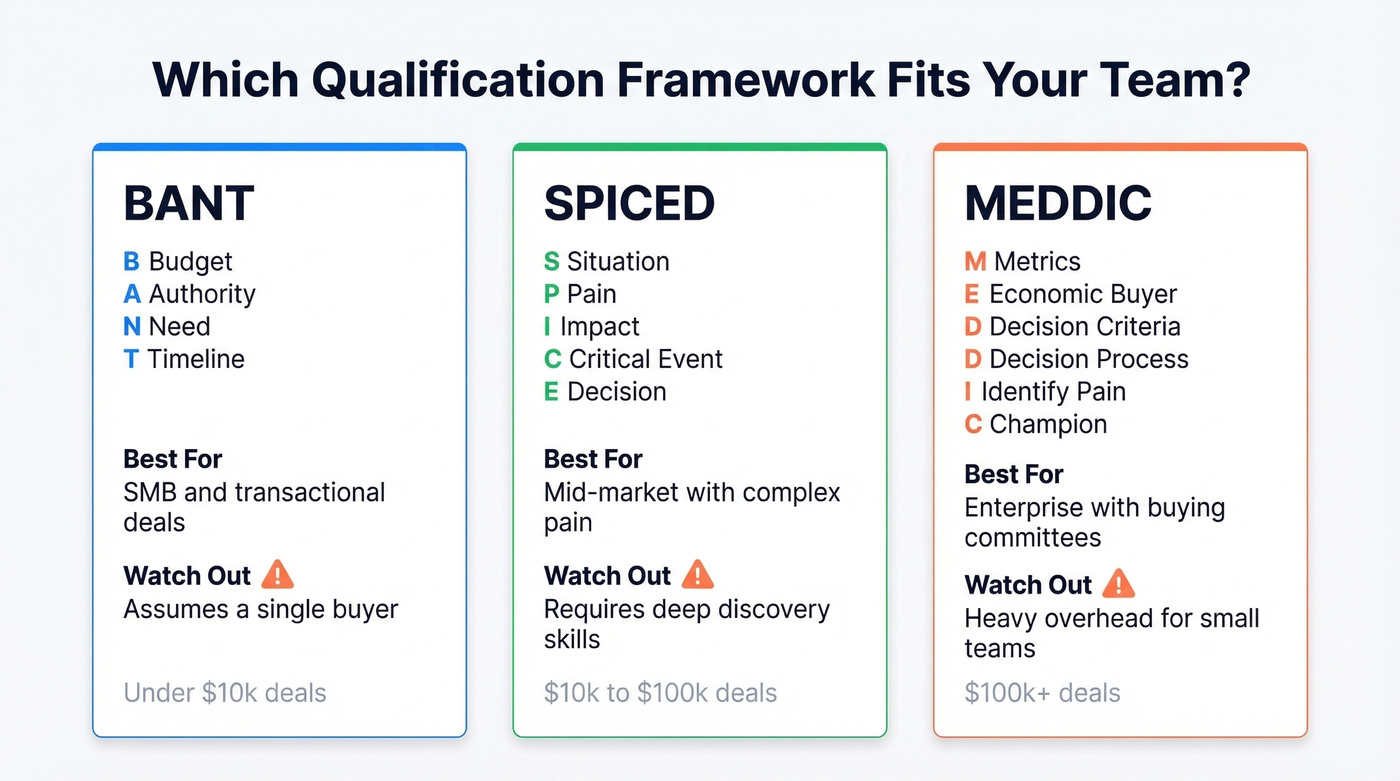
| Framework | Stands For | Best For | Weakness |
|---|---|---|---|
| BANT | Budget, Authority, Need, Timeline | Transactional / SMB | Assumes a single buyer |
| SPICED | Situation, Pain, Impact, Critical Event, Decision | Mid-market | Requires deep discovery |
| MEDDIC | Metrics, Economic Buyer, Decision Criteria, Decision Process, Identify Pain, Champion | Enterprise | Complex to implement |
SPICED is more customer-centric than BANT - it forces you to understand the prospect's situation before jumping to budget questions. MEDDIC is the gold standard for enterprise deals but requires serious training and CRM discipline. On r/sales, practitioners regularly debate whether simplified stage definitions beat complex frameworks. The answer depends on your deal complexity, not what sounds impressive on a slide.
Skip MEDDIC if your team is under 10 reps and your average deal closes in under 30 days. The overhead will slow you down more than the structure helps.

Your selling process dies at Step 1 if 48% of your emails bounce. Prospeo delivers 98% email accuracy on a 7-day refresh cycle - not the 6-week industry average - so every prospect you contact is real, reachable, and worth your rep's time.
Stop feeding your pipeline dead data. Start prospecting with verified contacts.
Conversion Benchmarks by Stage
Use these to diagnose where your process leaks - not as targets to hit. Two benchmark sources give you a range, which is more honest than a single number.
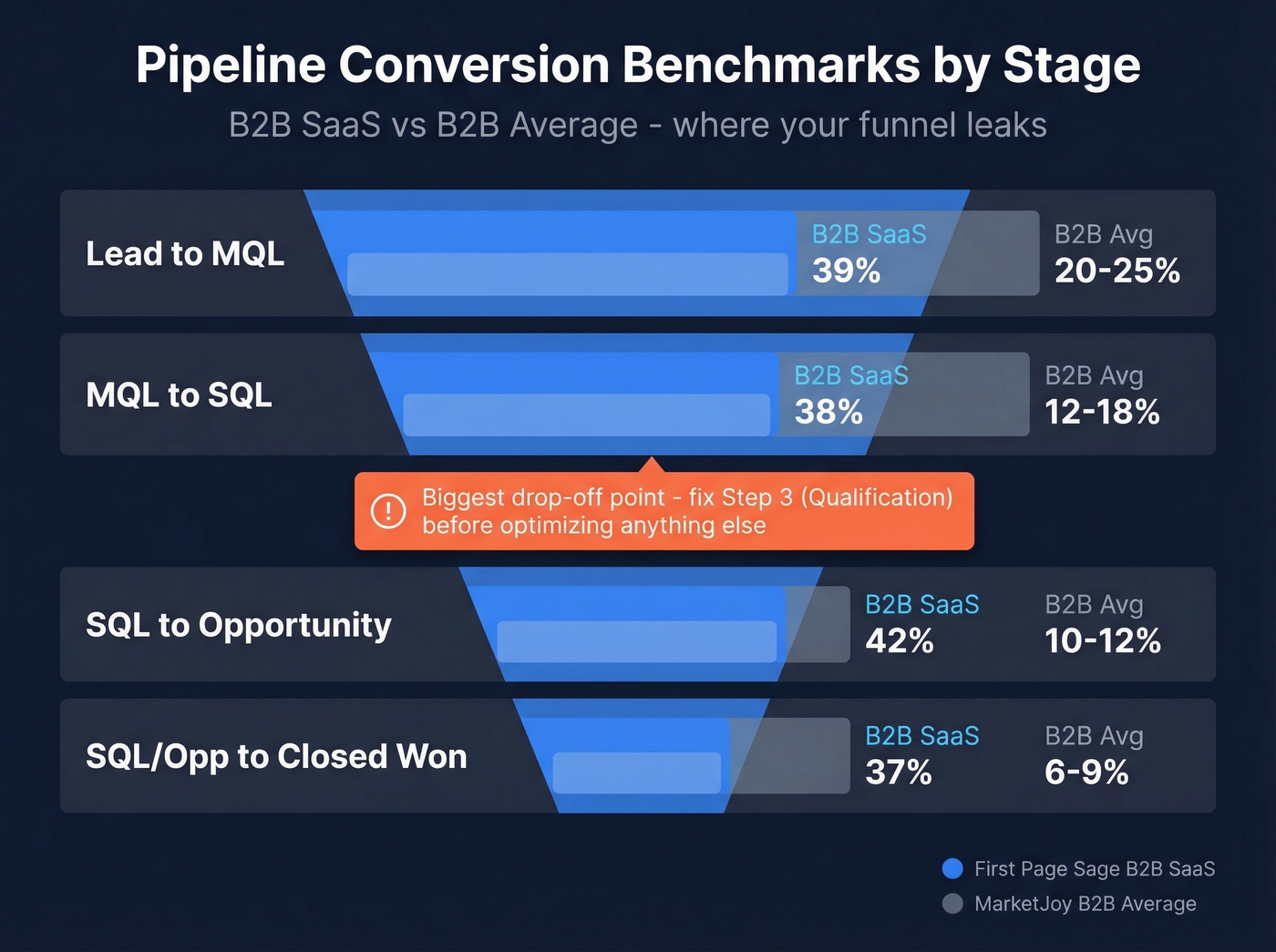
| Stage | First Page Sage (B2B SaaS) | MarketJoy (B2B Avg) |
|---|---|---|
| Lead → MQL | 39% | 20-25% |
| MQL → SQL | 38% | 12-18% |
| SQL → Opportunity | 42% | 10-12% |
| SQL/Opp → Closed Won | 37% | 6-9% |
The biggest drop-off typically happens at MQL → SQL. In our experience, this is where most teams hemorrhage deals - and where fixing the problem has the highest ROI. If your MQL → SQL rate is below 12%, your qualification step is broken. Fix Step 3 before you optimize anything else.
We've seen teams pour money into top-of-funnel lead gen when the real problem was a leaky middle - unqualified deals clogging the pipeline and wasting rep time downstream. One team we worked with doubled their SQL conversion rate just by adding three mandatory fields to their qualification stage. No new tools, no new hires. Just gates.
Stage Exit Criteria
If your CRM lets reps drag deals to any stage without completing exit criteria, you don't have a process. You have a suggestion.

Vouris offers a clean three-question framework for building usable exit gates: What are your deal stages? What happens inside each? How do you advance a deal from one stage to the next? FitGap takes it further with an operational model: define 5-8 exit criteria per stage, split them into auto-validated fields versus manager-judgment calls, and restrict reps from changing stages without completing the checklist.
Here's what concrete exit criteria look like:
- Prospecting → Initial Contact: Verified email or direct dial confirmed. ICP fit validated against 3+ firmographic criteria. Outreach sequence initiated.
- Qualification → Discovery: BANT/SPICED criteria documented in CRM. Next meeting scheduled with identified stakeholder. Budget range confirmed.
- Discovery → Presentation: Technical requirements mapped. Champion identified and engaged. Decision timeline documented with a specific date.
A common implementation pattern: Salesforce + Process Street + Zapier. Stage changes trigger checklist validation automatically. Reps can't advance a deal without completing required fields - and "TBD" doesn't count as a valid entry.
B2B vs B2C - How the Steps Shift
The same core stages show up in both B2B and B2C, but three stages expand dramatically in B2B: Qualification, Discovery, and Presentation.
B2B deals involve longer cycles, multiple stakeholders, and contracts that often reach six or seven figures. The decision is ROI-driven, committee-approved, and often takes months. B2C decisions are faster and more emotionally driven - retail ecommerce alone is projected to reach ~$1.8 trillion by 2028, powered by quick purchase cycles and individual buyers. The eight sales stages are the same in both contexts. The weight distribution is completely different.
In B2B, Qualification becomes a multi-meeting process because you're mapping an entire buying committee. Discovery goes deeper because the technical environment is complex. And Presentation shifts from a product demo to a business case with ROI projections, implementation timelines, and stakeholder-specific value narratives.
Common Mistakes That Break Your Process
Skipping qualification. The most expensive mistake in sales. Every unqualified deal that advances past Step 3 wastes hours of rep time in discovery, presentation, and negotiation - only to stall or ghost. Ruthless qualification early saves everyone downstream.
Relying on pressure tactics. The LinkBuilder.io data proved this quantitatively: replacing urgency-based CTAs with data-backed proposals and tailored value maps improved win rates by 20% over two quarters. Fake scarcity pushes deals to "no decision," not to closed-won.
No exit criteria between stages. Without gates, your pipeline is fiction. Deals sit in stages for months because nobody defined what "done" looks like for each step. This is the single most common complaint in r/salesforce threads about pipeline management - CRMs that provide zero value because stage definitions are meaningless.
Ignoring data quality in prospecting. 69% of cold email senders report declining performance. Nearly half report bounce rates between 2-5%. If your Step 1 data is bad, every subsequent step is built on a cracked foundation. Bad data kills outbound before your process even starts, and the domain reputation damage compounds with every bounced campaign. If you're seeing bounces creep up, start with email bounce rate benchmarks and fixes, then audit your list source.
Not measuring stage conversion rates. If you don't know your MQL → SQL rate, you can't diagnose where deals die. Set benchmarks, measure weekly, and investigate any stage where conversion drops more than 20% below your baseline. HubSpot's sales benchmarks and First Page Sage's conversion data are good starting points for calibrating your numbers. For a tighter operating cadence, track funnel metrics alongside stage-level conversion.
25% of sales pros say reaching decision-makers is their biggest challenge. Prospeo's 300M+ profiles with 30+ filters - buyer intent, job changes, org charts - let you skip the blockers and land directly on the economic buyer's desk.
Qualify faster when you already have the right contact at $0.01 per email.
FAQ
What's the most important step in the selling process?
Qualification (Step 3) is the highest-leverage stage. If unqualified deals advance, every downstream step wastes time and rep capacity. Use BANT for transactional deals under $15k, SPICED for mid-market, and MEDDIC for enterprise. Exit criteria here matter more than at any other stage.
How long should a B2B sales cycle take?
SMB cycles typically run 2-4 weeks, mid-market takes 1-3 months, and enterprise stretches 3-9 months. Flag any deal exceeding its segment benchmark by 50% - those are stalled, not progressing. Review stalled deals weekly and either re-qualify or disqualify them.
How do I improve my prospecting data quality?
Use a verified data source with 95%+ accuracy and a weekly refresh cycle. Bounce rates above 3% damage sender reputation and tank deliverability for every subsequent campaign. A 7-day refresh cycle catches job changes that monthly or quarterly refreshes miss entirely - and those stale contacts are the ones most likely to bounce.