

ABM vs ABX: What's Really Different and Does It Matter?
Your CMO came back from a conference asking why you're still "doing ABM" when everyone's moved to ABX. You nodded, opened a new tab, and started searching. Here's the thing: the real question behind ABM vs ABX isn't what the acronym stands for - it's whether this represents a meaningful shift in how you run your program or just another label designed to sell you a platform upgrade.
The Short Version
ABX is a real evolution - full-lifecycle, cross-functional, experience-driven. But it's also partly a vendor rebrand. We'd call it roughly 60% substance, 40% marketing.
Can't prove ABM ROI yet? 47% of teams can't. Fix that before adopting a new acronym. And neither approach works when your buying committee emails bounce at 35-40%.
Account-Based Marketing: 2026 Benchmarks
ITSMA coined ABM back in 2004. The original idea was simple: treat high-value accounts as markets of one, with integrated plans across sales and marketing. Today, 71% of B2B practitioners run some form of account-based marketing.
ABM operates in three tiers - 1:1 (fully custom), 1:few (cluster-based), and 1:many (programmatic). Demandbase's benchmark across 300+ marketers reports 81% higher ROI for ABM teams, and Gartner's analysis found a 14% pipeline conversion lift with 28% higher account engagement. Solid numbers. The challenges, though, haven't budged: proving ROI (47%), aligning sales and marketing (43%), and scaling programs (40%).
Account-Based Experience: Honest Context
ABX - account-based experience - extends ABM across the full customer lifecycle, from initial awareness through post-sale advocacy. Instead of marketing owning a campaign that hands off to sales, ABX distributes ownership across marketing, sales, and customer success. The shift is from campaign-driven to experience-driven.
Demandbase coined the term, which tells you something about the incentive structure behind it. But the underlying idea has legs. As a former ZoomInfo director put it, ABM implies "just marketing" - ABX should be shared across sales and marketing "throughout the entire customer life cycle." That distinction matters when buying committees regularly include 6-11 stakeholders and your biggest revenue lever is expansion, not net-new logos.
Side-by-Side Comparison
| Dimension | ABM | ABX |
|---|---|---|
| Scope | Pre-sale pipeline | Full lifecycle |
| Ownership | Marketing-led | Marketing + Sales + CS |
| Lifecycle stage | Awareness to close | Awareness to advocacy |
| Timing trigger | Campaign calendar | Intent + readiness signals |
| Core metrics | MQLs, pipeline, revenue | Win rate, NRR, deal velocity |
| Primary goal | Land accounts | Land, expand, retain |
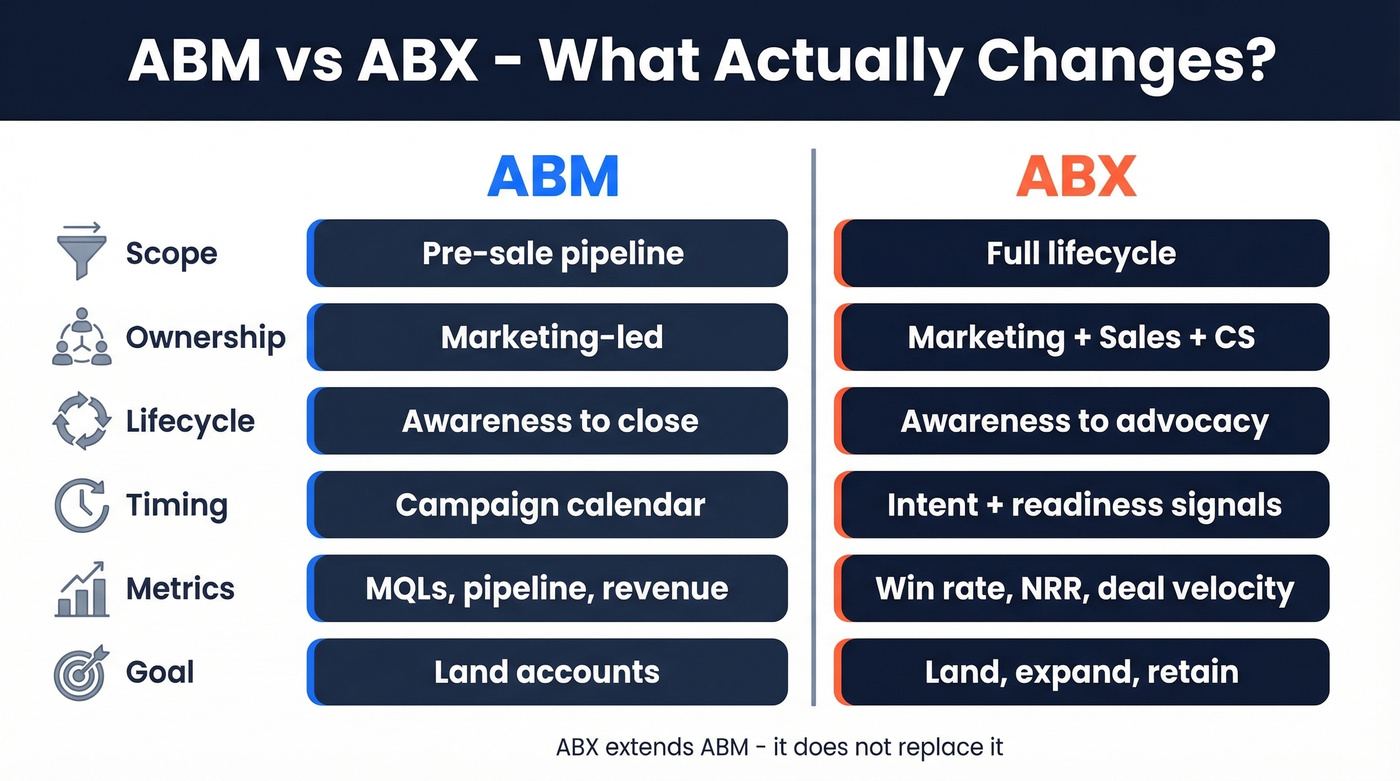
Platforms like Demandbase, 6sense, and Terminus have all repositioned around ABX messaging. The experience-first model also introduces new measurement constructs - Agent3 proposes an Experience Quality Score and Account Experience Gap Index - that go beyond traditional pipeline dashboards.

ABM and ABX both fail when you can't reach the buying committee. Prospeo gives you 98% verified emails and 125M+ direct dials across 300M+ profiles - with intent data on 15,000 topics to prioritize the accounts actually in-market. At $0.01/email, you skip the six-figure platform debate entirely.
Build your account-based foundation on data that actually connects.
Is ABX Just a Rebrand?
ABM has been "bastardized into good targeted demand gen." That's not our line - it's a common critique from practitioners who remember what ITSMA originally intended. The deeper problem: many teams adopted ABM as a quick-fix lead gen tactic, not the long-game strategic play it was designed to be. ABX is partly a correction for that misuse and partly a label created to differentiate a platform.
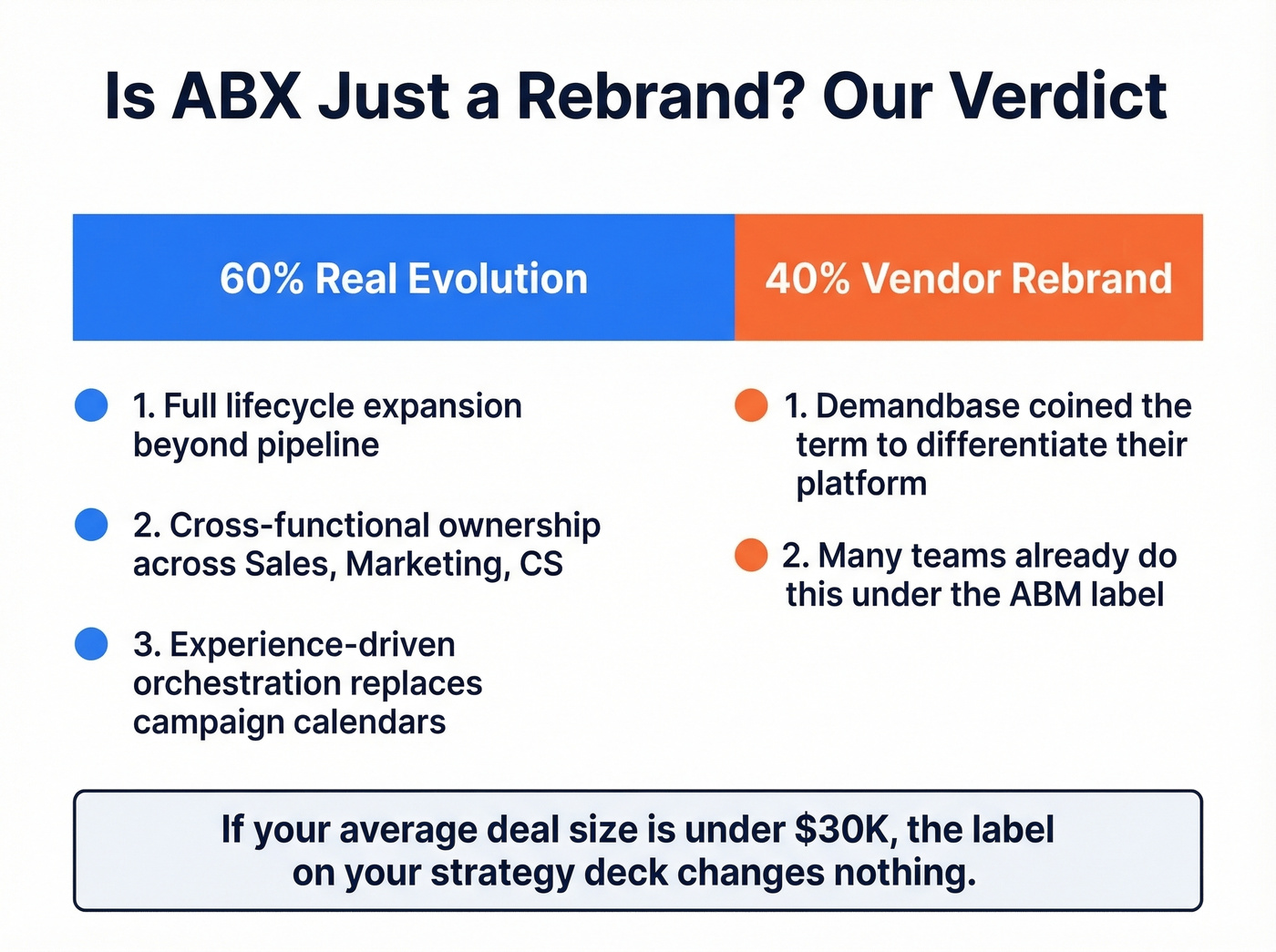
Our verdict: 60% real evolution, 40% vendor rebrand. The lifecycle expansion, cross-functional ownership, and experience-driven orchestration are genuinely different from how most teams run account-based marketing today. But you still don't need a new acronym to fix a broken program.
Let's be honest: if your average deal size sits below $30K, the whole debate is academic. You need clean data, a tight ICP, and reps who actually multi-thread into accounts. The label on your strategy deck changes nothing.
When ABM Is Enough vs When ABX Matters
Stick with ABM if:
- You're targeting fewer than 500 accounts
- You don't have a dedicated platform and don't need one at $30K-$100K+/year for Demandbase or 6sense
- You can't yet prove ROI on your current program
- Sales and marketing alignment is still aspirational
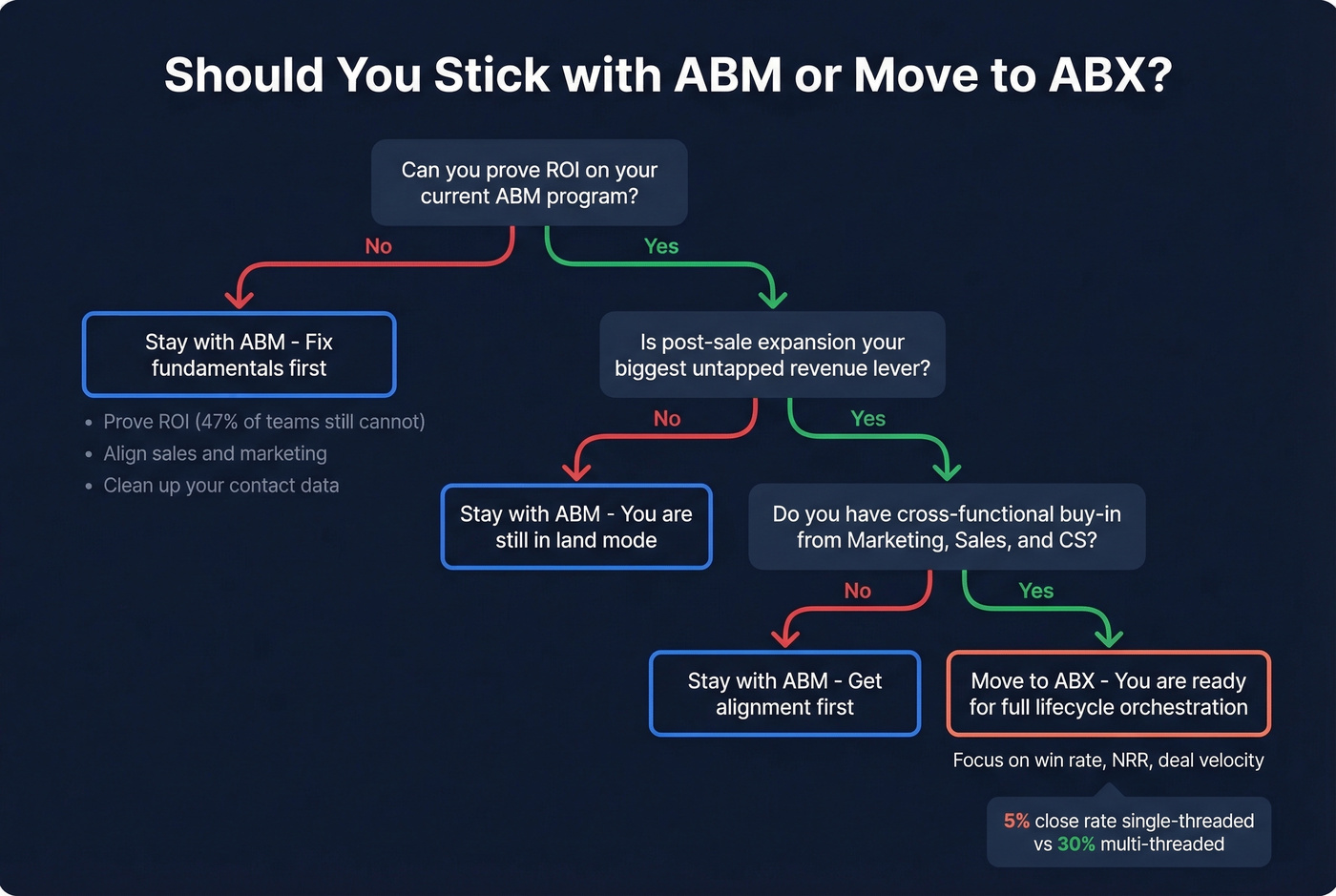
Move to ABX when:
- Post-sale expansion is your biggest untapped revenue lever
- You have genuine cross-functional buy-in from marketing, sales, and CS
- You're single-threaded into accounts - 5% close rate single-threaded vs 30% multi-threaded
- You've already proven ABM ROI and need the next gear
The difference comes down to lifecycle scope. ABM focuses on landing accounts; ABX carries that same rigor through expansion and retention. For teams making the switch, Only-B2B publishes a 30-day ABX launch plan worth bookmarking.
The Foundation Both Strategies Require
Neither account-based marketing nor account-based experience works if you can't reach the buying committee. When you're targeting 6-11 stakeholders per account, every bounced email and dead phone number is a thread you can't pull.

Clean contact data is the prerequisite. We've seen this firsthand - Snyk's 50-person AE team saw bounce rates drop from 35-40% to under 5% and AE-sourced pipeline jump 180% after switching to Prospeo and fixing their data foundation. With intent data tracking 15,000 topics via Bombora, you can layer buying signals directly into your account prioritization, whether you call the program ABM or ABX.
Skip the six-figure platform debate entirely if your contact data is garbage. No orchestration tool fixes a 35% bounce rate.
A Signal-Heat Score You Can Steal
Regardless of which framework you adopt, you need a way to prioritize accounts. Here's a Signal-Heat Score framework worth stealing:
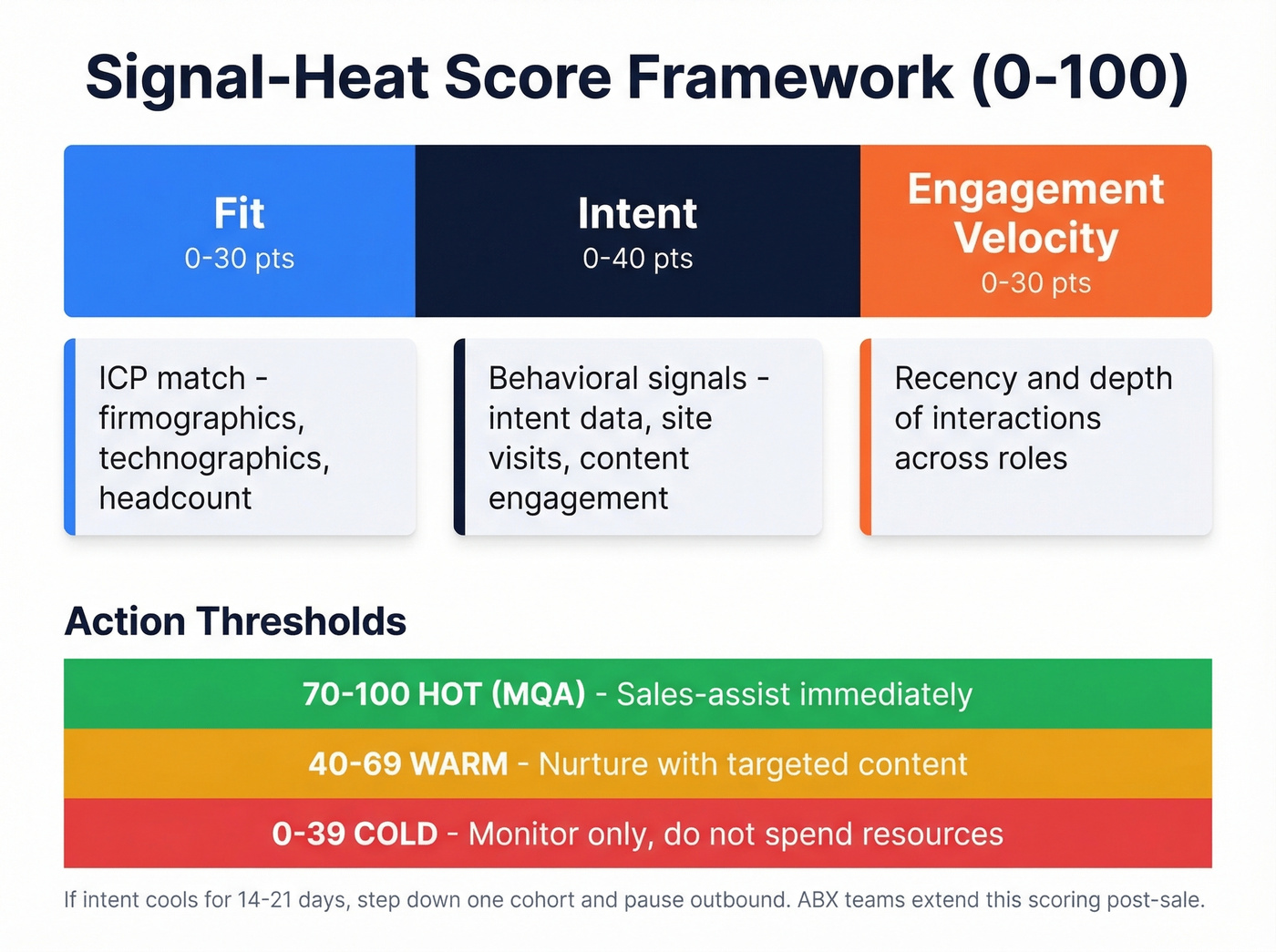
Signal-Heat Score (0-100):
- Fit (0-30): ICP match - firmographics, technographics, headcount
- Intent (0-40): Behavioral signals - intent data, site visits, content engagement
- Engagement Velocity (0-30): Recency and depth of interactions across roles
Thresholds: 70+ is hot (MQA) and gets sales-assist immediately. 40-69 is warm - nurture with targeted content. Under 40, monitor but don't spend resources. If intent cools for 14-21 days, step down one cohort and pause outbound.
This framework works for both approaches. The only divergence: ABX scoring extends post-sale, tracking expansion signals like product usage drops and renewal timing alongside pipeline signals.
Snyk's 50 AEs dropped bounce rates from 35% to under 5% and grew AE-sourced pipeline 180% with Prospeo. Whether you're running ABM or ABX, multi-threading into 6-11 stakeholder accounts requires verified contact data refreshed every 7 days - not the 6-week industry average.
Stop debating acronyms. Start multi-threading with clean data.
FAQ
Is ABX replacing ABM?
No. ABX extends ABM across the full customer lifecycle rather than replacing it. Most teams should master ABM fundamentals - proving ROI, aligning sales and marketing - before layering on ABX complexity. The label matters far less than shared account goals and clean execution.
Do I need a six-figure platform for ABX?
Not at all. Cognism drove $700K+ in pipeline without Demandbase or 6sense. Start with clean contact data, your CRM, and targeted content. Add orchestration platforms only when manual workflows break.
What's the single most important metric?
Pipeline velocity: (Qualified Opps x Avg Deal Size x Win Rate) / Avg Sales Cycle. It captures full-funnel impact - not just volume but speed and conversion. This metric applies equally to both ABM and ABX because both ultimately need to prove revenue impact.