

Account Based Marketing: What It Is, Why It Fails, and How to Do It Right
Your CEO just came back from a conference and said "we need to do ABM." The CMO nodded. The VP of Sales asked what changes. Nobody had an answer. Now it's your problem.
Account based marketing has three jobs: pick the right accounts, reach the right people inside those accounts, and measure account-level progress. Most ABM programs fail because they measure with demand gen metrics, run on stale contact data, and treat ABM as a campaign instead of an operating system. Everything below is what you need to build a program that actually works - including the minimum viable stack if you don't have a $50K platform budget.
What Is Account Based Marketing?
ABM is the practice of treating individual high-value accounts as markets of one. Instead of casting a wide net and hoping the right fish swim in, you identify specific companies, map the buying committees inside them, and run coordinated, personalized plays across sales and marketing to win those accounts.
The concept isn't new. Bev Burgess and the team at ITSMA formalized the term in 2003, and the underlying idea - focusing resources on your best-fit prospects - is as old as enterprise sales itself. What changed in the 2010s was the technology. Intent data, programmatic advertising, and enrichment platforms made it possible to run ABM across dozens or hundreds of accounts without hiring a dedicated marketer for each one.
The skeptic's question: "Isn't ABM just good targeting with a fancy name?" Fair pushback. The difference is structural. Good targeting means you're segmenting your audience well. An account-based approach means you're coordinating sales and marketing around named accounts, personalizing engagement to the buying committee rather than just the individual, and measuring progress at the account level.
A well-targeted demand gen campaign sends the right email to the right persona. An ABM program orchestrates twelve touchpoints across five decision-makers at a single company over three months. That's a fundamentally different motion.
Here's the thing most guides miss: ABM doesn't stop at acquisition. The same coordinated, multi-stakeholder approach works for expansion revenue and retention. If you're running personalized plays to land a $200K deal, you should be running similar plays to expand that account to $500K. Some of the best-performing programs we've seen dedicate 30-40% of their account list to existing customers with upsell potential.
ABM vs Demand Generation
The simplest framing: ABM is push, demand gen is pull. Account-based programs identify targets and go after them. Demand gen creates content and channels that attract inbound interest. Both are valid. The mistake is treating them as mutually exclusive.
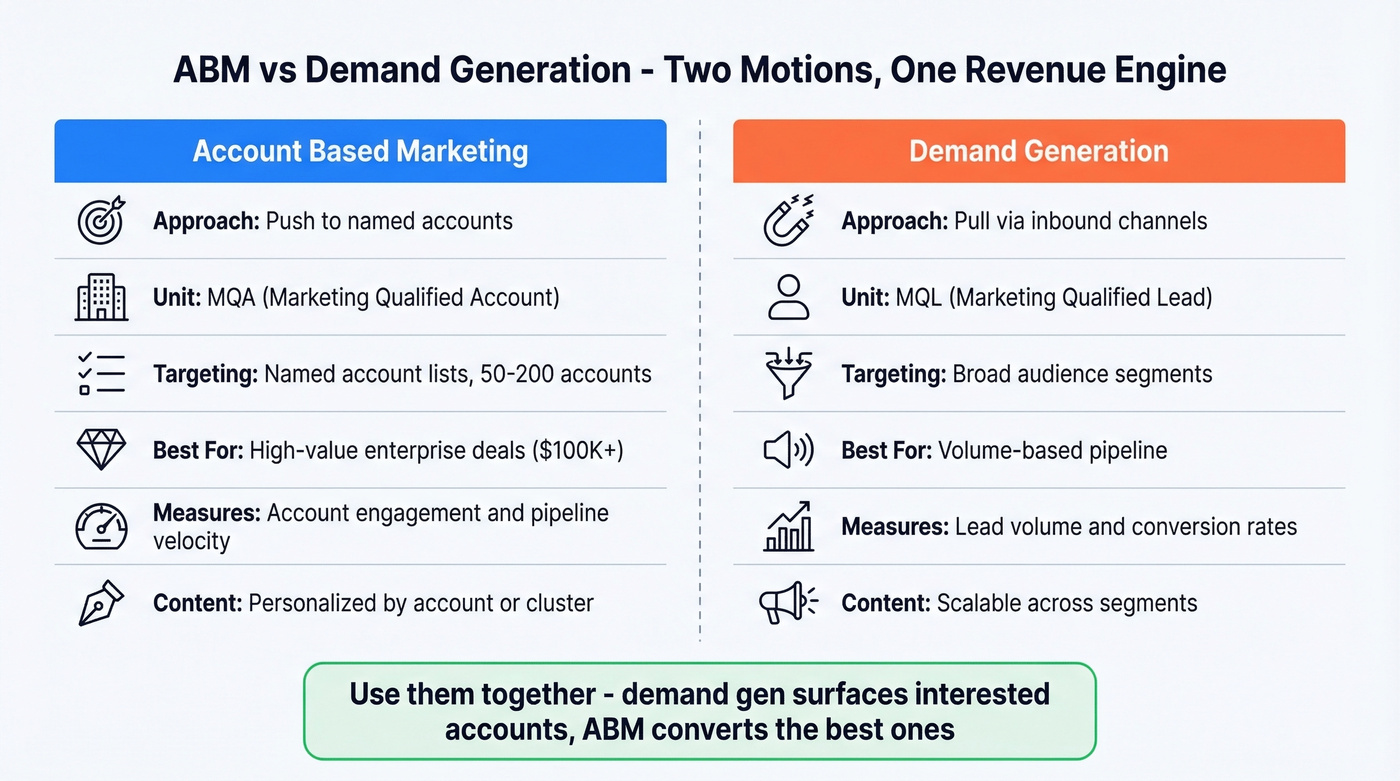
| Dimension | ABM | Demand Generation |
|---|---|---|
| Approach | Push (outbound to named accounts) | Pull (attract inbound interest) |
| Qualification unit | MQA (account) | MQL (lead) |
| Targeting | Named account lists | Broad audience segments |
| Best for | High-value enterprise deals | Volume-based pipeline |
| Measurement | Account engagement + pipeline | Lead volume + conversion |
| Content | Personalized by account/cluster | Scalable across segments |
Run ABM for your top 50-200 accounts where deal sizes justify the investment. Run demand gen for everything else. The two motions feed each other - demand gen surfaces accounts showing interest, and ABM converts the ones worth pursuing with a coordinated push.
The critical distinction is the unit of measurement. Demand gen counts leads. ABM counts accounts. If your marketing team is reporting MQLs from your ABM program, you're measuring the wrong thing - and we'll get into exactly why that kills programs in the measurement section below.
Why ABM Works: The Numbers
ABM works because it concentrates resources where the revenue actually is. A Demandbase benchmark study surveying 300+ global marketers found that top B2B marketers achieve 81% higher ROI with account-based strategies compared to other approaches. Industry benchmarks consistently show these programs delivering higher win rates, larger deal sizes, and faster revenue growth - MomentumABM (now Accenture Song), tracking performance across 500+ organizations, reports the same pattern.
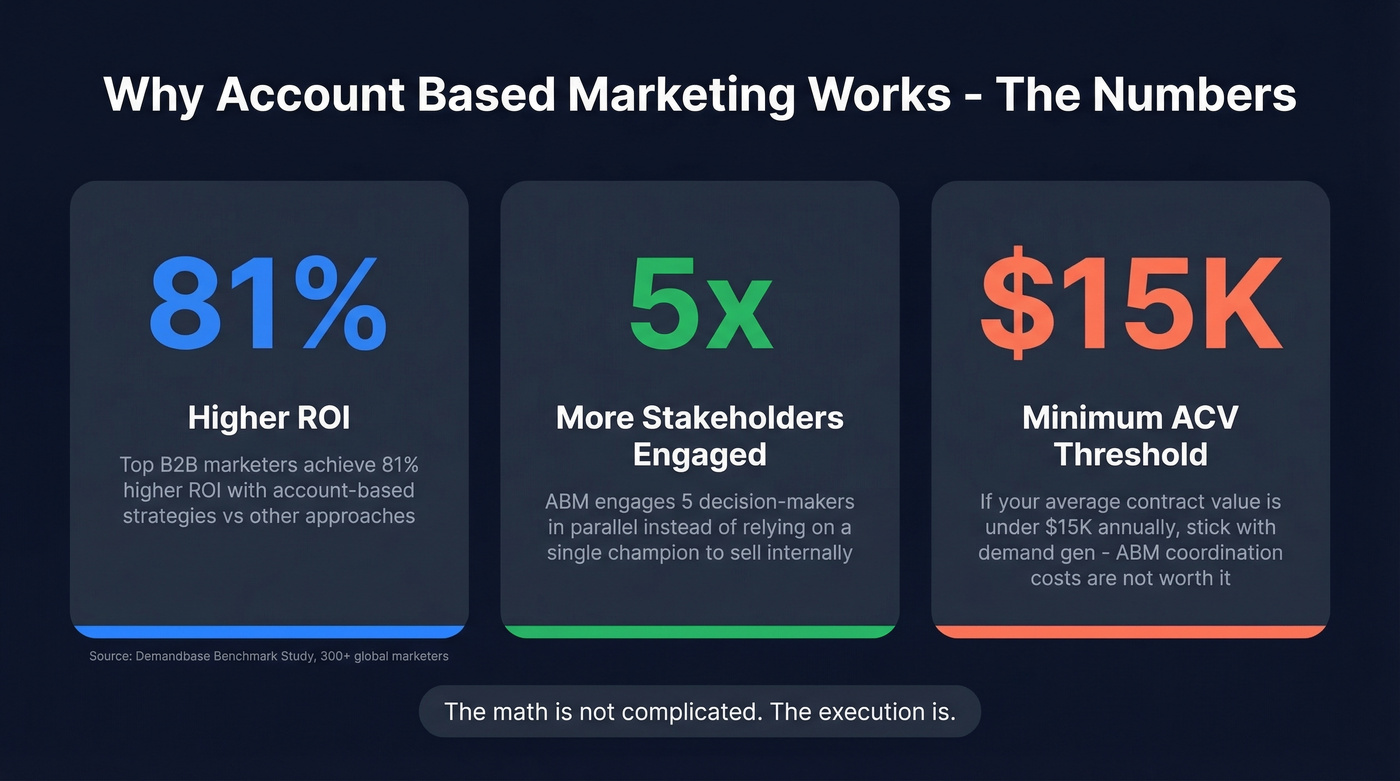
These numbers make intuitive sense. When you focus your best content, your sharpest reps, and your ad budget on 100 accounts instead of 10,000, conversion rates go up. When you engage five decision-makers instead of one, deals close faster because you're building consensus in parallel rather than hoping your single champion can sell internally.
The math isn't complicated. The execution is.
If your average contract value is under $15K annually, you probably don't need ABM. Run demand gen, tighten your targeting, and save the account-based motion for when your deal sizes justify the coordination cost. ABM's superpower is concentrating resources - and concentration only pays off when the prize is big enough.
Three Tiers of ABM
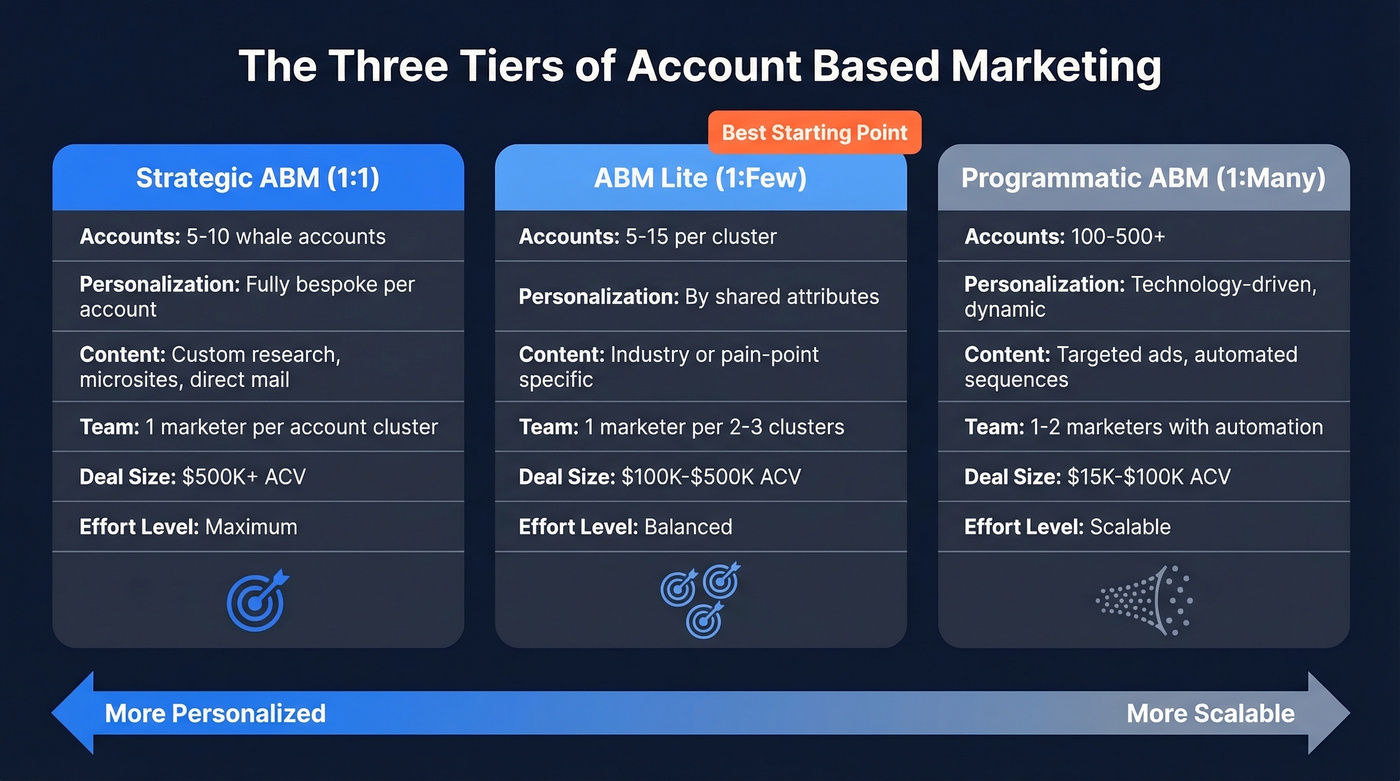
Not all ABM looks the same. The three-tier model gives you a framework for matching your investment to the opportunity.
Strategic ABM (1:1)
The full-court press. Five to ten whale accounts, each getting fully bespoke treatment - custom content, dedicated plays, executive-to-executive engagement. You're building a marketing plan for each account. It requires a dedicated marketer per account cluster and only makes sense for enterprise deals north of $500K ACV. Think custom research reports, personalized microsites, and hand-delivered direct mail.
ABM Lite (1:Few)
Cluster five to fifteen accounts that share common attributes - same industry, similar pain points, overlapping tech stacks - and personalize by cluster rather than by individual account. You're still doing account-level research, but the content and plays scale across the group. This is the starting point for most teams because it balances personalization with efficiency and doesn't require a massive headcount to execute.
Programmatic ABM (1:Many)
Hundreds of accounts targeted with technology-driven personalization: dynamic ads, personalized landing pages, automated sequences triggered by intent signals. This is the closest ABM gets to demand gen in execution, but the measurement stays account-centric. Influ2's analysis draws the line at whether you're targeting at the account level or the contact level - programmatic ABM typically operates at the account level, while more sophisticated programs layer in contact-level targeting for buying committee members.
Burgess has since expanded the model to include Scenario ABM and Pursuit Marketing, but the three-tier framework remains the most practical starting point.
Our recommendation: start with 1:few. It's the sweet spot where you learn the fundamentals without the resource demands of 1:1 or the technology requirements of programmatic.

ABM fails when your buying committee data is stale. Prospeo refreshes 300M+ profiles every 7 days - not every 6 weeks. Map every decision-maker with 98% email accuracy, 125M+ verified mobiles, and 30+ filters including buyer intent, technographics, and department headcount.
Stop running coordinated plays against outdated contacts.
How to Build an ABM Program
The best framing we've found comes from a practitioner on r/b2bmarketing who described their program failing when it was "a series of loosely connected one-off campaigns." The fix was treating ABM as an operating system with three components: shared definitions across sales and marketing, signal-based engagement instead of gut feel, and closed feedback loops.
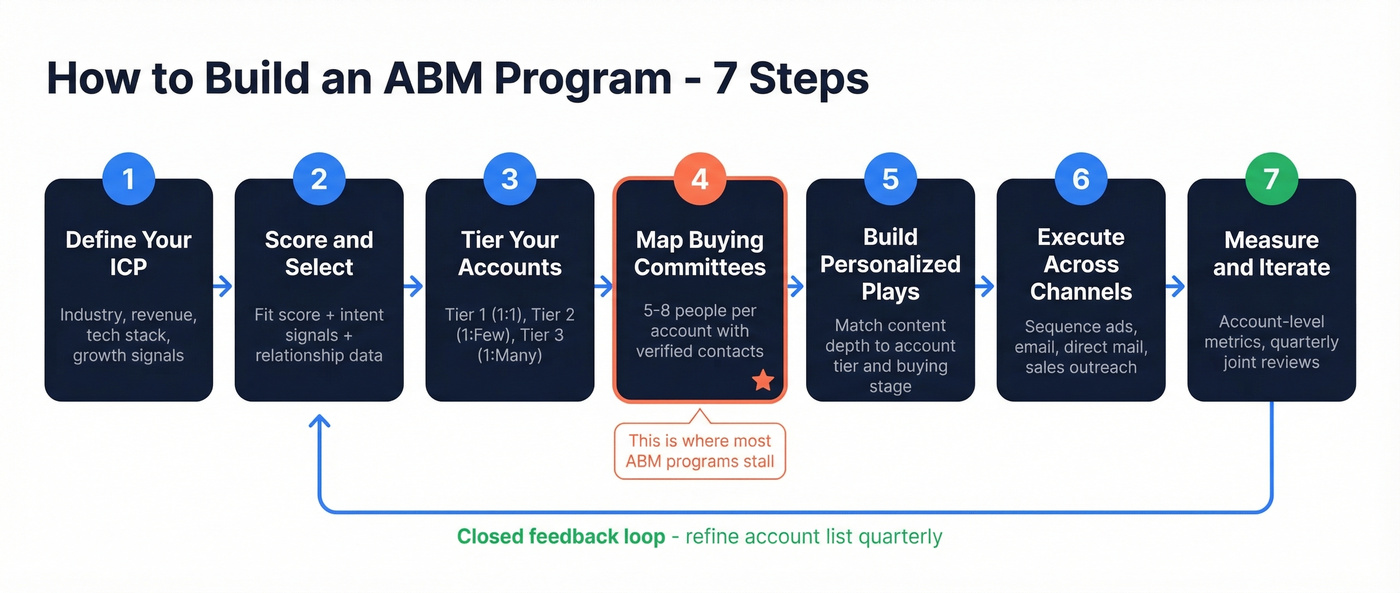
Define Your ICP
Get specific. Industry, revenue range ($10M-$500M SaaS companies, not "technology"), tech stack (runs Salesforce + Marketo), growth signals like hiring 5+ SDRs or raising Series B in the last 12 months. The more precise your ICP, the shorter your target account list - and that's the point. A staffing heuristic from HubSpot: plan for roughly 1 marketer per 10 salespeople, with each rep owning about 10 accounts.
Score and Select Accounts
Build a quantitative scoring model that combines fit score (firmographic match to ICP), intent signals showing whether they're actively researching your category, and relationship signals reflecting existing contacts or champions. Weight each factor, score every potential account, and rank them. A list built on data outperforms a list built in a sales kickoff brainstorm every single time.
Tier Your Accounts
Tier 1 gets 1:1 treatment - bespoke content, dedicated plays, executive engagement. Tier 2 gets clustered into 1:few groups by shared attributes. Tier 3 gets programmatic coverage. Don't spread Tier 1 effort across 200 accounts. That's how you end up doing mediocre ABM for everyone instead of exceptional ABM for anyone.
Map the Buying Committee
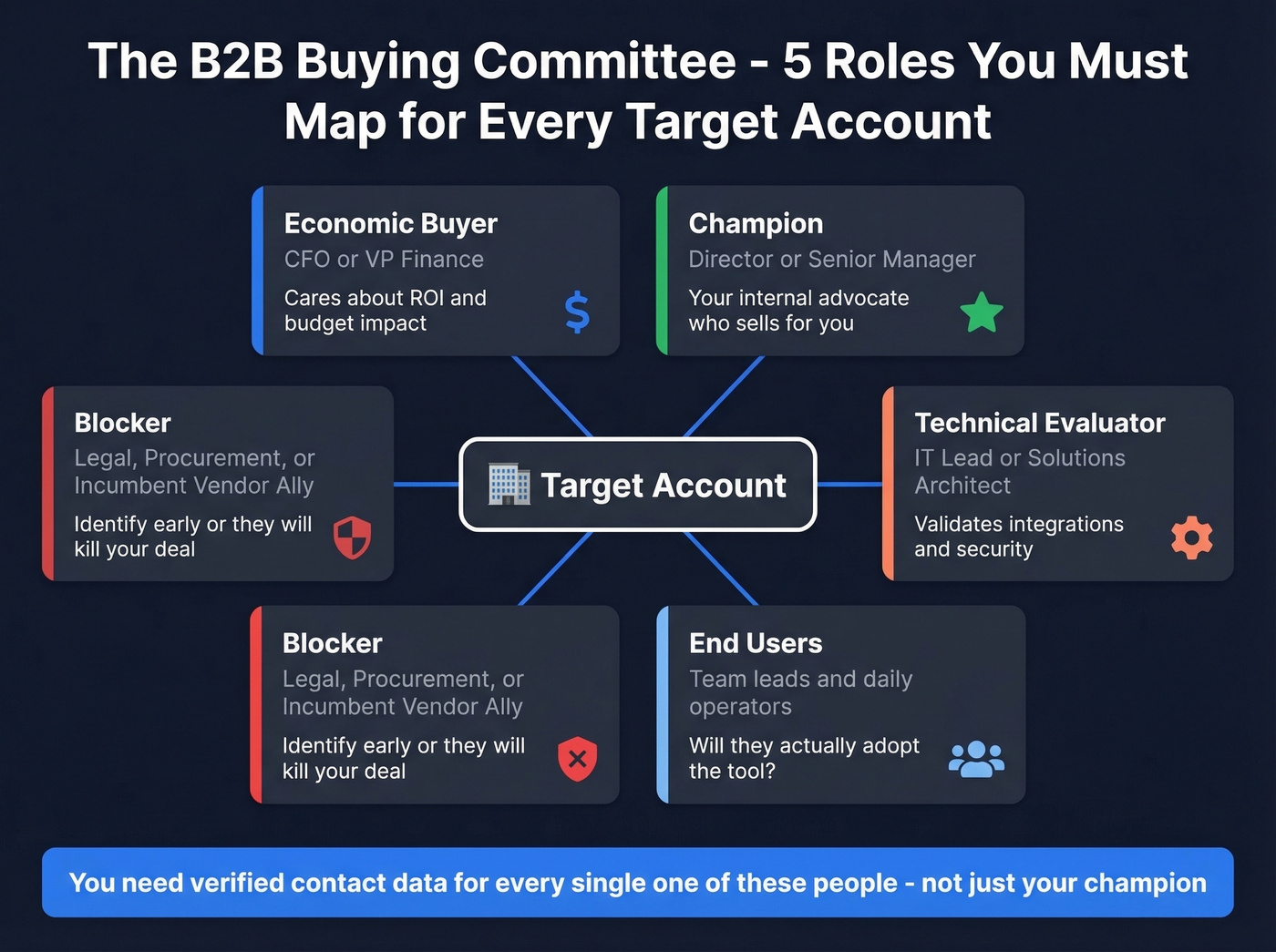
This is where most programs stall. For each target account, identify the five to eight people who influence the buying decision: economic buyer, champion, technical evaluator, end users, and potential blockers. Then you need verified contact data for every one of them.

Build Personalized Plays
Map content to each tier and buying stage. Tier 1 accounts get bespoke assets - custom ROI analyses, personalized video walkthroughs, industry-specific case studies. Tier 2 clusters get content personalized by shared pain point or industry vertical. Tier 3 gets dynamic personalization through targeted ads and automated sequences. Match the depth of personalization to the value of the account.
Execute Across Channels
ABM is inherently multi-channel: email sequences, targeted display ads, direct mail, events, social engagement, and sales outreach all working in coordination. Don't blast every channel simultaneously. Sequence them - warm with ads, follow with a personalized email, then have the rep call. Each touchpoint should build on the last.
Measure and Iterate
Track account-level metrics, not lead metrics. Run quarterly joint reviews between sales and marketing where you evaluate account engagement, pipeline progression, and what's working. Closed feedback loops separate ABM programs that improve over time from ones that stagnate after the first quarter.
Why ABM Programs Fail
We've seen more ABM programs fail than succeed. The failure modes are predictable, which means they're preventable.
Treating ABM as a Campaign
The most common failure. Teams launch an "ABM campaign" - a burst of personalized outreach to a target list - and then move on to the next initiative. ABM isn't a campaign. It's an operating system. The Reddit practitioner who described this shift nailed it: once they stopped treating ABM as disconnected plays and started treating it as a system, the results became repeatable.
Targeting the Wrong Accounts
An outdated ICP, no intent signals, and a target list built on gut feel. The fix is straightforward: build a quantitative scoring model, refresh it quarterly, and layer in intent data so you're targeting accounts that are actually in-market - not just accounts your reps wish they could sell to.
Bad Data
If your contact database hasn't been refreshed in months, you're personalizing emails to people who've already changed jobs. This kills ABM programs silently - your plays look right on paper, but they're reaching the wrong people or bouncing entirely. Weekly data refreshes and 98%+ email verification aren't nice-to-haves in ABM. They're table stakes.

Generic Content
"Dear [First Name], I noticed your company is in [Industry]..." is not personalization. Real ABM content maps to the specific account's pain points, competitive situation, and buying stage. If your Tier 1 content looks the same as your Tier 3 content, you're doing demand gen with extra steps.
Sales-Marketing Misalignment
Sales has one definition of "target account." Marketing has another. Nobody shares metrics. The fix is joint account planning sessions, shared dashboards, and a single source of truth for account tiering and engagement data. If sales and marketing can't agree on which 50 accounts matter most, ABM can't work.
No Follow-Through
Look, ABM requires sustained engagement over months - sometimes quarters. Teams launch strong, then lose momentum when results don't appear in week three. The fix is automated nurture paths that keep accounts warm between active plays, plus regular account reviews that surface early engagement signals before they become pipeline.
How to Measure ABM
The Measurement Crisis
Here's the stat that should alarm every ABM practitioner: nearly 80% of organizations report having an ABM program, but only 29% of ABM teams are measured solely through ABM-aligned metrics. Almost half - 49% - still measure ABM success by MQLs.
This is actively destructive. ABM is designed to reduce lead volume while increasing account engagement and deal quality. If you measure it by MQLs, it'll always look like it's failing. Marketing qualified accounts from target accounts tracked almost equally with MQLs from non-target accounts (49% vs 44%) in 6sense's analysis, which means MQL measurement can't distinguish between ABM impact and background noise.
Stop measuring ABM by MQLs. Full stop.
The Right Framework
Organize your ABM metrics into four categories that map to the buyer journey.
Engagement - Account engagement score tracks whether target accounts are interacting with your content. Reach within accounts measures how many buying committee members you're touching. Buying group engagement tells you whether multiple stakeholders are engaged, or just one lonely champion.
Pipeline - Marketing qualified accounts, ABM-sourced opportunities, and pipeline velocity showing how fast ABM accounts move through stages compared to non-ABM accounts.
Revenue - ABM pipeline value, customer lifetime value from ABM accounts, and program-level ROI. This is where you prove the business case.
Coverage - Target account penetration measuring what percentage of your target list has active engagement, sales cycle length for ABM vs non-ABM deals, and influenced pipeline attribution.
None of these metrics matter if your tracking is broken. Validate UTM consistency across campaigns, confirm pixel firing on key pages, and audit your data layer quarterly. Attribution debt compounds fast - catch it early.
Your Starter Dashboard
You don't need a $100K attribution platform to start measuring ABM.
| Metric | What It Measures | How to Calculate |
|---|---|---|
| Account engagement score | Activity depth across target accounts | Weighted sum of touches per account (web visits, email opens, ad clicks, content downloads) |
| MQAs | Accounts ready for sales engagement | Accounts exceeding engagement threshold + fit score |
| Pipeline velocity | Speed of ABM deals through stages | Days from MQA to closed-won, compared to non-ABM baseline |
| ABM pipeline value | Revenue potential from ABM accounts | Total open opportunity value from target account list |
| Account penetration rate | Buying committee coverage | Contacts engaged / total buying committee members identified |
| ABM ROI | Program efficiency | (ABM revenue - ABM program cost) / ABM program cost |
Track these monthly. Review with sales quarterly. Adjust your account list and plays based on what the data tells you.
ABM Tools and Platforms
Every ABM vendor hides pricing behind "talk to sales." Here are realistic ranges so you can budget before the first sales call.
Core ABM Platforms
Demandbase, 6sense, Terminus (DemandScience), RollWorks, Madison Logic, and Foundry. These are account-level orchestration platforms that combine intent data, advertising, and attribution into a single dashboard. They're powerful, but they're complex - Influ2 notes 3+ month implementations for platforms like 6sense in enterprise deployments. Enterprise pricing runs $25K-$100K+/year depending on account volume and modules. Skip these until you've proven the ABM motion works manually.
Data Quality and Enrichment
Your ABM program is only as good as your contact data. This is where most teams should spend first.
ZoomInfo ($15K-$40K+/year) offers the broadest US database and workflow integrations but bundles features most ABM teams won't use. Apollo.io (free tier, paid from $49/mo) is a solid budget option for prospecting but doesn't match the same email accuracy or refresh cycle. Clearbit works well for firmographic enrichment and company-level data but is narrower on contacts.
If you're comparing vendors, start with a shortlist of data enrichment services and sanity-check accuracy before you commit.
Intent Data
Bombora, 6sense, and G2 buyer intent are the main standalone options. Expect $20K-$50K/year for standalone intent data, though it's often bundled with ABM platforms or enrichment tools.
Minimum Viable ABM Stack
If you don't have an ABM platform budget, here's what you actually need: your CRM (you already have one), a data enrichment tool with verified contacts and intent signals, your existing marketing automation platform, and a spreadsheet for account tiering. That's it. Add an ABM platform after you've proven the motion works and can justify the spend with pipeline data.
| Tool | Category | Starting Price | Best For |
|---|---|---|---|
| Prospeo | Enrichment + intent | Free tier (~$0.01/email) | Verified contacts + intent |
| Apollo.io | Prospecting + data | Free tier ($49/mo paid) | Budget-friendly prospecting |
| HubSpot Marketing Hub | Marketing automation | $800/mo | Mid-market ABM orchestration |
| RollWorks | ABM platform | $10K-$30K/yr | SMB/mid-market ABM |
| Terminus | ABM platform | $25K-$75K/yr | Multi-channel ABM |
| Demandbase | ABM platform | $30K-$100K+/yr | Enterprise ABM |
| 6sense | ABM + intent | $30K-$100K+/yr | Predictive ABM |
| Madison Logic | ABM advertising | $40K-$100K+/yr | Content syndication ABM |
| Bombora | Intent data | $20K-$50K/yr | Standalone intent signals |
| ZoomInfo | Data + orchestration | $15K-$40K+/yr | US database depth |
ABM in Action: 3 Examples
GumGum's T-Rex Gambit
GumGum wanted to win T-Mobile as a client. Their team researched T-Mobile's CMO and discovered he was a comic book fan. So they created a custom comic book featuring T-Mobile's brand challenges and GumGum's solution - starring a T-Rex as a nod to T-Mobile's brand. They delivered it through multiple channels with coordinated follow-up. The campaign generated a 25,000% ROI.
The lesson isn't "make a comic book." It's that deep account research combined with creative risk produces outreach that cuts through the noise. Nobody ignores a custom comic book about their own company.
HealthLink Dimensions
HealthLink Dimensions ran an ABM pilot focused on healthcare data buyers - a niche vertical where they could deeply understand account-specific pain points. They personalized content by account need and coordinated outbound across channels. The result: +234% pipeline growth from the pilot cohort. ABM works especially well in niche verticals where you can demonstrate genuine understanding of the buyer's world, not just their job title.
BlueYonder's Pilot-First Approach
BlueYonder didn't try to launch ABM across 500 accounts on day one. They started with a small pilot targeting supply chain executives, proved $10M in pipeline from the initial cohort, and then scaled. This is the most practical lesson on this list: pilot first, prove the economics, then expand. Every successful ABM program we've seen started small and grew based on data, not ambition.
If you need a repeatable outbound motion to support ABM, borrow proven sales prospecting techniques and standardize them across reps.
Your ABM program needs five verified contacts per account, not one stale MQL. Prospeo's intent data tracks 15,000 topics so you target accounts already in-market, then surfaces every buying committee member with verified emails and direct dials - at $0.01 per email.
Enterprise ABM data without the enterprise contract. Start free today.
FAQ
What is account based marketing?
Account based marketing is the practice of treating individual high-value accounts as markets of one, coordinating sales and marketing engagement across the entire buying committee. Traditional marketing casts a wide net to generate leads; ABM flips that model by starting with a defined list of target accounts and working inward to build multi-stakeholder consensus.
Is ABM only for enterprise companies?
No - the three-tier model scales to any team size. SMBs can run effective ABM with a CRM, an enrichment tool, and 20-50 target accounts. You need a focused list and verified contact data, not a six-figure platform.
How long until ABM shows results?
Expect 2-3 months for engagement signals and 6-9 months for measurable pipeline impact. If leadership expects MQL-speed results, reset expectations before you launch - otherwise the program gets killed before it works.
Can I run ABM without a platform?
Yes. A CRM plus marketing automation plus a data enrichment tool plus manual account tiering is a viable starting stack. Buy the platform after you've proven the motion generates pipeline - BlueYonder proved $10M in pipeline before scaling their tooling.
What's the first ABM tool I should buy?
A data enrichment tool with verified contacts and intent signals. You can't reach buying committees with bad emails and disconnected phone numbers - get 98%+ email accuracy and weekly-refreshed data before investing in a $50K orchestration platform.