

ABX: The Complete Guide to Account-Based Experience in 2026
ABX means a dozen different things depending on who you ask - AbsoluteXtracts cannabis cartridges, ABX Packaging, radiopharmaceuticals, an antibiotics abbreviation, even an airline code. In B2B sales and marketing, ABX means Account-Based Experience. That's what this guide covers, and it's one of the biggest shifts in modern go-to-market strategy.
Most teams are still running ABM playbooks from 2019 while their buyers have moved on.
The Short Version
Account-Based Experience is ABM evolved - sales, marketing, and customer success aligned around the full buyer journey at target accounts, not just top-of-funnel marketing campaigns. You need three things to run it well: intent data to identify which accounts are actually in-market, verified contact data to reach the buying committee, and multi-channel orchestration to deliver personalized experiences across the entire lifecycle.
You don't need a $50K platform to start. A B2B data tool with intent signals, an outreach tool, and a free CRM gets you 80% of the way there. The remaining 20% is alignment, not software.
What Is Account-Based Experience?
In practical terms, it's a go-to-market strategy that coordinates every customer-facing team - marketing, sales, customer success, even product - around a shared set of target accounts. The goal isn't just generating pipeline. It's delivering a coherent, personalized experience from the first ad impression through renewal and expansion.
This approach emerged as a response to how "ABM" often got implemented in the real world: marketing-led account targeting that didn't translate into a consistent experience once sales and customer success got involved. The account-based experience philosophy reframes the question entirely. Instead of "how does marketing target accounts?" it asks "how does the entire organization deliver a great experience to the accounts that matter most?" That includes how SDRs personalize outreach, how AEs run discovery, how CS teams drive adoption, and how marketing supports every stage - not just awareness.
Here's the thing: this isn't a product category. It's a philosophy with a tech stack underneath it. The philosophy is simple - treat accounts as relationships, not campaigns. The tech stack is where it gets interesting and expensive, if you're not careful.
ABX vs ABM - What Actually Changed
Most marketers hear "account-based experience" and roll their eyes. Another rebrand. Another vendor buzzword designed to sell a new platform tier. The cynicism is earned - plenty of vendors have used new labels to justify higher-priced packages.
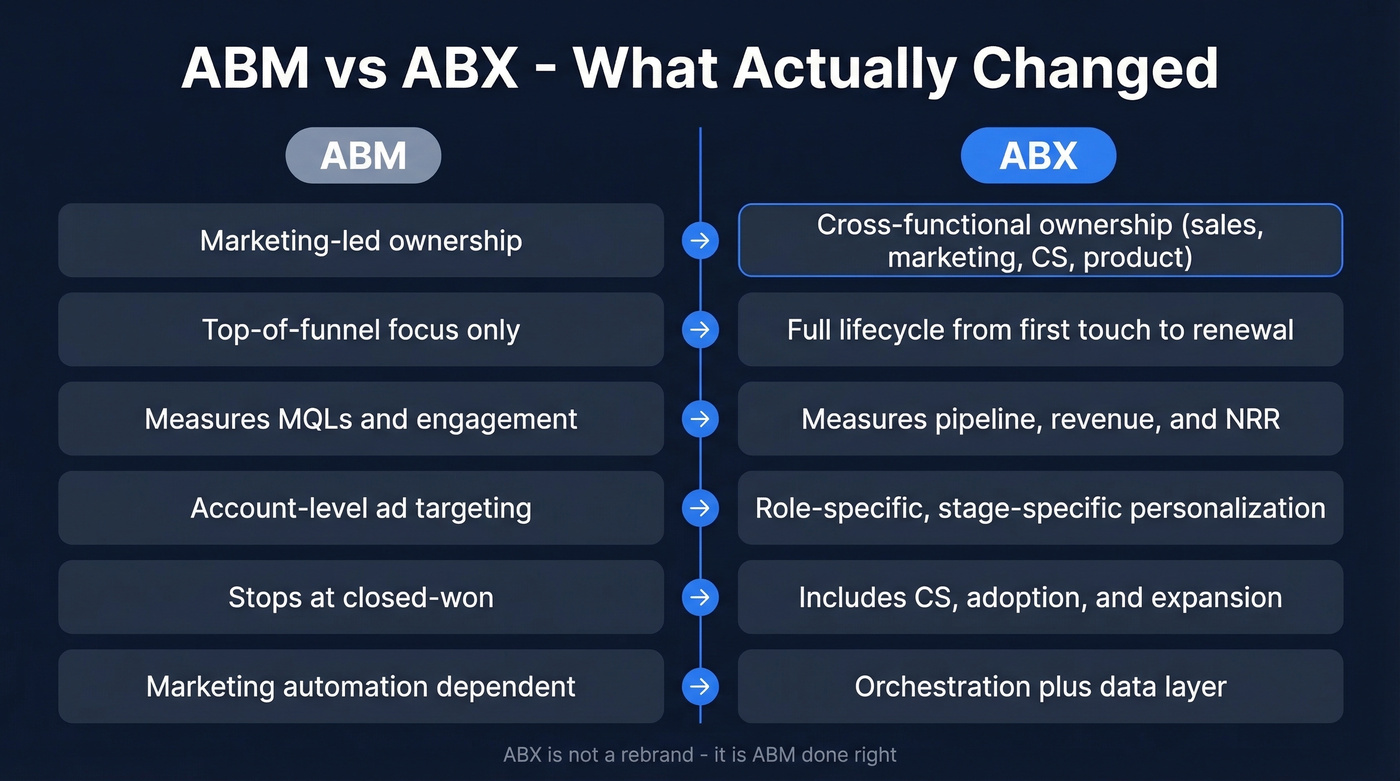
But the shift is real. Buying committees are bigger than they used to be, and buyers expect coordinated experiences. They notice when marketing sends a case study about Feature A while the SDR pitches Feature B and the AE demos Feature C. Siloed, marketing-only ABM programs underperform because they only influence one slice of a multi-threaded buying process.
The philosophy is ABM done right, not a rebrand. It's what ABM was supposed to be before it got reduced to "run some ads at a target account list."
| Dimension | ABM | ABX |
|---|---|---|
| Ownership | Marketing-led | Cross-functional |
| Scope | Top-of-funnel | Full lifecycle |
| Metrics | MQLs, engagement | Pipeline, revenue, NRR |
| Personalization | Account-level ads | Role-specific, stage-specific |
| Customer lifecycle | Stops at closed-won | Includes CS and expansion |
| Tool dependency | Marketing automation | Orchestration + data layer |
Most guides on this topic are written by the platforms selling you expensive software. That's like asking a car dealer if you need a new car. The honest answer: you need the strategy. The platform is optional, especially at the start.
If your average contract value is under $15K, you almost certainly don't need a dedicated orchestration platform. A focused team with clean data and a disciplined process will outperform a bloated tech stack every time. The teams spending $100K+ on tooling are often the same teams that can't tell you which 20 accounts closed last quarter and why.
Core Components of an ABX Strategy
Five things have to work together. Miss one, and you've got an expensive marketing program with a fancier name.
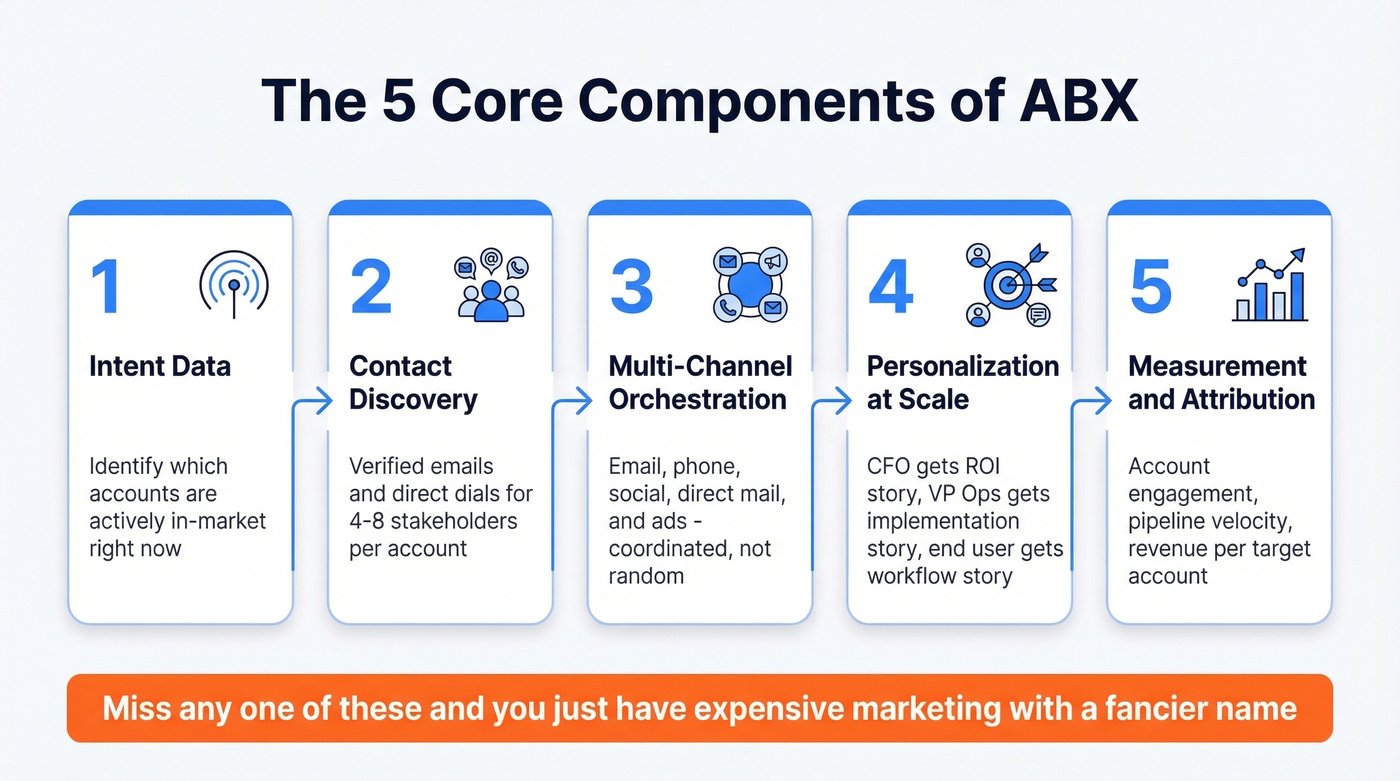
1. Account Identification via Intent Data
You can't target every company in your TAM. Intent data tells you which accounts are actively researching problems you solve - right now. This is the difference between spraying 5,000 accounts and focusing on the 200 that are actually in-market. Tools like Bombora and 6sense are common choices for surfacing account-level intent and prioritization.
2. Contact Discovery and Data Quality
The program fails when reps can't reach the buying committee. You need verified emails and direct dials for 4-8 stakeholders per account, not just the one person who downloaded a whitepaper. This is the most damaging component to skip - and the easiest to solve with the right data platform.
3. Multi-Channel Orchestration
Email alone doesn't cut it. Sequences should combine email, phone, social touches, direct mail, and targeted ads - coordinated across sales and marketing. The key word is "coordinated." If your SDR sends a cold email on Monday and marketing retargets the same person with an unrelated ad on Tuesday, that's not orchestration. That's noise.
4. Personalization at Scale
Generic "Hi {first_name}" isn't personalization. True personalization means tailoring messaging to the account's industry, tech stack, growth stage, and the individual's role in the buying committee. The CFO cares about ROI. The VP of Ops cares about implementation. The end user cares about daily workflow. Same product, three different stories.
5. Measurement and Attribution
Metrics look different here. You're measuring account engagement scores, pipeline velocity per account, multi-touch attribution across channels, and ultimately revenue influenced per target account. If you're still reporting on MQLs, you're not running a true account-based experience program.

ABX fails when reps can't reach the buying committee. Prospeo gives you 98% accurate emails and 125M+ verified mobile numbers across 4-8 stakeholders per account - plus Bombora intent data on 15,000 topics to prioritize the accounts actually in-market.
Build your ABX target list with data that actually connects.
How to Build an ABX Program
Your VP of Marketing just came back from a conference and announced you're shifting to account-based experience. Nobody knows what that means. Here's the step-by-step.
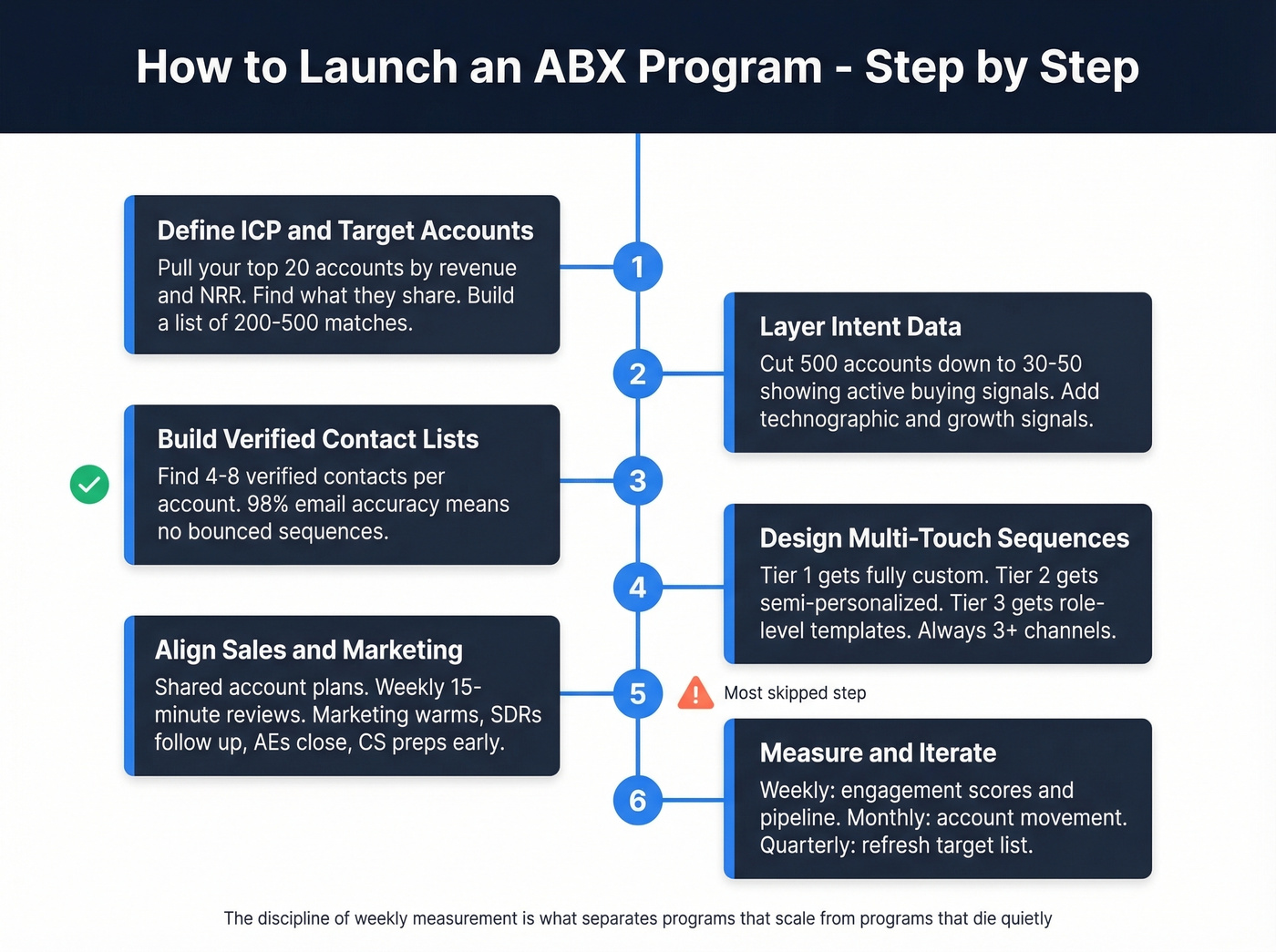
Define Your ICP and Target Accounts
Start with your best customers. Pull your top 20 accounts by revenue, NRR, and deal velocity. What do they have in common? Industry, headcount range, tech stack, funding stage, geography - that's your ICP. Now build a target account list of 200-500 companies that match those attributes.
Resist the temptation to go wider. This strategy works because it's focused.
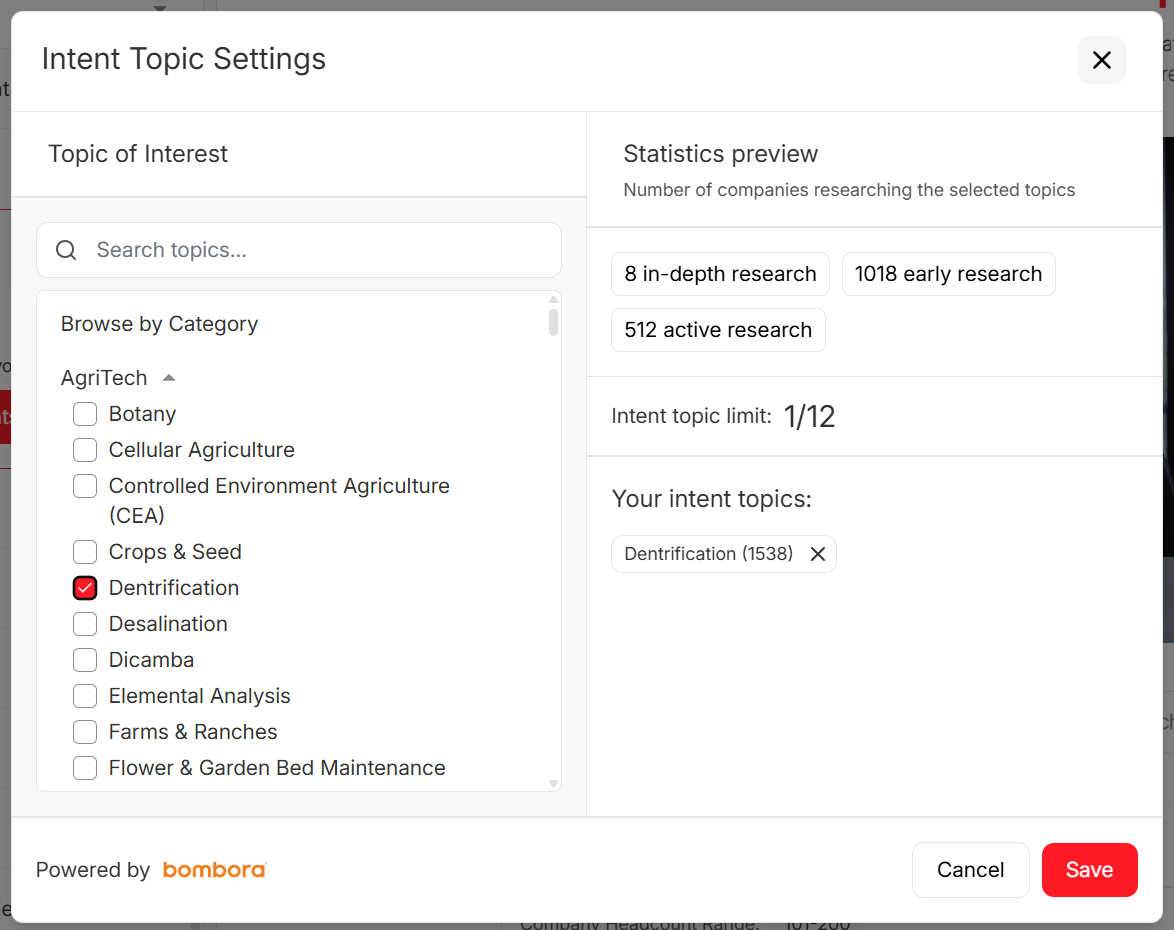
Layer Intent Data for Prioritization
A 500-account list is still too many to work simultaneously. Intent data cuts it down to the 30-50 accounts showing active buying signals. Layer intent with firmographic and technographic data - are they using a competitor? - and growth signals like recent funding or headcount expansion to build a prioritized shortlist.
Build Verified Contact Lists
Here's where most programs stall. You identified 47 accounts showing buying signals, and then your SDRs couldn't find verified contact info for half the buying committee. The fix is straightforward: use a data platform that lets you search by company, filter by department and seniority, and export verified emails and direct dials for the 4-8 people who influence the deal. At 98% email accuracy, you're not burning domain reputation on bounces.
Design Multi-Touch Sequences
Map out a 3-4 week sequence per account tier. Tier 1 accounts - your top 10-15 - get fully custom outreach: personalized emails referencing their specific tech stack, recent news, and business challenges. Tier 2 gets semi-personalized sequences with account-level customization. Tier 3 gets templated sequences with role-level personalization.
Every tier should include at least three channels: email, phone, and one additional touch like social, direct mail, or targeted ads.
Align Sales and Marketing
This is the step everyone skips and then wonders why things didn't work. Sales and marketing need a shared account plan - who's doing what, when, and how they'll hand off. Marketing warms the account with targeted content and ads. SDRs follow up with personalized outreach. AEs run discovery. CS preps for onboarding before the deal closes. Even 15-minute weekly account reviews keep everyone aligned.
Measure and Iterate
Track three things weekly: account engagement score, pipeline created from target accounts, and conversion rates at each stage. Monthly, review which accounts moved and which stalled. Quarterly, refresh your target account list based on new intent signals and closed-won patterns.
The consensus on r/sales and r/marketing isn't about tooling - it's about this measurement step. Teams launch the program, skip the weekly cadence, and three months later can't tell whether it worked. The discipline of measuring account-level outcomes weekly is what separates programs that scale from programs that get quietly abandoned.
The ABX Tech Stack
Let's break down what you actually need to spend - and what you don't.
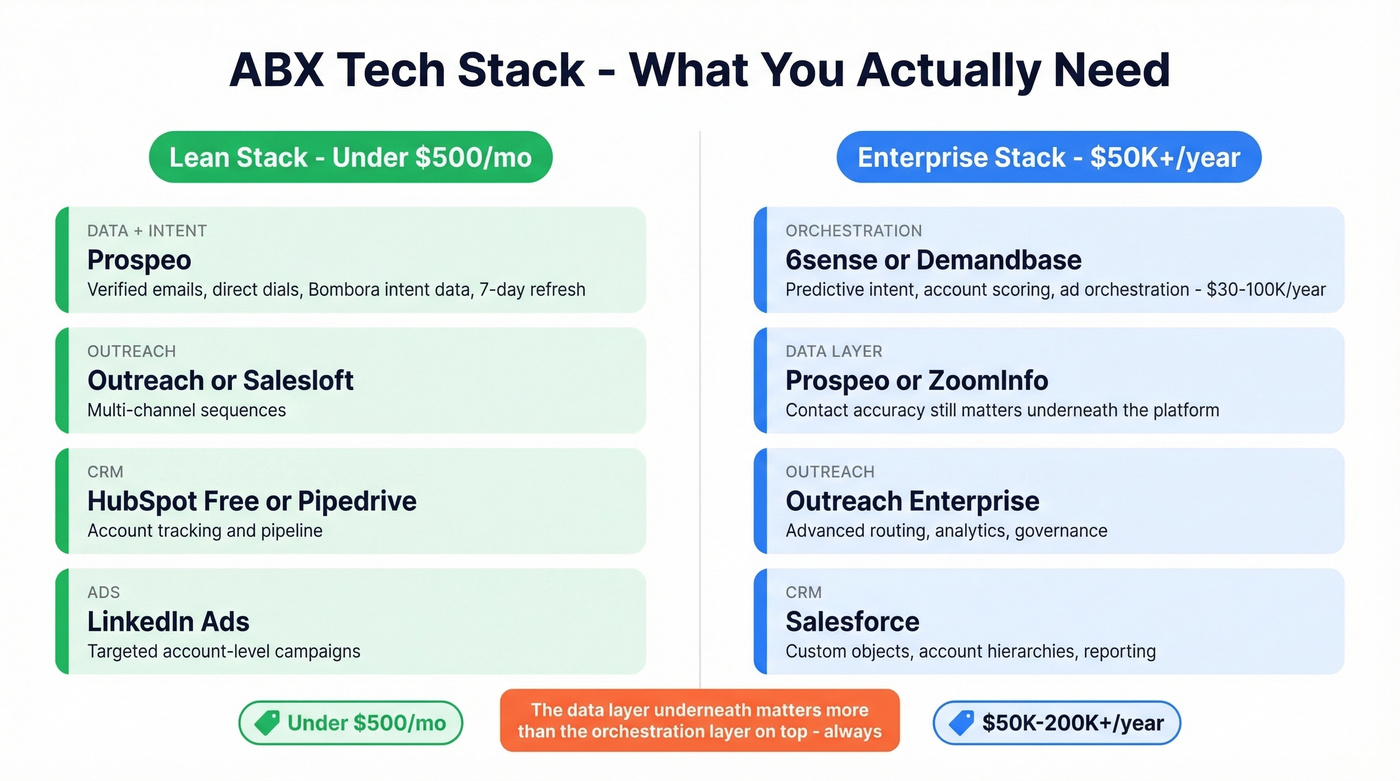
Lean Stack (Under $500/Month)
In our experience, the data layer is where teams should spend first. Prospeo's 98% email accuracy and 30% mobile pickup rate mean your sequences actually land - and the 7-day data refresh cycle means you're not calling people who changed jobs last month. We've seen teams book 26% more meetings compared to ZoomInfo users and 35% more than Apollo users, largely because the contact data is current and verified.
Enterprise Stack
Larger teams with budget add dedicated platforms for orchestration and analytics. 6sense typically runs $30-100K+/year and provides predictive intent, account scoring, and advertising orchestration. Demandbase offers similar capabilities at $25-75K+/year. These platforms shine when you're running the strategy across hundreds of accounts with multiple teams - but they're overkill for teams under 50 reps.
Even at the enterprise level, the data layer underneath these platforms matters more than the orchestration layer on top. Many enterprise teams pair a platform like 6sense with a dedicated data provider for higher accuracy on contacts and mobiles.

Pricing Reality Check
Every platform demo starts with "imagine you could see which accounts are in-market" and ends with a tens-of-thousands annual contract and an implementation timeline measured in months.
| Category | Tool | Approx. Pricing |
|---|---|---|
| Data + Intent | Prospeo | Free tier; paid ~$0.01/email |
| Data | ZoomInfo | $15-40K/yr |
| Data | Apollo | Free tier; from ~$49/mo |
| Data | Cognism | ~$1,000-3,000/mo |
| ABX Platform | 6sense | $30-100K+/yr |
| ABX Platform | Demandbase | $25-75K+/yr |
| ABX Platform | Terminus | $15-40K/yr |
| Outreach | Outreach | ~$100-150/user/mo |
| Outreach | Salesloft | ~$75-125/user/mo |
| Outreach | Instantly | From ~$30/mo |
| CRM | HubSpot | Free; Sales Hub from $45/mo |
| CRM | Salesforce | From $25/user/mo |
Skip the enterprise platforms if you're under 50 reps or your ACV is below $25K. The ROI math just doesn't work at that scale.
Running ABX Without Enterprise Budget
Account-based experience is a strategy, not a software category. The strategy - identify target accounts, prioritize by intent, reach the buying committee with personalized multi-channel outreach, and measure account-level outcomes - works at any budget level.
For teams just getting started, a B2B data platform with intent signals, an outreach tool like Instantly or Lemlist, and HubSpot's free CRM is enough. Total investment: under $300/month. Start with 10-15 target accounts. A free tier giving you 75 verified emails per month is enough to build buying committee lists for your first account cohort and test whether this approach moves pipeline faster than your current spray-and-pray method.
Real talk: the teams we've seen succeed on a budget aren't the ones who bought the fanciest platform. They're the ones who picked 20 accounts, did the research, wrote genuinely personalized outreach, and followed up consistently across channels. The data quality matters - you can't personalize outreach to people whose emails bounce - but the strategy matters more than the spend.
You don't need a $100K tech stack to run ABX. Prospeo combines intent signals, 30+ search filters, and verified contact data at $0.01/email - so you can layer ICP fit, technographics, and growth signals into a prioritized account list without enterprise pricing.
Stop overpaying for the data layer underneath your ABX strategy.
Why ABX Programs Fail
The most common reason isn't bad strategy. It's bad data.
We've seen this pattern repeatedly: a team invests weeks building account plays, designing personalized sequences, and aligning sales and marketing - then 30% of their emails bounce on the first send. Their orchestrated multi-touch sequence becomes expensive noise.
This isn't hypothetical. Snyk's team of 50 AEs was prospecting 4-6 hours per week with bounce rates running 35-40%. After fixing their data layer, bounces dropped to under 5%, AE-sourced pipeline jumped 180%, and the team generated 200+ new opportunities per month. GreyScout saw a similar pattern - bounce rates at 38% cratered their sequences until they cleaned up their contact data, after which pipeline climbed 140% and they doubled their sales team from 2 to 5 reps.
Treating it as marketing-only. If your SDRs aren't involved in account planning and your CS team doesn't know which accounts are in the program, you're running ABM with a new label. This requires shared ownership across revenue teams.
Targeting too many accounts. We've watched teams launch programs targeting 2,000 accounts and wonder why nothing feels personalized. Start with 50. Get good at 50. Then scale to 200. The math doesn't work at 2,000 unless you have a massive team and enterprise orchestration tools.
Ignoring existing customers. This isn't just for new logos. Your best expansion revenue comes from accounts that already trust you. Include your top 20 customers in your program - the CS team should be running account plays for expansion just like sales runs them for acquisition.
FAQ
What Does ABX Stand For?
ABX stands for Account-Based Experience. In B2B go-to-market, it aligns sales, marketing, and customer success around the full account lifecycle - not just top-of-funnel targeting. The "experience" reflects a shift from campaign-centric thinking to relationship-centric execution across every revenue team.
Is ABX the Same as ABM?
No. ABM focuses on marketing-led account targeting - ads, content, and events aimed at a defined list. ABX expands ownership to include sales engagement, customer success, and the entire buyer journey from first touch through renewal. Think of it as ABM with broader organizational buy-in and full-lifecycle scope.
What Tools Do You Need?
At minimum: a B2B data platform with intent signals, an outreach tool like Instantly or Lemlist, and a CRM like HubSpot or Salesforce. Enterprise teams add platforms like 6sense or Demandbase. A lean stack runs under $500/month.
How Much Does a Program Cost?
A lean stack runs $200-500/month - B2B data, outreach automation, and a free CRM. Enterprise platforms cost $30-100K+/year before you add data and outreach tools. Teams running focused plays on 50 accounts with a lean stack consistently outperform teams spraying 2,000 accounts with enterprise software.
How Is ABX Different from Demand Gen?
Demand gen casts a wide net to generate inbound interest across your total addressable market. An account-based experience strategy targets specific accounts with personalized, multi-channel outreach tailored to the buying committee. Most teams run both - ABX for high-value targets where deal sizes justify the personalization effort, and demand gen for volume and market awareness.