

5 Account-Based Marketing Case Studies With Actual Numbers (2026)
Most account-based marketing case studies are vendor press releases with a logo and a vague quote about "increased engagement." No pipeline figures. No conversion math. No tactics you can reverse-engineer. The five campaigns below include real numbers - response rates, pipeline dollars, and engagement lifts - plus a framework for why most ABM programs never produce results worth documenting.
ABM works when it's done right. Top B2B marketers achieve 81% higher ROI with account-based programs, and roughly 71% of organizations now run some form of ABM. The market is projected to grow from $1.4B to $3.8B by 2030. Yet 47% of practitioners still can't prove ROI to leadership. That gap between adoption and accountability is where campaigns go to die.
Here's the tension everyone ignores: 78.7% of companies now incorporate AI into ABM workflows, but nearly 70% find its current effectiveness limited. The tools are ahead of the execution. And nearly half of teams plan to increase ABM budgets in 2026 anyway.

5 ABM Campaigns That Drove Pipeline
| Company | ABM Tier | Key Tactic | Result |
|---|---|---|---|
| GumGum | 1:1 | Batman billboard stunt | Landed T-Mobile |
| Cloud Services Co. | 1:few | Content hubs + hyper-personalization | 70% engagement, 190% more contacts |
| Full-Funnel Pilot | 1:few | Podcast + direct mail + content hub | 76% response, 2 clients in 90 days |
| LinkedIn ABM Pilot | 1:few | LinkedIn-based ABM | $375K pipeline in 3 months |
| Invoca | 1:many | Intent data + programmatic ads | Lift in target account pipeline |
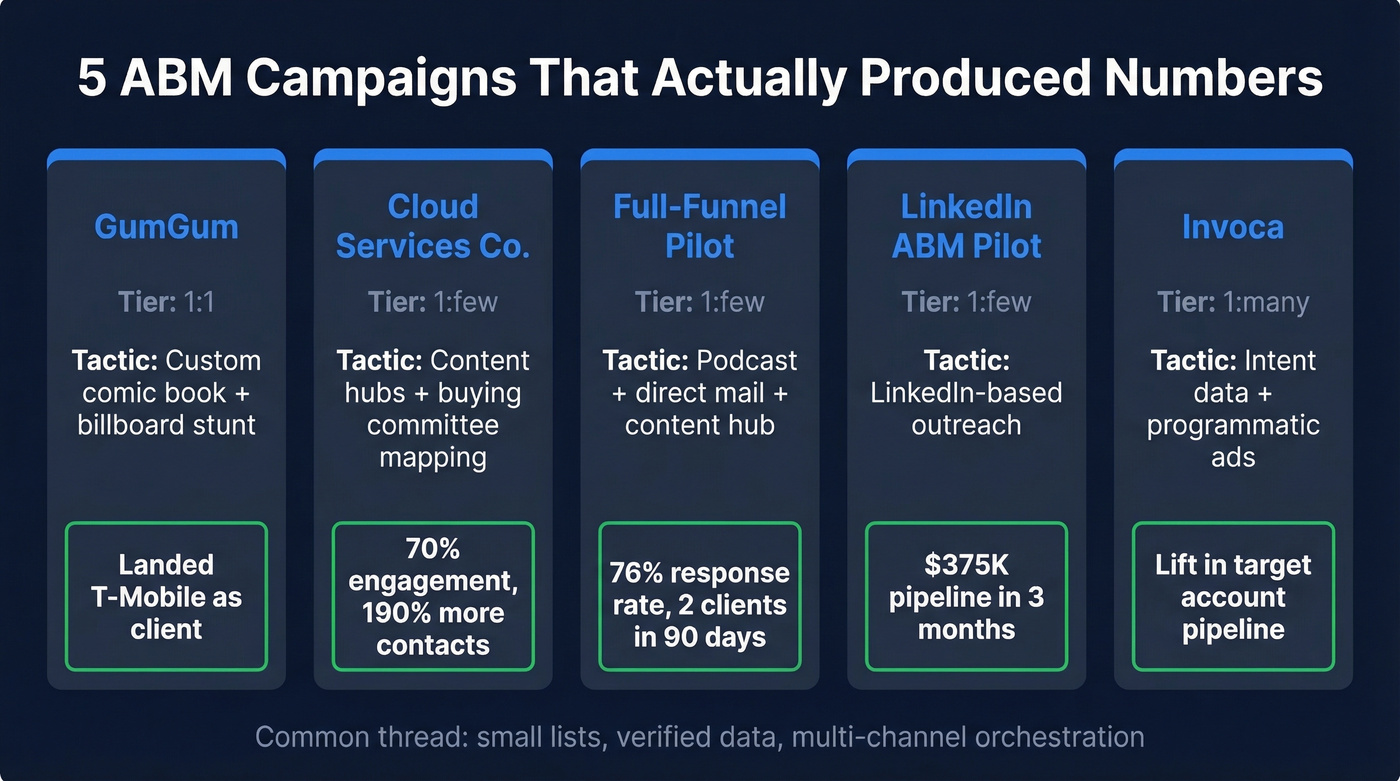
GumGum - The T-Mobile Batman Billboard
GumGum wanted T-Mobile as a client. They knew CEO John Legere was a Batman fan. So they created a custom comic book featuring Legere as Batman, paired it with a billboard near T-Mobile's headquarters, and ran a coordinated social campaign. Legere noticed. GumGum landed T-Mobile.
This 1:1 play proves that creative ABM can cost more in imagination than cash - and that account-based marketing doesn't always mean software. Sometimes it means knowing your prospect well enough to make them laugh.
Cloud Services Provider - 70% Engagement Across 50 Accounts
An [Inverta case study](https://www.inverta.com/resources/the-power-of-precision - building-effective-abm-campaigns-a-case-study) documented a cloud services provider targeting 50 enterprise manufacturing accounts. They built content hubs with hyper-personalized outreach mapped to buying committees of up to 12 people.
Results: 70% engagement rate and a 190% increase in successful contacts. As a B2B ABM case study, it's one of the clearest demonstrations of how precision targeting outperforms broad demand gen - especially when you're mapping the full buying committee instead of chasing a single lead.
Full-Funnel Pilot - 21 Accounts, 2 Clients in 3 Months
This is our favorite because the math is so clean. A team targeted just 21 accounts. They warmed prospects through a podcast - 76% response rate on interview requests, 46% actually interviewed. Then they sent personalized direct mail packages containing a custom proposal, a QR code linking to a content hub, and a personalized gift.
Two closed clients and six active opportunities in three months from a program that didn't require a six-figure platform. Let's be honest: most teams spending $150K/year on ABM software aren't producing those numbers. Orchestration matters more than budget.
Full-Funnel LinkedIn Pilot - $375K Pipeline
A separate pilot documented by Full-Funnel generated $375K in pipeline within three months using LinkedIn-based ABM. For teams already active on the platform, this validates it as a serious ABM vehicle - not just a brand awareness play. The pipeline-to-timeline ratio speaks for itself.
Invoca - Intent-Driven ABM at Scale
Invoca layered intent data on top of their target account list, triggered programmatic ad campaigns when accounts showed buying signals, and activated sales reps with real-time alerts. The insight here matters more than the specific tactic: reaching accounts when they're actively researching your category is worth more than a custom landing page they visit once. The personalization isn't in the creative. It's in the timing.
Here's the thing: if your average deal size is under $15K, you probably don't need a dedicated ABM platform. A CRM, verified contact data, and disciplined account selection will outperform a $100K tech stack with sloppy execution every time.
Why Most ABM Programs Fail
Buyers initiate 79% of vendor engagements themselves. Your ABM program isn't competing with other vendors - it's competing with the buyer's own research process. Most teams lose for three reasons.
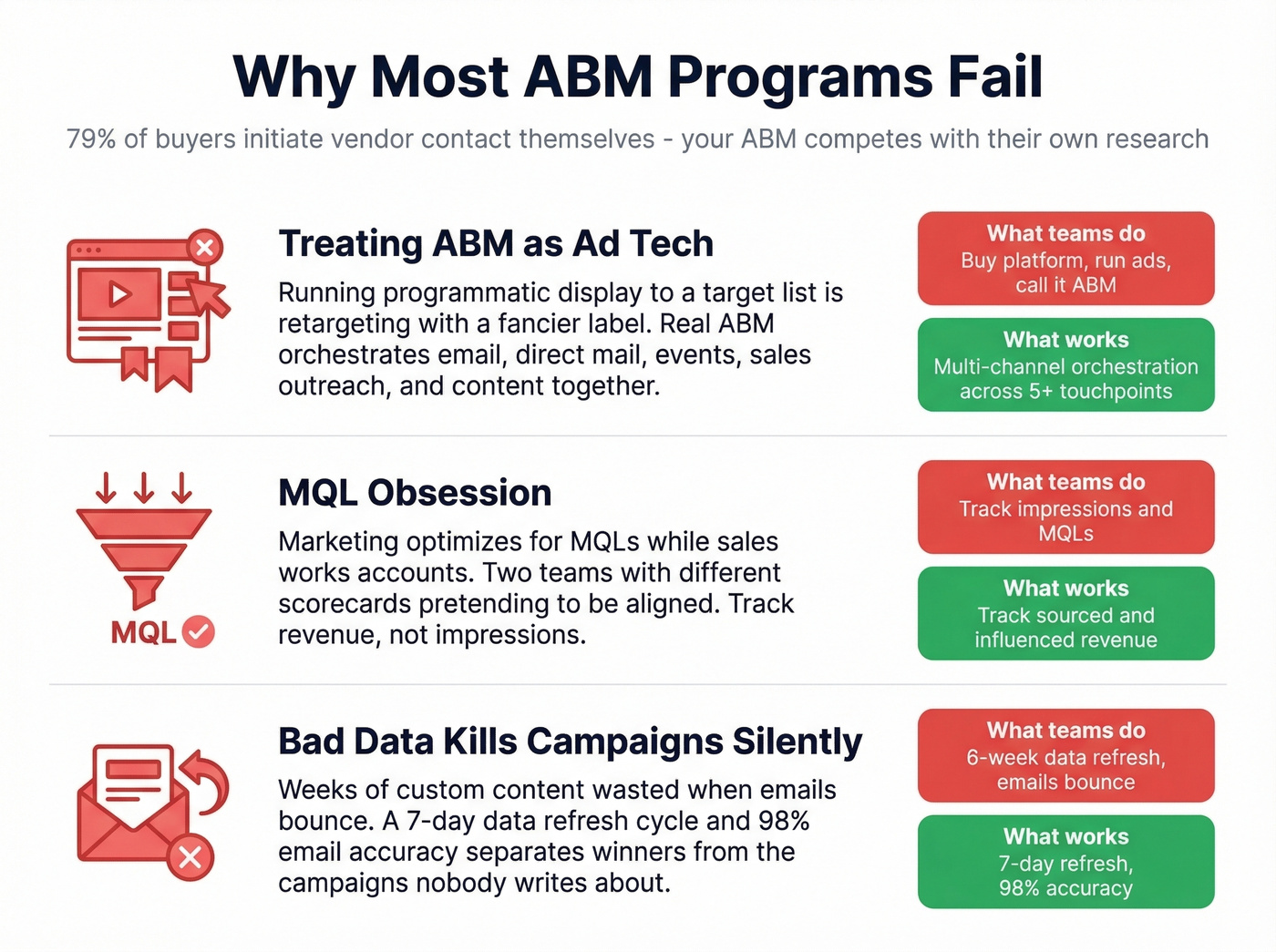
Treating ABM as ad tech. Too many teams buy a platform, run programmatic display ads to a target account list, and call it ABM. That's retargeting with a fancier label. Real ABM orchestrates across email, direct mail, events, sales outreach, and content - the kind of multi-channel coordination you see in every successful case study above.
MQL obsession. If marketing optimizes for MQLs while sales works accounts, you don't have ABM. You have two teams with different scorecards pretending to be aligned. The consensus on r/b2bmarketing is blunt: teams tracking impressions instead of revenue are fooling themselves.
Bad data kills campaigns silently. Your personalization is worthless if a big chunk of your emails bounce. We've seen teams invest weeks in custom content hubs and personalized sequences, then watch deliverability crater because contact data was stale. A 7-day data refresh cycle and 98% email accuracy - the kind of hygiene Prospeo provides - is what separates the successful campaigns above from the ones that never get written up.


Bad data killed more ABM programs than bad strategy ever will. Prospeo refreshes every record on a 7-day cycle - not the 6-week industry average - so your personalized sequences actually reach the buying committee. 98% email accuracy, 30+ filters to build your target account list, and intent data across 15,000 topics to time your outreach perfectly.
Stop building custom content hubs for emails that bounce.
Measuring ABM Without Fooling Yourself
Separate sourced revenue from influenced revenue. Sourced means ABM created the opportunity. Influenced means ABM touched an existing one. If you can't make that distinction, you have a PowerPoint deck, not measurement.
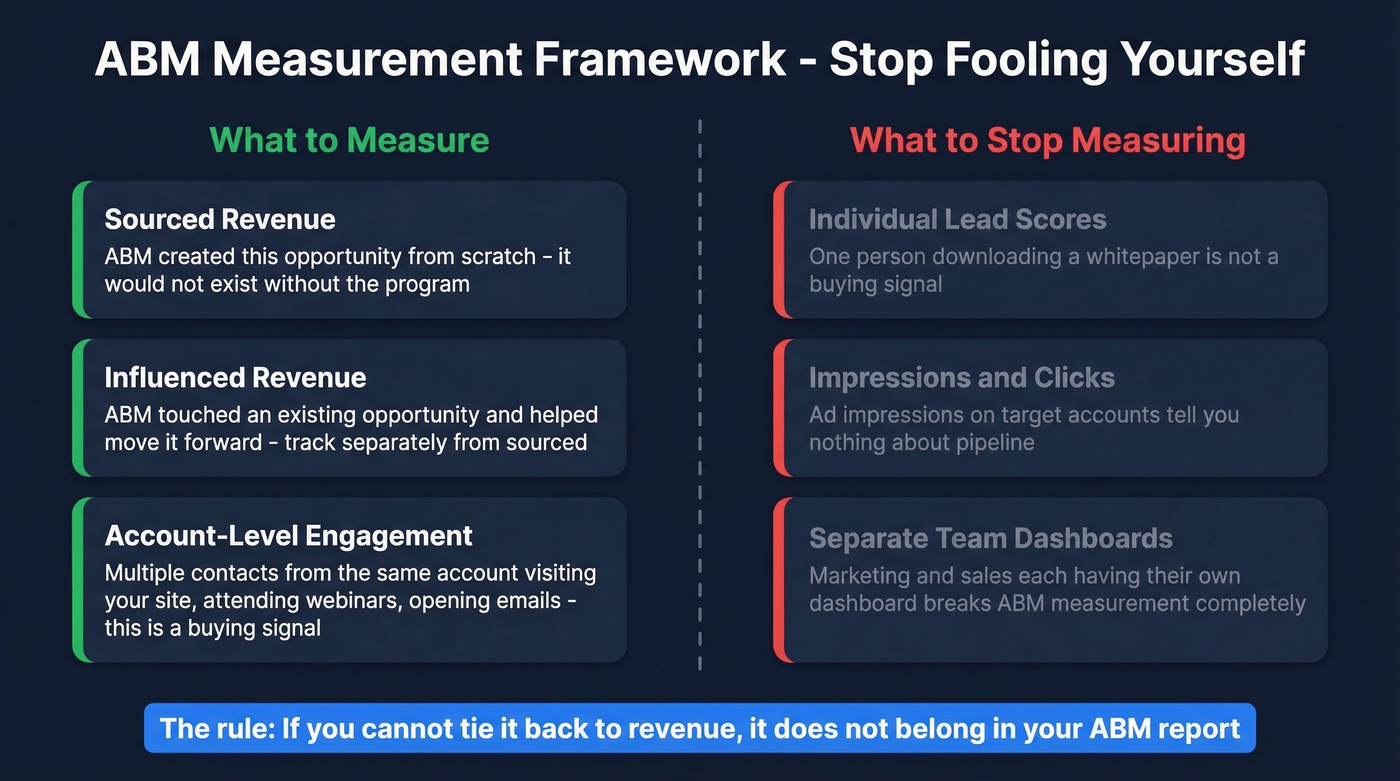
Track account-level engagement, not individual lead scores. Multiple contacts from the same account visiting your site, attending webinars, and opening emails is a buying signal. One person downloading a whitepaper is not. Connect marketing signals, sales activity, and customer data into a single view - ABM measurement breaks when each team has its own dashboard. Every account-based marketing case study worth reading ties results back to revenue, not vanity metrics.
Build Your Target Account List
Start with 50-100 accounts. Research each using press releases, exec interviews, earnings calls, and job postings. Map the buying committee - decision-makers, champions, influencers, blockers - because enterprise deals often involve 10-12 stakeholders. To build a verified contact list, paste a company URL into Prospeo's B2B database, filter by job title and department using 30+ search filters, and export verified emails in seconds.
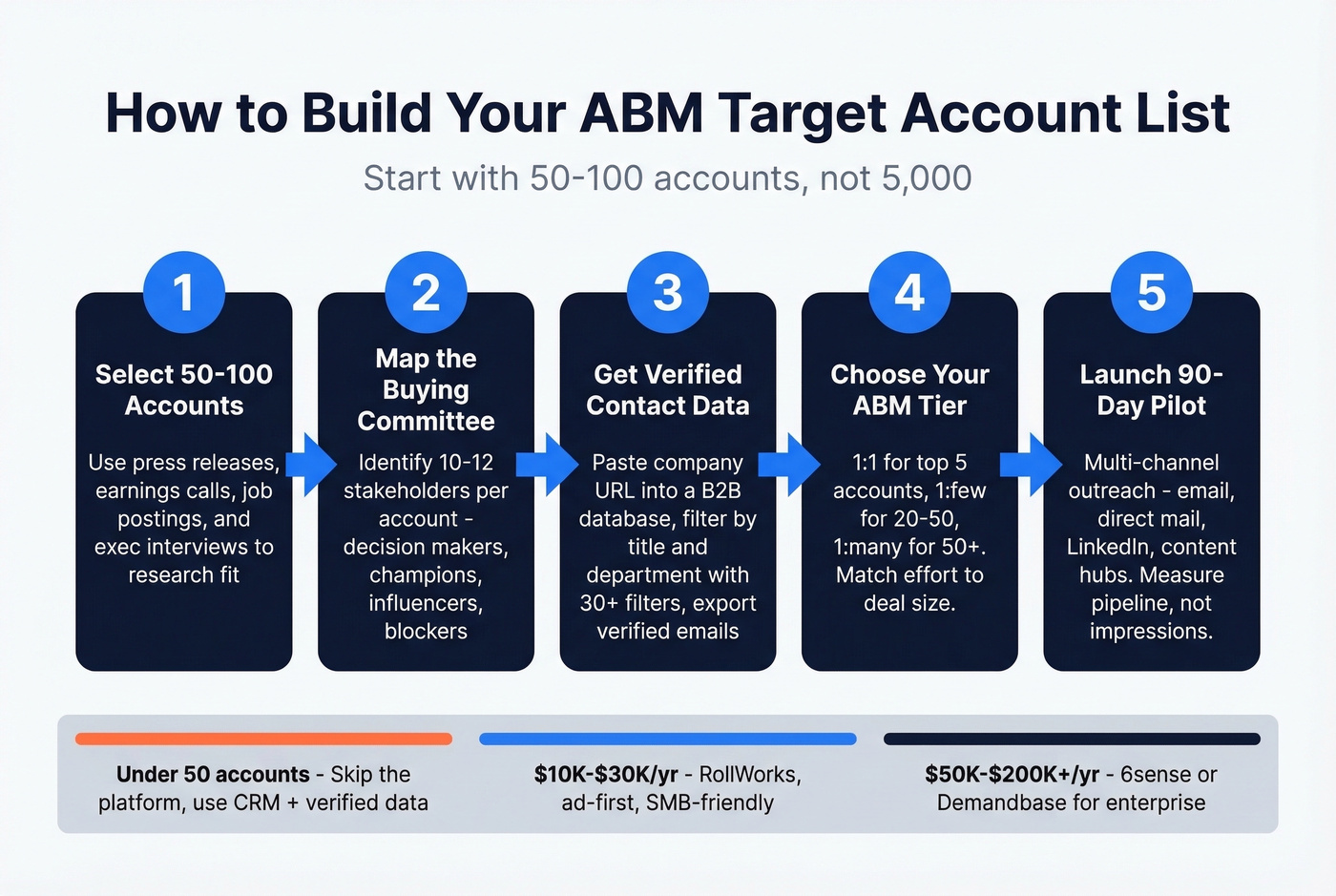
For ABM platforms, expect roughly $10K-$30K/year for RollWorks (ad-first, SMB-friendly), and $50K-$200K+/year for 6sense or Demandbase. Skip the platform entirely if you're running a pilot with under 50 accounts - the case studies above prove you don't need one to generate pipeline.
If you're building lists at scale, automate target account lists so reps spend time selling, not cleaning spreadsheets.
Stop Collecting, Start Executing
Every team we've talked to has a folder of ABM examples they've bookmarked and never acted on. The pattern in every successful campaign above is the same: small account list, verified contact data, multi-channel orchestration, and measuring revenue instead of impressions.
Pick 25 accounts and start a 90-day pilot. You'll learn more in three months than in another year of research. If you need a simple operating cadence, borrow a 30-60-90 day plan and run it like a sprint.
The best ABM campaigns in this article targeted 21-50 accounts with precision. Prospeo gives you 30+ filters - buyer intent, technographics, headcount growth, funding - to build that list in minutes, not weeks. Then delivers verified emails at $0.01 each and direct dials with a 30% pickup rate so your sales team actually reaches decision-makers.
Build a target account list with contacts that connect, starting free.
FAQ
How long does ABM take to show results?
Pilot programs typically show pipeline impact in 60-90 days. Enterprise 1:1 programs need 6-12 months for closed revenue, but engagement signals - site visits, email opens, ad clicks from target accounts - appear within the first quarter.
What's the minimum budget for an ABM pilot?
Under $5K. The key investments are verified contact data, personalized content, and dedicated sales time - not a platform. Start with 25 accounts, run multi-channel outreach for 90 days, and scale what produces pipeline.
What tools do you need for ABM?
A CRM like HubSpot or Salesforce, a verified contact data source for building target account lists with accurate emails and direct dials, and a content personalization approach. Enterprise teams add intent platforms like 6sense or Demandbase. The common thread across every successful program isn't tool complexity - it's data quality.