

7 Account-Based Marketing Success Stories With Real Numbers - And Why Most Programs Fail
Nearly half of ABM practitioners can't prove ROI. That's not a guess - 47% admitted it in a recent benchmark survey. Meanwhile, average ABM ROI sits at 137%, and 71% of B2B orgs now run some form of ABM. The gap between those two realities is pure execution.
Scroll any Reddit thread on ABM and you'll find practitioners calling it a buzzword for "basic good targeting with a fancier name." They're half-right - most ABM programs are just rebranded demand gen with a smaller list. The account-based marketing success stories below show what happens when they're not.
ABM Campaigns That Delivered
Each story has a named company, a specific tactic, and a hard number.
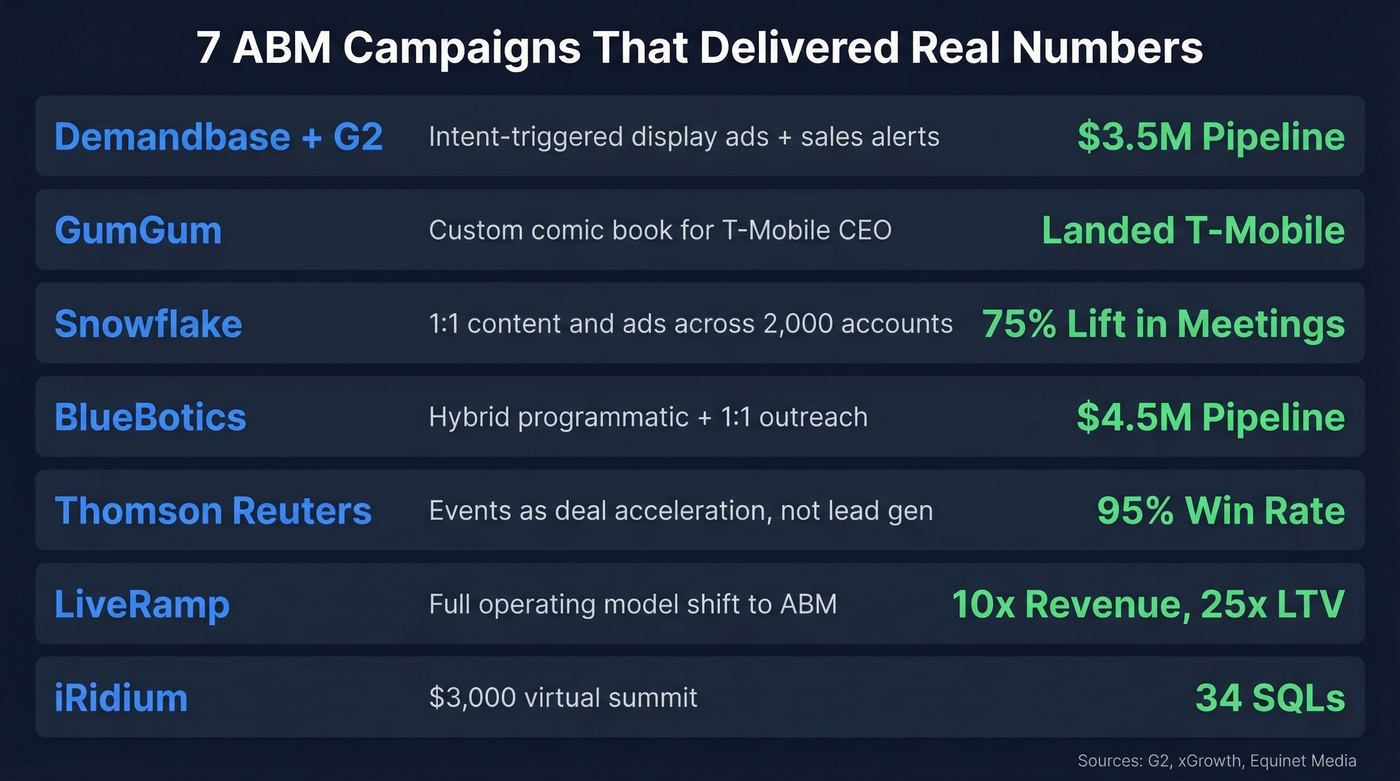
Demandbase + G2 - $3.5M Pipeline in One Quarter
Demandbase's mid-market segment was lagging until they discovered 80% of mid-market opportunities had shown G2 activity roughly a month before deals opened. They built daily intent reports, triggered 1:1 display ads for high-signal accounts, and armed sales with real-time alerts. One quarter later: $3.5M in pipeline, including 12 competitive-takeout opportunities and 10 opportunities from 1:1 display campaigns. Intent data isn't a nice-to-have. It's the trigger that makes ABM timing work.
GumGum's Comic Book Landed T-Mobile
Instead of a cold email sequence, GumGum created a custom comic book - T-Man and Gums - starring T-Mobile's CEO as a superhero. Absurd, creative, and impossible to ignore. It went viral inside T-Mobile and landed the account. Real 1:1 ABM doesn't mean personalized merge tags. It means doing something so specific to the account that it can't be mistaken for a mass campaign.
Snowflake - 1:1 ABM at 2,000 Accounts
Most teams would default to programmatic at this scale. Snowflake didn't. Each of their roughly 2,000 named accounts got custom content, personalized ads, and dedicated SDR outreach coordinated across channels - resulting in a 75% lift in SDR-booked meetings compared to non-ABM targets. That's the kind of result that justifies the operational complexity of running true 1:1 at scale, and it took tight coordination between marketing ops, content, and the SDR team to pull off.
BlueBotics - $4.5M on a Scrappy Budget
BlueBotics, a Swiss robotics company, ran a hybrid ABM program pairing programmatic ads with 1:1 outreach for top-tier accounts and generated $4.5M in pipeline. No Demandbase-level budget. No 20-person marketing team. Just targeted ads, personalized email sequences, and direct outreach. This is one of the strongest ABM case studies in Europe - and the example we point people to when they say ABM requires enterprise resources.
Thomson Reuters - 95% Win Rate From Events
Thomson Reuters didn't use events for lead gen. They used events as an ABM motion - and achieved a 95% win rate on event-sourced deals. With 72% of ABM practitioners citing events as a top channel, this makes sense. But 95% is still staggering. Events aren't top-of-funnel when you use them to accelerate deals already in motion.
LiveRamp - 10x Revenue, 25x LTV
LiveRamp's shift from broad demand gen to focused ABM produced 10x revenue growth and 25x improvement in lifetime value. No single tactic drove it - the entire operating model changed: shared account lists, account-level measurement, multi-channel orchestration over quarters instead of weeks. This wasn't a campaign. It was a company-wide bet.
What Winning ABM Programs Share
Tight account lists. Nobody above targeted 10,000 accounts. Snowflake's 2,000 was the largest, and even that got 1:1 treatment. In our experience working with teams running ABM at scale, the pattern is always the same: fewer accounts, more depth.
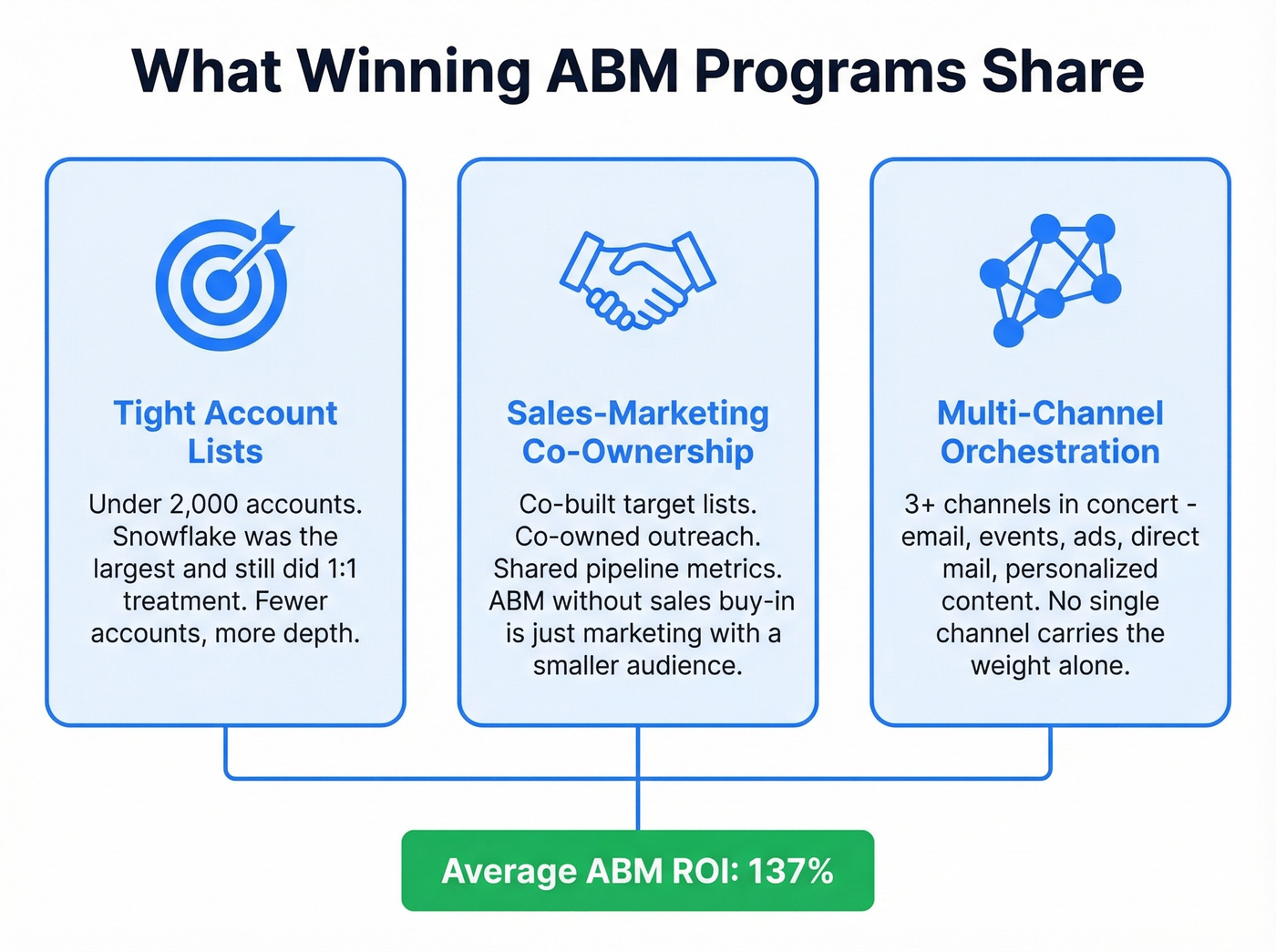
Sales-marketing co-ownership. Sales wasn't "handed leads" in any of these programs. They co-built target lists, co-owned outreach, and shared pipeline metrics. ABM without sales buy-in is just marketing with a smaller audience.
Multi-channel orchestration. Email, events, ads, direct mail, personalized content - winning programs used three or more channels in concert. Customer advisory boards are an underrated addition for understanding how target accounts actually buy.

These ABM wins share one thing: multi-channel outreach that actually reaches the buying committee. Prospeo gives you 98% accurate emails and 125M+ verified mobile numbers - refreshed every 7 days - so your 1:1 ABM campaigns land, not bounce.
Stop orchestrating ABM campaigns against stale data.
Why Most ABM Programs Fail
Here's the thing: buyers initiate 79% of engagements, according to 6sense data. Most of your "ABM touches" are hitting accounts already coming to you. That's humbling - and it explains why so many programs can't prove incremental value.
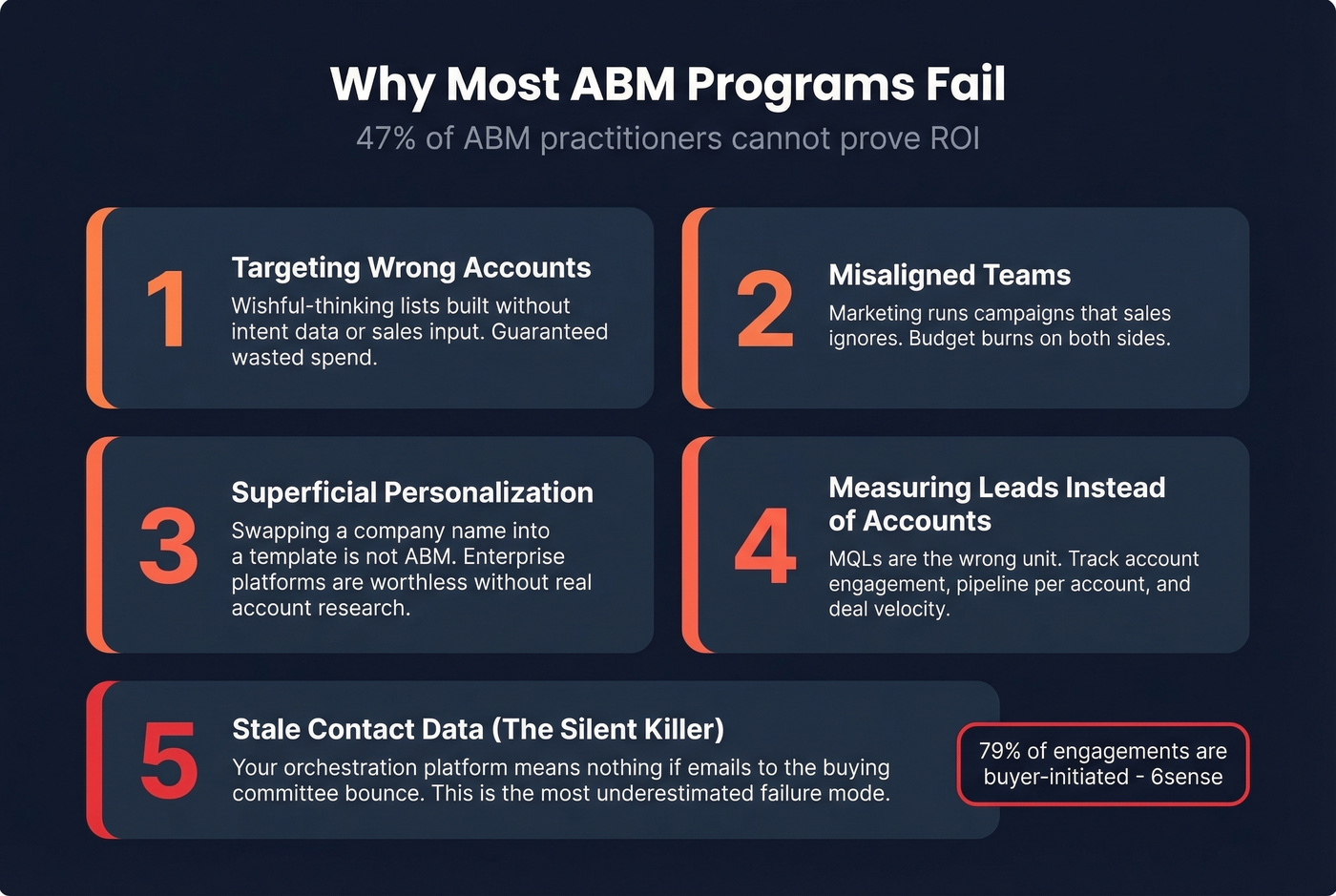
Targeting wrong accounts and misaligned teams are the two most common killers. Wishful-thinking lists built without intent data or sales input guarantee wasted spend. When marketing runs campaigns that sales ignores, you're burning budget on both sides. The fix is the same for both: shared account lists, shared KPIs, weekly pipeline reviews.
Superficial personalization is the third. Swapping a company name into a template isn't ABM. Neither is buying an enterprise platform and expecting it to do the thinking. Enterprise ABM platforms like Demandbase and 6sense typically run $40k-$100k+ annually - and they're worthless without genuine account research behind them.
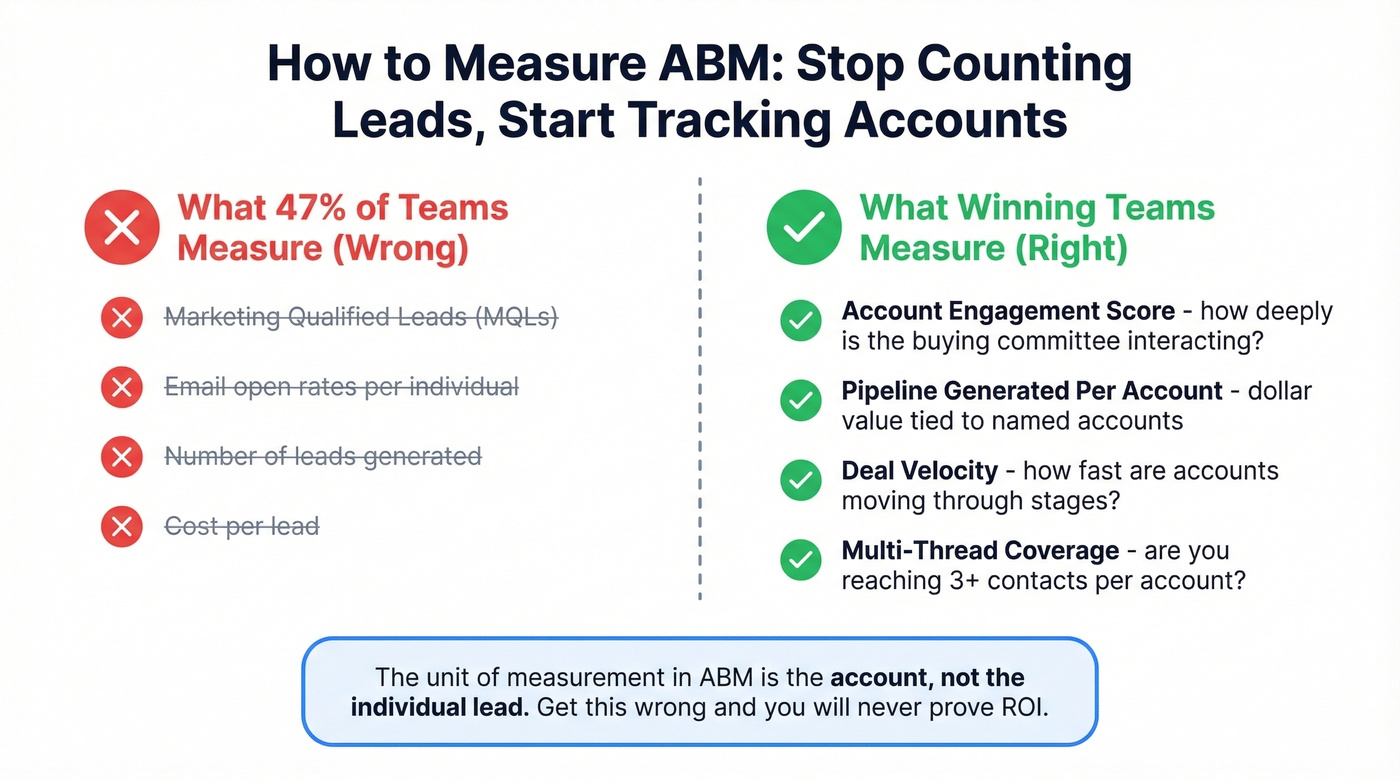
Measuring leads instead of accounts is the fourth. MQLs are the wrong unit. Track account engagement scores, pipeline per account, and deal velocity.
The fifth - and in our experience, the most underestimated - is bad data. Your orchestration platform means nothing if contact data is stale and emails to the buying committee never arrive.
Let's be honest about AI, too: 78.7% of companies now incorporate it into their ABM programs, but roughly 70% find current AI effectiveness limited. The teams winning at ABM in 2026 aren't winning because of AI. They're winning because of clean data, tight lists, and sales alignment. The fundamentals haven't changed.
The Silent ABM Killer: Stale Contact Data
For ABM specifically, Prospeo's intent data - tracking 15,000 topics via Bombora - lets you layer buyer signals with job role and company growth filters across firmographic criteria. That means your account list isn't firmographic guesswork; it's built on real in-market behavior.
Skip this approach if you're running broad demand gen to thousands of accounts. But for teams doing true ABM with a focused list, data accuracy is the difference between a campaign that converts and one that dies in your ESP's bounce log.

Bad data is the silent killer of ABM programs. Prospeo tracks 15,000 intent topics via Bombora and layers them with 30+ filters - job role, headcount growth, technographics - so your target account list is built on real buying signals, not firmographic guesswork.
Build intent-driven account lists for $0.01 per verified email.
FAQ
What's a Realistic ABM Budget to Start?
You don't need a $50k platform. iRidium generated 34 SQLs from a $3,000 virtual summit. Start with a clean account list, personalized emails, and one high-touch channel - most teams can launch a pilot for under $5,000. Add a platform once you've proven the model.
How Should I Measure ABM Success?
Track account engagement scores, pipeline generated per account, and deal velocity - not MQLs. The 47% who can't prove ROI are measuring the wrong unit. If you're counting individual leads instead of tracking account progression through pipeline stages, you'll never demonstrate ABM's incremental value.
Does Contact Data Accuracy Affect ABM Results?
It's the difference between a campaign that works and one that dies in silence. ABM depends on reaching specific people at specific companies - if your emails bounce at 30%+, none of that personalization matters. A 7-day data refresh cycle and 98% email accuracy are the baseline for the precision ABM demands.
What Do the Best Account-Based Marketing Success Stories Have in Common?
Tight target lists under 2,000 accounts, genuine sales-marketing co-ownership of pipeline, and multi-channel orchestration across 3+ channels. Every standout ABM result in this roundup combined intent-driven targeting with personalized outreach - not just firmographic list-building and templated emails.