

Account-Based Sales Intelligence: What It Is, What It Costs, and How to Make It Work
An ABM manager we know - three years in, two SaaS companies deep - built bespoke journeys for every top-tier account. Personalized landing pages, custom decks, the works. Pipeline impact? Barely moved. On r/marketing, this story repeats weekly: practitioners pouring effort into account-based programs that produce dashboards full of activity and pipelines full of nothing. The problem isn't the strategy. It's that most teams either drown in expensive platforms they can't operationalize or starve for the data quality that makes account-based sales intelligence actually work.
What You Need (Quick Version)
Account-based sales intelligence combines firmographic, technographic, intent, and behavioral data so your sales team knows which accounts to prioritize and what to say when they get there. Most teams overspend on enterprise platforms before nailing data quality. Start with verified contact data and intent signals, then add orchestration tools only when you've outgrown the basics.
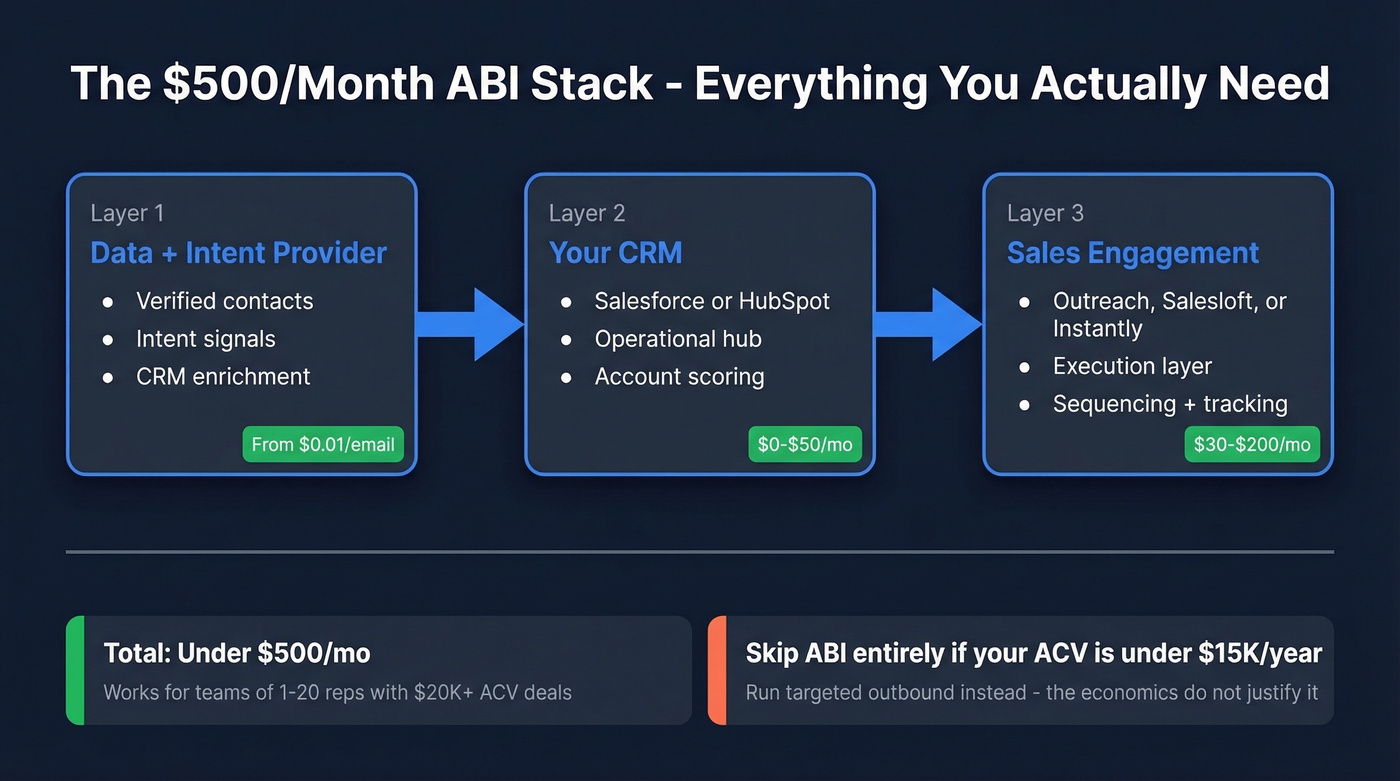
A functional ABI stack for most teams:
- A data + intent provider - verified contacts, intent signals, CRM enrichment
- Your CRM (Salesforce or HubSpot) - operational hub
- A sales engagement tool (Outreach, Salesloft, or Instantly) - execution layer
That's it. You can run a serious ABI program on under $500/month. The six-figure platforms come later - if they come at all.
Here's the thing: if your average deal value is under $15K/year, you probably don't need an account-based intelligence program at all. The economics don't work. Run targeted outbound instead and save the ABM budget for when your ACV justifies the effort.
What Is Account-Based Sales Intelligence?
Account-based sales intelligence isn't just ABM with a fancier name. ABM is a strategy - targeting specific accounts with personalized campaigns. ABI is the data infrastructure that powers it. Think of it as the difference between deciding to fish in a specific pond and having sonar that shows you exactly where the fish are, how deep they're swimming, and what bait they'll bite.
The distinction matters because most "ABM platforms" sell you orchestration and advertising without solving the underlying data problem. An account-based intelligence platform uses dynamic, real-time data rather than static snapshots. Contact databases tell you who to call. Intent platforms tell you who's researching. ABI combines both and adds the "why now" and "what to say" - firmographic context, technographic signals, behavioral patterns, and buying-stage indicators that turn a list of accounts into a prioritized action plan.
The Numbers Behind ABI in 2026
The 2025 ABM Benchmark Survey paints a telling picture: 71% of practitioners now run an ABM strategy, but 47% can't prove ROI. 43% struggle with sales-marketing alignment. 40% can't scale their programs. Email remains the dominant channel at 92%, with in-person events at 72%.
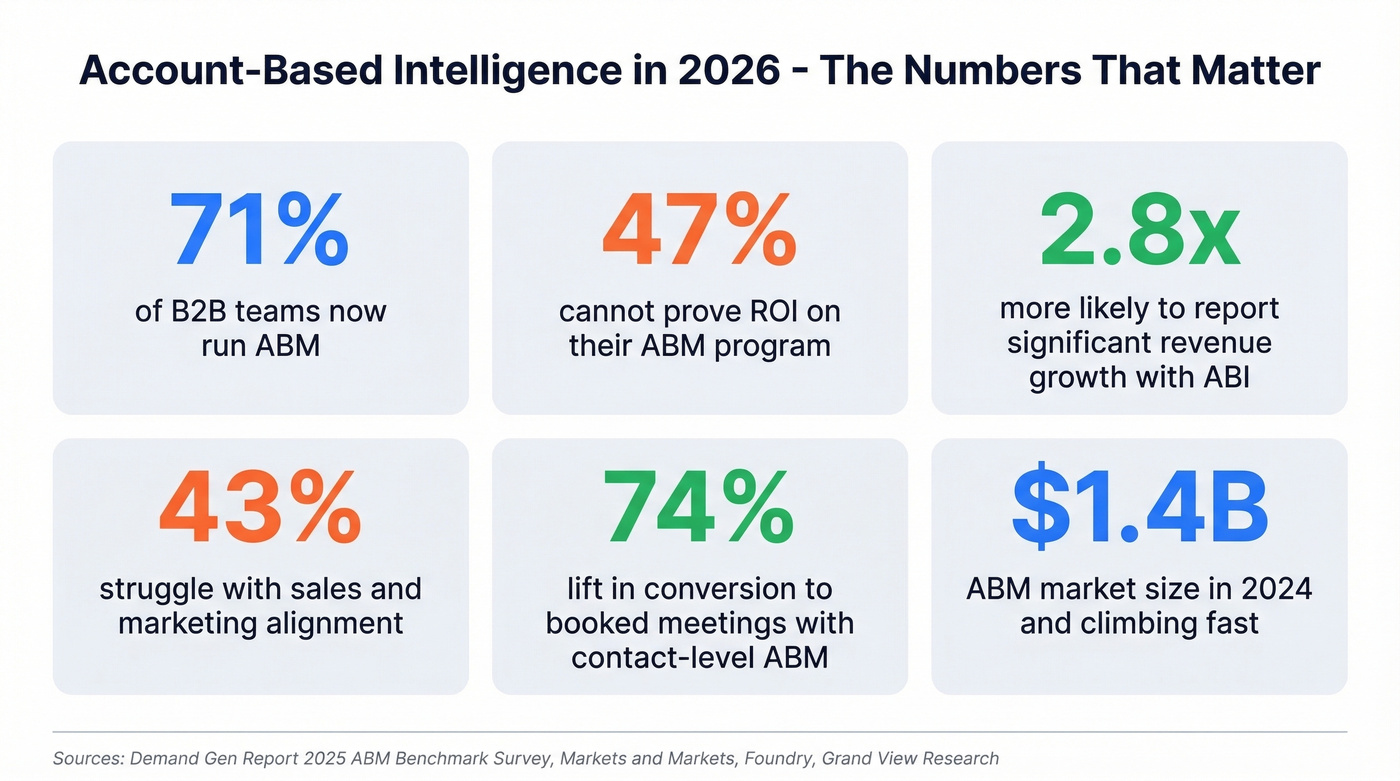
Companies using account-based intelligence are 2.8x more likely to report significant revenue growth. Yet nearly half the teams running these programs can't connect the effort to revenue. That gap isn't a strategy problem - it's a data and measurement problem. Teams invest in orchestration platforms before they've solved for data accuracy, buying committee coverage, and account-level attribution. Teams that nail contact-level ABM see a 74% lift in conversion to booked meetings and 118% improvement in pipeline conversion.
Grand View Research estimates the ABM market hit $1.4 billion in 2024 and is climbing fast. Money is flowing in. The question is whether your team is spending it on the right things.
5 Data Types That Power ABI
Every ABI program runs on five data types. Most teams over-index on one or two and ignore the rest.
| Data Type | What It Tells You | Example Signal | Action It Triggers |
|---|---|---|---|
| Firmographic | Company fit | 200 employees, Series B, SaaS | Include in target account list |
| Technographic | Tech stack fit | Uses Salesforce + Outreach | Tailor messaging to stack |
| Intent | Active research | Searching "sales intelligence" | Prioritize for outreach now |
| Behavioral | Engagement level | Visited pricing page 3x | Route to sales immediately |
| Contextual | Timing triggers | New VP Sales hired, funding round | Personalize the opening line |
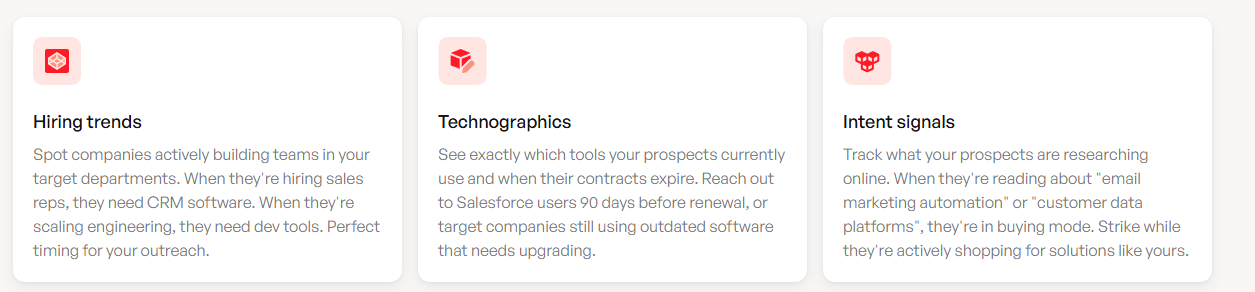
Firmographic and technographic data are table stakes - every decent database has them. Intent data is where ABI gets interesting. Bombora's co-op network pulls consent-based signals from 5,000+ B2B websites, tracking which companies are researching specific topics at above-baseline rates.
But none of this matters if the underlying data is garbage. 47% of data records contain at least one critical error, and only 3% of databases meet "acceptable" quality standards. Your scoring model is only as good as the data feeding it.
Mapping Signals to Buying Stages
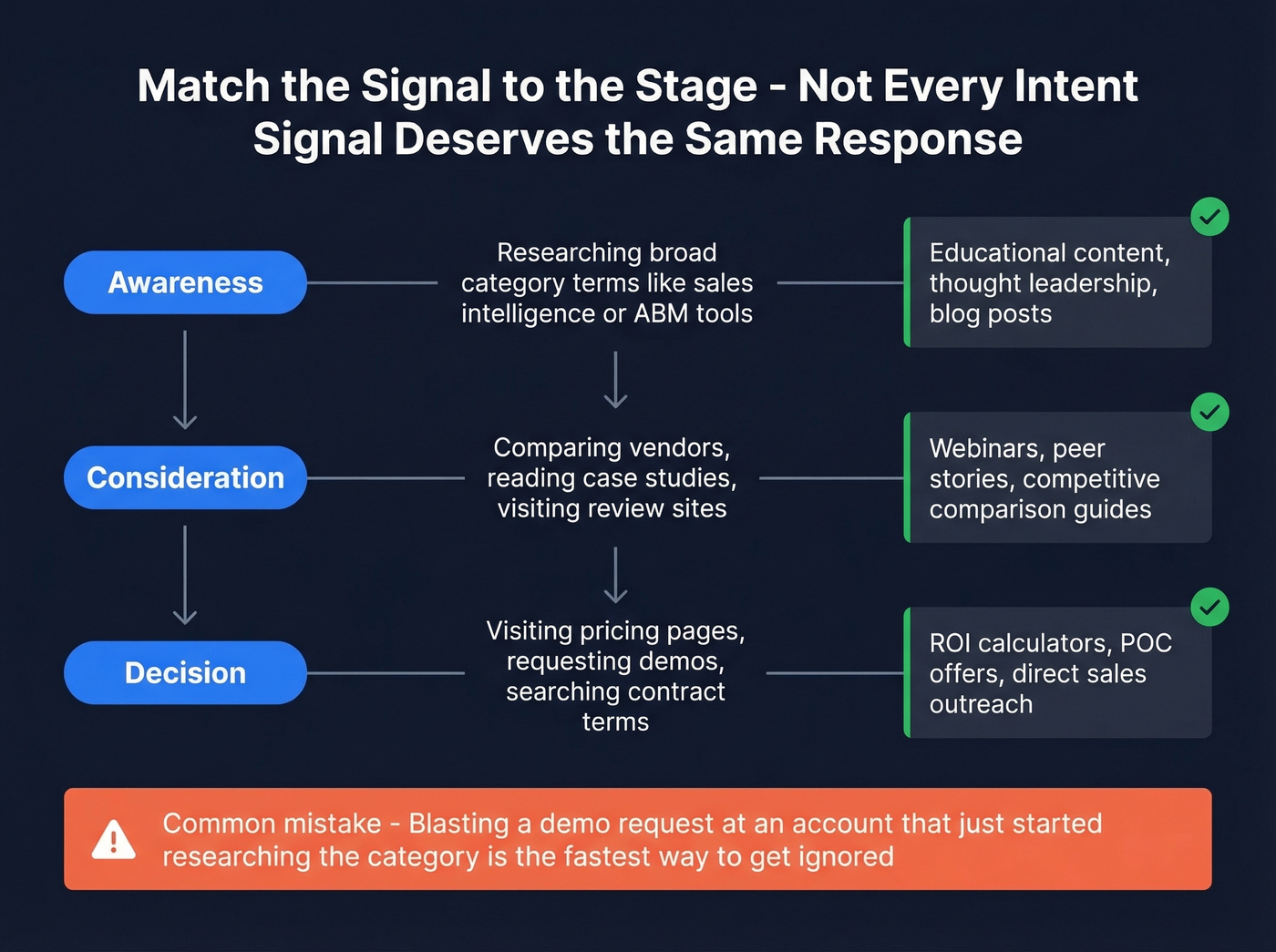
Not all intent signals deserve the same response. Match the signal to the stage:
| Buying Stage | Signal Type | Right Response |
|---|---|---|
| Awareness | Researching broad category terms | Educational content, thought leadership |
| Consideration | Comparing vendors, reading case studies | Webinars, peer stories, competitive guides |
| Decision | Visiting pricing pages, requesting demos | ROI calculators, POC offers, direct outreach |
Blasting a demo request at an account that just started researching the category is the fastest way to get ignored. Let the signal dictate the play.

The article says it: 47% of data records contain critical errors, and only 3% of databases meet quality standards. Your ABI scoring model is worthless without clean data underneath it. Prospeo delivers 98% email accuracy, 125M+ verified mobiles, and Bombora intent data across 15,000 topics - all refreshed every 7 days, not every 6 weeks.
Fix your data layer before you buy another orchestration tool.
Mapping the Buying Committee
The average B2B buying committee includes 11 stakeholders. Single-threading to one contact is a losing strategy, and it's the most common reason ABI programs underperform.
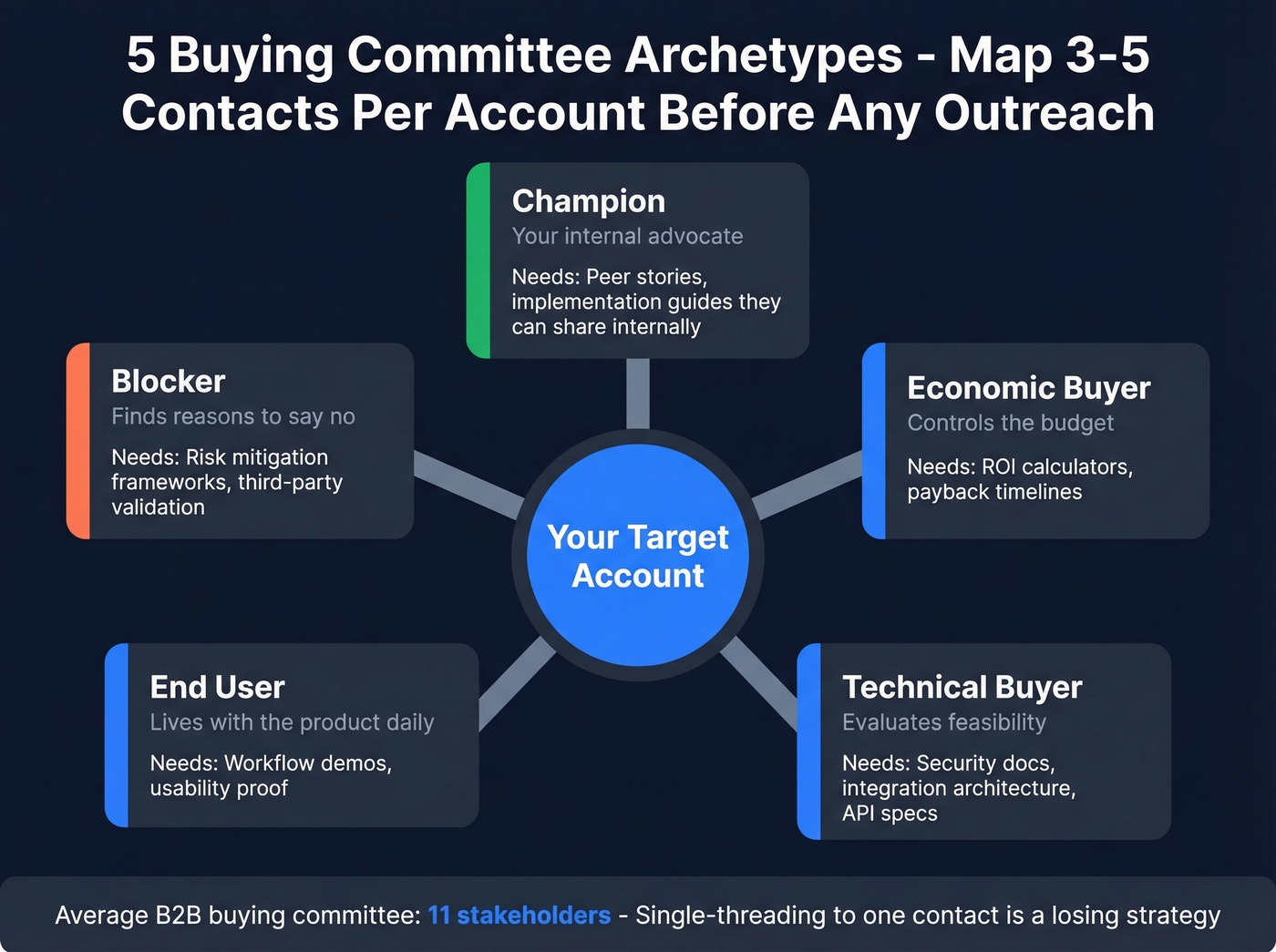
Five archetypes show up in nearly every deal:
- Champion - Your internal advocate. Needs peer stories and implementation guides they can share internally.
- Economic Buyer - Controls the budget. Needs ROI calculators and payback timelines.
- Technical Buyer - Evaluates feasibility. Needs security docs, integration architecture, and API specs.
- End User - Lives with the product daily. Needs workflow demos and usability proof.
- Blocker - Finds reasons to say no. Needs risk mitigation frameworks and third-party validation.
Map 3-5 contacts per account before launching any outreach. Stagger outreach over 2-3 weeks rather than blasting the entire committee on day one. Measure engagement at the account level, not the contact level - multi-stakeholder engagement across a buying committee is a far stronger buying signal than one person opening three emails.
Choosing the Right ABI Platform
Enterprise ABI platforms are expensive, and most vendors hide their pricing. Here's what companies actually pay, based on Vendr contract benchmarks for 6sense and Demandbase, plus published pricing for the rest.
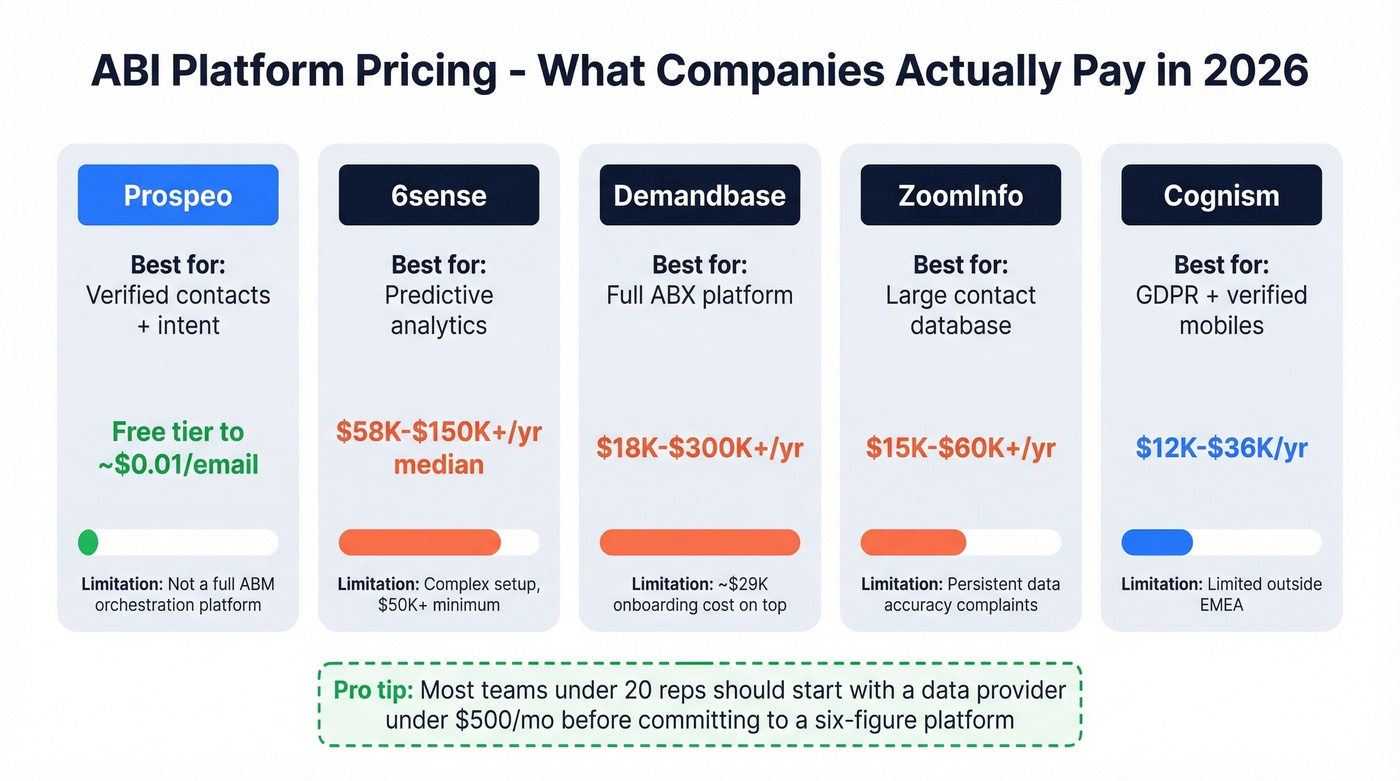
| Tool | Best For | Price Range | Key Limitation |
|---|---|---|---|
| Prospeo | Verified contacts + intent | Free tier; ~$0.01/email, scales with usage | Not a full ABM orchestration platform |
| 6sense | Predictive analytics | Free tier; $58K-$150K+/yr | Complex setup, $50K+ minimum |
| Demandbase | Full ABX platform | $18K-$300K+/yr | ~$29K onboarding cost |
| ZoomInfo | Large contact database | $15K-$60K+/yr | Persistent data accuracy complaints |
| Cognism | GDPR + verified mobiles | ~$12K-$36K/yr | Limited outside EMEA |
6sense
6sense is the heavyweight for predictive analytics and AI-driven account scoring. It identifies anonymous buying signals and predicts which accounts are in-market before they fill out a form. The free tier at 50 credits/month is genuinely useful for small teams testing the waters.
The median contract runs $58,617/year across 314 tracked purchases. Enterprise implementations push $150K-$300K+. Implementation takes weeks to months, and the platform controls much of the model configuration - limited flexibility is a common complaint on r/sales and RevOps communities. The attribution model also has a reputation for self-assigning credit to account movements, making ROI measurement circular. 6sense holds a 4.4/5 on G2 and 8.4/10 on TrustRadius, though most reviews come from enterprise teams with dedicated RevOps. You need that same level of operational support to make it work.
Demandbase
Demandbase takes the all-in-one ABX approach - marketing, sales, and customer success on a single platform with intent data, account identification, advertising, and cross-channel engagement baked in. If you want one vendor for everything account-based, this is the play.
The cost reflects that ambition. Starter plans run $18K-$24K/year. Professional tiers hit $45K-$65K/year. Enterprise deployments range from $70K to $300K+. The median buyer pays $65,981/year across 175 tracked purchases, and onboarding fees run around $29,000 on top. It's a serious investment that makes sense for mid-market and enterprise teams with the budget and headcount to operationalize it.
ZoomInfo: Skip This If You're Cost-Conscious
ZoomInfo's strength is database size and integration breadth - 500+ business app integrations make it the default for teams that want plug-and-play connectivity. Starter contracts run $15K-$25K/year; add intent data and advanced modules and you're looking at $30K-$60K+.
The #1 complaint on Reddit and in practitioner communities? Data accuracy. Employee counts, revenue figures, and contact details that don't match reality. ZoomInfo is still the market leader by install base, but the gap between its promise and its data quality is a recurring frustration.
Cognism
GDPR-focused with phone-verified mobile numbers and Bombora intent data. DNC checking across multiple countries, ISO 27701 and SOC 2 Type II certified. Expect roughly $1,000-$3,000/month. The strongest pick for EMEA-heavy prospecting, but limited value if your accounts are primarily North American.
Building an ABI Stack Under $500/Month
Use this if you're a team of 1-20 reps, selling deals above $20K ACV, and you don't have dedicated RevOps to manage a six-figure platform.
Skip this if you're running enterprise ABM with 50+ reps, a full marketing ops team, and the budget to justify 6sense or Demandbase.
Tier Your Accounts First
Before buying any tool, segment your target accounts:
- Tier 1 (10-20 accounts): Highest-value fits. Full buying committee mapping, personalized content per account, 1:1 outreach.
- Tier 2 (50-100 accounts): Strong fits. Multi-threaded outreach with role-based personalization, lighter content customization.
- Tier 3 (100-500 accounts): Good fits. Programmatic outreach with industry-level personalization, automated sequences.
This tiering determines how much effort each account gets - and prevents the most common ABI mistake of treating 500 accounts like they all deserve bespoke treatment.
The Stack
For the data layer, Prospeo handles contacts, intent, and enrichment - 300M+ professional profiles with 143M+ verified emails at 98% accuracy, 30+ search filters including buyer intent and technographics, and a 7-day data refresh cycle that keeps records current while most competitors refresh every 4-6 weeks. Your CRM serves as the operational hub. A sales engagement tool handles execution.

Compare $500/month to a median 6sense contract of $58,617/year or a Demandbase deployment at $65,981/year plus $29,000 in onboarding. The enterprise platforms add predictive scoring, advertising orchestration, and cross-channel analytics - capabilities that matter at scale. But if you haven't nailed your ICP, verified your contact data, and built repeatable outreach sequences, those features are expensive shelfware.
We've seen teams add 6sense or Demandbase only after outgrowing a lean stack, and that's the right sequence. Verified data and intent signals will outperform a half-implemented enterprise platform every time.
You need 3-5 verified contacts per account to map the buying committee. Prospeo gives you emails, direct dials, and 50+ data points per contact - with 30+ filters for firmographics, technographics, intent, and headcount growth. That's a complete ABI data layer for under $500/month, not six figures.
Cover the full buying committee with data that actually connects.
Mistakes That Kill ABI Programs
We've watched teams burn through six-figure budgets on ABI programs that produce nothing. The failure modes are predictable.
No defined ICP or target account list. If you can't articulate which accounts you're targeting and why, you're doing demand gen with extra steps. Start with 50-100 accounts, not 5,000. (If you need a framework, start with an Ideal Customer Profile.)
Measuring MQLs instead of account engagement. ABI is an account-level strategy. Track account penetration, multi-stakeholder engagement, and pipeline velocity - not individual lead scores. If you're rebuilding your measurement layer, a lean RevOps tech stack helps.
"Personalized" outreach that isn't. Swapping a company name into a template isn't personalization. Use contextual signals - funding rounds, job changes, tech stack - to make it specific. One team we spoke with tripled their reply rate just by referencing a prospect's recent tech adoption in the opening line. For a deeper system, see how to personalize cold emails.
Sales and marketing operating in silos. Duplicate outreach to the same buying committee is the fastest way to burn an account. Shared visibility into who's engaging and who owns the relationship is non-negotiable. Tighten the handoff with an MQL to SQL handoff process.
Tracking vanity metrics. Ad impressions, email opens, and website visits feel good in dashboards. They don't predict revenue. Track pipeline created, deal velocity, and win rate by account tier. If you want a clean model, use account executive KPIs as your baseline.
Ignoring post-sale accounts. ABI doesn't stop at closed-won. Expansion and retention revenue from existing accounts is where the highest ROI lives. (For plays, borrow from these cross selling examples.)
And underlying all of these: data quality. If 47% of your records have a critical error, your scoring model is building on sand. Fix the data first. Everything else is downstream.
FAQ
What's the difference between account-based intelligence and ABM?
ABM is the go-to-market strategy - targeting specific accounts with personalized campaigns across marketing and sales. Account-based intelligence is the data layer that powers ABM, combining firmographic, technographic, intent, and behavioral signals to tell you which accounts to target, when to engage, and what to say. You can't run effective ABM without ABI.
How much does an ABI platform cost?
Enterprise platforms run five to six figures annually. 6sense's median contract is $58,617/year; Demandbase's is $65,981/year plus ~$29K onboarding. Data-focused tools like Prospeo start with a free tier and scale to roughly $0.01 per verified email with intent data included. The right spend depends on team size and operational maturity.
What's the most important data type for ABI?
Intent data - it tells you which accounts are actively researching solutions right now. But intent signals without verified contact data are like having sonar without a fishing rod. You need both to act on the signals.
How many contacts should I map per target account?
Map at least 3-5 across the buying committee before launching outreach. The average B2B buying committee includes 11 stakeholders, so single-threading to one champion is a losing strategy. Cover the economic buyer, technical buyer, and at least one end user.
Can small teams run account-based sales intelligence?
Yes. A data provider with intent signals, your CRM, and a sales engagement tool give you a functional ABI stack for under $500/month. You don't need a six-figure platform - you need verified data, clear ICP criteria, and disciplined execution.